

The language of the tip of the nose
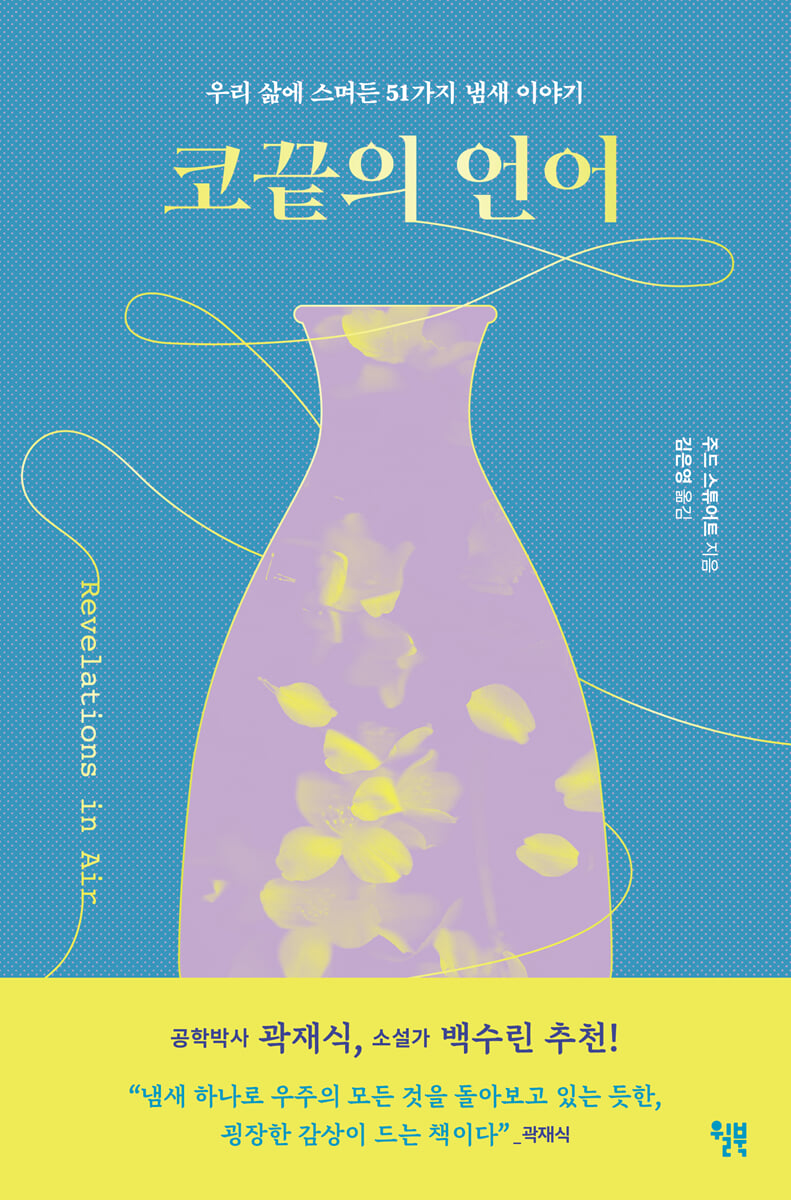 |
Description
Book Introduction
“This is a deeply moving book, as if you were looking back at the entire universe through a single scent.” _Kwak Jae-sik * Recommended by Dr. Jae-sik Kwak, PhD in Engineering, and novelist Su-rin Baek! * Exploring mysterious scents across science, history, geography, art, and culture The smell of earth on a rainy day, the scent of a newborn baby, the sweet scent of vanilla, the cool smell of the sea… A fascinating analysis and hidden stories unfold about all kinds of smells, both everyday and special. "The Language of the Nose" is a book in which journalist Jude Stewart, who has been exploring the subject of senses, delves into the subject of smell and olfaction. You can also discover new and unfamiliar knowledge about scents that have disappeared from the Earth and are now unseen, as well as new fragrances that were not present before. As I meticulously examine the countless scents of this world, I naturally cross over science, history, geography, and art. The author has uncovered the amazing world of smell through meticulous and extensive research, drawing on his own sensory experiences and consulting with experts, including the latest academic papers. Human memory has a smell. Whether it's a person, a space, or a time, an experience without smell is usually easily forgotten. Why do scents and olfactory sensations have such a profound impact on memory? Why are our bodies so sensitive to smells? Surprisingly, science still hasn't fully figured out how our bodies perceive smells. What is the final mystery of this sense of smell? Why is the same smell considered fragrant in some cultures and foul in others? What is the smell that is fragrant and refreshing to modern noses, but in the past symbolized plague and death? This book contains the answers to all these fascinating questions. Let's be sucked into a new world guided by all kinds of scent molecules floating in the air. |
- You can preview some of the book's contents.
Preview
index
Recommendation_We are all connected by smell
Introduction_ Why did I decide to write about smell?
How to read this book
nose
Introducing the nose
How does the sense of smell work?
A time travel of smell and emotion
How many senses do we have?
The nose, a synecdoche symbol of humanity
The smell of the future
Exercise 1: A great way to explore smells
floral and herbal scents
The smell of rain on dry land
rose
Jasmine
freshly cut grass
Laundry hung on a clothesline to dry
Exercise 2: Keep a Smell Diary
sweet scent
vanilla
Sweet Woodruff
Bitter Almond
Cinnamon
hot chocolate
Exercise 3: Compare similar smells
The smell of savory
bacon
durian
Cheese with a strong odor
Awi
cigarette
Exercise 4: Collecting new smells
The smell of earth
truffle
wine
smoke
Melting permafrost
car
Exercise 5: Get closer to the ground
resin scent
freshly sharpened pencil
agarwood
camphor
frankincense
Myrrh
Exercise 6: Let's walk around the room relying solely on smell.
musty smell
fat
new car
marijuana
money
gas
musk
Exercise 7: Be more curious about unpleasant smells
A refreshingly sharp scent
orange
lavender
skunk
beer
Don't eat
Exercise 8: Smell with both nostrils alternately.
Salty and savory smell
ocean
ambergris
Play-Doh
wet wool
peanut butter
Exercise 9 Let's sniff in different ways.
A refreshing and exciting scent
eye
thought
Rosemary
pine tree
Exercise 10: Prepare your training kit
Mysterious smell
newborn baby
Extinct flowers
The smell of creation
psychic body
The scent of a saint
old book
Exercise 11: Let's express smells in words.
Going out_ If I could smell more
Frequently Asked Questions
main
References
Introduction_ Why did I decide to write about smell?
How to read this book
nose
Introducing the nose
How does the sense of smell work?
A time travel of smell and emotion
How many senses do we have?
The nose, a synecdoche symbol of humanity
The smell of the future
Exercise 1: A great way to explore smells
floral and herbal scents
The smell of rain on dry land
rose
Jasmine
freshly cut grass
Laundry hung on a clothesline to dry
Exercise 2: Keep a Smell Diary
sweet scent
vanilla
Sweet Woodruff
Bitter Almond
Cinnamon
hot chocolate
Exercise 3: Compare similar smells
The smell of savory
bacon
durian
Cheese with a strong odor
Awi
cigarette
Exercise 4: Collecting new smells
The smell of earth
truffle
wine
smoke
Melting permafrost
car
Exercise 5: Get closer to the ground
resin scent
freshly sharpened pencil
agarwood
camphor
frankincense
Myrrh
Exercise 6: Let's walk around the room relying solely on smell.
musty smell
fat
new car
marijuana
money
gas
musk
Exercise 7: Be more curious about unpleasant smells
A refreshingly sharp scent
orange
lavender
skunk
beer
Don't eat
Exercise 8: Smell with both nostrils alternately.
Salty and savory smell
ocean
ambergris
Play-Doh
wet wool
peanut butter
Exercise 9 Let's sniff in different ways.
A refreshing and exciting scent
eye
thought
Rosemary
pine tree
Exercise 10: Prepare your training kit
Mysterious smell
newborn baby
Extinct flowers
The smell of creation
psychic body
The scent of a saint
old book
Exercise 11: Let's express smells in words.
Going out_ If I could smell more
Frequently Asked Questions
main
References
Detailed image

Into the book
The smell is similar to a four-dimensional hypercube created by crushing space and time.
---From the "first sentence"
Contrary to popular belief that we only smell with our nose, people smell with their entire body.
And the smells we perceive have a greater impact on our lives than we might think.
Olfactory receptors are found in a membrane-like covering inside the nose, but are also distributed throughout our skin, skeletal muscles, and major organs.
When exposed to the scent of sandalwood, abraded skin heals quickly and hair that has fallen out grows back.
There are even clinical trials showing that we can sense other people's emotions just by smell.
---From "Introduction: Why I Decided to Write About Smell"
Like most plants, grasses communicate with each other through scent.
Flowering plants use their scent to attract pollinators, and fruit trees use their smell to attract animals that will disperse their seeds.
Plants talk to each other a lot, but this fact is not widely known.
Unlike animals, plants live rooted in one place.
Even if a natural enemy approaches, you cannot run away.
So they use smell to avoid predators and warn each other.
---From "Flower and Herb Scent: Freshly Mowed Grass"
Even the most horrific smells we know, such as those of sewers, rotting garbage, and decaying corpses, are actually smells that exist in this world and to which humans have become accustomed.
The ideal recipe for a stink bomb is an 'unexpected' combination of a foul odor and a fragrant smell.
This synthetic odor must be simple enough that its individual odor components can be distinguished, yet when mixed together, it must create a harsh and unpleasant dissonance.
---From "The Smell of Savory Flavor: Durian"
Of course, finding a mate by smell isn't as simple as it sounds.
First of all, taking oral contraceptives may change a woman's taste in smell.
Because birth control pills chemically trick a woman's body into thinking she's pregnant, these women prefer the scent of men whose MHC profiles are similar to their own.
That is, they tend to like body odors similar to those of men who are blood related to them.
Imagine the confusing situation of stopping birth control pills and then simultaneously hating your spouse's body odor.
How big of a role does smell play in divorce?
---From "A Musty Smell: Flesh"
Iso E Super is not a replica or synthetic version of an existing scent.
This molecule does not exist anywhere in the real world except itself.
This means that it did not exist in nature before this molecule was invented.
Iso-E Super and its smell clearly confirm a very strange fact that we were not aware of.
It may be impossible to create a color that never existed before, but it is possible to create a smell that never existed before.
---From the "first sentence"
Contrary to popular belief that we only smell with our nose, people smell with their entire body.
And the smells we perceive have a greater impact on our lives than we might think.
Olfactory receptors are found in a membrane-like covering inside the nose, but are also distributed throughout our skin, skeletal muscles, and major organs.
When exposed to the scent of sandalwood, abraded skin heals quickly and hair that has fallen out grows back.
There are even clinical trials showing that we can sense other people's emotions just by smell.
---From "Introduction: Why I Decided to Write About Smell"
Like most plants, grasses communicate with each other through scent.
Flowering plants use their scent to attract pollinators, and fruit trees use their smell to attract animals that will disperse their seeds.
Plants talk to each other a lot, but this fact is not widely known.
Unlike animals, plants live rooted in one place.
Even if a natural enemy approaches, you cannot run away.
So they use smell to avoid predators and warn each other.
---From "Flower and Herb Scent: Freshly Mowed Grass"
Even the most horrific smells we know, such as those of sewers, rotting garbage, and decaying corpses, are actually smells that exist in this world and to which humans have become accustomed.
The ideal recipe for a stink bomb is an 'unexpected' combination of a foul odor and a fragrant smell.
This synthetic odor must be simple enough that its individual odor components can be distinguished, yet when mixed together, it must create a harsh and unpleasant dissonance.
---From "The Smell of Savory Flavor: Durian"
Of course, finding a mate by smell isn't as simple as it sounds.
First of all, taking oral contraceptives may change a woman's taste in smell.
Because birth control pills chemically trick a woman's body into thinking she's pregnant, these women prefer the scent of men whose MHC profiles are similar to their own.
That is, they tend to like body odors similar to those of men who are blood related to them.
Imagine the confusing situation of stopping birth control pills and then simultaneously hating your spouse's body odor.
How big of a role does smell play in divorce?
---From "A Musty Smell: Flesh"
Iso E Super is not a replica or synthetic version of an existing scent.
This molecule does not exist anywhere in the real world except itself.
This means that it did not exist in nature before this molecule was invented.
Iso-E Super and its smell clearly confirm a very strange fact that we were not aware of.
It may be impossible to create a color that never existed before, but it is possible to create a smell that never existed before.
---From "Mysterious Smell: The Made-Up Smell"
Publisher's Review
Rediscovering the sense of smell that had been overlooked
The wondrous world of the tip of your nose that will shake your sense of life
What is our most important sense? Many people would think of sight or hearing first, but the answer might be smell.
Heraclitus said, “Even if everything were smoke, our nostrils would still be able to tell the difference.”
As such, smell is the most primal, amazingly immediate, and pure of senses.
The nose detects through smell what the eyes cannot perceive.
This absolute judgment plays a crucial role in everything that shapes human life: danger, food, pleasure.
Even if the food looks good, if it smells bad, we won't eat it, and no matter how beautiful a space is, if it smells unfamiliar and unpleasant, we won't step foot in it.
"The Language of the Nose" is a book that truly reveals the instinctive and mysterious world of smell.
The author begins by describing the equipment needed for a scent journey: the nose.
How do odor molecules reach our noses? What would change in our lives if our sense of smell were further developed? The process of exploring these questions cracks our existing worldview, which has been centered around "sight," and allows us to perceive the world in a new way.
The author himself admits that his world has expanded dramatically as he has learned about smells and olfactory stimuli.
This book draws on personal sensory experience to uncover the mysteries of the world's countless scents, meticulously researching extensive data ranging from the latest academic papers to expert advice.
As you'll discover throughout this book, learning the language of your nose is like discovering your own body and opening the door to new experiences.
How accurately can you feel and describe all these smells?
An intellectual journey to discover the infinite scent particles in the air.
It is very difficult to properly express the numerous smells.
When we want to talk about smell, we usually bring up objects or foods that smell like that.
This may be because, from a neuroscientific perspective, the sense of smell has little to do with the organs responsible for logic and language, but it is also the influence of a culture that tries to create a 'scentless' daily life by looking down on smells that are not recognized as scents.
But whether we say it or not, we cannot be happy without smell.
If smells disappeared from this world, we would not be able to feel the joy of experiencing the change of seasons with our whole body, or the delight of vividly recalling past memories.
If you look closely, forming and maintaining a relationship with someone is also based on the sense of smell.
This is because the sense of smell reacts to the other person's scent before visual judgment.
Like the aroma of tea and madeleines in Proust's famous novel, the sense of smell is closely related to memory and cognition.
The brain devotes a significant portion of its energy to smelling, and many organs in our body, including the nose, lungs, blood vessels, and muscles, are constantly contributing to our sense of smell.
After reading this book, which scientifically explains the countless scents we pass by every day, the world will look different.
We chemically analyzed the reasons for the smells of everyday smells such as the scent of a newborn baby, old books, and even mysterious smells such as the scent of a ghost or the scent of a saint.
There are many surprising facts you will learn along the way.
The fresh scent of freshly cut grass is a danger signal that plants send to other plants when they are under attack.
The smell of laundry dried in the sun is the result of ozone in the atmosphere converting chemicals such as detergent contained in the laundry.
Once you learn these facts, you'll never go back to the way you used to ignore smells.
Let's be sucked into a new world guided by all kinds of scent molecules floating in the air.
Every scent has its own story
51 scent stories steeped in science and history
The more closely you look into these familiar scents, the more you discover the 'not trivial' historical and cultural significance they hold.
Analyzing the odor molecules of cinnamon reveals why this scent has long been a symbol of lust.
Why does the scent of a lover's body smell so appealing? The scientific exploration of this question brings us face-to-face with humanity's shameful history of racial discrimination based on body odor.
The fascinating relationship between science and smell is broadly covered, from methods to revive the scent of extinct flowers, to people creating new scents that never existed before, to efforts to capture natural scents.
This book is filled with expert answers and the latest research from a variety of scholars the author interviewed, including neuroscientists, technologists, chemists, historians, environmental scientists, psychologists, horticulturists, perfumers, brewers, and winemakers.
It also covers a variety of time periods, from ancient times, the Middle Ages, modern times, and the future, and various regions, including Europe, America, Asia, and India, and issues ranging from literature, medicine, and art to race, epidemics, and the environment.
You can also appreciate the author's unique writing style, which describes each scent in a lyrical yet pleasant way.
The wondrous world of the tip of your nose that will shake your sense of life
What is our most important sense? Many people would think of sight or hearing first, but the answer might be smell.
Heraclitus said, “Even if everything were smoke, our nostrils would still be able to tell the difference.”
As such, smell is the most primal, amazingly immediate, and pure of senses.
The nose detects through smell what the eyes cannot perceive.
This absolute judgment plays a crucial role in everything that shapes human life: danger, food, pleasure.
Even if the food looks good, if it smells bad, we won't eat it, and no matter how beautiful a space is, if it smells unfamiliar and unpleasant, we won't step foot in it.
"The Language of the Nose" is a book that truly reveals the instinctive and mysterious world of smell.
The author begins by describing the equipment needed for a scent journey: the nose.
How do odor molecules reach our noses? What would change in our lives if our sense of smell were further developed? The process of exploring these questions cracks our existing worldview, which has been centered around "sight," and allows us to perceive the world in a new way.
The author himself admits that his world has expanded dramatically as he has learned about smells and olfactory stimuli.
This book draws on personal sensory experience to uncover the mysteries of the world's countless scents, meticulously researching extensive data ranging from the latest academic papers to expert advice.
As you'll discover throughout this book, learning the language of your nose is like discovering your own body and opening the door to new experiences.
How accurately can you feel and describe all these smells?
An intellectual journey to discover the infinite scent particles in the air.
It is very difficult to properly express the numerous smells.
When we want to talk about smell, we usually bring up objects or foods that smell like that.
This may be because, from a neuroscientific perspective, the sense of smell has little to do with the organs responsible for logic and language, but it is also the influence of a culture that tries to create a 'scentless' daily life by looking down on smells that are not recognized as scents.
But whether we say it or not, we cannot be happy without smell.
If smells disappeared from this world, we would not be able to feel the joy of experiencing the change of seasons with our whole body, or the delight of vividly recalling past memories.
If you look closely, forming and maintaining a relationship with someone is also based on the sense of smell.
This is because the sense of smell reacts to the other person's scent before visual judgment.
Like the aroma of tea and madeleines in Proust's famous novel, the sense of smell is closely related to memory and cognition.
The brain devotes a significant portion of its energy to smelling, and many organs in our body, including the nose, lungs, blood vessels, and muscles, are constantly contributing to our sense of smell.
After reading this book, which scientifically explains the countless scents we pass by every day, the world will look different.
We chemically analyzed the reasons for the smells of everyday smells such as the scent of a newborn baby, old books, and even mysterious smells such as the scent of a ghost or the scent of a saint.
There are many surprising facts you will learn along the way.
The fresh scent of freshly cut grass is a danger signal that plants send to other plants when they are under attack.
The smell of laundry dried in the sun is the result of ozone in the atmosphere converting chemicals such as detergent contained in the laundry.
Once you learn these facts, you'll never go back to the way you used to ignore smells.
Let's be sucked into a new world guided by all kinds of scent molecules floating in the air.
Every scent has its own story
51 scent stories steeped in science and history
The more closely you look into these familiar scents, the more you discover the 'not trivial' historical and cultural significance they hold.
Analyzing the odor molecules of cinnamon reveals why this scent has long been a symbol of lust.
Why does the scent of a lover's body smell so appealing? The scientific exploration of this question brings us face-to-face with humanity's shameful history of racial discrimination based on body odor.
The fascinating relationship between science and smell is broadly covered, from methods to revive the scent of extinct flowers, to people creating new scents that never existed before, to efforts to capture natural scents.
This book is filled with expert answers and the latest research from a variety of scholars the author interviewed, including neuroscientists, technologists, chemists, historians, environmental scientists, psychologists, horticulturists, perfumers, brewers, and winemakers.
It also covers a variety of time periods, from ancient times, the Middle Ages, modern times, and the future, and various regions, including Europe, America, Asia, and India, and issues ranging from literature, medicine, and art to race, epidemics, and the environment.
You can also appreciate the author's unique writing style, which describes each scent in a lyrical yet pleasant way.
GOODS SPECIFICS
- Publication date: April 25, 2022
- Page count, weight, size: 424 pages | 614g | 145*220*30mm
- ISBN13: 9791155814796
- ISBN10: 1155814797
You may also like
카테고리
korean


korean

![ELLE 엘르 스페셜 에디션 A형 : 12월 [2025]](http://librairie.coreenne.fr/cdn/shop/files/b8e27a3de6c9538896439686c6b0e8fb.jpg?v=1766436872&width=3840)


