

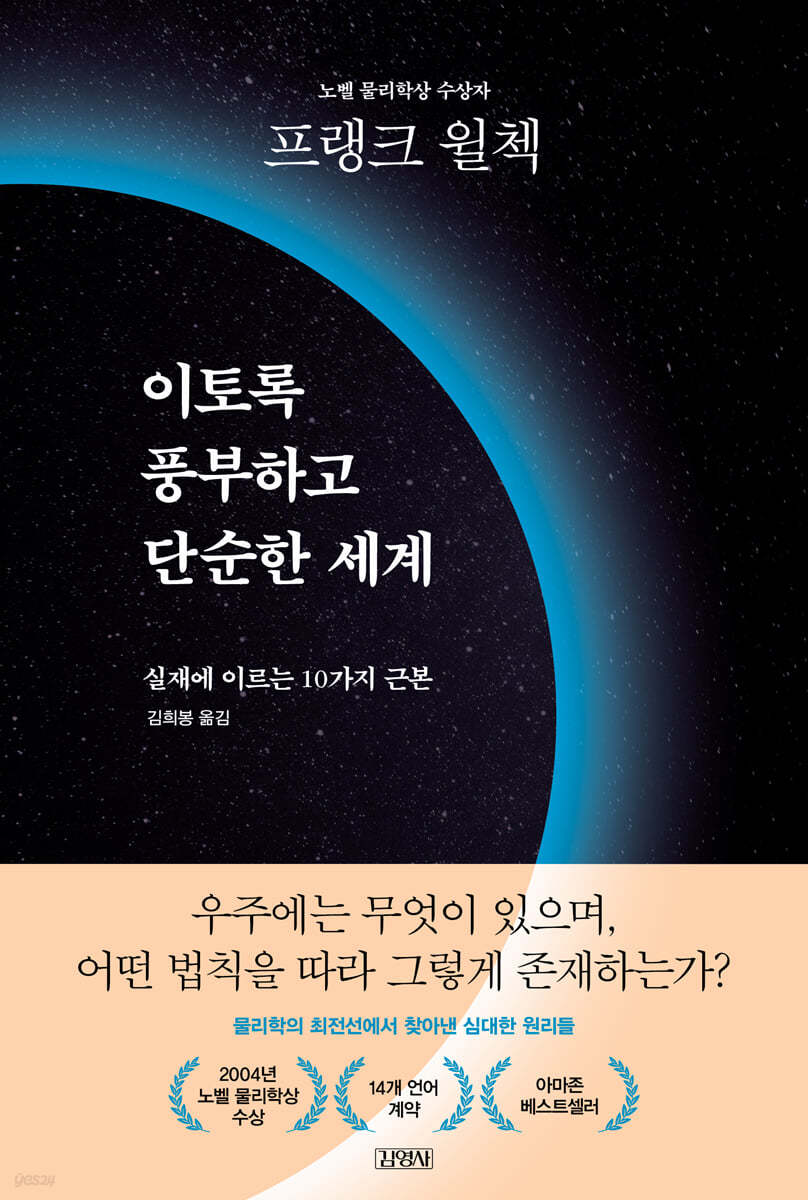
A World So Rich and Simple: 10 Fundamentals to Reality
 |
Description
Book Introduction
What is in the universe, and what laws govern its existence?
From the nature of space-time to matter and energy, complexity, complementarity, and the mysteries we are exploring at the forefront,
10 Profound Insights into a World Bigger, Richer, and Stranger Than You Think
2004 Nobel Prize in Physics, contracts in 14 languages, Amazon bestseller
One of the greatest physicists of our time introduces essential concepts we need to understand about what the world is and how it works.
By synthesizing fundamental questions, facts, and dazzling speculations, it explores the ideas that shape our understanding of the universe: time, space, matter, energy, complexity, and complementarity.
By retracing the history of science, we examine what we know and how we came to know it, while also reaching the limits of modern science to give a glimpse of what we may soon discover.
With his masterful clarity of understanding, his expansive perspective that surveys the entire spectrum of concepts from a high vantage point, his ingenious explanations of the principles he captures, and his infectious joy, Wilczek's voice reveals to readers a world far larger, richer, and stranger than they once knew, and at the same time, awe at the human intellect and imagination that comprehends this universe.
After completing this journey that will expand your world and mind, the world you see from now on will never be the same again.
From the nature of space-time to matter and energy, complexity, complementarity, and the mysteries we are exploring at the forefront,
10 Profound Insights into a World Bigger, Richer, and Stranger Than You Think
2004 Nobel Prize in Physics, contracts in 14 languages, Amazon bestseller
One of the greatest physicists of our time introduces essential concepts we need to understand about what the world is and how it works.
By synthesizing fundamental questions, facts, and dazzling speculations, it explores the ideas that shape our understanding of the universe: time, space, matter, energy, complexity, and complementarity.
By retracing the history of science, we examine what we know and how we came to know it, while also reaching the limits of modern science to give a glimpse of what we may soon discover.
With his masterful clarity of understanding, his expansive perspective that surveys the entire spectrum of concepts from a high vantage point, his ingenious explanations of the principles he captures, and his infectious joy, Wilczek's voice reveals to readers a world far larger, richer, and stranger than they once knew, and at the same time, awe at the human intellect and imagination that comprehends this universe.
After completing this journey that will expand your world and mind, the world you see from now on will never be the same again.
- You can preview some of the book's contents.
Preview
index
Preface: Reborn
Introduction
I.
Things that exist
1.
There is plenty of space
2.
Have plenty of time
3.
The ingredients are very small
4.
There are very few rules
5.
Abundant in matter and energy
II.
Beginning and End
6.
The history of the universe is an open book.
7.
Complexity emerges
8.
There's a lot more to see
9.
The mystery remains
10.
Complementarity expands the mind
Outgoing Post: The Long Journey Home
Acknowledgements
supplement
Translator's Note
Search
Introduction
I.
Things that exist
1.
There is plenty of space
2.
Have plenty of time
3.
The ingredients are very small
4.
There are very few rules
5.
Abundant in matter and energy
II.
Beginning and End
6.
The history of the universe is an open book.
7.
Complexity emerges
8.
There's a lot more to see
9.
The mystery remains
10.
Complementarity expands the mind
Outgoing Post: The Long Journey Home
Acknowledgements
supplement
Translator's Note
Search
Detailed image

Into the book
The most fundamental conclusion is that the same kinds of matter are found everywhere in the universe.
Moreover, we observe that the same laws apply everywhere.
Second, we observe that matter is organized in a hierarchical structure.
Wherever you look in the universe, there are stars.
Stars tend to group together to form galaxies, which are made up of roughly millions to billions of stars.
...
Third, all of these things are spread almost evenly throughout the universe.
We found that the density of galaxies is roughly the same in all directions and at all distances.
...
The same kind of matter is organized in the same way and is uniformly and abundantly distributed throughout the observable universe.
--- p.47-48
Trying to use waves to see objects smaller than the size of the waves is like trying to catch a marble while wearing boxing gloves.
The wavelength of visible light is approximately 1/2 millionth of a meter, so microscopes that use visible light to obtain images appear blurry at distances below that distance.
--- p.61
The following answer is often mistakenly attributed to Einstein, but it was first attributed to science fiction writer Ray Cummings.
“Time is what keeps things from happening all at once.” Another significant answer that doesn’t seem serious at first glance.
“Time is measured by the clock.” But I think this is the seed of the right answer.
We have to start from here.
--- p.78-79
Gravitons have never been observed as individual particles.
This is because gravitons interact so weakly with ordinary matter that it is practically impossible to observe them.
What is observed is the force of gravity, and recently gravitational waves have also been observed.
In theory, these observable effects arise from the cumulative action of many individual particles.
--- p.132
When I first started out as a physicist, I focused on studying fundamental particles in the traditional sense.
But long before that, I had heard a lecture by a scientist at Bell Labs, which I had visited during my student days.
When he explained his research to us, he said that phonons are quanta of vibration.
I didn't understand what he said, but I thought it was the most wonderful thing I'd ever heard.
The three strange concepts of phonons, vibrations, and quanta resonated with each other and, in a sense, were united as one.
--- p.136
If we think of matter as a home for quasiparticles, a profound question immediately arises.
Could it be that "empty space" itself is matter, and that its quasiparticles are our "elementary particles"? We can and should view it that way.
This is a very productive line of thinking, and we will explore it in more detail later.
--- p.138-139
The weak nuclear force acts wherever there are quarks.
Additionally, the weak nuclear force can convert neutrons into protons not only when they are isolated but also when they are inside an atomic nucleus.
After this happens, the new nucleus gains one proton and loses one neutron (an electron and an antineutrino escape).
Since the number of protons in an atom's nucleus determines its electrical properties, and thus its chemical properties, the weak nuclear force causes atoms to change chemically into different atoms.
This is what the alchemists aspired to, but what the pioneers of modern chemistry said was impossible.
The weak nuclear force performs nature's alchemy.
--- p.177
Let's compare the size of cosmic energy to human scale with a little comparison.
The typical nutritional intake for an adult is 2,000 calories per day.
This is roughly the energy needed to light a 100-watt light bulb.
If you continue to use this energy for a year, it's equivalent to 3 billion joules.
...
Let's call this amount of energy needed by a person for one year 1아HUMAN (of course, pronounced 'a human').
About 20 percent of this energy is used for brain activity.
Global energy consumption in 2020 is approximately 190 billion human-hours.
The world population in 2020 was approximately 7.5 billion, so each person used approximately 25 human-hours of energy.
...
Americans use roughly 95 AHUs per person.
The annual energy output from the sun is enough to supply approximately 500 trillion human beings.
...
More modestly, considering only the solar energy coming to Earth, we could harvest 'only' 10,000 times our current energy consumption.
This value is a more realistic number to evaluate the economic potential of solar energy.
Clearly, there is ample room for growth even without Dyson.
--- p.188-189
Gravitational instability, the most important reason for the emergence of complexity in the universe, is a type of Matthew effect.
In denser areas of space, stronger gravitational forces act to gather more matter, thus increasing its density.
On the other hand, areas with lower density are, on average, outcompeted and become increasingly empty.
--- p.232
For this reason, even if we fully understand the fundamental laws, this would not be a "theory of everything" or the "end of science" (two phrases I find deeply irritating, as they are so often used in popular science reporting). We would still need a complementary explanation of reality.
There will still be huge questions left unanswered, and great scientific research to be done.
--- p.307
In this way, complementarity is an invitation to consider different perspectives.
By complementarity, unfamiliar questions, unfamiliar facts, and unfamiliar attitudes provide opportunities to learn about new perspectives and things that can only be seen from that perspective.
Complementarity expands the mind.
Moreover, we observe that the same laws apply everywhere.
Second, we observe that matter is organized in a hierarchical structure.
Wherever you look in the universe, there are stars.
Stars tend to group together to form galaxies, which are made up of roughly millions to billions of stars.
...
Third, all of these things are spread almost evenly throughout the universe.
We found that the density of galaxies is roughly the same in all directions and at all distances.
...
The same kind of matter is organized in the same way and is uniformly and abundantly distributed throughout the observable universe.
--- p.47-48
Trying to use waves to see objects smaller than the size of the waves is like trying to catch a marble while wearing boxing gloves.
The wavelength of visible light is approximately 1/2 millionth of a meter, so microscopes that use visible light to obtain images appear blurry at distances below that distance.
--- p.61
The following answer is often mistakenly attributed to Einstein, but it was first attributed to science fiction writer Ray Cummings.
“Time is what keeps things from happening all at once.” Another significant answer that doesn’t seem serious at first glance.
“Time is measured by the clock.” But I think this is the seed of the right answer.
We have to start from here.
--- p.78-79
Gravitons have never been observed as individual particles.
This is because gravitons interact so weakly with ordinary matter that it is practically impossible to observe them.
What is observed is the force of gravity, and recently gravitational waves have also been observed.
In theory, these observable effects arise from the cumulative action of many individual particles.
--- p.132
When I first started out as a physicist, I focused on studying fundamental particles in the traditional sense.
But long before that, I had heard a lecture by a scientist at Bell Labs, which I had visited during my student days.
When he explained his research to us, he said that phonons are quanta of vibration.
I didn't understand what he said, but I thought it was the most wonderful thing I'd ever heard.
The three strange concepts of phonons, vibrations, and quanta resonated with each other and, in a sense, were united as one.
--- p.136
If we think of matter as a home for quasiparticles, a profound question immediately arises.
Could it be that "empty space" itself is matter, and that its quasiparticles are our "elementary particles"? We can and should view it that way.
This is a very productive line of thinking, and we will explore it in more detail later.
--- p.138-139
The weak nuclear force acts wherever there are quarks.
Additionally, the weak nuclear force can convert neutrons into protons not only when they are isolated but also when they are inside an atomic nucleus.
After this happens, the new nucleus gains one proton and loses one neutron (an electron and an antineutrino escape).
Since the number of protons in an atom's nucleus determines its electrical properties, and thus its chemical properties, the weak nuclear force causes atoms to change chemically into different atoms.
This is what the alchemists aspired to, but what the pioneers of modern chemistry said was impossible.
The weak nuclear force performs nature's alchemy.
--- p.177
Let's compare the size of cosmic energy to human scale with a little comparison.
The typical nutritional intake for an adult is 2,000 calories per day.
This is roughly the energy needed to light a 100-watt light bulb.
If you continue to use this energy for a year, it's equivalent to 3 billion joules.
...
Let's call this amount of energy needed by a person for one year 1아HUMAN (of course, pronounced 'a human').
About 20 percent of this energy is used for brain activity.
Global energy consumption in 2020 is approximately 190 billion human-hours.
The world population in 2020 was approximately 7.5 billion, so each person used approximately 25 human-hours of energy.
...
Americans use roughly 95 AHUs per person.
The annual energy output from the sun is enough to supply approximately 500 trillion human beings.
...
More modestly, considering only the solar energy coming to Earth, we could harvest 'only' 10,000 times our current energy consumption.
This value is a more realistic number to evaluate the economic potential of solar energy.
Clearly, there is ample room for growth even without Dyson.
--- p.188-189
Gravitational instability, the most important reason for the emergence of complexity in the universe, is a type of Matthew effect.
In denser areas of space, stronger gravitational forces act to gather more matter, thus increasing its density.
On the other hand, areas with lower density are, on average, outcompeted and become increasingly empty.
--- p.232
For this reason, even if we fully understand the fundamental laws, this would not be a "theory of everything" or the "end of science" (two phrases I find deeply irritating, as they are so often used in popular science reporting). We would still need a complementary explanation of reality.
There will still be huge questions left unanswered, and great scientific research to be done.
--- p.307
In this way, complementarity is an invitation to consider different perspectives.
By complementarity, unfamiliar questions, unfamiliar facts, and unfamiliar attitudes provide opportunities to learn about new perspectives and things that can only be seen from that perspective.
Complementarity expands the mind.
--- p.310
Publisher's Review
A lecture on the physical universe from the greatest living physicist
Frank Wilczek shared the 2004 Nobel Prize in Physics with David Gross and David Politzer for their research during their doctoral studies.
This was due to his “discovery of asymptotic freedom in the strong nuclear theory,” which attempted a new theoretical approach to explain the strange behavior of quarks, whose mutual force increases as they get farther apart and they become insensible to each other when they get extremely close.
He was incredibly fortunate to have won the Nobel Prize for his research in his early 20s, but he didn't stop there. He went on to enrich the world of physics by proposing many important and creative ideas.
The particle he named 'Axion' in 1977 is a strong candidate for dark matter and is currently being tracked by several research teams around the world, and the 'Time Crystal' he proposed in 2012 has since been observed by multiple research teams, confirming its existence.
The memory-carrying quasiparticle he introduced, 'Anion', is being used in the development of Microsoft's quantum computer.
In addition to his achievements in physics, he is also passionate about writing, reflecting his interests in various fields such as philosophy, art, and future technology. He writes a monthly series titled “Wilczek’s Universe” in the Wall Street Journal, and has also contributed numerous articles to Physics Today, Nova, and Quanta Magazine.
This rare popular book written by a Nobel Prize winner in physics reveals Wilczek's appeal as both a first-class physicist and a long-time, multifaceted writer.
The author's narrative threads unravel, constantly transcending the boundaries of typical academic disciplines and fields, encompassing not only his specialized field of theoretical physics but also astronomy, cosmology, biology, the future of technology, art, and even human morality. Through this, readers not only experience a high-level understanding of the physical facts discovered by modern science, but also participate in contemplation of the universe and human existence.
What does modern physics know, and how? What will it soon discover?
As stated in the preface, this book is written for the countless people he met who were “curious about the physical world and eager to learn what modern physics has to offer...
It is the product of an effort to convey “the central message of modern physics as simply as possible, without compromising accuracy,” in response to the needs of a “smart but uninformed” public.
We selected ten principles and explained them one by one in each chapter, adding outlooks and speculations about future developments.
From the geometry of ancient Greece to the cutting-edge scientific research of today, from the Big Bang to the distant future of the universe, from elementary particles to dark energy, from the evolution of matter to the human capacity for reason, we explore what is in this universe and why it is that way.
The universe, vast and 13.8 billion years old, is filled with a surprisingly uniform number of constituents, all operating according to a handful of physical laws.
In explaining this, the author takes the reader back to the beginning of the universe, to the distant future, and offers a concise but elegant sketch of the complexities that created celestial bodies, life, human society, culture, and art.
From discoveries made possible by microscopes, telescopes, and spectroscopy, to the detection of the Higgs boson at the LHC and gravitational waves at LIGO, it also shows how our perception of the physical world has expanded and how far it can go.
Many theories and concepts appear, but rather than simply explaining them in an easy and fun way, the book explains their meaning in the context of the background and the big picture, and goes beyond explaining the accepted theories to presenting one's own thoughts, imagination, and perspectives.
For example, Chapter 3 provides a fairly in-depth explanation of the properties of elementary particles, mass/charge/spin, and goes on to introduce topics that will see further discoveries in the future, such as ‘quasiparticles’ and ‘smart materials.’
Wilczek's personal stories, such as how he, a mathematician, ended up studying theoretical physics and why he named a new particle 'axion', are occasionally added to capture the reader's attention.
Key ideas about a world that is bigger, richer, and stranger than you think
“This book presents modern physics and the universe to the general reader in the broadest possible perspective.
Readers of all levels, not just the general public, will find something to gain from reading this book.
Perhaps the more you know about this topic, the more you will gain.
It covers the entire universe and physics, but it's not very long.
It explains what exists in the universe, what laws these beings follow, and what role these principles and laws play in the structure of the universe we see today.
This book does not go into the finer details of physics, but it does explain why general relativity had to be developed and what assumptions it was derived from.
We can also learn about the significance of the detection of the Higgs particle and the detection of gravitational waves.
“It provides a brief overview of the problems facing the Big Bang cosmology, the Standard Model (which the author calls the ‘core’), how difficult it is to improve it, and the prospects for doing so.” (From the translator’s note) Here are just a few of the interesting ideas in the book, extracted from the text and the translator’s note.
● Space-time is also a form of matter (pp. 71-73)
According to Einstein's general theory of relativity, space is a type of matter.
It bends and moves.
Calculations that take into account both general relativity and quantum mechanics show that space is like a constantly fluctuating jelly.
Space is made up of a huge number of identical units called 'space particles', each of which can come into contact with its neighbors, exchange messages, merge or split, and be born and disappear.
● Locality plays an important role in the universe (pp. 103-111)
What happens next to an object depends only on conditions in the object's immediate vicinity.
This is locality.
Thanks to this, when formulating laws, we do not need to consider the entire universe or the entire history.
If you just pay proper attention to the here and now, you can control all the related conditions.
A psychic who can spin a spoon from afar would never be able to slightly change the frequency of an atomic clock.
Even though it is possible with only a fraction of the energy required to bend a spoon.
Because the principle of locality holds true.
● Fields should be considered more important than particles (pp. 144-155)
In the past, 'field' was considered an additional component that complemented particles, but over the course of the 20th century, it took over the place of particles.
Today we understand that there is a deeper and more complete reality hidden within, and particles are its manifestations.
Particles are avatars of fields.
The reason all photons are identical is because particles are created as a result of disturbances of the same universal field.
Fields and particles can be said to be two aspects of the same reality.
In short, the quantum field rules.
● Not only is time in the universe abundant, but so is the time within us (pp. 90-91)
When you consider the 13.8 billion years of universe history, life seems like a fleeting moment.
But if you think about it, a human lifespan is quite a long time.
A hundred years is enough time for us to process a trillion scenes and have a billion thoughts.
We marvel at the geniuses who have accomplished things too great and amazing to be attributed to one person, and wonder how they could have accomplished so much in such a short time, yet we all have this abundance of time.
● The most ordinary and simple things are the most profound (pp. 69-70, 231-241)
The universe is amazingly uniform.
The entire universe is filled with the same matter, and all electrons are identical.
It is these simple, ordinary principles that have profound effects on the minute details of the vast universe.
Amazingly, this is why the universe is built on the laws of physics, and why structures are created within it that allow beings with human-like complexity to emerge.
Radical conservatism was the essential innovation of the scientific revolution (pp. 24-25)
The combination of these two attitudes—the humility to respect facts and learn from nature, and the systematic boldness to apply what we have learned beyond its original scope to every possible extent—can be called "radical conservatism," and this is the core aspect of the scientific method.
Science stays on the cutting edge by respecting facts and learning from nature (conservatism) and applying them wherever they are valuable (radicalism).
● It is amazing that we understand the universe, even if it is imperfect (pp. 9-10)
Perhaps the most fundamental message of all is that we understand the physical world very deeply.
As Albert Einstein said, the fact that we can understand the universe is a miracle.
Understanding the world through the eyes of science is like being reborn.
So what are the benefits of learning these fundamental principles? From infancy, humans build models of the world through experiences within the limits of their perceptions and environment.
While these models are certainly useful for our daily lives, modern science shows that the physical world is very different from these models.
Science provides an expanded perception beyond the five senses, and by reconstructing the information received through that perception, we can understand the universe more accurately.
When we learn to see in this new way, we can understand the world in a profound way.
According to the author, understanding the world in this way is an experience similar to being 'born again'.
“The process of being reborn can be confusing.
But it can also be a thrilling experience, like riding a roller coaster.
And this process brings gifts.
“To those reborn through science, the world appears fresh, clear, and surprisingly rich.” _Page 19
Frank Wilczek shared the 2004 Nobel Prize in Physics with David Gross and David Politzer for their research during their doctoral studies.
This was due to his “discovery of asymptotic freedom in the strong nuclear theory,” which attempted a new theoretical approach to explain the strange behavior of quarks, whose mutual force increases as they get farther apart and they become insensible to each other when they get extremely close.
He was incredibly fortunate to have won the Nobel Prize for his research in his early 20s, but he didn't stop there. He went on to enrich the world of physics by proposing many important and creative ideas.
The particle he named 'Axion' in 1977 is a strong candidate for dark matter and is currently being tracked by several research teams around the world, and the 'Time Crystal' he proposed in 2012 has since been observed by multiple research teams, confirming its existence.
The memory-carrying quasiparticle he introduced, 'Anion', is being used in the development of Microsoft's quantum computer.
In addition to his achievements in physics, he is also passionate about writing, reflecting his interests in various fields such as philosophy, art, and future technology. He writes a monthly series titled “Wilczek’s Universe” in the Wall Street Journal, and has also contributed numerous articles to Physics Today, Nova, and Quanta Magazine.
This rare popular book written by a Nobel Prize winner in physics reveals Wilczek's appeal as both a first-class physicist and a long-time, multifaceted writer.
The author's narrative threads unravel, constantly transcending the boundaries of typical academic disciplines and fields, encompassing not only his specialized field of theoretical physics but also astronomy, cosmology, biology, the future of technology, art, and even human morality. Through this, readers not only experience a high-level understanding of the physical facts discovered by modern science, but also participate in contemplation of the universe and human existence.
What does modern physics know, and how? What will it soon discover?
As stated in the preface, this book is written for the countless people he met who were “curious about the physical world and eager to learn what modern physics has to offer...
It is the product of an effort to convey “the central message of modern physics as simply as possible, without compromising accuracy,” in response to the needs of a “smart but uninformed” public.
We selected ten principles and explained them one by one in each chapter, adding outlooks and speculations about future developments.
From the geometry of ancient Greece to the cutting-edge scientific research of today, from the Big Bang to the distant future of the universe, from elementary particles to dark energy, from the evolution of matter to the human capacity for reason, we explore what is in this universe and why it is that way.
The universe, vast and 13.8 billion years old, is filled with a surprisingly uniform number of constituents, all operating according to a handful of physical laws.
In explaining this, the author takes the reader back to the beginning of the universe, to the distant future, and offers a concise but elegant sketch of the complexities that created celestial bodies, life, human society, culture, and art.
From discoveries made possible by microscopes, telescopes, and spectroscopy, to the detection of the Higgs boson at the LHC and gravitational waves at LIGO, it also shows how our perception of the physical world has expanded and how far it can go.
Many theories and concepts appear, but rather than simply explaining them in an easy and fun way, the book explains their meaning in the context of the background and the big picture, and goes beyond explaining the accepted theories to presenting one's own thoughts, imagination, and perspectives.
For example, Chapter 3 provides a fairly in-depth explanation of the properties of elementary particles, mass/charge/spin, and goes on to introduce topics that will see further discoveries in the future, such as ‘quasiparticles’ and ‘smart materials.’
Wilczek's personal stories, such as how he, a mathematician, ended up studying theoretical physics and why he named a new particle 'axion', are occasionally added to capture the reader's attention.
Key ideas about a world that is bigger, richer, and stranger than you think
“This book presents modern physics and the universe to the general reader in the broadest possible perspective.
Readers of all levels, not just the general public, will find something to gain from reading this book.
Perhaps the more you know about this topic, the more you will gain.
It covers the entire universe and physics, but it's not very long.
It explains what exists in the universe, what laws these beings follow, and what role these principles and laws play in the structure of the universe we see today.
This book does not go into the finer details of physics, but it does explain why general relativity had to be developed and what assumptions it was derived from.
We can also learn about the significance of the detection of the Higgs particle and the detection of gravitational waves.
“It provides a brief overview of the problems facing the Big Bang cosmology, the Standard Model (which the author calls the ‘core’), how difficult it is to improve it, and the prospects for doing so.” (From the translator’s note) Here are just a few of the interesting ideas in the book, extracted from the text and the translator’s note.
● Space-time is also a form of matter (pp. 71-73)
According to Einstein's general theory of relativity, space is a type of matter.
It bends and moves.
Calculations that take into account both general relativity and quantum mechanics show that space is like a constantly fluctuating jelly.
Space is made up of a huge number of identical units called 'space particles', each of which can come into contact with its neighbors, exchange messages, merge or split, and be born and disappear.
● Locality plays an important role in the universe (pp. 103-111)
What happens next to an object depends only on conditions in the object's immediate vicinity.
This is locality.
Thanks to this, when formulating laws, we do not need to consider the entire universe or the entire history.
If you just pay proper attention to the here and now, you can control all the related conditions.
A psychic who can spin a spoon from afar would never be able to slightly change the frequency of an atomic clock.
Even though it is possible with only a fraction of the energy required to bend a spoon.
Because the principle of locality holds true.
● Fields should be considered more important than particles (pp. 144-155)
In the past, 'field' was considered an additional component that complemented particles, but over the course of the 20th century, it took over the place of particles.
Today we understand that there is a deeper and more complete reality hidden within, and particles are its manifestations.
Particles are avatars of fields.
The reason all photons are identical is because particles are created as a result of disturbances of the same universal field.
Fields and particles can be said to be two aspects of the same reality.
In short, the quantum field rules.
● Not only is time in the universe abundant, but so is the time within us (pp. 90-91)
When you consider the 13.8 billion years of universe history, life seems like a fleeting moment.
But if you think about it, a human lifespan is quite a long time.
A hundred years is enough time for us to process a trillion scenes and have a billion thoughts.
We marvel at the geniuses who have accomplished things too great and amazing to be attributed to one person, and wonder how they could have accomplished so much in such a short time, yet we all have this abundance of time.
● The most ordinary and simple things are the most profound (pp. 69-70, 231-241)
The universe is amazingly uniform.
The entire universe is filled with the same matter, and all electrons are identical.
It is these simple, ordinary principles that have profound effects on the minute details of the vast universe.
Amazingly, this is why the universe is built on the laws of physics, and why structures are created within it that allow beings with human-like complexity to emerge.
Radical conservatism was the essential innovation of the scientific revolution (pp. 24-25)
The combination of these two attitudes—the humility to respect facts and learn from nature, and the systematic boldness to apply what we have learned beyond its original scope to every possible extent—can be called "radical conservatism," and this is the core aspect of the scientific method.
Science stays on the cutting edge by respecting facts and learning from nature (conservatism) and applying them wherever they are valuable (radicalism).
● It is amazing that we understand the universe, even if it is imperfect (pp. 9-10)
Perhaps the most fundamental message of all is that we understand the physical world very deeply.
As Albert Einstein said, the fact that we can understand the universe is a miracle.
Understanding the world through the eyes of science is like being reborn.
So what are the benefits of learning these fundamental principles? From infancy, humans build models of the world through experiences within the limits of their perceptions and environment.
While these models are certainly useful for our daily lives, modern science shows that the physical world is very different from these models.
Science provides an expanded perception beyond the five senses, and by reconstructing the information received through that perception, we can understand the universe more accurately.
When we learn to see in this new way, we can understand the world in a profound way.
According to the author, understanding the world in this way is an experience similar to being 'born again'.
“The process of being reborn can be confusing.
But it can also be a thrilling experience, like riding a roller coaster.
And this process brings gifts.
“To those reborn through science, the world appears fresh, clear, and surprisingly rich.” _Page 19
GOODS SPECIFICS
- Publication date: April 25, 2022
- Format: Hardcover book binding method guide
- Page count, weight, size: 360 pages | 444g | 124*190*30mm
- ISBN13: 9788934961741
- ISBN10: 8934961740
You may also like
카테고리
korean


korean

![GQ KOREA Mark (Monthly): December [2025]](http://librairie.coreenne.fr/cdn/shop/files/8ef265dbbfbf186523ed75ba7319009d.jpg?v=1765340328&width=3840)


