

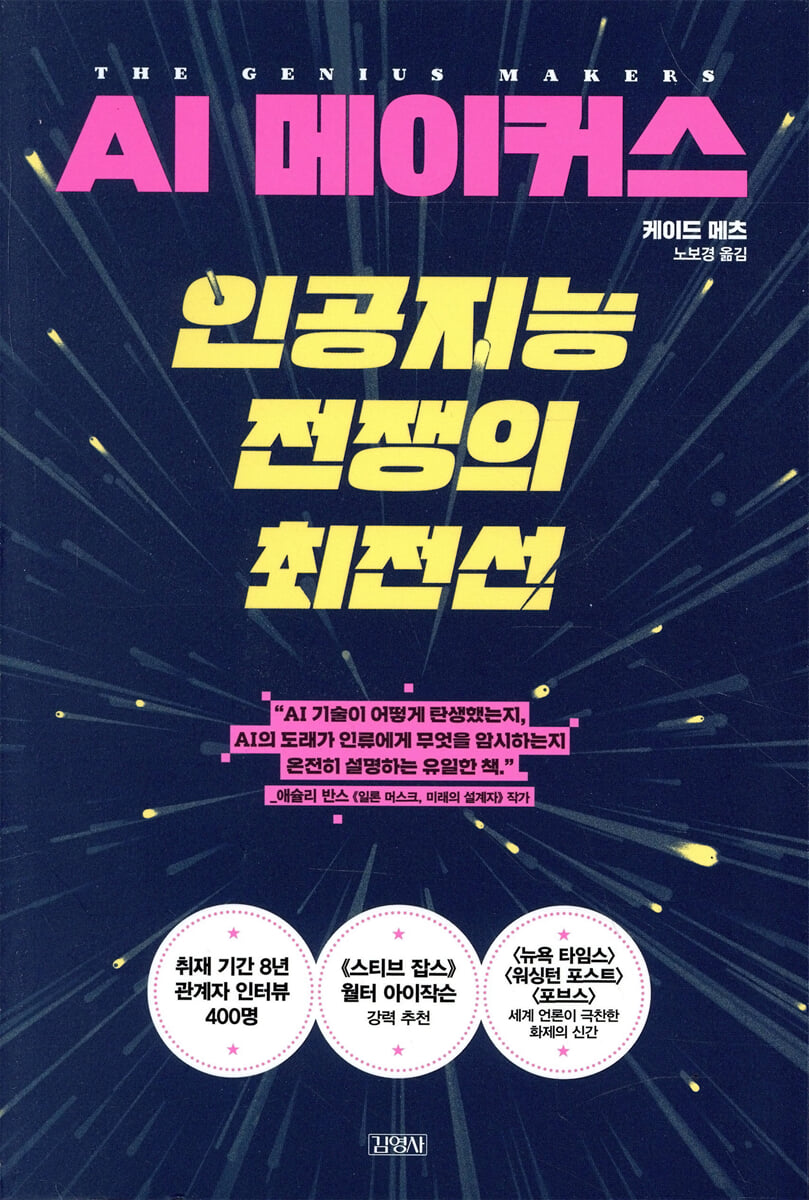
AI Makers, the Front Line of the Artificial Intelligence War
 |
Description
Book Introduction
8 years of reporting, 400 interviews with relevant personnel
A hot bestseller lauded by the world's media
From the 'Founder of Deep Learning' to the 'Father of AlphaGo'
The story of the genius developers who created useful and dangerous AI technology.
VVIP engineers who are offered tens of millions of dollars every year by Google, Facebook, Microsoft, and Baidu.
Owners of crazy minds who might bring about a 'singularity' in human history.
The one and only book that tells you everything about 'AI Makers'.
The most authoritative record reporting on the current state of the AI war that has lasted over 60 years and forecasting its future.
Everything humans need to know about artificial intelligence before it can understand humans.
A hot bestseller lauded by the world's media
From the 'Founder of Deep Learning' to the 'Father of AlphaGo'
The story of the genius developers who created useful and dangerous AI technology.
VVIP engineers who are offered tens of millions of dollars every year by Google, Facebook, Microsoft, and Baidu.
Owners of crazy minds who might bring about a 'singularity' in human history.
The one and only book that tells you everything about 'AI Makers'.
The most authoritative record reporting on the current state of the AI war that has lasted over 60 years and forecasting its future.
Everything humans need to know about artificial intelligence before it can understand humans.
- You can preview some of the book's contents.
Preview
index
Foreword: The Gray-Haired Startup Founder
Ⅰ.
The idea of a thinking machine
1.
Origin: The Shadow of the Perceptron
2.
Promise: Long Winter and Short Spring
3.
Rejection: LeQueue's Lynette, Hinton's Deep Learning
4.
Breakthrough: Into Silicon Valley
5.
Proof: Deep Learning Virus
6.
Ambition: DeepMind's Goals
Ⅱ.
Who will be the master of artificial intelligence?
7.
Competition: Talent Acquisition Campaign
8.
Hype: The Endless Path to Success
9.
Excessive Concern: The Need for Brakes
10.
Explosion: AlphaGo Shock
11.
Expansion: Google's Attack
12.
In a Dream: Microsoft in Mannerism
Ⅲ.
A double-edged sword, both useful and dangerous
13.
Deception: Fake images that look more real than the real thing
14.
Hubris: China Power
15.
Bias: Beyond Profit, Toward Ethics
16.
Weaponization: The AI Military Supply Controversy
17.
Powerlessness: Between Filtering and Censorship
Ⅳ.
What artificial intelligence wants to become
18.
Discussion: Different opinions
19.
Automation: Every Picking Robot
20.
Religion: A Veiled Future
21.
The Unknown Factor: An Unfinished Happy Ending
Acknowledgements
Chronology of Major Events
Characters
References
Search
Ⅰ.
The idea of a thinking machine
1.
Origin: The Shadow of the Perceptron
2.
Promise: Long Winter and Short Spring
3.
Rejection: LeQueue's Lynette, Hinton's Deep Learning
4.
Breakthrough: Into Silicon Valley
5.
Proof: Deep Learning Virus
6.
Ambition: DeepMind's Goals
Ⅱ.
Who will be the master of artificial intelligence?
7.
Competition: Talent Acquisition Campaign
8.
Hype: The Endless Path to Success
9.
Excessive Concern: The Need for Brakes
10.
Explosion: AlphaGo Shock
11.
Expansion: Google's Attack
12.
In a Dream: Microsoft in Mannerism
Ⅲ.
A double-edged sword, both useful and dangerous
13.
Deception: Fake images that look more real than the real thing
14.
Hubris: China Power
15.
Bias: Beyond Profit, Toward Ethics
16.
Weaponization: The AI Military Supply Controversy
17.
Powerlessness: Between Filtering and Censorship
Ⅳ.
What artificial intelligence wants to become
18.
Discussion: Different opinions
19.
Automation: Every Picking Robot
20.
Religion: A Veiled Future
21.
The Unknown Factor: An Unfinished Happy Ending
Acknowledgements
Chronology of Major Events
Characters
References
Search
Detailed image
.jpg)
Into the book
Geoffrey Hinton's research was dismissed as bizarre even at his own university, which for years ignored his requests to fill a professorship to join his arduous quest to develop self-learning machines.
He explained the reason as follows:
“I guess I was enough of a madman obsessed with this kind of research.”
--- p.16
Hinton liked to say, “Old ideas are fresh.”
What this means is that a scientist should never give up on an idea unless someone proves it wrong.
--- p.70~71
“Are you the devil?” Sejnoski asked.
Minsky dismissed the question, pointing out the limitations of neural networks and their failure to deliver the promised results.
Sejnoski asked again.
“Are you the devil?” Minsky finally answered, his face furious.
“Yes, I am a devil.”
--- p.112
Yann Le Quoc said, “How can you do research without being open, without sharing your research with others?
As long as secrecy is maintained, the quality of research is bound to suffer.
That means you can't get the best results.
“Because you won’t be able to meet someone who can innovate your research,” he said.
Even experts like Jeff Dean, accustomed to the corporate culture of secrecy, have recognized the benefits of openness.
--- p.200
They approached Peter Thiel through the Singularity meeting.
We also attracted investment from Jan Tallinn, one of the founders of the Internet phone service Skype.
Jan Tallinn soon founded the Future of Life Institute with several other scholars to explore the existential risks posed by artificial intelligence.
And Demis Hassabis and Shane Legge continued to spread the AI risk theory to new audiences.
--- p.238
As the Trump administration intensified its immigration crackdown, concerns about talent migration immediately intensified.
The number of international students in the United States, which was already on a downward curve, is now rapidly decreasing, and the American science and mathematics communities, which are heavily dependent on foreign talent, are beginning to suffer.
“This is like shooting ourselves in the head,” says Oren Etzioni, CEO of the influential Seattle-based Allen Institute for Artificial Intelligence.
It's not at the level of stepping on the foot.
“It’s suicide,” he said.
--- p.308~309
Drawing attention to himself and his work was Elon Musk's business acumen.
For a while, that method worked well at OpenAI, allowing the lab to recruit top talent in the field.
He explained the reason as follows:
“I guess I was enough of a madman obsessed with this kind of research.”
--- p.16
Hinton liked to say, “Old ideas are fresh.”
What this means is that a scientist should never give up on an idea unless someone proves it wrong.
--- p.70~71
“Are you the devil?” Sejnoski asked.
Minsky dismissed the question, pointing out the limitations of neural networks and their failure to deliver the promised results.
Sejnoski asked again.
“Are you the devil?” Minsky finally answered, his face furious.
“Yes, I am a devil.”
--- p.112
Yann Le Quoc said, “How can you do research without being open, without sharing your research with others?
As long as secrecy is maintained, the quality of research is bound to suffer.
That means you can't get the best results.
“Because you won’t be able to meet someone who can innovate your research,” he said.
Even experts like Jeff Dean, accustomed to the corporate culture of secrecy, have recognized the benefits of openness.
--- p.200
They approached Peter Thiel through the Singularity meeting.
We also attracted investment from Jan Tallinn, one of the founders of the Internet phone service Skype.
Jan Tallinn soon founded the Future of Life Institute with several other scholars to explore the existential risks posed by artificial intelligence.
And Demis Hassabis and Shane Legge continued to spread the AI risk theory to new audiences.
--- p.238
As the Trump administration intensified its immigration crackdown, concerns about talent migration immediately intensified.
The number of international students in the United States, which was already on a downward curve, is now rapidly decreasing, and the American science and mathematics communities, which are heavily dependent on foreign talent, are beginning to suffer.
“This is like shooting ourselves in the head,” says Oren Etzioni, CEO of the influential Seattle-based Allen Institute for Artificial Intelligence.
It's not at the level of stepping on the foot.
“It’s suicide,” he said.
--- p.308~309
Drawing attention to himself and his work was Elon Musk's business acumen.
For a while, that method worked well at OpenAI, allowing the lab to recruit top talent in the field.
--- p.410
Publisher's Review
★ 8 years of reporting, 400 interviews with relevant personnel
★ Highly recommended by Walter Isaacson and Song Gil-young
★ A hot new book that has been highlighted and praised by the New York Times, the Washington Post, and Forbes.
“A book that reveals, with a touch of wry humor, the inside story of how artificial intelligence ended up in the hands of big tech companies like Google and Facebook.”
Oren Etzioni, CEO of the Allen Institute for Artificial Intelligence
“Who will be the first to create the smartest AI?”
A Record of 60 Years of Fierce AI Technology Battlefield
Who do you look at and speak to as soon as you open your eyes in the morning? It's probably not a human being.
The AI embedded in every electronic device manages your schedule and automatically cleans and does laundry without your instructions.
And that's not all.
It can learn on its own like humans and is even smarter than humans.
Do you know when and by whom this new civilization called AI began? It was 60 years ago, by an American psychologist exploring the mysteries of the human brain.
At the time, the technology to implement human intellectual abilities on a computer was considered an impossible dream of eccentrics.
However, a major reversal occurred with the introduction of deep learning technology to Silicon Valley in 2007 and the emergence of AlphaGo in 2016.
At the same time, a war for AI development, or more precisely, a war for AI talent among big tech companies, has begun.
AI has taken human civilization to a new level, leading us to a higher level than anyone has ever experienced or could have predicted. Concerns are rising everywhere that, with AI technology advancing at its current pace, machines could dominate and even lead to the extinction of humans. The first step to maintaining control over AI is to examine its past, present, and future.
《AI Makers, the Front Line of the Artificial Intelligence War》(original title: The Genius Makers) is a must-read for the AI era that conveys everything humans need to know about AI before AI understands humans.
Immediately after its publication, it became an Amazon bestseller, receiving praise for "vividly capturing the events that marked a turning point in human history." This book reveals for the first time the fierce competition between genius developers and the stories behind how AI evolved from a simple idea to a core technology of the Fourth Industrial Revolution, used daily by people around the world.
“The system demonstrated superior performance to humans.”
From the "Founder of Deep Learning" to the "Father of AlphaGo," Crucial Moments in AI Technology Innovation
Author Cade Metz, a former tech reporter for The New York Times and a staff writer for Wired, has interviewed 400 developers on the front lines of the AI war over the past eight years.
Based on this, we conducted an in-depth report on the crucial moments of AI technology innovation.
▶ An unfamiliar term that appeared in the newspaper: 'artificial intelligence'
In 1958, psychologist Frank Rosenblatt and the U.S. Navy unveiled the 'Perceptron'.
It was an early artificial neural network that mimicked the learning ability of the human brain.
The media heightened public expectations by attaching provocative adjectives such as “artificial intelligence (AI)” and “thinking Frankenstein” to his research.
To attract government and private investors and secure research funding, artificial neural network researchers used the term AI, a choice they have regretted for half a century.
Because no one has yet demonstrated AI that approaches human intelligence.
The Emergence of True AI: The Development of Deep Learning
In 2007, University of Toronto professor Geoffrey Hinton developed 'deep learning', an artificial neural network that learns on its own without human assistance.
It was a major event that marked the end of the 'AI winter' that had continued since the 1970s.
Until then, Hinton's research had been considered bizarre even at the universities where he worked, and his requests for more faculty to join his AI research were ignored for years.
Hinton explained why:
“I guess I was enough of a madman obsessed with this kind of research.”
In 2012, a research team at the University of Toronto led by Geoffrey Hinton published a paper introducing 'AlexNet', a deep learning technology that can identify not only voices but also images.
Google, Baidu, Microsoft, and DeepMind have been secretly contacting each other to get their hands on this technology, which is considered one of the most groundbreaking inventions in the history of computer science.
Hinton founded a deep learning startup called DNN Research with two of his students and put the company up for auction via email.
The winning bid was $44 million, and Google was the ultimate winner of the auction.
▶ Rivals in the AI Era: Google's Geoffrey Hinton vs.
Facebook's Yann Lequon
In 2013, AI became a core technology in the big tech industry.
Google, which hired Geoffrey Hinton, the 'founder of deep learning,' also acquired DeepMind, founded by British chess prodigy Demis Hassabis, for $650 million.
And in March 2016, the scene where AlphaGo, an AI Go program developed by Google DeepMind, defeated Lee Sedol, the world's representative Go player, was broadcast live around the world.
The match between AlphaGo and Lee Sedol not only demonstrated that Google is the strongest player in the AI war, but also hinted that the "singularity" (the moment when technology surpasses humans) that futurist Ray Kurzweil spoke of could actually arrive, and that the point could come much sooner than we expect.
If Google had Geoffrey Hinton, Facebook had Yann LeQueux.
Mark Zuckerberg hired Yann LeCouq, another authority on deep learning and a professor at New York University, in exchange for establishing an AI research lab within Facebook.
In October 2015, Facebook officially announced its development of a Go AI, but lost its leader to Google just five months later.
Mark Zuckerberg and Yann Le Quoc, though heartbroken, accepted the defeat on the Go board and posted congratulatory messages on their respective Facebook pages for AlphaGo's success.
And we changed our research direction and focused on implementing technologies such as facial recognition, language translation, and automatic subtitle generation on social media.
“We could accidentally create something more dangerous than a nuclear weapon.”
AI technology in the hands of big tech companies, and the remaining problems.
Geoffrey Hinton and Yann Lequaux's ultimate goal in selling AI technology to Big Tech wasn't money.
It was to find the optimal settlement for his research.
We just chose places with better computer hardware and richer data.
They were scholars, not businessmen.
But as AI technology falls into the hands of corporations and governments, situations arise that even the creators of AI cannot control.
▶ Deepfakes: Fake images that look more real than the real thing
In 2014, Google researcher Alex Graves unveiled 'GANs' technology, which can freely create and modify detailed images, including faces.
And soon, the 'deepfake' controversy (AI-manipulated videos distributed on the Internet) erupted.
It was difficult to verify the authenticity of the video because the facial images in the deepfake looked “more real than the real thing.”
In particular, during the 2016 US presidential election, propaganda videos using images of Obama and Trump's faces were spread on Facebook, and the side effects of GANs technology spread to the political realm.
▶ China and Baidu: The Great Firewall that even Google can't overcome
In 2017, Google planned another 'AlphaGo Shock'.
Just as the match against Lee Sedol imprinted the power of AI in the minds of Koreans, it was judged that the defeat of the Chinese genius Go player Ke Jie would be an opportunity to secure a large number of Chinese customers.
This was a clear misjudgment.
It overlooks the fact that China is a state-led economic system.
The Chinese government has announced massive investment plans, with the ambition of becoming a global leader in AI.
Thus began the counterattack of Baidu, China's largest IT company.
Baidu recruited Chinese AI talents from around the world, including Microsoft's Vice President Qi Lu.
With government support, massive amounts of personal information were invested in in-house AI training, and the research results were used not only for economic growth but also for surveillance and control of the country's citizens.
▶ The U.S. Department of Defense's covert killer robot development plan, Project Maven
In 2018, nine Google developers revealed that the U.S. Department of Defense had been secretly developing AI lethal weapons for war in collaboration with executives from big tech companies, including Google.
A petition campaign opposing the weaponization of AI has emerged in the US and Europe.
Although the contract was withdrawn, the book states, “Google did not completely change its business direction.”
The Maven Project is just the tip of the iceberg.
There are also reports that AI technology is being used to suppress ethnic minorities in China, and AI technology has been introduced into all militaries around the world.
Elon Musk shocked people by claiming that AI could trigger World War III.
The “new weapon” called AI is a double-edged sword, both useful and dangerous.
The 'singularity' may come sooner, or it may not come at all.
However, it is necessary to prepare alternatives to address the ethical issues raised by AI and to compensate for the technical flaws of AI itself.
The author concludes his lengthy talk by presenting the potential and limitations of AI to those who create, sell, and buy AI, and then suggesting that they put their heads together to find alternatives.
★ Highly recommended by Walter Isaacson and Song Gil-young
★ A hot new book that has been highlighted and praised by the New York Times, the Washington Post, and Forbes.
“A book that reveals, with a touch of wry humor, the inside story of how artificial intelligence ended up in the hands of big tech companies like Google and Facebook.”
Oren Etzioni, CEO of the Allen Institute for Artificial Intelligence
“Who will be the first to create the smartest AI?”
A Record of 60 Years of Fierce AI Technology Battlefield
Who do you look at and speak to as soon as you open your eyes in the morning? It's probably not a human being.
The AI embedded in every electronic device manages your schedule and automatically cleans and does laundry without your instructions.
And that's not all.
It can learn on its own like humans and is even smarter than humans.
Do you know when and by whom this new civilization called AI began? It was 60 years ago, by an American psychologist exploring the mysteries of the human brain.
At the time, the technology to implement human intellectual abilities on a computer was considered an impossible dream of eccentrics.
However, a major reversal occurred with the introduction of deep learning technology to Silicon Valley in 2007 and the emergence of AlphaGo in 2016.
At the same time, a war for AI development, or more precisely, a war for AI talent among big tech companies, has begun.
AI has taken human civilization to a new level, leading us to a higher level than anyone has ever experienced or could have predicted. Concerns are rising everywhere that, with AI technology advancing at its current pace, machines could dominate and even lead to the extinction of humans. The first step to maintaining control over AI is to examine its past, present, and future.
《AI Makers, the Front Line of the Artificial Intelligence War》(original title: The Genius Makers) is a must-read for the AI era that conveys everything humans need to know about AI before AI understands humans.
Immediately after its publication, it became an Amazon bestseller, receiving praise for "vividly capturing the events that marked a turning point in human history." This book reveals for the first time the fierce competition between genius developers and the stories behind how AI evolved from a simple idea to a core technology of the Fourth Industrial Revolution, used daily by people around the world.
“The system demonstrated superior performance to humans.”
From the "Founder of Deep Learning" to the "Father of AlphaGo," Crucial Moments in AI Technology Innovation
Author Cade Metz, a former tech reporter for The New York Times and a staff writer for Wired, has interviewed 400 developers on the front lines of the AI war over the past eight years.
Based on this, we conducted an in-depth report on the crucial moments of AI technology innovation.
▶ An unfamiliar term that appeared in the newspaper: 'artificial intelligence'
In 1958, psychologist Frank Rosenblatt and the U.S. Navy unveiled the 'Perceptron'.
It was an early artificial neural network that mimicked the learning ability of the human brain.
The media heightened public expectations by attaching provocative adjectives such as “artificial intelligence (AI)” and “thinking Frankenstein” to his research.
To attract government and private investors and secure research funding, artificial neural network researchers used the term AI, a choice they have regretted for half a century.
Because no one has yet demonstrated AI that approaches human intelligence.
The Emergence of True AI: The Development of Deep Learning
In 2007, University of Toronto professor Geoffrey Hinton developed 'deep learning', an artificial neural network that learns on its own without human assistance.
It was a major event that marked the end of the 'AI winter' that had continued since the 1970s.
Until then, Hinton's research had been considered bizarre even at the universities where he worked, and his requests for more faculty to join his AI research were ignored for years.
Hinton explained why:
“I guess I was enough of a madman obsessed with this kind of research.”
In 2012, a research team at the University of Toronto led by Geoffrey Hinton published a paper introducing 'AlexNet', a deep learning technology that can identify not only voices but also images.
Google, Baidu, Microsoft, and DeepMind have been secretly contacting each other to get their hands on this technology, which is considered one of the most groundbreaking inventions in the history of computer science.
Hinton founded a deep learning startup called DNN Research with two of his students and put the company up for auction via email.
The winning bid was $44 million, and Google was the ultimate winner of the auction.
▶ Rivals in the AI Era: Google's Geoffrey Hinton vs.
Facebook's Yann Lequon
In 2013, AI became a core technology in the big tech industry.
Google, which hired Geoffrey Hinton, the 'founder of deep learning,' also acquired DeepMind, founded by British chess prodigy Demis Hassabis, for $650 million.
And in March 2016, the scene where AlphaGo, an AI Go program developed by Google DeepMind, defeated Lee Sedol, the world's representative Go player, was broadcast live around the world.
The match between AlphaGo and Lee Sedol not only demonstrated that Google is the strongest player in the AI war, but also hinted that the "singularity" (the moment when technology surpasses humans) that futurist Ray Kurzweil spoke of could actually arrive, and that the point could come much sooner than we expect.
If Google had Geoffrey Hinton, Facebook had Yann LeQueux.
Mark Zuckerberg hired Yann LeCouq, another authority on deep learning and a professor at New York University, in exchange for establishing an AI research lab within Facebook.
In October 2015, Facebook officially announced its development of a Go AI, but lost its leader to Google just five months later.
Mark Zuckerberg and Yann Le Quoc, though heartbroken, accepted the defeat on the Go board and posted congratulatory messages on their respective Facebook pages for AlphaGo's success.
And we changed our research direction and focused on implementing technologies such as facial recognition, language translation, and automatic subtitle generation on social media.
“We could accidentally create something more dangerous than a nuclear weapon.”
AI technology in the hands of big tech companies, and the remaining problems.
Geoffrey Hinton and Yann Lequaux's ultimate goal in selling AI technology to Big Tech wasn't money.
It was to find the optimal settlement for his research.
We just chose places with better computer hardware and richer data.
They were scholars, not businessmen.
But as AI technology falls into the hands of corporations and governments, situations arise that even the creators of AI cannot control.
▶ Deepfakes: Fake images that look more real than the real thing
In 2014, Google researcher Alex Graves unveiled 'GANs' technology, which can freely create and modify detailed images, including faces.
And soon, the 'deepfake' controversy (AI-manipulated videos distributed on the Internet) erupted.
It was difficult to verify the authenticity of the video because the facial images in the deepfake looked “more real than the real thing.”
In particular, during the 2016 US presidential election, propaganda videos using images of Obama and Trump's faces were spread on Facebook, and the side effects of GANs technology spread to the political realm.
▶ China and Baidu: The Great Firewall that even Google can't overcome
In 2017, Google planned another 'AlphaGo Shock'.
Just as the match against Lee Sedol imprinted the power of AI in the minds of Koreans, it was judged that the defeat of the Chinese genius Go player Ke Jie would be an opportunity to secure a large number of Chinese customers.
This was a clear misjudgment.
It overlooks the fact that China is a state-led economic system.
The Chinese government has announced massive investment plans, with the ambition of becoming a global leader in AI.
Thus began the counterattack of Baidu, China's largest IT company.
Baidu recruited Chinese AI talents from around the world, including Microsoft's Vice President Qi Lu.
With government support, massive amounts of personal information were invested in in-house AI training, and the research results were used not only for economic growth but also for surveillance and control of the country's citizens.
▶ The U.S. Department of Defense's covert killer robot development plan, Project Maven
In 2018, nine Google developers revealed that the U.S. Department of Defense had been secretly developing AI lethal weapons for war in collaboration with executives from big tech companies, including Google.
A petition campaign opposing the weaponization of AI has emerged in the US and Europe.
Although the contract was withdrawn, the book states, “Google did not completely change its business direction.”
The Maven Project is just the tip of the iceberg.
There are also reports that AI technology is being used to suppress ethnic minorities in China, and AI technology has been introduced into all militaries around the world.
Elon Musk shocked people by claiming that AI could trigger World War III.
The “new weapon” called AI is a double-edged sword, both useful and dangerous.
The 'singularity' may come sooner, or it may not come at all.
However, it is necessary to prepare alternatives to address the ethical issues raised by AI and to compensate for the technical flaws of AI itself.
The author concludes his lengthy talk by presenting the potential and limitations of AI to those who create, sell, and buy AI, and then suggesting that they put their heads together to find alternatives.
GOODS SPECIFICS
- Publication date: April 15, 2022
- Page count, weight, size: 504 pages | 672g | 145*215*35mm
- ISBN13: 9788934949541
- ISBN10: 8934949546
You may also like
카테고리
korean


korean

![ELLE 엘르 스페셜 에디션 A형 : 12월 [2025]](http://librairie.coreenne.fr/cdn/shop/files/b8e27a3de6c9538896439686c6b0e8fb.jpg?v=1766436872&width=3840)


