

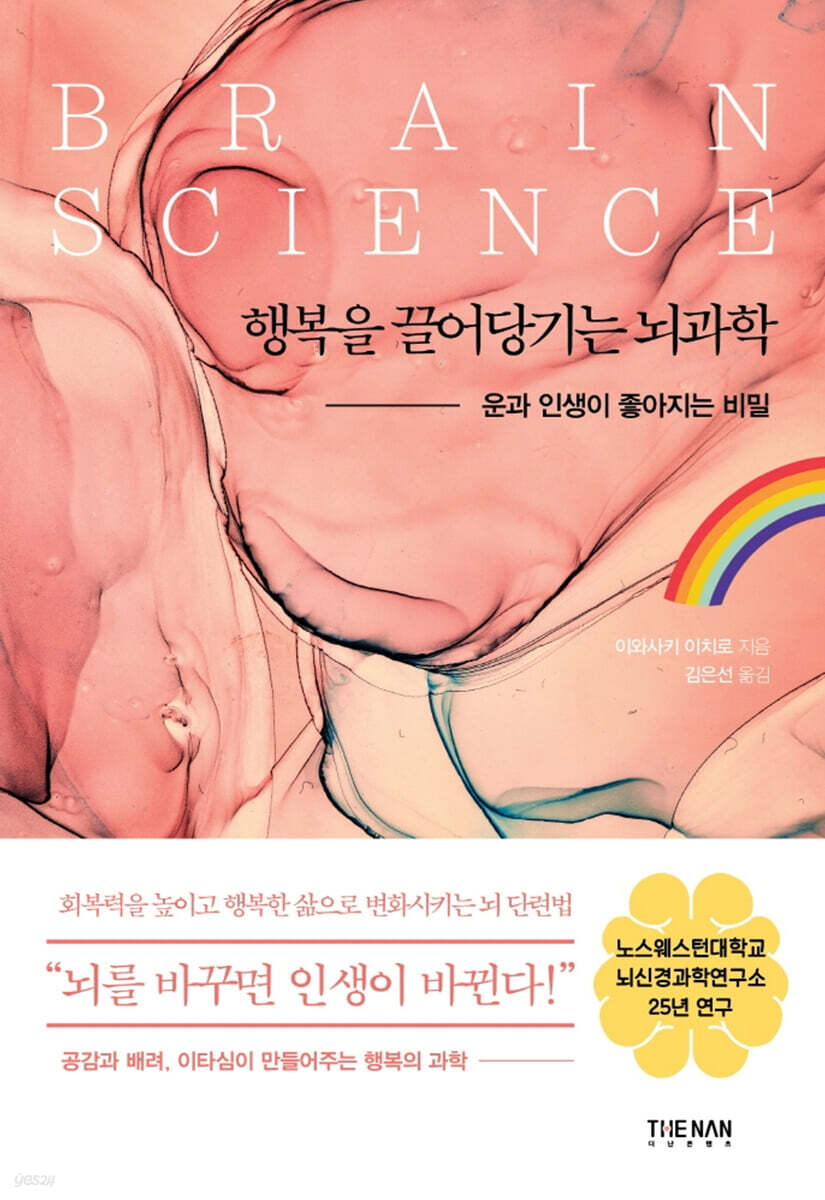
Brain Science That Attracts Happiness
 |
Description
Book Introduction
25 Years of Brain Science Research on How to Be Happy
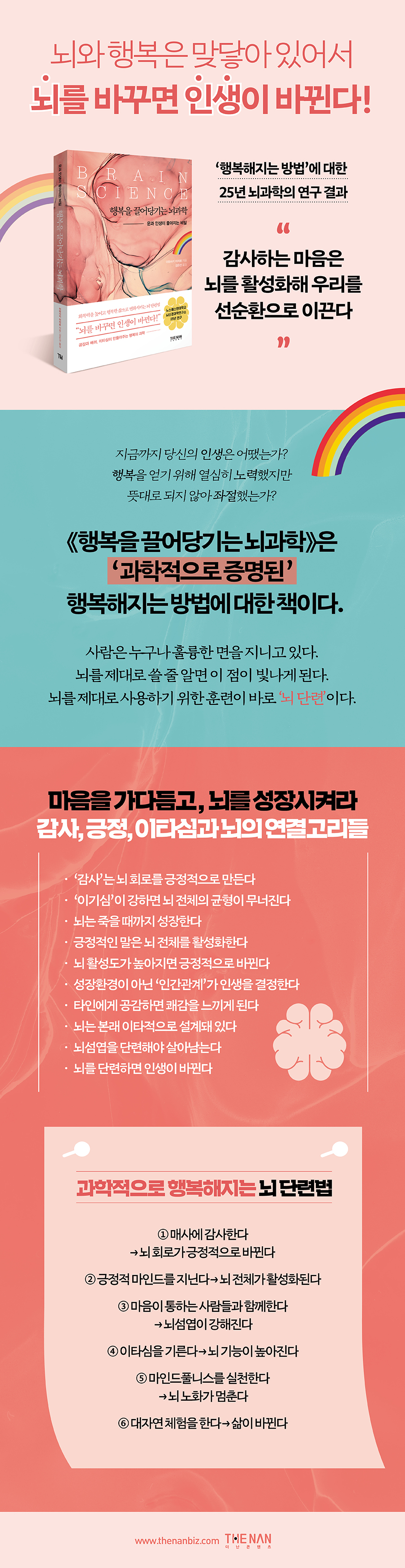
"The brain and happiness are interconnected, so change your brain and your life will change."
A book titled “The Brain Science that Attracts Happiness” has been published, explaining how to increase resilience and transform into a happy life.
The author, Ichiro Iwasaki, is a scientist who has been researching brain science for 25 years, including at the Northwestern University Brain and Neuroscience Research Institute.
The author, who himself had lived an unhappy life, studied 'how to become happy scientifically' and found the answer in the 'insular lobe'.
The insula is a region located deep within the brain. By consistently training this area and using the entire brain in a balanced and organic way, you can live a happy and prosperous life.
The brain and happiness are closely linked.
Each part of the brain has its own unique role, and the insula is responsible for social emotions, moral intuition, reactions to others, pain, and humor.
If there is a problem here, the person becomes helpless and broken.
The reason the insula is so important is because it acts as a kind of hub within the brain.
It connects external stimuli with internal sensations, and even connects the emotions of others with one's own.
In other words, we can understand and empathize with others through the insular cortex.
Empathy leads to psychological bonds and naturally leads to a happy life with like-minded people.
In this process, it is natural to feel altruism and gratitude for being alive, which come from the desire to 'make someone happy'.
Here are six ways to train your brain to live a happy life.
Be grateful for everything, have a positive mindset, surround yourself with like-minded people, cultivate altruism, practice mindfulness, and experience nature.
Now is the time to abandon the old, stereotypical way of thinking that says things like, "If I have a lot of money, I'll be happy," or "If I'm successful, I'll be happy," and learn brain training methods that will improve your luck and life.
"The brain and happiness are interconnected, so change your brain and your life will change."
A book titled “The Brain Science that Attracts Happiness” has been published, explaining how to increase resilience and transform into a happy life.
The author, Ichiro Iwasaki, is a scientist who has been researching brain science for 25 years, including at the Northwestern University Brain and Neuroscience Research Institute.
The author, who himself had lived an unhappy life, studied 'how to become happy scientifically' and found the answer in the 'insular lobe'.
The insula is a region located deep within the brain. By consistently training this area and using the entire brain in a balanced and organic way, you can live a happy and prosperous life.
The brain and happiness are closely linked.
Each part of the brain has its own unique role, and the insula is responsible for social emotions, moral intuition, reactions to others, pain, and humor.
If there is a problem here, the person becomes helpless and broken.
The reason the insula is so important is because it acts as a kind of hub within the brain.
It connects external stimuli with internal sensations, and even connects the emotions of others with one's own.
In other words, we can understand and empathize with others through the insular cortex.
Empathy leads to psychological bonds and naturally leads to a happy life with like-minded people.
In this process, it is natural to feel altruism and gratitude for being alive, which come from the desire to 'make someone happy'.
Here are six ways to train your brain to live a happy life.
Be grateful for everything, have a positive mindset, surround yourself with like-minded people, cultivate altruism, practice mindfulness, and experience nature.
Now is the time to abandon the old, stereotypical way of thinking that says things like, "If I have a lot of money, I'll be happy," or "If I'm successful, I'll be happy," and learn brain training methods that will improve your luck and life.
- You can preview some of the book's contents.
Preview
index
Prologue: Brain Training Methods Derived from the Latest Neuroscience
Chapter 1 | How to Use Your Brain Scientifically to Be Happy, and How to Use Your Brain Without Being Happy
If you think, "I want to be happy," happiness will be far away.
Why is it difficult for depressed people to become happy?
Money and happiness are proportional only up to an annual salary of 80 million won.
How to Set Goals That Increase Happiness, How to Set Goals That Decrease Happiness
Is a good education essential to living happily?
Psychological Test Reveals Ways to Improve Salary and Health
The Secret of the Tibetan Monk with the World's Happiest Brain
If selfishness is strong, the entire brain's balance is disrupted.
The 'insular cortex' is attracting attention.
The brain continues to grow until death.
Brain training methods that eliminate selfishness and utilize the entire brain.
Chapter 2 | Gratitude Shapes Positive Brain Circuits
Being grateful for everything gives you courage.
Always being grateful boosts your immunity.
Gratitude motivates growth.
Increased brain activity leads to positive changes
Gratitude fosters greater growth than self-criticism.
Develop your gratitude brain circuits
You can be grateful anytime you want
"Courage Brewing": Training the Gratitude Brain Circuit
Chapter 3 | A Positive Mindset Transforms Your Life, According to Neuroscience
Do you notice the negative aspects of people or things first?
Let's change Murphy's Law to Sally's Law
A positive mindset leads to good results.
Positive emotions enhance learning outcomes, income, and job performance.
Positive words activate the entire brain.
Positive emotions include calm and serenity.
What is the state of 'enjoying'?
Regardless of appearance, a smiling face can make life go well.
Saying hello first trains your Broca's area.
Focusing on small successes changes your brain in a positive way.
Motivation comes from a sense of accomplishment.
Overcoming challenges by focusing on growth rather than performance
Negative emotions play an important role
The 'mask of positivity' is the most dangerous.
Chapter 4 | "Good Relationships": Training the Insular Cortex
It's your relationships, not your upbringing, that determine your life.
Loneliness is poison to the human brain.
All I need is just one person to share my heart with.
Adults Need a 'Safe Base' Too
You have to train your insular cortex to survive.
Being affectionate to others releases happiness hormones.
Collective intelligence surpasses the intelligence of geniuses.
"Community thinking" unites hearts, while "separate thinking" fosters selfishness.
Repeat the growth cycle
Focus on growth in the present tense.
When you think about community, your brainwaves respond differently to failure.
Why is it better to ‘rejoice together’ than to ‘praise’?
Having people around you improves your concentration.
Brains exchange energy with each other.
Chapter 5 | Altruism, the act of caring for others, boosts brain function.
The difference between altruism and selfishness
Who earns more, an 'altruistic person' or a 'selfish person'?
Altruistic behavior based on empathy activates brain function.
Empathizing with others gives you a sense of pleasure.
Use both 'empathy' and 'altruism' simultaneously.
Altruistic behavior leads to longer-lasting happiness.
The brain is inherently designed to be altruistic.
Training the brain circuitry of altruism makes it possible to predict the future.
Accurate predictions that seem to see the future are also possible.
Human relationships and altruism, connected by the heart, changed my life ①
Human relationships and altruism, connected by the heart, changed my life ②
Chapter 6 | Mindfulness: Grow Your Brain by Refining Your Body and Mind
Mindfulness is a state where 'concentration' and 'relaxation' coexist.
Mind Exercise: Awareness of the State of the Body, Mind, and Brain
Approach mindfulness with a few minutes of "brain training" meditation each day.
Making mindfulness a habit can stop brain aging.
Mindfulness to improve sleep quality
Mindfulness can significantly improve your test scores.
The Relationship Between Immunity and Mindfulness
Diet failure is due to stress.
Pain such as back pain and headaches are relieved.
Flow State Makes Getting Things Done So Easy
Mindfulness reduces anxiety
You will become less angry and accept yourself as you are.
Chapter 7 | The Brain Changes Through "Nature Experiences": Becoming Awed by Nature
The brain is activated when we discover our "insignificant self" in the presence of nature.
We will act for the future 100 years from now.
Lower interleukin-6 levels lead to longer lifespan
Am I someone who finds it easy or difficult to experience the great outdoors?
Even "experiencing the great outdoors" has a dark side.
Experience nature in everyday life
Chapter 8 | Train Your Brain and Change Your Life
The brain cells of people who live with great ambition are not easily destroyed.
How to Discover Your Life Purpose
Altruism helps you discover your purpose in life.
You can discover your purpose in life by reflecting on your work.
You can't know what 'self-worth' is on your own.
Brain training can help you predict the future.
The brain grows more when the 'results of actions' are visible.
How Organizations Use Their Brains to Achieve Their Goals
Epilogue | Everyone Can Live a Happy and Prosperous Life
References
Chapter 1 | How to Use Your Brain Scientifically to Be Happy, and How to Use Your Brain Without Being Happy
If you think, "I want to be happy," happiness will be far away.
Why is it difficult for depressed people to become happy?
Money and happiness are proportional only up to an annual salary of 80 million won.
How to Set Goals That Increase Happiness, How to Set Goals That Decrease Happiness
Is a good education essential to living happily?
Psychological Test Reveals Ways to Improve Salary and Health
The Secret of the Tibetan Monk with the World's Happiest Brain
If selfishness is strong, the entire brain's balance is disrupted.
The 'insular cortex' is attracting attention.
The brain continues to grow until death.
Brain training methods that eliminate selfishness and utilize the entire brain.
Chapter 2 | Gratitude Shapes Positive Brain Circuits
Being grateful for everything gives you courage.
Always being grateful boosts your immunity.
Gratitude motivates growth.
Increased brain activity leads to positive changes
Gratitude fosters greater growth than self-criticism.
Develop your gratitude brain circuits
You can be grateful anytime you want
"Courage Brewing": Training the Gratitude Brain Circuit
Chapter 3 | A Positive Mindset Transforms Your Life, According to Neuroscience
Do you notice the negative aspects of people or things first?
Let's change Murphy's Law to Sally's Law
A positive mindset leads to good results.
Positive emotions enhance learning outcomes, income, and job performance.
Positive words activate the entire brain.
Positive emotions include calm and serenity.
What is the state of 'enjoying'?
Regardless of appearance, a smiling face can make life go well.
Saying hello first trains your Broca's area.
Focusing on small successes changes your brain in a positive way.
Motivation comes from a sense of accomplishment.
Overcoming challenges by focusing on growth rather than performance
Negative emotions play an important role
The 'mask of positivity' is the most dangerous.
Chapter 4 | "Good Relationships": Training the Insular Cortex
It's your relationships, not your upbringing, that determine your life.
Loneliness is poison to the human brain.
All I need is just one person to share my heart with.
Adults Need a 'Safe Base' Too
You have to train your insular cortex to survive.
Being affectionate to others releases happiness hormones.
Collective intelligence surpasses the intelligence of geniuses.
"Community thinking" unites hearts, while "separate thinking" fosters selfishness.
Repeat the growth cycle
Focus on growth in the present tense.
When you think about community, your brainwaves respond differently to failure.
Why is it better to ‘rejoice together’ than to ‘praise’?
Having people around you improves your concentration.
Brains exchange energy with each other.
Chapter 5 | Altruism, the act of caring for others, boosts brain function.
The difference between altruism and selfishness
Who earns more, an 'altruistic person' or a 'selfish person'?
Altruistic behavior based on empathy activates brain function.
Empathizing with others gives you a sense of pleasure.
Use both 'empathy' and 'altruism' simultaneously.
Altruistic behavior leads to longer-lasting happiness.
The brain is inherently designed to be altruistic.
Training the brain circuitry of altruism makes it possible to predict the future.
Accurate predictions that seem to see the future are also possible.
Human relationships and altruism, connected by the heart, changed my life ①
Human relationships and altruism, connected by the heart, changed my life ②
Chapter 6 | Mindfulness: Grow Your Brain by Refining Your Body and Mind
Mindfulness is a state where 'concentration' and 'relaxation' coexist.
Mind Exercise: Awareness of the State of the Body, Mind, and Brain
Approach mindfulness with a few minutes of "brain training" meditation each day.
Making mindfulness a habit can stop brain aging.
Mindfulness to improve sleep quality
Mindfulness can significantly improve your test scores.
The Relationship Between Immunity and Mindfulness
Diet failure is due to stress.
Pain such as back pain and headaches are relieved.
Flow State Makes Getting Things Done So Easy
Mindfulness reduces anxiety
You will become less angry and accept yourself as you are.
Chapter 7 | The Brain Changes Through "Nature Experiences": Becoming Awed by Nature
The brain is activated when we discover our "insignificant self" in the presence of nature.
We will act for the future 100 years from now.
Lower interleukin-6 levels lead to longer lifespan
Am I someone who finds it easy or difficult to experience the great outdoors?
Even "experiencing the great outdoors" has a dark side.
Experience nature in everyday life
Chapter 8 | Train Your Brain and Change Your Life
The brain cells of people who live with great ambition are not easily destroyed.
How to Discover Your Life Purpose
Altruism helps you discover your purpose in life.
You can discover your purpose in life by reflecting on your work.
You can't know what 'self-worth' is on your own.
Brain training can help you predict the future.
The brain grows more when the 'results of actions' are visible.
How Organizations Use Their Brains to Achieve Their Goals
Epilogue | Everyone Can Live a Happy and Prosperous Life
References
Detailed image
Into the book
The method of "brain training" is already based on scientific evidence, but in writing this book, I once again reviewed over 250 papers, including the most recent ones.
Before discussing how our actions affect our bodies and minds, I searched for and read the papers that serve as the basis for these discussions, and selected the most outstanding studies to introduce in this book.
---p.
11
The left side of the prefrontal cortex, located on the inside of the forehead, corresponds to the 'accelerator', and the right side corresponds to the 'brake'.
The operating principle is similar to that of a car. When you concentrate on something or think forward, the part corresponding to the accelerator is activated, and conversely, when this activity stops, the part corresponding to the brake is activated.
Also, when the accelerator is activated, you think positively and feel happy, and when the brake is applied strongly, your mood becomes depressed and you look at everything negatively, and in severe cases, you may even fall into depression.
Just as a car with only an accelerator and no brakes can lead to a major accident, the brain's accelerator and brakes each play important roles.
---p.
43
Dr. Hall's team at the University of Washington in the United States announced the results of a study that found that having a positive mindset broadens your perspective and prevents you from missing out on good news.
The subjects of the experiment were 80 people suffering from chronic stress, and the research team divided them into two groups. Just like Dr. Kress's study, only one group underwent a process to increase 'self-esteem'.
Then, without revealing the purpose of the experiment, they conducted the following test to see how much the two groups' vision expanded.
---p.
91
We found that people who 'think community' have a stronger brain wave called Event-Related Negativity (ERN) when they fail.
These brain waves are known to become stronger when you have a strong desire to learn something.
In other words, it has been discovered through brain science that people who think in a 'community' do not accept 'failure' as 'failure', but rather use it as a 'stepping stone for growth', just like Edison did when he invented the light bulb.
---p.
165
Observations of brain activity revealed that people who engage in altruistic behavior based on 'empathy' and those who do not have different connectivity states in each part of the brain.
People who acted altruistically based on 'empathy' showed bright light in the insula, anterior cingulate cortex, and striatum at the same time.
This means that these parts work organically with each other.
Meanwhile, people who acted altruistically as a way to repay a debt had weaker connections, so even if one area lit up, other areas did not activate.
---p.
187
The state in which oneself and the other coexist is the state of 'altruism', or 'selfless'.
When we reach the ultimate state of altruism, the ego disappears and we become included in the other.
The 'other' in 'itta' does not mean 'other' that distinguishes oneself from others, but rather means all members of the community, including oneself, and further, all living and breathing beings.
---p.
197
“The words ‘concentration’ and ‘enlightenment’ do not have any particularly religious meaning.
These are all related to the unique abilities of humans, and they are things that can be consciously trained and developed.
This is what you can achieve through mindfulness.”
Before discussing how our actions affect our bodies and minds, I searched for and read the papers that serve as the basis for these discussions, and selected the most outstanding studies to introduce in this book.
---p.
11
The left side of the prefrontal cortex, located on the inside of the forehead, corresponds to the 'accelerator', and the right side corresponds to the 'brake'.
The operating principle is similar to that of a car. When you concentrate on something or think forward, the part corresponding to the accelerator is activated, and conversely, when this activity stops, the part corresponding to the brake is activated.
Also, when the accelerator is activated, you think positively and feel happy, and when the brake is applied strongly, your mood becomes depressed and you look at everything negatively, and in severe cases, you may even fall into depression.
Just as a car with only an accelerator and no brakes can lead to a major accident, the brain's accelerator and brakes each play important roles.
---p.
43
Dr. Hall's team at the University of Washington in the United States announced the results of a study that found that having a positive mindset broadens your perspective and prevents you from missing out on good news.
The subjects of the experiment were 80 people suffering from chronic stress, and the research team divided them into two groups. Just like Dr. Kress's study, only one group underwent a process to increase 'self-esteem'.
Then, without revealing the purpose of the experiment, they conducted the following test to see how much the two groups' vision expanded.
---p.
91
We found that people who 'think community' have a stronger brain wave called Event-Related Negativity (ERN) when they fail.
These brain waves are known to become stronger when you have a strong desire to learn something.
In other words, it has been discovered through brain science that people who think in a 'community' do not accept 'failure' as 'failure', but rather use it as a 'stepping stone for growth', just like Edison did when he invented the light bulb.
---p.
165
Observations of brain activity revealed that people who engage in altruistic behavior based on 'empathy' and those who do not have different connectivity states in each part of the brain.
People who acted altruistically based on 'empathy' showed bright light in the insula, anterior cingulate cortex, and striatum at the same time.
This means that these parts work organically with each other.
Meanwhile, people who acted altruistically as a way to repay a debt had weaker connections, so even if one area lit up, other areas did not activate.
---p.
187
The state in which oneself and the other coexist is the state of 'altruism', or 'selfless'.
When we reach the ultimate state of altruism, the ego disappears and we become included in the other.
The 'other' in 'itta' does not mean 'other' that distinguishes oneself from others, but rather means all members of the community, including oneself, and further, all living and breathing beings.
---p.
197
“The words ‘concentration’ and ‘enlightenment’ do not have any particularly religious meaning.
These are all related to the unique abilities of humans, and they are things that can be consciously trained and developed.
This is what you can achieve through mindfulness.”
---p.
219
219
Publisher's Review
Clear your mind and grow your brain
The brain continues to grow until death, transforming our minds and lives.
The key to happiness hidden in the insula, a secret part of the brain
Mathieu Ricard, a Tibetan Buddhist monk known as 'the happiest man in the world'.
When scientists measured and studied his brain waves, they found that he had characteristics that were different from those of ordinary people.
The brain also has areas that correspond to the 'accelerator' and 'brake' of a car.
Just like how a car works, when we focus on something, the accelerator area of our brain is activated, and when we stop, the brake area is activated.
Also, when the axel area is activated, people think positively and feel happy.
The EEG study examined the brain's axon activity, and the monk Mathieu Ricard had the highest axon activity among 1,000 subjects.
His brain activity was usually about 100 times higher than that of an average person, but there were times when it was even higher.
It was at that time that I was meditating, full of altruism, praying for world peace and the happiness of humanity.
At this time, his brain activity was more than five times higher than usual, and 500 times higher than that of an average person.
Stimulating the insular cortex can help you use your brain in a balanced way.
What is noteworthy in the study of monk Mathieu Ricard is that the moments when his brain's accelerator activity was high, that is, when he was happiest, were 'when he was meditating with a sense of altruism, wishing for world peace and human happiness.'
At this time, his brain was in a selfless state.
Selflessness, which can be directly translated as 'selfless', refers to a state in which the entire brain is used evenly and in a balanced manner.
To use our brains evenly, we need to go back to the insula.
Because if you train your insular cortex, you can use your entire brain.
Therefore, in order to become happy, we need to intentionally and consistently train our insular cortex.
There are moments in our daily lives when the insular cortex, the secret part of the brain that brings happiness, is trained and stimulated.
When we encounter text, music, or pictures, emotions or feelings arise, when multiple senses are integrated, when social interactions occur, when we empathize with others, and when we begin to focus on something.
In this way, the brain constantly changes and grows as a person lives, changing the mind and even life.
6 Brain Training Techniques That Scientifically Boost Happiness
The author, a neuroscientist, discovered six brain training methods to become happier through 25 years of research.
First, if you have a grateful heart in everything, your brain circuits will change positively.
Second, if you have a positive mindset, your entire brain becomes activated and you become closer to happiness.
Third, spending time with like-minded people strengthens the insular cortex.
Fourth, cultivating altruism improves brain function.
Fifth, practicing mindfulness stops brain aging.
Sixth, experiencing nature changes our lives.
The author has maintained his happiness by training his brain for a certain amount of time every day.
Because I personally realized that this is the way to increase mental resilience and change into a happy life.
The Science of Happiness: Empathy, Consideration, and Altruism
On the other hand, the brain's balance may be disrupted and you may become unhappy.
The author warns that this can happen especially when selfishness is strong, because when selfishness is strong, the brain's circuits are disconnected, the overall brain balance is disrupted, and brain function is dulled as a result.
It has been proven through neuroscience that selfishness has a negative impact not only on others but also on oneself.
Unlike selfishness, altruism, which is about helping others, enhances our brain function.
Altruistic behavior based on empathy for others activates brain function, and the moment you empathize with others, dopamine is secreted in the brain, making you feel pleasure.
The author recommends using both empathy and altruism, saying, above all, that "the brain is inherently designed to be altruistic."
When we conducted an experiment that controlled the part of the brain that controls emotions, it was shown that altruistic behavior increased.
Increasing altruism and empathizing with others are all ways to make yourself happy.
The saying that 'living well will lead to losses', which was once taken for granted, can now be comfortably forgotten.
The brain continues to grow until death, transforming our minds and lives.
The key to happiness hidden in the insula, a secret part of the brain
Mathieu Ricard, a Tibetan Buddhist monk known as 'the happiest man in the world'.
When scientists measured and studied his brain waves, they found that he had characteristics that were different from those of ordinary people.
The brain also has areas that correspond to the 'accelerator' and 'brake' of a car.
Just like how a car works, when we focus on something, the accelerator area of our brain is activated, and when we stop, the brake area is activated.
Also, when the axel area is activated, people think positively and feel happy.
The EEG study examined the brain's axon activity, and the monk Mathieu Ricard had the highest axon activity among 1,000 subjects.
His brain activity was usually about 100 times higher than that of an average person, but there were times when it was even higher.
It was at that time that I was meditating, full of altruism, praying for world peace and the happiness of humanity.
At this time, his brain activity was more than five times higher than usual, and 500 times higher than that of an average person.
Stimulating the insular cortex can help you use your brain in a balanced way.
What is noteworthy in the study of monk Mathieu Ricard is that the moments when his brain's accelerator activity was high, that is, when he was happiest, were 'when he was meditating with a sense of altruism, wishing for world peace and human happiness.'
At this time, his brain was in a selfless state.
Selflessness, which can be directly translated as 'selfless', refers to a state in which the entire brain is used evenly and in a balanced manner.
To use our brains evenly, we need to go back to the insula.
Because if you train your insular cortex, you can use your entire brain.
Therefore, in order to become happy, we need to intentionally and consistently train our insular cortex.
There are moments in our daily lives when the insular cortex, the secret part of the brain that brings happiness, is trained and stimulated.
When we encounter text, music, or pictures, emotions or feelings arise, when multiple senses are integrated, when social interactions occur, when we empathize with others, and when we begin to focus on something.
In this way, the brain constantly changes and grows as a person lives, changing the mind and even life.
6 Brain Training Techniques That Scientifically Boost Happiness
The author, a neuroscientist, discovered six brain training methods to become happier through 25 years of research.
First, if you have a grateful heart in everything, your brain circuits will change positively.
Second, if you have a positive mindset, your entire brain becomes activated and you become closer to happiness.
Third, spending time with like-minded people strengthens the insular cortex.
Fourth, cultivating altruism improves brain function.
Fifth, practicing mindfulness stops brain aging.
Sixth, experiencing nature changes our lives.
The author has maintained his happiness by training his brain for a certain amount of time every day.
Because I personally realized that this is the way to increase mental resilience and change into a happy life.
The Science of Happiness: Empathy, Consideration, and Altruism
On the other hand, the brain's balance may be disrupted and you may become unhappy.
The author warns that this can happen especially when selfishness is strong, because when selfishness is strong, the brain's circuits are disconnected, the overall brain balance is disrupted, and brain function is dulled as a result.
It has been proven through neuroscience that selfishness has a negative impact not only on others but also on oneself.
Unlike selfishness, altruism, which is about helping others, enhances our brain function.
Altruistic behavior based on empathy for others activates brain function, and the moment you empathize with others, dopamine is secreted in the brain, making you feel pleasure.
The author recommends using both empathy and altruism, saying, above all, that "the brain is inherently designed to be altruistic."
When we conducted an experiment that controlled the part of the brain that controls emotions, it was shown that altruistic behavior increased.
Increasing altruism and empathizing with others are all ways to make yourself happy.
The saying that 'living well will lead to losses', which was once taken for granted, can now be comfortably forgotten.
GOODS SPECIFICS
- Date of issue: February 4, 2022
- Page count, weight, size: 320 pages | 538g | 140*205*30mm
- ISBN13: 9788984058453
- ISBN10: 8984058459
You may also like
카테고리
korean


korean

![ELLE 엘르 스페셜 에디션 A형 : 12월 [2025]](http://librairie.coreenne.fr/cdn/shop/files/b8e27a3de6c9538896439686c6b0e8fb.jpg?v=1766436872&width=3840)


