

Extreme Physics
 |
Description
Book Introduction
Can anyone easily understand quantum mechanics?
Anything is possible with scientific curiosity and perseverance!
A fascinating physics thought experiment set in six extreme worlds.
A book has been published that comprehensively covers all areas of physics, which were once considered complex and difficult, and provides clear explanations.
This is the new Green Book, "Extreme Physics," which shows the end of physics with 650 pages.
The title has two meanings.
If the first intention is to show the ultimate of physics, the second means that the limits of physical quantities have been explored.
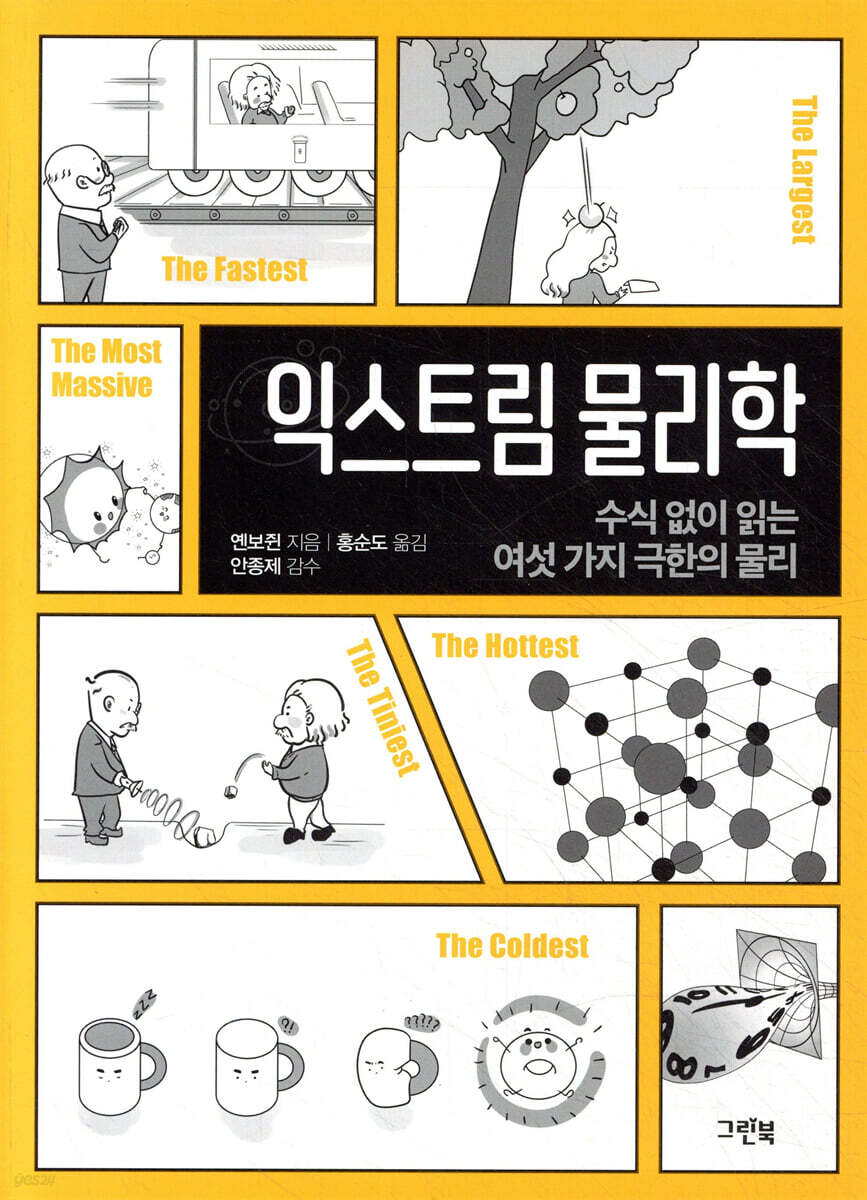
It deals with almost all physical phenomena occurring in the real and virtual world by sending basic physical quantities based on human senses to the extremes, such as extreme speed, extreme size, extreme weight, and extreme temperature.
As you follow the author's fascinating thought experiments and insightful explanations of fundamental principles, you'll soon master the seemingly intricate physics theories of special relativity, general relativity, quantum mechanics, particle physics, thermodynamics, and more.
This book is designed to help you understand the basic concepts of physics without the need for complex formulas or equations.
The author argues that physics is difficult because of the mathematical calculations involved, but that the basic principles are actually simple.
The more grand theories that underpin physics, the simpler their principles become. Anyone with basic scientific knowledge, curiosity, and the perseverance to explore the six extreme realms under the author's guidance can reach the ultimate in physics.
The author is a renowned physicist and influencer in mainland China, boasting 10 million followers and 300 million views per post.
He is also well-versed in the arts, and lectures on science and art through various online media. He is well-known as a lecturer who conveys difficult knowledge to the public in an easy and fun way.
He has garnered much attention through [Hardcore Science Show] on Himalaya FM, an audio content platform, and [Western Art Lectures] on the educational content platform Dao, and is also one of the '10 Best Online Instructors' selected by the current affairs weekly Xinzhoukan.
This book was reviewed by experts to compare and verify the official physics terminology used in our country with the terminology found in high school physics textbooks.
Anyone, from teenagers to college students, majors and non-majors, and even general readers, can read it with immersion without feeling the foreignness of a translated book.
For readers who want to solidify their understanding of the fundamental concepts of physics from beginning to end, or for those who have read science books but are looking for a physics theory book that offers a fresh perspective, Extreme Physics will be a good choice.
Anything is possible with scientific curiosity and perseverance!
A fascinating physics thought experiment set in six extreme worlds.
A book has been published that comprehensively covers all areas of physics, which were once considered complex and difficult, and provides clear explanations.
This is the new Green Book, "Extreme Physics," which shows the end of physics with 650 pages.
The title has two meanings.
If the first intention is to show the ultimate of physics, the second means that the limits of physical quantities have been explored.
It deals with almost all physical phenomena occurring in the real and virtual world by sending basic physical quantities based on human senses to the extremes, such as extreme speed, extreme size, extreme weight, and extreme temperature.
As you follow the author's fascinating thought experiments and insightful explanations of fundamental principles, you'll soon master the seemingly intricate physics theories of special relativity, general relativity, quantum mechanics, particle physics, thermodynamics, and more.
This book is designed to help you understand the basic concepts of physics without the need for complex formulas or equations.
The author argues that physics is difficult because of the mathematical calculations involved, but that the basic principles are actually simple.
The more grand theories that underpin physics, the simpler their principles become. Anyone with basic scientific knowledge, curiosity, and the perseverance to explore the six extreme realms under the author's guidance can reach the ultimate in physics.
The author is a renowned physicist and influencer in mainland China, boasting 10 million followers and 300 million views per post.
He is also well-versed in the arts, and lectures on science and art through various online media. He is well-known as a lecturer who conveys difficult knowledge to the public in an easy and fun way.
He has garnered much attention through [Hardcore Science Show] on Himalaya FM, an audio content platform, and [Western Art Lectures] on the educational content platform Dao, and is also one of the '10 Best Online Instructors' selected by the current affairs weekly Xinzhoukan.
This book was reviewed by experts to compare and verify the official physics terminology used in our country with the terminology found in high school physics textbooks.
Anyone, from teenagers to college students, majors and non-majors, and even general readers, can read it with immersion without feeling the foreignness of a translated book.
For readers who want to solidify their understanding of the fundamental concepts of physics from beginning to end, or for those who have read science books but are looking for a physics theory book that offers a fresh perspective, Extreme Physics will be a good choice.
- You can preview some of the book's contents.
Preview
Detailed image

Publisher's Review
From special relativity to condensed matter physics,
Digging into the core of all areas of physics
Part 1: The Fastest: What Would You See If You Traveled at the Speed of Light?
We introduce the principle of relativity and the principle of constancy of the speed of light, which are the basic foundations of special relativity.
Based on these two principles, all the effects of special relativity can be logically derived.
However, special relativity is a logical deduction for ideal situations and does not apply to most realities.
We will learn about the famous ladder paradox, the rigid body paradox about the properties of materials, the Ehrenfest paradox showing the warping of spacetime, and the twin paradox.
Part 1 also provides a detailed introduction to aerodynamics based on real-world phenomena, exploring the technological hurdles that must be overcome to reach the speed of light.
Part 2: The Largest: The Origin of the Universe
In Part 2, we push the size of space and the length of time to their limits.
The largest size we can think of is, of course, the universe.
First, we will learn about the birth and development of the universe, and its future, based on the Big Bang theory.
And find out what's out there in space.
It organizes various celestial bodies such as stars, planets, satellites, comets, neutron stars, white dwarfs, red dwarfs, black dwarfs, red giants, and supernovae, and explains the mass class that determines the direction of evolution of celestial bodies.
Part 2 also explains the interactions of celestial bodies based on universal gravitation, and introduces the process by which Newton established the law of universal gravitation with the help of two scientists, Kepler and Galileo.
Part 3: The Most Massive: General Relativity
We will learn about Einstein's general theory of relativity to explain the larger dimensions of space and time that cannot be explained by the law of universal gravitation.
We will learn about the genius discovery of general relativity, which holds a 'lofty' position in the entire field of physics, and the birth of modern cosmology.
Based on the general theory of relativity, we can see that gravity is not a 'force' but an effect of accelerated motion caused by the warping of space.
We also explore gravitational waves, GPS, and black holes.
Part 4: The Tiniest: The Bizarre Microscopic World
Part 4 deals with the laws of physics at extremely small scales, that is, the microscopic world.
Even in modern physics, there is no conclusion regarding the smallest building block of matter.
First, we explore the world of atomic physics.
We will learn about how classical theory collapsed in the face of atomic structure and quantum mechanics was born.
Quantum mechanics can be used to interpret the motion of electrons inside an atom, and the Schrödinger equation and the Copenhagen interpretation can be used to understand the motion of electrons.
We also look at the nucleus, which is one-thousandth of a trillionth of an atom in size.
We also learn about the interactions between protons and neutrons that make up the nucleus and nuclear reactions.
Next, we take a look at the even more microscopic world of particle physics.
We introduce quarks, the smallest units that make up protons and neutrons, and learn about the Yang-Mills field theory and the Standard Model theory that explain elementary particles.
Part 5: The Hottest: The Real World of Order in Chaos
Part 5 looks into the world of multiparticle systems and ensembles, that is, the real world rather than the theoretical physical states of individual objects.
To do that, let's first find out what temperature is.
We define the concept of temperature as the average kinetic energy value of a large number of particles, and examine the relationship between various properties of matter and temperature.
The relationship between the physical properties of a system and temperature has developed into a discipline called thermodynamics.
We will examine the theory and laws of thermodynamics and also look at the definition of entropy established through the development of statistical mechanics.
Next, we will learn about the changes in the state of matter as temperature increases, and how to create a high-temperature environment that can cause nuclear reactions.
Part 5 also explains complexity science, discussing the three-body problem, the butterfly effect, and chaotic systems.
Part 6 The Coldest: Order in Low Temperatures
In Part 6, which corresponds to Part 5, we will learn about the phenomena that occur when the temperature is lowered from room temperature to absolute zero.
First, we explore the physical properties of solids based on the fact that substances universally exist in a solid state at relatively low temperatures.
By examining the mechanical, thermal, electrical, and magnetic properties of solids, you can understand the core of materials physics.
And we will summarize the various properties of solids based on quantum mechanics, that is, the contents of solid-state physics.
Finally, we introduce the field of condensed matter physics by learning about quantum mechanical phenomena that occur when the temperature approaches absolute zero: superfluidity, superconductivity, and the quantum Hall effect.
What if you don't have the basic physics skills you need, but don't want to open a textbook?
Extreme Physics is the answer!
It is said that freshmen in science and engineering colleges have difficulty taking classes due to their low basic science skills, and many of them even give up their majors.
Some universities even provide supplementary high school level physics and chemistry classes to freshmen.
It is said that the increase in elective subjects for the convenience of entrance exams resulted in students being reluctant to study difficult subjects.
A decline in basic science skills will inevitably lead to a decline in the overall capabilities of human resources in science and technology.
For science and engineering students reluctant to return to their high school textbooks or to studying for college entrance exams, Extreme Physics can be an alternative.
This is because the book covers all areas of physics while remaining faithful to the fundamental concepts, and the author's unique perspective in guiding the reader through the long journey makes difficult concepts accessible and engaging.
After experiencing all six extreme worlds of physics, 73 scientists, 47 physics principles and theorems, 25 physics experiments and thought experiments, 44 physics theories, and 541 physics and mathematics concepts will all be yours.
Digging into the core of all areas of physics
Part 1: The Fastest: What Would You See If You Traveled at the Speed of Light?
We introduce the principle of relativity and the principle of constancy of the speed of light, which are the basic foundations of special relativity.
Based on these two principles, all the effects of special relativity can be logically derived.
However, special relativity is a logical deduction for ideal situations and does not apply to most realities.
We will learn about the famous ladder paradox, the rigid body paradox about the properties of materials, the Ehrenfest paradox showing the warping of spacetime, and the twin paradox.
Part 1 also provides a detailed introduction to aerodynamics based on real-world phenomena, exploring the technological hurdles that must be overcome to reach the speed of light.
Part 2: The Largest: The Origin of the Universe
In Part 2, we push the size of space and the length of time to their limits.
The largest size we can think of is, of course, the universe.
First, we will learn about the birth and development of the universe, and its future, based on the Big Bang theory.
And find out what's out there in space.
It organizes various celestial bodies such as stars, planets, satellites, comets, neutron stars, white dwarfs, red dwarfs, black dwarfs, red giants, and supernovae, and explains the mass class that determines the direction of evolution of celestial bodies.
Part 2 also explains the interactions of celestial bodies based on universal gravitation, and introduces the process by which Newton established the law of universal gravitation with the help of two scientists, Kepler and Galileo.
Part 3: The Most Massive: General Relativity
We will learn about Einstein's general theory of relativity to explain the larger dimensions of space and time that cannot be explained by the law of universal gravitation.
We will learn about the genius discovery of general relativity, which holds a 'lofty' position in the entire field of physics, and the birth of modern cosmology.
Based on the general theory of relativity, we can see that gravity is not a 'force' but an effect of accelerated motion caused by the warping of space.
We also explore gravitational waves, GPS, and black holes.
Part 4: The Tiniest: The Bizarre Microscopic World
Part 4 deals with the laws of physics at extremely small scales, that is, the microscopic world.
Even in modern physics, there is no conclusion regarding the smallest building block of matter.
First, we explore the world of atomic physics.
We will learn about how classical theory collapsed in the face of atomic structure and quantum mechanics was born.
Quantum mechanics can be used to interpret the motion of electrons inside an atom, and the Schrödinger equation and the Copenhagen interpretation can be used to understand the motion of electrons.
We also look at the nucleus, which is one-thousandth of a trillionth of an atom in size.
We also learn about the interactions between protons and neutrons that make up the nucleus and nuclear reactions.
Next, we take a look at the even more microscopic world of particle physics.
We introduce quarks, the smallest units that make up protons and neutrons, and learn about the Yang-Mills field theory and the Standard Model theory that explain elementary particles.
Part 5: The Hottest: The Real World of Order in Chaos
Part 5 looks into the world of multiparticle systems and ensembles, that is, the real world rather than the theoretical physical states of individual objects.
To do that, let's first find out what temperature is.
We define the concept of temperature as the average kinetic energy value of a large number of particles, and examine the relationship between various properties of matter and temperature.
The relationship between the physical properties of a system and temperature has developed into a discipline called thermodynamics.
We will examine the theory and laws of thermodynamics and also look at the definition of entropy established through the development of statistical mechanics.
Next, we will learn about the changes in the state of matter as temperature increases, and how to create a high-temperature environment that can cause nuclear reactions.
Part 5 also explains complexity science, discussing the three-body problem, the butterfly effect, and chaotic systems.
Part 6 The Coldest: Order in Low Temperatures
In Part 6, which corresponds to Part 5, we will learn about the phenomena that occur when the temperature is lowered from room temperature to absolute zero.
First, we explore the physical properties of solids based on the fact that substances universally exist in a solid state at relatively low temperatures.
By examining the mechanical, thermal, electrical, and magnetic properties of solids, you can understand the core of materials physics.
And we will summarize the various properties of solids based on quantum mechanics, that is, the contents of solid-state physics.
Finally, we introduce the field of condensed matter physics by learning about quantum mechanical phenomena that occur when the temperature approaches absolute zero: superfluidity, superconductivity, and the quantum Hall effect.
What if you don't have the basic physics skills you need, but don't want to open a textbook?
Extreme Physics is the answer!
It is said that freshmen in science and engineering colleges have difficulty taking classes due to their low basic science skills, and many of them even give up their majors.
Some universities even provide supplementary high school level physics and chemistry classes to freshmen.
It is said that the increase in elective subjects for the convenience of entrance exams resulted in students being reluctant to study difficult subjects.
A decline in basic science skills will inevitably lead to a decline in the overall capabilities of human resources in science and technology.
For science and engineering students reluctant to return to their high school textbooks or to studying for college entrance exams, Extreme Physics can be an alternative.
This is because the book covers all areas of physics while remaining faithful to the fundamental concepts, and the author's unique perspective in guiding the reader through the long journey makes difficult concepts accessible and engaging.
After experiencing all six extreme worlds of physics, 73 scientists, 47 physics principles and theorems, 25 physics experiments and thought experiments, 44 physics theories, and 541 physics and mathematics concepts will all be yours.
GOODS SPECIFICS
- Date of issue: January 17, 2022
- Page count, weight, size: 656 pages | 1,060g | 170*235*35mm
- ISBN13: 9788955883978
- ISBN10: 8955883978
You may also like
카테고리
korean


korean

![GQ KOREA Mark (Monthly): December [2025]](http://librairie.coreenne.fr/cdn/shop/files/8ef265dbbfbf186523ed75ba7319009d.jpg?v=1765340328&width=3840)


