

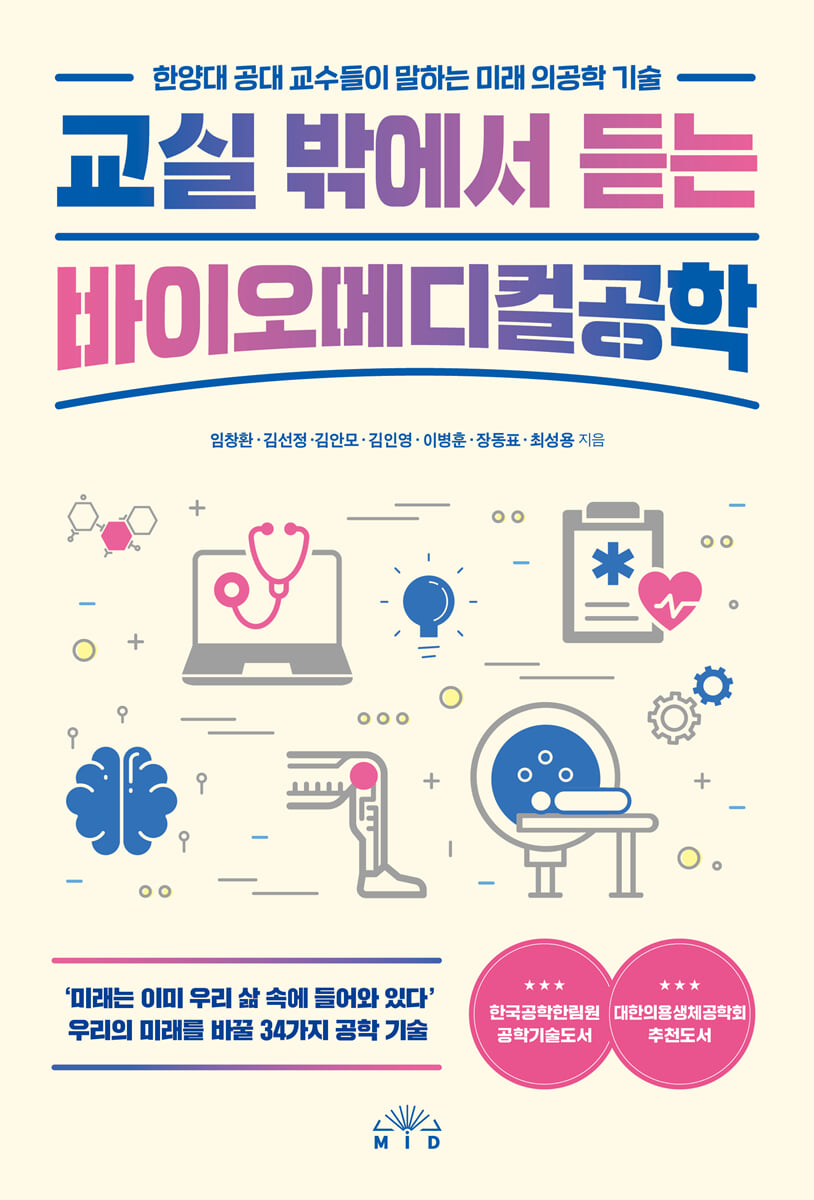
Biomedical Engineering Outside the Classroom
 |
Description
Book Introduction
From 'electronic drugs' to 'brain-computer interfaces'
What if the future we've only imagined has already arrived?
From disease treatment to human augmentation, biomedical engineering is on the rise.
Elon Musk, CEO of Tesla, a leader in the global automobile market, is interested in another area: the brain.
Currently, they are researching technology to treat diseases such as epilepsy by implanting electrodes in the brain, but ultimately, they say their goal is to develop it to the point where we can upload our thoughts into a computer.
And he actually demonstrated its potential by implanting electrodes in the brains of monkeys and allowing them to play computer games using only their minds.
What we thought was a story of the distant future is closer than we thought.
The advancement of biomedical engineering, commonly referred to as biomedical engineering, played a significant role in the success of this amazing experiment.
Until 100 years ago, we didn't even have X-ray technology, so it was difficult to see inside our bodies and find out where things hurt.
However, thanks to advances in biomedical engineering, it is now possible to capture the heart's movements in seconds, and artificial organs such as cochlear implants have become commercialized, giving many people a new lease on life.
Moreover, biomedical engineering is already making realities we could only imagine possible, such as 'electronic drugs' that cure diseases without ingestion and CT scans interpreted by 'artificial intelligence'.
And now, along with the great flow of the Fourth Industrial Revolution, biomedical engineering is running tirelessly to conquer diseases that humanity has been unable to overcome, such as Parkinson's disease and dementia, to develop cutting-edge medical devices such as 'robotic arms', and ultimately to augment humans through 'brain-computer interface' technology.
It has now become a 'future core industrial technology' that will be responsible for future medical services and human welfare.
What if the future we've only imagined has already arrived?
From disease treatment to human augmentation, biomedical engineering is on the rise.
Elon Musk, CEO of Tesla, a leader in the global automobile market, is interested in another area: the brain.
Currently, they are researching technology to treat diseases such as epilepsy by implanting electrodes in the brain, but ultimately, they say their goal is to develop it to the point where we can upload our thoughts into a computer.
And he actually demonstrated its potential by implanting electrodes in the brains of monkeys and allowing them to play computer games using only their minds.
What we thought was a story of the distant future is closer than we thought.
The advancement of biomedical engineering, commonly referred to as biomedical engineering, played a significant role in the success of this amazing experiment.
Until 100 years ago, we didn't even have X-ray technology, so it was difficult to see inside our bodies and find out where things hurt.
However, thanks to advances in biomedical engineering, it is now possible to capture the heart's movements in seconds, and artificial organs such as cochlear implants have become commercialized, giving many people a new lease on life.
Moreover, biomedical engineering is already making realities we could only imagine possible, such as 'electronic drugs' that cure diseases without ingestion and CT scans interpreted by 'artificial intelligence'.
And now, along with the great flow of the Fourth Industrial Revolution, biomedical engineering is running tirelessly to conquer diseases that humanity has been unable to overcome, such as Parkinson's disease and dementia, to develop cutting-edge medical devices such as 'robotic arms', and ultimately to augment humans through 'brain-computer interface' technology.
It has now become a 'future core industrial technology' that will be responsible for future medical services and human welfare.
- You can preview some of the book's contents.
Preview
Detailed image
Publisher's Review
For the MZ generation who will live in a future changed by biomedical engineering.
Biomedical Engineering Trends Introduced by Hanyang University College of Engineering Faculty
However, biomedical engineering is still an unfamiliar field to us.
This is especially true for the MZ generation and youth who will live in a future led by biomedical engineering.
This is because there is a common preconception that the fields covered by biomedical engineering are limited to ‘medical care’ and ‘treatment.’
However, as previously introduced, biomedical engineering has a very wide range of applications, from 'smart medical devices' to 'brain engineering', and it is essential to integrate with various fields of study such as medicine, electronic engineering, computer engineering, materials engineering, and life sciences, so it is a field that future generations should pay more attention to.
For those who still feel unfamiliar with biomedical engineering, and for those who are encountering biomedical engineering for the first time, the professors of Hanyang University's Department of Biomedical Engineering have gathered to introduce the current state of biomedical engineering in an 'easy' and, above all, 'interesting' way.
As you read biomedical engineering trends, each utilizing their respective fields of expertise, such as "wearable devices," "brain engineering," and "artificial intelligence," in language that anyone can easily understand, you'll find yourself captivated by the vision that biomedical engineering envisions.
Biomedical engineering is running towards a "healthier, happier life." How about meeting the future that has already arrived through this lecture outside the classroom and dreaming of making the world a better place together?
Biomedical Engineering Trends Introduced by Hanyang University College of Engineering Faculty
However, biomedical engineering is still an unfamiliar field to us.
This is especially true for the MZ generation and youth who will live in a future led by biomedical engineering.
This is because there is a common preconception that the fields covered by biomedical engineering are limited to ‘medical care’ and ‘treatment.’
However, as previously introduced, biomedical engineering has a very wide range of applications, from 'smart medical devices' to 'brain engineering', and it is essential to integrate with various fields of study such as medicine, electronic engineering, computer engineering, materials engineering, and life sciences, so it is a field that future generations should pay more attention to.
For those who still feel unfamiliar with biomedical engineering, and for those who are encountering biomedical engineering for the first time, the professors of Hanyang University's Department of Biomedical Engineering have gathered to introduce the current state of biomedical engineering in an 'easy' and, above all, 'interesting' way.
As you read biomedical engineering trends, each utilizing their respective fields of expertise, such as "wearable devices," "brain engineering," and "artificial intelligence," in language that anyone can easily understand, you'll find yourself captivated by the vision that biomedical engineering envisions.
Biomedical engineering is running towards a "healthier, happier life." How about meeting the future that has already arrived through this lecture outside the classroom and dreaming of making the world a better place together?
About the author
Professor Lim Chang-hwan (Chief Author)
He is a neuroscientist who studies brain-computer interfaces and brain control technologies, which are technologies that connect the human brain and computers.
His representative publications include 『Engineering that Changed the Brain, the Brain that Changed Engineering』(2015), 『Bionic Man』(2017), 『Brain 3.0』(2020), and 『Can We Upload Our Brains to Computers?』(2020).
Professor Kim Seon-jeong
I am researching biomimetic engineering and developing artificial muscles and energy systems that can drive them.
Professor Kim An-mo
We are conducting research on the visual and spatial memory of insects and using this to develop lightweight and fast artificial intelligence.
Professor Kim In-young
I am a physician-scientist who conducts research on measuring biosignals using wearable devices and analyzing them using artificial intelligence.
Professor Lee Byeong-hun
We are conducting research to develop ultra-small biomedical devices that can be attached and inserted into the human body using electrical, electronic, and radio wave technologies.
Professor Jang Dong-pyo
We are conducting research to treat brain diseases through neuromodulation based on the brain's electrical and chemical signals.
Professor Choi Seong-yong
A biomedical engineer who studies in vitro diagnostic and therapeutic technologies based on micro- and nano-engineering to diagnose and utilize immune cells as therapeutic agents.
Professor Lim Chang-hwan (Chief Author)
He is a neuroscientist who studies brain-computer interfaces and brain control technologies, which are technologies that connect the human brain and computers.
His representative publications include 『Engineering that Changed the Brain, the Brain that Changed Engineering』(2015), 『Bionic Man』(2017), 『Brain 3.0』(2020), and 『Can We Upload Our Brains to Computers?』(2020).
Professor Kim Seon-jeong
I am researching biomimetic engineering and developing artificial muscles and energy systems that can drive them.
Professor Kim An-mo
We are conducting research on the visual and spatial memory of insects and using this to develop lightweight and fast artificial intelligence.
Professor Kim In-young
I am a physician-scientist who conducts research on measuring biosignals using wearable devices and analyzing them using artificial intelligence.
Professor Lee Byeong-hun
We are conducting research to develop ultra-small biomedical devices that can be attached and inserted into the human body using electrical, electronic, and radio wave technologies.
Professor Jang Dong-pyo
We are conducting research to treat brain diseases through neuromodulation based on the brain's electrical and chemical signals.
Professor Choi Seong-yong
A biomedical engineer who studies in vitro diagnostic and therapeutic technologies based on micro- and nano-engineering to diagnose and utilize immune cells as therapeutic agents.
GOODS SPECIFICS
- Publication date: December 17, 2021
- Page count, weight, size: 328 pages | 574g | 153*225*30mm
- ISBN13: 9791190116619
- ISBN10: 1190116618
You may also like
카테고리
korean


korean

![ELLE 엘르 스페셜 에디션 A형 : 12월 [2025]](http://librairie.coreenne.fr/cdn/shop/files/b8e27a3de6c9538896439686c6b0e8fb.jpg?v=1766436872&width=3840)


