

Space debris is coming
 |
Description
Book Introduction
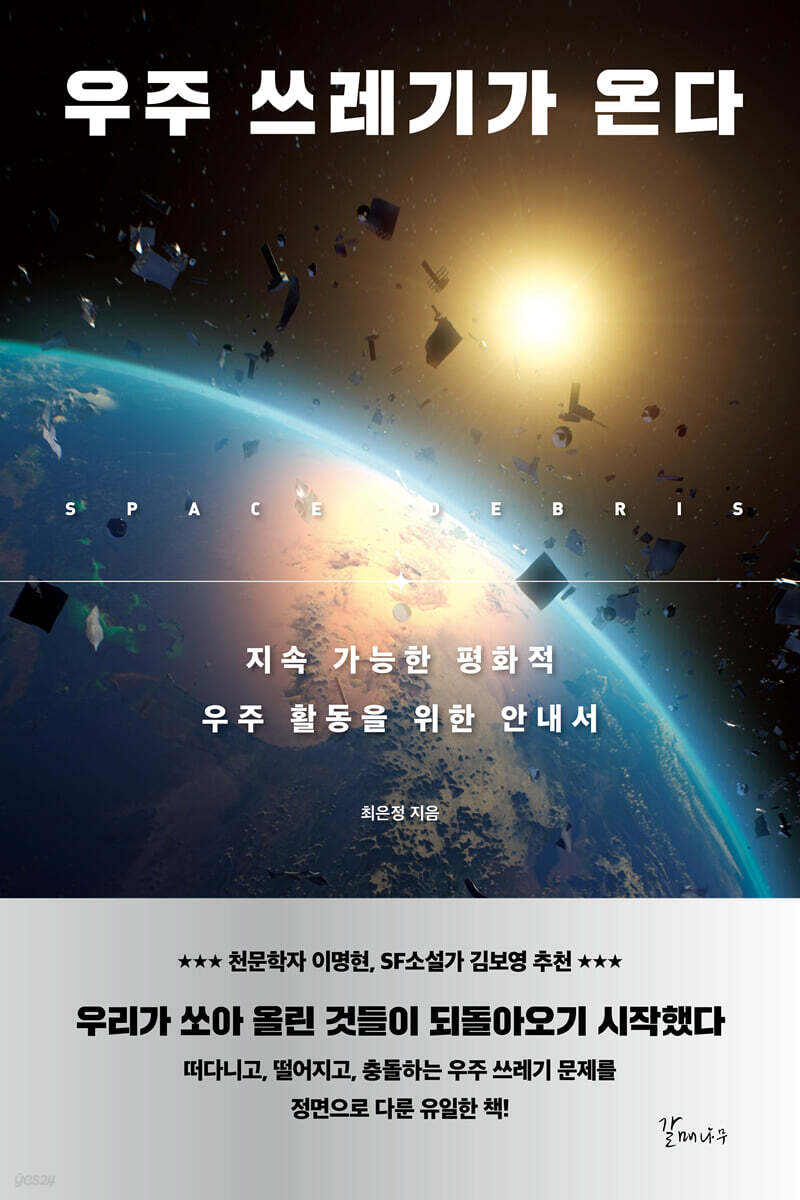
The things we shot up started coming back. Floating, falling, and crashing As dangerous and destructive waste A universe crowded with increasing space debris Can humanity's dream of traveling beyond Earth come true? Wherever humans go, 'trash' is left behind. ‘Space’ is no exception. Humanity's dream of exploring space and the glorious history of space development have resulted in the seemingly vast and infinite universe being filled with garbage. Currently, space debris orbits the Earth at a speed of 7 to 8 times faster than a bullet, causing collisions with operating satellites or falling to Earth, threatening humanity. Moreover, the limited space in Earth's orbit has become so filled with space debris that there is no space left to launch new satellites. "Space Junk is Coming" may seem like a story from a movie, but it actually deals with the current state and future prospects of space junk, which is fast approaching. Written by Eun-Jeong Choi, a space scientist currently working at the Korea Astronomy and Space Science Institute's Space Risk Monitoring Center, who predicts and analyzes the risks of satellites and space debris. The book vividly examines the current state of the increasingly fierce space development competition in the New Space era, and examines in detail the space debris problem that the author witnessed from the front lines of space surveillance. It also suggests that we confront what is being sacrificed to sustain humanity's dream of reaching beyond Earth. We hope that this book, which sheds new light on space from both a scientific and technological perspective and an environmental one, will serve as a helpful guide, offering a better direction to all those who dream of space. |
- You can preview some of the book's contents.
Preview
index
Prologue : Extraterrestrial waste threatens humanity.
Part 1: The New Space Era, Crowded Space
1 Space debris surrounding the Earth
Humans leave trash in space, too. The oldest satellite left in space. Debris from the rockets that launched it. Even space debris has names and numbers. Satellites can explode at any time. Debris from collisions and destruction.
2 How has space changed?
The most crowded place in space: low Earth orbit | Geostationary orbit: a limited space spot | Cislunar: the path from Earth to the Moon | A time capsule left in space
3 Until a satellite becomes space debris
Why Humanity Goes to Space│Satellites Have Graveyards Too│Space Junk Dump Sites on Earth
4. The assault of artificial satellites that filled the night sky
From Old Space to New Space│The Golden Age of Small Satellites│Satellites Blocking Starlight
2021 Space Odyssey: The Rosy Prospects and Shadows of the Space Industry
Part 2: Danger from Falling and Colliding Space
5 Space objects falling to Earth
The identity of the light that crosses the night sky│The end of artificial satellites, falling or being abandoned│The force that causes space debris to fall│What if a satellite falls to Earth?│Debris of space launch vehicles that fell to Earth│The crash of a large space object, the space station│The probability of a satellite falling to Korea│The probability of a person being hit by space debris
Predict the crash of Tiangong-1 in 2021: A Space Odyssey: Satellite Crash Situation Room
6 Colliding satellites and space debris
The Most Dangerous and Destructive Debris│Satellite Collisions, Space Traffic Accidents│Worst-Case Space Disasters
7. Monitor space hazards.
The first thing to do to prevent space hazards│How to monitor space with optical telescopes│How to monitor space with radar│How to monitor space with lasers
2021 Space Odyssey: Predict the Orbit of a Space Object
Part 3: A Guide to Sustainable Peaceful Space Activities
8 Norms that Humanity Must Observe in Space
Who Owns the Universe? Even Space Junk Has Owners. The Tragedy of the Commons.
2021 Space Odyssey: Four Perspectives on the Future of Space
9 Humanity's Efforts to Reduce Space Debris
Are There Plastic Bags Floating in Space? │Space Debris Reduction Guidelines
10. How to deal with space debris
We Clean Up Space Debris│How to Dispose of Space Debris│The Right Way to Dispose of Satellites
11 The Right Way to Create Opportunities to Go Out into Space
When Space Situational Awareness is Needed│Space Needs Traffic Management│Protect Korea's Satellites│Why Space Security Matters
2021 Space Odyssey: The Space Force Protecting Space Safety and Peace
Epilogue: Dreaming of a Sustainable Universe for Future Space Activists
References
Recommendation
Part 1: The New Space Era, Crowded Space
1 Space debris surrounding the Earth
Humans leave trash in space, too. The oldest satellite left in space. Debris from the rockets that launched it. Even space debris has names and numbers. Satellites can explode at any time. Debris from collisions and destruction.
2 How has space changed?
The most crowded place in space: low Earth orbit | Geostationary orbit: a limited space spot | Cislunar: the path from Earth to the Moon | A time capsule left in space
3 Until a satellite becomes space debris
Why Humanity Goes to Space│Satellites Have Graveyards Too│Space Junk Dump Sites on Earth
4. The assault of artificial satellites that filled the night sky
From Old Space to New Space│The Golden Age of Small Satellites│Satellites Blocking Starlight
2021 Space Odyssey: The Rosy Prospects and Shadows of the Space Industry
Part 2: Danger from Falling and Colliding Space
5 Space objects falling to Earth
The identity of the light that crosses the night sky│The end of artificial satellites, falling or being abandoned│The force that causes space debris to fall│What if a satellite falls to Earth?│Debris of space launch vehicles that fell to Earth│The crash of a large space object, the space station│The probability of a satellite falling to Korea│The probability of a person being hit by space debris
Predict the crash of Tiangong-1 in 2021: A Space Odyssey: Satellite Crash Situation Room
6 Colliding satellites and space debris
The Most Dangerous and Destructive Debris│Satellite Collisions, Space Traffic Accidents│Worst-Case Space Disasters
7. Monitor space hazards.
The first thing to do to prevent space hazards│How to monitor space with optical telescopes│How to monitor space with radar│How to monitor space with lasers
2021 Space Odyssey: Predict the Orbit of a Space Object
Part 3: A Guide to Sustainable Peaceful Space Activities
8 Norms that Humanity Must Observe in Space
Who Owns the Universe? Even Space Junk Has Owners. The Tragedy of the Commons.
2021 Space Odyssey: Four Perspectives on the Future of Space
9 Humanity's Efforts to Reduce Space Debris
Are There Plastic Bags Floating in Space? │Space Debris Reduction Guidelines
10. How to deal with space debris
We Clean Up Space Debris│How to Dispose of Space Debris│The Right Way to Dispose of Satellites
11 The Right Way to Create Opportunities to Go Out into Space
When Space Situational Awareness is Needed│Space Needs Traffic Management│Protect Korea's Satellites│Why Space Security Matters
2021 Space Odyssey: The Space Force Protecting Space Safety and Peace
Epilogue: Dreaming of a Sustainable Universe for Future Space Activists
References
Recommendation
Detailed image

Into the book
The 60 years or so that humanity has been developing space have also been a time of scattering artificial satellites and space debris into Earth's orbit.
Perhaps, it could be said that the artificial satellites that made humanity's dreams come true and died heroically are preserved in Earth's orbit as relics.
There are already countless satellites, debris from rockets launched from satellite launches, and debris from collisions floating around as space debris.
And that amount is increasing at a steep rate.
--- pp.21~22, "Prologue: Extraterrestrial waste threatens humanity"
On February 10, 2009, the operational U.S. civilian communications satellite Iridium 33 and the retired Russian military communications satellite Cosmos 2251 collided 790 kilometers above Siberia.
It was the first 'space accident' in which two satellites collided since mankind launched satellites.
(…) The collision of the two satellites resulted in a total of about 2,400 pieces of space debris, including about 1,700 pieces of debris from Cosmos 2251 and about 800 pieces of debris from Iridium 33.
The aftermath of this accident is ongoing.
This is because debris from the collision of the two satellites still remains in Earth's orbit.
--- pp.52~53, “2 How has space changed?”
If a satellite worth hundreds of billions of dollars is degraded or lost due to space debris, the cost may be greater than solving the space debris problem.
Therefore, used satellites must be returned to Earth and burned up in the atmosphere or moved to unused space to ensure that operating satellites can continue to operate safely.
Re-entry to Earth also requires careful planning to ensure that any debris left in the atmosphere falls to a safe location, such as Point Nemo.
This is because space debris falling to the ground and causing damage to people or property is a major risk factor for space activities.
Ultimately, the only way to design the final fate of a satellite is to either drop it back to Earth or move it to a safe space.
--- pp.117~118, "5 Space Objects Falling to Earth"
When Kessler predicted in 1978, there were about 3,800 space objects in Earth's orbit, but by 2021, there were already over 24,000.
It has increased by nearly six times.
As the number of artificial space objects increases, it is easy to assume that the rate of collisions between fragments resulting from explosions or collisions will also accelerate.
Ultimately, we are entering an era of catastrophic, random collision risk, just as Kessler predicted.
As with most environmental issues, solving space environmental problems inevitably requires significant initial costs.
However, if space debris is left unattended or the problem is not addressed, it will lead to a greater disaster.
Kessler had already predicted and warned of this fact.
Kessler Syndrome remains a challenge for humanity to address in the future.
--- p.164, “6 Colliding Satellites and Space Debris”
Unregulated space exploration is increasing space debris in Earth's orbit.
Space debris poses a threat to operating satellites.
The debris from satellites that collide with space debris or explode breaks into smaller pieces, increasing the number of fragments. As a result, the phenomenon of a chain of satellite collisions leads to an explosive increase in space debris is repeated.
This is a vicious cycle created by artificial satellites launched indiscriminately by everyone, a tragedy of the commons.
--- p.209, "8 Norms Humanity Must Observe in Space"
Compared to Zermatt, the universe is incomparably vast and expansive.
But isn't it humanity's responsibility for future generations to expand the "sustainable eco-friendliness" achieved by Zermatt across the globe and into space?
I hope that the international community's efforts to maintain guidelines for sustainable space activities will continue, so that everyone can safely operate in space.
Perhaps, it could be said that the artificial satellites that made humanity's dreams come true and died heroically are preserved in Earth's orbit as relics.
There are already countless satellites, debris from rockets launched from satellite launches, and debris from collisions floating around as space debris.
And that amount is increasing at a steep rate.
--- pp.21~22, "Prologue: Extraterrestrial waste threatens humanity"
On February 10, 2009, the operational U.S. civilian communications satellite Iridium 33 and the retired Russian military communications satellite Cosmos 2251 collided 790 kilometers above Siberia.
It was the first 'space accident' in which two satellites collided since mankind launched satellites.
(…) The collision of the two satellites resulted in a total of about 2,400 pieces of space debris, including about 1,700 pieces of debris from Cosmos 2251 and about 800 pieces of debris from Iridium 33.
The aftermath of this accident is ongoing.
This is because debris from the collision of the two satellites still remains in Earth's orbit.
--- pp.52~53, “2 How has space changed?”
If a satellite worth hundreds of billions of dollars is degraded or lost due to space debris, the cost may be greater than solving the space debris problem.
Therefore, used satellites must be returned to Earth and burned up in the atmosphere or moved to unused space to ensure that operating satellites can continue to operate safely.
Re-entry to Earth also requires careful planning to ensure that any debris left in the atmosphere falls to a safe location, such as Point Nemo.
This is because space debris falling to the ground and causing damage to people or property is a major risk factor for space activities.
Ultimately, the only way to design the final fate of a satellite is to either drop it back to Earth or move it to a safe space.
--- pp.117~118, "5 Space Objects Falling to Earth"
When Kessler predicted in 1978, there were about 3,800 space objects in Earth's orbit, but by 2021, there were already over 24,000.
It has increased by nearly six times.
As the number of artificial space objects increases, it is easy to assume that the rate of collisions between fragments resulting from explosions or collisions will also accelerate.
Ultimately, we are entering an era of catastrophic, random collision risk, just as Kessler predicted.
As with most environmental issues, solving space environmental problems inevitably requires significant initial costs.
However, if space debris is left unattended or the problem is not addressed, it will lead to a greater disaster.
Kessler had already predicted and warned of this fact.
Kessler Syndrome remains a challenge for humanity to address in the future.
--- p.164, “6 Colliding Satellites and Space Debris”
Unregulated space exploration is increasing space debris in Earth's orbit.
Space debris poses a threat to operating satellites.
The debris from satellites that collide with space debris or explode breaks into smaller pieces, increasing the number of fragments. As a result, the phenomenon of a chain of satellite collisions leads to an explosive increase in space debris is repeated.
This is a vicious cycle created by artificial satellites launched indiscriminately by everyone, a tragedy of the commons.
--- p.209, "8 Norms Humanity Must Observe in Space"
Compared to Zermatt, the universe is incomparably vast and expansive.
But isn't it humanity's responsibility for future generations to expand the "sustainable eco-friendliness" achieved by Zermatt across the globe and into space?
I hope that the international community's efforts to maintain guidelines for sustainable space activities will continue, so that everyone can safely operate in space.
--- p.270, "Epilogue: Dreaming of a Sustainable Universe for Future Space Activists"
Publisher's Review
The things we shot up started coming back.
Floating, falling, and crashing
As dangerous and destructive waste
A universe crowded with increasing space debris
Can humanity's dream of traveling beyond Earth come true?
From satellite collisions and crashes to humanity's efforts to monitor them.
The A to Z of Space Debris Explained by a Space Scientist
●Recommended by astronomer Lee Myeong-hyeon and science fiction writer Kim Bo-young!
●I wonder if the debris that suddenly falls will fall where I live.
Checking the weather every day might be the start of your day!
● A Korean space scientist who predicted the collision of an Iridium satellite and the crash of Tiangong-1.
A book that contains everything about space debris, researched over 20 years on the front lines of space surveillance!
Wherever humans go, 'trash' is left behind.
‘Space’ is no exception.
Humanity's dream of exploring space and the glorious history of space development have resulted in the seemingly vast and infinite universe being filled with garbage.
Currently, space debris orbits the Earth at a speed of 7 to 8 times faster than a bullet, causing collisions with operating satellites or falling to Earth, threatening humanity.
Moreover, the limited space in Earth's orbit has become so filled with space debris that there is no space left to launch new satellites.
《Space Junk is Coming》 may seem like a story from a movie, but it deals with the current state and future prospects of space junk, which is actually fast approaching.
Written by Eun-Jeong Choi, a space scientist currently working at the Korea Astronomy and Space Science Institute's Space Risk Monitoring Center, who predicts and analyzes the risks of satellites and space debris.
The book vividly examines the current state of the increasingly fierce space development competition in the New Space era, and examines in detail the problem of space debris that the author witnessed from the front lines of space surveillance.
It also suggests that we confront what is being sacrificed to sustain humanity's dream of reaching beyond Earth.
This book, which sheds new light on space from both a scientific and technological perspective as well as an environmental one, will hopefully serve as a helpful guide, offering a better direction to all those who dream of space.
The first book by a Korean space scientist at the forefront of space research.
As a space surveillance expert, I have vividly witnessed and foreseen the chaos and future of space.
In April 2018, China's space station Tiangong-1 crashed uncontrollably back to Earth.
At the time, Korea was predicted to be within the crash site during the re-entry of Tiangong-1 to Earth, and as this fact was reported through the media, public interest and concern grew.
If the debris from Tiangong-1, which weighs 8.5 tons and is the size of a bus, were to fall on a residential area, it would be a dangerous situation that could cause significant damage.
Countries around the world predicted the satellite's trajectory in real time and prepared for any potential damage, and Korea also operated a satellite crash situation room and made thorough preparations.
Author Choi Eun-jeong contributed to calmly responding to the dangerous situation by predicting the final range and time of Tiangong-1's crash in the satellite crash situation room that was running at an alarming rate at the time.
The crash of Tiangong-1 was an event that made us realize that the fall of artificial space objects that have outlived their usefulness, that is, space debris, can pose a real threat to us.
The threat of space debris is becoming increasingly real.
There are over 20,000 pieces of space debris floating in Earth's orbit, and of these, an average of over 400 pieces fall into Earth's atmosphere every year.
Some burn up in the atmosphere, but others fall to the ground as fragments.
For over 60 years, humanity has been exploring space, and behind it, there has been trash, and that trash is returning to Earth.
Countries around the world are working to build space surveillance systems to identify the number of satellites and space debris and predict their movements.
The most representative space surveillance system is the Space Surveillance Network (SSN) operated by the Combined Space Operation Center (CSpOC) in the United States.
The Space Surveillance Network catalogs all discovered artificial space objects by assigning them a serial identification number.
Not only the operating satellites but also the pieces floating in orbit as space debris are numbered.
The Space Surveillance Network can detect artificial space objects larger than 10 centimeters in diameter using optical telescopes and radar.
The total number of objects discovered so far is approximately 48,000, of which approximately 11,000 are satellites and 37,000 are space debris.
Excluding the approximately 25,000 registered space objects that have fallen into the Earth's atmosphere and disappeared, there are currently approximately 23,000 artificial space objects in Earth's orbit.
Of these, only 10 percent are operational satellites, and the remaining 90 percent are space debris.
If we could find all the undiscovered space debris, the number would likely exceed 100 million.
Because no other country has as extensive a space surveillance system as the United States, most countries rely on the United States for information about artificial space objects.
Even during the Tiangong-1 crash, Korea received and analyzed information released by the United States.
Of course, Korea's analytical capabilities are excellent, allowing it to make faster and more accurate predictions than other countries.
However, the inability to produce its own information is a clear limitation, and to overcome this, Korea is also building its own space surveillance system.
Korea's space surveillance system has established a Space Object Wide-field patroL Network called 'OWL-Net'.
Aulnet is a system of five optical telescopes, each of which is located around the world and operated unmanned.
The installed telescope is remotely controlled by the Korea Astronomy and Space Science Institute to collect data.
Determining the location of a space object that is constantly moving while floating in Earth's orbit is not an easy task even with current technology.
However, humanity continues to develop space surveillance technology and strives to ensure safe activities on Earth and in space.
In "Space Junk is Coming," the history of human space surveillance is introduced, along with the current status of space surveillance systems in countries such as the United States and Korea, and the pros and cons of various space surveillance technologies.
Although it is a deep topic that is difficult for just anyone to access, it is explained in an easy-to-understand manner, satisfying everyone from space enthusiasts to experts.
Monitoring and predicting dangers from space, such as crashes and collisions, is also a task that protects peace on Earth and in space.
Space scientists working in space surveillance fields are actually doing work that is like the main characters in a movie.
The author has been working on the front lines of space surveillance for a long time, studying space debris.
With his field experience and insights, he vividly conveys the increasingly serious problem of space debris and the dangers it poses.
The History of Space Development, From the Arms Race to the Space Business
The only book on space debris, a threat to the space environment.
It is now the age of the great universe.
The 'Old Space' era, in which space development was dominated by the United States and the Soviet Union, characterized by a government-led arms race, has passed, and the 'New Space' era has begun, in which individuals and civilians freely venture into space.
Elon Musk's SpaceX is launching dozens of Starlink satellites at a time, and Jeff Bezos' Amazon is not to be outdone, pushing even harder into space exploration.
Commercial use of space is becoming more active, driven by private companies.
Satellites launched into space are now having a profound impact on human life, and we live in an era where life without satellites is no longer possible.
Since the launch of Sputnik 1 in 1957, humanity's dream of space has continued, and as a result, the Earth's orbit has been filled with artificial satellites.
Although the universe always seems vast, the space that humans can actually use is limited.
In particular, the Earth orbits from which satellites can be launched are even more limited.
Due to human space exploration that has continued for over 60 years, space is becoming increasingly crowded.
The area of 35,800 meters above the Earth's equator is the geostationary orbit region.
In this orbit, satellites that provide services for specific regions, such as communications, broadcasting, and meteorological missions, are mainly located because the orbital period of the satellite matches the Earth's rotational period.
Because the geostationary orbit area is particularly limited, if satellites that have reached the end of their lifespan remain in orbit, there will be no place for new satellites to be established.
So, when geostationary satellites complete their mission, they either re-enter the Earth's atmosphere or move to a decommissioned orbit, becoming space debris.
As the number of satellites and space debris floating in Earth's orbit increases, space accidents where two objects collide in Earth's orbit are also occurring more frequently.
The space debris orbiting Cosmos 2251 and the operational satellite Iridium 33 actually collided in 2009.
The accident generated about 2,400 pieces of debris, which are expected to remain in orbit for tens to hundreds of years.
These small pieces of debris orbit at such high speeds that they can cause damage to other operating satellites.
In fact, the Hubble Space Telescope's solar array has been scarred by over 500 impacts over the past seven years from collisions with small debris.
Earth's orbit is becoming increasingly crowded and dangerous due to the increase in space debris.
Ironically, the process of realizing humanity's dream of reaching beyond Earth is leading to the result of blocking the path to space.
In "Space Debris is Coming," we will guide you through the history of human space exploration and the rapidly changing space landscape in the new space era, as if broadcasting live.
The sight of the Earth surrounded by increasing amounts of satellites and space debris is a spectacular sight in itself.
However, it is time to look back and see what we are missing in that landscape.
New environmental problems facing humanity in the new space era
Challenges to be solved to sustain space development and peace
The scope of human activity is expanding into space.
The dream of space and the advancement of science and technology to realize it will allow humanity to enter and exit space with increasing freedom.
Space is no longer just a subject of development or exploration, but is becoming a space where humanity operates.
Therefore, the growing problem of space debris poses a real threat to humanity.
In fact, astronauts living on space stations feel the threat of space debris most closely.
The number of manned spacecraft carrying people to the moon and Mars is also increasing.
You never know when a disaster like the one in the movie Gravity might happen.
To understand space, we need to recall the phenomenon of the 'tragedy of the commons'.
Commons refers to a phenomenon in which, when a resource is freely available, everyone abuses it in a selfish manner, ultimately leading to the depletion or destruction of the resource, which is detrimental to everyone who wants to use it.
Outer space is also a kind of commons that no specific country or individual can claim ownership of.
If we leave it free to everyone to use without any agreement or regulation, Earth's orbit will end up being monopolized by a few advanced space-developing countries or private companies.
For countries that are latecomers to space development, there may not even be an opportunity to launch satellites.
Additionally, if we use space indiscriminately and do not take responsibility for space debris, the worst-case scenario for a space disaster, the Kessler Syndrome, could come true.
A chain reaction of random collisions between artificial space objects could lead to an exponential increase in the number of fragments, potentially permanently blocking the path to space.
Fortunately, humanity is recognizing these problems and finding ways to ensure sustainable, peaceful space activities.
The world is working to establish and enforce regulations for space activities through communication and agreement.
In 2007, the United Nations Committee on the Peaceful Uses of Outer Space (COPUOS) announced the ‘Guidelines for Reducing Space Debris.’
The 'Space Debris Reduction Guidelines' present seven guidelines to be followed during space development to reduce space debris.
Although it is still only a 'guideline' with no binding force, each country is enacting its own laws and policies based on this guideline.
While preventing further increases in space debris is paramount, research is also continuing on technologies to safely dispose of space debris already floating in Earth's orbit.
There are two main ways to deal with space debris in orbit.
The first is the 'Post-Mission Disposal (PMD)' method, in which the satellite self-destructs when its lifespan ends, and the second is the 'Active Debris Removal (ADR)' method, in which a cleaning satellite is sent out to directly collect the debris.
Most of the cases reported in the media are active removal methods.
It is easy to understand if you think of the method of directly approaching and capturing orbiting space debris, like the scene in the movie “Space Sweepers.”
In fact, Swiss private company ClearSpace plans to launch a cleaning satellite equipped with a robotic arm to clean up space debris called "Vespa" floating in Earth's orbit.
In addition, humanity is making various efforts to peacefully utilize outer space, a new arena for activity.
We are establishing a 'space situational awareness' system to recognize and respond to risks in space, and a 'space traffic management' system based on this.
The book comprehensively introduces examples of sustainable space development based on cutting-edge science and technology, technological and policy approaches to reducing space debris, and international cooperation for the peaceful use of space.
Space debris is actually the most dangerous and destructive type of debris.
Even small fragments have destructive power because they move at high speeds, collide, and fall.
And with that power, it comes back to us, not metaphorically, but in reality.
Space debris intuitively demonstrates a very simple lesson: what we throw away will eventually come back to us.
And sometimes, those things that come back can destroy us.
The author's perspective on space from an environmental perspective and the problem of space debris as another environmental problem facing humanity is therefore valuable.
We must now recognize outer space as a space where humanity operates, as the 'environment' that surrounds us.
Only then can we devise solutions to the space debris problem and find ways to conduct space activities in a sustainable manner.
"Space Debris is Coming" will help us shift our perception and look at space from a new perspective.
Floating, falling, and crashing
As dangerous and destructive waste
A universe crowded with increasing space debris
Can humanity's dream of traveling beyond Earth come true?
From satellite collisions and crashes to humanity's efforts to monitor them.
The A to Z of Space Debris Explained by a Space Scientist
●Recommended by astronomer Lee Myeong-hyeon and science fiction writer Kim Bo-young!
●I wonder if the debris that suddenly falls will fall where I live.
Checking the weather every day might be the start of your day!
● A Korean space scientist who predicted the collision of an Iridium satellite and the crash of Tiangong-1.
A book that contains everything about space debris, researched over 20 years on the front lines of space surveillance!
Wherever humans go, 'trash' is left behind.
‘Space’ is no exception.
Humanity's dream of exploring space and the glorious history of space development have resulted in the seemingly vast and infinite universe being filled with garbage.
Currently, space debris orbits the Earth at a speed of 7 to 8 times faster than a bullet, causing collisions with operating satellites or falling to Earth, threatening humanity.
Moreover, the limited space in Earth's orbit has become so filled with space debris that there is no space left to launch new satellites.
《Space Junk is Coming》 may seem like a story from a movie, but it deals with the current state and future prospects of space junk, which is actually fast approaching.
Written by Eun-Jeong Choi, a space scientist currently working at the Korea Astronomy and Space Science Institute's Space Risk Monitoring Center, who predicts and analyzes the risks of satellites and space debris.
The book vividly examines the current state of the increasingly fierce space development competition in the New Space era, and examines in detail the problem of space debris that the author witnessed from the front lines of space surveillance.
It also suggests that we confront what is being sacrificed to sustain humanity's dream of reaching beyond Earth.
This book, which sheds new light on space from both a scientific and technological perspective as well as an environmental one, will hopefully serve as a helpful guide, offering a better direction to all those who dream of space.
The first book by a Korean space scientist at the forefront of space research.
As a space surveillance expert, I have vividly witnessed and foreseen the chaos and future of space.
In April 2018, China's space station Tiangong-1 crashed uncontrollably back to Earth.
At the time, Korea was predicted to be within the crash site during the re-entry of Tiangong-1 to Earth, and as this fact was reported through the media, public interest and concern grew.
If the debris from Tiangong-1, which weighs 8.5 tons and is the size of a bus, were to fall on a residential area, it would be a dangerous situation that could cause significant damage.
Countries around the world predicted the satellite's trajectory in real time and prepared for any potential damage, and Korea also operated a satellite crash situation room and made thorough preparations.
Author Choi Eun-jeong contributed to calmly responding to the dangerous situation by predicting the final range and time of Tiangong-1's crash in the satellite crash situation room that was running at an alarming rate at the time.
The crash of Tiangong-1 was an event that made us realize that the fall of artificial space objects that have outlived their usefulness, that is, space debris, can pose a real threat to us.
The threat of space debris is becoming increasingly real.
There are over 20,000 pieces of space debris floating in Earth's orbit, and of these, an average of over 400 pieces fall into Earth's atmosphere every year.
Some burn up in the atmosphere, but others fall to the ground as fragments.
For over 60 years, humanity has been exploring space, and behind it, there has been trash, and that trash is returning to Earth.
Countries around the world are working to build space surveillance systems to identify the number of satellites and space debris and predict their movements.
The most representative space surveillance system is the Space Surveillance Network (SSN) operated by the Combined Space Operation Center (CSpOC) in the United States.
The Space Surveillance Network catalogs all discovered artificial space objects by assigning them a serial identification number.
Not only the operating satellites but also the pieces floating in orbit as space debris are numbered.
The Space Surveillance Network can detect artificial space objects larger than 10 centimeters in diameter using optical telescopes and radar.
The total number of objects discovered so far is approximately 48,000, of which approximately 11,000 are satellites and 37,000 are space debris.
Excluding the approximately 25,000 registered space objects that have fallen into the Earth's atmosphere and disappeared, there are currently approximately 23,000 artificial space objects in Earth's orbit.
Of these, only 10 percent are operational satellites, and the remaining 90 percent are space debris.
If we could find all the undiscovered space debris, the number would likely exceed 100 million.
Because no other country has as extensive a space surveillance system as the United States, most countries rely on the United States for information about artificial space objects.
Even during the Tiangong-1 crash, Korea received and analyzed information released by the United States.
Of course, Korea's analytical capabilities are excellent, allowing it to make faster and more accurate predictions than other countries.
However, the inability to produce its own information is a clear limitation, and to overcome this, Korea is also building its own space surveillance system.
Korea's space surveillance system has established a Space Object Wide-field patroL Network called 'OWL-Net'.
Aulnet is a system of five optical telescopes, each of which is located around the world and operated unmanned.
The installed telescope is remotely controlled by the Korea Astronomy and Space Science Institute to collect data.
Determining the location of a space object that is constantly moving while floating in Earth's orbit is not an easy task even with current technology.
However, humanity continues to develop space surveillance technology and strives to ensure safe activities on Earth and in space.
In "Space Junk is Coming," the history of human space surveillance is introduced, along with the current status of space surveillance systems in countries such as the United States and Korea, and the pros and cons of various space surveillance technologies.
Although it is a deep topic that is difficult for just anyone to access, it is explained in an easy-to-understand manner, satisfying everyone from space enthusiasts to experts.
Monitoring and predicting dangers from space, such as crashes and collisions, is also a task that protects peace on Earth and in space.
Space scientists working in space surveillance fields are actually doing work that is like the main characters in a movie.
The author has been working on the front lines of space surveillance for a long time, studying space debris.
With his field experience and insights, he vividly conveys the increasingly serious problem of space debris and the dangers it poses.
The History of Space Development, From the Arms Race to the Space Business
The only book on space debris, a threat to the space environment.
It is now the age of the great universe.
The 'Old Space' era, in which space development was dominated by the United States and the Soviet Union, characterized by a government-led arms race, has passed, and the 'New Space' era has begun, in which individuals and civilians freely venture into space.
Elon Musk's SpaceX is launching dozens of Starlink satellites at a time, and Jeff Bezos' Amazon is not to be outdone, pushing even harder into space exploration.
Commercial use of space is becoming more active, driven by private companies.
Satellites launched into space are now having a profound impact on human life, and we live in an era where life without satellites is no longer possible.
Since the launch of Sputnik 1 in 1957, humanity's dream of space has continued, and as a result, the Earth's orbit has been filled with artificial satellites.
Although the universe always seems vast, the space that humans can actually use is limited.
In particular, the Earth orbits from which satellites can be launched are even more limited.
Due to human space exploration that has continued for over 60 years, space is becoming increasingly crowded.
The area of 35,800 meters above the Earth's equator is the geostationary orbit region.
In this orbit, satellites that provide services for specific regions, such as communications, broadcasting, and meteorological missions, are mainly located because the orbital period of the satellite matches the Earth's rotational period.
Because the geostationary orbit area is particularly limited, if satellites that have reached the end of their lifespan remain in orbit, there will be no place for new satellites to be established.
So, when geostationary satellites complete their mission, they either re-enter the Earth's atmosphere or move to a decommissioned orbit, becoming space debris.
As the number of satellites and space debris floating in Earth's orbit increases, space accidents where two objects collide in Earth's orbit are also occurring more frequently.
The space debris orbiting Cosmos 2251 and the operational satellite Iridium 33 actually collided in 2009.
The accident generated about 2,400 pieces of debris, which are expected to remain in orbit for tens to hundreds of years.
These small pieces of debris orbit at such high speeds that they can cause damage to other operating satellites.
In fact, the Hubble Space Telescope's solar array has been scarred by over 500 impacts over the past seven years from collisions with small debris.
Earth's orbit is becoming increasingly crowded and dangerous due to the increase in space debris.
Ironically, the process of realizing humanity's dream of reaching beyond Earth is leading to the result of blocking the path to space.
In "Space Debris is Coming," we will guide you through the history of human space exploration and the rapidly changing space landscape in the new space era, as if broadcasting live.
The sight of the Earth surrounded by increasing amounts of satellites and space debris is a spectacular sight in itself.
However, it is time to look back and see what we are missing in that landscape.
New environmental problems facing humanity in the new space era
Challenges to be solved to sustain space development and peace
The scope of human activity is expanding into space.
The dream of space and the advancement of science and technology to realize it will allow humanity to enter and exit space with increasing freedom.
Space is no longer just a subject of development or exploration, but is becoming a space where humanity operates.
Therefore, the growing problem of space debris poses a real threat to humanity.
In fact, astronauts living on space stations feel the threat of space debris most closely.
The number of manned spacecraft carrying people to the moon and Mars is also increasing.
You never know when a disaster like the one in the movie Gravity might happen.
To understand space, we need to recall the phenomenon of the 'tragedy of the commons'.
Commons refers to a phenomenon in which, when a resource is freely available, everyone abuses it in a selfish manner, ultimately leading to the depletion or destruction of the resource, which is detrimental to everyone who wants to use it.
Outer space is also a kind of commons that no specific country or individual can claim ownership of.
If we leave it free to everyone to use without any agreement or regulation, Earth's orbit will end up being monopolized by a few advanced space-developing countries or private companies.
For countries that are latecomers to space development, there may not even be an opportunity to launch satellites.
Additionally, if we use space indiscriminately and do not take responsibility for space debris, the worst-case scenario for a space disaster, the Kessler Syndrome, could come true.
A chain reaction of random collisions between artificial space objects could lead to an exponential increase in the number of fragments, potentially permanently blocking the path to space.
Fortunately, humanity is recognizing these problems and finding ways to ensure sustainable, peaceful space activities.
The world is working to establish and enforce regulations for space activities through communication and agreement.
In 2007, the United Nations Committee on the Peaceful Uses of Outer Space (COPUOS) announced the ‘Guidelines for Reducing Space Debris.’
The 'Space Debris Reduction Guidelines' present seven guidelines to be followed during space development to reduce space debris.
Although it is still only a 'guideline' with no binding force, each country is enacting its own laws and policies based on this guideline.
While preventing further increases in space debris is paramount, research is also continuing on technologies to safely dispose of space debris already floating in Earth's orbit.
There are two main ways to deal with space debris in orbit.
The first is the 'Post-Mission Disposal (PMD)' method, in which the satellite self-destructs when its lifespan ends, and the second is the 'Active Debris Removal (ADR)' method, in which a cleaning satellite is sent out to directly collect the debris.
Most of the cases reported in the media are active removal methods.
It is easy to understand if you think of the method of directly approaching and capturing orbiting space debris, like the scene in the movie “Space Sweepers.”
In fact, Swiss private company ClearSpace plans to launch a cleaning satellite equipped with a robotic arm to clean up space debris called "Vespa" floating in Earth's orbit.
In addition, humanity is making various efforts to peacefully utilize outer space, a new arena for activity.
We are establishing a 'space situational awareness' system to recognize and respond to risks in space, and a 'space traffic management' system based on this.
The book comprehensively introduces examples of sustainable space development based on cutting-edge science and technology, technological and policy approaches to reducing space debris, and international cooperation for the peaceful use of space.
Space debris is actually the most dangerous and destructive type of debris.
Even small fragments have destructive power because they move at high speeds, collide, and fall.
And with that power, it comes back to us, not metaphorically, but in reality.
Space debris intuitively demonstrates a very simple lesson: what we throw away will eventually come back to us.
And sometimes, those things that come back can destroy us.
The author's perspective on space from an environmental perspective and the problem of space debris as another environmental problem facing humanity is therefore valuable.
We must now recognize outer space as a space where humanity operates, as the 'environment' that surrounds us.
Only then can we devise solutions to the space debris problem and find ways to conduct space activities in a sustainable manner.
"Space Debris is Coming" will help us shift our perception and look at space from a new perspective.
GOODS SPECIFICS
- Date of issue: July 1, 2021
- Page count, weight, size: 276 pages | 446g | 140*210*17mm
- ISBN13: 9791190123990
- ISBN10: 1190123991
You may also like
카테고리
korean


korean

![GQ KOREA Mark (Monthly): December [2025]](http://librairie.coreenne.fr/cdn/shop/files/8ef265dbbfbf186523ed75ba7319009d.jpg?v=1765340328&width=3840)


