

Bioscience
 |
Description
Book Introduction
Life Science for Everyone Living in an Age of Uncertainty
The latest trends in cell science, holding the secrets to immunity and longevity.
The 21st century is the first era of longevity since the emergence of mankind on Earth.
This is why knowledge of biology is considered essential knowledge for modern people.
Especially during the COVID-19 pandemic, unfiltered claims about immunology, cytology, and viruses poured out from various media outlets, making it difficult for the public to discern what was scientifically sound. This situation led to an infodemic that was even more frightening than the pandemic itself.
Dr. Tamotsu Yoshimori, a world-renowned life scientist and one of the leading authorities on autophagy, or self-eating, writes in his new book, “Bioscience 2025,” “We make many decisions every day.
As a scientist, I believe that having properly updated life science knowledge at this time will allow us to make better decisions than we did yesterday.
This is scientific thinking.
“Scientific thinking increases our chances of survival,” he emphasizes.
This book is a general science textbook that teaches not only the basic knowledge and latest trends in the field of life sciences, which he is involved in, but also 'scientific thinking' as if it were a lecture.
The basis of life is cells.
Therefore, it can be said that knowing about cells means knowing most of life science.
In this book, Dr. Tamotsu Yoshimori explains the basic concepts of biology, such as DNA, genes, genomes, viruses and bacteria, and immunity, in an easy-to-understand manner, and then naturally moves on to explain autophagy, his area of expertise.
Autophagy is also the subject of the 2016 Nobel Prize in Physiology or Medicine awarded to Dr. Yoshinori Ohsumi of Japan.
『Bioscience 2025』 is a science book written by a world-renowned scholar.
But anyone can easily understand it.
The fact that he can write about the vast world of cell science so easily and wittily demonstrates his deep inner strength and sincerity as a veteran scientist.
This book will provide essential knowledge on scientific thinking, life science, and autophagy that all modern people who wish to live a long and healthy life must know.
The latest trends in cell science, holding the secrets to immunity and longevity.
The 21st century is the first era of longevity since the emergence of mankind on Earth.
This is why knowledge of biology is considered essential knowledge for modern people.
Especially during the COVID-19 pandemic, unfiltered claims about immunology, cytology, and viruses poured out from various media outlets, making it difficult for the public to discern what was scientifically sound. This situation led to an infodemic that was even more frightening than the pandemic itself.
Dr. Tamotsu Yoshimori, a world-renowned life scientist and one of the leading authorities on autophagy, or self-eating, writes in his new book, “Bioscience 2025,” “We make many decisions every day.
As a scientist, I believe that having properly updated life science knowledge at this time will allow us to make better decisions than we did yesterday.
This is scientific thinking.
“Scientific thinking increases our chances of survival,” he emphasizes.
This book is a general science textbook that teaches not only the basic knowledge and latest trends in the field of life sciences, which he is involved in, but also 'scientific thinking' as if it were a lecture.
The basis of life is cells.
Therefore, it can be said that knowing about cells means knowing most of life science.
In this book, Dr. Tamotsu Yoshimori explains the basic concepts of biology, such as DNA, genes, genomes, viruses and bacteria, and immunity, in an easy-to-understand manner, and then naturally moves on to explain autophagy, his area of expertise.
Autophagy is also the subject of the 2016 Nobel Prize in Physiology or Medicine awarded to Dr. Yoshinori Ohsumi of Japan.
『Bioscience 2025』 is a science book written by a world-renowned scholar.
But anyone can easily understand it.
The fact that he can write about the vast world of cell science so easily and wittily demonstrates his deep inner strength and sincerity as a veteran scientist.
This book will provide essential knowledge on scientific thinking, life science, and autophagy that all modern people who wish to live a long and healthy life must know.
- You can preview some of the book's contents.
Preview
index
To our Korean readers,
Recommended article: “A cell is a universe.”
Recommended Reading : "Essential Literacy for Modern People in the COVID-19 Era"
introduction
Chapter 1: Learning Scientific Thinking
Scientific thinking is an essential skill in this age.
The war against infectious diseases is humanity's destiny.
Scientific thinking protects our bodies
Being able to filter scientific information increases your chances of survival.
Modern science can be both medicine and poison
Should I avoid buying foods labeled as genetically modified?
Scientific thinking doesn't require memorization or formulas.
Science is infinitely closer to the truth.
Hypothesis and verification are the foundation of science.
A person who is decisive is unscientific.
Mendel counted the wrinkles on peas for eight years
Science is like a detective novel.
First, question and doubt common sense.
The most powerful tools: 'correlation' and 'causality'
To avoid being fooled by pseudoscience
Column #01 Research is evaluated through papers.
Column #02 There are academic guidance grades.
Column #03 Research papers are evaluated based on the premise of the theory of human nature.
The issue isn't whether STAP cells exist.
Even papers published in academic journals can be wrong.
Fabrication and falsification destroy science.
Errors advance science.
Column #04 Top 3 Journals in Life Sciences
Column #05 China is Breathing Change into the Western-Centric World of Research
Chapter 2: Understanding Cells Can Help You Understand Life
The basis of all life is cells
Audrey Hepburn and an orangutan have the same cells.
Cells are the basic units of life because each and every cell is alive.
How to test a drug?
Every single cell contains all the information
Be conscious of size
The characteristics of life are hierarchy and dynamic equilibrium.
Inside the cell is society
The society within the cell is the 'membrane' is the center of traffic
Genes are the blueprints for proteins
Gene is a sentence written in the letters DNA
One gene makes one protein
How proteins are made from DNA
Proteins power the human body
The genome is the collection of genes needed to create a human being.
Why Cells Are the Foundation of Life
There are quite a few errors in genetic information.
Evolution begins with a wrong letter
How does it evolve if it's random?
It is important that all living things are different.
Humanity will also become extinct someday.
Column #06 Research doesn't necessarily have to be beneficial to something.
Chapter 3: Let's Learn About Bottles
When cells become abnormal, they become sick.
The reason why your body today is no different from yesterday is thanks to your cells.
There are several patterns in how cells go awry.
What is a virus originally?
Why do we get sick from viruses?
Damage to mitochondria can lead to cancer and heart failure.
Cells sometimes commit suicide
Cells are always prepared for emergencies
When cells proliferate abnormally, cancer occurs.
Hereditary and non-hereditary diseases
Hormones transmit information to cells.
Cerebral infarction occurs due to lack of oxygen in cells.
Why do humans need oxygen?
Even if information transmission is not smooth, you can get sick.
Germs that destroy transportation systems
Immunity excludes external enemies
Colds don't get better with antibiotics.
Column #07 Overuse of Antibiotics Causes Bacteria to Evolve
There are three types of immunity.
Antibodies, a third means of eliminating enemies
The relationship between a key and a keyhole holds the key to life.
Antibodies constantly check keys and keyholes.
Natural immunity and acquired immunity
Immunity isn't just about antibodies.
Column #08 Regarding drug development
Understanding inflammation
What is herd immunity?
Column #09: Understanding Cross-Reactivity
There are creatures that do not die
Humans may not die
Humans have deliberately chosen to age.
Humans age at an incredible rate.
Humanity, having survived aging, is now rejecting it.
Is it a good thing or a bad thing to not die?
Chapter 4: Understanding Autophagy: The Future of Cells
Autophagy rejuvenates cells
Autophagy breaks down substances inside cells
A garbage truck transports trash to a recycling plant
What does autophagy do?
The moment when autophagy is crucial
Every day, 240 grams of protein are broken down and reborn as new protein.
Column #10 The moment when yeast autophagy was discovered, leading to the Nobel Prize
Column #11 Marker discovery is a crucial element in advancing research.
Remove harmful substances
Viruses that interfere with autophagy
As our immune systems evolve, so do pathogens.
Why Autophagy Can Recognize Enemies
Pathogens enter cells while surrounded by a membrane.
Autophagy occurs when a hole is made in the membrane of a cell organelle.
Recovering harmful substances can help prevent many diseases.
Neurons last a lifetime
Autophagy becomes inactive with age
Column #12 When a gene is discovered, research proceeds explosively.
Column #13 Autophagy was discovered using yeast.
Rubicon, a protein that stops autophagy
Eating fatty foods increases Rubicon
Experiments to determine causality have made great strides thanks to genetic manipulation.
Column #14 Regarding naming
Column #15: The protein from glowing jellyfish advances life sciences.
Chapter 5: What can you do to extend your life?
5 Ways to Increase Your Lifespan
Autophagy activation is involved in life extension.
As we age, the Rubicon increases.
Inhibiting Rubicon could potentially halt aging.
Column #16 Don't be fooled by graphs
Activating autophagy may suppress neurodegenerative diseases.
Why does Rubicon exist?
The Relationship Between Autophagy and Disease
Autophagy actually helps cancer cells.
Autophagy is essential for strengthening immunity.
It may also increase the effectiveness of vaccines or suppress inflammation.
Column #17 Mitochondria in textbooks are not what they appear to be.
Autophagy is also good for beauty.
How to Boost Autophagy in Your Daily Life
Beans and mushrooms activate autophagy
Red wine and cheese at night
What has been known to be good for health is also good for autophagy.
Long-term fasting causes muscle loss
Moderate exercise activates autophagy
It's best to eat less and exercise more
Column #18: Researchers Establish Venture Businesses
Column #19 Research is a team effort
Reviews
References
Recommended article: “A cell is a universe.”
Recommended Reading : "Essential Literacy for Modern People in the COVID-19 Era"
introduction
Chapter 1: Learning Scientific Thinking
Scientific thinking is an essential skill in this age.
The war against infectious diseases is humanity's destiny.
Scientific thinking protects our bodies
Being able to filter scientific information increases your chances of survival.
Modern science can be both medicine and poison
Should I avoid buying foods labeled as genetically modified?
Scientific thinking doesn't require memorization or formulas.
Science is infinitely closer to the truth.
Hypothesis and verification are the foundation of science.
A person who is decisive is unscientific.
Mendel counted the wrinkles on peas for eight years
Science is like a detective novel.
First, question and doubt common sense.
The most powerful tools: 'correlation' and 'causality'
To avoid being fooled by pseudoscience
Column #01 Research is evaluated through papers.
Column #02 There are academic guidance grades.
Column #03 Research papers are evaluated based on the premise of the theory of human nature.
The issue isn't whether STAP cells exist.
Even papers published in academic journals can be wrong.
Fabrication and falsification destroy science.
Errors advance science.
Column #04 Top 3 Journals in Life Sciences
Column #05 China is Breathing Change into the Western-Centric World of Research
Chapter 2: Understanding Cells Can Help You Understand Life
The basis of all life is cells
Audrey Hepburn and an orangutan have the same cells.
Cells are the basic units of life because each and every cell is alive.
How to test a drug?
Every single cell contains all the information
Be conscious of size
The characteristics of life are hierarchy and dynamic equilibrium.
Inside the cell is society
The society within the cell is the 'membrane' is the center of traffic
Genes are the blueprints for proteins
Gene is a sentence written in the letters DNA
One gene makes one protein
How proteins are made from DNA
Proteins power the human body
The genome is the collection of genes needed to create a human being.
Why Cells Are the Foundation of Life
There are quite a few errors in genetic information.
Evolution begins with a wrong letter
How does it evolve if it's random?
It is important that all living things are different.
Humanity will also become extinct someday.
Column #06 Research doesn't necessarily have to be beneficial to something.
Chapter 3: Let's Learn About Bottles
When cells become abnormal, they become sick.
The reason why your body today is no different from yesterday is thanks to your cells.
There are several patterns in how cells go awry.
What is a virus originally?
Why do we get sick from viruses?
Damage to mitochondria can lead to cancer and heart failure.
Cells sometimes commit suicide
Cells are always prepared for emergencies
When cells proliferate abnormally, cancer occurs.
Hereditary and non-hereditary diseases
Hormones transmit information to cells.
Cerebral infarction occurs due to lack of oxygen in cells.
Why do humans need oxygen?
Even if information transmission is not smooth, you can get sick.
Germs that destroy transportation systems
Immunity excludes external enemies
Colds don't get better with antibiotics.
Column #07 Overuse of Antibiotics Causes Bacteria to Evolve
There are three types of immunity.
Antibodies, a third means of eliminating enemies
The relationship between a key and a keyhole holds the key to life.
Antibodies constantly check keys and keyholes.
Natural immunity and acquired immunity
Immunity isn't just about antibodies.
Column #08 Regarding drug development
Understanding inflammation
What is herd immunity?
Column #09: Understanding Cross-Reactivity
There are creatures that do not die
Humans may not die
Humans have deliberately chosen to age.
Humans age at an incredible rate.
Humanity, having survived aging, is now rejecting it.
Is it a good thing or a bad thing to not die?
Chapter 4: Understanding Autophagy: The Future of Cells
Autophagy rejuvenates cells
Autophagy breaks down substances inside cells
A garbage truck transports trash to a recycling plant
What does autophagy do?
The moment when autophagy is crucial
Every day, 240 grams of protein are broken down and reborn as new protein.
Column #10 The moment when yeast autophagy was discovered, leading to the Nobel Prize
Column #11 Marker discovery is a crucial element in advancing research.
Remove harmful substances
Viruses that interfere with autophagy
As our immune systems evolve, so do pathogens.
Why Autophagy Can Recognize Enemies
Pathogens enter cells while surrounded by a membrane.
Autophagy occurs when a hole is made in the membrane of a cell organelle.
Recovering harmful substances can help prevent many diseases.
Neurons last a lifetime
Autophagy becomes inactive with age
Column #12 When a gene is discovered, research proceeds explosively.
Column #13 Autophagy was discovered using yeast.
Rubicon, a protein that stops autophagy
Eating fatty foods increases Rubicon
Experiments to determine causality have made great strides thanks to genetic manipulation.
Column #14 Regarding naming
Column #15: The protein from glowing jellyfish advances life sciences.
Chapter 5: What can you do to extend your life?
5 Ways to Increase Your Lifespan
Autophagy activation is involved in life extension.
As we age, the Rubicon increases.
Inhibiting Rubicon could potentially halt aging.
Column #16 Don't be fooled by graphs
Activating autophagy may suppress neurodegenerative diseases.
Why does Rubicon exist?
The Relationship Between Autophagy and Disease
Autophagy actually helps cancer cells.
Autophagy is essential for strengthening immunity.
It may also increase the effectiveness of vaccines or suppress inflammation.
Column #17 Mitochondria in textbooks are not what they appear to be.
Autophagy is also good for beauty.
How to Boost Autophagy in Your Daily Life
Beans and mushrooms activate autophagy
Red wine and cheese at night
What has been known to be good for health is also good for autophagy.
Long-term fasting causes muscle loss
Moderate exercise activates autophagy
It's best to eat less and exercise more
Column #18: Researchers Establish Venture Businesses
Column #19 Research is a team effort
Reviews
References
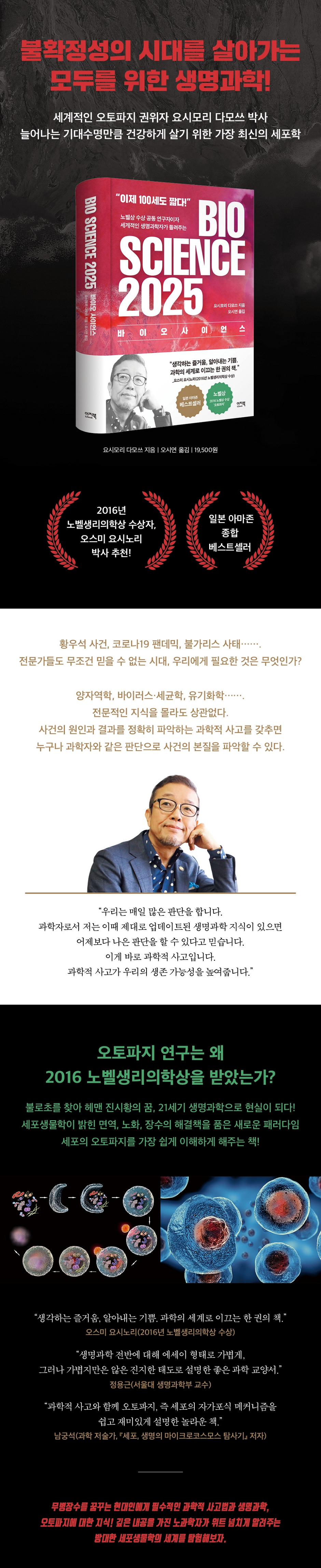
Detailed image
Into the book
… … Scientific thinking is not a special way of thinking reserved only for scientists.
It refers to a rational and logical way of thinking, and anyone can do it.
If you think scientifically, you won't be fooled by the fake science or absurd numbers in this world.
Not only that, but with the wealth of scientific information available to me, I can make decisions I won't regret later.
Perhaps scientific thinking may be a more powerful weapon in our lives than knowledge of life science itself.
And you will also be able to understand the story about cells more quickly.
… …
--- p.24
… … Virus experts provide information about viruses, and economic experts provide information about the economy, but they do not talk about the big picture.
Ultimately, in uncertain situations, you have no choice but to think for yourself.
In such cases, it is very helpful to learn scientific thinking.
… …
--- p.33
… … make a hypothesis and predict its outcome.
And we verify it through experimentation and observation.
If that prediction is correct, the certainty of the hypothesis increases.
This is one of the scientific thinking techniques.
… …
--- p.45
Now you probably understand that the first reason cells are considered the basic units of life is that 'each cell is alive.'
Another important reason is that all the genetic information that makes up a human being is contained within a single cell.
As we will discuss in detail in later chapters, everything in life is determined by genes.
There are tens of thousands of types of genes in the body, and they record (or can be seen as recording code) the information needed to create a human being.
This set of genes is called a genome.
It can be said to be the blueprint of life.
… …
--- p.96
… … What determines a protein is the ‘line up’ of ‘amino acids indicated by three DNA letters lined up.’
They call it a gene.
Proteins are determined by genes.
Therefore, genes can be said to be the blueprint for proteins.
And the double helix of DNA is made up of these multiple genes (blueprints) lined up in a row.
It's a collection of genes. If the double helix of DNA is a book, then genes are the sentences written in that book.
Do you understand up to this point? … …
--- p.118
It is not yet clear why this evolution of living things occurs, but one thing is clear.
It means that diversity is essential for the survival of living things.
Diversity is the law that sustains life.
… …because the essence of life is that without diversity, one would die.
… … There is no life that is not worth living.
… …
--- pp.139~140
The human body has a characteristic called homeostasis.
To put it simply, it is about keeping the body in a constant state.
Thanks to this, our body temperature and weight fluctuate within a certain range and do not deviate significantly.
… … Cells work to maintain homeostasis.
… … If homeostasis is lost, the body cannot maintain its own state.
That is, you get sick.
There are also several causes for cells to lose homeostasis.
--- p.151
… … But what exactly is immunity? Isn't it something we know about, but can't quite explain? Simply put, immunity is a system that protects the body by eliminating external enemies.
… … External enemies refer to pathogens or parasites, and pathogens are broadly divided into three types.
These include viruses, bacteria, fungi, and protozoa.
… … What these pathogens and parasites have in common is that they invade the host's body and cause the host to become sick.
Diseases like this are called infectious diseases.
--- pp.181~182
Viruses cannot freely enter cells.
Interestingly, entering a cell requires a key.
… … If a virus cannot find a protein on the cell surface that matches the shape of the protein called spike on its surface, it cannot invade the cell.
… … and antibodies use this principle to prevent invasion.
It sticks to the virus's key so that it cannot be put into the keyhole.
… …Antibodies that properly attach to the part that goes into the keyhole of the key are called neutralizing antibodies.
However, it is not possible to determine whether these neutralizing antibodies have been produced through conventional antibody tests.
… …
--- pp.190~191
… … The reason we can spend today no different from yesterday is because our cells maintain a ‘always the same’ state, that is, homeostasis.
Disease and aging are the causes of this breakdown in homeostasis.
Simply put, autophagy plays a role in maintaining homeostasis within cells.
… … Therefore, by understanding autophagy, it is beginning to appear that we can prevent disease or slow down the aging process, thereby extending our healthy lifespan.
… … Learning about the principles of autophagy and what role it plays is the latest information on aging and longevity at this stage.
… …
--- pp.231~232
… … There are numerous experiments that directly demonstrate the importance of autophagy in neurons.
For example, mice genetically engineered to suppress autophagy only in their neurons developed Alzheimer's-like symptoms at an early age.
… … The mice used in this experiment are healthy mice that do not carry the gene for such a disease.
That is, even if there is no problem with the protein, clumps form without autophagy.
… …because there is a possibility of curing Alzheimer’s and Parkinson’s diseases, for which there was no specific treatment.
It refers to a rational and logical way of thinking, and anyone can do it.
If you think scientifically, you won't be fooled by the fake science or absurd numbers in this world.
Not only that, but with the wealth of scientific information available to me, I can make decisions I won't regret later.
Perhaps scientific thinking may be a more powerful weapon in our lives than knowledge of life science itself.
And you will also be able to understand the story about cells more quickly.
… …
--- p.24
… … Virus experts provide information about viruses, and economic experts provide information about the economy, but they do not talk about the big picture.
Ultimately, in uncertain situations, you have no choice but to think for yourself.
In such cases, it is very helpful to learn scientific thinking.
… …
--- p.33
… … make a hypothesis and predict its outcome.
And we verify it through experimentation and observation.
If that prediction is correct, the certainty of the hypothesis increases.
This is one of the scientific thinking techniques.
… …
--- p.45
Now you probably understand that the first reason cells are considered the basic units of life is that 'each cell is alive.'
Another important reason is that all the genetic information that makes up a human being is contained within a single cell.
As we will discuss in detail in later chapters, everything in life is determined by genes.
There are tens of thousands of types of genes in the body, and they record (or can be seen as recording code) the information needed to create a human being.
This set of genes is called a genome.
It can be said to be the blueprint of life.
… …
--- p.96
… … What determines a protein is the ‘line up’ of ‘amino acids indicated by three DNA letters lined up.’
They call it a gene.
Proteins are determined by genes.
Therefore, genes can be said to be the blueprint for proteins.
And the double helix of DNA is made up of these multiple genes (blueprints) lined up in a row.
It's a collection of genes. If the double helix of DNA is a book, then genes are the sentences written in that book.
Do you understand up to this point? … …
--- p.118
It is not yet clear why this evolution of living things occurs, but one thing is clear.
It means that diversity is essential for the survival of living things.
Diversity is the law that sustains life.
… …because the essence of life is that without diversity, one would die.
… … There is no life that is not worth living.
… …
--- pp.139~140
The human body has a characteristic called homeostasis.
To put it simply, it is about keeping the body in a constant state.
Thanks to this, our body temperature and weight fluctuate within a certain range and do not deviate significantly.
… … Cells work to maintain homeostasis.
… … If homeostasis is lost, the body cannot maintain its own state.
That is, you get sick.
There are also several causes for cells to lose homeostasis.
--- p.151
… … But what exactly is immunity? Isn't it something we know about, but can't quite explain? Simply put, immunity is a system that protects the body by eliminating external enemies.
… … External enemies refer to pathogens or parasites, and pathogens are broadly divided into three types.
These include viruses, bacteria, fungi, and protozoa.
… … What these pathogens and parasites have in common is that they invade the host's body and cause the host to become sick.
Diseases like this are called infectious diseases.
--- pp.181~182
Viruses cannot freely enter cells.
Interestingly, entering a cell requires a key.
… … If a virus cannot find a protein on the cell surface that matches the shape of the protein called spike on its surface, it cannot invade the cell.
… … and antibodies use this principle to prevent invasion.
It sticks to the virus's key so that it cannot be put into the keyhole.
… …Antibodies that properly attach to the part that goes into the keyhole of the key are called neutralizing antibodies.
However, it is not possible to determine whether these neutralizing antibodies have been produced through conventional antibody tests.
… …
--- pp.190~191
… … The reason we can spend today no different from yesterday is because our cells maintain a ‘always the same’ state, that is, homeostasis.
Disease and aging are the causes of this breakdown in homeostasis.
Simply put, autophagy plays a role in maintaining homeostasis within cells.
… … Therefore, by understanding autophagy, it is beginning to appear that we can prevent disease or slow down the aging process, thereby extending our healthy lifespan.
… … Learning about the principles of autophagy and what role it plays is the latest information on aging and longevity at this stage.
… …
--- pp.231~232
… … There are numerous experiments that directly demonstrate the importance of autophagy in neurons.
For example, mice genetically engineered to suppress autophagy only in their neurons developed Alzheimer's-like symptoms at an early age.
… … The mice used in this experiment are healthy mice that do not carry the gene for such a disease.
That is, even if there is no problem with the protein, clumps form without autophagy.
… …because there is a possibility of curing Alzheimer’s and Parkinson’s diseases, for which there was no specific treatment.
--- p.275
Publisher's Review
“Qin Shi Huang’s dream of finding the elixir of life becomes reality through 21st-century life science!”
The COVID-19 pandemic, the Bulgarian crisis…
Scientific thinking to make accurate judgments without being swayed by illusions
A first-class lecture on life sciences by Dr. Tamotsu Yoshimori, a world authority on autophagy.
“The joy of thinking, the joy of finding out.
“A book that will lead you into the world of science.” _Yoshinori Ohsumi (2016 Nobel Prize in Physiology or Medicine)
"A good science textbook that explains the life sciences in general in a light-hearted, yet serious, manner, in essay form." _Jeong Yong-geun (Professor, Department of Life Sciences, Seoul National University)
"A remarkable book that explains autophagy, the cellular self-eating mechanism, in an easy and engaging way, with scientific thinking." _Namgung Seok (science writer, author of "Cells: Exploring the Microcosmos of Life")
This is an era where science is omnipotent.
So people are often seduced by the word “science” when it comes to diseases like COVID-19 and health-related issues like immunity and longevity.
For example, the Bulgaris incident at Namyang Dairy Products that recently shook our country is one such example.
Companies used experts to exaggerate the results of their animal testing, and people who believed these "experts" at face value bought the products in bulk and even invested in the companies.
This incident had significant repercussions, including the resignation of the group's chairman. But is there any other case that better demonstrates the importance of scientific thinking?
Just because you're an expert doesn't mean you know everything.
Regarding the COVID-19 outbreak, the virus's mechanism has not been clearly elucidated, and no clear answers have yet been provided regarding the efficacy and side effects of vaccines.
In fact, science is a process of endlessly 'getting closer to the truth' by establishing a hypothesis, discarding that hypothesis, establishing another hypothesis, and then discarding that hypothesis again.
The COVID-19 pandemic leaves us with little time to formulate, test, and develop new hypotheses.
So, there are various theories about COVID-19, but they are all just 'hypotheses'.
The virus is spreading, but the data is so incomplete that even the most brilliant experts can only formulate imperfect hypotheses.
Understanding this process will help us avoid being swayed by unverified claims even if an unknown virus like COVID-19 appears again in the future.
Knowledge of science is not important in scientific thinking.
The most important thing is to examine cause and effect, that is, causal relationships.
If you can determine whether two events are correlated or causally related, the chances of making a wrong decision are greatly reduced.
This is why the scientific thinking method explained in this book is useful to everyone.
“Intermittent fasting also helps with longevity by activating autophagy!”
The mysterious cellular mechanism for living a long and healthy life,
The easiest book to understand autophagy!
The basis of life is cells.
Therefore, it can be said that knowing about cells means knowing most of life science.
In this book, Dr. Tamotsu Yoshimori explains the basic concepts of biology, such as DNA, genes, genomes, viruses and bacteria, and immunity, in an easy-to-understand manner, and then naturally moves on to explain autophagy, his area of expertise.
Autophagy is also the subject of the 2016 Nobel Prize in Physiology or Medicine awarded to Dr. Yoshinori Ohsumi of Japan.
Dr. Tamotsu Yoshimori is a leading authority on mammalian autophagy, having worked with Dr. Yoshinori Ohsumi's research team.
Autophagy, which has been attracting worldwide attention since the Nobel Prize, is, in a word, 'a cellular mechanism that breaks down and recycles the inside of the cell.'
The inside of a cell is like a society.
Outside, invaders like bacteria and viruses are constantly waiting for an opportunity, and inside, we have to deal with the breakdowns caused by the organelles that make up the cell.
And the cell's ability to simultaneously deal with these invaders and breakdown of cellular organelles is autophagy.
Activating this autophagy extends lifespan.
It also has the function of increasing the effectiveness of vaccines, suppressing inflammation, and strengthening immunity, and is also good for beauty.
This book, written by a world-renowned expert, explains autophagy in an easy and fun way, and also provides tips on how to strengthen autophagy, such as intermittent fasting and exercise.
“This is the first book that conveys the latest knowledge in such an easy and fun way.”
An Amazon Japan comprehensive bestseller immediately after publication!
A science textbook that highlights the depth and wit of a world-renowned scholar.
When the COVID-19 pandemic broke out, all media outlets were flooded with information.
However, in the end, it is up to the individual to decide which information to select from the sea of information.
To do that, you need to have the ability to think rationally and logically for yourself.
The author argues that this is scientific thinking, and that it is an ability that anyone can possess, regardless of their level of knowledge.
“I think our researchers are also at fault.
Haven't researchers been too reserved about their own thoughts, the research they're currently conducting, and what they've learned from it? When I was younger, I rarely engaged in such activities, focusing solely on research.
But now, we live in an era where it is difficult to actively respond to something without a good understanding of science.”
『Bioscience 2025』 is a science book written by a world-renowned scholar.
But anyone can easily understand it.
The fact that he can write about the vast world of cell science so easily and wittily demonstrates his deep inner strength and sincerity as a veteran scientist.
This book will provide essential knowledge on scientific thinking, life science, and autophagy that all modern people who wish to live a long and healthy life must know.
The COVID-19 pandemic, the Bulgarian crisis…
Scientific thinking to make accurate judgments without being swayed by illusions
A first-class lecture on life sciences by Dr. Tamotsu Yoshimori, a world authority on autophagy.
“The joy of thinking, the joy of finding out.
“A book that will lead you into the world of science.” _Yoshinori Ohsumi (2016 Nobel Prize in Physiology or Medicine)
"A good science textbook that explains the life sciences in general in a light-hearted, yet serious, manner, in essay form." _Jeong Yong-geun (Professor, Department of Life Sciences, Seoul National University)
"A remarkable book that explains autophagy, the cellular self-eating mechanism, in an easy and engaging way, with scientific thinking." _Namgung Seok (science writer, author of "Cells: Exploring the Microcosmos of Life")
This is an era where science is omnipotent.
So people are often seduced by the word “science” when it comes to diseases like COVID-19 and health-related issues like immunity and longevity.
For example, the Bulgaris incident at Namyang Dairy Products that recently shook our country is one such example.
Companies used experts to exaggerate the results of their animal testing, and people who believed these "experts" at face value bought the products in bulk and even invested in the companies.
This incident had significant repercussions, including the resignation of the group's chairman. But is there any other case that better demonstrates the importance of scientific thinking?
Just because you're an expert doesn't mean you know everything.
Regarding the COVID-19 outbreak, the virus's mechanism has not been clearly elucidated, and no clear answers have yet been provided regarding the efficacy and side effects of vaccines.
In fact, science is a process of endlessly 'getting closer to the truth' by establishing a hypothesis, discarding that hypothesis, establishing another hypothesis, and then discarding that hypothesis again.
The COVID-19 pandemic leaves us with little time to formulate, test, and develop new hypotheses.
So, there are various theories about COVID-19, but they are all just 'hypotheses'.
The virus is spreading, but the data is so incomplete that even the most brilliant experts can only formulate imperfect hypotheses.
Understanding this process will help us avoid being swayed by unverified claims even if an unknown virus like COVID-19 appears again in the future.
Knowledge of science is not important in scientific thinking.
The most important thing is to examine cause and effect, that is, causal relationships.
If you can determine whether two events are correlated or causally related, the chances of making a wrong decision are greatly reduced.
This is why the scientific thinking method explained in this book is useful to everyone.
“Intermittent fasting also helps with longevity by activating autophagy!”
The mysterious cellular mechanism for living a long and healthy life,
The easiest book to understand autophagy!
The basis of life is cells.
Therefore, it can be said that knowing about cells means knowing most of life science.
In this book, Dr. Tamotsu Yoshimori explains the basic concepts of biology, such as DNA, genes, genomes, viruses and bacteria, and immunity, in an easy-to-understand manner, and then naturally moves on to explain autophagy, his area of expertise.
Autophagy is also the subject of the 2016 Nobel Prize in Physiology or Medicine awarded to Dr. Yoshinori Ohsumi of Japan.
Dr. Tamotsu Yoshimori is a leading authority on mammalian autophagy, having worked with Dr. Yoshinori Ohsumi's research team.
Autophagy, which has been attracting worldwide attention since the Nobel Prize, is, in a word, 'a cellular mechanism that breaks down and recycles the inside of the cell.'
The inside of a cell is like a society.
Outside, invaders like bacteria and viruses are constantly waiting for an opportunity, and inside, we have to deal with the breakdowns caused by the organelles that make up the cell.
And the cell's ability to simultaneously deal with these invaders and breakdown of cellular organelles is autophagy.
Activating this autophagy extends lifespan.
It also has the function of increasing the effectiveness of vaccines, suppressing inflammation, and strengthening immunity, and is also good for beauty.
This book, written by a world-renowned expert, explains autophagy in an easy and fun way, and also provides tips on how to strengthen autophagy, such as intermittent fasting and exercise.
“This is the first book that conveys the latest knowledge in such an easy and fun way.”
An Amazon Japan comprehensive bestseller immediately after publication!
A science textbook that highlights the depth and wit of a world-renowned scholar.
When the COVID-19 pandemic broke out, all media outlets were flooded with information.
However, in the end, it is up to the individual to decide which information to select from the sea of information.
To do that, you need to have the ability to think rationally and logically for yourself.
The author argues that this is scientific thinking, and that it is an ability that anyone can possess, regardless of their level of knowledge.
“I think our researchers are also at fault.
Haven't researchers been too reserved about their own thoughts, the research they're currently conducting, and what they've learned from it? When I was younger, I rarely engaged in such activities, focusing solely on research.
But now, we live in an era where it is difficult to actively respond to something without a good understanding of science.”
『Bioscience 2025』 is a science book written by a world-renowned scholar.
But anyone can easily understand it.
The fact that he can write about the vast world of cell science so easily and wittily demonstrates his deep inner strength and sincerity as a veteran scientist.
This book will provide essential knowledge on scientific thinking, life science, and autophagy that all modern people who wish to live a long and healthy life must know.
GOODS SPECIFICS
- Date of issue: May 27, 2021
- Format: Hardcover book binding method guide
- Page count, weight, size: 360 pages | 532g | 150*210*22mm
- ISBN13: 9788957079010
- ISBN10: 8957079017
You may also like
카테고리
korean


korean

![ELLE 엘르 스페셜 에디션 A형 : 12월 [2025]](http://librairie.coreenne.fr/cdn/shop/files/b8e27a3de6c9538896439686c6b0e8fb.jpg?v=1766436872&width=3840)


