

animal
 |
Description
Book Introduction
100,000 copies published in 11 countries worldwide!
A collection of the British Museum of Natural History and the Smithsonian Museum in the United States.
DK Encyclopedia Animals
On March 3rd, World Wildlife Day, Australia designated the world's first platypus sanctuary, a critically endangered species that is losing its habitat due to successive wildfires.
As Earth Day (April 22nd) approaches, it is crucial to revisit ecosystems threatened by climate change and habitat loss.
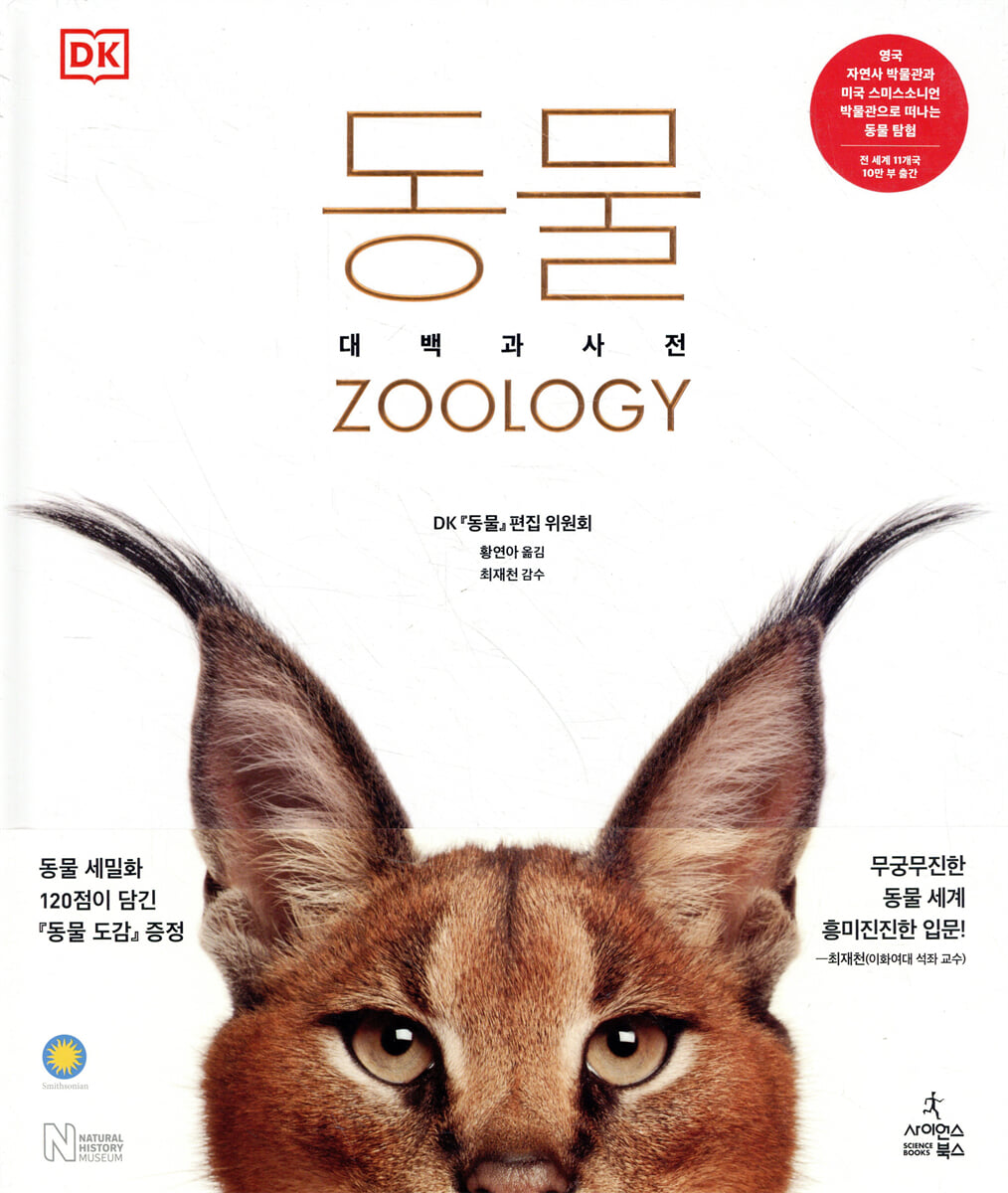
The latest edition of the encyclopedia series exploring all life on Earth, "Zoology," condenses the wondrous world of nature and the latest trends in zoological research into a single, accessible overview.
This is an encyclopedia of animals that was born from the collaboration between the Smithsonian in the United States, the Natural History Museum in the UK, and the renowned British publishing house Dorling Kindersley (DK), following 『Flora』, which was translated and published in 16 countries around the world and introduced by Science Books last year.
Museums and photographers from around the world participated, including the National Museum of Natural History, which houses over 80 million specimens spanning 4.6 billion years of history, and the Smithsonian Museum of Natural History, which has a collection of over 126 million items.
"Animals" offers colorful and surprising images and friendly, insightful explanations that will captivate young readers new to the animal world, as well as anyone interested in the environment and ecology.
Translator Yeon-ah Hwang, who holds a master's degree in animal behavior and participated in magpie research at Harvard University, is also the co-translator of 『The Natural History Book』, a bestseller in the DK Encyclopedia series.
Also, Professor Jae-Cheon Choi, a distinguished professor in the Department of Ecology at Ewha Womans University who supervised this book, is the president of the Biodiversity Foundation and the editor-in-chief of the Encyclopedia of Animal Behavior, and he strongly recommends 『Animal』 as “an encyclopedia that provides just the right amount of information.”
In the special appendix, “Animal Encyclopedia,” you can carefully examine 120 detailed drawings of various animals, sorted by species.
A collection of the British Museum of Natural History and the Smithsonian Museum in the United States.
DK Encyclopedia Animals
On March 3rd, World Wildlife Day, Australia designated the world's first platypus sanctuary, a critically endangered species that is losing its habitat due to successive wildfires.
As Earth Day (April 22nd) approaches, it is crucial to revisit ecosystems threatened by climate change and habitat loss.
The latest edition of the encyclopedia series exploring all life on Earth, "Zoology," condenses the wondrous world of nature and the latest trends in zoological research into a single, accessible overview.
This is an encyclopedia of animals that was born from the collaboration between the Smithsonian in the United States, the Natural History Museum in the UK, and the renowned British publishing house Dorling Kindersley (DK), following 『Flora』, which was translated and published in 16 countries around the world and introduced by Science Books last year.
Museums and photographers from around the world participated, including the National Museum of Natural History, which houses over 80 million specimens spanning 4.6 billion years of history, and the Smithsonian Museum of Natural History, which has a collection of over 126 million items.
"Animals" offers colorful and surprising images and friendly, insightful explanations that will captivate young readers new to the animal world, as well as anyone interested in the environment and ecology.
Translator Yeon-ah Hwang, who holds a master's degree in animal behavior and participated in magpie research at Harvard University, is also the co-translator of 『The Natural History Book』, a bestseller in the DK Encyclopedia series.
Also, Professor Jae-Cheon Choi, a distinguished professor in the Department of Ecology at Ewha Womans University who supervised this book, is the president of the Biodiversity Foundation and the editor-in-chief of the Encyclopedia of Animal Behavior, and he strongly recommends 『Animal』 as “an encyclopedia that provides just the right amount of information.”
In the special appendix, “Animal Encyclopedia,” you can carefully examine 120 detailed drawings of various animals, sorted by species.
index
Animal Kingdom / 12 What is an Animal? / 14 Evolution / 16 Types of Animals / 18 Behavior of Beetles / 20 Fish and Amphibians / 22 Reptiles and Birds / 24 Mammals / 26 Prehistoric Painting / Body Shape and Size / 30 Symmetry and Asymmetry / 32 Colony Formation / 34 Radial Symmetry / 36 Symmetry in Motion / 38 Darwinists / 40 Comb Jellies / 42 Body with a Simple Head / 44 Sexual Differences / 46 The Renaissance Eye / 48 Segmented Body / 50 Vertebrate Body / 52 Body Type of Frog / 54 Body Rolling for Defense / 56 Giant Animals / 58 Fantastic Animals / 60 Tall Animals / Skeletons 64 Hollow Skeletons / 66 Male Skeletons / 68 Exoskeletons / 70 Land Animals with Exoskeletons / 72 Cretaceous Skeletons / 74 Endoskeletons / 76 Indigenous Insights / 78 Skeletons of vertebrates/ 80 Shells of vertebrates/ 82 Skeletons of birds/ 84 Cheetah/ 86 Horns of mammals/ 88 Antlers of deer/ Skin, integument, and armor/ 92 Permeable skin/ 94 Obtaining oxygen/ 96 Poisonous skin/ 98 Skin color/ 100 Formation of shells/ 102 Shells of mollusks/ 104 Scales of vertebrates/ 106 Skins of reptiles/ 108 Advertising colors/ 110 Art of the Mughal court/ 112 Shawls and chin pouches/ 114 Weapons and fighting/ 116 Blending in with the background/ 118 Caterpillars/ 120 Feathers/ 122 Feathers for flight/ 124 Feathers for display/ 126 Seasonal protection/ 128 Fur of mammals/ 130 The essence of expressionism/ 132 Skin glands/ 134 From skin to bone/ 136 Armed Skin/ Senses/ 140 Sensitive antennae/ 142 Sensory setae/ 144 Small world/ 146 Whiskers that sense sensations/ 148 Senses of underwater animals/ 150 Tasting air/ 152 Heat detection/ 154 Electric sense/ 156 Light detection/ 158 Pupil shape/ 160 Compound eyes/ 162 Color vision/ 164 Depth seeing/ 166 Kingfishers/ 168 Smell detection/ 170 Birds' sense of smell/ 172 Songbirds/ 174 Mammalian sense of smell/ 176 Animals' hearing/ 178 Mammalian ears/ 180 Echo listening/ 182 Common dolphin/ Mouth and jaw/ 186 Filter feeding/ 188 Christmas tree worm/ 190 Invertebrate jaws/ 192 Injecting venom/ 194 Vertebrate jaws/ 196 Birds' beaks/ 198 Birds' beaks Form/ 200 The Art of Ornithologists/ 202 The Teeth of Carnivores/ 204 The Giant Panda/ 206 Herbivory/ 208 The Flexible Face/ Legs, Arms, Tentacles, and Tails/ 212 Tube Feet/ 214 Leg Joints/ 216 The Limbs of Vertebrates/ 218 The Claws of Mammalians/ 220 The Tiger/ 222 Sticky Feet/ 224 The Feet That Bring Death/ 226 Climbing and Perching on Branches/ 228 The Hoofs of Mammalians/ 230 The Alpine Ibex/ 232 The Pincers of Arthropods/ 234 Artists in the Ephemeral World/ 236 Swinging Through Trees/ 238 The Hands of Primates/ 240 The Orangutan/ 242 The Arms of the Octopus/ 244 The Stinging Tentacles/ 246 The Prehensile Tail/ 248 The Celestial Bird/ Fins, Flippers, Paddles / 252 Nekton and Plankton / 254 Blue Nudibranchs / 256 Swimming of Fish / 258 Wings in Water / 260 Fins of Fish / 262 Swimming with Dorsal Fins / 264 Flying Fish / 266 Poisonous Thorns / 268 Empire of Abundance / 270 Walking on the Seabed / 272 Returning to the Water / 274 Whale Tails / Wings and Wing Membrane / 278 Flight of Insects / 280 Wings Covered with Scales / 282 Gliding and Falling / 284 Flight of Birds / 286 Bearded Vultures / 288 Wings of Birds / 290 Emperor Penguins / 292 Hovering Flight / 294 Birds of Egypt / 296 Wings Made of Skin / Eggs and Chicks / 300 Making Eggs / 302 Fertilization / 304 Parental Devotion / 306 Polar bear / 308 Eggshell / 310 Bird eggs / 312 Marsupial pouch / 314 From larva to adult / 316 Metamorphosis in amphibians / 318 Becoming mature / 320 Glossary / 326 Index / 334 Copyright of illustrations
Detailed image

Publisher's Review
100,000 copies published in 11 countries worldwide!
A collection of the British Museum of Natural History and the Smithsonian Museum in the United States.
DK Encyclopedia Animals
Includes four Fantastic Beasts postcards and a special detailed animal guide.
An encyclopedia of animal morphology, physiology, behavior, and adaptation, blending information and entertainment. ― Choi Jae-cheon (Professor Emeritus, Department of Ecology, Ewha Womans University; Director of the Biodiversity Foundation; Editor-in-Chief, Encyclopedia of Animal Behavior)
This beautiful book offers a perfect model for celebrating art, revealing truth, and igniting curiosity about the natural sciences.
― Chris Packham (naturalist, broadcaster, author and photographer)
On March 3rd, World Wildlife Day, Australia designated the world's first platypus sanctuary, a critically endangered species that is losing its habitat due to successive wildfires.
As Earth Day (April 22nd) approaches, it is crucial to revisit ecosystems threatened by climate change and habitat loss.
The latest edition of the encyclopedia series exploring all life on Earth, "Zoology," condenses the wondrous world of nature and the latest trends in zoological research into a single, accessible overview.
This is an encyclopedia of animals that was born from the collaboration between the Smithsonian in the United States, the Natural History Museum in the UK, and the renowned British publishing house Dorling Kindersley (DK), following 『Flora』, which was translated and published in 16 countries around the world and introduced by Science Books last year.
Museums and photographers from around the world participated, including the National Museum of Natural History, which houses over 80 million specimens spanning 4.6 billion years of history, and the Smithsonian Museum of Natural History, which has a collection of over 126 million items.
"Animals" offers colorful and surprising images and friendly, insightful explanations that will captivate young readers new to the animal world, as well as anyone interested in the environment and ecology.
Translator Yeon-ah Hwang, who holds a master's degree in animal behavior and participated in magpie research at Harvard University, is also the co-translator of 『The Natural History Book』, a bestseller in the DK Encyclopedia series.
Also, Professor Jae-Cheon Choi, a distinguished professor in the Department of Ecology at Ewha Womans University who supervised this book, is the president of the Biodiversity Foundation and the editor-in-chief of the Encyclopedia of Animal Behavior, and he strongly recommends 『Animal』 as “an encyclopedia that provides just the right amount of information.”
In the special appendix, “Animal Encyclopedia,” you can carefully examine 120 detailed drawings of various animals, sorted by species.
Antennae and horns, wings and fins
All about three-dimensional animals
The rim of the jellyfish cap contains gravity-sensing cells that help it distinguish between up and down.
A black poison frog climbs 50 meters to reach a pool of water in a tree hole.
A cheetah's stride can be up to 9 meters.
A whale's tail has no bones.
This book takes a unique approach to organization based on the form and function of animals.
Each chapter introduces the diverse and mysterious "animal kingdom" freely through keywords such as "body shape and size", "skeleton", "skin, integument, armor", "sense", "mouth and jaw", "legs, arms, tentacles, tail", "fins, flippers, paddles", "wings and wing membranes", and "eggs, eggs, young".
Every form of life has its own function, and the structure of nature helps us classify them by discovering the flexible relationships between species and revealing the process of evolution.
About a quarter of the approximately 15 million animal species known to inhabit the sea and land belong to a single insect taxon called beetles.
Scientists classify different animals based on common traits they inherited from a common ancestor.
All animals alive today have evolved from other animals that existed in the past.
"Body Shape and Size" Tentacled animals were common in the prehistoric seas 500 million years ago, and many tentacled animals still remain today.
During the evolutionary process, insects became segmented so that each part of their body could move independently, and jointed legs were added to allow for more efficient movement.
The body shape of frogs and toads, found on every continent except Antarctica, has remained virtually unchanged for 250 million years.
The "skeleton" supports the animal's shape and movement.
As seen in corals, the skeleton can effectively support the sprawling colony, much like a tree trunk and branches support leaves.
Many animals have protrusions on their bodies, from the Amazon green beetle to the horn-like scales of some lizards, but only ungulates, such as antelope, have true horns, which are bone extensions of the skull and are used for dominance battles between males or defense against predators.
「Skin, Outer Shell, Armor」 Most of the beautiful colors that decorate the bodies of animals are due to pigments created by chemical processes in skin cells, but green, blue, and purple are usually created when skin, scales, or feathers reflect light from the body surface.
"Sense" The skin of all animals is at the forefront of encountering the environment, so it is filled with sensory nerve endings that detect signals from the environment and transmit them to the brain.
When stimulated sensors send electrical signals deep inside the body, the animal perceives its environment, and when the animal's brain receives the electrical signals, it processes the information and decides how to react.
Echidnas can find bugs in the dirt with the electrical sensors in their pointed noses, and platypuses use sensors in their beaks to detect electrical signals from food and movement in water.
"Mouth and Jaws" Animals have evolved efficient techniques to collect food floating in the water.
The sharp jaws were effective as defensive weapons or as tools for catching and killing prey.
For animals that rely heavily on sight and display behavior, the face has become a means of expressing mood and interest.
A journey of knowledge through the natural history museum in the book
Discover the beautiful and wondrous animal kingdom through the Encyclopedia series.
The natural feeling for life that animals have awakens all the goodness within me.
─ Franz Marc
As a falcon, I live in the light.
My crown and my splendor have given me power.
─ 『The Book of the Dead』
I have not spent a single day listening to the songs of birds, observing their peculiar habits, or studying them in as much detail as possible.
I can't give up on technology.
─ John James Audubon
"Legs, arms, tentacles, tail" All birds, most reptiles, and mammals have claws, and some amphibians also have claws.
The white-breasted baboon is agile enough to run down tree trunks with its head down, and the great ape's hands are strong and surprisingly sensitive.
An octopus's arms move solely by muscle power, like a tongue or an elephant's trunk, without an exoskeleton.
"Fins, flippers, paddles" Large rays fly through the ocean by flapping their pectoral fins like wings.
The shaman shad has the ability to crawl along the seabed, luring small fish into its mouth using a flag-like lure.
Different swimming vertebrates have evolved flippers with hydrodynamic shapes like shark fins, while turtles and dolphins evolved from walking ancestors, while penguins' flippers are modified wings.
"Wings and Membranes" To fly, you must overcome gravity, lift your body into the air, and receive propulsion to move forward.
400 million years ago, insects evolved wings from their hard exoskeletal coverings, enabling them to levitate and maneuver through the air.
By transforming their wings into flaps, like those of the Sunda flying monkey, which can glide 100 meters while falling from a height of 10 meters, animals can reduce their impact speed and land safely.
Bat wings, made of living skin, can sensitively sense the surrounding air.
"Eggs, eggs, offspring" All parents invest time and energy in reproduction, going beyond producing eggs and sperm to raising offspring.
All animals undergo changes as they develop from juveniles to sexually mature adults, but in insects the changes are particularly dramatic.
The beauty of living animals in works of art
A sophisticated meeting of science and art
The Altamira Cave paintings have reached the pinnacle of perfection and cannot be improved upon any further.
─ Luis Pericot-Garcia
The close relationships among all beings belonging to the same taxonomic group can be represented as one giant tree.
─ Charles Darwin
Every animal shows some naturalness and some beauty.
─ Aristotle
Thanks to the microscope, there is no object too small to be studied.
─ Robert Hook
If you observe nature carefully, you will understand all things better.
─ Albert Einstein
Animals have also been a constant source of inspiration in the history of art.
The wallaby paintings on the walls of Australia's Ubirr Cave are nothing short of modern art.
The ancient Egyptians attributed religious significance to birds and depicted them in paintings and sculptures.
Fish and exotic pets in ancient Roman mosaics were tools for celebrating the bounty of nature, and fable books for illiterate medieval people featured colorful animal drawings.
Artists of the Renaissance era began to rediscover nature, and with the development of microscopes and printing techniques, this became an era where art and science met anew.
This book presents a selection of the most essential illustrations, a fusion of aesthetic diversity and zoological discovery.
From the cat fresco in "Nevamun Hunting in the Swamp" to Maria Sibylla Merian's "Caterpillar, Butterfly, and Flower," John James Audubon's "White-billed Woodpecker," and Franz Marc's "The Blue Fox," "Animals" come alive in works of art that powerfully capture the shapes and colors of nature, transcending time and space to offer readers new emotions.
First of all, the photos are amazing.
It's enough to get anyone hooked.
We carefully select animals that are familiar to us because we have seen them often, as well as animals that we cannot help but like once we get to know them, and explain their morphology, physiology, behavior, adaptation, habitat, and migration in an engaging and appropriate way.
Information about the conservation of endangered wildlife is particularly useful and valuable.
Even the best encyclopedia cannot contain everything.
This is especially true for encyclopedias for children.
But 『Animal』 surprisingly blends information and fun.
If you try to teach too openly, children will soon lose interest.
We provide you with the information you need, in the amount you need.
As someone who has created an encyclopedia, I cannot help but be impressed.
It seems like time flies when you have a child.
Choi Jae-cheon (Professor Emeritus, Department of Ecology, Ewha Womans University; Director of the Biodiversity Foundation; Editor-in-Chief, Encyclopedia of Animal Behavior)
A collection of the British Museum of Natural History and the Smithsonian Museum in the United States.
DK Encyclopedia Animals
Includes four Fantastic Beasts postcards and a special detailed animal guide.
An encyclopedia of animal morphology, physiology, behavior, and adaptation, blending information and entertainment. ― Choi Jae-cheon (Professor Emeritus, Department of Ecology, Ewha Womans University; Director of the Biodiversity Foundation; Editor-in-Chief, Encyclopedia of Animal Behavior)
This beautiful book offers a perfect model for celebrating art, revealing truth, and igniting curiosity about the natural sciences.
― Chris Packham (naturalist, broadcaster, author and photographer)
On March 3rd, World Wildlife Day, Australia designated the world's first platypus sanctuary, a critically endangered species that is losing its habitat due to successive wildfires.
As Earth Day (April 22nd) approaches, it is crucial to revisit ecosystems threatened by climate change and habitat loss.
The latest edition of the encyclopedia series exploring all life on Earth, "Zoology," condenses the wondrous world of nature and the latest trends in zoological research into a single, accessible overview.
This is an encyclopedia of animals that was born from the collaboration between the Smithsonian in the United States, the Natural History Museum in the UK, and the renowned British publishing house Dorling Kindersley (DK), following 『Flora』, which was translated and published in 16 countries around the world and introduced by Science Books last year.
Museums and photographers from around the world participated, including the National Museum of Natural History, which houses over 80 million specimens spanning 4.6 billion years of history, and the Smithsonian Museum of Natural History, which has a collection of over 126 million items.
"Animals" offers colorful and surprising images and friendly, insightful explanations that will captivate young readers new to the animal world, as well as anyone interested in the environment and ecology.
Translator Yeon-ah Hwang, who holds a master's degree in animal behavior and participated in magpie research at Harvard University, is also the co-translator of 『The Natural History Book』, a bestseller in the DK Encyclopedia series.
Also, Professor Jae-Cheon Choi, a distinguished professor in the Department of Ecology at Ewha Womans University who supervised this book, is the president of the Biodiversity Foundation and the editor-in-chief of the Encyclopedia of Animal Behavior, and he strongly recommends 『Animal』 as “an encyclopedia that provides just the right amount of information.”
In the special appendix, “Animal Encyclopedia,” you can carefully examine 120 detailed drawings of various animals, sorted by species.
Antennae and horns, wings and fins
All about three-dimensional animals
The rim of the jellyfish cap contains gravity-sensing cells that help it distinguish between up and down.
A black poison frog climbs 50 meters to reach a pool of water in a tree hole.
A cheetah's stride can be up to 9 meters.
A whale's tail has no bones.
This book takes a unique approach to organization based on the form and function of animals.
Each chapter introduces the diverse and mysterious "animal kingdom" freely through keywords such as "body shape and size", "skeleton", "skin, integument, armor", "sense", "mouth and jaw", "legs, arms, tentacles, tail", "fins, flippers, paddles", "wings and wing membranes", and "eggs, eggs, young".
Every form of life has its own function, and the structure of nature helps us classify them by discovering the flexible relationships between species and revealing the process of evolution.
About a quarter of the approximately 15 million animal species known to inhabit the sea and land belong to a single insect taxon called beetles.
Scientists classify different animals based on common traits they inherited from a common ancestor.
All animals alive today have evolved from other animals that existed in the past.
"Body Shape and Size" Tentacled animals were common in the prehistoric seas 500 million years ago, and many tentacled animals still remain today.
During the evolutionary process, insects became segmented so that each part of their body could move independently, and jointed legs were added to allow for more efficient movement.
The body shape of frogs and toads, found on every continent except Antarctica, has remained virtually unchanged for 250 million years.
The "skeleton" supports the animal's shape and movement.
As seen in corals, the skeleton can effectively support the sprawling colony, much like a tree trunk and branches support leaves.
Many animals have protrusions on their bodies, from the Amazon green beetle to the horn-like scales of some lizards, but only ungulates, such as antelope, have true horns, which are bone extensions of the skull and are used for dominance battles between males or defense against predators.
「Skin, Outer Shell, Armor」 Most of the beautiful colors that decorate the bodies of animals are due to pigments created by chemical processes in skin cells, but green, blue, and purple are usually created when skin, scales, or feathers reflect light from the body surface.
"Sense" The skin of all animals is at the forefront of encountering the environment, so it is filled with sensory nerve endings that detect signals from the environment and transmit them to the brain.
When stimulated sensors send electrical signals deep inside the body, the animal perceives its environment, and when the animal's brain receives the electrical signals, it processes the information and decides how to react.
Echidnas can find bugs in the dirt with the electrical sensors in their pointed noses, and platypuses use sensors in their beaks to detect electrical signals from food and movement in water.
"Mouth and Jaws" Animals have evolved efficient techniques to collect food floating in the water.
The sharp jaws were effective as defensive weapons or as tools for catching and killing prey.
For animals that rely heavily on sight and display behavior, the face has become a means of expressing mood and interest.
A journey of knowledge through the natural history museum in the book
Discover the beautiful and wondrous animal kingdom through the Encyclopedia series.
The natural feeling for life that animals have awakens all the goodness within me.
─ Franz Marc
As a falcon, I live in the light.
My crown and my splendor have given me power.
─ 『The Book of the Dead』
I have not spent a single day listening to the songs of birds, observing their peculiar habits, or studying them in as much detail as possible.
I can't give up on technology.
─ John James Audubon
"Legs, arms, tentacles, tail" All birds, most reptiles, and mammals have claws, and some amphibians also have claws.
The white-breasted baboon is agile enough to run down tree trunks with its head down, and the great ape's hands are strong and surprisingly sensitive.
An octopus's arms move solely by muscle power, like a tongue or an elephant's trunk, without an exoskeleton.
"Fins, flippers, paddles" Large rays fly through the ocean by flapping their pectoral fins like wings.
The shaman shad has the ability to crawl along the seabed, luring small fish into its mouth using a flag-like lure.
Different swimming vertebrates have evolved flippers with hydrodynamic shapes like shark fins, while turtles and dolphins evolved from walking ancestors, while penguins' flippers are modified wings.
"Wings and Membranes" To fly, you must overcome gravity, lift your body into the air, and receive propulsion to move forward.
400 million years ago, insects evolved wings from their hard exoskeletal coverings, enabling them to levitate and maneuver through the air.
By transforming their wings into flaps, like those of the Sunda flying monkey, which can glide 100 meters while falling from a height of 10 meters, animals can reduce their impact speed and land safely.
Bat wings, made of living skin, can sensitively sense the surrounding air.
"Eggs, eggs, offspring" All parents invest time and energy in reproduction, going beyond producing eggs and sperm to raising offspring.
All animals undergo changes as they develop from juveniles to sexually mature adults, but in insects the changes are particularly dramatic.
The beauty of living animals in works of art
A sophisticated meeting of science and art
The Altamira Cave paintings have reached the pinnacle of perfection and cannot be improved upon any further.
─ Luis Pericot-Garcia
The close relationships among all beings belonging to the same taxonomic group can be represented as one giant tree.
─ Charles Darwin
Every animal shows some naturalness and some beauty.
─ Aristotle
Thanks to the microscope, there is no object too small to be studied.
─ Robert Hook
If you observe nature carefully, you will understand all things better.
─ Albert Einstein
Animals have also been a constant source of inspiration in the history of art.
The wallaby paintings on the walls of Australia's Ubirr Cave are nothing short of modern art.
The ancient Egyptians attributed religious significance to birds and depicted them in paintings and sculptures.
Fish and exotic pets in ancient Roman mosaics were tools for celebrating the bounty of nature, and fable books for illiterate medieval people featured colorful animal drawings.
Artists of the Renaissance era began to rediscover nature, and with the development of microscopes and printing techniques, this became an era where art and science met anew.
This book presents a selection of the most essential illustrations, a fusion of aesthetic diversity and zoological discovery.
From the cat fresco in "Nevamun Hunting in the Swamp" to Maria Sibylla Merian's "Caterpillar, Butterfly, and Flower," John James Audubon's "White-billed Woodpecker," and Franz Marc's "The Blue Fox," "Animals" come alive in works of art that powerfully capture the shapes and colors of nature, transcending time and space to offer readers new emotions.
First of all, the photos are amazing.
It's enough to get anyone hooked.
We carefully select animals that are familiar to us because we have seen them often, as well as animals that we cannot help but like once we get to know them, and explain their morphology, physiology, behavior, adaptation, habitat, and migration in an engaging and appropriate way.
Information about the conservation of endangered wildlife is particularly useful and valuable.
Even the best encyclopedia cannot contain everything.
This is especially true for encyclopedias for children.
But 『Animal』 surprisingly blends information and fun.
If you try to teach too openly, children will soon lose interest.
We provide you with the information you need, in the amount you need.
As someone who has created an encyclopedia, I cannot help but be impressed.
It seems like time flies when you have a child.
Choi Jae-cheon (Professor Emeritus, Department of Ecology, Ewha Womans University; Director of the Biodiversity Foundation; Editor-in-Chief, Encyclopedia of Animal Behavior)
GOODS SPECIFICS
- Date of issue: April 1, 2021
- Format: Hardcover book binding method guide
- Page count, weight, size: 336 pages | 2,612g | 260*308*34mm
- ISBN13: 9791190403412
- ISBN10: 1190403412
You may also like
카테고리
korean


korean

![ELLE 엘르 스페셜 에디션 A형 : 12월 [2025]](http://librairie.coreenne.fr/cdn/shop/files/b8e27a3de6c9538896439686c6b0e8fb.jpg?v=1766436872&width=3840)


