

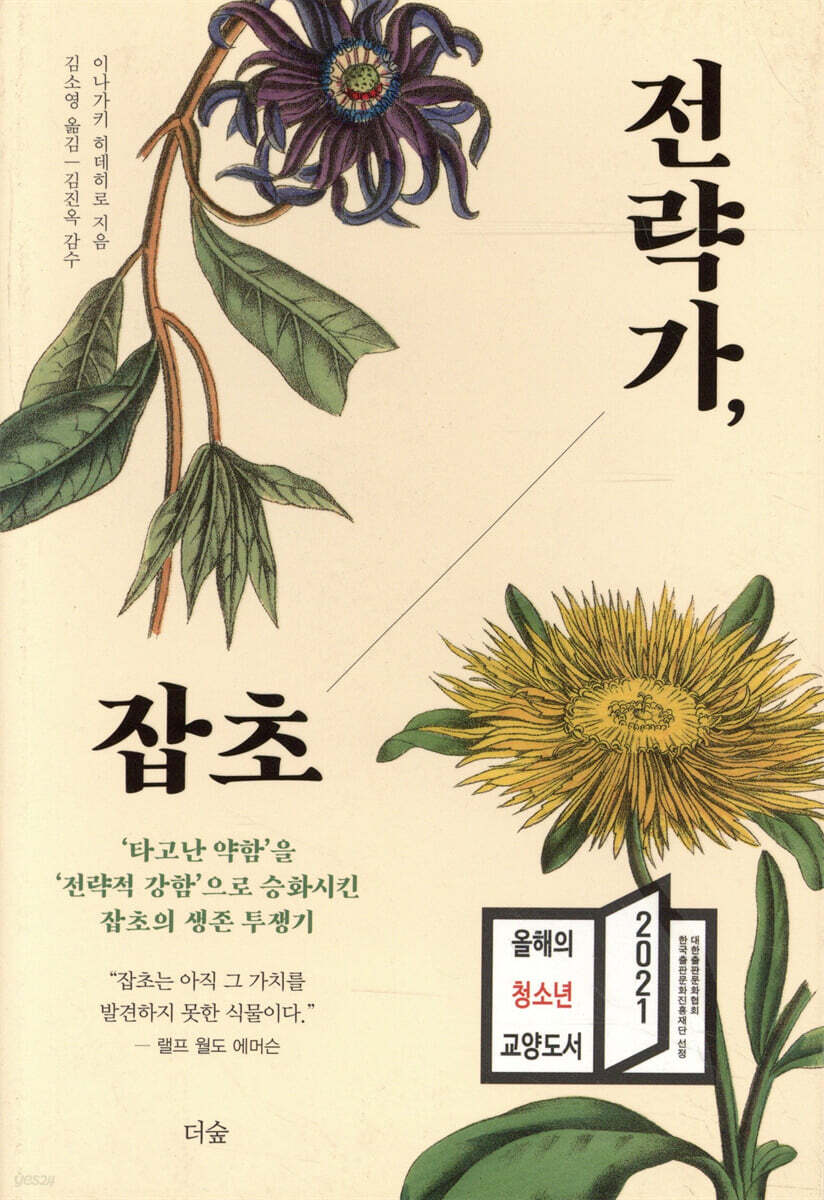
Strategist, Weed
 |
Description
Book Introduction
Rich scientific knowledge presented with a unique perspective and witty writing
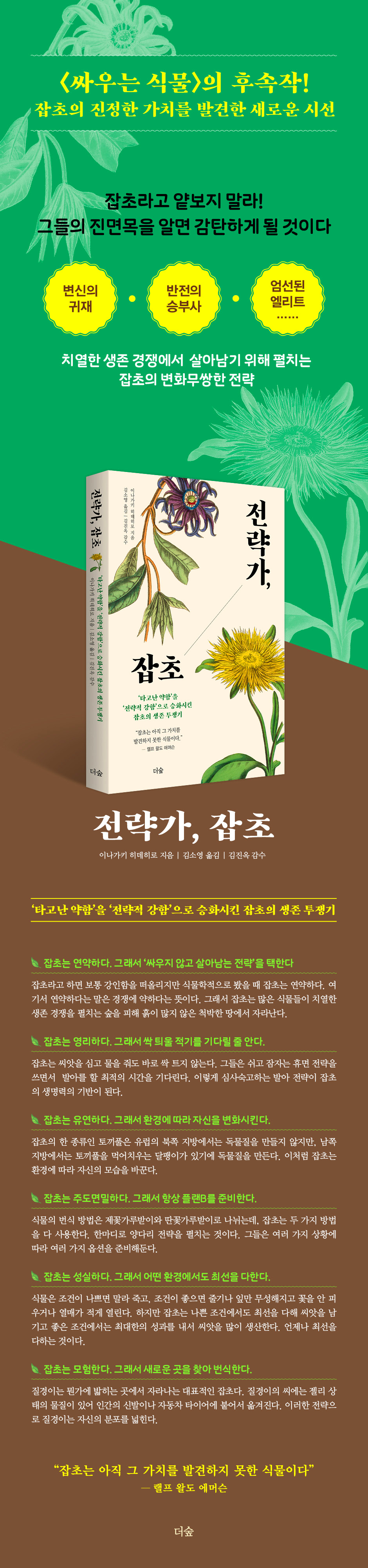
Hidehiro Inagaki, a bestselling botany author with a solid fan base!
Uncover the ingenious survival strategies of a weed often dismissed as insignificant!
Hidehiro Inagaki, a leading Japanese botanist and bestselling science author who has secured a solid fan base in Korea with works such as “Botany Stories That Will Keep You Reading All Night” and “Fighting Plants,” has now focused on the survival strategies of weeds, which are considered useless plants.
When we think of weeds, we think of them as nuisances and troublemakers that grow endlessly no matter how much we pull them out, tormenting humans.
But in fact, weeds are very clever plants that have overcome their 'innate weakness' with 'strategic strength'.
They employ various survival strategies to sprout alone in a barren place where no one cares.
They do not sprout blindly just because the environment is good, but carefully wait for the optimal time.
And they are masters of transformation who change their traits to suit different environments, brave pioneers who constantly seek out new places to breed, and unexpected challengers who always prepare a plan B to survive.
By employing these versatile strategies, weeds have been able to emerge from the weakest to the strongest plants in the fierce competition for survival in the plant kingdom.
In fact, weeds grow in places created by humans, such as roads, fields, and parks, which are special environments that do not exist in nature.
Therefore, weeds are special plants that have adapted to special environments and achieved special evolution.
Hidehiro Inagaki reveals that not just any plant can become a weed, and that weeds are the elite, carefully selected from a special field.
Looking at the ecology of weeds introduced in this book, we realize that weeds are no longer strange, useless plants, but rather great plants that have survived in nature through various strategies.
Hidehiro Inagaki, a bestselling botany author with a solid fan base!
Uncover the ingenious survival strategies of a weed often dismissed as insignificant!
Hidehiro Inagaki, a leading Japanese botanist and bestselling science author who has secured a solid fan base in Korea with works such as “Botany Stories That Will Keep You Reading All Night” and “Fighting Plants,” has now focused on the survival strategies of weeds, which are considered useless plants.
When we think of weeds, we think of them as nuisances and troublemakers that grow endlessly no matter how much we pull them out, tormenting humans.
But in fact, weeds are very clever plants that have overcome their 'innate weakness' with 'strategic strength'.
They employ various survival strategies to sprout alone in a barren place where no one cares.
They do not sprout blindly just because the environment is good, but carefully wait for the optimal time.
And they are masters of transformation who change their traits to suit different environments, brave pioneers who constantly seek out new places to breed, and unexpected challengers who always prepare a plan B to survive.
By employing these versatile strategies, weeds have been able to emerge from the weakest to the strongest plants in the fierce competition for survival in the plant kingdom.
In fact, weeds grow in places created by humans, such as roads, fields, and parks, which are special environments that do not exist in nature.
Therefore, weeds are special plants that have adapted to special environments and achieved special evolution.
Hidehiro Inagaki reveals that not just any plant can become a weed, and that weeds are the elite, carefully selected from a special field.
Looking at the ecology of weeds introduced in this book, we realize that weeds are no longer strange, useless plants, but rather great plants that have survived in nature through various strategies.
- You can preview some of the book's contents.
Preview
index
A word from the supervisor: “Weeds are plants whose value has not yet been discovered.” 4
Introduction_ Special plants and weeds adapted to special environments 6
Chapter 1: On Weediness
Words with "jab" (stuff) 15 | Is a radish growing on asphalt a weed? 17 | Is a melon a vegetable or a fruit? 19 | Weeds are grasses that tend to get in the way 21 | It's hard to become a weed 22
Chapter 2: Weakness Makes Us Strong
One Common Characteristic of Weeds 29 | Are Weeds Weak? 30 | Strategies for Surviving Without Fighting 31 | What Does Resilience Mean? 32 | The Resilience of Weeds 34 | How to Get Rid of Weeds 35 Vegetation Changes Depending on the Circumstances 37 | How Weeds Change 38 | Resetting the Cycle 40 | What Weeds Looked Like Before History 43 | The World After Human Extinction 44
Chapter 3: The Cleverness of Waiting for the Right Time to Sprout
Growing Weeds is Hard 49 | Rest and Sleep Strategy 50 | Don't Sprout Right Away 51 | Seeds That Wake Up and Sleep Again 52 | Every Seed Has Its Own Personality 54 | What Secrets Does the Goblin Thorn Have? 55 | Seed Bank 57 | Sprouts Stimulated by Light 58 | Photogermination in Lettuce Seeds 60 | Red Signals It's Time to Start 61
Chapter 4: Changing Yourself According to Your Environment
The Strategy of Diversity 67 | Crops Become Uniform 68 | Why Diversity is Important to Plants 69 | Weeds Have Different Traits 71 | They Divide by Region 72 | How Do Variations Occur Between Populations 74 | The Origin of the Galapagos Cell Phone 75 | Change Sometimes Occurs by Chance 77 | Weeds Adapt to Human Society 79 | Weeds Adapt to Golf Courses 80 | Plasticity or Mutation 81 | Intraspecific Mutation or Speciation 82 | The Power of Change 85 | Doing Our Best in Good Times and Bad Times 87 | Changing Freely for a Purpose 88 | Weeds Transcend Human Classification 89
Chapter 5: Prepare Plan B to Survive
The Color of Flowers Has a Meaning 95 | Who Did the Purple Flower Choose as its Mate 97 | What Secret Does the Common Creeper Hold? 99 | The Symbiotic Relationship Between Flowers and Insects 102 | Evolution from Wind-Pollination to Insect-Pollination 103 | Evolution Back to Wind-Pollination 105 | Why Do We Need to Transfer Pollen 106 | Crops Using Mendel's Laws 108 | Why Self-Pollination Is Disadvantageous 109 | Plants That Avoid Self-Pollination 111 | Why Do Stamens and Pistils Come Together in a Flower? 113 Self-Pollination Over Cross-Pollination 116 | The Choice of the Blackthorn 117 | In More Harsh Environments 119 | The Two-Way Strategy of Weeds 120
Chapter 6: Finding a new place to breed
A chance for immobile plants to move 125 | Seeds: A remarkable plant invention 126 | How to move a wad of paper far 128 | Making ants carry seeds 130 | Why plants need to spread their seeds widely 133 | Plants from foreign countries 135 | Are there no native weeds in Japan? 136 | Naturalized weeds are not strong 137 | Introduced and native dandelions 139 | Why the western dandelion is increasing 140 | How the western dandelion succeeded 142 | A favorable environment for naturalized weeds is unfolding 143 | Operation Trojan Horse 144 | The tragedy of the rice-sucking scandal 146 | Alcohol is unacceptable 147 | From Korea to overseas 149
Chapter 7: The Tenacious Battle Between Weeds and Humans
The Immortal Monster Weed 155 | The Difference Between Plant and Weed Classification 156 | Science is a Double-Edged Sword 157 | Doraemon's Secret Tool 158 | The Structure of Herbicides 160 | Exploiting the Differences Between Animals and Plants 161 | Inhibiting Photosynthesis 162 | Inhibiting Amino Acid Synthesis 163 | The Secret of Crops That Don't Wither 165 | The Appearance of Superweeds 166 | Don't Rely on Herbicides Alone 167 | Various Weeding Methods 169 | Weeding Methods Using Living Organisms 170 | The Trial and Error of the Giant Snail 172 | Utilizing Various Organisms 174 | Weeds of the 22nd Century 175
Chapter 8: Becoming a Weed Requires Special Abilities
Twelve Conditions for an Ideal Weed 180 | The Lily That Became a Weed 185 | Who is the Greatest Traitor? 188 | Using Weeds as Crops 190 | Utilizing Weeds 192 | A New Definition of Weed 193
Chapter 9: Number One and Only One Weed
Weeds Don't Rise Even When Stepped On 197 | Number One or Only One 199 | Only Number One Survives 199 | Territory Dividing Strategies 201 | Find the Only One Place Where You Can Be Number One 204 | Lack of Confidence Becomes Individuality 205 | What Can Be Number One 207 | Living Things Help Each Other 209 | You're Lucky 211
Conclusion: A Weed Scientist's Shortcut 214
Reference 226
Introduction_ Special plants and weeds adapted to special environments 6
Chapter 1: On Weediness
Words with "jab" (stuff) 15 | Is a radish growing on asphalt a weed? 17 | Is a melon a vegetable or a fruit? 19 | Weeds are grasses that tend to get in the way 21 | It's hard to become a weed 22
Chapter 2: Weakness Makes Us Strong
One Common Characteristic of Weeds 29 | Are Weeds Weak? 30 | Strategies for Surviving Without Fighting 31 | What Does Resilience Mean? 32 | The Resilience of Weeds 34 | How to Get Rid of Weeds 35 Vegetation Changes Depending on the Circumstances 37 | How Weeds Change 38 | Resetting the Cycle 40 | What Weeds Looked Like Before History 43 | The World After Human Extinction 44
Chapter 3: The Cleverness of Waiting for the Right Time to Sprout
Growing Weeds is Hard 49 | Rest and Sleep Strategy 50 | Don't Sprout Right Away 51 | Seeds That Wake Up and Sleep Again 52 | Every Seed Has Its Own Personality 54 | What Secrets Does the Goblin Thorn Have? 55 | Seed Bank 57 | Sprouts Stimulated by Light 58 | Photogermination in Lettuce Seeds 60 | Red Signals It's Time to Start 61
Chapter 4: Changing Yourself According to Your Environment
The Strategy of Diversity 67 | Crops Become Uniform 68 | Why Diversity is Important to Plants 69 | Weeds Have Different Traits 71 | They Divide by Region 72 | How Do Variations Occur Between Populations 74 | The Origin of the Galapagos Cell Phone 75 | Change Sometimes Occurs by Chance 77 | Weeds Adapt to Human Society 79 | Weeds Adapt to Golf Courses 80 | Plasticity or Mutation 81 | Intraspecific Mutation or Speciation 82 | The Power of Change 85 | Doing Our Best in Good Times and Bad Times 87 | Changing Freely for a Purpose 88 | Weeds Transcend Human Classification 89
Chapter 5: Prepare Plan B to Survive
The Color of Flowers Has a Meaning 95 | Who Did the Purple Flower Choose as its Mate 97 | What Secret Does the Common Creeper Hold? 99 | The Symbiotic Relationship Between Flowers and Insects 102 | Evolution from Wind-Pollination to Insect-Pollination 103 | Evolution Back to Wind-Pollination 105 | Why Do We Need to Transfer Pollen 106 | Crops Using Mendel's Laws 108 | Why Self-Pollination Is Disadvantageous 109 | Plants That Avoid Self-Pollination 111 | Why Do Stamens and Pistils Come Together in a Flower? 113 Self-Pollination Over Cross-Pollination 116 | The Choice of the Blackthorn 117 | In More Harsh Environments 119 | The Two-Way Strategy of Weeds 120
Chapter 6: Finding a new place to breed
A chance for immobile plants to move 125 | Seeds: A remarkable plant invention 126 | How to move a wad of paper far 128 | Making ants carry seeds 130 | Why plants need to spread their seeds widely 133 | Plants from foreign countries 135 | Are there no native weeds in Japan? 136 | Naturalized weeds are not strong 137 | Introduced and native dandelions 139 | Why the western dandelion is increasing 140 | How the western dandelion succeeded 142 | A favorable environment for naturalized weeds is unfolding 143 | Operation Trojan Horse 144 | The tragedy of the rice-sucking scandal 146 | Alcohol is unacceptable 147 | From Korea to overseas 149
Chapter 7: The Tenacious Battle Between Weeds and Humans
The Immortal Monster Weed 155 | The Difference Between Plant and Weed Classification 156 | Science is a Double-Edged Sword 157 | Doraemon's Secret Tool 158 | The Structure of Herbicides 160 | Exploiting the Differences Between Animals and Plants 161 | Inhibiting Photosynthesis 162 | Inhibiting Amino Acid Synthesis 163 | The Secret of Crops That Don't Wither 165 | The Appearance of Superweeds 166 | Don't Rely on Herbicides Alone 167 | Various Weeding Methods 169 | Weeding Methods Using Living Organisms 170 | The Trial and Error of the Giant Snail 172 | Utilizing Various Organisms 174 | Weeds of the 22nd Century 175
Chapter 8: Becoming a Weed Requires Special Abilities
Twelve Conditions for an Ideal Weed 180 | The Lily That Became a Weed 185 | Who is the Greatest Traitor? 188 | Using Weeds as Crops 190 | Utilizing Weeds 192 | A New Definition of Weed 193
Chapter 9: Number One and Only One Weed
Weeds Don't Rise Even When Stepped On 197 | Number One or Only One 199 | Only Number One Survives 199 | Territory Dividing Strategies 201 | Find the Only One Place Where You Can Be Number One 204 | Lack of Confidence Becomes Individuality 205 | What Can Be Number One 207 | Living Things Help Each Other 209 | You're Lucky 211
Conclusion: A Weed Scientist's Shortcut 214
Reference 226
Detailed image
Into the book
Weeds are often categorized as 'nuisance weeds', but in reality, it is quite difficult to become a nuisance weed.
Weeds are said to be common and insignificant plants, but that doesn't mean they grow everywhere.
Also, not all plants can become weeds.
It is quite a special thing for a plant to sprout and spread on the roadside or in a field, and it takes that special ability to become a nuisance.
The property of plants that makes them prone to becoming weeds is called 'weediness', and only plants with this weediness can survive as weeds; not all plants can become weeds.
--- From "Chapter 1: On Weediness"
Weeds grow back no matter how many times you pull them out, so it's like trying to get rid of them completely, down to the roots. However, there is only one way to safely get rid of weeds.
It is 'not pulling out weeds'.
What does it mean to not pull out weeds? And what happens if you don't remove them? Weeds multiply rapidly if you don't pull them out.
Then, not only weeds but also large plants such as shrubs grow one after another, forming thickets, and trees grow luxuriantly to form a forest.
Plants called weeds are generally said to be weak in competition with other plants.
So weeds cannot grow in a rich forest.
--- From "Chapter 2: Weakness Makes Us Strong"
However, it is important to sow weed seeds at as irregular a time as possible.
What if weed seeds sprouted all at once, like vegetable or flower seeds? Then, when humans pull out the weeds, they all perish.
So, the sprouting period is intentionally staggered to allow for sporadic emergence.
In the human world, this kind of different personality is called 'individuality', but in the weed world, this individuality is very important.
--- From "Chapter 3: The Cleverness of Waiting for the Right Time to Sprout"
Because weeds are prone to change, such mutations occur frequently.
For example, there are types of rabbit grass that produce a poison called cyanide and types that do not.
In the northern regions of Europe, there are types that do not produce poison, but in the southern regions, there are types that produce poison.
In the southern regions, there are snails that eat the clover, so the clover produces a poison to protect itself.
However, in the cold northern regions, there are no pest snails, so the rabbit grass does not produce poison.
--- From "Chapter 4: Changing Yourself According to the Environment"
There is also a structure called a closed flower.
Everyone knows that violets bloom in spring, but not many people know that violets are closed flowers that bloom in summer as well.
As the days get warmer in summer, fewer insects visit flowers.
Even in such a summer, the violets have flower buds, but the buds never open.
In fact, violets do not open their flower buds, but rather the stamens attach directly to the pistils and pollinate the flower.
This is a closed flower, but no one notices it because the closed flower is green in the bud state.
The previously introduced clown plant also uses its brain to bloom diligently, but in the summer, it blooms closed flowers in the bud state at the location where the leaves are attached.
In this way, weeds provide the insurance of self-pollination while pollinating other flowers.
The weed strategy is to always have several options available rather than choosing just one.
--- From "Chapter 5: Preparing Plan B to Survive"
On unpaved roads, it is common to see plantains growing along the tire tracks.
Among the scientific names of the plantain, the genus name is 'plantago', which is a Latin word meaning to move with the soles of the feet.
Another Chinese character name is 'Chajeoncho車前草', which also comes from the saying that it grows anywhere along the road.
The reason it grows along the road like this is because people or cars have carried the seeds.
In this case, being stepped on is not something to be endured, much less a challenge to be overcome.
It is a good use of that point that it can only spread widely if it is stepped on.
There are weeds that multiply by being stepped on by people, and among the weeds that grow in cities where people gather, there are many that have seeds that are bumpy and structured so that they can easily stick to the bottom of shoes.
Humans are also contributing to the widespread spread of weed seeds without even realizing it.
--- From "Chapter 6: Finding New Places to Breed"
The control method using herbicides is called 'chemical control'.
However, if you blindly rely on herbicides, it will result in the emergence of resistant weeds that do not respond to herbicides.
Therefore, weeds must be removed by combining various weeding methods, not just herbicides.
Also, if you try to get rid of weeds completely, you will inevitably end up resorting to herbicides, and naturally, the number of times you spray herbicides will increase.
Therefore, it is suggested to use various weeding methods to suppress weeds to a level that does not cause damage rather than completely eradicating them. This is called 'Integrated Weed Management (IWM).'
--- From "Chapter 7: The Tenacious Battle Between Weeds and Humans"
People have been using weeds since ancient times.
For example, oats, also known as oatmeal, were originally a weed growing in barley fields called maggot.
Oats grew vigorously even in places and climates where barley did not grow well.
It is not known whether they thought it would be better to cultivate oats, but oats were cultivated and became oatmeal.
Wild plants can be improved to become cultivated plants, and crops improved from wild plants are called primary crops.
In contrast, oats evolved from a wild plant into a weed called oat, and then the weed oat was bred to create a crop.
Plants that evolved from weeds and became crops are called secondary crops.
Rye, the raw material for rye bread, like oats, was originally a weed in a barley field but was later used as a crop. Job's tears, the raw material for Job's tears tea, is also a secondary crop created by improving the weed Yeomju.
--- From "Chapter 8: Special Abilities Are Needed to Become a Weed"
Organisms living in similar environments compete fiercely, and only the best survive.
However, if the living environments are different, they can coexist.
Although it is the iron law of nature that only the best survive, many creatures live there.
In other words, every living thing is number one in its own domain.
Is being number one important, or being the only one? You probably already know the answer.
All living things are number one.
And we have a place where we can be number one.
This place is only one.
That is, all living things are number one and only one.
Weeds are said to be common and insignificant plants, but that doesn't mean they grow everywhere.
Also, not all plants can become weeds.
It is quite a special thing for a plant to sprout and spread on the roadside or in a field, and it takes that special ability to become a nuisance.
The property of plants that makes them prone to becoming weeds is called 'weediness', and only plants with this weediness can survive as weeds; not all plants can become weeds.
--- From "Chapter 1: On Weediness"
Weeds grow back no matter how many times you pull them out, so it's like trying to get rid of them completely, down to the roots. However, there is only one way to safely get rid of weeds.
It is 'not pulling out weeds'.
What does it mean to not pull out weeds? And what happens if you don't remove them? Weeds multiply rapidly if you don't pull them out.
Then, not only weeds but also large plants such as shrubs grow one after another, forming thickets, and trees grow luxuriantly to form a forest.
Plants called weeds are generally said to be weak in competition with other plants.
So weeds cannot grow in a rich forest.
--- From "Chapter 2: Weakness Makes Us Strong"
However, it is important to sow weed seeds at as irregular a time as possible.
What if weed seeds sprouted all at once, like vegetable or flower seeds? Then, when humans pull out the weeds, they all perish.
So, the sprouting period is intentionally staggered to allow for sporadic emergence.
In the human world, this kind of different personality is called 'individuality', but in the weed world, this individuality is very important.
--- From "Chapter 3: The Cleverness of Waiting for the Right Time to Sprout"
Because weeds are prone to change, such mutations occur frequently.
For example, there are types of rabbit grass that produce a poison called cyanide and types that do not.
In the northern regions of Europe, there are types that do not produce poison, but in the southern regions, there are types that produce poison.
In the southern regions, there are snails that eat the clover, so the clover produces a poison to protect itself.
However, in the cold northern regions, there are no pest snails, so the rabbit grass does not produce poison.
--- From "Chapter 4: Changing Yourself According to the Environment"
There is also a structure called a closed flower.
Everyone knows that violets bloom in spring, but not many people know that violets are closed flowers that bloom in summer as well.
As the days get warmer in summer, fewer insects visit flowers.
Even in such a summer, the violets have flower buds, but the buds never open.
In fact, violets do not open their flower buds, but rather the stamens attach directly to the pistils and pollinate the flower.
This is a closed flower, but no one notices it because the closed flower is green in the bud state.
The previously introduced clown plant also uses its brain to bloom diligently, but in the summer, it blooms closed flowers in the bud state at the location where the leaves are attached.
In this way, weeds provide the insurance of self-pollination while pollinating other flowers.
The weed strategy is to always have several options available rather than choosing just one.
--- From "Chapter 5: Preparing Plan B to Survive"
On unpaved roads, it is common to see plantains growing along the tire tracks.
Among the scientific names of the plantain, the genus name is 'plantago', which is a Latin word meaning to move with the soles of the feet.
Another Chinese character name is 'Chajeoncho車前草', which also comes from the saying that it grows anywhere along the road.
The reason it grows along the road like this is because people or cars have carried the seeds.
In this case, being stepped on is not something to be endured, much less a challenge to be overcome.
It is a good use of that point that it can only spread widely if it is stepped on.
There are weeds that multiply by being stepped on by people, and among the weeds that grow in cities where people gather, there are many that have seeds that are bumpy and structured so that they can easily stick to the bottom of shoes.
Humans are also contributing to the widespread spread of weed seeds without even realizing it.
--- From "Chapter 6: Finding New Places to Breed"
The control method using herbicides is called 'chemical control'.
However, if you blindly rely on herbicides, it will result in the emergence of resistant weeds that do not respond to herbicides.
Therefore, weeds must be removed by combining various weeding methods, not just herbicides.
Also, if you try to get rid of weeds completely, you will inevitably end up resorting to herbicides, and naturally, the number of times you spray herbicides will increase.
Therefore, it is suggested to use various weeding methods to suppress weeds to a level that does not cause damage rather than completely eradicating them. This is called 'Integrated Weed Management (IWM).'
--- From "Chapter 7: The Tenacious Battle Between Weeds and Humans"
People have been using weeds since ancient times.
For example, oats, also known as oatmeal, were originally a weed growing in barley fields called maggot.
Oats grew vigorously even in places and climates where barley did not grow well.
It is not known whether they thought it would be better to cultivate oats, but oats were cultivated and became oatmeal.
Wild plants can be improved to become cultivated plants, and crops improved from wild plants are called primary crops.
In contrast, oats evolved from a wild plant into a weed called oat, and then the weed oat was bred to create a crop.
Plants that evolved from weeds and became crops are called secondary crops.
Rye, the raw material for rye bread, like oats, was originally a weed in a barley field but was later used as a crop. Job's tears, the raw material for Job's tears tea, is also a secondary crop created by improving the weed Yeomju.
--- From "Chapter 8: Special Abilities Are Needed to Become a Weed"
Organisms living in similar environments compete fiercely, and only the best survive.
However, if the living environments are different, they can coexist.
Although it is the iron law of nature that only the best survive, many creatures live there.
In other words, every living thing is number one in its own domain.
Is being number one important, or being the only one? You probably already know the answer.
All living things are number one.
And we have a place where we can be number one.
This place is only one.
That is, all living things are number one and only one.
--- From "Chapter 9: The Number One and Only Weed"
Publisher's Review
Weeds are fragile!
So their strategy is 'survive without fighting'
When we think of weeds, we usually think of tenacious vitality and strength.
But botanically speaking, weeds are fragile.
Here, weak means weak to competition.
So they make 'not fighting' their first strategy.
In fact, weeds cannot survive in forests where many plants grow.
Because while a rich forest is suitable for plant survival, it is also a battlefield.
A forest where many plants compete fiercely for survival is not a suitable place for weeds that are weak to competition.
Weeds avoid this competition by growing where plants do not grow, such as in poor soil with little soil or in fields that have been tilled or weeded.
In short, he is a loser who ran away from a competitive society.
However, living in an environment with little soil or where you never know what will happen at any time is a huge fight for survival for weeds.
Weeds may be weak to competition, but they are strong in unpredictable environmental changes, and have the power to adapt to the situation and overcome changes.
Dormancy of weeds is not just a simple rest!
Finding and preparing for the optimal germination time
When we see weeds growing all around us without anyone caring for them, we might think that weeds are plants that are easy to grow.
But if you actually try growing weeds, you will see that this is clearly a misunderstanding.
Weeds do not sprout even if you plant the seeds in the ground and water them.
This is because it has the property of ‘dormancy’, which is resting and sleeping.
Even if the seeds of a weed ripen and fall to the ground, that does not necessarily mean that it is the right time for germination.
If a seed that falls in the fall sprouts as it is, it will die from the harsh winter cold, and if there are many plants around it, it will die from lack of light.
Therefore, the timing of weed sprouting is a matter of life and death.
Weeds enter primary dormancy while waiting for the right time to germinate.
Autumn, when seeds ripen, has temperatures similar to spring, but they do not sprout because they have not experienced the cold of winter.
And even after a certain amount of time has passed, the seed wakes up from dormancy and reads the environment in a complex manner to determine when it will sprout.
If the environment is not suitable for sprouting at this time, it enters secondary dormancy.
In this way, the seeds of weeds repeat the cycle of awakening and dormancy, waiting for the right time to sprout.
The dormant structure of weeds is not a simple structure that sprouts regularly according to the season, but is very complex.
These carefully considered germination strategies form the basis of the weed's vitality.
Weed's two-legged strategy!
Prepare a plan B to survive
Plants reproduce through two methods: self-pollination and cross-pollination. Which do weeds prefer? In fact, it's foolish to ask a weed this question.
The environment in which weeds grow is usually unstable and can change at any time, so there is no definitive answer to the question of which is more advantageous in the world of weeds.
Rather, it is better to have weeds of both.
So, weeds choose a 'two-way strategy' where they can pollinate both their own flowers and other flowers depending on the situation.
For example, the chicken manure plant blooms in the morning and withers in the afternoon. If no insects visit during this time, the pistil bends inward as the flower closes and the stamens also bend, attaching pollen to the pistil and allowing self-pollination.
In this way, weeds provide the insurance of self-pollination while pollinating other flowers.
Another strategy of weeding is to prepare various options for different situations.
In addition, weeds show the appearance of 'pioneer plants' that grow before other plants in places where there are no plants yet, and each seed has its own individuality, preventing them from going extinct all at once.
Also, when conditions are bad, it works hard to produce as many seeds as possible, and when conditions are good, it also works hard to produce as many seeds as possible.
By employing these various strategies, weeds were able to become the hardy plants we know today.
So their strategy is 'survive without fighting'
When we think of weeds, we usually think of tenacious vitality and strength.
But botanically speaking, weeds are fragile.
Here, weak means weak to competition.
So they make 'not fighting' their first strategy.
In fact, weeds cannot survive in forests where many plants grow.
Because while a rich forest is suitable for plant survival, it is also a battlefield.
A forest where many plants compete fiercely for survival is not a suitable place for weeds that are weak to competition.
Weeds avoid this competition by growing where plants do not grow, such as in poor soil with little soil or in fields that have been tilled or weeded.
In short, he is a loser who ran away from a competitive society.
However, living in an environment with little soil or where you never know what will happen at any time is a huge fight for survival for weeds.
Weeds may be weak to competition, but they are strong in unpredictable environmental changes, and have the power to adapt to the situation and overcome changes.
Dormancy of weeds is not just a simple rest!
Finding and preparing for the optimal germination time
When we see weeds growing all around us without anyone caring for them, we might think that weeds are plants that are easy to grow.
But if you actually try growing weeds, you will see that this is clearly a misunderstanding.
Weeds do not sprout even if you plant the seeds in the ground and water them.
This is because it has the property of ‘dormancy’, which is resting and sleeping.
Even if the seeds of a weed ripen and fall to the ground, that does not necessarily mean that it is the right time for germination.
If a seed that falls in the fall sprouts as it is, it will die from the harsh winter cold, and if there are many plants around it, it will die from lack of light.
Therefore, the timing of weed sprouting is a matter of life and death.
Weeds enter primary dormancy while waiting for the right time to germinate.
Autumn, when seeds ripen, has temperatures similar to spring, but they do not sprout because they have not experienced the cold of winter.
And even after a certain amount of time has passed, the seed wakes up from dormancy and reads the environment in a complex manner to determine when it will sprout.
If the environment is not suitable for sprouting at this time, it enters secondary dormancy.
In this way, the seeds of weeds repeat the cycle of awakening and dormancy, waiting for the right time to sprout.
The dormant structure of weeds is not a simple structure that sprouts regularly according to the season, but is very complex.
These carefully considered germination strategies form the basis of the weed's vitality.
Weed's two-legged strategy!
Prepare a plan B to survive
Plants reproduce through two methods: self-pollination and cross-pollination. Which do weeds prefer? In fact, it's foolish to ask a weed this question.
The environment in which weeds grow is usually unstable and can change at any time, so there is no definitive answer to the question of which is more advantageous in the world of weeds.
Rather, it is better to have weeds of both.
So, weeds choose a 'two-way strategy' where they can pollinate both their own flowers and other flowers depending on the situation.
For example, the chicken manure plant blooms in the morning and withers in the afternoon. If no insects visit during this time, the pistil bends inward as the flower closes and the stamens also bend, attaching pollen to the pistil and allowing self-pollination.
In this way, weeds provide the insurance of self-pollination while pollinating other flowers.
Another strategy of weeding is to prepare various options for different situations.
In addition, weeds show the appearance of 'pioneer plants' that grow before other plants in places where there are no plants yet, and each seed has its own individuality, preventing them from going extinct all at once.
Also, when conditions are bad, it works hard to produce as many seeds as possible, and when conditions are good, it also works hard to produce as many seeds as possible.
By employing these various strategies, weeds were able to become the hardy plants we know today.
GOODS SPECIFICS
- Publication date: March 26, 2021
- Page count, weight, size: 228 pages | 308g | 130*190*18mm
- ISBN13: 9791190357593
- ISBN10: 1190357593
You may also like
카테고리
korean


korean

![GQ KOREA Mark (Monthly): December [2025]](http://librairie.coreenne.fr/cdn/shop/files/8ef265dbbfbf186523ed75ba7319009d.jpg?v=1765340328&width=3840)


