

Evolution Express
 |
Description
Book Introduction
The source of one of the oldest and most vexing questions in scientific history: the evolution of life.
The Beagle awakens, exploring everything about evolution!
"Where did I, where did we come from?" How did all living things, including humans, evolve to their current form? Is evolution even possible? Could life have been created by a Creator? Since time immemorial, humanity has grappled with and debated this question.
Then, about 160 years ago, with the publication of 『The Origin of Species』, Darwin's theory of evolution emerged, causing a tectonic shift in the global knowledge ecosystem and, furthermore, in human perception itself, and ultimately, evolution became an undeniable fact.
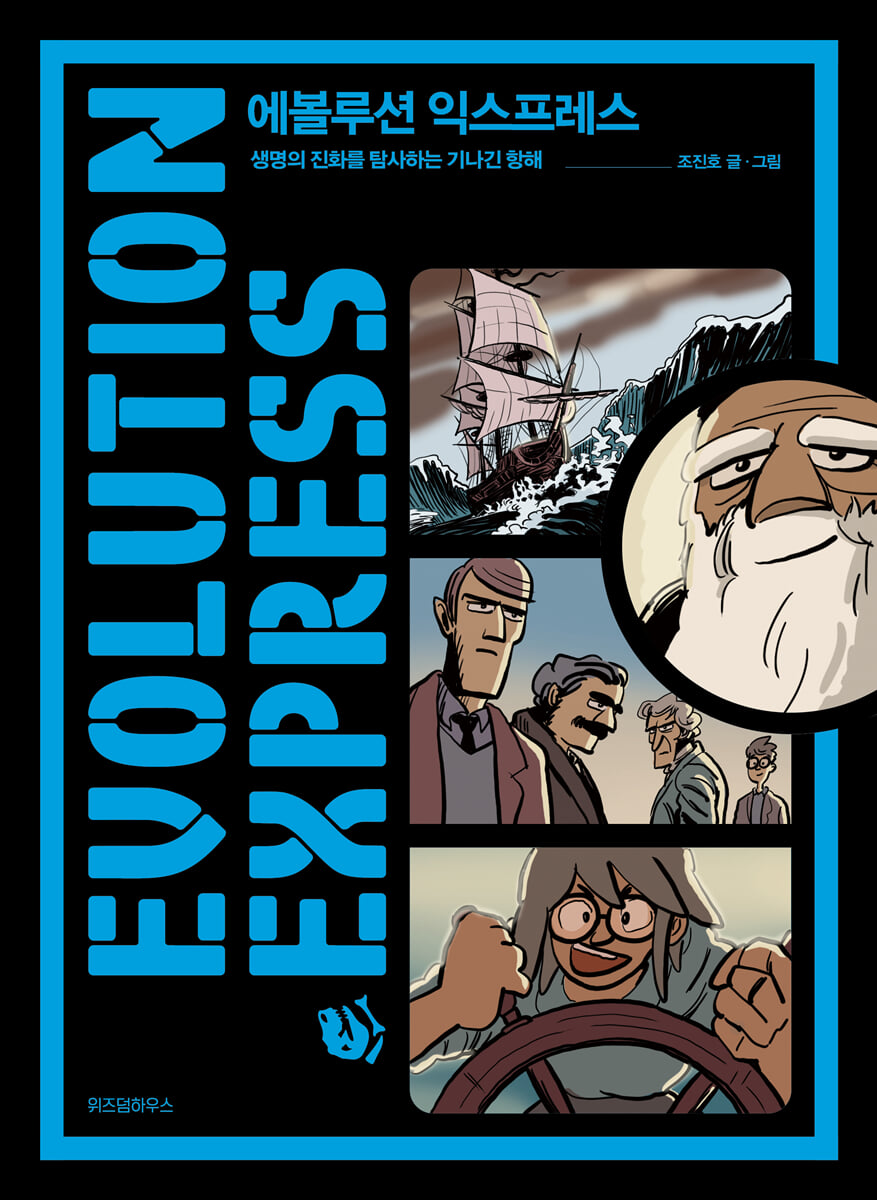
The fourth installment of Jo Jin-ho's amazing scientific journey, the Express Series, "Evolution Express," embarks on a journey to uncover the secrets of evolution.
To answer the age-old question, 'Where do all living things come from?', this time we board Darwin's Beagle instead of a train.
Beginning with Epicurean materialism, it progresses through Lamarck's theory of evolution, Darwin's theory of evolution, and Mendel's genetics, and is joined by 20th-century scientists such as Morgan, Weismann, McClintock, Meyer, and Gould.
If we go through the history of evolution step by step, based on the common ancestor of living things and the principle of natural selection, the entire theory of evolution will come into view.
Beginning with the birth of life, a long and wondrous voyage begins, leading to profound questions about the meaning of existence.
The Beagle awakens, exploring everything about evolution!
"Where did I, where did we come from?" How did all living things, including humans, evolve to their current form? Is evolution even possible? Could life have been created by a Creator? Since time immemorial, humanity has grappled with and debated this question.
Then, about 160 years ago, with the publication of 『The Origin of Species』, Darwin's theory of evolution emerged, causing a tectonic shift in the global knowledge ecosystem and, furthermore, in human perception itself, and ultimately, evolution became an undeniable fact.
The fourth installment of Jo Jin-ho's amazing scientific journey, the Express Series, "Evolution Express," embarks on a journey to uncover the secrets of evolution.
To answer the age-old question, 'Where do all living things come from?', this time we board Darwin's Beagle instead of a train.
Beginning with Epicurean materialism, it progresses through Lamarck's theory of evolution, Darwin's theory of evolution, and Mendel's genetics, and is joined by 20th-century scientists such as Morgan, Weismann, McClintock, Meyer, and Gould.
If we go through the history of evolution step by step, based on the common ancestor of living things and the principle of natural selection, the entire theory of evolution will come into view.
Beginning with the birth of life, a long and wondrous voyage begins, leading to profound questions about the meaning of existence.
index
Reviewer's Note: "Evolution Express": Awakening the Sleeping Beagle
1.
How did life arise?
2.
All life originates from a common ancestor.
3.
How did this happen?
4.
The frustrations and successes of Darwin's theory
5.
Enough with the theory
6.
The greatest history
7.
What modern biology tells us
8.
The probability of evolution
9.
endless debate
10.
Could the history of life on Earth have been plausible?
11.
Is there a direction?
12.
Is it just us?
13.
Where is the meaning
In Conclusion: On Life, That Incredible Fortune
Introduction of main characters
References
History of Life
Search
1.
How did life arise?
2.
All life originates from a common ancestor.
3.
How did this happen?
4.
The frustrations and successes of Darwin's theory
5.
Enough with the theory
6.
The greatest history
7.
What modern biology tells us
8.
The probability of evolution
9.
endless debate
10.
Could the history of life on Earth have been plausible?
11.
Is there a direction?
12.
Is it just us?
13.
Where is the meaning
In Conclusion: On Life, That Incredible Fortune
Introduction of main characters
References
History of Life
Search
Into the book
What is that change of thinking?
In fact, the idea that species evolve was not particularly new at the time.
There are two other reasons why he should be awarded.
One is that it proposed an evolutionary mechanism, and the other is that it explained speciation by comparing it to the way a tree branches out.
Since Darwin, we have finally been able to intellectually explain the ways in which life changes and its diversity.
--- p.4-5
Darwin's voice as he unfolds 'The Origin of Species' is gentle and sweet, but its content is terribly cruel.
Living things evolve at an unpredictable pace.
Humans, like many other creatures, are a species that arose by mere chance.
--- p.48
If we go back to the beginning, we will eventually find that all life on earth originated from a single common ancestor.
Darwin expressed this pattern of evolution with the term succession with variation.
As descendants of ancestors who lived in the distant past disperse to various habitats, they gradually accumulate changes in search of special ways of living.
In this way, life evolves by branching out like a tree.
This is the fundamental origin of many species of life on Earth today.
--- p.68
“It’s rare to find a truly amazing fossil, and we evolutionists call it a missing link.
“The reason the missing link is important is because it provides solid evidence for the theory of common descent.”
--- p.80
All breeders did was select and breed individuals with the desired traits.
A very simple method of repeating this selective crossbreeding was used.
Darwin realized that the natural world also has a process of 'selection', just like breeders do.
--- p.99
Natural selection reveals the tragic history of life.
It suggests that many organisms do not survive long enough to reproduce successfully, and that numerous species in the past have gone extinct because they failed to adapt.
Natural selection is a brutal process of elimination.
--- p.111
Darwin was unable to provide conclusive evidence that his theory of mutation was wrong.
At this time, a new genetic theory emerged, giving CPR to Darwin's theory.
If Mendel's theory of heredity had not been discovered, Darwin's theory might have remained a mere theory and then forgotten.
--- p.119
Only mutations that occur in germ cells are passed on to the next generation.
This is Weismann's germplasm continuity theory.
To prove his theory, Weismann conducted a rather bizarre experiment in which he cut off the tails of several generations of rats.
No matter how many times the experiment was repeated, the tails of the somatic mice did not get any shorter.
--- p.126
Just as we can now determine the absolute age of meteorites and the specific thousands of years that ancient artifacts are, we can now also determine the absolute age of fossils.
--- p.146
About 200,000 years ago, we first walked on land on four legs, but strangely enough, species that now walk on two legs have emerged.
If we were to compress the 4 billion years of life history into a 24-hour day, this species lived for 5 seconds before the clock struck midnight, and began farming 0.2 seconds before that.
These are Homo sapiens.
We are human.
--- p.
169
“No! No! Saying that something has evolved and saying that life must evolve are two different things.
Why do you think Professor Darwin was attacked so many times? Evolution has no reason.
This fact is what bothers people.”
--- p.178
Even sexually reproducing organisms cannot prevent mutations from occurring over generations, but there are opportunities to eliminate them.
Rather than consuming the organism like bacteria, it gradually eliminates harmful genetic combinations over time.
And you can leave behind a safe combination.
Sexual reproduction is a very careful way to eliminate harmful genes.
--- p.202
Among many possibilities, I happened to use one of these and it has continued to be used in later generations.
Creek described this as a frozen coincidence.
"Why did the first life form like this? Not because it's the only answer, nor because it's a particularly good one."
--- p.236
People's opinions are generally inclined towards the existence of extraterrestrial life.
“Why is that?” “Simply put… because there is life on Earth.
This is why.”
--- p.258
Our universe offers no care or expectation for life to appear and evolve on Earth.
Life on Earth is a reflection of that indifference.
There is no purpose.
The first question I had.
Then why am I here?
In fact, the idea that species evolve was not particularly new at the time.
There are two other reasons why he should be awarded.
One is that it proposed an evolutionary mechanism, and the other is that it explained speciation by comparing it to the way a tree branches out.
Since Darwin, we have finally been able to intellectually explain the ways in which life changes and its diversity.
--- p.4-5
Darwin's voice as he unfolds 'The Origin of Species' is gentle and sweet, but its content is terribly cruel.
Living things evolve at an unpredictable pace.
Humans, like many other creatures, are a species that arose by mere chance.
--- p.48
If we go back to the beginning, we will eventually find that all life on earth originated from a single common ancestor.
Darwin expressed this pattern of evolution with the term succession with variation.
As descendants of ancestors who lived in the distant past disperse to various habitats, they gradually accumulate changes in search of special ways of living.
In this way, life evolves by branching out like a tree.
This is the fundamental origin of many species of life on Earth today.
--- p.68
“It’s rare to find a truly amazing fossil, and we evolutionists call it a missing link.
“The reason the missing link is important is because it provides solid evidence for the theory of common descent.”
--- p.80
All breeders did was select and breed individuals with the desired traits.
A very simple method of repeating this selective crossbreeding was used.
Darwin realized that the natural world also has a process of 'selection', just like breeders do.
--- p.99
Natural selection reveals the tragic history of life.
It suggests that many organisms do not survive long enough to reproduce successfully, and that numerous species in the past have gone extinct because they failed to adapt.
Natural selection is a brutal process of elimination.
--- p.111
Darwin was unable to provide conclusive evidence that his theory of mutation was wrong.
At this time, a new genetic theory emerged, giving CPR to Darwin's theory.
If Mendel's theory of heredity had not been discovered, Darwin's theory might have remained a mere theory and then forgotten.
--- p.119
Only mutations that occur in germ cells are passed on to the next generation.
This is Weismann's germplasm continuity theory.
To prove his theory, Weismann conducted a rather bizarre experiment in which he cut off the tails of several generations of rats.
No matter how many times the experiment was repeated, the tails of the somatic mice did not get any shorter.
--- p.126
Just as we can now determine the absolute age of meteorites and the specific thousands of years that ancient artifacts are, we can now also determine the absolute age of fossils.
--- p.146
About 200,000 years ago, we first walked on land on four legs, but strangely enough, species that now walk on two legs have emerged.
If we were to compress the 4 billion years of life history into a 24-hour day, this species lived for 5 seconds before the clock struck midnight, and began farming 0.2 seconds before that.
These are Homo sapiens.
We are human.
--- p.
169
“No! No! Saying that something has evolved and saying that life must evolve are two different things.
Why do you think Professor Darwin was attacked so many times? Evolution has no reason.
This fact is what bothers people.”
--- p.178
Even sexually reproducing organisms cannot prevent mutations from occurring over generations, but there are opportunities to eliminate them.
Rather than consuming the organism like bacteria, it gradually eliminates harmful genetic combinations over time.
And you can leave behind a safe combination.
Sexual reproduction is a very careful way to eliminate harmful genes.
--- p.202
Among many possibilities, I happened to use one of these and it has continued to be used in later generations.
Creek described this as a frozen coincidence.
"Why did the first life form like this? Not because it's the only answer, nor because it's a particularly good one."
--- p.236
People's opinions are generally inclined towards the existence of extraterrestrial life.
“Why is that?” “Simply put… because there is life on Earth.
This is why.”
--- p.258
Our universe offers no care or expectation for life to appear and evolve on Earth.
Life on Earth is a reflection of that indifference.
There is no purpose.
The first question I had.
Then why am I here?
--- p.287
Publisher's Review
“From monkey to man?” It’s time to move beyond the false image of evolution.
A science comic that addresses questions and corrects misconceptions about the theory of evolution.
In the history of human intelligence, few topics have been as revolutionary, yet so controversial and misunderstood, as the theory of evolution.
Even after the theory of evolution was confirmed as fact by various scientific fields such as genetics, physics, and embryology, controversy and disputes continued, and it has been less than 10 years since it began to develop into a comprehensive academic discipline.
The 'Darwinian Revolution' is still ongoing, 160 years later, and the theory of evolution has permeated psychology, economics, philosophy, and even religious studies, spurring the evolution of each field.
"Evolution Express" faithfully covers the basic concepts that make up the theory of evolution, as well as various controversial points, and explains the entire theory of evolution, which was once difficult to understand, in an easy-to-understand comic format.
Dr. Dae-ik Jang, an evolutionary scholar (professor at Seoul National University's College of Liberal Arts), who reviewed and recommended this book, said that "Evolution Express" is like a drop of rain in a situation where there are so few books on Darwin and evolution written by domestic authors.
Geneticist Dr. Woojae Kim (Professor at the Harbin Institute of Technology Life Science Center) also left a recommendation, saying that while popular books on evolutionary biology are popular in the publishing market, he is also glad to see an in-depth book dealing with evolution that addresses the reality in Korea where creation science societies are active even at universities.
"Evolution Express" goes beyond correcting misconceptions like, "So, humans evolved from monkeys?" to become a guide to understanding the "cutting-edge" science of evolution.
Unfortunately, there is probably no country where Darwin is as underrated as ours.
This can be quickly seen by looking at the extremely small number of books on Darwin and evolution written by domestic authors.
It is also a sad reality that creationism still holds considerable power.
In this context, 『Evolution Express』 by Jin-ho Jo, Korea's best science cartoonist, is definitely a must-read.
(…) This 『Evolution Express』 is so well-organized in its molecular biology section that it can be recognized for its originality even when compared to leading overseas evolution-related content.
This book is a sophisticated masterpiece that blends Darwin's fascinating life, his brilliant theories, and the fundamental questions he poses to his descendants. It is an express ticket to an exciting start for anyone who wants to understand evolution.
_From the writings of Jang Dae-ik, the editor
1.
How did life arise?
Where did all of us living things come from? Aristotle argued that life arose spontaneously at some point and has continued to exist to this day, while Cuvier argued, citing various grounds, that evolution is impossible.
On the other hand, Lamarck argues that living things have evolved… The protagonist and Meyer visit Darwin on his deathbed.
They board the Beagle with Darwin, who is searching for 'another Galapagos'.
2.
All life originates from a common ancestor.
Darwin tells the story of the Beagle expedition in his youth.
Although he didn't pay much attention to the Galapagos Islands when he was exploring them, the islands' animals later sparked a spark of curiosity in him.
The secrets whispered by the tiny Galapagos finches.
Darwin built his theory of evolution, which would later be summarized in 'The Origin of Species', by grasping the concepts of common ancestry and 'succession with variation'.
3.
How did this happen?
It is a well-documented fact that living things have evolved from a common ancestor.
But how? By what principles do living things evolve? Malthus's population theory and Lyell's uniformitarianism guide Darwin's thinking, and the hidden principles of evolution are revealed within the brutal process of elimination known as natural selection.
4.
The frustrations and successes of Darwin's theory
A reliable theory of heredity was essential to support Darwin's theory of evolution.
Genetics, a savior, appears in front of the theory of evolution, which could have been forgotten as an interesting theory.
Fortunately, Mendel's theory of heredity, Morgan's chromosome research, and Weismann's principles of heredity revived Darwin's fading theory of natural selection.
5.
Enough with the theory
McClintock, Mendel, and Gould join the Beagle on the sea where the history of life churns.
As we enter the age of technology, new genetic discoveries, as well as achievements in physics and quantum mechanics, make common descent and natural selection irrefutable truths.
The secrets of evolution unfold before humanity, who has calculated the age of the Earth and even looked into the structure of genes!
6.
The greatest history
The Beagle heads to the distant past, to the beginning of the universe.
About 13.8 billion years ago, everything in the universe began, and about 4.6 billion years ago, our home, Earth, was born.
And about 4 billion years ago, the common ancestor of all living things, 'LUCA (Last Universal Common Ancestor),' was born.
Suddenly? Why? How? And how did the birth of eukaryotic cells occur?
7.
What modern biology tells us
While the Beagle is briefly stranded in a rift in time, McClintock unravels the insights his "Genome Express" journey has given to evolutionary theory from the way genes work.
The structures of each living thing were just the right amount of sophistication, neither too precise nor too clumsy, to sustain their survival.
It's not like anyone adjusted it that way, but it's just the guys with that kind of balance that survived.
This gradually led to evolution.
8.
The probability of evolution
Most species of living things exist in the form of male and female.
And all of them cannot escape the fate of eventually dying.
We take these facts for granted, but there is no truth that says that living things should be like this.
As we explore evolution, we now have a better understanding of why certain biological characteristics, such as species, sex, and death, arose.
9.
endless debate
Scientists today agree broadly that life descended from a single ancestor and evolved by pruning branches, but they disagree on the details.
Have organisms evolved gradually over long periods of time, or rapidly over short periods? How much influence has natural selection had on evolution? Let's examine the numerous debates within the theory of evolution.
10.
Could the history of life on Earth have been plausible?
One important question arises.
Were the pivotal evolutionary events that led to the existence of modern life truly inevitable? Were they, though not as unlikely, still highly probable? Could it be that the ancestors of life and eukaryotic cells didn't actually look like they do today? Scientists concoct scenarios as best they can, but no one knows for sure what's true.
11.
Is there a direction?
The evolution of life seems to progress gradually from the lower to the higher.
Looking at human evolution, modern humans seem to have larger brains and are also smarter than their ancestors from millions of years ago.
So, can we say that life is ‘progressing’ towards becoming better?
Why did Darwin ask that creatures from the early stages of evolution be described as “old” rather than “lower”?
12.
Is it just us?
The search for life leads to the search for extraterrestrial life forms that are completely different from our own.
Are there friends like us out there in the vastness of space? Shouldn't there be intelligent life forms, one or two, in this vast universe? What is the meaning of physicist Fermi's question, "Why is there no one?"
The Beagle is sucked into the middle of a storm.
13.
Where is the meaning
If the evolution of life was entirely accidental, what meaning does our existence have? A single finch suddenly flies in before those drifting by.
Finally, the 'other Galapagos' that Darwin was searching for appears in the distance.
What awaits him on that island where only Darwin can land?
A science comic that addresses questions and corrects misconceptions about the theory of evolution.
In the history of human intelligence, few topics have been as revolutionary, yet so controversial and misunderstood, as the theory of evolution.
Even after the theory of evolution was confirmed as fact by various scientific fields such as genetics, physics, and embryology, controversy and disputes continued, and it has been less than 10 years since it began to develop into a comprehensive academic discipline.
The 'Darwinian Revolution' is still ongoing, 160 years later, and the theory of evolution has permeated psychology, economics, philosophy, and even religious studies, spurring the evolution of each field.
"Evolution Express" faithfully covers the basic concepts that make up the theory of evolution, as well as various controversial points, and explains the entire theory of evolution, which was once difficult to understand, in an easy-to-understand comic format.
Dr. Dae-ik Jang, an evolutionary scholar (professor at Seoul National University's College of Liberal Arts), who reviewed and recommended this book, said that "Evolution Express" is like a drop of rain in a situation where there are so few books on Darwin and evolution written by domestic authors.
Geneticist Dr. Woojae Kim (Professor at the Harbin Institute of Technology Life Science Center) also left a recommendation, saying that while popular books on evolutionary biology are popular in the publishing market, he is also glad to see an in-depth book dealing with evolution that addresses the reality in Korea where creation science societies are active even at universities.
"Evolution Express" goes beyond correcting misconceptions like, "So, humans evolved from monkeys?" to become a guide to understanding the "cutting-edge" science of evolution.
Unfortunately, there is probably no country where Darwin is as underrated as ours.
This can be quickly seen by looking at the extremely small number of books on Darwin and evolution written by domestic authors.
It is also a sad reality that creationism still holds considerable power.
In this context, 『Evolution Express』 by Jin-ho Jo, Korea's best science cartoonist, is definitely a must-read.
(…) This 『Evolution Express』 is so well-organized in its molecular biology section that it can be recognized for its originality even when compared to leading overseas evolution-related content.
This book is a sophisticated masterpiece that blends Darwin's fascinating life, his brilliant theories, and the fundamental questions he poses to his descendants. It is an express ticket to an exciting start for anyone who wants to understand evolution.
_From the writings of Jang Dae-ik, the editor
1.
How did life arise?
Where did all of us living things come from? Aristotle argued that life arose spontaneously at some point and has continued to exist to this day, while Cuvier argued, citing various grounds, that evolution is impossible.
On the other hand, Lamarck argues that living things have evolved… The protagonist and Meyer visit Darwin on his deathbed.
They board the Beagle with Darwin, who is searching for 'another Galapagos'.
2.
All life originates from a common ancestor.
Darwin tells the story of the Beagle expedition in his youth.
Although he didn't pay much attention to the Galapagos Islands when he was exploring them, the islands' animals later sparked a spark of curiosity in him.
The secrets whispered by the tiny Galapagos finches.
Darwin built his theory of evolution, which would later be summarized in 'The Origin of Species', by grasping the concepts of common ancestry and 'succession with variation'.
3.
How did this happen?
It is a well-documented fact that living things have evolved from a common ancestor.
But how? By what principles do living things evolve? Malthus's population theory and Lyell's uniformitarianism guide Darwin's thinking, and the hidden principles of evolution are revealed within the brutal process of elimination known as natural selection.
4.
The frustrations and successes of Darwin's theory
A reliable theory of heredity was essential to support Darwin's theory of evolution.
Genetics, a savior, appears in front of the theory of evolution, which could have been forgotten as an interesting theory.
Fortunately, Mendel's theory of heredity, Morgan's chromosome research, and Weismann's principles of heredity revived Darwin's fading theory of natural selection.
5.
Enough with the theory
McClintock, Mendel, and Gould join the Beagle on the sea where the history of life churns.
As we enter the age of technology, new genetic discoveries, as well as achievements in physics and quantum mechanics, make common descent and natural selection irrefutable truths.
The secrets of evolution unfold before humanity, who has calculated the age of the Earth and even looked into the structure of genes!
6.
The greatest history
The Beagle heads to the distant past, to the beginning of the universe.
About 13.8 billion years ago, everything in the universe began, and about 4.6 billion years ago, our home, Earth, was born.
And about 4 billion years ago, the common ancestor of all living things, 'LUCA (Last Universal Common Ancestor),' was born.
Suddenly? Why? How? And how did the birth of eukaryotic cells occur?
7.
What modern biology tells us
While the Beagle is briefly stranded in a rift in time, McClintock unravels the insights his "Genome Express" journey has given to evolutionary theory from the way genes work.
The structures of each living thing were just the right amount of sophistication, neither too precise nor too clumsy, to sustain their survival.
It's not like anyone adjusted it that way, but it's just the guys with that kind of balance that survived.
This gradually led to evolution.
8.
The probability of evolution
Most species of living things exist in the form of male and female.
And all of them cannot escape the fate of eventually dying.
We take these facts for granted, but there is no truth that says that living things should be like this.
As we explore evolution, we now have a better understanding of why certain biological characteristics, such as species, sex, and death, arose.
9.
endless debate
Scientists today agree broadly that life descended from a single ancestor and evolved by pruning branches, but they disagree on the details.
Have organisms evolved gradually over long periods of time, or rapidly over short periods? How much influence has natural selection had on evolution? Let's examine the numerous debates within the theory of evolution.
10.
Could the history of life on Earth have been plausible?
One important question arises.
Were the pivotal evolutionary events that led to the existence of modern life truly inevitable? Were they, though not as unlikely, still highly probable? Could it be that the ancestors of life and eukaryotic cells didn't actually look like they do today? Scientists concoct scenarios as best they can, but no one knows for sure what's true.
11.
Is there a direction?
The evolution of life seems to progress gradually from the lower to the higher.
Looking at human evolution, modern humans seem to have larger brains and are also smarter than their ancestors from millions of years ago.
So, can we say that life is ‘progressing’ towards becoming better?
Why did Darwin ask that creatures from the early stages of evolution be described as “old” rather than “lower”?
12.
Is it just us?
The search for life leads to the search for extraterrestrial life forms that are completely different from our own.
Are there friends like us out there in the vastness of space? Shouldn't there be intelligent life forms, one or two, in this vast universe? What is the meaning of physicist Fermi's question, "Why is there no one?"
The Beagle is sucked into the middle of a storm.
13.
Where is the meaning
If the evolution of life was entirely accidental, what meaning does our existence have? A single finch suddenly flies in before those drifting by.
Finally, the 'other Galapagos' that Darwin was searching for appears in the distance.
What awaits him on that island where only Darwin can land?
GOODS SPECIFICS
- Publication date: February 10, 2021
- Page count, weight, size: 308 pages | 804g | 188*257*30mm
- ISBN13: 9791191308327
- ISBN10: 1191308324
You may also like
카테고리
korean


korean

![GQ KOREA Mark (Monthly): December [2025]](http://librairie.coreenne.fr/cdn/shop/files/8ef265dbbfbf186523ed75ba7319009d.jpg?v=1765340328&width=3840)


