

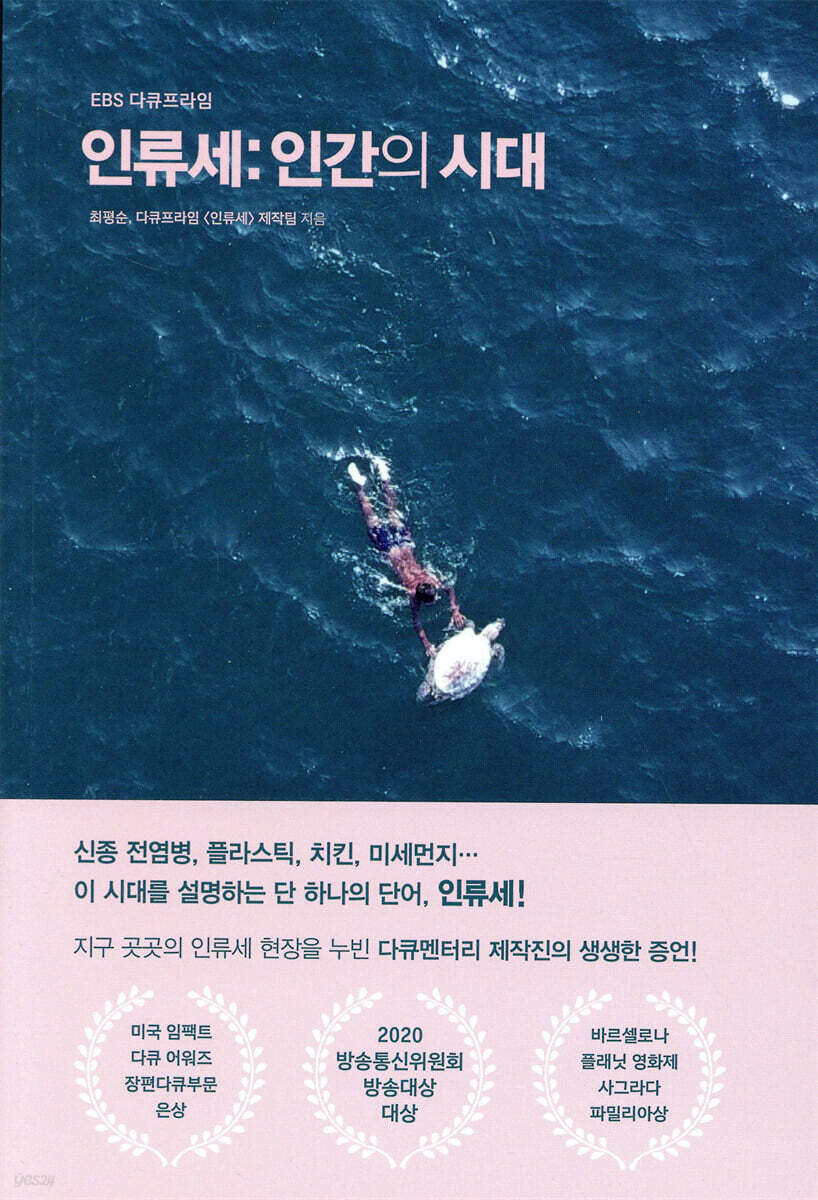
Anthropocene: The Age of Humans
 |
Description
Book Introduction
Humans, the conquerors of the Earth.
Where do we come from, what are we, where are we going?
A journey to find evidence of the Anthropocene, a new geological era created by humans.
Vivid testimony from a documentary crew that traveled to Anthropocene sites around the globe!
The Anthropocene, an era dominated by a species that has grown so powerful that it has gained the power to control the fate of the entire planet, including itself.
How will humans and nature survive in the Anthropocene? How will this era end? And what will we leave behind? The EBS Documentary Prime production team traveled the world to find answers to these questions, interviewing leading scholars like Edward Wilson and Jared Diamond.
After two years of production and filming in 10 countries, the three-part documentary [Anthropocene] was born.
『Anthropocene: The Age of Humans』 contains vivid records of the scenes witnessed by the [Anthropocene] production team while traveling around the world, including Korea, scientific content that could not be included due to length, behind-the-scenes stories of filming, and honest feelings felt while facing the Anthropocene and the future of humanity.
Where do we come from, what are we, where are we going?
A journey to find evidence of the Anthropocene, a new geological era created by humans.
Vivid testimony from a documentary crew that traveled to Anthropocene sites around the globe!
The Anthropocene, an era dominated by a species that has grown so powerful that it has gained the power to control the fate of the entire planet, including itself.
How will humans and nature survive in the Anthropocene? How will this era end? And what will we leave behind? The EBS Documentary Prime production team traveled the world to find answers to these questions, interviewing leading scholars like Edward Wilson and Jared Diamond.
After two years of production and filming in 10 countries, the three-part documentary [Anthropocene] was born.
『Anthropocene: The Age of Humans』 contains vivid records of the scenes witnessed by the [Anthropocene] production team while traveling around the world, including Korea, scientific content that could not be included due to length, behind-the-scenes stories of filming, and honest feelings felt while facing the Anthropocene and the future of humanity.
- You can preview some of the book's contents.
Preview
index
Introduction: A New Era
Chapter 1: What is the Anthropocene?
eggshell
huge acceleration
Holocene
Golden Nail
Bungin Island 1 Andre's Sea
Chapter 2: The Sixth Mass Extinction
Sea of Death
Planet of the Chickens
Frozen Ark
Kinabatangan River
python
orangutan
Bungin Island 2 Sea Turtle
Chapter 3 Plastic Sphere
immortal being
The first plastic
Plastic machine
The myth of recycling
destination
plastiglomerate
Camilo Beach
new ecosystem
rook
GPGP
Five Giant Garbage Patches
Bungin Island 3 Goat
Chapter 4 City
Megacity
fine dust
festivities
intake
Made in Korea
Yamuna River
Bungin Island 4 Real Estate
Bungin Island 5 Changes
Chapter 5: The Future of the Anthropocene
half of the Earth
The collapse of civilization
Bungin Island 6 Prayer
Bungin Island 7 Ecological Footprint
The night the words that went out disappeared
What is a human being?
Acknowledgements
Recommendation
Chapter 1: What is the Anthropocene?
eggshell
huge acceleration
Holocene
Golden Nail
Bungin Island 1 Andre's Sea
Chapter 2: The Sixth Mass Extinction
Sea of Death
Planet of the Chickens
Frozen Ark
Kinabatangan River
python
orangutan
Bungin Island 2 Sea Turtle
Chapter 3 Plastic Sphere
immortal being
The first plastic
Plastic machine
The myth of recycling
destination
plastiglomerate
Camilo Beach
new ecosystem
rook
GPGP
Five Giant Garbage Patches
Bungin Island 3 Goat
Chapter 4 City
Megacity
fine dust
festivities
intake
Made in Korea
Yamuna River
Bungin Island 4 Real Estate
Bungin Island 5 Changes
Chapter 5: The Future of the Anthropocene
half of the Earth
The collapse of civilization
Bungin Island 6 Prayer
Bungin Island 7 Ecological Footprint
The night the words that went out disappeared
What is a human being?
Acknowledgements
Recommendation
Detailed image

Into the book
The landscape of modern cities in the 21st century is similar everywhere, whether in Seoul, Busan, Tokyo, London, or New York.
We live in buildings made of concrete, eating, wearing, and using mass-produced products.
Roads fill the spaces between buildings, helicopters and airplanes pass above the buildings, and subways pass below.
The only things moving on the ground are cars, people, dogs, and stray cats.
Cities are usually noisy and have bad air quality.
Because of the transportation and distribution systems that connect cities and continents, new infectious diseases can easily spread and become pandemics.
What should we call this sight that will make many people nod their heads?
--- p.9
A hot air balloon rises into the sky with a whoosh as the pilot blows air into it.
The passengers riding together scream with excitement.
Less than two minutes later, the hot air balloon, which had risen about 250 meters, stopped rising, and as if by magic, the sun appeared.
The sunrise in Canberra is beautiful.
The clouds are thick from the rain the day before, and above the clouds, a hot air balloon, the sun, and a tower are visible.
The Black Mountain transmission tower, one of Canberra's symbols, stands tall.
“It’s a truly anthropocene landscape.
“All you see at this height are humans and human-built structures that were built using fossil fuels.”
The red-tinted sky is romantic, and the air is refreshing.
How much of Earth's mass is air? If Earth were an egg, the atmosphere would be like the shell.
It's as thin as an eggshell that breaks if you tap it with a teaspoon.
“The Anthropocene has arrived, and the concentration of carbon dioxide in the atmosphere has increased by enormous amounts.
“Before the industrial revolution, it was 280 ppm, now it’s 400 ppm.”
--- p.16
Meghalaya in northeastern India.
As its name suggests, the place has a lot of rainfall and is mostly foggy.
Standing at Cherrapunji, 1,400 meters above sea level, you can overlook the gigantic Nokkalikai Falls.
The spectacular view, which seems to have cut off the plateau, earned it the nickname of 'The Grand Canyon of the East'.
After passing the waterfall and driving for a while through the winding mountainous terrain, you will come across the entrance to a mysterious cave.
Right here, at Maumulu Cave.
Enter the world of geology through a cave entrance that requires you to bend down and crawl.
About 20 explorers move in a single line, struggling.
There aren't many sections where two people can walk side by side.
Some sections are only about 1 meter high, so you can barely get through them by crawling low.
The place where the water that comes out then collects.
I climb an 80 degree slope, soaking wet up to my buttocks and my boots already full of water.
“Oh my gosh, look at this.
“That didn’t come from this cave.”
Professor Chithenipattu Rajendran of the Centre for Earth Sciences at the Indian Institute of Science, who accompanied us, pointed to a place where plastic waste was hanging from a stalagmite.
After heavy rains, debris from the ground flows into this historic cave, leaving traces of it.
--- p.39
As the morning dawns, we head out to the river with crocodile researcher Sai Curicia Quintaya.
This field laboratory is staffed by two PhDs, four PhD students, four undergraduate students, and local staff.
Curicha, a PhD researcher, is collecting genetic samples from Indian crocodiles.
To know how they live, we need to collect 20 adult specimens, and so far we have collected 5 specimens.
Crocodile populations have declined significantly, making it difficult to collect specimens.
The Indian crocodile is listed as an endangered species in Sabah.
“I study crocodiles in the Kinabatangan River and other rivers, but it has become difficult to see crocodiles.
In some rivers, you can only see ten of them in the entire basin.”
The boat is carrying a large trap.
Big enough for one person to fit in.
Curicia conducts research by luring crocodiles, capturing them, and then releasing them after a brief examination and sample collection.
“That would be a good place.
“It’s a place that crocodiles would love.”
--- p.106
Edward Wilson, the ant researcher who is often mentioned as one of the world's most renowned biologists, is a two-time Pulitzer Prize-winning author and professor emeritus at Harvard University. He has discovered approximately 450 new species of ants on land alone.
If it weren't for Wilson, the 450 species of ants we know would not exist in the world.
His research doesn't stop at ants.
He founded sociobiology and also coined the concept of 'integration'.
What does this 92-year-old scholar have to say to us?
“How many species of plants and animals are there on Earth? There are about 2 million species with scientific names.
It's hard to know for sure, considering there are still undiscovered species, but statistically, it's estimated that there are 10 million species.
Yet we are destroying them at least 100 times faster than their natural extinction rate.”
We live in buildings made of concrete, eating, wearing, and using mass-produced products.
Roads fill the spaces between buildings, helicopters and airplanes pass above the buildings, and subways pass below.
The only things moving on the ground are cars, people, dogs, and stray cats.
Cities are usually noisy and have bad air quality.
Because of the transportation and distribution systems that connect cities and continents, new infectious diseases can easily spread and become pandemics.
What should we call this sight that will make many people nod their heads?
--- p.9
A hot air balloon rises into the sky with a whoosh as the pilot blows air into it.
The passengers riding together scream with excitement.
Less than two minutes later, the hot air balloon, which had risen about 250 meters, stopped rising, and as if by magic, the sun appeared.
The sunrise in Canberra is beautiful.
The clouds are thick from the rain the day before, and above the clouds, a hot air balloon, the sun, and a tower are visible.
The Black Mountain transmission tower, one of Canberra's symbols, stands tall.
“It’s a truly anthropocene landscape.
“All you see at this height are humans and human-built structures that were built using fossil fuels.”
The red-tinted sky is romantic, and the air is refreshing.
How much of Earth's mass is air? If Earth were an egg, the atmosphere would be like the shell.
It's as thin as an eggshell that breaks if you tap it with a teaspoon.
“The Anthropocene has arrived, and the concentration of carbon dioxide in the atmosphere has increased by enormous amounts.
“Before the industrial revolution, it was 280 ppm, now it’s 400 ppm.”
--- p.16
Meghalaya in northeastern India.
As its name suggests, the place has a lot of rainfall and is mostly foggy.
Standing at Cherrapunji, 1,400 meters above sea level, you can overlook the gigantic Nokkalikai Falls.
The spectacular view, which seems to have cut off the plateau, earned it the nickname of 'The Grand Canyon of the East'.
After passing the waterfall and driving for a while through the winding mountainous terrain, you will come across the entrance to a mysterious cave.
Right here, at Maumulu Cave.
Enter the world of geology through a cave entrance that requires you to bend down and crawl.
About 20 explorers move in a single line, struggling.
There aren't many sections where two people can walk side by side.
Some sections are only about 1 meter high, so you can barely get through them by crawling low.
The place where the water that comes out then collects.
I climb an 80 degree slope, soaking wet up to my buttocks and my boots already full of water.
“Oh my gosh, look at this.
“That didn’t come from this cave.”
Professor Chithenipattu Rajendran of the Centre for Earth Sciences at the Indian Institute of Science, who accompanied us, pointed to a place where plastic waste was hanging from a stalagmite.
After heavy rains, debris from the ground flows into this historic cave, leaving traces of it.
--- p.39
As the morning dawns, we head out to the river with crocodile researcher Sai Curicia Quintaya.
This field laboratory is staffed by two PhDs, four PhD students, four undergraduate students, and local staff.
Curicha, a PhD researcher, is collecting genetic samples from Indian crocodiles.
To know how they live, we need to collect 20 adult specimens, and so far we have collected 5 specimens.
Crocodile populations have declined significantly, making it difficult to collect specimens.
The Indian crocodile is listed as an endangered species in Sabah.
“I study crocodiles in the Kinabatangan River and other rivers, but it has become difficult to see crocodiles.
In some rivers, you can only see ten of them in the entire basin.”
The boat is carrying a large trap.
Big enough for one person to fit in.
Curicia conducts research by luring crocodiles, capturing them, and then releasing them after a brief examination and sample collection.
“That would be a good place.
“It’s a place that crocodiles would love.”
--- p.106
Edward Wilson, the ant researcher who is often mentioned as one of the world's most renowned biologists, is a two-time Pulitzer Prize-winning author and professor emeritus at Harvard University. He has discovered approximately 450 new species of ants on land alone.
If it weren't for Wilson, the 450 species of ants we know would not exist in the world.
His research doesn't stop at ants.
He founded sociobiology and also coined the concept of 'integration'.
What does this 92-year-old scholar have to say to us?
“How many species of plants and animals are there on Earth? There are about 2 million species with scientific names.
It's hard to know for sure, considering there are still undiscovered species, but statistically, it's estimated that there are 10 million species.
Yet we are destroying them at least 100 times faster than their natural extinction rate.”
--- p.278
Publisher's Review
★★★ 2020 Korea Communications Commission Broadcasting Awards Grand Prize
★★★ Silver Medal in the Feature Documentary Category at the US Impact Documentary Awards
★★★ Barcelona Planet Film Festival Sagrada Familia Award
★★★ Best Program of the Month Award selected by the Korea Communications Standards Commission
★★★ Ranked 9th most-viewed content by MIPDoc in France
“Humanity appeared 200,000 years ago
“It destroyed the Earth that had endured for 4.6 billion years.”
○ Countless chicken bones eaten and thrown away
○ Overflowing plastic waste
○ Large-scale extinction event
○ Climate disasters that are constantly getting worse
○ A city densely packed with people
○ A new infectious disease that spreads in an instant
Humanity has left countless traces on Earth in a short period of time.
“Someone thought.
“Shouldn’t we give this Earth a new name?”
The Anthropocene, an era in which one species, humanity, has changed the entire Earth's environment!
Concrete, plastic, chicken, fine dust, cities, climate change, mass extinction, and even new infectious diseases…
If you could describe the world we live in in just one word, what would it be? Nobel Prize winner in chemistry Paul Crutzen first proposed the concept of the "Anthropocene" at a scientific conference in 2000.
A new geological term warns that human activity is causing a marked change in Earth's history.
Twenty years later, the term Anthropocene has become a buzzword for many people, transcending the scientific community and encompassing fields such as humanities, art, society, and politics.
The Anthropocene is considered the only word to describe this era.
The Anthropocene is an era dominated by a species that has become so powerful that it has gained the power to control the fate of the entire planet, including its own.
A planet covered in non-billion-dollar plastic waste and chicken bones from the hundreds of billions of chickens slaughtered each year.
Due to global warming caused by greenhouse gases, the scale and frequency of climate disasters such as heat waves and typhoons are increasing exponentially.
As biodiversity declines due to mass extinctions, humans and their domesticated animals account for 97 percent of all mammal and bird species.
In just a few decades, humans have gained the power to determine the fate of the Earth.
And this includes our own destiny.
“Humans are the most powerful species on Earth today.
“It is a species more powerful than any species that has ever existed in history.”
Jared Diamond, Professor of Geography at UCLA
How will humans and nature survive in the Anthropocene? How will this era end, and what will we leave behind? What hope remains for us? The EBS Documentary Prime production team visited sites of the Anthropocene around the world in search of answers to these questions.
The production team searches for evidence that determines the boundaries of geologic time in ice cores from the freezer at the Niels Bohr Institute in Denmark and stalagmites from the Maumulu Cave in India.
In England, we meet a geologist studying chicken bones and visit a cryogenic ark that preserves endangered animals.
We interview endangered wildlife and researchers concerned about their future in the Malaysian jungle, and discover new rocks born of the Anthropocene in Hawaii.
On the California coast, we hear from a scientist studying the fate of all the plastic humanity has ever produced, and off the coast of San Francisco, we interview a young Dutchman who has set out to clean up the ocean of plastic waste.
The production team also covers the Indonesian island of Bungin, a "miniature one-hundred-millionth of the Earth."
Bungin Island is one of the most densely populated islands in the world, with a population of about 3,400 people living on a 9-hectare area.
Although it is a backward island where most of the inhabitants are fishermen, it is a microcosm of the Anthropocene, embodying the various problems faced by humans and nature living in the Anthropocene.
Destructive overfishing and coral damage caused by global warming have led to declining fish catches, while population explosion and uncontrolled expansion of villages amidst land shortages have left the region vulnerable to disasters.
The coastal waters are filled with plastic waste due to the reckless dumping of waste.
The reporter's camera follows the daily life of Andre, an ordinary boy from Bungin Island.
Andre, a boy born to a fisherman, dreams of becoming a fisherman himself.
Will Andre be able to make a living fishing like his father? Can Bungin Island be transformed into a sustainable place?
“South Korea is a clear example of the Anthropocene.”
South Korea is also a clear example of the Anthropocene.
Seoul covered in fine dust, crows along the Taehwa River in Ulsan eating rubber bands, sea turtles in the West Sea dying after eating plastic labels, and mountains of trash abandoned all over the country.
The Korean Peninsula and the beings living on it are also not free from the influence of the Anthropocene.
The production team searches for human traces in the sedimentary layers of the Han River estuary and films lugworms breaking down plastic buoys on the beaches of Geoje Island.
The process by which microplastics decomposed by lugworms ultimately return to us through the food chain makes us reflect on ourselves as both perpetrators and victims of the Anthropocene.
At MIPDOC, the world's largest documentary content market held in Cannes, France in April 2019, the EBS anniversary special documentary "Anthropocene" ranked 9th among the most screened programs among over 20,000 screening programs.
This is a remarkable achievement considering that the other top 10 programs are from just three countries: the UK, Germany, and France.
This shows how important a discourse the term 'Anthropocene' is, attracting global attention.
“Can we really change?”
The Anthropocene is increasingly being mentioned in speeches and on paper.
When we are helpless against a terrifying new pandemic, when the monsoon season won't end, when hurricanes of unprecedented scale strike, when wildfires won't go down, people talk about the Anthropocene.
We have named the times we live in ourselves.
And while we let go, the end of that era is converging.
Scientists who think about the future of humanity and ordinary people who live with concern for the next generation are all speaking with one voice.
That it needs to change.
Can we really change?
★★★ Silver Medal in the Feature Documentary Category at the US Impact Documentary Awards
★★★ Barcelona Planet Film Festival Sagrada Familia Award
★★★ Best Program of the Month Award selected by the Korea Communications Standards Commission
★★★ Ranked 9th most-viewed content by MIPDoc in France
“Humanity appeared 200,000 years ago
“It destroyed the Earth that had endured for 4.6 billion years.”
○ Countless chicken bones eaten and thrown away
○ Overflowing plastic waste
○ Large-scale extinction event
○ Climate disasters that are constantly getting worse
○ A city densely packed with people
○ A new infectious disease that spreads in an instant
Humanity has left countless traces on Earth in a short period of time.
“Someone thought.
“Shouldn’t we give this Earth a new name?”
The Anthropocene, an era in which one species, humanity, has changed the entire Earth's environment!
Concrete, plastic, chicken, fine dust, cities, climate change, mass extinction, and even new infectious diseases…
If you could describe the world we live in in just one word, what would it be? Nobel Prize winner in chemistry Paul Crutzen first proposed the concept of the "Anthropocene" at a scientific conference in 2000.
A new geological term warns that human activity is causing a marked change in Earth's history.
Twenty years later, the term Anthropocene has become a buzzword for many people, transcending the scientific community and encompassing fields such as humanities, art, society, and politics.
The Anthropocene is considered the only word to describe this era.
The Anthropocene is an era dominated by a species that has become so powerful that it has gained the power to control the fate of the entire planet, including its own.
A planet covered in non-billion-dollar plastic waste and chicken bones from the hundreds of billions of chickens slaughtered each year.
Due to global warming caused by greenhouse gases, the scale and frequency of climate disasters such as heat waves and typhoons are increasing exponentially.
As biodiversity declines due to mass extinctions, humans and their domesticated animals account for 97 percent of all mammal and bird species.
In just a few decades, humans have gained the power to determine the fate of the Earth.
And this includes our own destiny.
“Humans are the most powerful species on Earth today.
“It is a species more powerful than any species that has ever existed in history.”
Jared Diamond, Professor of Geography at UCLA
How will humans and nature survive in the Anthropocene? How will this era end, and what will we leave behind? What hope remains for us? The EBS Documentary Prime production team visited sites of the Anthropocene around the world in search of answers to these questions.
The production team searches for evidence that determines the boundaries of geologic time in ice cores from the freezer at the Niels Bohr Institute in Denmark and stalagmites from the Maumulu Cave in India.
In England, we meet a geologist studying chicken bones and visit a cryogenic ark that preserves endangered animals.
We interview endangered wildlife and researchers concerned about their future in the Malaysian jungle, and discover new rocks born of the Anthropocene in Hawaii.
On the California coast, we hear from a scientist studying the fate of all the plastic humanity has ever produced, and off the coast of San Francisco, we interview a young Dutchman who has set out to clean up the ocean of plastic waste.
The production team also covers the Indonesian island of Bungin, a "miniature one-hundred-millionth of the Earth."
Bungin Island is one of the most densely populated islands in the world, with a population of about 3,400 people living on a 9-hectare area.
Although it is a backward island where most of the inhabitants are fishermen, it is a microcosm of the Anthropocene, embodying the various problems faced by humans and nature living in the Anthropocene.
Destructive overfishing and coral damage caused by global warming have led to declining fish catches, while population explosion and uncontrolled expansion of villages amidst land shortages have left the region vulnerable to disasters.
The coastal waters are filled with plastic waste due to the reckless dumping of waste.
The reporter's camera follows the daily life of Andre, an ordinary boy from Bungin Island.
Andre, a boy born to a fisherman, dreams of becoming a fisherman himself.
Will Andre be able to make a living fishing like his father? Can Bungin Island be transformed into a sustainable place?
“South Korea is a clear example of the Anthropocene.”
South Korea is also a clear example of the Anthropocene.
Seoul covered in fine dust, crows along the Taehwa River in Ulsan eating rubber bands, sea turtles in the West Sea dying after eating plastic labels, and mountains of trash abandoned all over the country.
The Korean Peninsula and the beings living on it are also not free from the influence of the Anthropocene.
The production team searches for human traces in the sedimentary layers of the Han River estuary and films lugworms breaking down plastic buoys on the beaches of Geoje Island.
The process by which microplastics decomposed by lugworms ultimately return to us through the food chain makes us reflect on ourselves as both perpetrators and victims of the Anthropocene.
At MIPDOC, the world's largest documentary content market held in Cannes, France in April 2019, the EBS anniversary special documentary "Anthropocene" ranked 9th among the most screened programs among over 20,000 screening programs.
This is a remarkable achievement considering that the other top 10 programs are from just three countries: the UK, Germany, and France.
This shows how important a discourse the term 'Anthropocene' is, attracting global attention.
“Can we really change?”
The Anthropocene is increasingly being mentioned in speeches and on paper.
When we are helpless against a terrifying new pandemic, when the monsoon season won't end, when hurricanes of unprecedented scale strike, when wildfires won't go down, people talk about the Anthropocene.
We have named the times we live in ourselves.
And while we let go, the end of that era is converging.
Scientists who think about the future of humanity and ordinary people who live with concern for the next generation are all speaking with one voice.
That it needs to change.
Can we really change?
GOODS SPECIFICS
- Date of issue: September 3, 2020
- Page count, weight, size: 324 pages | 556g | 145*215*18mm
- ISBN13: 9791164050727
- ISBN10: 1164050729
You may also like
카테고리
korean


korean

![GQ KOREA Mark (Monthly): December [2025]](http://librairie.coreenne.fr/cdn/shop/files/8ef265dbbfbf186523ed75ba7319009d.jpg?v=1765340328&width=3840)


