

scientific principles
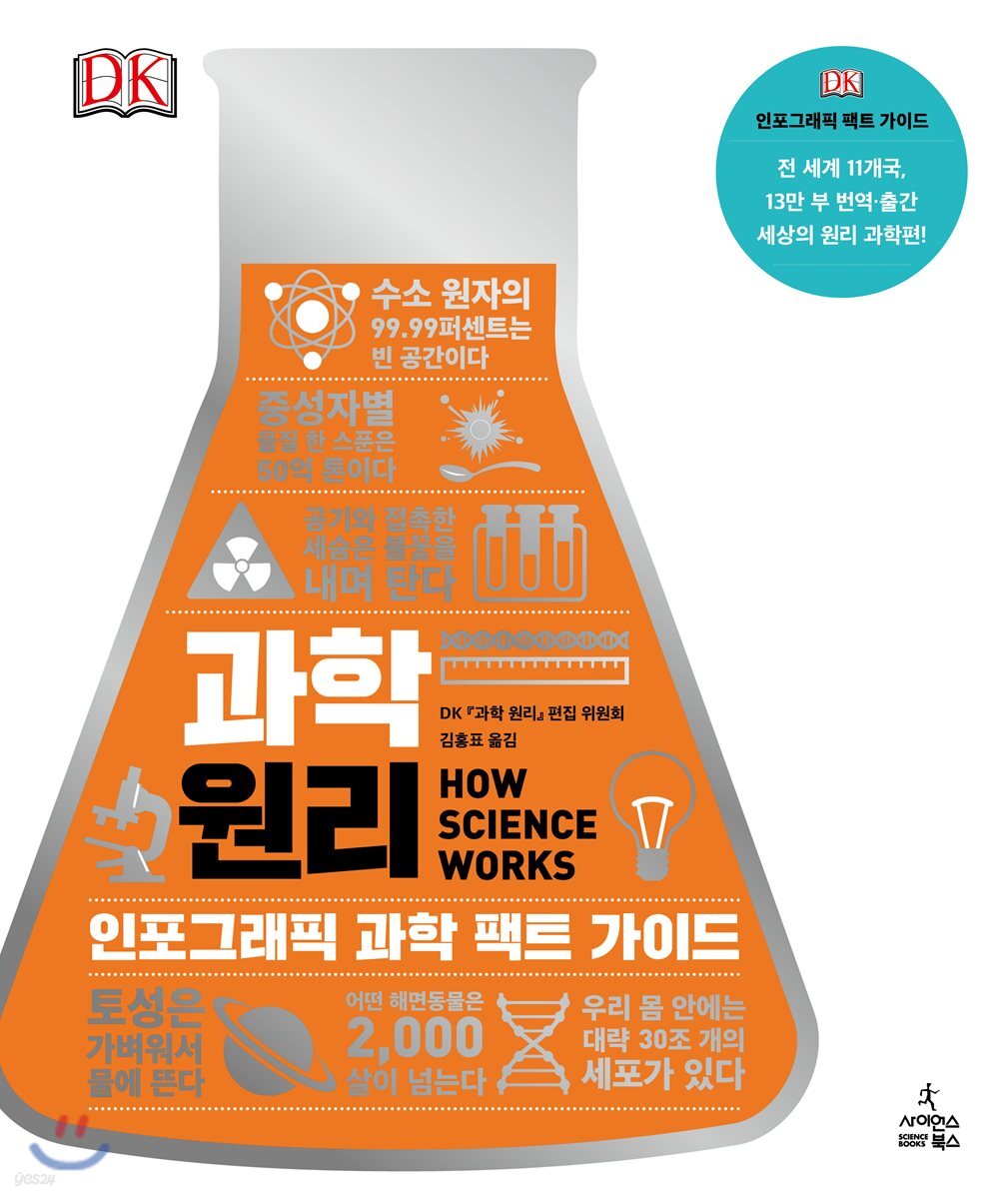 |
Description
Book Introduction
130,000 copies translated and published in 11 countries around the world
The fourth book in the "Principles of the World" series
In accordance with the revised 2015 curriculum, integrated science was designated as a required science subject for first-year high school students starting in 2018.
Integrated science emphasizes convergent education by integrating existing sciences, which were divided into physics, chemistry, biology, and earth science, into one according to the structure of big history.
While some welcomed the introduction of a new science education paradigm, there were also voices of bewilderment in the educational field.
The main criticism was that it was difficult to learn because it required a lot of integrated thinking skills, and that the test questions were difficult to create and evaluate.
However, scientists like Kim Sang-wook, a professor of physics at Kyung Hee University, emphasize the importance of an integrated scientific approach, saying, “If you haven’t been able to properly understand the world after studying science, it’s because you haven’t tried to see the whole picture.”
Furthermore, integrated science education is essential “to comprehensively understand the universe and solve the crises facing humanity.”
Although integrated science was excluded from the 2022 College Scholastic Ability Test (CSAT) for students entering high school this year, contrary to the original plan, it is clear that integrated science will play a significant role in future college admissions and the educational process.
So how should we prepare for integrated science? Experts in the science and education fields who have been involved in developing integrated science curricula emphasize the importance of "building background knowledge through natural reading of science books."
In particular, they often order reading of various science textbooks “during the last winter break of the third year of middle school.”
The book 『How Science Works: The Facts Visually Explained』, published by DK and Science Books, Inc., is exactly what meets the demand for integrated science education.
This book is the fourth book in the "Principles of the World" series published by Science Books, Inc., and is a translation of one of the infographic series published by DK (Dorling Kindersley), a British publisher specializing in educational/culture/practical guides.
Covering a wide range of fields including medicine, anatomy, physiology, nutrition, economics, philosophy, and engineering, this "Principles of the World" series, which fact-checks scientific information and knowledge that young people and general readers are curious about in their daily lives with beautiful and intuitive infographics and diagrams, is a worldwide bestseller series that has been translated and published in over a dozen countries around the world for each book published, selling hundreds of thousands of copies.
Currently, 『Principles of the Human Body』, 『Principles of Food』, and 『Principles of Money』 have been published in Korea and are receiving love from readers.
The fourth book in this series, "Principles of Science," takes "science" as its theme and guides readers into the world of scientific "facts" using splendid infographics and diagrams.
You can find real answers to questions that always come up when thinking about science, such as “When and how did the universe come into being?”, “What is life?”, “Is global warming real?”, “What can we do with gravitational waves?”, “Will artificial intelligence take over humanity?”, and “What will the end of the universe be like?”
Moreover, it is composed of five chapters: “Matter,” “Energy and Force,” “Life,” “Space,” and “Earth,” showing a structure that is precisely aligned with the curriculum of integrated science.
This book provides a comprehensive overview of the achievements of modern science for middle school students preparing for integrated science before entering high school, high school students already studying integrated science, teachers concerned about teaching integrated science when it was suddenly introduced without prior preparation or educational support, and even general readers with an interest in science.
Kim Hong-pyo, a professor at Ajou University's College of Pharmacy who translated this book into Korean, evaluates the book's strength as providing a "connecting point" that allows for an integrated view of the world through science.
We learn about science by dividing it into four fields: physics, chemistry, biology, and earth science. However, any scientist will “quickly realize” that no question in any field of science can be answered with knowledge from that field alone.
The energy of living things is created by mitochondria, but mitochondria are beings that lived independently and then joined our cells through symbiotic evolution. The energy production process of mitochondria cannot be understood without understanding the chemical concept of proton gradient, and without quantum mechanics, the process of electrons moving around within cellular proteins cannot be understood.
Science is all connected like this.
"Principles of Science" introduces 115 concepts that precisely point out the connections between physics, chemistry, biology, and earth science.
And each concept is presented accurately and beautifully in one or two infographics that fill a single two-page spread.
This is not all.
According to Professor Kim Hong-pyo, there is another hidden advantage: “You can immerse yourself in a scientific journey by going here and there without having to follow a logical order, just like looking at an animal guide you stumbled upon in a library in the days when books were rare.”
The fourth book in the "Principles of the World" series
In accordance with the revised 2015 curriculum, integrated science was designated as a required science subject for first-year high school students starting in 2018.
Integrated science emphasizes convergent education by integrating existing sciences, which were divided into physics, chemistry, biology, and earth science, into one according to the structure of big history.
While some welcomed the introduction of a new science education paradigm, there were also voices of bewilderment in the educational field.
The main criticism was that it was difficult to learn because it required a lot of integrated thinking skills, and that the test questions were difficult to create and evaluate.
However, scientists like Kim Sang-wook, a professor of physics at Kyung Hee University, emphasize the importance of an integrated scientific approach, saying, “If you haven’t been able to properly understand the world after studying science, it’s because you haven’t tried to see the whole picture.”
Furthermore, integrated science education is essential “to comprehensively understand the universe and solve the crises facing humanity.”
Although integrated science was excluded from the 2022 College Scholastic Ability Test (CSAT) for students entering high school this year, contrary to the original plan, it is clear that integrated science will play a significant role in future college admissions and the educational process.
So how should we prepare for integrated science? Experts in the science and education fields who have been involved in developing integrated science curricula emphasize the importance of "building background knowledge through natural reading of science books."
In particular, they often order reading of various science textbooks “during the last winter break of the third year of middle school.”
The book 『How Science Works: The Facts Visually Explained』, published by DK and Science Books, Inc., is exactly what meets the demand for integrated science education.
This book is the fourth book in the "Principles of the World" series published by Science Books, Inc., and is a translation of one of the infographic series published by DK (Dorling Kindersley), a British publisher specializing in educational/culture/practical guides.
Covering a wide range of fields including medicine, anatomy, physiology, nutrition, economics, philosophy, and engineering, this "Principles of the World" series, which fact-checks scientific information and knowledge that young people and general readers are curious about in their daily lives with beautiful and intuitive infographics and diagrams, is a worldwide bestseller series that has been translated and published in over a dozen countries around the world for each book published, selling hundreds of thousands of copies.
Currently, 『Principles of the Human Body』, 『Principles of Food』, and 『Principles of Money』 have been published in Korea and are receiving love from readers.
The fourth book in this series, "Principles of Science," takes "science" as its theme and guides readers into the world of scientific "facts" using splendid infographics and diagrams.
You can find real answers to questions that always come up when thinking about science, such as “When and how did the universe come into being?”, “What is life?”, “Is global warming real?”, “What can we do with gravitational waves?”, “Will artificial intelligence take over humanity?”, and “What will the end of the universe be like?”
Moreover, it is composed of five chapters: “Matter,” “Energy and Force,” “Life,” “Space,” and “Earth,” showing a structure that is precisely aligned with the curriculum of integrated science.
This book provides a comprehensive overview of the achievements of modern science for middle school students preparing for integrated science before entering high school, high school students already studying integrated science, teachers concerned about teaching integrated science when it was suddenly introduced without prior preparation or educational support, and even general readers with an interest in science.
Kim Hong-pyo, a professor at Ajou University's College of Pharmacy who translated this book into Korean, evaluates the book's strength as providing a "connecting point" that allows for an integrated view of the world through science.
We learn about science by dividing it into four fields: physics, chemistry, biology, and earth science. However, any scientist will “quickly realize” that no question in any field of science can be answered with knowledge from that field alone.
The energy of living things is created by mitochondria, but mitochondria are beings that lived independently and then joined our cells through symbiotic evolution. The energy production process of mitochondria cannot be understood without understanding the chemical concept of proton gradient, and without quantum mechanics, the process of electrons moving around within cellular proteins cannot be understood.
Science is all connected like this.
"Principles of Science" introduces 115 concepts that precisely point out the connections between physics, chemistry, biology, and earth science.
And each concept is presented accurately and beautifully in one or two infographics that fill a single two-page spread.
This is not all.
According to Professor Kim Hong-pyo, there is another hidden advantage: “You can immerse yourself in a scientific journey by going here and there without having to follow a logical order, just like looking at an animal guide you stumbled upon in a library in the days when books were rare.”
- You can preview some of the book's contents.
Preview
index
What makes science special?
substance
What is matter? / Solids / Liquids / Gases / Strange states / Matter transformations / Inside the atom / Subatomic world / Waves and particles / The world of quantum / Particle accelerators / Elements / Radioactivity / Mixtures and compounds / Molecules and ions / Reacting / Reactions and energy / Metals / Hydrogen / Carbon / Air / Combustion and explosion / Water / Acids and bases / Crystals / Solutions and solvents / Catalysts / Making chemicals / Plastics / Glass and ceramics / Amazing materials
Energy and strength
What is energy? / Static electricity / Electric current / Magnetic field / Power generation / Alternative energy / Principles of electronics / Microchips / Principles of computers / Virtual reality / Nanotechnology / Robotics and automation / Artificial intelligence / Waves / From radio waves to gamma rays / Color / Mirrors and lenses / Principles of lasers / Applications of optics / Sound / Heat / Heat transfer / Force / Velocity and acceleration / Machines / Friction / Springs and pendulums / Pressure / Flight / Principles of buoyancy / Vacuum / Gravity / Special relativity / General relativity / Gravitational waves / String theory
life
What is life? / Types of life / Viruses / Cells / Principles of genes / Reproduction / Gene transfer / How did life begin? / How does it evolve? / How do plants move the world? / Plant respiration / Carbon cycle / Aging / Genome / Genetic engineering / Gene therapy / Stem cells / Cloning
universe
Stars / Sun / Solar System / Space Drifters / Black Holes / Galaxies / Big Bang / How Big is the Universe? / Dark Matter and Dark Energy / The End of the Universe / Looking at the Universe / Are We Alone in the Universe? / Space Flight / Living in Space / Space Travel
earth
The Earth's Inner Parts / Plate Tectonics / Earthquakes / Volcanoes / Rock Cycle / Oceans / Atmosphere / Principles of Weather / Climate Change / Climate and Seasons / Water Cycle / Greenhouse Effect / Climate Change
Search
Acknowledgements
substance
What is matter? / Solids / Liquids / Gases / Strange states / Matter transformations / Inside the atom / Subatomic world / Waves and particles / The world of quantum / Particle accelerators / Elements / Radioactivity / Mixtures and compounds / Molecules and ions / Reacting / Reactions and energy / Metals / Hydrogen / Carbon / Air / Combustion and explosion / Water / Acids and bases / Crystals / Solutions and solvents / Catalysts / Making chemicals / Plastics / Glass and ceramics / Amazing materials
Energy and strength
What is energy? / Static electricity / Electric current / Magnetic field / Power generation / Alternative energy / Principles of electronics / Microchips / Principles of computers / Virtual reality / Nanotechnology / Robotics and automation / Artificial intelligence / Waves / From radio waves to gamma rays / Color / Mirrors and lenses / Principles of lasers / Applications of optics / Sound / Heat / Heat transfer / Force / Velocity and acceleration / Machines / Friction / Springs and pendulums / Pressure / Flight / Principles of buoyancy / Vacuum / Gravity / Special relativity / General relativity / Gravitational waves / String theory
life
What is life? / Types of life / Viruses / Cells / Principles of genes / Reproduction / Gene transfer / How did life begin? / How does it evolve? / How do plants move the world? / Plant respiration / Carbon cycle / Aging / Genome / Genetic engineering / Gene therapy / Stem cells / Cloning
universe
Stars / Sun / Solar System / Space Drifters / Black Holes / Galaxies / Big Bang / How Big is the Universe? / Dark Matter and Dark Energy / The End of the Universe / Looking at the Universe / Are We Alone in the Universe? / Space Flight / Living in Space / Space Travel
earth
The Earth's Inner Parts / Plate Tectonics / Earthquakes / Volcanoes / Rock Cycle / Oceans / Atmosphere / Principles of Weather / Climate Change / Climate and Seasons / Water Cycle / Greenhouse Effect / Climate Change
Search
Acknowledgements
Detailed image
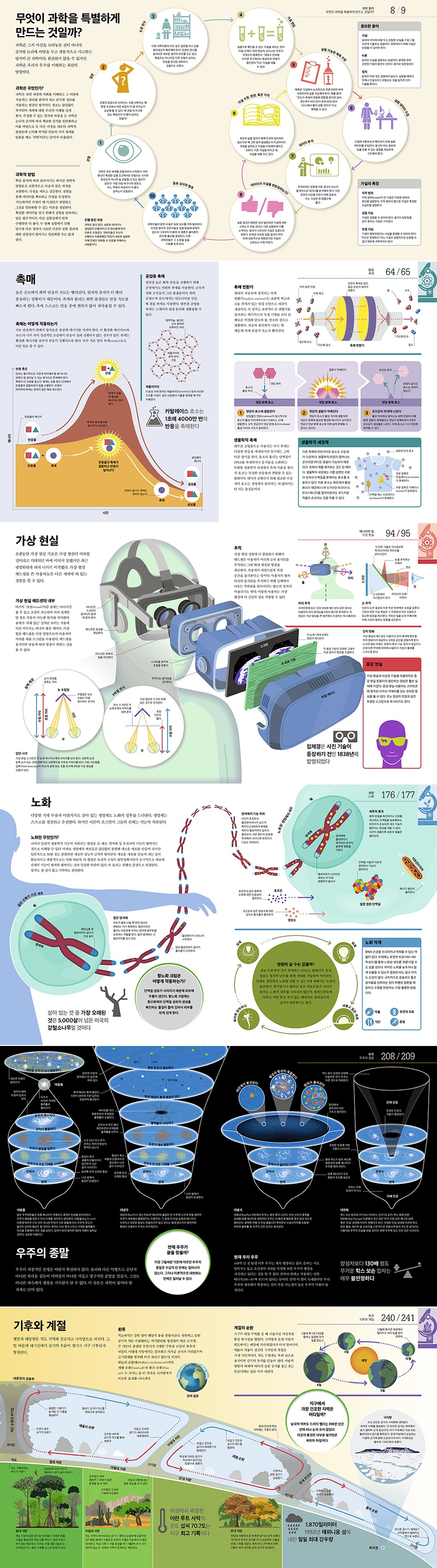
Publisher's Review
Why is science special?
The world's simplest science dictionary!
- Science is a systematic way of thinking based on evidence and logic.
- Matter is a substance that occupies space and has mass.
- A chemical reaction is a process that breaks atomic bonds and creates new bonds.
This book is largely divided into five chapters.
First, the book opens with the question, “What makes science special?”
This chapter describes the process of scientific research, which involves researching a paper, formulating a hypothesis, making predictions, collecting data, and publishing the results for peer review.
This suggests that science is not a fixed body of facts, but rather a process of discovery that can undergo constant revision and transformation.
The first chapter is “Matter.”
The various states of matter, such as solid, liquid, gas, plasma, superconductor, and superfluid, and the processes by which changes occur between states are explained.
Next, we will look at the nucleus and electrons, which are the units of atoms, and explore the subatomic world that makes up protons and neutrons.
It includes explanations of phenomena occurring at subatomic levels, such as quantum and radioactivity, as well as particle accelerators, which are instruments used to study them, so that you can understand each concept while also understanding the phenomena occurring at atoms.
Next, the mechanism of chemical reactions, major molecules such as carbon, hydrogen, and water, and the properties and manufacturing processes of chemicals made from these materials are explained.
Matter and energy, life and the universe, Earth and the environment
A vivid and special science story at a glance!
- 1 Newton accelerates an object with a mass of 1 kilogram at 1 meter per second.
- Strong AI can know what it doesn't know and learn from it to become wiser.
- The genetic information of a living organism is contained in DNA molecules, and this entire DNA is called the genome.
The chapter "Energy and Force" explains what forces are involved in the various types of physical movements that occur in everyday life and how energies such as sound and heat work.
Electricity and magnetic phenomena, which are also important topics in the secondary education curriculum, are also included.
The explanations, which follow a series of keywords such as electromagnetic waves, laser principles, and the use of optics, make us realize that scientific facts are not fragmented but connected and require an integrated understanding.
In addition to the latest physics knowledge, including the theory of relativity, gravitational waves, and string theory, which are not easily found in secondary education, it also explains engineering fields such as the principles of electronic engineering and microchips used in semiconductors.
We tried to keep up with the times by including information on emerging fields such as computers, virtual reality, nanotechnology, robots, and artificial intelligence.
Chapter "Life" begins with an introduction to the definition of life and the principles of how life phenomena work, and then examines the units that generate and maintain life phenomena, following the components of life such as cells, genes, and DNA.
In addition, after exploring which aspects of biological phenomena growth and aging are related, we explain technologies such as gene therapy and cloning that have become possible due to the advancement of modern genetic engineering.
Embracing space exploration and the future of Earth
Latest Infographic Guide
- The sun will remain stable for about 5 billion years.
- While living in space, an astronaut's height can grow up to 3 percent.
- 2016 was the warmest year on record.
The chapter "Universe" contains an explanation of the beginning and end of the universe, along with things that exist in the universe such as the sun, galaxies, and black holes.
Are we alone in the universe? What would happen to our bodies if we lived in space? Discover what would happen if the problems imagined in science fiction movies actually happened through engaging explanations, allowing you to spark your imagination.
Chapter "Earth" begins by introducing the internal structure of the Earth.
Introduces the theory of plate tectonics, which states that the lithosphere is made up of plates, and explains how earthquakes and volcanoes occur.
It then explains the elements that make up the Earth's environment, such as rocks, oceans, and atmosphere, and explains the principles of weather, climate, the water cycle, and the greenhouse effect.
How can we integrate the seemingly disparate principles of science, from the microscopic world of cells to the macroscopic and expansive world of the universe? "Principles of Science" will help us find the answer.
The world's simplest science dictionary!
- Science is a systematic way of thinking based on evidence and logic.
- Matter is a substance that occupies space and has mass.
- A chemical reaction is a process that breaks atomic bonds and creates new bonds.
This book is largely divided into five chapters.
First, the book opens with the question, “What makes science special?”
This chapter describes the process of scientific research, which involves researching a paper, formulating a hypothesis, making predictions, collecting data, and publishing the results for peer review.
This suggests that science is not a fixed body of facts, but rather a process of discovery that can undergo constant revision and transformation.
The first chapter is “Matter.”
The various states of matter, such as solid, liquid, gas, plasma, superconductor, and superfluid, and the processes by which changes occur between states are explained.
Next, we will look at the nucleus and electrons, which are the units of atoms, and explore the subatomic world that makes up protons and neutrons.
It includes explanations of phenomena occurring at subatomic levels, such as quantum and radioactivity, as well as particle accelerators, which are instruments used to study them, so that you can understand each concept while also understanding the phenomena occurring at atoms.
Next, the mechanism of chemical reactions, major molecules such as carbon, hydrogen, and water, and the properties and manufacturing processes of chemicals made from these materials are explained.
Matter and energy, life and the universe, Earth and the environment
A vivid and special science story at a glance!
- 1 Newton accelerates an object with a mass of 1 kilogram at 1 meter per second.
- Strong AI can know what it doesn't know and learn from it to become wiser.
- The genetic information of a living organism is contained in DNA molecules, and this entire DNA is called the genome.
The chapter "Energy and Force" explains what forces are involved in the various types of physical movements that occur in everyday life and how energies such as sound and heat work.
Electricity and magnetic phenomena, which are also important topics in the secondary education curriculum, are also included.
The explanations, which follow a series of keywords such as electromagnetic waves, laser principles, and the use of optics, make us realize that scientific facts are not fragmented but connected and require an integrated understanding.
In addition to the latest physics knowledge, including the theory of relativity, gravitational waves, and string theory, which are not easily found in secondary education, it also explains engineering fields such as the principles of electronic engineering and microchips used in semiconductors.
We tried to keep up with the times by including information on emerging fields such as computers, virtual reality, nanotechnology, robots, and artificial intelligence.
Chapter "Life" begins with an introduction to the definition of life and the principles of how life phenomena work, and then examines the units that generate and maintain life phenomena, following the components of life such as cells, genes, and DNA.
In addition, after exploring which aspects of biological phenomena growth and aging are related, we explain technologies such as gene therapy and cloning that have become possible due to the advancement of modern genetic engineering.
Embracing space exploration and the future of Earth
Latest Infographic Guide
- The sun will remain stable for about 5 billion years.
- While living in space, an astronaut's height can grow up to 3 percent.
- 2016 was the warmest year on record.
The chapter "Universe" contains an explanation of the beginning and end of the universe, along with things that exist in the universe such as the sun, galaxies, and black holes.
Are we alone in the universe? What would happen to our bodies if we lived in space? Discover what would happen if the problems imagined in science fiction movies actually happened through engaging explanations, allowing you to spark your imagination.
Chapter "Earth" begins by introducing the internal structure of the Earth.
Introduces the theory of plate tectonics, which states that the lithosphere is made up of plates, and explains how earthquakes and volcanoes occur.
It then explains the elements that make up the Earth's environment, such as rocks, oceans, and atmosphere, and explains the principles of weather, climate, the water cycle, and the greenhouse effect.
How can we integrate the seemingly disparate principles of science, from the microscopic world of cells to the macroscopic and expansive world of the universe? "Principles of Science" will help us find the answer.
GOODS SPECIFICS
- Publication date: December 15, 2018
- Format: Hardcover book binding method guide
- Page count, weight, size: 256 pages | 640g | 195*230*20mm
- ISBN13: 9791189198183
- ISBN10: 1189198185
You may also like
카테고리
korean


korean

![ELLE 엘르 스페셜 에디션 A형 : 12월 [2025]](http://librairie.coreenne.fr/cdn/shop/files/b8e27a3de6c9538896439686c6b0e8fb.jpg?v=1766436872&width=3840)


