

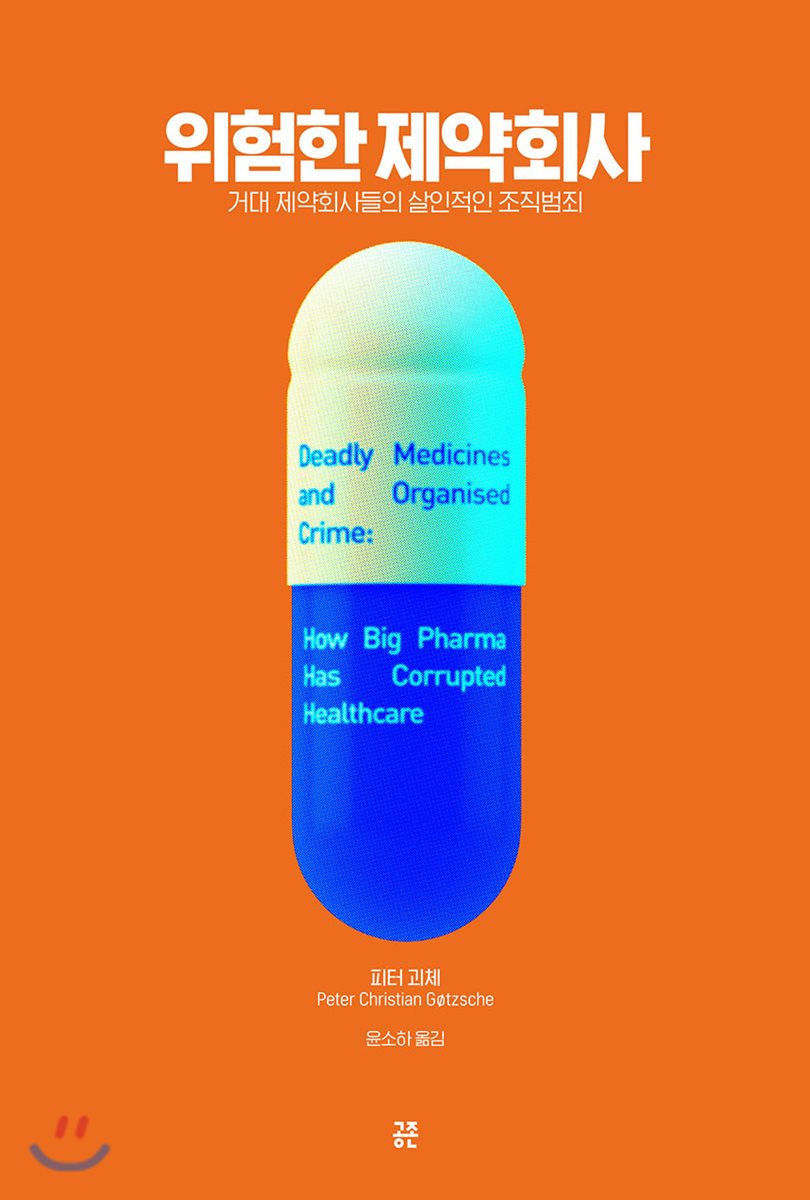
Dangerous pharmaceutical companies
 |
Description
Book Introduction
Professor Peter Goetze of the University of Copenhagen Medical School, co-founder of the Cochrane Collaboration and a global authority on evidence-based medicine, reveals the anti-humanitarian organized crime of large pharmaceutical companies. Winner of the British Medical Association's "Book of the Year" Award (first in the "Fundamentals of Medicine" category)! A hit book published in 16 languages and an Amazon medical bestseller! “In the United States and Europe, drugs are the third leading cause of death, after heart disease and cancer.” You only realize it when you stop taking the medication! The author is co-founder of the Cochrane Collaboration, an international non-profit organization that researches and verifies health care issues, founder and director of the Nordic Cochrane Centre, and chief physician at the Royal Danish Hospital. He also visited Korea to attend the 'Cochrane Colloquium' academic conference held in Seoul in October 2016. In an email exchange with the publisher, Gongjon, on August 31, 2017, the author responded to the question, “What are some notable changes that have occurred in the pharmaceutical industry and society since the publication of this book?” “Not all the changes that occur in a complex system like healthcare can be said to have been achieved by one person. There are always other people out there trying to solve the same problem as me. So if change happens, who should we praise? The most significant change, I think, is that I have patients who have stopped taking certain medications they had been taking for a long time after reading my book. They told me that their quality of life improved after they stopped taking those drugs. Most people don't realize that problems like fatigue, lack of libido, muscle pain, and memory loss may be side effects of the medications they are taking. “You only realize it when you stop taking the medication!” |
- You can preview some of the book's contents.
Preview
index
Preface 1
Preface 2
Chapter 1.
A drug epidemic is raging
Chapter 2.
I confess, the pharmaceutical company's secret!
Chapter 3.
Organized crime is the pharmaceutical company's business model.
Chapter 4.
Very few patients benefit from medication.
Chapter 5.
Clinical trials that violate the social contract
Chapter 6.
Medical journals that thrive on conflicts of interest
Chapter 7.
The temptation of easy money and the medical-industrial complex
Chapter 8.
What about all those doctors employed by pharmaceutical companies?
Do you do
Chapter 9.
A cunning, evil, and greedy pharmacist
Chapter 10.
corrupt and irresponsible regulators
Chapter 11.
Make all pharmaceutical research data public
Chapter 12.
A miraculous medicine that cures ten thousand diseases
Chapter 13.
Merck prioritizes patient death
Chapter 14.
Clinical trial manipulation and new drug marketing
Chapter 15.
Giving expensive medicine to poor patients instead of cheap medicine
energy
Chapter 16.
They say the medicine is effective, but patients are dying.
Chapter 17.
Psychiatry, a paradise for pharmaceutical companies
Chapter 18.
Children who commit suicide by taking Happy Pills
Chapter 19.
Organized violence to protect sales
Chapter 20.
The Truth Behind the False Beliefs Concocted by Pharmaceutical Companies
Chapter 21.
Clean up the corruption in our healthcare system.
Chapter 22.
There is no pharmaceutical company for the patients.
Translator's Note
References
Search
Preface 2
Chapter 1.
A drug epidemic is raging
Chapter 2.
I confess, the pharmaceutical company's secret!
Chapter 3.
Organized crime is the pharmaceutical company's business model.
Chapter 4.
Very few patients benefit from medication.
Chapter 5.
Clinical trials that violate the social contract
Chapter 6.
Medical journals that thrive on conflicts of interest
Chapter 7.
The temptation of easy money and the medical-industrial complex
Chapter 8.
What about all those doctors employed by pharmaceutical companies?
Do you do
Chapter 9.
A cunning, evil, and greedy pharmacist
Chapter 10.
corrupt and irresponsible regulators
Chapter 11.
Make all pharmaceutical research data public
Chapter 12.
A miraculous medicine that cures ten thousand diseases
Chapter 13.
Merck prioritizes patient death
Chapter 14.
Clinical trial manipulation and new drug marketing
Chapter 15.
Giving expensive medicine to poor patients instead of cheap medicine
energy
Chapter 16.
They say the medicine is effective, but patients are dying.
Chapter 17.
Psychiatry, a paradise for pharmaceutical companies
Chapter 18.
Children who commit suicide by taking Happy Pills
Chapter 19.
Organized violence to protect sales
Chapter 20.
The Truth Behind the False Beliefs Concocted by Pharmaceutical Companies
Chapter 21.
Clean up the corruption in our healthcare system.
Chapter 22.
There is no pharmaceutical company for the patients.
Translator's Note
References
Search
Detailed image

Publisher's Review
Rebate offerings in the pharmaceutical industry are virtually standard practice due to lax regulations.
This is partly because lobbying can create or maintain lax regulations, but more importantly, the benefits of offering rebates are far greater than fines or penalties, and the punishment for those responsible is lenient.
Recently in 2017, Chairman Kang Jeong-seok of Dong-A Socio Holdings, the holding company of Dong-A Pharmaceutical, was arrested and indicted on charges of embezzling 70 billion won of company funds, providing 5.5 billion won of it as pharmaceutical rebates, and evading taxes.
And a prison sentence of one year and six months was sought for a nun who was the head of the pharmacy department at Fatima Hospital in Daegu on charges of receiving 650 million won in bribes for purchasing drugs from a subsidiary of Dong-A Socio Holdings over eight years.
But as is often the case, the most important information was not disclosed.
There is no precise data on what drugs hospitals purchased or doctors prescribed in return for rebates, what their efficacy and side effects were, or how much of each drug was prescribed to whom.
The biggest reason rebate offers are bad is because they can lead to patients being prescribed unnecessary, unnecessary, or harmful medications that can lead to poor health or even death.
According to the new book Deadly Medicines and Organized Crime, “In the United States and Europe, drugs are the third leading cause of death, behind heart disease and cancer” (see pp. 439-441).
This is not due to drug abuse, but rather the result of pharmaceutical companies concealing or manipulating the serious side effects of their drugs.
Most regular patients don't think there's a problem with their medication.
We have a vague belief that the medicine must have been made properly, and that if it wasn't, the doctor wouldn't prescribe it.
But the truth that this book conveys in detail is truly shocking.
Peter C. Götze, a world authority on evidence-based medicine at the University of Copenhagen Medical School,
Professor Gøtzsche, based on his long-term experience as a salesperson for a large pharmaceutical company, his expertise and rigor as a scholar specializing in biology, chemistry, and medicine, his field experience as an internist identifying real-world problems in the healthcare industry, and his expertise in verifying medical research, including clinical trials, revealing research misconduct and scientific fraud at pharmaceutical companies, explains in detail how pharmaceutical companies make money by deceiving doctors and patients and selling harmful or useless drugs.
However, this does not mean that the author argues that all drugs are useless.
According to the "Foreword" by Richard Smith, former editor-in-chief of the British Medical Journal, the monster acknowledges that some medicines have brought significant benefits.
He did it in just one sentence.
“This book is not about the well-known benefits of the drug, such as its effectiveness in treating infectious diseases, heart disease, some cancers, or hormone deficiencies such as type 1 diabetes.” Some readers may find this insufficient.
So, the book makes it clear that this is a book about the failure of the entire system, including drug development, manufacturing, marketing, and regulation.
This is not a book about the benefits of medicine.
This book is an investigative report on organized crime in pharmaceutical companies, armed with 'real names' and 'facts' based on over 900 verified documents and data. The author is a pharmaceutical company's .
They say the business model is no different from organized crime.
Because the evil actions of big pharmaceutical companies meet the elements of organized crime as defined by U.S. law (p. 85).
The author not only exposes and highlights the many problems in the pharmaceutical, medical, health care, political, and administrative industries, but also suggests feasible and rational solutions (Chapter 21).
Additionally, the author seeks to dispel the false beliefs that pharmaceutical companies have created and that we blindly believe.
Chapter 20 lists 10 representative 'false beliefs'.
It also introduces specific countermeasures that general readers can take toward doctors from the patient's perspective (page 481).
This is partly because lobbying can create or maintain lax regulations, but more importantly, the benefits of offering rebates are far greater than fines or penalties, and the punishment for those responsible is lenient.
Recently in 2017, Chairman Kang Jeong-seok of Dong-A Socio Holdings, the holding company of Dong-A Pharmaceutical, was arrested and indicted on charges of embezzling 70 billion won of company funds, providing 5.5 billion won of it as pharmaceutical rebates, and evading taxes.
And a prison sentence of one year and six months was sought for a nun who was the head of the pharmacy department at Fatima Hospital in Daegu on charges of receiving 650 million won in bribes for purchasing drugs from a subsidiary of Dong-A Socio Holdings over eight years.
But as is often the case, the most important information was not disclosed.
There is no precise data on what drugs hospitals purchased or doctors prescribed in return for rebates, what their efficacy and side effects were, or how much of each drug was prescribed to whom.
The biggest reason rebate offers are bad is because they can lead to patients being prescribed unnecessary, unnecessary, or harmful medications that can lead to poor health or even death.
According to the new book Deadly Medicines and Organized Crime, “In the United States and Europe, drugs are the third leading cause of death, behind heart disease and cancer” (see pp. 439-441).
This is not due to drug abuse, but rather the result of pharmaceutical companies concealing or manipulating the serious side effects of their drugs.
Most regular patients don't think there's a problem with their medication.
We have a vague belief that the medicine must have been made properly, and that if it wasn't, the doctor wouldn't prescribe it.
But the truth that this book conveys in detail is truly shocking.
Peter C. Götze, a world authority on evidence-based medicine at the University of Copenhagen Medical School,
Professor Gøtzsche, based on his long-term experience as a salesperson for a large pharmaceutical company, his expertise and rigor as a scholar specializing in biology, chemistry, and medicine, his field experience as an internist identifying real-world problems in the healthcare industry, and his expertise in verifying medical research, including clinical trials, revealing research misconduct and scientific fraud at pharmaceutical companies, explains in detail how pharmaceutical companies make money by deceiving doctors and patients and selling harmful or useless drugs.
However, this does not mean that the author argues that all drugs are useless.
According to the "Foreword" by Richard Smith, former editor-in-chief of the British Medical Journal, the monster acknowledges that some medicines have brought significant benefits.
He did it in just one sentence.
“This book is not about the well-known benefits of the drug, such as its effectiveness in treating infectious diseases, heart disease, some cancers, or hormone deficiencies such as type 1 diabetes.” Some readers may find this insufficient.
So, the book makes it clear that this is a book about the failure of the entire system, including drug development, manufacturing, marketing, and regulation.
This is not a book about the benefits of medicine.
This book is an investigative report on organized crime in pharmaceutical companies, armed with 'real names' and 'facts' based on over 900 verified documents and data. The author is a pharmaceutical company's .
They say the business model is no different from organized crime.
Because the evil actions of big pharmaceutical companies meet the elements of organized crime as defined by U.S. law (p. 85).
The author not only exposes and highlights the many problems in the pharmaceutical, medical, health care, political, and administrative industries, but also suggests feasible and rational solutions (Chapter 21).
Additionally, the author seeks to dispel the false beliefs that pharmaceutical companies have created and that we blindly believe.
Chapter 20 lists 10 representative 'false beliefs'.
It also introduces specific countermeasures that general readers can take toward doctors from the patient's perspective (page 481).
GOODS SPECIFICS
- Date of publication: September 15, 2017
- Format: Paperback book binding method guide
- Page count, weight, size: 589 pages | 833g | 150*220*35mm
- ISBN13: 9791195526574
- ISBN10: 1195526571
You may also like
카테고리
korean


korean

![ELLE 엘르 스페셜 에디션 A형 : 12월 [2025]](http://librairie.coreenne.fr/cdn/shop/files/b8e27a3de6c9538896439686c6b0e8fb.jpg?v=1766436872&width=3840)


