

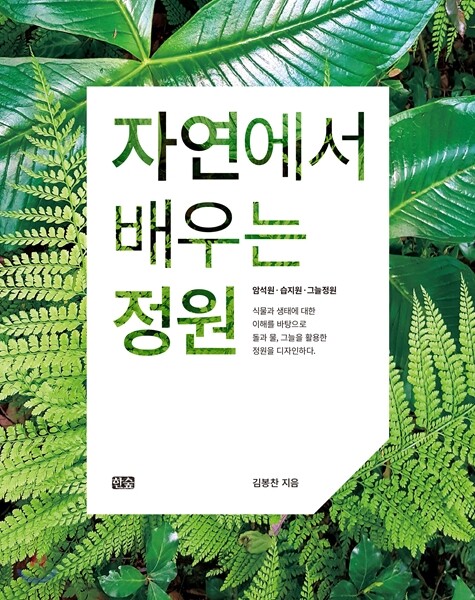
Gardens that Learn from Nature
 |
Description
Book Introduction
This book is a compilation of gardening techniques utilizing stones, water, and shade, based on an understanding of plants and ecology.
The author, who is recognized for his leading technical skills in the field through the creation of rock gardens and wetlands at Pyeonggang Botanical Garden, Yeomiji Botanical Garden, Gonjiam Hwadam Forest, Jeju Biotopia, and Baekdudaegan National Arboretum, has systematically organized the experiences and knowledge he has gained while studying and creating various types of gardens for over 30 years.
In particular, the specific creation techniques, methods, and precautions for rock gardens, wetland gardens, and shade gardens are introduced in detail, and the know-how on ‘soil and plants’, which are the most important things in a garden, is also abundant.
For example, in the rock garden composition technique, the 'punghyeolji principle' is used.
Minimize radiant heat from the topsoil.
Install a mist fountain.
Make a high-altitude cold room.
It is created to resemble the soil of highland areas.
You can get detailed advice such as 'consider the micro-environment (microclimate)'.
It also provides separate information on various themed gardens, including the Wall Garden, Paving Garden, Sink Garden, Moss Garden, Fern Garden, and Rhododendron Garden, and includes the sequential creation process of each garden as well as seasonal maintenance tips.
The author, who has also led a field trip group called “Garden Study Group in Nature” since 2015, emphasizes that the answer to a healthy and beautiful garden lies in nature, saying, “The mountains and valleys embraced by nature are my laboratory, eternal teachers, and source of inspiration.”
The author, who is recognized for his leading technical skills in the field through the creation of rock gardens and wetlands at Pyeonggang Botanical Garden, Yeomiji Botanical Garden, Gonjiam Hwadam Forest, Jeju Biotopia, and Baekdudaegan National Arboretum, has systematically organized the experiences and knowledge he has gained while studying and creating various types of gardens for over 30 years.
In particular, the specific creation techniques, methods, and precautions for rock gardens, wetland gardens, and shade gardens are introduced in detail, and the know-how on ‘soil and plants’, which are the most important things in a garden, is also abundant.
For example, in the rock garden composition technique, the 'punghyeolji principle' is used.
Minimize radiant heat from the topsoil.
Install a mist fountain.
Make a high-altitude cold room.
It is created to resemble the soil of highland areas.
You can get detailed advice such as 'consider the micro-environment (microclimate)'.
It also provides separate information on various themed gardens, including the Wall Garden, Paving Garden, Sink Garden, Moss Garden, Fern Garden, and Rhododendron Garden, and includes the sequential creation process of each garden as well as seasonal maintenance tips.
The author, who has also led a field trip group called “Garden Study Group in Nature” since 2015, emphasizes that the answer to a healthy and beautiful garden lies in nature, saying, “The mountains and valleys embraced by nature are my laboratory, eternal teachers, and source of inspiration.”
index
Rock Garden
The protagonist of the rock garden, alpine plants
Rock garden creation technology
How to create a rock garden
Applications of rock gardens
Wetland Garden_Water Garden
The foundation of wetlands, lake ecosystems
Wetland creation technology as seen through examples
Method of creating a wetland
Shade Garden
A new perspective and approach to shade
Moss Garden
Fern Garden
Rhododendron Garden
The protagonist of the rock garden, alpine plants
Rock garden creation technology
How to create a rock garden
Applications of rock gardens
Wetland Garden_Water Garden
The foundation of wetlands, lake ecosystems
Wetland creation technology as seen through examples
Method of creating a wetland
Shade Garden
A new perspective and approach to shade
Moss Garden
Fern Garden
Rhododendron Garden
Into the book
A garden is a place where humans create new things in nature.
Science and art come together here.
Especially in the case of rock gardens, scientific composition techniques are absolutely necessary, as they cannot be completed with aesthetics or artistic inspiration alone.
Growing alpine plants in climate and soil conditions that are completely different from those of the highlands is more difficult and arduous than you might think.
--- p.
26
Also, water is flexible.
Flowing, filling and illuminating.
It is neither monotonous nor prominent.
My heart often races when I look at the water shadows that capture the entire world.
Maybe that's why.
People have wanted to have water close by since long ago.
…Behind the hardship of digging the ground and bringing water from far away to create a pond, there was a desire to have the primal life force and indescribable beauty of water by one's side.
--- p.
82
People say that it is difficult to plant colorful, bright flowers in the shade or that the plants that are planted grow tall and lose their shape.
But this may be due to a lack of experience and understanding of shade gardens.
Let's think of a natural forest.
…The hot sunlight softens as it passes between the leaves, and the wind blows gently, embracing the people walking through the forest.
The forest provides adequate shade, creating a cozy and peaceful atmosphere.
--- p.
144
There is always moss in the forest.
Forests with high humidity are the perfect place for moss to live.
Long before flowering plants appeared in the world, moss existed, and people admire it for its depth of timelessness.
The greatest charm of moss is its morphological simplicity, which allows it to form clusters low to the ground, making it easy to blend in with any other plant or facility.
--- p.
160
Imagine a garden centered around deciduous trees.
The vegetation in the lower layers becomes more abundant and seasonal changes can be felt frequently.
If winter is a bit bleak, you can use evergreen shrubs.
Evergreen shrubs that grow while maintaining their shape provide a solid framework for the garden at the base of the deciduous forest.
However, the shrubs used at this time must be very cold-resistant, have some adaptability to shade, and have beautiful flowers and leaves.
Science and art come together here.
Especially in the case of rock gardens, scientific composition techniques are absolutely necessary, as they cannot be completed with aesthetics or artistic inspiration alone.
Growing alpine plants in climate and soil conditions that are completely different from those of the highlands is more difficult and arduous than you might think.
--- p.
26
Also, water is flexible.
Flowing, filling and illuminating.
It is neither monotonous nor prominent.
My heart often races when I look at the water shadows that capture the entire world.
Maybe that's why.
People have wanted to have water close by since long ago.
…Behind the hardship of digging the ground and bringing water from far away to create a pond, there was a desire to have the primal life force and indescribable beauty of water by one's side.
--- p.
82
People say that it is difficult to plant colorful, bright flowers in the shade or that the plants that are planted grow tall and lose their shape.
But this may be due to a lack of experience and understanding of shade gardens.
Let's think of a natural forest.
…The hot sunlight softens as it passes between the leaves, and the wind blows gently, embracing the people walking through the forest.
The forest provides adequate shade, creating a cozy and peaceful atmosphere.
--- p.
144
There is always moss in the forest.
Forests with high humidity are the perfect place for moss to live.
Long before flowering plants appeared in the world, moss existed, and people admire it for its depth of timelessness.
The greatest charm of moss is its morphological simplicity, which allows it to form clusters low to the ground, making it easy to blend in with any other plant or facility.
--- p.
160
Imagine a garden centered around deciduous trees.
The vegetation in the lower layers becomes more abundant and seasonal changes can be felt frequently.
If winter is a bit bleak, you can use evergreen shrubs.
Evergreen shrubs that grow while maintaining their shape provide a solid framework for the garden at the base of the deciduous forest.
However, the shrubs used at this time must be very cold-resistant, have some adaptability to shade, and have beautiful flowers and leaves.
--- p.
201
201
GOODS SPECIFICS
- Date of publication: May 17, 2017
- Page count, weight, size: 224 pages | 596g | 190*240*15mm
- ISBN13: 9791187511090
- ISBN10: 1187511099
You may also like
카테고리
korean


korean

![GQ KOREA Mark (Monthly): December [2025]](http://librairie.coreenne.fr/cdn/shop/files/8ef265dbbfbf186523ed75ba7319009d.jpg?v=1765340328&width=3840)


