

The moment when math becomes this fun
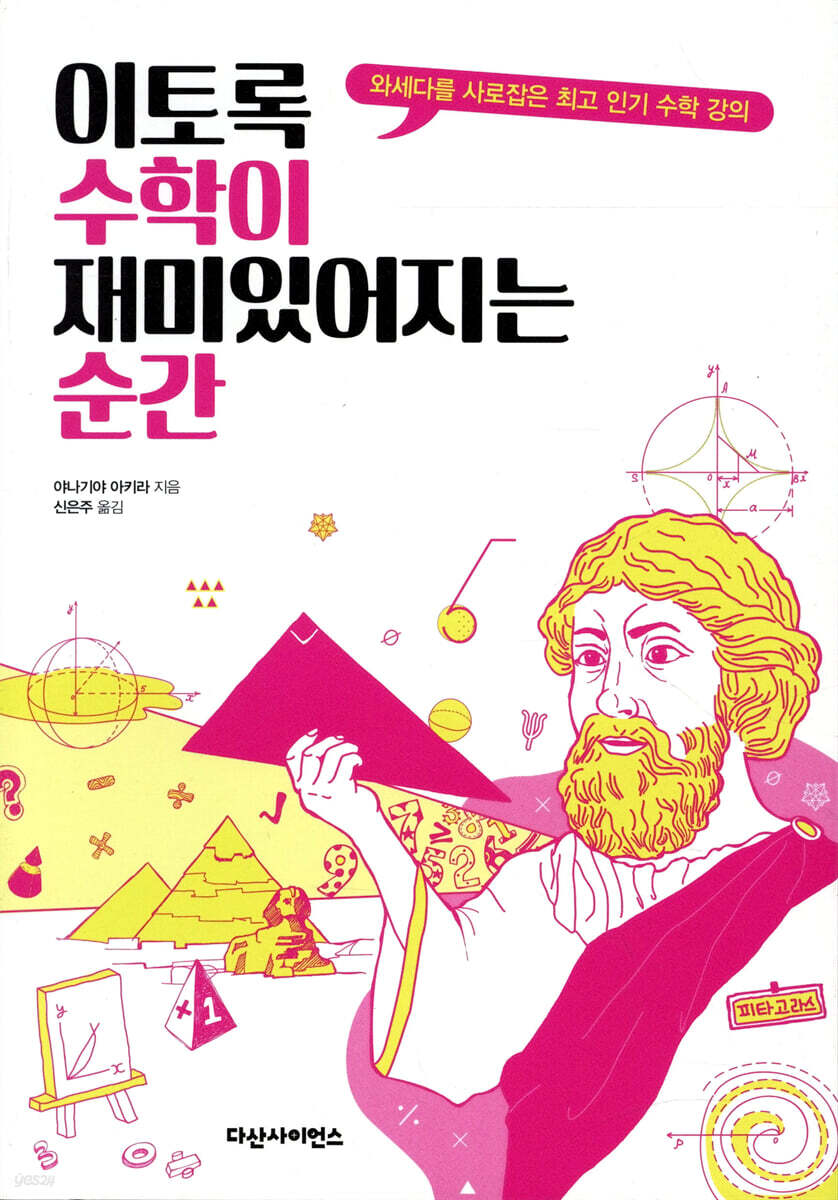 |
Description
Book Introduction
A delightful guide that will draw even those who have avoided mathematics into the fascinating world of mathematics.
The author, who has been featured in the media as a 'charismatic and popular math teacher,' vividly captures the core parts of his math lectures with rich images.
This book begins with the invention of numbers and follows the main lines of the history of mathematics, explaining various mathematical knowledge such as irrational numbers, quadratic equations, calculus, statistics, probability, auxiliary lines, sets, and infinity through various examples and episodes.
The author's fascinating mathematical stories show how closely human history and our daily lives are intertwined with mathematics.
It also reminds us of the true value and joy of mathematics.
The author, who has been featured in the media as a 'charismatic and popular math teacher,' vividly captures the core parts of his math lectures with rich images.
This book begins with the invention of numbers and follows the main lines of the history of mathematics, explaining various mathematical knowledge such as irrational numbers, quadratic equations, calculus, statistics, probability, auxiliary lines, sets, and infinity through various examples and episodes.
The author's fascinating mathematical stories show how closely human history and our daily lives are intertwined with mathematics.
It also reminds us of the true value and joy of mathematics.
- You can preview some of the book's contents.
Preview
index
(Story 1) The Revolution of Numbers
- How were numbers created?
- Numbers that formed the brilliant ancient civilization
- A slightly more special number, zero (0)
- The development of Arabic numerals
(Story 2) Civilization needed the Pythagorean theorem.
- Ancient essential knowledge, the Pythagorean theorem
- The superpower of mathematics
- All things are made of numbers.
(Story 3) The Great Challenge of Genius Mathematicians
- Such a great quadratic equation
- Amateur mathematician, Viet
- Philosopher and mathematician, Descartes
- Fermat, the mathematician who left behind a riddle
(Story 4) Differentiation and integration were born on the shoulders of giants.
- Calculus that even elementary school students can calculate
- The steps that started again after 2000 years
- Kepler's thoughts
- Mathematics that protects human life
(Story 5) How to avoid being fooled by statistical numbers
- Statistics is a useful tool
- Don't be fooled by numbers.
- Can statistics predict the future?
(Story 6) There is a separate logic to mathematics.
- Defining a set
- Find the real set
- The illusion that mathematics is always logical
- The auxiliary line is the wisdom of life
- A fierce battle between mathematicians
(Story 7) A Whole New World Created by Geometry
- The meaning of 'counting'
- Thought experiment on infinity
- The problem that plagued the genius Gauss
- The sum of the interior angles of a triangle is not 180 degrees?
- Question your mathematical common sense.
- How were numbers created?
- Numbers that formed the brilliant ancient civilization
- A slightly more special number, zero (0)
- The development of Arabic numerals
(Story 2) Civilization needed the Pythagorean theorem.
- Ancient essential knowledge, the Pythagorean theorem
- The superpower of mathematics
- All things are made of numbers.
(Story 3) The Great Challenge of Genius Mathematicians
- Such a great quadratic equation
- Amateur mathematician, Viet
- Philosopher and mathematician, Descartes
- Fermat, the mathematician who left behind a riddle
(Story 4) Differentiation and integration were born on the shoulders of giants.
- Calculus that even elementary school students can calculate
- The steps that started again after 2000 years
- Kepler's thoughts
- Mathematics that protects human life
(Story 5) How to avoid being fooled by statistical numbers
- Statistics is a useful tool
- Don't be fooled by numbers.
- Can statistics predict the future?
(Story 6) There is a separate logic to mathematics.
- Defining a set
- Find the real set
- The illusion that mathematics is always logical
- The auxiliary line is the wisdom of life
- A fierce battle between mathematicians
(Story 7) A Whole New World Created by Geometry
- The meaning of 'counting'
- Thought experiment on infinity
- The problem that plagued the genius Gauss
- The sum of the interior angles of a triangle is not 180 degrees?
- Question your mathematical common sense.
Detailed image
Into the book
When it comes to mathematics, many people ignore or dismiss it, saying, “It’s not something that’s really needed in everyday life.”
But that's just a prejudice.
Hasn't the discipline of mathematics existed for thousands of years?
This fact itself tells us how closely mathematics is related to our daily lives.
If mathematics were a discipline disconnected from life, it would have disappeared from history long ago.
So we should be interested in mathematics.
― (Story 1) The Revolution of Numbers
If ancient civilizations had not known the Pythagorean theorem, they would not have been able to accurately measure right angles, and they would not have been able to build such great structures.
The pyramids of Egypt are a prime example of the power of the Pythagorean theorem.
The base of a pyramid is a square with all four angles being right angles.
If there had been an error in this angle, a major accident would have occurred where the top part did not fit exactly.
― (Story 2) Civilization needed the Pythagorean theorem.
When an actor immerses himself in a role and delivers a truly impressive performance, the audience often perceives the actor and the role as one entity.
As a result, we end up remembering that actor for only one role.
This is despite the fact that the actor has played many other roles.
It's a bit of a shame.
Even among the geniuses who left their mark on the history of mathematics, there are those who experienced such unpleasant things.
The most typical example among them is Fermat.
― (Story 3) The Great Challenge of Genius Mathematicians
Calculus is also deeply related to our daily lives.
For example, we can think of the rate at which the number of people infected with an infectious disease increases as a 'speed'.
The wind speed is also a factor.
So, by applying calculus, we can measure the spread of an epidemic or forecast the weather.
In the past, people were often helpless against epidemics or weather, but thanks to calculus, that is now much less of a problem.
― (Story 4) Differentiation and integration were born on the shoulders of giants.
I often emphasize that we must be careful when looking at statistics.
There are people who only put forward favorable representative values to make their own point.
Even the government does that sometimes.
You can't say it's a lie, but you can't say it's the truth either.
That's why we need to know the principles of statistics.
Don't blindly trust statistical results; you should examine the criteria and process behind them.
Only through such efforts can we get closer to the truth contained in the data.
― (Story 5) How to avoid being fooled by statistical numbers
The more you practice, the more you will get a feel for the auxiliary line.
The thought immediately comes to mind, “Oh, this is a circle, so if I draw an auxiliary line here, it will be solved.”
Even among mathematicians, opinions on auxiliary lines seem to differ.
Some people say that geometry is more interesting because of its unexpectedness, while others say that they do not want to recognize geometry as mathematics because of the illogical methods it uses.
As for me, I'm in the former position.
The auxiliary line gives you the joy of solving a problem in an instant.
If you draw just one auxiliary line on a difficult shape that you have no idea how to approach, the solution will suddenly pop out.
The more you know that joy, the more fun geometry problems become.
― (Story 6) The logic of mathematics is separate.
The birth of non-Euclidean geometry made us question the common sense of mathematics.
Don't be confident and say, 'What I've learned so far is obviously true,' but always be skeptical and challenge yourself.
Don't be afraid of failure.
Even the mathematical genius Gauss experienced failure.
So what if we fail?
― (Story 7) A Whole New World Created by Geometry
But that's just a prejudice.
Hasn't the discipline of mathematics existed for thousands of years?
This fact itself tells us how closely mathematics is related to our daily lives.
If mathematics were a discipline disconnected from life, it would have disappeared from history long ago.
So we should be interested in mathematics.
― (Story 1) The Revolution of Numbers
If ancient civilizations had not known the Pythagorean theorem, they would not have been able to accurately measure right angles, and they would not have been able to build such great structures.
The pyramids of Egypt are a prime example of the power of the Pythagorean theorem.
The base of a pyramid is a square with all four angles being right angles.
If there had been an error in this angle, a major accident would have occurred where the top part did not fit exactly.
― (Story 2) Civilization needed the Pythagorean theorem.
When an actor immerses himself in a role and delivers a truly impressive performance, the audience often perceives the actor and the role as one entity.
As a result, we end up remembering that actor for only one role.
This is despite the fact that the actor has played many other roles.
It's a bit of a shame.
Even among the geniuses who left their mark on the history of mathematics, there are those who experienced such unpleasant things.
The most typical example among them is Fermat.
― (Story 3) The Great Challenge of Genius Mathematicians
Calculus is also deeply related to our daily lives.
For example, we can think of the rate at which the number of people infected with an infectious disease increases as a 'speed'.
The wind speed is also a factor.
So, by applying calculus, we can measure the spread of an epidemic or forecast the weather.
In the past, people were often helpless against epidemics or weather, but thanks to calculus, that is now much less of a problem.
― (Story 4) Differentiation and integration were born on the shoulders of giants.
I often emphasize that we must be careful when looking at statistics.
There are people who only put forward favorable representative values to make their own point.
Even the government does that sometimes.
You can't say it's a lie, but you can't say it's the truth either.
That's why we need to know the principles of statistics.
Don't blindly trust statistical results; you should examine the criteria and process behind them.
Only through such efforts can we get closer to the truth contained in the data.
― (Story 5) How to avoid being fooled by statistical numbers
The more you practice, the more you will get a feel for the auxiliary line.
The thought immediately comes to mind, “Oh, this is a circle, so if I draw an auxiliary line here, it will be solved.”
Even among mathematicians, opinions on auxiliary lines seem to differ.
Some people say that geometry is more interesting because of its unexpectedness, while others say that they do not want to recognize geometry as mathematics because of the illogical methods it uses.
As for me, I'm in the former position.
The auxiliary line gives you the joy of solving a problem in an instant.
If you draw just one auxiliary line on a difficult shape that you have no idea how to approach, the solution will suddenly pop out.
The more you know that joy, the more fun geometry problems become.
― (Story 6) The logic of mathematics is separate.
The birth of non-Euclidean geometry made us question the common sense of mathematics.
Don't be confident and say, 'What I've learned so far is obviously true,' but always be skeptical and challenge yourself.
Don't be afraid of failure.
Even the mathematical genius Gauss experienced failure.
So what if we fail?
― (Story 7) A Whole New World Created by Geometry
___From the text
Publisher's Review
There is a special joy in mathematics!
An invitation to a special math story that breaks the stereotype that math is difficult.
We live in a world surrounded by mathematics.
Everyone writes and reads numbers every day, and various types of graphs appear in the news.
Companies develop business plans based on accounting data, and the government produces various statistics to create effective policies.
If there were no mathematics, our daily lives would be completely paralyzed.
Despite this, most people tend to view mathematics as a field far removed from themselves.
It is a fact that the term 'supoja', meaning someone who has given up on math, is gaining a lot of sympathy.
When asked which subject was the most difficult during school, many people would choose math without hesitation.
If you ask the same question to today's youth, the results are similar.
The ongoing debate surrounding the difficulty of math textbook revisions reflects this situation. "The Moment Math Becomes This Fun" is a book that introduces the true joy of mathematics to all those who struggle with it.
The author of this book, Akira Yanagiya, is a mathematics teacher at Waseda University High School and a mathematics lecturer at Waseda University's Faculty of Science and Engineering. He himself is a graduate of Waseda's Department of Mathematics.
His lectures are the most popular math lectures at Waseda, and he enjoys the full support of students, and he has been introduced in the media as a "charismatic and popular math teacher."
"The Moment When Math Becomes Fun" is a collection of the most essential parts of the author's lectures.
This book begins with the invention of numbers and follows the main lines of the history of mathematics, explaining various mathematical knowledge such as irrational numbers, quadratic equations, calculus, statistics, probability, auxiliary lines, sets, and infinity, using abundant examples and episodes.
The mathematical stories told by the author show us how closely human history and our daily lives are connected to mathematics.
It also reminds us of the fundamental beauty and interest inherent in the discipline of mathematics itself.
This book will serve as a delightful guide that will immerse readers in the fascinating world of mathematics.
The most popular math teacher that Waseda students are crazy about tells us
The true value and fun of mathematics
Many young people ask, “Why do I have to learn math?” and “How can math help me in life?”
Adults also have the same questions during their youth, so they cannot give clear answers to such questions.
“As someone who teaches mathematics, I feel responsible for this,” the author says.
Therefore, the author's mathematics lectures focus on conveying the true value of mathematics rather than simply memorizing formulas and performing precise calculations.
How did the shift from hunter-gatherer to agricultural societies impact the development of numbers? What role did the Pythagorean theorem play in the founding of ancient civilizations? Who was the first mathematician to devise mathematical concepts we now know? How does calculus benefit us in the modern world? How can statistical results vary depending on various criteria? What questions did the concept of sets pose to existing mathematicians? What stereotypes were hidden in Euclidean geometry? The author's intriguing questions dispel any resistance to mathematics and gently remind us that it is the most fascinating intellectual adventure in human history.
It is precisely for this reason that his lectures captured the hearts of students who disliked math, and became known by word of mouth as 'lectures that liberal arts students like better.'
Students who used to ask, “Why do I have to learn math?” were delighted to hear his lectures and said, “I want to know more about math.”
This book, which contains only the essential points of these lectures, conveys the necessity and enjoyment of mathematics to even those who have usually avoided it.
With vivid expressions and rich images
The most enjoyable introduction to mathematics
This book vividly conveys the author's actual lectures, including keeping the author's tone of voice intact.
As you read the book, you feel as if you are watching the author's passionate lecture right before your eyes.
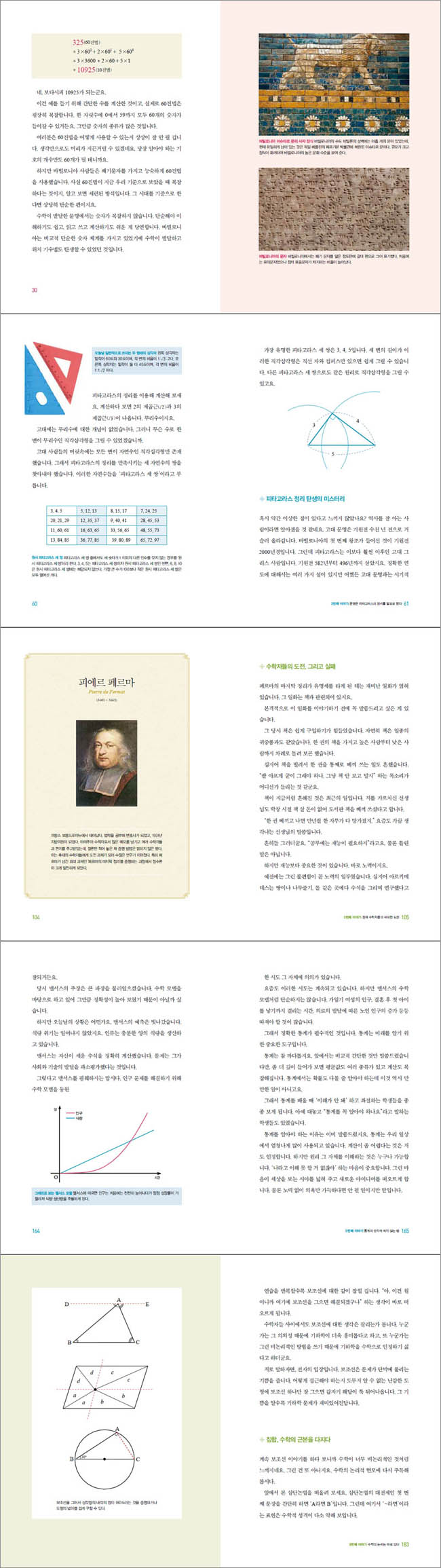
Additionally, this book contains over 120 related images, including photographs, shapes, and graphs, making it easier to convey mathematical knowledge.
In addition, the lives and achievements of major mathematicians who left their mark on the history of mathematics are summarized here and there to help readers understand.
For both adults and teenagers, this book is the most convenient and friendly textbook on mathematics.
Through this book, adults can rediscover and enjoy mathematics as a fundamental knowledge that modern people must know.
Teenagers can gain motivation and enthusiasm for studying mathematics.
Once you experience the moment when math, which was once considered burdensome, becomes so fun, math will become the greatest joy of all.
An invitation to a special math story that breaks the stereotype that math is difficult.
We live in a world surrounded by mathematics.
Everyone writes and reads numbers every day, and various types of graphs appear in the news.
Companies develop business plans based on accounting data, and the government produces various statistics to create effective policies.
If there were no mathematics, our daily lives would be completely paralyzed.
Despite this, most people tend to view mathematics as a field far removed from themselves.
It is a fact that the term 'supoja', meaning someone who has given up on math, is gaining a lot of sympathy.
When asked which subject was the most difficult during school, many people would choose math without hesitation.
If you ask the same question to today's youth, the results are similar.
The ongoing debate surrounding the difficulty of math textbook revisions reflects this situation. "The Moment Math Becomes This Fun" is a book that introduces the true joy of mathematics to all those who struggle with it.
The author of this book, Akira Yanagiya, is a mathematics teacher at Waseda University High School and a mathematics lecturer at Waseda University's Faculty of Science and Engineering. He himself is a graduate of Waseda's Department of Mathematics.
His lectures are the most popular math lectures at Waseda, and he enjoys the full support of students, and he has been introduced in the media as a "charismatic and popular math teacher."
"The Moment When Math Becomes Fun" is a collection of the most essential parts of the author's lectures.
This book begins with the invention of numbers and follows the main lines of the history of mathematics, explaining various mathematical knowledge such as irrational numbers, quadratic equations, calculus, statistics, probability, auxiliary lines, sets, and infinity, using abundant examples and episodes.
The mathematical stories told by the author show us how closely human history and our daily lives are connected to mathematics.
It also reminds us of the fundamental beauty and interest inherent in the discipline of mathematics itself.
This book will serve as a delightful guide that will immerse readers in the fascinating world of mathematics.
The most popular math teacher that Waseda students are crazy about tells us
The true value and fun of mathematics
Many young people ask, “Why do I have to learn math?” and “How can math help me in life?”
Adults also have the same questions during their youth, so they cannot give clear answers to such questions.
“As someone who teaches mathematics, I feel responsible for this,” the author says.
Therefore, the author's mathematics lectures focus on conveying the true value of mathematics rather than simply memorizing formulas and performing precise calculations.
How did the shift from hunter-gatherer to agricultural societies impact the development of numbers? What role did the Pythagorean theorem play in the founding of ancient civilizations? Who was the first mathematician to devise mathematical concepts we now know? How does calculus benefit us in the modern world? How can statistical results vary depending on various criteria? What questions did the concept of sets pose to existing mathematicians? What stereotypes were hidden in Euclidean geometry? The author's intriguing questions dispel any resistance to mathematics and gently remind us that it is the most fascinating intellectual adventure in human history.
It is precisely for this reason that his lectures captured the hearts of students who disliked math, and became known by word of mouth as 'lectures that liberal arts students like better.'
Students who used to ask, “Why do I have to learn math?” were delighted to hear his lectures and said, “I want to know more about math.”
This book, which contains only the essential points of these lectures, conveys the necessity and enjoyment of mathematics to even those who have usually avoided it.
With vivid expressions and rich images
The most enjoyable introduction to mathematics
This book vividly conveys the author's actual lectures, including keeping the author's tone of voice intact.
As you read the book, you feel as if you are watching the author's passionate lecture right before your eyes.
Additionally, this book contains over 120 related images, including photographs, shapes, and graphs, making it easier to convey mathematical knowledge.
In addition, the lives and achievements of major mathematicians who left their mark on the history of mathematics are summarized here and there to help readers understand.
For both adults and teenagers, this book is the most convenient and friendly textbook on mathematics.
Through this book, adults can rediscover and enjoy mathematics as a fundamental knowledge that modern people must know.
Teenagers can gain motivation and enthusiasm for studying mathematics.
Once you experience the moment when math, which was once considered burdensome, becomes so fun, math will become the greatest joy of all.
GOODS SPECIFICS
- Date of issue: June 1, 2015
- Page count, weight, size: 228 pages | 370g | 148*210*14mm
- ISBN13: 9791130605197
- ISBN10: 1130605191
You may also like
카테고리
korean


korean

![GQ KOREA Mark (Monthly): December [2025]](http://librairie.coreenne.fr/cdn/shop/files/8ef265dbbfbf186523ed75ba7319009d.jpg?v=1765340328&width=3840)


