

All life helps one another
 |
Description
Book Introduction
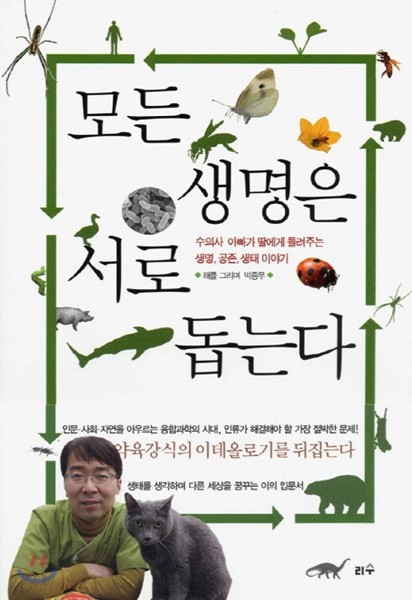
[All Life Helps One Another] is a book written by a veterinarian father to his daughter, which easily conveys the problems and solutions of the view of life that is pervasive in the ideology of survival of the fittest.
This book delves into the reality of the law of the jungle, which defies the natural law of coexistence, and shares our understanding of our distorted life structure and alternatives.
This book delves into the reality of the law of the jungle, which defies the natural law of coexistence, and shares our understanding of our distorted life structure and alternatives.
- You can preview some of the book's contents.
Preview
index
Recommendation
Acknowledgements
Opening Remarks - A Story of Coexistence, Not Survival of the Fittest
Part 1.
Animals living in the same era as us
1.
The animals we eat are all living things.
2.
Animal testing driven by greed and arrogance must stop.
3.
Animals that have become spectacles
4.
Is human violence and exploitation of animals ethical?
5.
Pets in Crisis
6.
The problem of euthanasia of abandoned dogs
7.
What is the minimum courtesy we should have toward living animals?
Part 2: What is Life?
1.
Life is a survival of the fittest
2.
Life forms that evolved through cooperation with each other
3.
The history of microorganisms, the origin of life on Earth, about bacteria
4.
Life is a relationship of dynamic equilibrium.
5.
Lives connected by a net
Part 3: What is Evolution?
1.
Darwin did not argue for the evolution of life.
2.
Evolution is not only for the strong.
3.
All life helps one another
4.
What did our unique language and cognition look like?
Part 4: Life is Symbiosis
1.
Are germs the enemy of humans?
2.
Fungi that enable the cycle of life
3.
Earthworms, the silent workers who save the land
4.
The Earth is a large living organism with an organic relationship with other living things.
5.
Can humans survive in space?
Part 5: About the Ecosystem
1.
Anti-life things disguised as science
2.
Thinking about the coexistence of life in the thornbush
3.
Endless cornfields, isn't that strange?
4.
The sixth extinction is happening right now, driven by us.
5.
Okavango, a treasure trove of life, and a life in turmoil
Part 6: GMOs and Meat
1.
What do we eat?
2.
Meat-eating leads to the destruction of the Earth's ecosystem and life
3.
Monsanto, the corporation of death, and GMO, the seed of death
4.
Why Half the World Is Starving
Part 7: On Ecology
1.
Why Consider Eco-Cities?
2.
A transition to a life that yearns for the sun
3.
Change your dining table and the world will change.
4.
Eating is what completes the body, eating is what sustains the body.
5.
A little happiness from the weekend farm
6.
Dreaming of another world
Closing Remarks - All life on Earth must coexist to survive.
References
Search
Acknowledgements
Opening Remarks - A Story of Coexistence, Not Survival of the Fittest
Part 1.
Animals living in the same era as us
1.
The animals we eat are all living things.
2.
Animal testing driven by greed and arrogance must stop.
3.
Animals that have become spectacles
4.
Is human violence and exploitation of animals ethical?
5.
Pets in Crisis
6.
The problem of euthanasia of abandoned dogs
7.
What is the minimum courtesy we should have toward living animals?
Part 2: What is Life?
1.
Life is a survival of the fittest
2.
Life forms that evolved through cooperation with each other
3.
The history of microorganisms, the origin of life on Earth, about bacteria
4.
Life is a relationship of dynamic equilibrium.
5.
Lives connected by a net
Part 3: What is Evolution?
1.
Darwin did not argue for the evolution of life.
2.
Evolution is not only for the strong.
3.
All life helps one another
4.
What did our unique language and cognition look like?
Part 4: Life is Symbiosis
1.
Are germs the enemy of humans?
2.
Fungi that enable the cycle of life
3.
Earthworms, the silent workers who save the land
4.
The Earth is a large living organism with an organic relationship with other living things.
5.
Can humans survive in space?
Part 5: About the Ecosystem
1.
Anti-life things disguised as science
2.
Thinking about the coexistence of life in the thornbush
3.
Endless cornfields, isn't that strange?
4.
The sixth extinction is happening right now, driven by us.
5.
Okavango, a treasure trove of life, and a life in turmoil
Part 6: GMOs and Meat
1.
What do we eat?
2.
Meat-eating leads to the destruction of the Earth's ecosystem and life
3.
Monsanto, the corporation of death, and GMO, the seed of death
4.
Why Half the World Is Starving
Part 7: On Ecology
1.
Why Consider Eco-Cities?
2.
A transition to a life that yearns for the sun
3.
Change your dining table and the world will change.
4.
Eating is what completes the body, eating is what sustains the body.
5.
A little happiness from the weekend farm
6.
Dreaming of another world
Closing Remarks - All life on Earth must coexist to survive.
References
Search
Into the book
Animal testing is a huge industry.
Laws governing clinical trials require animal testing, and government agencies, pharmaceutical companies, and charities fund animal testing.
So, researchers say, "When mice are given drugs, they vomit out papers."
p35
Despite Darwin's assertion that organisms do not progress, people continue to make the mistake of equating biological evolution with progress.
This has led to many unfortunate consequences.
A typical example is racism.
The white people of Europe thought that they were the most evolved and that the native people living in the colonies they conquered were less evolved and therefore deserved to be dominated.
In relation to evolution, attempts to categorize humanity and differentiate people have been made in many ways.
European white male societies have consistently argued that women are less evolved than men and therefore should be ruled by men, and that black people are less evolved than white people and therefore should be ruled by white people.
The worst form of the claim that there are differences in evolution between races is eugenics.
The Nazis carried out ethnic cleansing at Auschwitz, claiming that Jews were a threat to humanity, based on eugenics.
p113
If we look at many animals, we can see the results of various evolutions that do not seem wise or conducive to the reproduction of the species.
If the purpose of evolution is to advance only to animals that are more intelligent or have the temperament to adapt to the environment, many behaviors are unnecessary or excessive.
Many animals, such as the peacock's colorful tail that easily catches the eye of predators, the booby that can't even protect its own eggs, the albatross that can't fly well, the penguin that is uncomfortable living on land, and the rhinoceros that sticks to an excessively large area, show the results of evolution that is not appropriate to be called the survival of the fittest method.
The direction of life evolution that can be inferred from these seemingly inefficiently evolved creatures is diversity.
p118
If humans have reason, eagles have strong wings, rhinoceroses have horns, rabbits have long ears, and bats have ultrasonic sense organs.
These differences between each species are merely differences and cannot be the basis for discrimination.
Life on Earth is a diverse group of co-evolved beings, each with their own differences.
p135
It is said that a healthy organism is not free from bacterial infection.
A healthy organism is one that maintains a dynamic equilibrium while suppressing the excessive proliferation of bacteria in a state of bacterial infection.
p142
When you take antibiotics, not only do they kill bad bacteria, they also kill bacteria that are beneficial to the body and bacteria that are not good for the body.
This can cause various problems with antibiotic administration.
However, because people have not learned to care for the beneficial bacteria that coexist with their bodies, they tend to use the latest powerful antibiotics without much thought.
Without bacteria, no life could exist.
Humans are not evolved to be superior to bacteria, but rather, they have evolved with the help of bacteria in one of the many ways that life can exist.
p144~145
Excessive meat consumption is causing environmental problems such as the depletion of fossil fuels, the destruction of ecosystems including the Amazon, and the production of methane gas, which contributes to global warming.
Furthermore, the suffering of workers in the livestock industry and the suffering of animals raised and slaughtered in miserable conditions are being ignored.
It also played a significant role in aggravating humanity's unequal food shortage.
Despite this, developed countries such as the United States and Europe do not seem to be concerned at all about the impact their excessive consumption of beef has on the Earth's ecosystem and third world countries.
They just think that because they are a rich country, they eat a lot of beef as a result.
Laws governing clinical trials require animal testing, and government agencies, pharmaceutical companies, and charities fund animal testing.
So, researchers say, "When mice are given drugs, they vomit out papers."
p35
Despite Darwin's assertion that organisms do not progress, people continue to make the mistake of equating biological evolution with progress.
This has led to many unfortunate consequences.
A typical example is racism.
The white people of Europe thought that they were the most evolved and that the native people living in the colonies they conquered were less evolved and therefore deserved to be dominated.
In relation to evolution, attempts to categorize humanity and differentiate people have been made in many ways.
European white male societies have consistently argued that women are less evolved than men and therefore should be ruled by men, and that black people are less evolved than white people and therefore should be ruled by white people.
The worst form of the claim that there are differences in evolution between races is eugenics.
The Nazis carried out ethnic cleansing at Auschwitz, claiming that Jews were a threat to humanity, based on eugenics.
p113
If we look at many animals, we can see the results of various evolutions that do not seem wise or conducive to the reproduction of the species.
If the purpose of evolution is to advance only to animals that are more intelligent or have the temperament to adapt to the environment, many behaviors are unnecessary or excessive.
Many animals, such as the peacock's colorful tail that easily catches the eye of predators, the booby that can't even protect its own eggs, the albatross that can't fly well, the penguin that is uncomfortable living on land, and the rhinoceros that sticks to an excessively large area, show the results of evolution that is not appropriate to be called the survival of the fittest method.
The direction of life evolution that can be inferred from these seemingly inefficiently evolved creatures is diversity.
p118
If humans have reason, eagles have strong wings, rhinoceroses have horns, rabbits have long ears, and bats have ultrasonic sense organs.
These differences between each species are merely differences and cannot be the basis for discrimination.
Life on Earth is a diverse group of co-evolved beings, each with their own differences.
p135
It is said that a healthy organism is not free from bacterial infection.
A healthy organism is one that maintains a dynamic equilibrium while suppressing the excessive proliferation of bacteria in a state of bacterial infection.
p142
When you take antibiotics, not only do they kill bad bacteria, they also kill bacteria that are beneficial to the body and bacteria that are not good for the body.
This can cause various problems with antibiotic administration.
However, because people have not learned to care for the beneficial bacteria that coexist with their bodies, they tend to use the latest powerful antibiotics without much thought.
Without bacteria, no life could exist.
Humans are not evolved to be superior to bacteria, but rather, they have evolved with the help of bacteria in one of the many ways that life can exist.
p144~145
Excessive meat consumption is causing environmental problems such as the depletion of fossil fuels, the destruction of ecosystems including the Amazon, and the production of methane gas, which contributes to global warming.
Furthermore, the suffering of workers in the livestock industry and the suffering of animals raised and slaughtered in miserable conditions are being ignored.
It also played a significant role in aggravating humanity's unequal food shortage.
Despite this, developed countries such as the United States and Europe do not seem to be concerned at all about the impact their excessive consumption of beef has on the Earth's ecosystem and third world countries.
They just think that because they are a rich country, they eat a lot of beef as a result.
---From the text
Publisher's Review
"All living things help each other" is a book that summarizes the problems and solutions of the view of life that is pervasive in the ideology of the survival of the fittest, written in an easy-to-understand style by a father who is a veterinarian, to his daughter.
The distorted view of life based on the law of the jungle resembles the logic of capital.
The virtue of coexistence was destroyed for the benefit of one side.
Even now, animals are suffering to fill someone's stomach, the Amazon rainforest is being destroyed, and humans are consuming genetically modified foods without even knowing it.
This book seeks to share awareness and alternatives to our distorted way of life by thoroughly examining the reality of the survival of the fittest, which defies the natural law of coexistence.
Are humans the powerhouses of the ecosystem or its destroyers?
The first life forms on Earth were simple bacteria.
Starting from this, over the past 3.5 billion years, at least 10 million different species of life have lived on Earth.
These creatures partially had the aspect of the law of the jungle, but the main premise was coexistence.
Because it is so difficult to pioneer a new world alone, all life has evolved in cooperation with other species.
The Earth today is the result of coevolution and is an organism in itself.
Although humans have only appeared recently in the long history of human existence, they have reduced the ecosystem to their own tools based on the logic of the law of the jungle and survival of the fittest.
Endless fields of GMO corn, factory farmed livestock that eat that corn, the destruction of the soil that those animals trample, the methane gas they emit, the depletion of fresh water, and the Amazon rainforest being cut down to make way for more corn fields. Humans have demonstrated their power to change the map of life, but the consequences are coming back to haunt them.
The excessive meat consumption of today, believed to be possible due to economic growth, and the mechanization of agriculture, believed to have become a reality thanks to the advancement of science and technology, are the main culprits of the sixth extinction, threatening human survival, with environmental destruction, energy depletion, and the loss of 30,000 species of life each year.
Can animal abuse be rationalized with the logic of survival of the fittest?
Chicken is very popular as a snack and side dish.
But we don't know that these chickens never see sunlight in their entire lives, and that they live only about 35 days after birth in crowded chicken coops.
Chickens under extreme stress peck at other chickens, so their beaks are cut off 5 to 7 days after hatching.
This is no different from cutting off a person's finger.
The author, a veterinarian, recalls his college days when he first learned about bloat, a common disease in cattle.
“I thought the animal called Sora was a really ridiculous animal.
"If a veterinarian doesn't take immediate and appropriate action, they'll die from stomach upset. How could they have survived in a time without veterinarians? It's amazing that cows survived and didn't go extinct even when veterinary surgery wasn't as advanced as it is today."
However, goiter is not a disease that can occur in cattle in the first place.
Strictly speaking, the cause of this disease is human.
This is because it is a disease that occurs when bacteria rapidly multiply in the stomach and gas is produced due to feeding cows corn instead of grass.
In addition to the feed problem, cows are no longer living beings in the current livestock farming system due to weakened immunity caused by unsanitary and cramped living conditions and the resulting overuse of antibiotics.
It is simply a machine that exchanges corn for meat protein for the profit of the companies that collect, slaughter, process, and distribute livestock.
In addition to this, the book shows various cases of abused animals, including zoo animals, companion animals, and the ethical exploitation of laboratory animals, thereby forcing readers to face the reality of animal abuse that is rationalized by the logic of the law of the jungle.
What is the basis for not being the law of the jungle?
We often equate the evolution of life with progress.
Life has evolved by choosing the superior side.
However, Darwin, the founder of the theory of evolution, did not use the word 'evolution'.
Although it was called 'inheritance accompanied by mutation', 'evolution' became an irreversible trend regardless of Darwin's will, swept up in the atmosphere and political inclination of Britain at the time, which was obsessed with colonial development.
In a time when discrimination was necessary, the concept of 'evolution' was used for white supremacy, male supremacy, and the Nazi genocide of Jews, and justified human domination over other living creatures.
The logic of survival of the fittest, which overturns the coexistence of life, has in some ways distorted our judgment.
For example, humans view bacteria as something that needs to be eradicated.
However, this idea overlooks the fact that fungi are at the heart of ecological cycles.
Fungi are the recycling centers of the biosphere.
Fungi are responsible for converting dead organisms into carbon-rich humus.
There can be no ecosystem without fungi.
Today, mankind is spending astronomical amounts of money on space development.
The reason for this is said to be to find new stars in case life on Earth becomes uninhabitable due to environmental pollution, although some say it is to find alternative resources.
The belief that we can survive simply with water and air is an idea that ignores the history of life that has evolved together.
Even if we find such a place, humans cannot survive there.
This is because a place without fungi is not an environment where life can circulate.
It also shows that fungi are not something to be eradicated, but rather are living organisms that have coexisted with us.
It is not because humans are strong that the Earth has been able to maintain a homeostasis that allows life to exist.
Because various living things have coexisted.
The book explains that the nature of life is not survival of the fittest, but coexistence, not only from the perspectives of evolution, symbiosis, and biology, but also from a physical perspective, using scientific evidence.
Living an ecological life
Scientists predict that peak oil will occur in 2030.
Unless we stop our current excessive meat consumption and energy-rich lifestyle, the future of humanity is not bright.
Some hope that scientific advancements will provide solutions for the post-peak oil era, but in principle, they cannot be a fundamental solution unless we slow down the pace of energy consumption.
Here, the author introduces an ecological lifestyle as an alternative.
Living ecologically is not difficult.
It is about living naturally in the form of life itself.
Just as all living things on Earth have maintained their place according to the laws of nature, humans too must follow the laws of nature.
It starts with living life with what is around us, rather than bringing in excessive energy or material from outside.
It refers to a life that consumes less energy, such as wearing cool clothes in the summer and underwear in the winter.
Avoid excessive meat consumption, reduce consumption, and live a frugal life.
The period since the emergence of humans is but a fleeting moment compared to the time when life began on Earth, but the enormous destructive power perpetrated in that short period in the name of development is enough to warrant discussion of the sixth extinction.
Faced with the current ecosystem facing crisis, we have a duty to recognize the truth that "all life helps one another" and a responsibility to act to achieve "coexistence."
In a narrow sense, for the world our children will live in, and in a broader sense, for the coexistence of all living things.
An introductory book for those who dream of a different world while considering ecology.
This book is for young people and general readers who have always thought about ecology and dreamed of a healthier life.
While previous books on life, evolution, and ecology, written from pure scientific and sociological perspectives, were difficult to access for the general reader due to their high difficulty level, this book starts with familiar animal stories told by a veterinarian and our food, making it easy to empathize with the fact that the stories of life and ecology are no longer distant issues.
In addition, it adds various scientific evidence and historical facts, ensuring understanding, depth, and fun, and helping to expand the integrated thinking of natural, social, and humanities sciences.
The distorted view of life based on the law of the jungle resembles the logic of capital.
The virtue of coexistence was destroyed for the benefit of one side.
Even now, animals are suffering to fill someone's stomach, the Amazon rainforest is being destroyed, and humans are consuming genetically modified foods without even knowing it.
This book seeks to share awareness and alternatives to our distorted way of life by thoroughly examining the reality of the survival of the fittest, which defies the natural law of coexistence.
Are humans the powerhouses of the ecosystem or its destroyers?
The first life forms on Earth were simple bacteria.
Starting from this, over the past 3.5 billion years, at least 10 million different species of life have lived on Earth.
These creatures partially had the aspect of the law of the jungle, but the main premise was coexistence.
Because it is so difficult to pioneer a new world alone, all life has evolved in cooperation with other species.
The Earth today is the result of coevolution and is an organism in itself.
Although humans have only appeared recently in the long history of human existence, they have reduced the ecosystem to their own tools based on the logic of the law of the jungle and survival of the fittest.
Endless fields of GMO corn, factory farmed livestock that eat that corn, the destruction of the soil that those animals trample, the methane gas they emit, the depletion of fresh water, and the Amazon rainforest being cut down to make way for more corn fields. Humans have demonstrated their power to change the map of life, but the consequences are coming back to haunt them.
The excessive meat consumption of today, believed to be possible due to economic growth, and the mechanization of agriculture, believed to have become a reality thanks to the advancement of science and technology, are the main culprits of the sixth extinction, threatening human survival, with environmental destruction, energy depletion, and the loss of 30,000 species of life each year.
Can animal abuse be rationalized with the logic of survival of the fittest?
Chicken is very popular as a snack and side dish.
But we don't know that these chickens never see sunlight in their entire lives, and that they live only about 35 days after birth in crowded chicken coops.
Chickens under extreme stress peck at other chickens, so their beaks are cut off 5 to 7 days after hatching.
This is no different from cutting off a person's finger.
The author, a veterinarian, recalls his college days when he first learned about bloat, a common disease in cattle.
“I thought the animal called Sora was a really ridiculous animal.
"If a veterinarian doesn't take immediate and appropriate action, they'll die from stomach upset. How could they have survived in a time without veterinarians? It's amazing that cows survived and didn't go extinct even when veterinary surgery wasn't as advanced as it is today."
However, goiter is not a disease that can occur in cattle in the first place.
Strictly speaking, the cause of this disease is human.
This is because it is a disease that occurs when bacteria rapidly multiply in the stomach and gas is produced due to feeding cows corn instead of grass.
In addition to the feed problem, cows are no longer living beings in the current livestock farming system due to weakened immunity caused by unsanitary and cramped living conditions and the resulting overuse of antibiotics.
It is simply a machine that exchanges corn for meat protein for the profit of the companies that collect, slaughter, process, and distribute livestock.
In addition to this, the book shows various cases of abused animals, including zoo animals, companion animals, and the ethical exploitation of laboratory animals, thereby forcing readers to face the reality of animal abuse that is rationalized by the logic of the law of the jungle.
What is the basis for not being the law of the jungle?
We often equate the evolution of life with progress.
Life has evolved by choosing the superior side.
However, Darwin, the founder of the theory of evolution, did not use the word 'evolution'.
Although it was called 'inheritance accompanied by mutation', 'evolution' became an irreversible trend regardless of Darwin's will, swept up in the atmosphere and political inclination of Britain at the time, which was obsessed with colonial development.
In a time when discrimination was necessary, the concept of 'evolution' was used for white supremacy, male supremacy, and the Nazi genocide of Jews, and justified human domination over other living creatures.
The logic of survival of the fittest, which overturns the coexistence of life, has in some ways distorted our judgment.
For example, humans view bacteria as something that needs to be eradicated.
However, this idea overlooks the fact that fungi are at the heart of ecological cycles.
Fungi are the recycling centers of the biosphere.
Fungi are responsible for converting dead organisms into carbon-rich humus.
There can be no ecosystem without fungi.
Today, mankind is spending astronomical amounts of money on space development.
The reason for this is said to be to find new stars in case life on Earth becomes uninhabitable due to environmental pollution, although some say it is to find alternative resources.
The belief that we can survive simply with water and air is an idea that ignores the history of life that has evolved together.
Even if we find such a place, humans cannot survive there.
This is because a place without fungi is not an environment where life can circulate.
It also shows that fungi are not something to be eradicated, but rather are living organisms that have coexisted with us.
It is not because humans are strong that the Earth has been able to maintain a homeostasis that allows life to exist.
Because various living things have coexisted.
The book explains that the nature of life is not survival of the fittest, but coexistence, not only from the perspectives of evolution, symbiosis, and biology, but also from a physical perspective, using scientific evidence.
Living an ecological life
Scientists predict that peak oil will occur in 2030.
Unless we stop our current excessive meat consumption and energy-rich lifestyle, the future of humanity is not bright.
Some hope that scientific advancements will provide solutions for the post-peak oil era, but in principle, they cannot be a fundamental solution unless we slow down the pace of energy consumption.
Here, the author introduces an ecological lifestyle as an alternative.
Living ecologically is not difficult.
It is about living naturally in the form of life itself.
Just as all living things on Earth have maintained their place according to the laws of nature, humans too must follow the laws of nature.
It starts with living life with what is around us, rather than bringing in excessive energy or material from outside.
It refers to a life that consumes less energy, such as wearing cool clothes in the summer and underwear in the winter.
Avoid excessive meat consumption, reduce consumption, and live a frugal life.
The period since the emergence of humans is but a fleeting moment compared to the time when life began on Earth, but the enormous destructive power perpetrated in that short period in the name of development is enough to warrant discussion of the sixth extinction.
Faced with the current ecosystem facing crisis, we have a duty to recognize the truth that "all life helps one another" and a responsibility to act to achieve "coexistence."
In a narrow sense, for the world our children will live in, and in a broader sense, for the coexistence of all living things.
An introductory book for those who dream of a different world while considering ecology.
This book is for young people and general readers who have always thought about ecology and dreamed of a healthier life.
While previous books on life, evolution, and ecology, written from pure scientific and sociological perspectives, were difficult to access for the general reader due to their high difficulty level, this book starts with familiar animal stories told by a veterinarian and our food, making it easy to empathize with the fact that the stories of life and ecology are no longer distant issues.
In addition, it adds various scientific evidence and historical facts, ensuring understanding, depth, and fun, and helping to expand the integrated thinking of natural, social, and humanities sciences.
GOODS SPECIFICS
- Date of issue: April 1, 2014
- Page count, weight, size: 292 pages | 580g | 148*210*20mm
- ISBN13: 9788990449016
- ISBN10: 8990449014
You may also like
카테고리
korean


korean

![GQ KOREA Mark (Monthly): December [2025]](http://librairie.coreenne.fr/cdn/shop/files/8ef265dbbfbf186523ed75ba7319009d.jpg?v=1765340328&width=3840)


