

Great Math Problems
 |
Description
Book Introduction
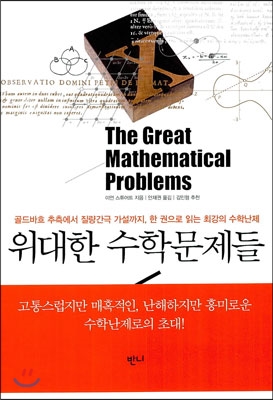
There are quite a few difficult problems that modern mathematics has yet to solve, and among them, the most famous are the '7 Greatest Problems in the World' selected and announced by the 'Clay Mathematics Institute (CMI)' in the United States in 2000. "Great Math Problems" is a book that solves 14 difficult problems, including the "7 Greatest Problems in the World," among the most difficult mathematical problems. It explains them faithfully enough that even general readers can understand them. It also covers the meaning of the problems, the future that their solutions will bring, and even the episodes of mathematicians who struggle to solve them. Ian Stewart, the author of this book and a professor of mathematics at the University of Warwick in the UK, lives up to his reputation as the "best writer to popularize mathematics," and tells an interesting story about how these seemingly unrelated mathematical problems are actually related to our lives. The preface also states that 'the guideline was to explain concepts while excluding many formulas.' It may seem difficult because of the name 'Difficult Problem', but if you read it while following in the footsteps of mathematicians, you will be immersed in the world of mathematics. * Watch related videos Watch related videos |
- You can preview some of the book's contents.
Preview
index
Recommendation/Preface to the Korean edition/Preface
01 Great Math Problems
02 Goldbach Conjecture of a Small Territory
03 Pi's Riddle Circle Problem
04 Map Making Puzzle 4 Colors
05 Space-filling symmetry Kepler conjecture
06 New solution model speculation for old ones
07 Insufficient Margin Fermat's Last Theorem
08 Chaotic three-body problem in orbit
09 Prime Pattern Riemann Hypothesis
What is the shape of a sphere? The Poincaré conjecture
11 It can't be that easy, the P/NP problem
12 Fluid Thinking Navier-Stokes Equations
13 Quantum Mystery Mass Gap Hypothesis
14 Diophantus' Dream Birch-Swinnerton-Dyer Conjecture
15 Complex Cycle Hodge Conjecture
16 Where should we go now?
17 12 Problems for the Future
Glossary of Terms/ Further Reading/ Notes/ Index/ Image Copyright
01 Great Math Problems
02 Goldbach Conjecture of a Small Territory
03 Pi's Riddle Circle Problem
04 Map Making Puzzle 4 Colors
05 Space-filling symmetry Kepler conjecture
06 New solution model speculation for old ones
07 Insufficient Margin Fermat's Last Theorem
08 Chaotic three-body problem in orbit
09 Prime Pattern Riemann Hypothesis
What is the shape of a sphere? The Poincaré conjecture
11 It can't be that easy, the P/NP problem
12 Fluid Thinking Navier-Stokes Equations
13 Quantum Mystery Mass Gap Hypothesis
14 Diophantus' Dream Birch-Swinnerton-Dyer Conjecture
15 Complex Cycle Hodge Conjecture
16 Where should we go now?
17 12 Problems for the Future
Glossary of Terms/ Further Reading/ Notes/ Index/ Image Copyright
Publisher's Review
A friendly guide to 14 challenging problems that shook the history of mathematics!
A great problem is a tool that efficiently generates the energy needed for exploration.......
That energy ultimately manifests itself in powerful theories that broaden and enhance our understanding of the vast mathematical landscape.
-Kim Min-hyung (Professor of Mathematics, Oxford University)
Last April, an interesting piece of news hit the pages.
It was reported that Professor Yong-Min Cho of Konkuk University, a physicist, had found a solution to one of the seven greatest mathematical problems of the 20th century: the Yang-Mills theory and the mass gap hypothesis.
This hypothesis was considered a representative difficult problem in the world of mathematics, with a prize of as much as 1 million dollars at stake, and it is said that a Korean scholar has found a solution to it.
Although the debate continued over the differences between mathematical and physical perspectives and whether the term "solved" could be used, it brought to the public's attention the many challenges that modern mathematics has yet to find solutions to.
Just how difficult must a problem be to be called a "hard problem"? In fact, there are quite a few problems that modern mathematics has yet to solve, and among them, the seven most famous are those considered the "Seven Greatest Problems of All Time."
These seven great problems were selected and announced by the Clay Mathematics Institute (CMI) in the United States in 2000, and include the P/NP problem, the Hodge conjecture, the Poincaré conjecture, the Riemann hypothesis, the Yang-Mills theory and the mass gap hypothesis, the Navier-Stokes equations, and the Butts-Swinnerton-Dyer conjecture.
The Clay Mathematics Institute has been waiting for scholars to challenge these seven great problems, also known as the "Millennium Problems," with a prize of $1 million each, but only one, the Poincaré conjecture, has had a formalized solution so far.
Mathematical problems that even genius mathematicians struggle to solve.
However, it is often the case that the problem itself is not that difficult, but that finding the solution process is difficult.
A representative example is 'Fermat's Last Theorem', which everyone has probably heard of at least once.
Even if you don't know exactly what it means or how to solve it, it's a formula that even a middle school student can understand.
This book, [Great Math Problems], is a book that solves 14 difficult math problems, including the '7 Greatest Problems in the World'.
While explaining the problem faithfully enough for general readers to understand, it also covers the meaning of the problem, the future that solving the problem will bring, and even the episodes of mathematicians struggling to solve the problem.
This is largely thanks to the writing skills of author Ian Stewart, a professor of mathematics at the University of Warwick in the UK.
Living up to his reputation as the "best math popularizer," he provides interesting explanations of how these seemingly unrelated mathematical problems are actually related to our lives.
The preface also states that 'the guideline was to explain concepts while excluding many formulas.'
Also, the words of Professor Minhyung Kim, a world-renowned mathematician, in his recommendation, “Great problems are tools that generate the energy needed for the long exploration of mathematics,” serve as a welcome stepping stone to approaching difficult problems.
An invitation to a painful yet fascinating, difficult yet interesting math challenge!
Mathematical puzzles are questions asked by genius mathematicians.
The 'Poincaré conjecture' mentioned above is a theory that Poincaré, known as a genius mathematician, came up with about 100 years ago after researching three-dimensional space.
However, this was not proven and was called a 'conjecture', but in 2003, Russian mathematician Grigory Perelman finally proved it.
He is also known as the 'reclusive mathematician' and is a unique eccentric who refused the $1 million prize from the Clay Mathematics Institute, the Fields Medal, which is the Nobel Prize of mathematics, and the highest honor for a scholar, membership in the Russian Academy of Sciences.
There are also some weird questions.
'Fermat's Last Theorem', which is familiar to many people just by its name, begins with a note left by the mathematician Fermat in Diophantus's [Arithmetic].
"It is impossible to divide a cube into two cubes, or a fourth power into two fourth powers, or in general any power greater than 2 into two powers of the same power.
I have discovered a truly astonishing proof of this, but space is limited to include it."
If expressed in a formula, it is very simple.
This simple formula and the note from the genius mathematician Fermat, which said, "I have discovered a proof, but the margins are too narrow to contain it," touched the pride of mathematicians.
That wasn't all.
The mathematical community was in an uproar because the inability to prove a simple theorem meant that something essential was missing from existing mathematical theory.
Many mathematicians tried to prove it, and finally in 1997, a British mathematician named Andrew Wiles proved it.
He first encountered this theorem at the age of ten and was determined to solve it, and finally proved it at the age of forty-two after 'seven years of secret research'.
In the end, it took a whopping 350 years to find the answer.
There are also eccentric genius mathematicians who burn what they know.
The 'Riemann hypothesis' about the regularity of prime numbers is related to cryptographic algorithms that are widely used today.
Some worry that if the Riemann hypothesis is proven, it will render the Internet's encryption system ineffective and paralyze global e-commerce.
Riemann was able to prove that his hypothesis was correct, but he was unable to prove the essential proposition related to it (the zeta function).
He even had a wall of solitude, so he burned the evidence of his hypothesis without disclosing it.
For the next 150 years, renowned mathematicians have attempted to prove or disprove the Riemann hypothesis, but it remains the holy grail of mathematics.
Great Math Problems That Will Change Our Future
The pinnacle of mathematics seems within reach, but it is not easy to conquer.
Someone comes up with a new hypothesis, and someone else proves it.
In the midst of this, mathematics develops and our lives change little by little.
Ian Stewart presents 14 major math problems, as well as 12 that could change our future.
These include Broca's problem, odd perfect numbers, the Collatz conjecture, the irrationality of Euler's constant, the ABC conjecture, Langton's ants, and the lone runner conjecture.
Among these, 'Langton's Ants' is particularly interesting.
In 1986, American Christopher Langton created a virtual 'Langton's ants' and conducted a simulation, and the ants showed a certain pattern.
However, what controls ant behavior remains an open question.
Unraveling the secrets of Langton's ant behavior could help us predict patterns of group human behavior, such as how 100,000 people move in a stadium.
There is also a problem with the amusing name of the 'lonely racer conjecture'.
If n racers race around a circular track at different speeds, at what point do all racers become lonely? The answer and proof have been found for cases with 4, 5, 6, and 7 racers, but the problem with 8 or more racers remains unsolved.
Finding the answer will help us better understand and manage the flow of urban traffic.
Example) What is the most dense way to pack balls in a limited space?
Although mathematical puzzles may have disturbed mathematicians whenever they were revealed to the world, they ultimately contributed greatly to the advancement of mathematics.
For example, let's look at the difficult problem called '4-color theorem'.
The theorem states that when you say, 'Color the map so that the areas are distinct using the minimum number of colors,' you can color any complex map with just four colors.
How could such a simple problem become a global challenge? The reason it became a "hard problem" was because it was difficult to "prove."
Let's apply this to real life.
When playing a game, they usually wear uniforms of a different color from the opposing team.
If 16 teams are competing in a tournament, the uniform colors can be determined so that they do not overlap with the colors of the opposing teams.
It is enough to have a uniform of only four colors.
So what about the Kepler conjecture? It asks, "What is the densest way to pack spheres in a confined space?"
It took 400 years to prove, but the answer is surprisingly easy.
Just stack them one by one like any other fruit shop owner would stack their fruit.
14 difficult problems that shook the history of mathematics!
■ Every even number greater than 2 is the sum of two prime numbers.
Goldbach conjecture
■ Can you construct a square with the same area as a given circle? Circle Area Problem
■ When a, b, and c are non-zero integers and n is a natural number greater than 2, there are no natural numbers a, b, and c that satisfy an + bn = cn.
Fermat's Last Theorem
■ What pattern do prime numbers like 2, 3, 5, and 7 have? The Riemann Hypothesis
■ If all closed curves are contracted to become one point, the shape of that space is like a sphere.
Poincaré conjecture
■ Can you prove that a three-dimensional solution to this equation always exists? Navier-Stokes equation
■ When three objects move while being attracted to each other by universal gravitation, their orbits cannot be determined.
three-body problem
■ Can any map be colored with only four colors when adjacent surfaces are colored with different colors? Four-color theorem
......
■ Kepler's conjecture
■ Model Inference
■ P/NP problem
■ Mass gap hypothesis
■ Birch-Swinnerton-Dyer conjecture
■ Hodge's conjecture
A great problem is a tool that efficiently generates the energy needed for exploration.......
That energy ultimately manifests itself in powerful theories that broaden and enhance our understanding of the vast mathematical landscape.
-Kim Min-hyung (Professor of Mathematics, Oxford University)
Last April, an interesting piece of news hit the pages.
It was reported that Professor Yong-Min Cho of Konkuk University, a physicist, had found a solution to one of the seven greatest mathematical problems of the 20th century: the Yang-Mills theory and the mass gap hypothesis.
This hypothesis was considered a representative difficult problem in the world of mathematics, with a prize of as much as 1 million dollars at stake, and it is said that a Korean scholar has found a solution to it.
Although the debate continued over the differences between mathematical and physical perspectives and whether the term "solved" could be used, it brought to the public's attention the many challenges that modern mathematics has yet to find solutions to.
Just how difficult must a problem be to be called a "hard problem"? In fact, there are quite a few problems that modern mathematics has yet to solve, and among them, the seven most famous are those considered the "Seven Greatest Problems of All Time."
These seven great problems were selected and announced by the Clay Mathematics Institute (CMI) in the United States in 2000, and include the P/NP problem, the Hodge conjecture, the Poincaré conjecture, the Riemann hypothesis, the Yang-Mills theory and the mass gap hypothesis, the Navier-Stokes equations, and the Butts-Swinnerton-Dyer conjecture.
The Clay Mathematics Institute has been waiting for scholars to challenge these seven great problems, also known as the "Millennium Problems," with a prize of $1 million each, but only one, the Poincaré conjecture, has had a formalized solution so far.
Mathematical problems that even genius mathematicians struggle to solve.
However, it is often the case that the problem itself is not that difficult, but that finding the solution process is difficult.
A representative example is 'Fermat's Last Theorem', which everyone has probably heard of at least once.
Even if you don't know exactly what it means or how to solve it, it's a formula that even a middle school student can understand.
This book, [Great Math Problems], is a book that solves 14 difficult math problems, including the '7 Greatest Problems in the World'.
While explaining the problem faithfully enough for general readers to understand, it also covers the meaning of the problem, the future that solving the problem will bring, and even the episodes of mathematicians struggling to solve the problem.
This is largely thanks to the writing skills of author Ian Stewart, a professor of mathematics at the University of Warwick in the UK.
Living up to his reputation as the "best math popularizer," he provides interesting explanations of how these seemingly unrelated mathematical problems are actually related to our lives.
The preface also states that 'the guideline was to explain concepts while excluding many formulas.'
Also, the words of Professor Minhyung Kim, a world-renowned mathematician, in his recommendation, “Great problems are tools that generate the energy needed for the long exploration of mathematics,” serve as a welcome stepping stone to approaching difficult problems.
An invitation to a painful yet fascinating, difficult yet interesting math challenge!
Mathematical puzzles are questions asked by genius mathematicians.
The 'Poincaré conjecture' mentioned above is a theory that Poincaré, known as a genius mathematician, came up with about 100 years ago after researching three-dimensional space.
However, this was not proven and was called a 'conjecture', but in 2003, Russian mathematician Grigory Perelman finally proved it.
He is also known as the 'reclusive mathematician' and is a unique eccentric who refused the $1 million prize from the Clay Mathematics Institute, the Fields Medal, which is the Nobel Prize of mathematics, and the highest honor for a scholar, membership in the Russian Academy of Sciences.
There are also some weird questions.
'Fermat's Last Theorem', which is familiar to many people just by its name, begins with a note left by the mathematician Fermat in Diophantus's [Arithmetic].
"It is impossible to divide a cube into two cubes, or a fourth power into two fourth powers, or in general any power greater than 2 into two powers of the same power.
I have discovered a truly astonishing proof of this, but space is limited to include it."
If expressed in a formula, it is very simple.
This simple formula and the note from the genius mathematician Fermat, which said, "I have discovered a proof, but the margins are too narrow to contain it," touched the pride of mathematicians.
That wasn't all.
The mathematical community was in an uproar because the inability to prove a simple theorem meant that something essential was missing from existing mathematical theory.
Many mathematicians tried to prove it, and finally in 1997, a British mathematician named Andrew Wiles proved it.
He first encountered this theorem at the age of ten and was determined to solve it, and finally proved it at the age of forty-two after 'seven years of secret research'.
In the end, it took a whopping 350 years to find the answer.
There are also eccentric genius mathematicians who burn what they know.
The 'Riemann hypothesis' about the regularity of prime numbers is related to cryptographic algorithms that are widely used today.
Some worry that if the Riemann hypothesis is proven, it will render the Internet's encryption system ineffective and paralyze global e-commerce.
Riemann was able to prove that his hypothesis was correct, but he was unable to prove the essential proposition related to it (the zeta function).
He even had a wall of solitude, so he burned the evidence of his hypothesis without disclosing it.
For the next 150 years, renowned mathematicians have attempted to prove or disprove the Riemann hypothesis, but it remains the holy grail of mathematics.
Great Math Problems That Will Change Our Future
The pinnacle of mathematics seems within reach, but it is not easy to conquer.
Someone comes up with a new hypothesis, and someone else proves it.
In the midst of this, mathematics develops and our lives change little by little.
Ian Stewart presents 14 major math problems, as well as 12 that could change our future.
These include Broca's problem, odd perfect numbers, the Collatz conjecture, the irrationality of Euler's constant, the ABC conjecture, Langton's ants, and the lone runner conjecture.
Among these, 'Langton's Ants' is particularly interesting.
In 1986, American Christopher Langton created a virtual 'Langton's ants' and conducted a simulation, and the ants showed a certain pattern.
However, what controls ant behavior remains an open question.
Unraveling the secrets of Langton's ant behavior could help us predict patterns of group human behavior, such as how 100,000 people move in a stadium.
There is also a problem with the amusing name of the 'lonely racer conjecture'.
If n racers race around a circular track at different speeds, at what point do all racers become lonely? The answer and proof have been found for cases with 4, 5, 6, and 7 racers, but the problem with 8 or more racers remains unsolved.
Finding the answer will help us better understand and manage the flow of urban traffic.
Example) What is the most dense way to pack balls in a limited space?
Although mathematical puzzles may have disturbed mathematicians whenever they were revealed to the world, they ultimately contributed greatly to the advancement of mathematics.
For example, let's look at the difficult problem called '4-color theorem'.
The theorem states that when you say, 'Color the map so that the areas are distinct using the minimum number of colors,' you can color any complex map with just four colors.
How could such a simple problem become a global challenge? The reason it became a "hard problem" was because it was difficult to "prove."
Let's apply this to real life.
When playing a game, they usually wear uniforms of a different color from the opposing team.
If 16 teams are competing in a tournament, the uniform colors can be determined so that they do not overlap with the colors of the opposing teams.
It is enough to have a uniform of only four colors.
So what about the Kepler conjecture? It asks, "What is the densest way to pack spheres in a confined space?"
It took 400 years to prove, but the answer is surprisingly easy.
Just stack them one by one like any other fruit shop owner would stack their fruit.
14 difficult problems that shook the history of mathematics!
■ Every even number greater than 2 is the sum of two prime numbers.
Goldbach conjecture
■ Can you construct a square with the same area as a given circle? Circle Area Problem
■ When a, b, and c are non-zero integers and n is a natural number greater than 2, there are no natural numbers a, b, and c that satisfy an + bn = cn.
Fermat's Last Theorem
■ What pattern do prime numbers like 2, 3, 5, and 7 have? The Riemann Hypothesis
■ If all closed curves are contracted to become one point, the shape of that space is like a sphere.
Poincaré conjecture
■ Can you prove that a three-dimensional solution to this equation always exists? Navier-Stokes equation
■ When three objects move while being attracted to each other by universal gravitation, their orbits cannot be determined.
three-body problem
■ Can any map be colored with only four colors when adjacent surfaces are colored with different colors? Four-color theorem
......
■ Kepler's conjecture
■ Model Inference
■ P/NP problem
■ Mass gap hypothesis
■ Birch-Swinnerton-Dyer conjecture
■ Hodge's conjecture
GOODS SPECIFICS
- Date of issue: September 10, 2013
- Page count, weight, size: 492 pages | 794g | 153*224*30mm
- ISBN13: 9788996914655
- ISBN10: 8996914657
You may also like
카테고리
korean


korean

![GQ KOREA Mark (Monthly): December [2025]](http://librairie.coreenne.fr/cdn/shop/files/8ef265dbbfbf186523ed75ba7319009d.jpg?v=1765340328&width=3840)


