

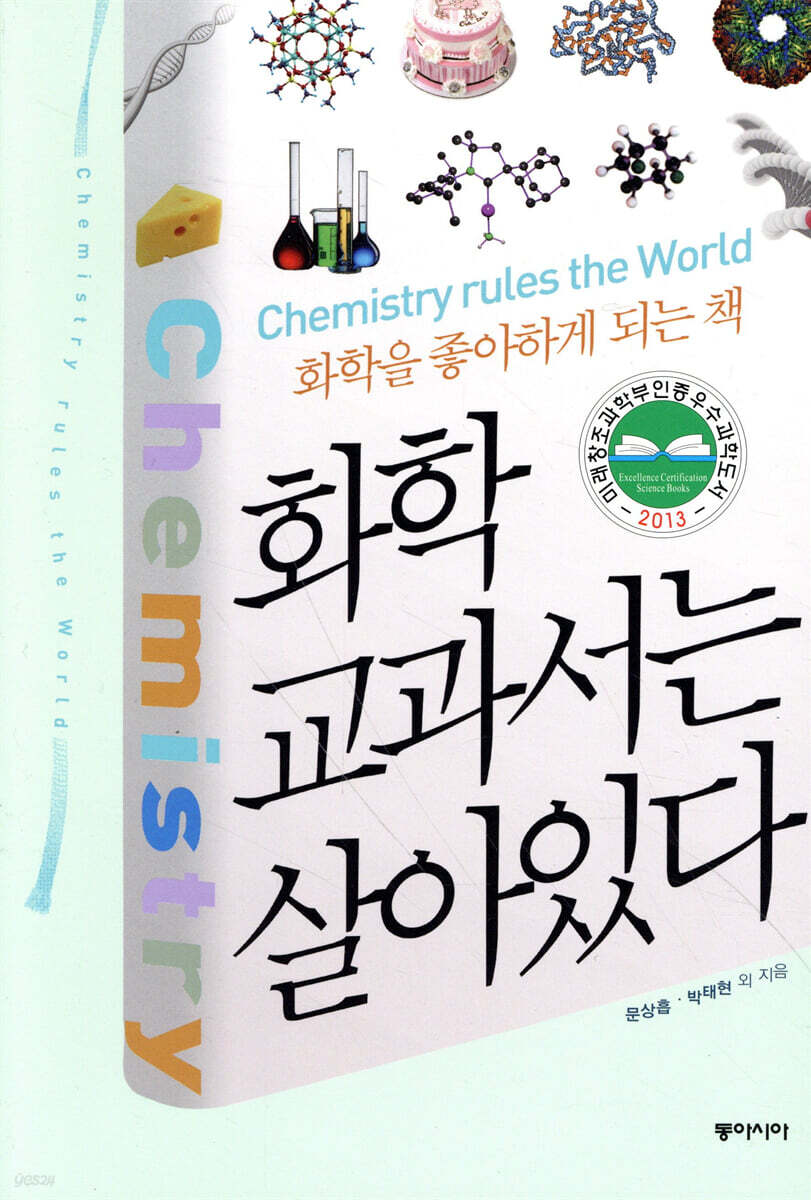
Chemistry textbooks are alive
 |
Description
Book Introduction
We aim to make studying chemistry fun by revealing the chemical processes and principles hidden everywhere around us and closely related to our daily lives.
To that end, Korea's top chemical engineering professors have gathered to cover all areas of high school chemistry textbooks, explaining chemistry from the basics to its applications in an easy-to-understand and fun way.
It is particularly significant as it is a book published to commemorate the 50th anniversary of the Korean Institute of Chemical Engineers.
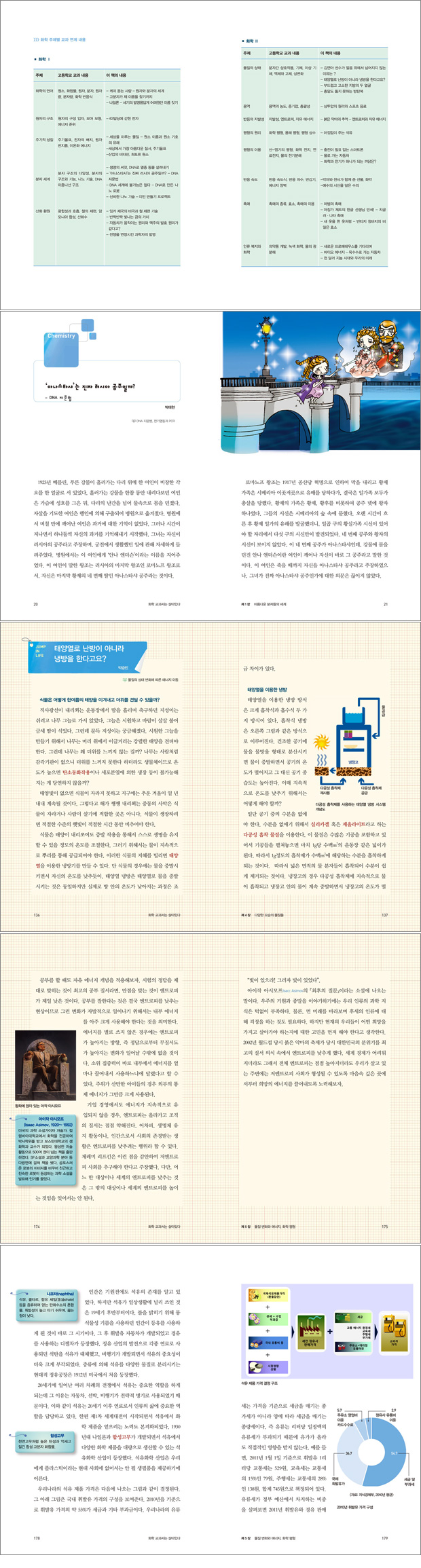
The book contains interesting anecdotes that make it easy to understand that many things we encounter in our daily lives are ultimately closely related to chemistry, such as DNA fingerprinting, which was used to uncover the truth about a woman who claimed to be the last princess of Russia, Anastasia.
It also contains the development of chemistry one by one.
It shows that chemistry goes beyond the academic field of chemistry and is closely related to human life and even survival.
To that end, Korea's top chemical engineering professors have gathered to cover all areas of high school chemistry textbooks, explaining chemistry from the basics to its applications in an easy-to-understand and fun way.
It is particularly significant as it is a book published to commemorate the 50th anniversary of the Korean Institute of Chemical Engineers.
The book contains interesting anecdotes that make it easy to understand that many things we encounter in our daily lives are ultimately closely related to chemistry, such as DNA fingerprinting, which was used to uncover the truth about a woman who claimed to be the last princess of Russia, Anastasia.
It also contains the development of chemistry one by one.
It shows that chemistry goes beyond the academic field of chemistry and is closely related to human life and even survival.
- You can preview some of the book's contents.
Preview
index
Opening Note: A book that will make you love chemistry.
Chapter 1: The World of Beautiful Molecules
The Seed of Life: Saving Extinct Animals with DNA / Park Tae-hyun
Was Anastasia a Real Russian Princess? - DNA Fingerprinting / Park Tae-hyun
Jump In Life: Nothing is Impossible in the DNA World - Nanorobots Made of DNA / Park Tae-hyun
Mysterious Nanotechnology - The Beauty Creation Project / Seong Jong-hwan
Jump In Life: How Polymers Find Their Name / Ha Chang-sik
Nylon - A Difficult Name for the Invention of the Century / Ha Chang-sik
Chapter 2: Elements with Unique Characters
Chemistry in Love - The World of Atoms and Molecules / Noh Jung-seok
The Substances That Make Up the World - The Origin of Element Names and Symbols / Oh Myung-sook
The most beautiful order in the world, the periodic table / Noh Jung-seok
Vitamins of Industry: Rare Earth Elements / Oh Myung-sook
Jump In Life: Electron Trapped in the 63 Building / Park Seung-bin
Chapter 3 Similar Chemical Reactions
The Tragedy of the Inca Empire and Iron Smelting Technology / Moon Sang-heup
The value of sparkling gold / Tak Yong-seok
The principle of how a car moves is the same as the principle of how beer ferments? / Seong Jong-hwan
Jump In Life: The Scientist's Invention That Extended the War / Moon Sang-heup
Chapter 4: Materials of Various Forms
Why doesn't Kim Yuna fall on the ice? / Park Seung-bin
Jump In Life: Cooling, Not Heating, with Solar Energy? / Seungbin Park
The Two Faces of Soft, Savory Fat / Seong Jong-hwan
Bulletproof vest that can't even penetrate a bullet / Ha Chang-sik
The Principle of Osmosis and Sports Drinks / Park Tae-hyun
Chapter 5: Matter Changes and Energy, Chemical Equilibrium
Jump In Life: Memories of the Red Devils - Entropy and Free Energy / Noh Jung-seok
Oil given generously / Lee Kwan-young
Smartphones that don't need charging / Tabletop
Car on Water / Table Stone
Jump In Life: Why Chemistry and Electricity Become One / Tak Yong-seok
Chapter 6 Chemical Reactions and Rates
Gunpowder, a gift from both the devil and the angel / Moon Sang-heup
The shroud covering Jesus' body / Moon Sang-heup
The Magic Catalyst / Lee Kwan-young
Jump In Life: Mazinger Jet's Korean Teacher Hurray! - Ziegler and Natasha Catalyst / Ha Chang-sik
New Clothes Like Old - The Secret to Vintage Jeans: Enzymes / Park Tae-hyun
Chapter 7: Chemistry for the Wide Benefit of Humanity
Waiting for a New Prometheus / Moon Sang-heup
Jump In Life Bioenergy - A Car That Runs on Corn / Seong Jong-hwan
The Million Dollar Genome Era and Our Future / Park Tae-hyun
Chapter 1: The World of Beautiful Molecules
The Seed of Life: Saving Extinct Animals with DNA / Park Tae-hyun
Was Anastasia a Real Russian Princess? - DNA Fingerprinting / Park Tae-hyun
Jump In Life: Nothing is Impossible in the DNA World - Nanorobots Made of DNA / Park Tae-hyun
Mysterious Nanotechnology - The Beauty Creation Project / Seong Jong-hwan
Jump In Life: How Polymers Find Their Name / Ha Chang-sik
Nylon - A Difficult Name for the Invention of the Century / Ha Chang-sik
Chapter 2: Elements with Unique Characters
Chemistry in Love - The World of Atoms and Molecules / Noh Jung-seok
The Substances That Make Up the World - The Origin of Element Names and Symbols / Oh Myung-sook
The most beautiful order in the world, the periodic table / Noh Jung-seok
Vitamins of Industry: Rare Earth Elements / Oh Myung-sook
Jump In Life: Electron Trapped in the 63 Building / Park Seung-bin
Chapter 3 Similar Chemical Reactions
The Tragedy of the Inca Empire and Iron Smelting Technology / Moon Sang-heup
The value of sparkling gold / Tak Yong-seok
The principle of how a car moves is the same as the principle of how beer ferments? / Seong Jong-hwan
Jump In Life: The Scientist's Invention That Extended the War / Moon Sang-heup
Chapter 4: Materials of Various Forms
Why doesn't Kim Yuna fall on the ice? / Park Seung-bin
Jump In Life: Cooling, Not Heating, with Solar Energy? / Seungbin Park
The Two Faces of Soft, Savory Fat / Seong Jong-hwan
Bulletproof vest that can't even penetrate a bullet / Ha Chang-sik
The Principle of Osmosis and Sports Drinks / Park Tae-hyun
Chapter 5: Matter Changes and Energy, Chemical Equilibrium
Jump In Life: Memories of the Red Devils - Entropy and Free Energy / Noh Jung-seok
Oil given generously / Lee Kwan-young
Smartphones that don't need charging / Tabletop
Car on Water / Table Stone
Jump In Life: Why Chemistry and Electricity Become One / Tak Yong-seok
Chapter 6 Chemical Reactions and Rates
Gunpowder, a gift from both the devil and the angel / Moon Sang-heup
The shroud covering Jesus' body / Moon Sang-heup
The Magic Catalyst / Lee Kwan-young
Jump In Life: Mazinger Jet's Korean Teacher Hurray! - Ziegler and Natasha Catalyst / Ha Chang-sik
New Clothes Like Old - The Secret to Vintage Jeans: Enzymes / Park Tae-hyun
Chapter 7: Chemistry for the Wide Benefit of Humanity
Waiting for a New Prometheus / Moon Sang-heup
Jump In Life Bioenergy - A Car That Runs on Corn / Seong Jong-hwan
The Million Dollar Genome Era and Our Future / Park Tae-hyun
Detailed image
Publisher's Review
A fun chemistry story that appears in textbooks but we didn't know much about.
Korea's top chemical engineering professors are stepping up!
1.
A book that will make you love chemistry
When we think of 'chemistry', we often think of the periodic table with its 100 or so element symbols and numbers, and complex chemical reaction equations involving the combination of (+) and (-) ions.
For that reason, you may remember getting a headache during chemistry class and losing sleep over memorizing the complex material during exam time.
What's the secret to studying well? Just study because you love it.
Because a smart person can't beat a hard worker, and a hard worker can't beat a person who does it because they like it.
So how can we develop a love for studying? The answer is also simple.
Just make studying fun.
If you do something because it's fun, you'll naturally start to like it, and then you'll do well in your studies.
- From the introduction
As I mentioned in the introduction that the secret to studying well is to do it because you like it and have fun, "Chemistry Textbooks Are Alive" aims to help you study chemistry in a fun way by revealing the chemical processes and principles hidden everywhere around us, which are closely related to our daily lives.
To that end, Korea's top chemical engineering professors have gathered to cover all areas of high school chemistry textbooks, explaining chemistry from the basics to its applications in an easy-to-understand and fun way.
It is particularly significant as it is a book published to commemorate the 50th anniversary of the Korean Institute of Chemical Engineers.
The book includes DNA fingerprinting, which was used to uncover the truth about a woman who claimed to be the last princess of Russia, Anastasia; carbon dating, which contributed to revealing that a piece of cloth believed to have wrapped the body of Jesus for hundreds of years was fake; the tragedy of the Inca Empire, which was conquered by Spain due to its lack of iron refining technology, and the discovery of a catalyst used in iron production; Napoleon III, who cherished the aluminum metal commonly used today; the story of Kevlar, which made movies about cool action scenes wearing bulletproof bulletproof vests a reality; the secret of sports drinks that instantly quench thirst; a car that runs on water, which will completely solve the problems of environmental pollution and fossil fuel depletion; the behind-the-scenes story of the ammonia synthesis method that produced two Nobel Prize winners and continued World War I; technology for making sunscreen using nanoparticles; interesting stories about the names of elements that make up the world; rare earth elements, which are essential for making smartphones, which are necessities for modern people; and weapons like the atomic bomb that were developed to harm humanity. Gunpowder, which brought disasters while also bringing blessings by drastically reducing human labor by being used to carve roads through mountains, is an example of how countless things we encounter in our daily lives are closely related to chemistry, presented through interesting anecdotes that make it easy to understand.
2.
A book that opens new horizons and adds depth to chemistry.
In the past, the main interest of the discipline of chemistry was to provide a consistent explanation for the questions of 'why a substance has a certain form, what characteristics cause it to exhibit such properties, and how it interacts with other substances to form new substances or decompose.'
In other words, while classical chemistry was about elucidating the substances existing in the world and understanding their principles, modern chemists are going one step further and focusing on synthesizing new substances.
As a result, chemical processes that began in the early days of human civilization, such as cooking, fermentation, and metallurgy, have continued to develop and have now led to the synthesis of representative products of the chemical industry, such as vinyl, Teflon, liquid crystals, semiconductors, and superconductors.
Moreover, the 20th century's efforts to understand the complex biochemistry of the body have broadened our understanding of human disease and health.
Through the continuous efforts of chemists, chemistry has developed into chemical engineering.
The book contains each and every one of these developments in chemistry.
“The Thousand Dollar Genome Era and Our Future (Park Tae-hyun),” which covers the personal genetic information analysis service made possible by the Human Genome Project that uncovered the human DNA base sequence; “Magic Catalysts (Lee Gwan-young),” which tells the story of various catalysts that served as a mediator in the ammonia synthesis process that enabled nitrogen fertilizer, which solved humanity’s food problem, and made possible petrochemical products that form the basis of modern material civilization; “Nothing is Impossible in the World of DNA - DNA Nano Robots (Park Tae-hyun),” which achieved remarkable results by combining nanotechnology with chemistry; “Waiting for a New Prometheus (Moon Sang-heup),” which deals with water electrolysis that presents the answer to a new energy source that will solve fossil fuel depletion, alternative energy, and environmental pollution; “Bioenergy - Cars That Run on Corn (Seong Jong-hwan),” “Smartphones That Don’t Need Charging (Tak Yong-seok),” which addresses the energy source issue of smartphones that now have various functions beyond simple phones, such as personal computers, cameras, and game consoles; and polymers that are indispensable to modern people’s lives, such as bulletproof vests, automobile parts, everyday items, and artificial hearts. “Bulletproof Jackets (Ha Chang-sik)”, which deals with the story of chemical products, shows that chemistry goes beyond the academic field of chemistry and is closely related to human life and even survival.
It would not be an exaggeration to say that the level of development in chemistry in modern countries determines the industrial development of the country.
By the time you finish reading this book, you will realize that human civilization is transitioning from the "Iron Age" to the "Polymer Age" based on chemistry.
3.
A new paradigm in modern scholarship, the embodiment of consilience
Modern scholarship does not remain confined to individual fields, but interacts with surrounding disciplines, shares academic achievements, and develops together.
"The Chemistry Textbook is Alive" is a book that clearly demonstrates the virtue of such integration.
By combining chemistry and nanotechnology, chemistry and biotechnology, chemistry and biotechnology, and chemistry and renewable energy, we breathe new life into chemical engineering by not remaining confined to a single academic field but by integrating it with surrounding disciplines.
This tendency is not limited to the integration of academic fields, but is also evident in the authors' way of thinking and writing.
In the process of explaining the principles and history of gunpowder, books such as “Gunpowder, a gift from both angels and devils (Moon Sang-heup)”, which reveals that the victory of the British Navy led by Admiral Nelson over the combined forces of France and Spain was due to its superior cannons; Goodyear’s efforts to discover the principle of vulcanization; and “Long Live the Korean Teacher of Mazinger Jet! - Ziegler-Natta Catalyst (Ha Chang-sik)”, which states that the research of the Curies, who won the Nobel Prize for radium, originated from serendipity, explain chemistry-related content in an easy-to-understand way by connecting it to historical facts or everyday content that may seem unimportant.
Becoming an expert in a field demonstrates that one has a deep understanding of other disciplines beyond one's own.
4.
Various devices to make chemistry easier to understand
To compensate for the fact that chemistry is a rigid and difficult field, this book provides various devices.
1.
We have included content related to each chemistry subject to help with studying.
2.
Through abundant photos and illustrations, it helped to understand parts that were difficult to understand through text.
3.
For technical and difficult terms, explanations are provided next to the terms to make them easier to understand.
4.
For unfamiliar or difficult topics, we've treated the entire chapter as a 'Jump In Life' to help you focus on them.
5.
Important terms are given a separate color to make them easy to recognize at a glance.
6.
Chemical formulas and complex diagrams are displayed in boxes in the middle of the text to make them easy to understand at a glance.
Korea's top chemical engineering professors are stepping up!
1.
A book that will make you love chemistry
When we think of 'chemistry', we often think of the periodic table with its 100 or so element symbols and numbers, and complex chemical reaction equations involving the combination of (+) and (-) ions.
For that reason, you may remember getting a headache during chemistry class and losing sleep over memorizing the complex material during exam time.
What's the secret to studying well? Just study because you love it.
Because a smart person can't beat a hard worker, and a hard worker can't beat a person who does it because they like it.
So how can we develop a love for studying? The answer is also simple.
Just make studying fun.
If you do something because it's fun, you'll naturally start to like it, and then you'll do well in your studies.
- From the introduction
As I mentioned in the introduction that the secret to studying well is to do it because you like it and have fun, "Chemistry Textbooks Are Alive" aims to help you study chemistry in a fun way by revealing the chemical processes and principles hidden everywhere around us, which are closely related to our daily lives.
To that end, Korea's top chemical engineering professors have gathered to cover all areas of high school chemistry textbooks, explaining chemistry from the basics to its applications in an easy-to-understand and fun way.
It is particularly significant as it is a book published to commemorate the 50th anniversary of the Korean Institute of Chemical Engineers.
The book includes DNA fingerprinting, which was used to uncover the truth about a woman who claimed to be the last princess of Russia, Anastasia; carbon dating, which contributed to revealing that a piece of cloth believed to have wrapped the body of Jesus for hundreds of years was fake; the tragedy of the Inca Empire, which was conquered by Spain due to its lack of iron refining technology, and the discovery of a catalyst used in iron production; Napoleon III, who cherished the aluminum metal commonly used today; the story of Kevlar, which made movies about cool action scenes wearing bulletproof bulletproof vests a reality; the secret of sports drinks that instantly quench thirst; a car that runs on water, which will completely solve the problems of environmental pollution and fossil fuel depletion; the behind-the-scenes story of the ammonia synthesis method that produced two Nobel Prize winners and continued World War I; technology for making sunscreen using nanoparticles; interesting stories about the names of elements that make up the world; rare earth elements, which are essential for making smartphones, which are necessities for modern people; and weapons like the atomic bomb that were developed to harm humanity. Gunpowder, which brought disasters while also bringing blessings by drastically reducing human labor by being used to carve roads through mountains, is an example of how countless things we encounter in our daily lives are closely related to chemistry, presented through interesting anecdotes that make it easy to understand.
2.
A book that opens new horizons and adds depth to chemistry.
In the past, the main interest of the discipline of chemistry was to provide a consistent explanation for the questions of 'why a substance has a certain form, what characteristics cause it to exhibit such properties, and how it interacts with other substances to form new substances or decompose.'
In other words, while classical chemistry was about elucidating the substances existing in the world and understanding their principles, modern chemists are going one step further and focusing on synthesizing new substances.
As a result, chemical processes that began in the early days of human civilization, such as cooking, fermentation, and metallurgy, have continued to develop and have now led to the synthesis of representative products of the chemical industry, such as vinyl, Teflon, liquid crystals, semiconductors, and superconductors.
Moreover, the 20th century's efforts to understand the complex biochemistry of the body have broadened our understanding of human disease and health.
Through the continuous efforts of chemists, chemistry has developed into chemical engineering.
The book contains each and every one of these developments in chemistry.
“The Thousand Dollar Genome Era and Our Future (Park Tae-hyun),” which covers the personal genetic information analysis service made possible by the Human Genome Project that uncovered the human DNA base sequence; “Magic Catalysts (Lee Gwan-young),” which tells the story of various catalysts that served as a mediator in the ammonia synthesis process that enabled nitrogen fertilizer, which solved humanity’s food problem, and made possible petrochemical products that form the basis of modern material civilization; “Nothing is Impossible in the World of DNA - DNA Nano Robots (Park Tae-hyun),” which achieved remarkable results by combining nanotechnology with chemistry; “Waiting for a New Prometheus (Moon Sang-heup),” which deals with water electrolysis that presents the answer to a new energy source that will solve fossil fuel depletion, alternative energy, and environmental pollution; “Bioenergy - Cars That Run on Corn (Seong Jong-hwan),” “Smartphones That Don’t Need Charging (Tak Yong-seok),” which addresses the energy source issue of smartphones that now have various functions beyond simple phones, such as personal computers, cameras, and game consoles; and polymers that are indispensable to modern people’s lives, such as bulletproof vests, automobile parts, everyday items, and artificial hearts. “Bulletproof Jackets (Ha Chang-sik)”, which deals with the story of chemical products, shows that chemistry goes beyond the academic field of chemistry and is closely related to human life and even survival.
It would not be an exaggeration to say that the level of development in chemistry in modern countries determines the industrial development of the country.
By the time you finish reading this book, you will realize that human civilization is transitioning from the "Iron Age" to the "Polymer Age" based on chemistry.
3.
A new paradigm in modern scholarship, the embodiment of consilience
Modern scholarship does not remain confined to individual fields, but interacts with surrounding disciplines, shares academic achievements, and develops together.
"The Chemistry Textbook is Alive" is a book that clearly demonstrates the virtue of such integration.
By combining chemistry and nanotechnology, chemistry and biotechnology, chemistry and biotechnology, and chemistry and renewable energy, we breathe new life into chemical engineering by not remaining confined to a single academic field but by integrating it with surrounding disciplines.
This tendency is not limited to the integration of academic fields, but is also evident in the authors' way of thinking and writing.
In the process of explaining the principles and history of gunpowder, books such as “Gunpowder, a gift from both angels and devils (Moon Sang-heup)”, which reveals that the victory of the British Navy led by Admiral Nelson over the combined forces of France and Spain was due to its superior cannons; Goodyear’s efforts to discover the principle of vulcanization; and “Long Live the Korean Teacher of Mazinger Jet! - Ziegler-Natta Catalyst (Ha Chang-sik)”, which states that the research of the Curies, who won the Nobel Prize for radium, originated from serendipity, explain chemistry-related content in an easy-to-understand way by connecting it to historical facts or everyday content that may seem unimportant.
Becoming an expert in a field demonstrates that one has a deep understanding of other disciplines beyond one's own.
4.
Various devices to make chemistry easier to understand
To compensate for the fact that chemistry is a rigid and difficult field, this book provides various devices.
1.
We have included content related to each chemistry subject to help with studying.
2.
Through abundant photos and illustrations, it helped to understand parts that were difficult to understand through text.
3.
For technical and difficult terms, explanations are provided next to the terms to make them easier to understand.
4.
For unfamiliar or difficult topics, we've treated the entire chapter as a 'Jump In Life' to help you focus on them.
5.
Important terms are given a separate color to make them easy to recognize at a glance.
6.
Chemical formulas and complex diagrams are displayed in boxes in the middle of the text to make them easy to understand at a glance.
GOODS SPECIFICS
- Date of publication: October 23, 2012
- Page count, weight, size: 275 pages | 479g | 153*224*20mm
- ISBN13: 9788962620580
- ISBN10: 8962620588
You may also like
카테고리
korean


korean

![GQ KOREA Mark (Monthly): December [2025]](http://librairie.coreenne.fr/cdn/shop/files/8ef265dbbfbf186523ed75ba7319009d.jpg?v=1765340328&width=3840)


