

Pocket Spider Encyclopedia
 |
Description
Book Introduction
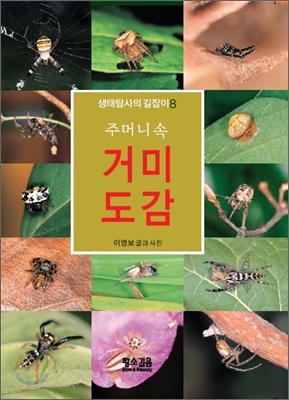
『Pocket Spider Encyclopedia』 is a spider encyclopedia that contains 142 species of spiders that are known to live in Korea, focusing on those that can be seen in everyday life.
This book is not simply a list of spiders; it contains the author's extensive experience of studying spider ecology, developing and operating experiential learning programs, and teaching about spiders.
First, to increase understanding of spiders, we explained the 'appearance and characteristics of spiders', introduced the details necessary for 'collecting and observing', and included an explanation of terminology.
In our must-know spiders, we classify spiders by family and provide information on their ecological characteristics, habitat, size, appearance time, and lifestyle to help you observe them in the field.
In particular, the ecology of important spiders such as the mountain spider, the long-horned spider, the Chinese spider, the scarlet spider, and the water spider is described in detail over 3-4 pages.
This book is small and light enough to carry around at any time, and is made with special binding (PUR binding) so that it opens well and is sturdy. It is a spider ecology guide that is designed to help ecology guides, forest interpreters, the general public, and even children easily understand and approach spiders.
This book is not simply a list of spiders; it contains the author's extensive experience of studying spider ecology, developing and operating experiential learning programs, and teaching about spiders.
First, to increase understanding of spiders, we explained the 'appearance and characteristics of spiders', introduced the details necessary for 'collecting and observing', and included an explanation of terminology.
In our must-know spiders, we classify spiders by family and provide information on their ecological characteristics, habitat, size, appearance time, and lifestyle to help you observe them in the field.
In particular, the ecology of important spiders such as the mountain spider, the long-horned spider, the Chinese spider, the scarlet spider, and the water spider is described in detail over 3-4 pages.
This book is small and light enough to carry around at any time, and is made with special binding (PUR binding) so that it opens well and is sturdy. It is a spider ecology guide that is designed to help ecology guides, forest interpreters, the general public, and even children easily understand and approach spiders.
index
■ Welcome to the world of spiders
■ Appearance and characteristics of spiders
□ External structure of spiders
□ Internal structure of a spider
□ Taxonomic position of spiders
□ Spider characteristics and defense methods
■ Glossary of Terms
■ Collection and observation
□ Materials for collection
□ Collection method
□ Precautions when collecting
□ Making a sample (immersion)
□ Spider specimen observation
□ Spider Photography for Beginners
■ Our spiders you must know
■ Search
■ Appearance and characteristics of spiders
□ External structure of spiders
□ Internal structure of a spider
□ Taxonomic position of spiders
□ Spider characteristics and defense methods
■ Glossary of Terms
■ Collection and observation
□ Materials for collection
□ Collection method
□ Precautions when collecting
□ Making a sample (immersion)
□ Spider specimen observation
□ Spider Photography for Beginners
■ Our spiders you must know
■ Search
Into the book
If we broaden our understanding and use of spiders a little more, we can see that spiders are not disgusting creatures that should be killed, but rather useful animals for humans.
To understand spiders more deeply, the first step is to learn the names of the spiders around you.
So, I wrote "Pocket Spider Guide" so that anyone interested in spiders, including children, eco-guides, forest interpreters, and the general public, can easily talk about spiders and identify spiders they find around them.
To understand spiders more deeply, the first step is to learn the names of the spiders around you.
So, I wrote "Pocket Spider Guide" so that anyone interested in spiders, including children, eco-guides, forest interpreters, and the general public, can easily talk about spiders and identify spiders they find around them.
---From the text
Publisher's Review
How much do we understand about spiders?
We tend to dislike or have a negative view of spiders because they are dark, have hairy legs, are poisonous, and use webs to catch their prey.
But when you learn about spiders, you realize that they are not things to be hated and killed, but rather animals that are very useful to humans.
The US Defense Research Laboratory appears early in the movie 'Spider-Man', which is about spiders.
This is a scene showing that spiders are being studied there.
Kevlar, currently used as a material for bulletproof vests and helmets, is a lightweight, strong, and highly functional artificial fiber.
But there is a natural fiber that is even better than this: spider silk.
Spider-Man was able to fly between buildings by hanging on to the spider web because of the spider web's high strength and elasticity.
Spider silk is five times stronger than steel and at the same time has excellent elasticity.
It also has a waterproof function that does not change easily even at high temperatures and allows air to pass through but does not allow moisture to penetrate.
Because of these advantages, research is actively being conducted on methods for mass producing spider silk.
In Korea and many other countries around the world, research and trials on eco-friendly farming methods that utilize spiders to control crop pests are actively underway.
This prevents various types of pesticide contamination and has the effect of reducing costs and increasing yield.
Spiders are used to repel mealybugs, red borers, rice planthoppers, and grasshoppers (mainly wolf spiders, jumping spiders, crab spiders, etc.). The common spider is used to repel cockroaches, and the common scorpion spider is used to repel pine gall midges.
In fact, spiders eat over 5 billion pests every year, which is said to be more than the number of pests that humans kill with pesticides.
To understand spiders, the first step is to learn the names of the spiders around you.
Through this book, anyone interested in spiders will be able to easily recognize and talk about spiders they find around them.
We tend to dislike or have a negative view of spiders because they are dark, have hairy legs, are poisonous, and use webs to catch their prey.
But when you learn about spiders, you realize that they are not things to be hated and killed, but rather animals that are very useful to humans.
The US Defense Research Laboratory appears early in the movie 'Spider-Man', which is about spiders.
This is a scene showing that spiders are being studied there.
Kevlar, currently used as a material for bulletproof vests and helmets, is a lightweight, strong, and highly functional artificial fiber.
But there is a natural fiber that is even better than this: spider silk.
Spider-Man was able to fly between buildings by hanging on to the spider web because of the spider web's high strength and elasticity.
Spider silk is five times stronger than steel and at the same time has excellent elasticity.
It also has a waterproof function that does not change easily even at high temperatures and allows air to pass through but does not allow moisture to penetrate.
Because of these advantages, research is actively being conducted on methods for mass producing spider silk.
In Korea and many other countries around the world, research and trials on eco-friendly farming methods that utilize spiders to control crop pests are actively underway.
This prevents various types of pesticide contamination and has the effect of reducing costs and increasing yield.
Spiders are used to repel mealybugs, red borers, rice planthoppers, and grasshoppers (mainly wolf spiders, jumping spiders, crab spiders, etc.). The common spider is used to repel cockroaches, and the common scorpion spider is used to repel pine gall midges.
In fact, spiders eat over 5 billion pests every year, which is said to be more than the number of pests that humans kill with pesticides.
To understand spiders, the first step is to learn the names of the spiders around you.
Through this book, anyone interested in spiders will be able to easily recognize and talk about spiders they find around them.
GOODS SPECIFICS
- Date of issue: February 28, 2008
- Page count, weight, size: 198 pages | 198g | 112*152*20mm
- ISBN13: 9788989370590
- ISBN10: 8989370590
You may also like
카테고리
korean


korean

![ELLE 엘르 스페셜 에디션 A형 : 12월 [2025]](http://librairie.coreenne.fr/cdn/shop/files/b8e27a3de6c9538896439686c6b0e8fb.jpg?v=1766436872&width=3840)


