

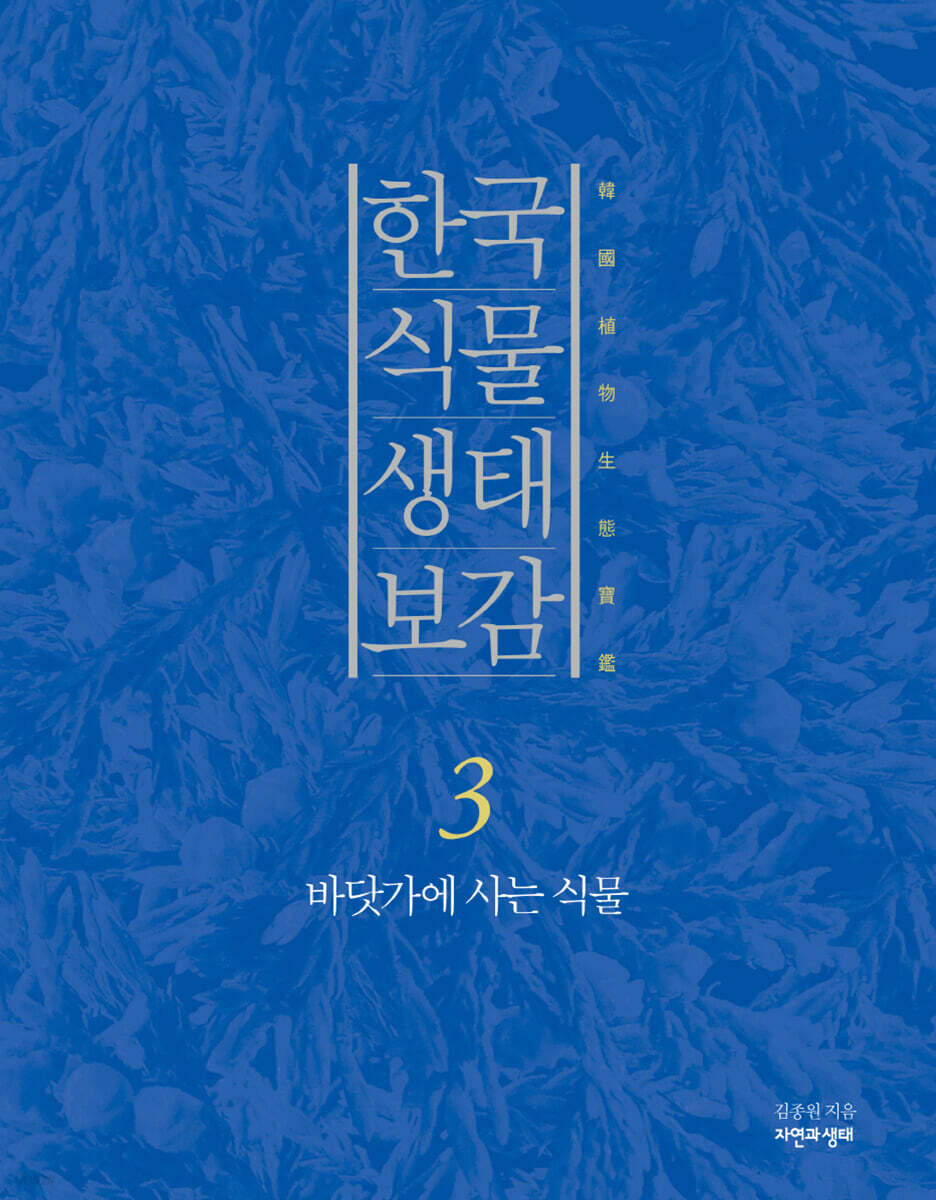
Korean Plant Ecology Encyclopedia 3
 |
Description
Book Introduction
A Difficult Lifestyle: Plants Surviving on the Coast
The series 『Encyclopedia of Korean Plant Ecology』, which examines the various aspects of our plants based on their habitats, has now headed to the seaside.
We introduced 104 species of coastal plants, including 44 species from coastal cliffs, 32 species from sand dunes, and 28 species from salt marshes.
The coastal plants referred to here include three types of halophytes (obligate, facultative, and pseudo-halophytes) and two types of neutral plants (salt-tolerant and salt-tolerant).
In addition, 238 species of plants were included, with their morphological and ecological characteristics comparable to those of these, for a total of 342 species.
Information on 104 species of coastal plants is summarized by morphological classification, ecological classification, and name dictionary, and in Econote, the related content is presented more faithfully from the perspectives of morphology, ecology, geography, humanities, and history.
The series 『Encyclopedia of Korean Plant Ecology』, which examines the various aspects of our plants based on their habitats, has now headed to the seaside.
We introduced 104 species of coastal plants, including 44 species from coastal cliffs, 32 species from sand dunes, and 28 species from salt marshes.
The coastal plants referred to here include three types of halophytes (obligate, facultative, and pseudo-halophytes) and two types of neutral plants (salt-tolerant and salt-tolerant).
In addition, 238 species of plants were included, with their morphological and ecological characteristics comparable to those of these, for a total of 342 species.
Information on 104 species of coastal plants is summarized by morphological classification, ecological classification, and name dictionary, and in Econote, the related content is presented more faithfully from the perspectives of morphology, ecology, geography, humanities, and history.
- You can preview some of the book's contents.
Preview
index
Note 4
Preface 10
The Elements of Life in the Seaside Plant Community 13
Part 1: Coastal Rock-Cliff Habitat
Coastal Rock-Cliff Habitat and Plant Distribution 24
Stone bracken (fern) 26
Goblin Beef Steak 29
Black pine (Pinus japonica) 34
Island pine 39
46 cedar trees
60 hornbeam trees (hornbeam, hornbeam)
Oak 68
Pine tree 74
Firewood 82
Wanghojanggeun (Yeottaedae) 88
Sea squirrel 96
Hairy janggupul (hairy jangguchae, sea tangle) 101
Ant 107
Crow's-eye twig (Crow's-eye twig) 111
Umuksa Srepi 116
Geotjangdae 121
Jeju Island ginseng (Jeju Island ginseng) 124
Money tree (Haedong tree, Seom-eum tree) 128
Dajeongkeumnamu 135
Stone thorn (Shiny thorn) 142
Cancer drama 148
152 Four Seasons Trees
Jujube tree 159
Barley tree (spring barley tree) 166
Gaetganghwal 173
Seaweed Box 177
Seaweed 181
Magpie Beard 185
Fishing Stone Grass (Gadgeia japonica) 189
193 for the first time
Gaejilgyeongi 198
Island fire tree 203
Artemisia capillaris 209
Seaweed (Island seaweed) 214
Haeguk 218
Long-necked sea squirt (long-necked sea squirt) 223
Hairy Head 229
Noganjubijjaru 234
Hangover porridge 240
Seaweed 246
250 reeds (true reeds)
Sea buckthorn 255
Gaetbawi Cheongsacho 259
Sea sedge (milsaecho) 264
Part 2: Coastal Dune Habitats
Coastal dune habitats and plant distribution 272
276th episode of Beonhaengcho
Thin-leafed ginseng (Gaining ginseng) 281
Rat Ming-Aju (Chwi Ming-Aju) 286
Blue dandelion (Homocho) 291
thorn pine herb (water spinach) 296
Prayer Beads Bag (Gaehyunhosaek) 300
Seaweed (Muajaebi) 304
Western sea buckthorn 308
314 Wonsan dwarf flower
Rose of Sharon 318
330 sea cucumber beans (sea cucumber beans)
Sea peas 336
Lead-winged magpie (Namgasae) 340
Evening Primrose 345
Sea breeze (liberation breeze) 350
Seaweed (coastal weed) 354
Sand squirrel 358
Sunbiginamu 362
369
374
378
Geumgangbulcho 383
Moon Soo-ran (Moon Ju-ran) 387
Umbrella Grass (Umbrella Grass) 395
Baby barley (Gaetgeuryeong) 400
Deulmuksae (Gukju Kim's Hair) 406
Zodiac sign 411
Seaweed barley 417
Wang Jandi 423
Mogigol 428
Sand sedge (Zombori sedge) 432
Tongbori Sacho 437
Part 3: Coastal Wetland Habitats
Coastal wetland habitats and plant distribution 444
447 Cnidaria
450 for the Ganeungneungjaengi
455 Tongtongmadi
Namunjae (Sea pine herb) 462
Chilmyeoncho 466
Seaweed (Haeongi) 470
Snowdrop 474
Hwanggeun 479
Welcome to the Sea 485
Seascape Sutra (Seascape Sutra) 492
Artemisia capillaris (large Artemisia capillaris) 497
Sea squirt 502
Geatchangpo (Jichae) 506
Seaweed (Seaweed) 511
Shrimp 517
Baby's Breed (Leech's Breed) 522
531
Mosaedal 535
Reed 541
Gatpiajaebi (Gaetsoedolpi) 546
Sea squirt (Sea squirt) 551
Seagrass 558
English sedge (Western sedge) 563
Sea mustard (Cheonilsacho) 573
Sea Sky Keeper 579
582
Layered Goraengi 590
Night Songi Bangdong Sani (Gaetbangdong Sani) 596
supplement
Morphological Dictionary 600
Ecological Dictionary 607
References 634
Search
Scientific name 665|Korean name 672|English name 683|
Chinese name 686|Japanese name 688
Epilogue 690
Preface 10
The Elements of Life in the Seaside Plant Community 13
Part 1: Coastal Rock-Cliff Habitat
Coastal Rock-Cliff Habitat and Plant Distribution 24
Stone bracken (fern) 26
Goblin Beef Steak 29
Black pine (Pinus japonica) 34
Island pine 39
46 cedar trees
60 hornbeam trees (hornbeam, hornbeam)
Oak 68
Pine tree 74
Firewood 82
Wanghojanggeun (Yeottaedae) 88
Sea squirrel 96
Hairy janggupul (hairy jangguchae, sea tangle) 101
Ant 107
Crow's-eye twig (Crow's-eye twig) 111
Umuksa Srepi 116
Geotjangdae 121
Jeju Island ginseng (Jeju Island ginseng) 124
Money tree (Haedong tree, Seom-eum tree) 128
Dajeongkeumnamu 135
Stone thorn (Shiny thorn) 142
Cancer drama 148
152 Four Seasons Trees
Jujube tree 159
Barley tree (spring barley tree) 166
Gaetganghwal 173
Seaweed Box 177
Seaweed 181
Magpie Beard 185
Fishing Stone Grass (Gadgeia japonica) 189
193 for the first time
Gaejilgyeongi 198
Island fire tree 203
Artemisia capillaris 209
Seaweed (Island seaweed) 214
Haeguk 218
Long-necked sea squirt (long-necked sea squirt) 223
Hairy Head 229
Noganjubijjaru 234
Hangover porridge 240
Seaweed 246
250 reeds (true reeds)
Sea buckthorn 255
Gaetbawi Cheongsacho 259
Sea sedge (milsaecho) 264
Part 2: Coastal Dune Habitats
Coastal dune habitats and plant distribution 272
276th episode of Beonhaengcho
Thin-leafed ginseng (Gaining ginseng) 281
Rat Ming-Aju (Chwi Ming-Aju) 286
Blue dandelion (Homocho) 291
thorn pine herb (water spinach) 296
Prayer Beads Bag (Gaehyunhosaek) 300
Seaweed (Muajaebi) 304
Western sea buckthorn 308
314 Wonsan dwarf flower
Rose of Sharon 318
330 sea cucumber beans (sea cucumber beans)
Sea peas 336
Lead-winged magpie (Namgasae) 340
Evening Primrose 345
Sea breeze (liberation breeze) 350
Seaweed (coastal weed) 354
Sand squirrel 358
Sunbiginamu 362
369
374
378
Geumgangbulcho 383
Moon Soo-ran (Moon Ju-ran) 387
Umbrella Grass (Umbrella Grass) 395
Baby barley (Gaetgeuryeong) 400
Deulmuksae (Gukju Kim's Hair) 406
Zodiac sign 411
Seaweed barley 417
Wang Jandi 423
Mogigol 428
Sand sedge (Zombori sedge) 432
Tongbori Sacho 437
Part 3: Coastal Wetland Habitats
Coastal wetland habitats and plant distribution 444
447 Cnidaria
450 for the Ganeungneungjaengi
455 Tongtongmadi
Namunjae (Sea pine herb) 462
Chilmyeoncho 466
Seaweed (Haeongi) 470
Snowdrop 474
Hwanggeun 479
Welcome to the Sea 485
Seascape Sutra (Seascape Sutra) 492
Artemisia capillaris (large Artemisia capillaris) 497
Sea squirt 502
Geatchangpo (Jichae) 506
Seaweed (Seaweed) 511
Shrimp 517
Baby's Breed (Leech's Breed) 522
531
Mosaedal 535
Reed 541
Gatpiajaebi (Gaetsoedolpi) 546
Sea squirt (Sea squirt) 551
Seagrass 558
English sedge (Western sedge) 563
Sea mustard (Cheonilsacho) 573
Sea Sky Keeper 579
582
Layered Goraengi 590
Night Songi Bangdong Sani (Gaetbangdong Sani) 596
supplement
Morphological Dictionary 600
Ecological Dictionary 607
References 634
Search
Scientific name 665|Korean name 672|English name 683|
Chinese name 686|Japanese name 688
Epilogue 690
Detailed image
Publisher's Review
A wondrous microcosm rooted in a harsh, salty environment
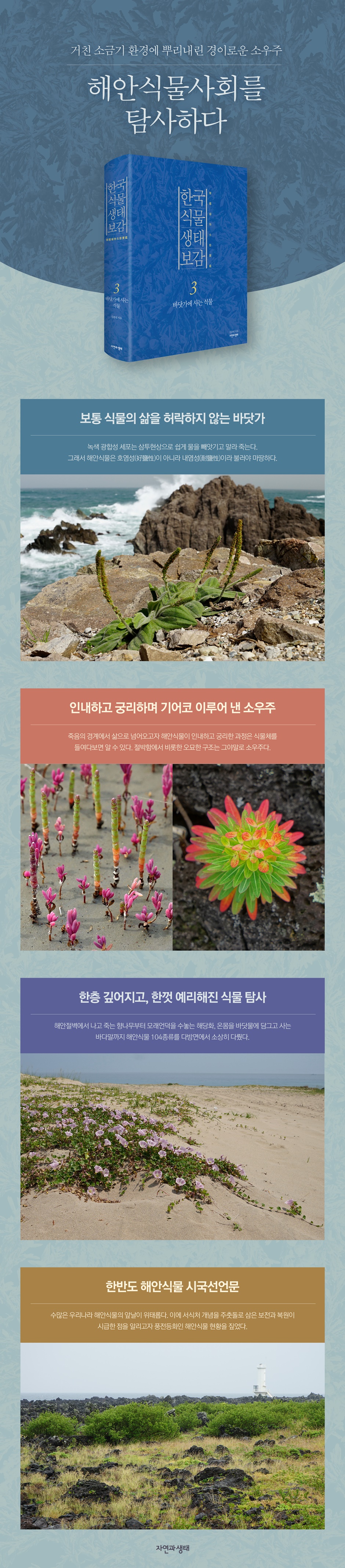
Exploring coastal plant communities
Persevere, ponder, and somehow manage to live on
Salt is poison to plants that live rooted in the ground.
This is because green photosynthetic cells easily lose water through osmosis and dry out and die.
Coastal plants that survive on the seashore, which usually does not allow plant life, should be called salt-tolerant rather than halophilic.
The process through which they endured and pondered over the long years to cross the border of death to life can be clearly seen by looking closely at the plant.
The mysterious structure that arises from desperation is truly a microcosm.
Deeper and sharper plant exploration
We conducted an in-depth analysis of 104 plant species that live in diverse coastal environments, from pine trees that grow and die on dry coastal cliffs, to roses that adorn silvery sand dunes, and sea cucumbers that re-enter saltwater waters from freshwater habitats.
We have meticulously organized ecological information, which is a means of understanding morphological characteristics and behavioral patterns that are helpful for classification, and we have also covered in detail the natural and cultural history of coastal plants on the Korean Peninsula.
Following volumes 1 and 2, we also put consistent effort into tracing the unique names of our plants.
Declaration on the Current Situation of Coastal Plants on the Korean Peninsula
The future of many coastal plants in Korea, including the island pine, which forms a very unique plant community, the ice age relict plant, the snowdrop, and the ecologically essential resource, the sedge, is in jeopardy.
This is because human interference, such as reckless development and the reckless introduction of foreign flowering plants, is constant, and habitats are disappearing or being destroyed due to rising temperatures and sea level changes caused by climate change.
To highlight the urgent need for conservation and restoration based on the concept of habitat, we have detailed the current status of coastal plants, which are vulnerable to wind damage.
Exploring coastal plant communities
Persevere, ponder, and somehow manage to live on
Salt is poison to plants that live rooted in the ground.
This is because green photosynthetic cells easily lose water through osmosis and dry out and die.
Coastal plants that survive on the seashore, which usually does not allow plant life, should be called salt-tolerant rather than halophilic.
The process through which they endured and pondered over the long years to cross the border of death to life can be clearly seen by looking closely at the plant.
The mysterious structure that arises from desperation is truly a microcosm.
Deeper and sharper plant exploration
We conducted an in-depth analysis of 104 plant species that live in diverse coastal environments, from pine trees that grow and die on dry coastal cliffs, to roses that adorn silvery sand dunes, and sea cucumbers that re-enter saltwater waters from freshwater habitats.
We have meticulously organized ecological information, which is a means of understanding morphological characteristics and behavioral patterns that are helpful for classification, and we have also covered in detail the natural and cultural history of coastal plants on the Korean Peninsula.
Following volumes 1 and 2, we also put consistent effort into tracing the unique names of our plants.
Declaration on the Current Situation of Coastal Plants on the Korean Peninsula
The future of many coastal plants in Korea, including the island pine, which forms a very unique plant community, the ice age relict plant, the snowdrop, and the ecologically essential resource, the sedge, is in jeopardy.
This is because human interference, such as reckless development and the reckless introduction of foreign flowering plants, is constant, and habitats are disappearing or being destroyed due to rising temperatures and sea level changes caused by climate change.
To highlight the urgent need for conservation and restoration based on the concept of habitat, we have detailed the current status of coastal plants, which are vulnerable to wind damage.
GOODS SPECIFICS
- Date of issue: January 21, 2025
- Format: Hardcover book binding method guide
- Page count, weight, size: 688 pages | 1,004g | 165*210*30mm
- ISBN13: 9791164500659
- ISBN10: 1164500651
You may also like
카테고리
korean


korean

![ELLE 엘르 스페셜 에디션 A형 : 12월 [2025]](http://librairie.coreenne.fr/cdn/shop/files/b8e27a3de6c9538896439686c6b0e8fb.jpg?v=1766436872&width=3840)


