

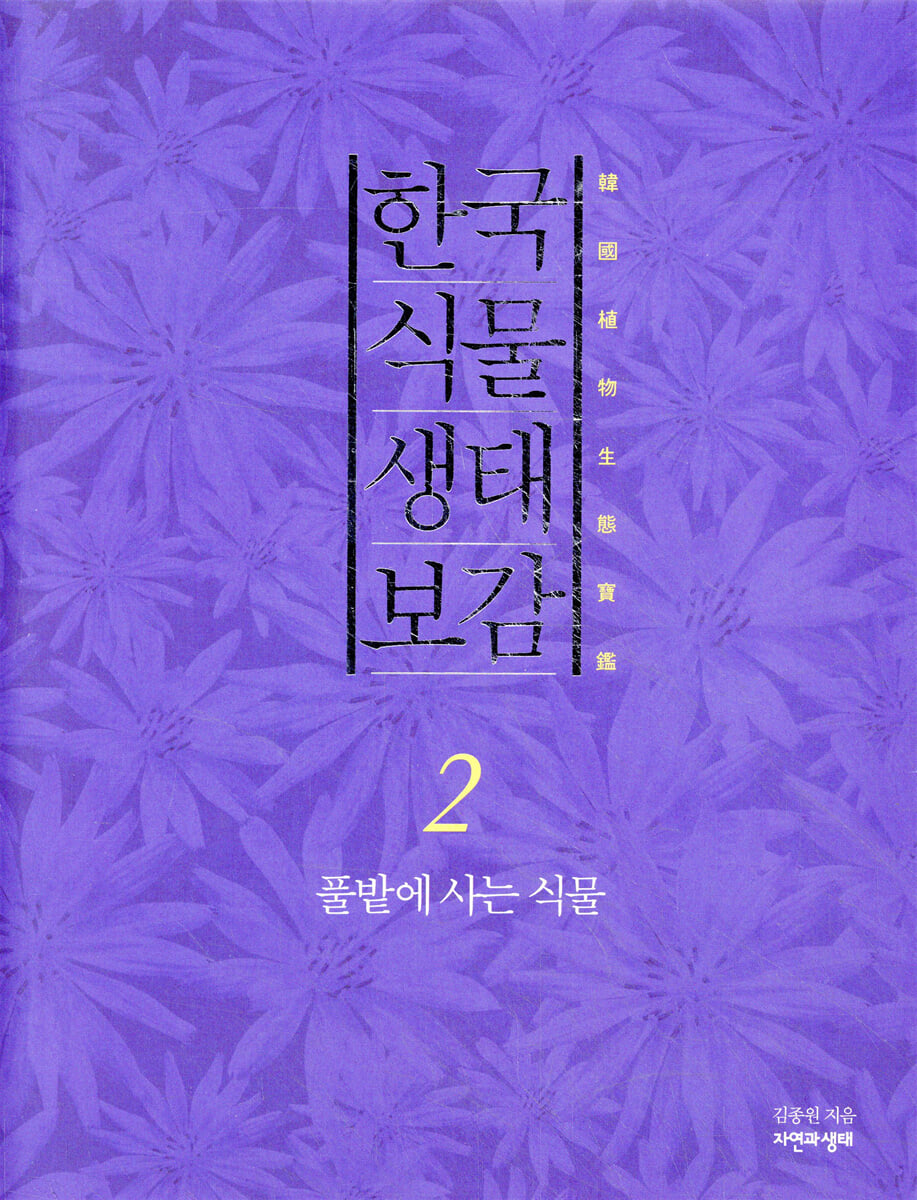
Korean Plant Ecology Encyclopedia 2
 |
Description
Book Introduction
A treasure trove of biodiversity, a home to wild vegetable culture
Recording the value of 'grass'
This is the second book in the 『Encyclopedia of Korean Plant Ecology』 series, which examines the life and society of plants by habitat.
Volume 2 deals with the grassland, a plant community formed under the blazing sun.
Unlike plants that live in shady forests, plants that live in grasslands have formed unique societies that can withstand the scorching sun.
The plant diversity per unit area of grassland is richer than that of forests.
This is why many regions and countries are focusing on grasslands as biodiversity hotspots.
There is one more special reason why we should care about grass.
This is because the 'wild vegetable culture', which cannot be found in any other country in the world, originated from grasslands.
The uniqueness of 'namul', whose meaning cannot be fully expressed in any other language, can be seen in the grass.
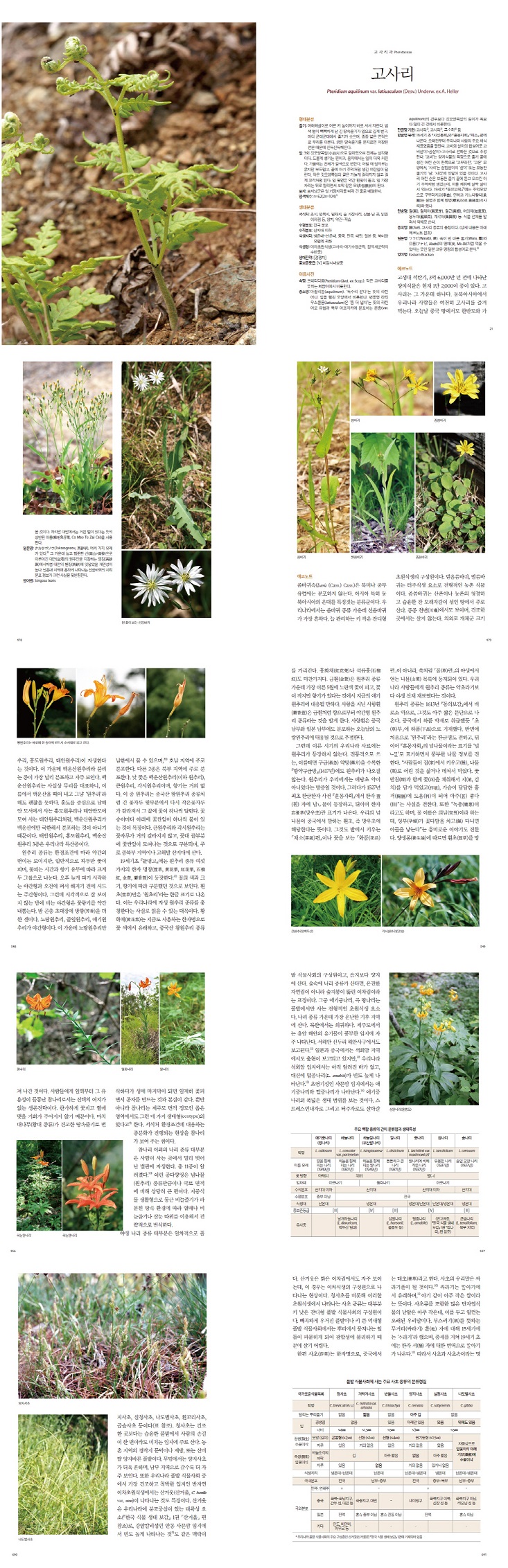
We selected 208 species of plants living in grasslands and introduced a total of 501 species by covering related plants together.
The description of each species is meticulously recorded in four major categories: morphological classification, ecological classification, name dictionary, and eco-note. The history and cultural history of grass plants are also richly explained.
Recording the value of 'grass'
This is the second book in the 『Encyclopedia of Korean Plant Ecology』 series, which examines the life and society of plants by habitat.
Volume 2 deals with the grassland, a plant community formed under the blazing sun.
Unlike plants that live in shady forests, plants that live in grasslands have formed unique societies that can withstand the scorching sun.
The plant diversity per unit area of grassland is richer than that of forests.
This is why many regions and countries are focusing on grasslands as biodiversity hotspots.
There is one more special reason why we should care about grass.
This is because the 'wild vegetable culture', which cannot be found in any other country in the world, originated from grasslands.
The uniqueness of 'namul', whose meaning cannot be fully expressed in any other language, can be seen in the grass.
We selected 208 species of plants living in grasslands and introduced a total of 501 species by covering related plants together.
The description of each species is meticulously recorded in four major categories: morphological classification, ecological classification, name dictionary, and eco-note. The history and cultural history of grass plants are also richly explained.
index
Note 4
Author's Preface 8
Why Grass? 10
Bracken family 21
Sandalwood and 24
26 of the knotweed family
Caryophyllaceae 48
Ranunculaceae 61
Single-parent family 80
Water parsley and 84
Brassicaceae 88
Panthera tigris alba 97
Rosaceae 100
Beans and 128
Rat's Hand Plant 184
Flax family 193
The polar and 196
Yunhyang and 203
Wonjigwa 208
Asteraceae 216
Violet and 219
Needleflower and 232
Ant Tower and 235
Mountain type 237
Primulaceae 259
Magic and 274
Yongdam and 276
Asteraceae 288
Family Apiaceae 292
Kokduseon Family 298
Dental Clinic 309
Lamiaceae 315
Scrophularia chinensis and 347
371 with heat
Matariidae 379
387 of the mountain rabbit flower
394 bellflowers
Asteraceae 418
Lily and 536
Iris 581
592 of the family Reed and Reed
Gramineae 596
Cyperaceae 684
Orchidaceae 694
supplement
Morphological terminology board 710
Morphological Dictionary 721
Ecological Dictionary 730
References 755
Plant Species Index
Scientific name 781│Korean name 790│English name 807│Chinese name 810│
Japanese name 813
Epilogue 816
Author's Preface 8
Why Grass? 10
Bracken family 21
Sandalwood and 24
26 of the knotweed family
Caryophyllaceae 48
Ranunculaceae 61
Single-parent family 80
Water parsley and 84
Brassicaceae 88
Panthera tigris alba 97
Rosaceae 100
Beans and 128
Rat's Hand Plant 184
Flax family 193
The polar and 196
Yunhyang and 203
Wonjigwa 208
Asteraceae 216
Violet and 219
Needleflower and 232
Ant Tower and 235
Mountain type 237
Primulaceae 259
Magic and 274
Yongdam and 276
Asteraceae 288
Family Apiaceae 292
Kokduseon Family 298
Dental Clinic 309
Lamiaceae 315
Scrophularia chinensis and 347
371 with heat
Matariidae 379
387 of the mountain rabbit flower
394 bellflowers
Asteraceae 418
Lily and 536
Iris 581
592 of the family Reed and Reed
Gramineae 596
Cyperaceae 684
Orchidaceae 694
supplement
Morphological terminology board 710
Morphological Dictionary 721
Ecological Dictionary 730
References 755
Plant Species Index
Scientific name 781│Korean name 790│English name 807│Chinese name 810│
Japanese name 813
Epilogue 816
Detailed image
Into the book
It is a ‘habitat of life’ that is completely different from grasslands and forests.
The forest is dark, the grass is always bright.
If darkness is the regulator of life for forest plants, then in the grassland, intense direct sunlight fundamentally controls life.
--- p.10
Although we habitually use the term 'tiger', it is damaging the dignity and roots of the Korean word 'beom'.
The first word 'tiger' appears in the 1459 『Wolinseokbo』 along with the word 'lion'. Here, the two characters 'ho' (虎) and 'rang' (狼) refer to 'beom' (虎) and 'wili' (狼), respectively, and not to a single species of tiger as is the case today.
At the end of the Joseon Dynasty in the 19th century, when the country was on the verge of collapse, a Westerner published 『Jinri Pyeondok Samjagyeong』, where a tiger turned into a tigress.
--- p.31
When rabbit grass is eaten, it releases cyanide (HCN) from the wounds it leaves behind.
Those with a distinct 'V' shaped white pattern on the leaf surface do so.
Even a small amount of cyanide can cause confusion in light-weight snails and grasshoppers.
The fact that groups of clover with 'V'-shaped patterns are more abundant and common in the wild is a natural result of leaf-eating groups avoiding them.
--- p.167
We become barbarians by committing barbarian acts, not by being called barbarian by others.
This is why I cannot abandon the delicious name ‘Barbarian Flower’ rather than the name ‘Violet Flower’ which I do not understand.
--- p.276
Typically, the parasitic process, in which the seeds of a parasitic plant awaken from dormancy, germinate, and continue to produce parasitic roots, begins only when the host plant releases a chemical signal that will accept the parasite.
For example, the parasite's choice is not its own, but entirely dependent on the host's choice.
So, I don't think it's right to blame parasites as being all bad.
They just live together with the consideration and generosity of the host.
It is a misunderstanding to think that Yago lives by stealing other people's hard work.
There is no shamelessness or timidity in the natural ecosystem.
All are absolutely interdependent.
--- p.378
Doraji is a pure Korean word.
The first written characters are 刀?次 and 都羅次 (doracha), which are borrowed from the Chinese characters that represent the sound of doraji.
In the early 15th century, 『Hyangyak Gugeupbang』 conveyed the Chinese character Gilgyeong (吉梗) in a vulgar rhyme.
In Korean, the first recorded use of 'Dorat' was in the late 15th century in the 『Gugeungganibang』.
After that, Do-eul-ajil, Do-al-at, and Do-eul-la-jil are recorded.
Therefore, it does not originate from the Idu style name Doracha (道羅次).
Doracha (道羅次) is the Idu transcription of the pure Korean word doraji, which our ancestors called since the time when the Korean alphabet did not exist.
--- p.414
The history of using mugwort as a folk medicine is very long.
A boy who was suffering from malaria and was dying was cured by his mother's loving treatment with the scent of mugwort.
This is a story from my childhood in a mountain village in Yeongyang in the mid-1960s.
--- p.426
The original name of the dogwood, 'Taeng-al', comes from the texture and shape of its roots.
In the early 19th century, the notation '알알' appears in the 『Mulmyeonggo』.
It suggests that it may come from a tangled root.
When the rhizome gets old, it becomes hard, and when it dries, it has a slightly odor, but when the root is dug up, it is slightly thick and plump.
The common name 地加乙 (地加乙) and the local name ?加乙 (태가을) recorded in the 1417 Hyangyak Gugeupbang were written using Chinese characters, and were written from the beginning as tangle in tangle.
--- p.443
The reason chives are considered one of the oldest wild vegetables of Koreans is because they are commonly found growing in crevices of limestone rocks on the Korean Peninsula.
Paleolithic people who lived in caves in limestone regions could not help but recognize the peculiar aroma of chives from early on.
Although chives are commonly cultivated today and are known to be native to China, this is a mistake made without any knowledge of the true nature of chives' native habitat.
--- p.541
The long feathers of a pine tree have a four-dimensional structure.
First of all, it looks like a thin but strong wire.
It is more than 10 times longer than the ear of Isaac, and is bent two or three times at large or small angles.
In addition, the lower surface of the cap has a groove that goes to the left like a screw, and there are many strong hairs like thorns.
Finally, it twists to the left like a rope with a neighboring skein, forming a strong wire.
The moment the ear of Isaac lightly touches the soft ground, it turns 'right' and digs into the soil like an excavator.
This is because the long hairs that rise into the air create a large circle due to centrifugal force, creating rotational force.
It digs into the soil with strong rotational force, but the ear of grain is not damaged.
This is because the part of the head of the ear that touches the ground is covered with tough hairs.
It truly seems like a 'godly stroke' to see the dispersal and settlement of the pine tree's seeds.
The forest is dark, the grass is always bright.
If darkness is the regulator of life for forest plants, then in the grassland, intense direct sunlight fundamentally controls life.
--- p.10
Although we habitually use the term 'tiger', it is damaging the dignity and roots of the Korean word 'beom'.
The first word 'tiger' appears in the 1459 『Wolinseokbo』 along with the word 'lion'. Here, the two characters 'ho' (虎) and 'rang' (狼) refer to 'beom' (虎) and 'wili' (狼), respectively, and not to a single species of tiger as is the case today.
At the end of the Joseon Dynasty in the 19th century, when the country was on the verge of collapse, a Westerner published 『Jinri Pyeondok Samjagyeong』, where a tiger turned into a tigress.
--- p.31
When rabbit grass is eaten, it releases cyanide (HCN) from the wounds it leaves behind.
Those with a distinct 'V' shaped white pattern on the leaf surface do so.
Even a small amount of cyanide can cause confusion in light-weight snails and grasshoppers.
The fact that groups of clover with 'V'-shaped patterns are more abundant and common in the wild is a natural result of leaf-eating groups avoiding them.
--- p.167
We become barbarians by committing barbarian acts, not by being called barbarian by others.
This is why I cannot abandon the delicious name ‘Barbarian Flower’ rather than the name ‘Violet Flower’ which I do not understand.
--- p.276
Typically, the parasitic process, in which the seeds of a parasitic plant awaken from dormancy, germinate, and continue to produce parasitic roots, begins only when the host plant releases a chemical signal that will accept the parasite.
For example, the parasite's choice is not its own, but entirely dependent on the host's choice.
So, I don't think it's right to blame parasites as being all bad.
They just live together with the consideration and generosity of the host.
It is a misunderstanding to think that Yago lives by stealing other people's hard work.
There is no shamelessness or timidity in the natural ecosystem.
All are absolutely interdependent.
--- p.378
Doraji is a pure Korean word.
The first written characters are 刀?次 and 都羅次 (doracha), which are borrowed from the Chinese characters that represent the sound of doraji.
In the early 15th century, 『Hyangyak Gugeupbang』 conveyed the Chinese character Gilgyeong (吉梗) in a vulgar rhyme.
In Korean, the first recorded use of 'Dorat' was in the late 15th century in the 『Gugeungganibang』.
After that, Do-eul-ajil, Do-al-at, and Do-eul-la-jil are recorded.
Therefore, it does not originate from the Idu style name Doracha (道羅次).
Doracha (道羅次) is the Idu transcription of the pure Korean word doraji, which our ancestors called since the time when the Korean alphabet did not exist.
--- p.414
The history of using mugwort as a folk medicine is very long.
A boy who was suffering from malaria and was dying was cured by his mother's loving treatment with the scent of mugwort.
This is a story from my childhood in a mountain village in Yeongyang in the mid-1960s.
--- p.426
The original name of the dogwood, 'Taeng-al', comes from the texture and shape of its roots.
In the early 19th century, the notation '알알' appears in the 『Mulmyeonggo』.
It suggests that it may come from a tangled root.
When the rhizome gets old, it becomes hard, and when it dries, it has a slightly odor, but when the root is dug up, it is slightly thick and plump.
The common name 地加乙 (地加乙) and the local name ?加乙 (태가을) recorded in the 1417 Hyangyak Gugeupbang were written using Chinese characters, and were written from the beginning as tangle in tangle.
--- p.443
The reason chives are considered one of the oldest wild vegetables of Koreans is because they are commonly found growing in crevices of limestone rocks on the Korean Peninsula.
Paleolithic people who lived in caves in limestone regions could not help but recognize the peculiar aroma of chives from early on.
Although chives are commonly cultivated today and are known to be native to China, this is a mistake made without any knowledge of the true nature of chives' native habitat.
--- p.541
The long feathers of a pine tree have a four-dimensional structure.
First of all, it looks like a thin but strong wire.
It is more than 10 times longer than the ear of Isaac, and is bent two or three times at large or small angles.
In addition, the lower surface of the cap has a groove that goes to the left like a screw, and there are many strong hairs like thorns.
Finally, it twists to the left like a rope with a neighboring skein, forming a strong wire.
The moment the ear of Isaac lightly touches the soft ground, it turns 'right' and digs into the soil like an excavator.
This is because the long hairs that rise into the air create a large circle due to centrifugal force, creating rotational force.
It digs into the soil with strong rotational force, but the ear of grain is not damaged.
This is because the part of the head of the ear that touches the ground is covered with tough hairs.
It truly seems like a 'godly stroke' to see the dispersal and settlement of the pine tree's seeds.
--- pp.673-674
Publisher's Review
Why We Should Pay Attention to 'Grass'
When we think of plant societies, forests usually come to mind first.
Our country is a country of forests belonging to the temperate forest biome, and any empty land is constantly transformed into forests through the natural power of 'transition', so perhaps this perception is natural.
However, even in temperate regions, there are lands where forests cannot grow (barren lands), and there are also lands that have been formed in a different way from forests, intertwined with human life.
It's a grassy field.
So, grasslands, especially natural grasslands (naturally generated grasslands), are always scattered like small islands in a plant community full of forests.
It is not uncommon to see ice age relics, rare plants, and endemic species in the grasslands, and this is also why biodiversity is so rich.
For this reason, ecologically advanced countries have long paid attention to grassland plant communities.
Some countries have designated the meadows where the Korean iris, a semi-endemic species, lives as natural monuments, and are also making efforts to protect old pastures.
Meanwhile, what is the situation in our country?
Natural grassland vegetation is in danger of extinction.
Of course, there are many reasons, including climate change, but the biggest factors that have contributed to the situation are various developments and a lack of understanding of grasslands.
The misguided and biased love for forests and the short-sighted view of grasslands that has persisted since the Japanese colonial period are also major problems.
For us, the grassland is a place of great cultural and historical significance.
This is because the grassland is where unique 'greens' grow, the meaning of which cannot be clearly explained in any other language such as English, Chinese, or Japanese.
Vegetables are not just food for us.
All the acts of digging, boiling, seasoning, and eating wild vegetables are imbued with our very old traditional culture.
So, if we look into the grass, we can also find our old future.
This is why we need to know and protect the grasslands now.
Understanding the concept of grassland plant communities
There is probably no one who does not know what a meadow is, but if you ask them what the concept of a meadow is, there will be few who can answer clearly.
At the beginning of the book, it explains what grasslands are in terms of plant ecology, how they are classified, and why they are important.
Before getting to know individual species, it will be helpful to get a general idea of the grassland plant community.
Finding More In-Depth Korean Plant Names
We have selected 208 species of plants living in grasslands (501 species in total including related plants) and comprehensively covered their classification, ecology, morphology, geography, culture, and history.
In particular, in Volume 2, the origins and meanings of the scientific names, Korean names, Chinese names, Japanese names, and English names of each species were traced in greater detail and organized separately in a 'Name Dictionary'.
The reason I searched through countless documents to find the origin of Korean words was to find the original names of our plants that were lost or changed during the Japanese colonial period.
As in Volume 1, I provided the names of those who wished to find my name along with a reason.
10 Years, 10 Volumes, a Series Exploring Plant Society
The [Korean Plant Ecology Encyclopedia] series was planned to be published in 10 volumes over 10 years as the work of one author.
Following the first volume, “Plants We Always Encounter Around Us,” published in December 2013, this second volume sheds light on the grassland plant community, and plans are in place to publish the following volumes: “Plants Living by the Sea,” “Plants Living on Rocks and Rocks,” “Plants Living in Wet Land,” “Plants Living in Developed Land,” “Plants Living in Deciduous Broad-Leaf Forests,” “Plants Living in Evergreen Broad-Leaf Forests,” “Plants Living in Subalpine and Alpine Regions,” and “Plants with Unique Distributions.”
When we think of plant societies, forests usually come to mind first.
Our country is a country of forests belonging to the temperate forest biome, and any empty land is constantly transformed into forests through the natural power of 'transition', so perhaps this perception is natural.
However, even in temperate regions, there are lands where forests cannot grow (barren lands), and there are also lands that have been formed in a different way from forests, intertwined with human life.
It's a grassy field.
So, grasslands, especially natural grasslands (naturally generated grasslands), are always scattered like small islands in a plant community full of forests.
It is not uncommon to see ice age relics, rare plants, and endemic species in the grasslands, and this is also why biodiversity is so rich.
For this reason, ecologically advanced countries have long paid attention to grassland plant communities.
Some countries have designated the meadows where the Korean iris, a semi-endemic species, lives as natural monuments, and are also making efforts to protect old pastures.
Meanwhile, what is the situation in our country?
Natural grassland vegetation is in danger of extinction.
Of course, there are many reasons, including climate change, but the biggest factors that have contributed to the situation are various developments and a lack of understanding of grasslands.
The misguided and biased love for forests and the short-sighted view of grasslands that has persisted since the Japanese colonial period are also major problems.
For us, the grassland is a place of great cultural and historical significance.
This is because the grassland is where unique 'greens' grow, the meaning of which cannot be clearly explained in any other language such as English, Chinese, or Japanese.
Vegetables are not just food for us.
All the acts of digging, boiling, seasoning, and eating wild vegetables are imbued with our very old traditional culture.
So, if we look into the grass, we can also find our old future.
This is why we need to know and protect the grasslands now.
Understanding the concept of grassland plant communities
There is probably no one who does not know what a meadow is, but if you ask them what the concept of a meadow is, there will be few who can answer clearly.
At the beginning of the book, it explains what grasslands are in terms of plant ecology, how they are classified, and why they are important.
Before getting to know individual species, it will be helpful to get a general idea of the grassland plant community.
Finding More In-Depth Korean Plant Names
We have selected 208 species of plants living in grasslands (501 species in total including related plants) and comprehensively covered their classification, ecology, morphology, geography, culture, and history.
In particular, in Volume 2, the origins and meanings of the scientific names, Korean names, Chinese names, Japanese names, and English names of each species were traced in greater detail and organized separately in a 'Name Dictionary'.
The reason I searched through countless documents to find the origin of Korean words was to find the original names of our plants that were lost or changed during the Japanese colonial period.
As in Volume 1, I provided the names of those who wished to find my name along with a reason.
10 Years, 10 Volumes, a Series Exploring Plant Society
The [Korean Plant Ecology Encyclopedia] series was planned to be published in 10 volumes over 10 years as the work of one author.
Following the first volume, “Plants We Always Encounter Around Us,” published in December 2013, this second volume sheds light on the grassland plant community, and plans are in place to publish the following volumes: “Plants Living by the Sea,” “Plants Living on Rocks and Rocks,” “Plants Living in Wet Land,” “Plants Living in Developed Land,” “Plants Living in Deciduous Broad-Leaf Forests,” “Plants Living in Evergreen Broad-Leaf Forests,” “Plants Living in Subalpine and Alpine Regions,” and “Plants with Unique Distributions.”
GOODS SPECIFICS
- Date of issue: September 8, 2016
- Format: Hardcover book binding method guide
- Page count, weight, size: 816 pages | 165*210*40mm
- ISBN13: 9788997429691
- ISBN10: 8997429698
You may also like
카테고리
korean


korean

![ELLE 엘르 스페셜 에디션 A형 : 12월 [2025]](http://librairie.coreenne.fr/cdn/shop/files/b8e27a3de6c9538896439686c6b0e8fb.jpg?v=1766436872&width=3840)


