

Race to space
 |
Description
Book Introduction
A sophisticated commentary on the genealogy of global rocket technology, written in the language of engineers.
A new era of space development: where should Korea go?
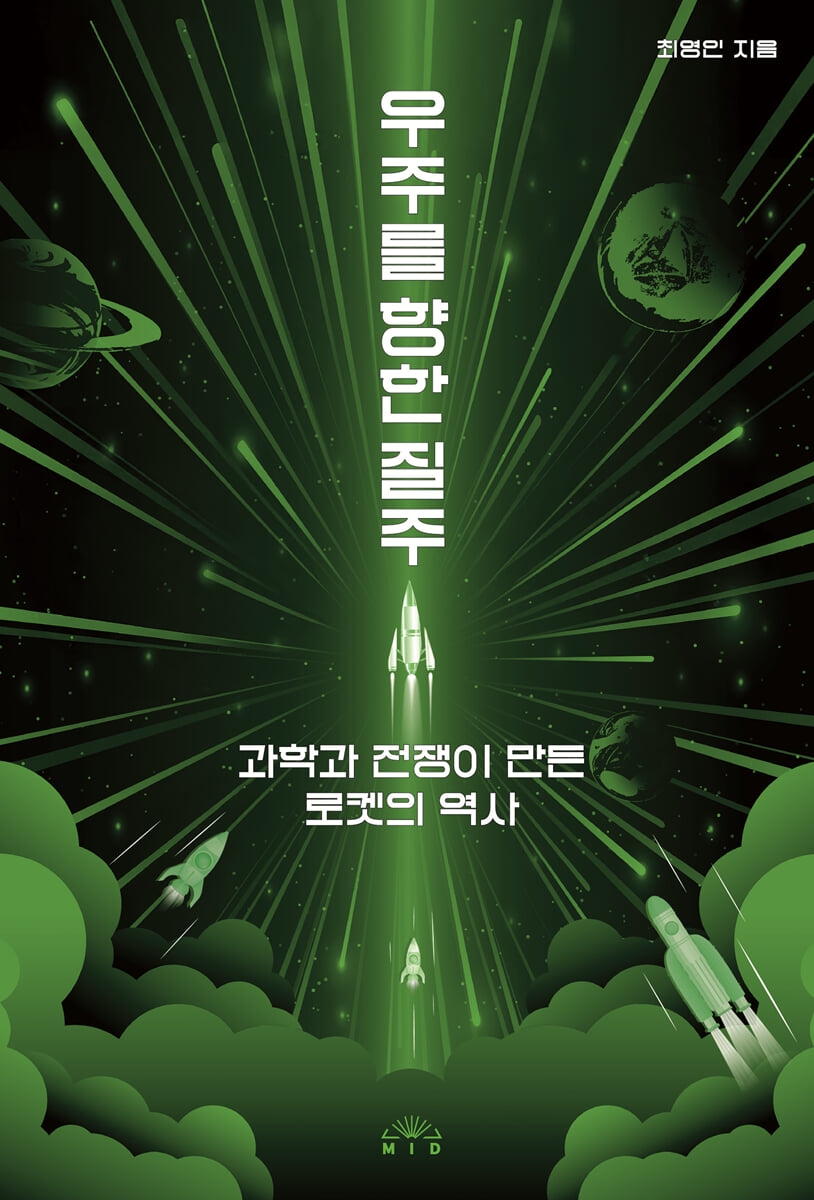
"Running to Space" is an engineering record that contains the technological background and history of how rockets were born and evolved.
The evolution of the ancient gunpowder rockets, the V-2, the Saturn V, the Space Shuttle, and the reusable rockets of private companies is not simply a chronology of events.
The development of rocket technology was shaped by the intertwining of war, politics, scientific research, and industrial necessity, and this book contextualizes how these factors shaped technological choices and the direction of innovation.
Rockets are a complex product of science, engineering, and human will working together to meet the demands of the times.
The author, Choi Young-in, is an engineer who participated in the development of Naro (KSLV-I) and Nuri (KSLV-II), and is someone who experienced firsthand the technical difficulties and on-site challenges in the midst of the process of establishing South Korea's launch vehicle technology.
In the book, he connects his own development journey with the history of global launch vehicle technology, explaining how the technological traditions and design philosophies of each era have developed.
It helps readers gain a three-dimensional view of the structure of launch vehicle technology by explaining, from an engineer's perspective, why certain technologies are chosen, what the testing and verification process means, and why rocketry is such a complex system.
This book organizes the technological lineage from the birth of rockets, through the Cold War competition, the lessons of the Space Shuttle program, and the modern space industry driven by private companies into a single, overarching narrative.
At the same time, as the world enters a new competition centered on reusable rockets, it also calmly examines Korea's position and what preparations are needed going forward.
"The Race to Space" will serve as a solid guide for readers seeking to understand the structure of rocketry, and for those interested in the future of space development, it will serve as a grand map showing the era we are currently living through.
A new era of space development: where should Korea go?
"Running to Space" is an engineering record that contains the technological background and history of how rockets were born and evolved.
The evolution of the ancient gunpowder rockets, the V-2, the Saturn V, the Space Shuttle, and the reusable rockets of private companies is not simply a chronology of events.
The development of rocket technology was shaped by the intertwining of war, politics, scientific research, and industrial necessity, and this book contextualizes how these factors shaped technological choices and the direction of innovation.
Rockets are a complex product of science, engineering, and human will working together to meet the demands of the times.
The author, Choi Young-in, is an engineer who participated in the development of Naro (KSLV-I) and Nuri (KSLV-II), and is someone who experienced firsthand the technical difficulties and on-site challenges in the midst of the process of establishing South Korea's launch vehicle technology.
In the book, he connects his own development journey with the history of global launch vehicle technology, explaining how the technological traditions and design philosophies of each era have developed.
It helps readers gain a three-dimensional view of the structure of launch vehicle technology by explaining, from an engineer's perspective, why certain technologies are chosen, what the testing and verification process means, and why rocketry is such a complex system.
This book organizes the technological lineage from the birth of rockets, through the Cold War competition, the lessons of the Space Shuttle program, and the modern space industry driven by private companies into a single, overarching narrative.
At the same time, as the world enters a new competition centered on reusable rockets, it also calmly examines Korea's position and what preparations are needed going forward.
"The Race to Space" will serve as a solid guide for readers seeking to understand the structure of rocketry, and for those interested in the future of space development, it will serve as a grand map showing the era we are currently living through.
- You can preview some of the book's contents.
Preview
index
prolog
Chapter 1.
What is a rocket?
A history of challenges to fly
The history of the challenge of flying into space
How rockets fly into space
Chapter 2.
German rocket development: A-1, A-2, A-3, A5, and A-4 (V-2)
Germany, which created the V-2 rocket that carried mankind into space for the first time
Transfer Germany's V-2 rocket technology home.
Chapter 3.
The First Space Race: Humanity's First Artificial Satellite
The Soviet Union succeeded in placing the first artificial satellite into Earth's orbit.
America's rocket development had a brilliant start, but eventually fell far behind the Soviet Union.
Chapter 4.
Second Space Race: The first nation to send humans into space
The Soviet Union, which produced the first human being in space
The United States struggles to catch up with the Soviet Union in the space race.
Chapter 5.
The Third Space Race: The First Country to Put a Man on the Moon
The United States, the first country in the world to successfully land a man on the moon
The Soviet Union began a manned lunar landing program but ultimately failed.
Chapter 6.
The Fourth Space Race: Humanity's First Reusable Space Shuttle
The United States, the first country to develop and operate a reusable space shuttle
The Soviet Union developed and even test-launched a reusable space shuttle.
Chapter 7.
The Fifth Space Race: Humanity's First Reusable Rocket
SpaceX, the only company on Earth operating a rocket with a reusable first-stage booster
Private space companies challenging the development of reusable rockets
Epilogue
Chapter 1.
What is a rocket?
A history of challenges to fly
The history of the challenge of flying into space
How rockets fly into space
Chapter 2.
German rocket development: A-1, A-2, A-3, A5, and A-4 (V-2)
Germany, which created the V-2 rocket that carried mankind into space for the first time
Transfer Germany's V-2 rocket technology home.
Chapter 3.
The First Space Race: Humanity's First Artificial Satellite
The Soviet Union succeeded in placing the first artificial satellite into Earth's orbit.
America's rocket development had a brilliant start, but eventually fell far behind the Soviet Union.
Chapter 4.
Second Space Race: The first nation to send humans into space
The Soviet Union, which produced the first human being in space
The United States struggles to catch up with the Soviet Union in the space race.
Chapter 5.
The Third Space Race: The First Country to Put a Man on the Moon
The United States, the first country in the world to successfully land a man on the moon
The Soviet Union began a manned lunar landing program but ultimately failed.
Chapter 6.
The Fourth Space Race: Humanity's First Reusable Space Shuttle
The United States, the first country to develop and operate a reusable space shuttle
The Soviet Union developed and even test-launched a reusable space shuttle.
Chapter 7.
The Fifth Space Race: Humanity's First Reusable Rocket
SpaceX, the only company on Earth operating a rocket with a reusable first-stage booster
Private space companies challenging the development of reusable rockets
Epilogue
Publisher's Review
In an era where rocket launches have become a daily occurrence,
The pace of space development demands new standards.
Nowadays, news of rocket launches is more familiar than ever.
SpaceX's string of reusable flights has become so routine that it's hardly news anymore, and Blue Origin's New Glenn's successful maiden flight has kicked off the race for the largest reusable rocket.
Nuriho is also about to make its fourth flight.
As launch vehicles around the world fly 'more frequently, bigger, and faster,' we live in an era where the pace of space development has noticeably changed.
But behind these frequent launches lies a long history of accumulated technology and traces of complex choices.
Rockets are not simply a technology that increases thrust; they are a system created through decades of design philosophy, accumulated infrastructure, and repeated experimentation and failure.
"Running to Space" is a book that shows the flow of how this system was created.
From the early rockets of the Middle Ages, to the V-2 rocket of World War II, the space race between the United States and the Soviet Union, the Saturn V rocket that led the competition for space supremacy, manned lunar exploration and the space shuttle, and now the reusable era led by SpaceX and Blue Origin.
This book organizes the history of human rocket development within a technological context, focusing on the principles and needs that have shaped its evolution.
Space development is currently in a transitional phase, with multiple axes moving simultaneously: private-sector-led innovation, the emergence of ultra-large reusable rockets, competition in satellite constellations for communications and observation, and the securing of independent launch infrastructure by each country.
In these times, revisiting the history and technical logic of rocket development goes beyond mere study; it provides the framework for thinking necessary to determine future directions.
Korea, too, faces an important choice amidst this changing landscape.
While Nuri and Danuri have begun to build independent capabilities, a leap forward in the space industry requires not only technological development but also a supporting testing infrastructure, a private enterprise ecosystem, and a stable, long-term investment structure.
As the era of reusable rockets begins in earnest, the discussion on the pace and direction Korea should pursue has become even more urgent.
"Running to Space" goes beyond examining the historical lineage and technical principles of rocket technology, providing a foundation for considering what Korea should prepare for during this transitional period.
"Running to Space" is a textbook that helps rocket engineers understand the technology, opens strategic perspectives for those working in the space industry, and provides a standard for general readers to view the space age we are currently living through.
This book helps us understand the layers of history and technological context behind the moment a rocket ascends into the sky.
The pace of space development demands new standards.
Nowadays, news of rocket launches is more familiar than ever.
SpaceX's string of reusable flights has become so routine that it's hardly news anymore, and Blue Origin's New Glenn's successful maiden flight has kicked off the race for the largest reusable rocket.
Nuriho is also about to make its fourth flight.
As launch vehicles around the world fly 'more frequently, bigger, and faster,' we live in an era where the pace of space development has noticeably changed.
But behind these frequent launches lies a long history of accumulated technology and traces of complex choices.
Rockets are not simply a technology that increases thrust; they are a system created through decades of design philosophy, accumulated infrastructure, and repeated experimentation and failure.
"Running to Space" is a book that shows the flow of how this system was created.
From the early rockets of the Middle Ages, to the V-2 rocket of World War II, the space race between the United States and the Soviet Union, the Saturn V rocket that led the competition for space supremacy, manned lunar exploration and the space shuttle, and now the reusable era led by SpaceX and Blue Origin.
This book organizes the history of human rocket development within a technological context, focusing on the principles and needs that have shaped its evolution.
Space development is currently in a transitional phase, with multiple axes moving simultaneously: private-sector-led innovation, the emergence of ultra-large reusable rockets, competition in satellite constellations for communications and observation, and the securing of independent launch infrastructure by each country.
In these times, revisiting the history and technical logic of rocket development goes beyond mere study; it provides the framework for thinking necessary to determine future directions.
Korea, too, faces an important choice amidst this changing landscape.
While Nuri and Danuri have begun to build independent capabilities, a leap forward in the space industry requires not only technological development but also a supporting testing infrastructure, a private enterprise ecosystem, and a stable, long-term investment structure.
As the era of reusable rockets begins in earnest, the discussion on the pace and direction Korea should pursue has become even more urgent.
"Running to Space" goes beyond examining the historical lineage and technical principles of rocket technology, providing a foundation for considering what Korea should prepare for during this transitional period.
"Running to Space" is a textbook that helps rocket engineers understand the technology, opens strategic perspectives for those working in the space industry, and provides a standard for general readers to view the space age we are currently living through.
This book helps us understand the layers of history and technological context behind the moment a rocket ascends into the sky.
GOODS SPECIFICS
- Date of issue: November 25, 2025
- Page count, weight, size: 316 pages | 152*225*30mm
- ISBN13: 9791193828298
- ISBN10: 1193828295
You may also like
카테고리
korean


korean

![GQ KOREA Mark (Monthly): December [2025]](http://librairie.coreenne.fr/cdn/shop/files/8ef265dbbfbf186523ed75ba7319009d.jpg?v=1765340328&width=3840)


