

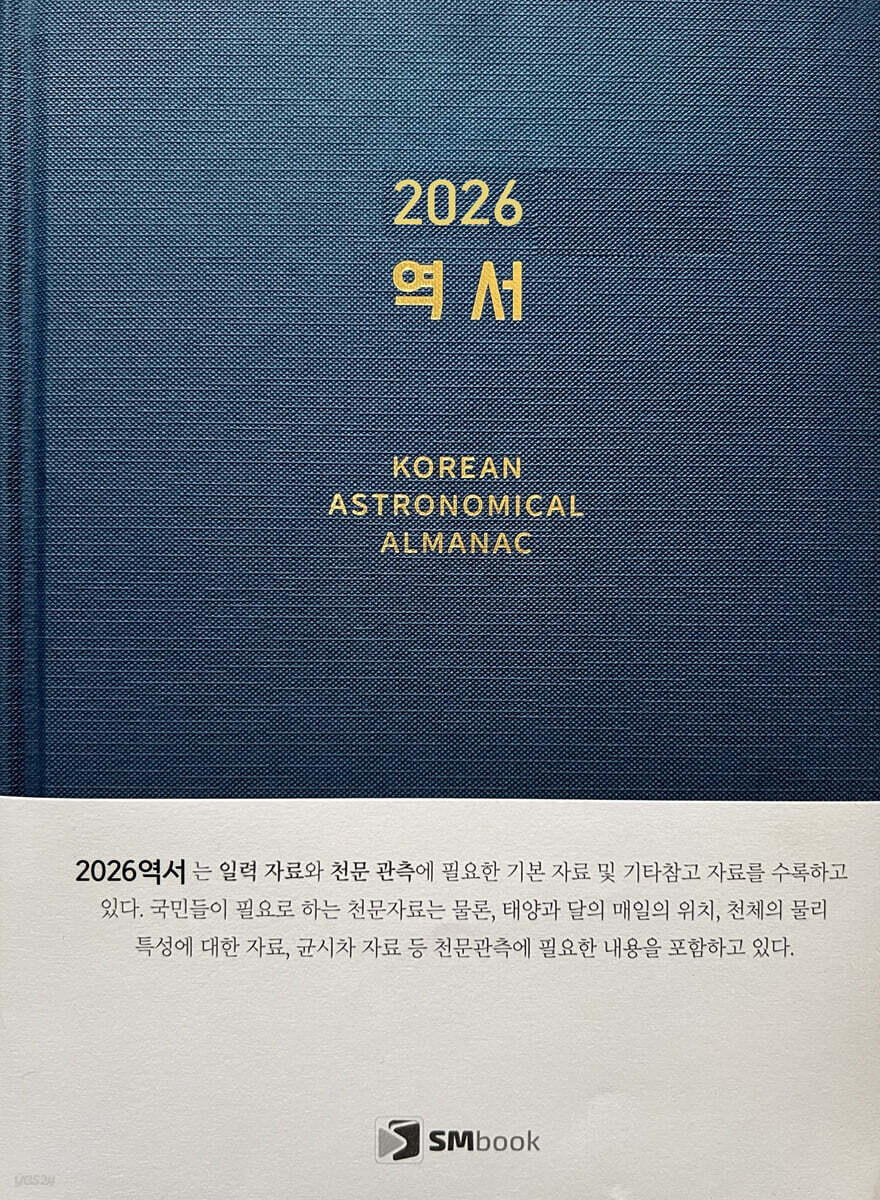
2026 translation
 |
Description
Book Introduction
『Yeokseo』 was published annually by the Gwansanggam during the Joseon Dynasty, and following that tradition, the Korea Astronomy and Space Science Institute published its 46th year of Yeokseo this year.
The positions of the moon, sun, and solar system planets included in the book were calculated using the ephemeris produced and distributed by NASA's Jet Propulsion Laboratory.
And, unless otherwise specified, the times listed in the translation are Korean Standard Time (KST) based on the Korean Standard Meridian (135 degrees east longitude).
The positions of the moon, sun, and solar system planets included in the book were calculated using the ephemeris produced and distributed by NASA's Jet Propulsion Laboratory.
And, unless otherwise specified, the times listed in the translation are Korean Standard Time (KST) based on the Korean Standard Meridian (135 degrees east longitude).
index
1. Calendar data
The solar and lunar rise and set times, meridian times, twilight times, solar altitudes, and azimuths included in the calendar data were calculated based on the coordinates announced by the National Geographic Information Institute of the national control point near Seoul City Hall (37 degrees 33 minutes 58 seconds north latitude, 126 degrees 58 minutes 58 seconds east longitude).
The definition of each item included in the calendar data is as follows.
· Sunrise and sunset times: The times when the uppermost parts of the sun and moon appear and disappear above the horizon, based on the Earth's ellipsoidal altitude of 0 meters.
Days marked with "-- --" for moonrise and moonset times mean that the phenomenon does not occur.
· Day length: This is simply the difference between sunset and sunrise, and may be twice as large as the sunrise/sunset times.
· Ilnamjung and Wolnamjung time: the time when the center of the sun and moon cross the meridian of the area
· Lunar age: The time from the time of the previous new moon to 9 p.m. each day (expressed in days)
· Civil twilight time: the time when the center of the sun is 6 degrees below the horizon
· Navigational and astronomical twilight times: The times when the center of the Sun is 12 and 18 degrees below the horizon, respectively.
(Morning twilight is the time when twilight begins, and evening twilight is the time when twilight ends)
· Solar altitude: the vertical angle between the horizon and the sun
· Solar azimuth: The angle from due north to the sun's projection on the horizon in the east direction
2.
Sunrise and sunset times and twilight times in each region
The location of each region was determined using the coordinates announced by the National Geographic Information Institute of the national control point near the city hall or county office.
3.
time
Time is a fundamental physical quantity that represents the position of a celestial body along with its spatial coordinates.
When indicating the positions of celestial bodies, various time scales are used depending on the purpose or object of observation or calculation.
Below is a brief description of the types of vision commonly used in astronomy.
4.
sun
The solar motion and orbital data were obtained from Astronomical Almanac 2019 C1-C3.
5.
moon
The times of conjunction, first quarter, full moon, and last quarter are the times when the difference in ecliptic longitude between the moon and the sun is 0 degrees, 90 degrees, 180 degrees, and 270 degrees, respectively.
The lunar motion and orbital data were obtained from the Astronomical Almanac 2019 D2.
6.
planet
The position and time of appearance of each planet are recorded at different intervals for each planet: Mercury at 3 days, Venus, Mars, Jupiter, and Saturn at 5 days, and Uranus and Neptune at 10 days.
7.
Periodic comet data
The orbital elements of the periodic comet were obtained from the International Astronomical Union (IAU) Minor Planet Center in July 2018.
(This material is continuously updated.)
8.
sun
J2019.5, the standard used in major star tables, corresponds to July 2.625, 2019, or JD 245 8302.125 days.
9.
Astronomical constants and data
It is an astronomical constant adopted at an international conference.
This is a constant included in the International Astronomical Union (LAU) 2012 astronomical constant system, as defined by the International Astronomical Union Working Group on ‘Numerical Standards in Fundamental Astronomy’ (NSFA, 2011).
The solar and lunar rise and set times, meridian times, twilight times, solar altitudes, and azimuths included in the calendar data were calculated based on the coordinates announced by the National Geographic Information Institute of the national control point near Seoul City Hall (37 degrees 33 minutes 58 seconds north latitude, 126 degrees 58 minutes 58 seconds east longitude).
The definition of each item included in the calendar data is as follows.
· Sunrise and sunset times: The times when the uppermost parts of the sun and moon appear and disappear above the horizon, based on the Earth's ellipsoidal altitude of 0 meters.
Days marked with "-- --" for moonrise and moonset times mean that the phenomenon does not occur.
· Day length: This is simply the difference between sunset and sunrise, and may be twice as large as the sunrise/sunset times.
· Ilnamjung and Wolnamjung time: the time when the center of the sun and moon cross the meridian of the area
· Lunar age: The time from the time of the previous new moon to 9 p.m. each day (expressed in days)
· Civil twilight time: the time when the center of the sun is 6 degrees below the horizon
· Navigational and astronomical twilight times: The times when the center of the Sun is 12 and 18 degrees below the horizon, respectively.
(Morning twilight is the time when twilight begins, and evening twilight is the time when twilight ends)
· Solar altitude: the vertical angle between the horizon and the sun
· Solar azimuth: The angle from due north to the sun's projection on the horizon in the east direction
2.
Sunrise and sunset times and twilight times in each region
The location of each region was determined using the coordinates announced by the National Geographic Information Institute of the national control point near the city hall or county office.
3.
time
Time is a fundamental physical quantity that represents the position of a celestial body along with its spatial coordinates.
When indicating the positions of celestial bodies, various time scales are used depending on the purpose or object of observation or calculation.
Below is a brief description of the types of vision commonly used in astronomy.
4.
sun
The solar motion and orbital data were obtained from Astronomical Almanac 2019 C1-C3.
5.
moon
The times of conjunction, first quarter, full moon, and last quarter are the times when the difference in ecliptic longitude between the moon and the sun is 0 degrees, 90 degrees, 180 degrees, and 270 degrees, respectively.
The lunar motion and orbital data were obtained from the Astronomical Almanac 2019 D2.
6.
planet
The position and time of appearance of each planet are recorded at different intervals for each planet: Mercury at 3 days, Venus, Mars, Jupiter, and Saturn at 5 days, and Uranus and Neptune at 10 days.
7.
Periodic comet data
The orbital elements of the periodic comet were obtained from the International Astronomical Union (IAU) Minor Planet Center in July 2018.
(This material is continuously updated.)
8.
sun
J2019.5, the standard used in major star tables, corresponds to July 2.625, 2019, or JD 245 8302.125 days.
9.
Astronomical constants and data
It is an astronomical constant adopted at an international conference.
This is a constant included in the International Astronomical Union (LAU) 2012 astronomical constant system, as defined by the International Astronomical Union Working Group on ‘Numerical Standards in Fundamental Astronomy’ (NSFA, 2011).
GOODS SPECIFICS
- Date of issue: October 2, 2025
- Format: Hardcover book binding method guide
- Page count, weight, size: 232 pages | 180*250*20mm
- ISBN13: 9791195436552
- ISBN10: 1195436556
You may also like
카테고리
korean


korean

![ELLE 엘르 스페셜 에디션 A형 : 12월 [2025]](http://librairie.coreenne.fr/cdn/shop/files/b8e27a3de6c9538896439686c6b0e8fb.jpg?v=1766436872&width=3840)


