

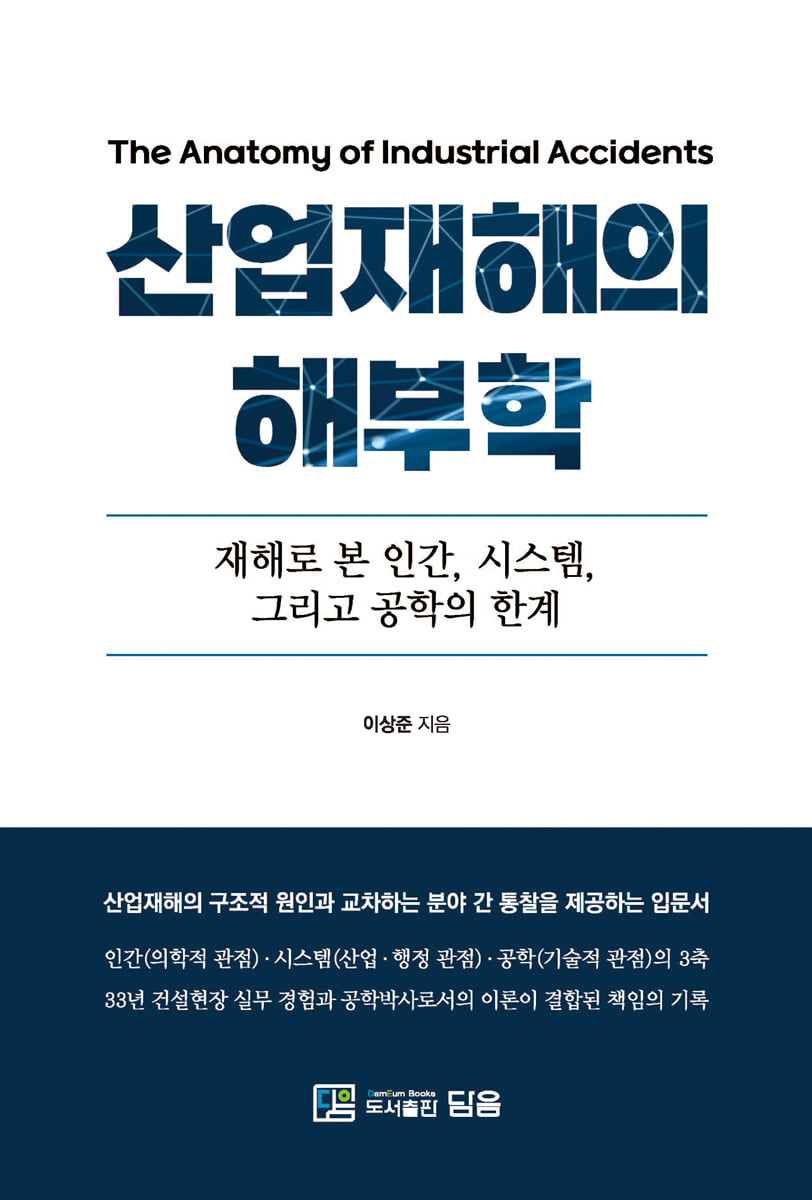
Anatomy of Industrial Accidents
 |
Description
index
01 Invisible Risks: Definitions and Misconceptions of Industrial Accidents
Industrial Accidents Are Not 'Accidents' | Statistics Hide 'Disasters' | Why Are Invisible Risks Dangerous? | Industrial Accidents Are Not an Individual Problem
02 The Truth Beyond the Numbers: What Industrial Accident Statistics Don't Tell You
Unreported disasters | Are low numbers necessarily good? | We need a new standard for reading the numbers | Look where the statistics don't point
03 Industrial Safety: Why Prevention Fails
There are manuals, but they are not applied | Training is formal, supervision is intermittent | Technology advances, but human senses deteriorate | 'It'll be okay' breaks through the system | Five structures where prevention fails | Prevention is a structure, not a technique
04 Voices from the Field: The Pathology of Repeated Mistakes and Habits
Familiarity is forgetting | 'Experienced people' can be more dangerous | Safety is a culture and a language | Mistakes are not 'personal problems' | The gap between 'knowing' and 'doing'
12 Anatomy of Industrial Accidents [Humans, Systems, and the Limitations of Engineering as Seen Through Disasters]
05 Why Humans Make Mistakes: Cognitive Science and Safety Psychology
Humans are designed to make mistakes | There are 'types' of mistakes: Reason's classification of errors | 'Overly familiar tasks' are more dangerous | Humans always choose 'cognitive shortcuts' | Stress, emotions, and mistakes | To reduce mistakes, change the structure, not the human | Conclusion of the dissection: Human errors are the responsibility of the structure
06 Designed Risks: System Errors and Engineering Limitations
Systems breed mistakes | Accidents occur in a chain reaction: The 'Swiss Cheese Model' | Engineering must also be human-centered | Gaps in institutions weaken the system | There is also 'designed neglect' | Anatomy's conclusion: The system harbors failure.
07 Were the Systems Enough?: Structural Blind Spots in Law and Management
The law does not 'exist' but 'works' | Safety 'exists on paper' and 'absent on site' | Responsibility is everywhere and to no one | Administration is focused on 'punishment', while prevention takes a back seat | Why is the Serious Disaster Punishment Act not working as expected? | There is a management system, but there is no 'system' | Conclusion of the dissection: The system is complete, but the structure is collapsed
08 Blind Spots in Health: How Disease Becomes Disaster
Occupational diseases are industrial accidents | Pain exists, but there are no records | Diseases accumulate, management systems are disconnected | Medicine sees disease, but occupational health sees the environment | Women, the elderly, foreigners: increasingly invisible bodies | Anatomy's conclusion: Disease is a silent disaster
09 [Case 1] Construction Site Fall: "Falls Always Speak the Language of Rescue"
Case 2: Toxic Chemical Poisoning: "The levels were normal, so why did they die?"
Case 3: Crane Overturning Accident: "A Process Failure, Not a Moment"
Case 4: Heatstroke and Work Intensity: "Who Calculates Working Hours?"
13 [Case 5] Commuting Disaster: “Who Draws the Lines of Disaster?”
14 The Intersection of Occupational Health and Medicine
Medicine looks at the individual body, while public health looks at the environment | What hospitals don't know: "It's a work-related illness..." | The gap in responsibility surrounding diagnosis | Things not found through physical examinations | Doctors look after an accident, while occupational health looks before the accident | The need for cooperation: Creating a 'diagnosing system' for disasters | The conclusion of anatomy: Disasters are ultimately the 'language of the body'
15 Technologies to Reduce Industrial Accidents vs. Attitudes to Prevent Industrial Accidents
Technology is just a tool; humans are the subject | Technology becomes complex, and people become insensitive | The simplest techniques: speaking, stopping, and checking | Organizations must systematize their 'mind' rather than their technology | Thinking is a failure of respect for people before it is a failure of technology | The conclusion of the dissection: Technology reduces, attitude blocks
14 Anatomy of Industrial Accidents [Humans, Systems, and the Limitations of Engineering as Seen Through Disasters]
Is the Zero Harm Myth Possible? 271
Ideals and Reality: The Intention of Zero Harm is Right | Slogans Can Be Pressure, Not a System | Complete Safety Does Not Exist | A Truly Safe Organization is a 'Confessional Organization' | What We Should Aim for is a 'Safe Error-Tolerant Structure' | Conclusion of the Dissection: Zero Harm Should Be a Question, Not a Goal
17 After the Disaster: Organizational Culture and Accountability 285
Not the End of an Accident, but the Beginning of an Organizational Diagnosis | Does Responsibility Flow Only 'From Top to Bottom'? | Why 'Avoiding Responsibility' Repeats | Reconstructing Organizational Culture: Creating a Questioning Organization | The Memories of Victims Reveal the Ethics of an Organization | The Conclusion of Dissection: The Organization After a Disaster Is Its True Form
Industrial Accidents Are Not 'Accidents' | Statistics Hide 'Disasters' | Why Are Invisible Risks Dangerous? | Industrial Accidents Are Not an Individual Problem
02 The Truth Beyond the Numbers: What Industrial Accident Statistics Don't Tell You
Unreported disasters | Are low numbers necessarily good? | We need a new standard for reading the numbers | Look where the statistics don't point
03 Industrial Safety: Why Prevention Fails
There are manuals, but they are not applied | Training is formal, supervision is intermittent | Technology advances, but human senses deteriorate | 'It'll be okay' breaks through the system | Five structures where prevention fails | Prevention is a structure, not a technique
04 Voices from the Field: The Pathology of Repeated Mistakes and Habits
Familiarity is forgetting | 'Experienced people' can be more dangerous | Safety is a culture and a language | Mistakes are not 'personal problems' | The gap between 'knowing' and 'doing'
12 Anatomy of Industrial Accidents [Humans, Systems, and the Limitations of Engineering as Seen Through Disasters]
05 Why Humans Make Mistakes: Cognitive Science and Safety Psychology
Humans are designed to make mistakes | There are 'types' of mistakes: Reason's classification of errors | 'Overly familiar tasks' are more dangerous | Humans always choose 'cognitive shortcuts' | Stress, emotions, and mistakes | To reduce mistakes, change the structure, not the human | Conclusion of the dissection: Human errors are the responsibility of the structure
06 Designed Risks: System Errors and Engineering Limitations
Systems breed mistakes | Accidents occur in a chain reaction: The 'Swiss Cheese Model' | Engineering must also be human-centered | Gaps in institutions weaken the system | There is also 'designed neglect' | Anatomy's conclusion: The system harbors failure.
07 Were the Systems Enough?: Structural Blind Spots in Law and Management
The law does not 'exist' but 'works' | Safety 'exists on paper' and 'absent on site' | Responsibility is everywhere and to no one | Administration is focused on 'punishment', while prevention takes a back seat | Why is the Serious Disaster Punishment Act not working as expected? | There is a management system, but there is no 'system' | Conclusion of the dissection: The system is complete, but the structure is collapsed
08 Blind Spots in Health: How Disease Becomes Disaster
Occupational diseases are industrial accidents | Pain exists, but there are no records | Diseases accumulate, management systems are disconnected | Medicine sees disease, but occupational health sees the environment | Women, the elderly, foreigners: increasingly invisible bodies | Anatomy's conclusion: Disease is a silent disaster
09 [Case 1] Construction Site Fall: "Falls Always Speak the Language of Rescue"
Case 2: Toxic Chemical Poisoning: "The levels were normal, so why did they die?"
Case 3: Crane Overturning Accident: "A Process Failure, Not a Moment"
Case 4: Heatstroke and Work Intensity: "Who Calculates Working Hours?"
13 [Case 5] Commuting Disaster: “Who Draws the Lines of Disaster?”
14 The Intersection of Occupational Health and Medicine
Medicine looks at the individual body, while public health looks at the environment | What hospitals don't know: "It's a work-related illness..." | The gap in responsibility surrounding diagnosis | Things not found through physical examinations | Doctors look after an accident, while occupational health looks before the accident | The need for cooperation: Creating a 'diagnosing system' for disasters | The conclusion of anatomy: Disasters are ultimately the 'language of the body'
15 Technologies to Reduce Industrial Accidents vs. Attitudes to Prevent Industrial Accidents
Technology is just a tool; humans are the subject | Technology becomes complex, and people become insensitive | The simplest techniques: speaking, stopping, and checking | Organizations must systematize their 'mind' rather than their technology | Thinking is a failure of respect for people before it is a failure of technology | The conclusion of the dissection: Technology reduces, attitude blocks
14 Anatomy of Industrial Accidents [Humans, Systems, and the Limitations of Engineering as Seen Through Disasters]
Is the Zero Harm Myth Possible? 271
Ideals and Reality: The Intention of Zero Harm is Right | Slogans Can Be Pressure, Not a System | Complete Safety Does Not Exist | A Truly Safe Organization is a 'Confessional Organization' | What We Should Aim for is a 'Safe Error-Tolerant Structure' | Conclusion of the Dissection: Zero Harm Should Be a Question, Not a Goal
17 After the Disaster: Organizational Culture and Accountability 285
Not the End of an Accident, but the Beginning of an Organizational Diagnosis | Does Responsibility Flow Only 'From Top to Bottom'? | Why 'Avoiding Responsibility' Repeats | Reconstructing Organizational Culture: Creating a Questioning Organization | The Memories of Victims Reveal the Ethics of an Organization | The Conclusion of Dissection: The Organization After a Disaster Is Its True Form
Publisher's Review
introduction
The art of seeing the person behind the numbers
- Anatomy of industrial accidents
Every year we come across industrial accident statistics.
I nod my head in front of the numbers, “How many people were injured this year?” and “How many fewer people died?” and sometimes feel relieved.
But behind the statistics are people.
It is often forgotten what name stood in the place of the number '1', and what family and life existed behind that name.
This book does not treat industrial accidents as mere misfortune or exceptional events.
Industrial accidents always result from complex failures of people, technology, organizations, and institutions.
It's the accumulation of small, invisible signals and warnings, ignored voices, and repeated structural errors that one day explode into an accident.
And disasters have always been telling us that such a 'process' was the problem.
But we didn't hear, we didn't see.
No, maybe I just ignored it.
I have worked in construction and industrial settings for 33 years.
From team leaders and field managers at Hanwha Engineering & Construction's headquarters to CSOs (Chief Safety Officers) at specialized construction companies and the president of the Construction Safety and Health Council, I have witnessed and responded to disasters in various positions.
In the process, I have prevented countless accidents, and at times, I have felt helpless in the face of disasters that I could not prevent.
But the most painful lesson I learned was this one sentence:
“The disaster was always talking.
“We just didn’t listen.”
This book is an attempt to 'dissect' industrial accidents.
It's not just about analyzing the cause of the accident and repeating the manual.
Through each case, we relentlessly trace why human judgment wavered, where vulnerabilities in system design lay, and how institutions and organizational culture led to the choice of silence.
We want to examine the disaster closely, not just with a technical explanation, but also beyond that, to examine the structures, attitudes, and social indifference that lie beyond it.
This book aims to provide students majoring in industrial safety with the language of the field where life and technology are organically connected, to medical students and industrial health experts, it shows the structure of the connection between the 'body' and the 'environment,' to field managers, it makes them reconsider the context of organization and responsibility, and to ask companies and policymakers who advocate for zero accidents, the question, 'What needs to change?'
So I lowered the language as much as possible.
It contains human stories, memories, and the context of failures rather than jargon and statistics.
I wanted to write a book that engineers and doctors, managers and workers could read and discuss together, using language that would allow them to understand and empathize with each other's perspectives.
The term 'industrial safety' is a very familiar word.
But I hope this book will be an opportunity for readers to discover in those familiar words unfamiliar insights, deep responsibility, and the courage to make sustainable change.
Disasters can be prevented.
But to do that, we must first face what we have not heard and what we have ignored.
Dissecting industrial accidents is not simply recording the past, but redesigning the future.
I hope this book will be the first screw in that design.
The art of seeing the person behind the numbers
- Anatomy of industrial accidents
Every year we come across industrial accident statistics.
I nod my head in front of the numbers, “How many people were injured this year?” and “How many fewer people died?” and sometimes feel relieved.
But behind the statistics are people.
It is often forgotten what name stood in the place of the number '1', and what family and life existed behind that name.
This book does not treat industrial accidents as mere misfortune or exceptional events.
Industrial accidents always result from complex failures of people, technology, organizations, and institutions.
It's the accumulation of small, invisible signals and warnings, ignored voices, and repeated structural errors that one day explode into an accident.
And disasters have always been telling us that such a 'process' was the problem.
But we didn't hear, we didn't see.
No, maybe I just ignored it.
I have worked in construction and industrial settings for 33 years.
From team leaders and field managers at Hanwha Engineering & Construction's headquarters to CSOs (Chief Safety Officers) at specialized construction companies and the president of the Construction Safety and Health Council, I have witnessed and responded to disasters in various positions.
In the process, I have prevented countless accidents, and at times, I have felt helpless in the face of disasters that I could not prevent.
But the most painful lesson I learned was this one sentence:
“The disaster was always talking.
“We just didn’t listen.”
This book is an attempt to 'dissect' industrial accidents.
It's not just about analyzing the cause of the accident and repeating the manual.
Through each case, we relentlessly trace why human judgment wavered, where vulnerabilities in system design lay, and how institutions and organizational culture led to the choice of silence.
We want to examine the disaster closely, not just with a technical explanation, but also beyond that, to examine the structures, attitudes, and social indifference that lie beyond it.
This book aims to provide students majoring in industrial safety with the language of the field where life and technology are organically connected, to medical students and industrial health experts, it shows the structure of the connection between the 'body' and the 'environment,' to field managers, it makes them reconsider the context of organization and responsibility, and to ask companies and policymakers who advocate for zero accidents, the question, 'What needs to change?'
So I lowered the language as much as possible.
It contains human stories, memories, and the context of failures rather than jargon and statistics.
I wanted to write a book that engineers and doctors, managers and workers could read and discuss together, using language that would allow them to understand and empathize with each other's perspectives.
The term 'industrial safety' is a very familiar word.
But I hope this book will be an opportunity for readers to discover in those familiar words unfamiliar insights, deep responsibility, and the courage to make sustainable change.
Disasters can be prevented.
But to do that, we must first face what we have not heard and what we have ignored.
Dissecting industrial accidents is not simply recording the past, but redesigning the future.
I hope this book will be the first screw in that design.
GOODS SPECIFICS
- Date of issue: November 1, 2025
- Page count, weight, size: 308 pages | 152*225*30mm
- ISBN13: 9791199525511
- ISBN10: 1199525510
You may also like
카테고리
korean


korean

![GQ KOREA Mark (Monthly): December [2025]](http://librairie.coreenne.fr/cdn/shop/files/8ef265dbbfbf186523ed75ba7319009d.jpg?v=1765340328&width=3840)


