

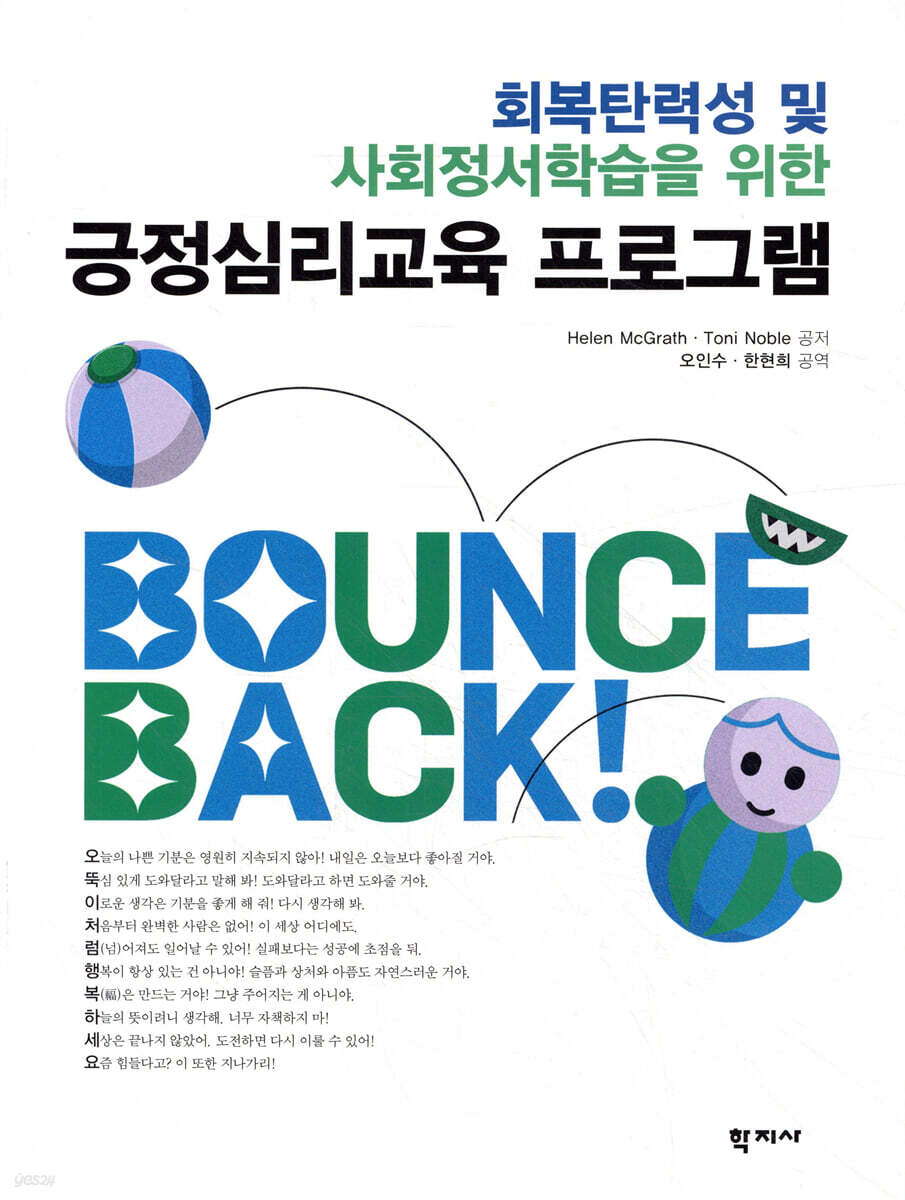
Positive Psychology Education Program
 |
Description
Book Introduction
In the 'Positive Psychology Education Program', you can learn about the Australian 'Bounce Back!' program, famous for KidMatter.
It was difficult to find a high-quality positive psychology education program for improving resilience in Korea, so I came across this program. It is a program that fosters social and emotional competencies across all areas of students' lives, such as resilience, courage, optimism, emotions, relationships, humor, safety, and achievement.
It was difficult to find a high-quality positive psychology education program for improving resilience in Korea, so I came across this program. It is a program that fosters social and emotional competencies across all areas of students' lives, such as resilience, courage, optimism, emotions, relationships, humor, safety, and achievement.
index
Translator's Preface
About the Bounce Back! Program
How to Use Bounce Back!
Handbook
Chapter 1: What is the Bounce Back! Program?
1.
About Bounce Back!
2.
The Birth and History of the Bounce Back! Program
3.
Key Features and Benefits
4.
Expected results
Chapter 2: Bounce Back! Curriculum
1.
Curriculum structure
2.
Unit 1: Core Values/Unit 2: Social Values
3.
Unit 3: Resilience
4.
Unit 4: Courage
5.
Unit 5: Optimism
6.
Unit 6: Emotions
7.
Unit 7: Relationships
8.
Unit 8: Humor
9.
Unit 9: Safety
10.
Unit 10: Achievement
Chapter 3: Well-being and Resilience
1.
What is Student Wellbeing?
2.
What is Teacher Well-being?
3.
What is mental health?
4.
What is mental fitness?
5.
What is resilience?
6.
What is Social Emotional Learning?
7.
Student well-being at the core of education policy
8.
A protection system that promotes student well-being and resilience.
9.
Bounce Back!'s personalized strategy
Chapter 4: Social-Emotional and Coping Skills for Well-Being and Resilience
1.
Major stressors that occur daily
2.
Social-Emotional and Coping Skills: Self-Awareness
3.
Social-Emotional and Coping Skills: Self-Management
4.
Social-Emotional and Coping Skills: Social Cognition
5.
Social-Emotional and Coping Skills: Social Management and Interpersonal Skills
6.
Social-Emotional and Coping Skills: Responsible Decision-Making
Chapter 5: Bounce Back! 10 Coping Principles
1.
Guidelines for guiding the 10 Coping Principles
2.
The core principles of 'Be Happy as a Rock'
3.
How to Use the 10 Coping Principles
4.
Using the 10 Coping Principles of "Be Happy Like a Rock" as Questions
5.
10 Myths and Truths About Resilience
6.
Indicators for identifying students who need referral to a specialist
Chapter 6: Executing and Maintaining Bounce Back!
1.
Bounce Back! in action
2.
Bounce Back! Review
3.
Assessment of degree of change
4.
Exploring Strengths to Update Bounce Back!
5.
Advice for managing difficult situations
Unit Table of Contents
Teaching Strategies and Materials
1.
Circle Time
2.
Safe Class Discussion
3.
How to use literary works
4.
Questions about the 10 coping principles of Bounce Back!
5.
Pair and small group activities
6.
Class meetings and student councils
7.
Effective Teaching Strategies
8.
Cooperative Game: Team League
9.
Classroom learning materials
Unit 1 Core Values
1.
Learning materials
2.
Act honestly
3.
Act fairly
4.
Fairness, Justice, Human Rights
5.
Act responsibly
6.
Behave responsibly towards your pets
7.
It's okay to be different
8.
Unit Summary
9.
Bounce Back! Activity Sheet
Unit 2 Social Values
1.
Learning materials
2.
Kindness and support for others
3.
Cooperation is important
4.
Cooperation to protect our environment
5.
Kindness and acceptance of others
6.
It is important to respect others.
7.
It is important to have self-esteem
8.
Unit Summary
9.
Bounce Back! Activity Sheet
Unit 3 Resilience
1.
Learning materials
2.
Life has its ups and downs, but we can recover.
3.
Today's bad mood won't last forever! Tomorrow will be better than today.
3-1.
Losing a loved one or pet
4.
Just ask for help with determination! If you ask for help, I'll help you.
5.
Positive thoughts make you feel good! Think again.
6.
No one is perfect from the start! Nowhere in this world.
7.
Even if you fall, you can get up! Focus on success rather than failure.
8.
Happiness isn't always there! Sadness, hurt, and pain are also natural.
9.
Fortune is something you make! It's not something that's just given to you.
10.
I think it must be heaven's will.
Don't blame yourself too much
11.
The world is not over.
If you challenge yourself, you can achieve it again
12.
Are you having a hard time these days? This too shall pass.
13.
Unit Summary
14.
Bounce Back! Activity Sheet
Unit 4 Courage
1.
Learning materials
2.
What is courage?
3.
We don't all feel fear or anxiety about the same things.
4.
Courage to do the right thing
5.
Finding your own courage
6.
Who is the hero?
7.
Brave, stupid, or someone who enjoys risk?
8.
Unit Summary
9.
Bounce Back! Activity Sheet
Unit 5 Optimism
1.
Learning materials
2.
Let go of dark thoughts and use bright ones
3.
Use positive trackers
4.
Have hope
5.
Feeling and expressing gratitude
6.
Create your own luck
7.
Unit Summary
8.
Bounce Back! Activity Sheet
Unit 6 Emotions
1.
Learning materials
2.
All emotions, including unpleasant ones, are necessary.
3.
What is this feeling?
4.
Understanding Complex Emotions
5.
Raising positive and happy emotions
6.
Practice mindfulness
7.
Managing tension, anxiety, and stress
8.
Managing Anger
9.
Managing Grief
10.
Managing unpleasant emotions such as jealousy or disappointment
11.
Developing empathy
12.
Unit Summary
13.
Bounce Back! Activity Sheet
Unit 7 Relationships
1.
Learning materials
2.
Getting along well with others
3.
Develop conversation skills
4.
Be a good winner and a good loser
5.
Making friends and maintaining relationships
6.
Share friendship with friends
7.
How to Negotiate Well
8.
Becoming a good leader
9.
Unit Summary
10.
Bounce Back! Activity Sheet
Unit 8 Humor
1.
Learning materials
2.
What is humor? What makes people laugh?
3.
Being able to joke skillfully is a social skill
4.
Positive humor is healthy and enjoyable.
5.
Humor helps you cope better
6.
Humor that ignores others is not allowed.
7.
Unit Summary
8.
Bounce Back! Activity Sheet
Unit 9 Safety
1.
Learning materials
2.
What is bullying?
3.
Spreading rumors can be a form of bullying.
4.
Ignoring is a form of bullying
5.
Bullying while exercising
6.
Bullying and the Law
7.
Who is bullying and who is being targeted?
8.
How to defend yourself from bullying
9.
How can we stop bullying at school?
10.
Become a peer mediator against bullying
11.
Don't give in to peer pressure
12.
Unit Summary
13.
Bounce Back! Activity Sheet
Unit 10 Achievement
1.
Learning materials
2.
Train your brain for growth and think like a winner.
3.
Strengths - What are your strengths?
4.
Character Strengths - What is your best trait?
5.
Immerse yourself
6.
Setting smart goals to help you plan and achieve them
7.
Use your abilities and character strengths to help others.
8.
Interesting mistakes can happen
9.
No effort, no results - challenge yourself.
10.
Organization and self-management to reach goals
11.
Remove obstacles and temptations
12.
Don't Give Up - Use Grit to Overcome Obstacles
13.
Morality and honesty must be the principles.
Otherwise it's not worth it
14.
Sometimes you have to take risks - trust yourself.
15.
Unit Summary
16.
Bounce Back! Activity Sheet
About the Bounce Back! Program
How to Use Bounce Back!
Handbook
Chapter 1: What is the Bounce Back! Program?
1.
About Bounce Back!
2.
The Birth and History of the Bounce Back! Program
3.
Key Features and Benefits
4.
Expected results
Chapter 2: Bounce Back! Curriculum
1.
Curriculum structure
2.
Unit 1: Core Values/Unit 2: Social Values
3.
Unit 3: Resilience
4.
Unit 4: Courage
5.
Unit 5: Optimism
6.
Unit 6: Emotions
7.
Unit 7: Relationships
8.
Unit 8: Humor
9.
Unit 9: Safety
10.
Unit 10: Achievement
Chapter 3: Well-being and Resilience
1.
What is Student Wellbeing?
2.
What is Teacher Well-being?
3.
What is mental health?
4.
What is mental fitness?
5.
What is resilience?
6.
What is Social Emotional Learning?
7.
Student well-being at the core of education policy
8.
A protection system that promotes student well-being and resilience.
9.
Bounce Back!'s personalized strategy
Chapter 4: Social-Emotional and Coping Skills for Well-Being and Resilience
1.
Major stressors that occur daily
2.
Social-Emotional and Coping Skills: Self-Awareness
3.
Social-Emotional and Coping Skills: Self-Management
4.
Social-Emotional and Coping Skills: Social Cognition
5.
Social-Emotional and Coping Skills: Social Management and Interpersonal Skills
6.
Social-Emotional and Coping Skills: Responsible Decision-Making
Chapter 5: Bounce Back! 10 Coping Principles
1.
Guidelines for guiding the 10 Coping Principles
2.
The core principles of 'Be Happy as a Rock'
3.
How to Use the 10 Coping Principles
4.
Using the 10 Coping Principles of "Be Happy Like a Rock" as Questions
5.
10 Myths and Truths About Resilience
6.
Indicators for identifying students who need referral to a specialist
Chapter 6: Executing and Maintaining Bounce Back!
1.
Bounce Back! in action
2.
Bounce Back! Review
3.
Assessment of degree of change
4.
Exploring Strengths to Update Bounce Back!
5.
Advice for managing difficult situations
Unit Table of Contents
Teaching Strategies and Materials
1.
Circle Time
2.
Safe Class Discussion
3.
How to use literary works
4.
Questions about the 10 coping principles of Bounce Back!
5.
Pair and small group activities
6.
Class meetings and student councils
7.
Effective Teaching Strategies
8.
Cooperative Game: Team League
9.
Classroom learning materials
Unit 1 Core Values
1.
Learning materials
2.
Act honestly
3.
Act fairly
4.
Fairness, Justice, Human Rights
5.
Act responsibly
6.
Behave responsibly towards your pets
7.
It's okay to be different
8.
Unit Summary
9.
Bounce Back! Activity Sheet
Unit 2 Social Values
1.
Learning materials
2.
Kindness and support for others
3.
Cooperation is important
4.
Cooperation to protect our environment
5.
Kindness and acceptance of others
6.
It is important to respect others.
7.
It is important to have self-esteem
8.
Unit Summary
9.
Bounce Back! Activity Sheet
Unit 3 Resilience
1.
Learning materials
2.
Life has its ups and downs, but we can recover.
3.
Today's bad mood won't last forever! Tomorrow will be better than today.
3-1.
Losing a loved one or pet
4.
Just ask for help with determination! If you ask for help, I'll help you.
5.
Positive thoughts make you feel good! Think again.
6.
No one is perfect from the start! Nowhere in this world.
7.
Even if you fall, you can get up! Focus on success rather than failure.
8.
Happiness isn't always there! Sadness, hurt, and pain are also natural.
9.
Fortune is something you make! It's not something that's just given to you.
10.
I think it must be heaven's will.
Don't blame yourself too much
11.
The world is not over.
If you challenge yourself, you can achieve it again
12.
Are you having a hard time these days? This too shall pass.
13.
Unit Summary
14.
Bounce Back! Activity Sheet
Unit 4 Courage
1.
Learning materials
2.
What is courage?
3.
We don't all feel fear or anxiety about the same things.
4.
Courage to do the right thing
5.
Finding your own courage
6.
Who is the hero?
7.
Brave, stupid, or someone who enjoys risk?
8.
Unit Summary
9.
Bounce Back! Activity Sheet
Unit 5 Optimism
1.
Learning materials
2.
Let go of dark thoughts and use bright ones
3.
Use positive trackers
4.
Have hope
5.
Feeling and expressing gratitude
6.
Create your own luck
7.
Unit Summary
8.
Bounce Back! Activity Sheet
Unit 6 Emotions
1.
Learning materials
2.
All emotions, including unpleasant ones, are necessary.
3.
What is this feeling?
4.
Understanding Complex Emotions
5.
Raising positive and happy emotions
6.
Practice mindfulness
7.
Managing tension, anxiety, and stress
8.
Managing Anger
9.
Managing Grief
10.
Managing unpleasant emotions such as jealousy or disappointment
11.
Developing empathy
12.
Unit Summary
13.
Bounce Back! Activity Sheet
Unit 7 Relationships
1.
Learning materials
2.
Getting along well with others
3.
Develop conversation skills
4.
Be a good winner and a good loser
5.
Making friends and maintaining relationships
6.
Share friendship with friends
7.
How to Negotiate Well
8.
Becoming a good leader
9.
Unit Summary
10.
Bounce Back! Activity Sheet
Unit 8 Humor
1.
Learning materials
2.
What is humor? What makes people laugh?
3.
Being able to joke skillfully is a social skill
4.
Positive humor is healthy and enjoyable.
5.
Humor helps you cope better
6.
Humor that ignores others is not allowed.
7.
Unit Summary
8.
Bounce Back! Activity Sheet
Unit 9 Safety
1.
Learning materials
2.
What is bullying?
3.
Spreading rumors can be a form of bullying.
4.
Ignoring is a form of bullying
5.
Bullying while exercising
6.
Bullying and the Law
7.
Who is bullying and who is being targeted?
8.
How to defend yourself from bullying
9.
How can we stop bullying at school?
10.
Become a peer mediator against bullying
11.
Don't give in to peer pressure
12.
Unit Summary
13.
Bounce Back! Activity Sheet
Unit 10 Achievement
1.
Learning materials
2.
Train your brain for growth and think like a winner.
3.
Strengths - What are your strengths?
4.
Character Strengths - What is your best trait?
5.
Immerse yourself
6.
Setting smart goals to help you plan and achieve them
7.
Use your abilities and character strengths to help others.
8.
Interesting mistakes can happen
9.
No effort, no results - challenge yourself.
10.
Organization and self-management to reach goals
11.
Remove obstacles and temptations
12.
Don't Give Up - Use Grit to Overcome Obstacles
13.
Morality and honesty must be the principles.
Otherwise it's not worth it
14.
Sometimes you have to take risks - trust yourself.
15.
Unit Summary
16.
Bounce Back! Activity Sheet
Publisher's Review
How can we increase the happiness of individuals facing adversity? The academic challenge of addressing this question gave rise to positive psychology, which expanded into the study of concepts like resilience.
Over the past 25 years, positive psychology has developed and expanded theoretically, producing various academic achievements.
Unfortunately, however, it was difficult to find a high-quality positive psychology education program to improve resilience in Korea.
While searching for a good positive psychology program, I came across the Australian program 'Bounce Back!', famous for KidsMatter.
Translating the theoretical portion of this program convinced me that 'Bounce Back!' is a rare and useful program based on solid theory.
In particular, it was judged to have high potential for future use as it combined elements of social-emotional learning (SEL), which has recently been gaining increasing attention, with positive psychology education.
Additionally, the 'Bounce Back!' program is a program that fosters social-emotional competencies across all areas of students' lives, such as courage, optimism, emotions, relationships, humor, safety, and achievement, in addition to the aforementioned resilience.
So, I thought that this program was even more necessary for Korean students whose happiness levels have hit rock bottom.
We hope that students who learn this program will develop resilience and develop internal mechanisms that generate happiness even in the face of various adversities.
Over the past 25 years, positive psychology has developed and expanded theoretically, producing various academic achievements.
Unfortunately, however, it was difficult to find a high-quality positive psychology education program to improve resilience in Korea.
While searching for a good positive psychology program, I came across the Australian program 'Bounce Back!', famous for KidsMatter.
Translating the theoretical portion of this program convinced me that 'Bounce Back!' is a rare and useful program based on solid theory.
In particular, it was judged to have high potential for future use as it combined elements of social-emotional learning (SEL), which has recently been gaining increasing attention, with positive psychology education.
Additionally, the 'Bounce Back!' program is a program that fosters social-emotional competencies across all areas of students' lives, such as courage, optimism, emotions, relationships, humor, safety, and achievement, in addition to the aforementioned resilience.
So, I thought that this program was even more necessary for Korean students whose happiness levels have hit rock bottom.
We hope that students who learn this program will develop resilience and develop internal mechanisms that generate happiness even in the face of various adversities.
GOODS SPECIFICS
- Date of issue: August 30, 2024
- Format: Paperback book binding method guide
- Page count, weight, size: 640 pages | 210*280*27mm
- ISBN13: 9788999731549
You may also like
카테고리
korean


korean

![GQ KOREA Mark (Monthly): December [2025]](http://librairie.coreenne.fr/cdn/shop/files/8ef265dbbfbf186523ed75ba7319009d.jpg?v=1765340328&width=3840)


