

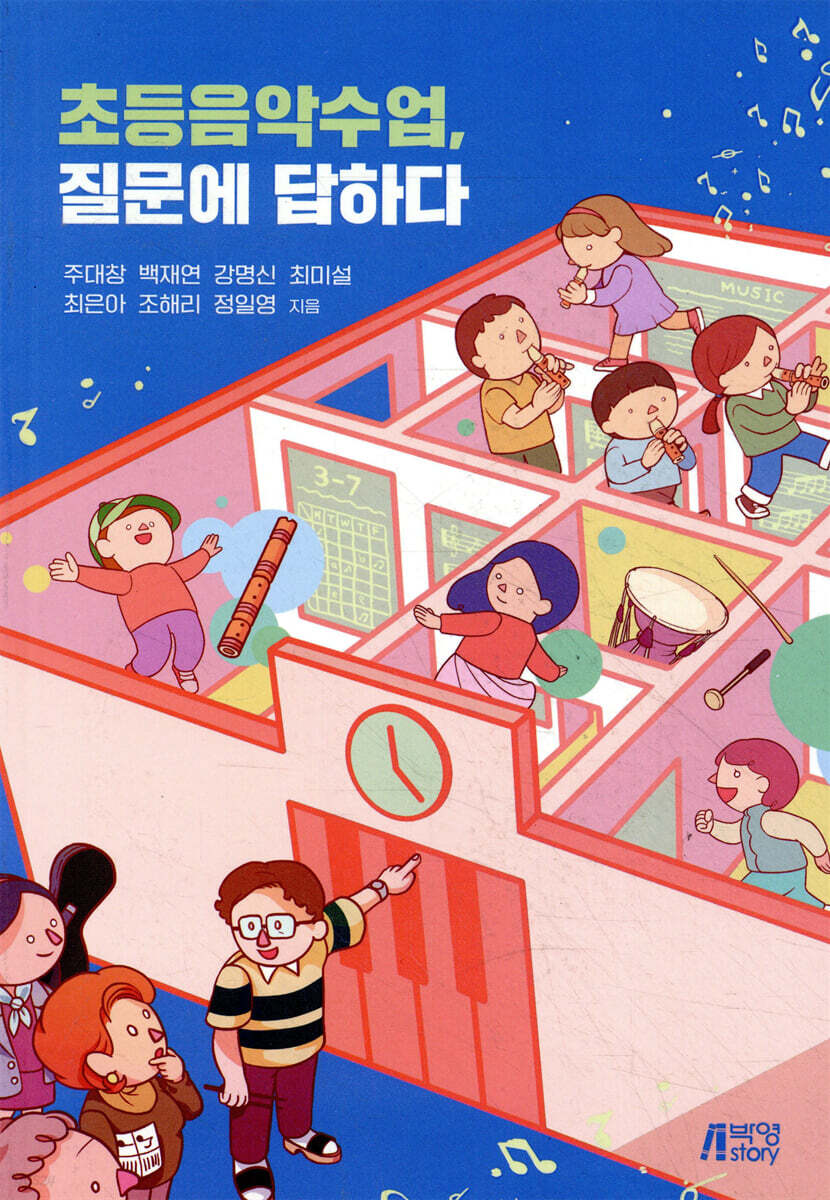
Elementary Music Class: Answering Questions
 |
Description
index
Opening remarks i
Writing Intention iii
Ⅰ Singing Lessons Anyone Can Enjoy 001
01 Why should we teach singing? 004
02 Singing Lessons: What Should I Do? 007
03 Singing Lessons: Try This! 018
Ⅱ Easy and Fun Instrument Playing Lesson 033
01 Why Learn to Play a Musical Instrument? 037
02 How should I take a musical instrument lesson? 039
03 How to Play an Instrument Lesson: Try It This Way! 048
Ⅲ Creative Class: Cooking Delicious Music 071
01 Why Should We Learn Music Creation? 075
02 Music Creation Class: What Should I Do? 078
03 Music Creation Class: Try This! 086
Ⅳ Music Appreciation Class with Activities 113
01 Why Should We Learn Music Appreciation? 116
02 Music Appreciation Lessons: What Should I Do? 119
03 Music Appreciation Lessons: Try This! 125
V Music Lifestyle Lesson 145 Discovered by Students
01 Why should we incorporate music into our daily lives? 148
02 How should I incorporate music into my daily life? 151
03 Music Lifestyle Lesson: Try It This Way! 155
Ⅵ Traditional Korean Music Class: Developing the Style and Taste of Our Music 165
01 Why Should We Learn Korean Traditional Music? 170
02 How should I teach Korean traditional music? 172
03 Korean Traditional Music Class: Try This! 190
Writing Intention iii
Ⅰ Singing Lessons Anyone Can Enjoy 001
01 Why should we teach singing? 004
02 Singing Lessons: What Should I Do? 007
03 Singing Lessons: Try This! 018
Ⅱ Easy and Fun Instrument Playing Lesson 033
01 Why Learn to Play a Musical Instrument? 037
02 How should I take a musical instrument lesson? 039
03 How to Play an Instrument Lesson: Try It This Way! 048
Ⅲ Creative Class: Cooking Delicious Music 071
01 Why Should We Learn Music Creation? 075
02 Music Creation Class: What Should I Do? 078
03 Music Creation Class: Try This! 086
Ⅳ Music Appreciation Class with Activities 113
01 Why Should We Learn Music Appreciation? 116
02 Music Appreciation Lessons: What Should I Do? 119
03 Music Appreciation Lessons: Try This! 125
V Music Lifestyle Lesson 145 Discovered by Students
01 Why should we incorporate music into our daily lives? 148
02 How should I incorporate music into my daily life? 151
03 Music Lifestyle Lesson: Try It This Way! 155
Ⅵ Traditional Korean Music Class: Developing the Style and Taste of Our Music 165
01 Why Should We Learn Korean Traditional Music? 170
02 How should I teach Korean traditional music? 172
03 Korean Traditional Music Class: Try This! 190
Publisher's Review
Opening remarks
This book began by listening to the concerns and questions of teachers who teach music in elementary schools.
The authors have been collecting questions from teachers who struggle with music lessons, and have been working to find answers, resulting in a small book.
The direction the authors pursued while writing the book is contained in the following 'VISION'.
▣ (Variety) Acknowledge the diversity of the world's sounds, traditional Korean music, and music from various countries, and understand the world's diverse cultures with an open attitude.
▣ (Integration) Expand your perspective on music by discovering the humanities, social sciences, and natural sciences characteristics of music, and effectively integrate music education.
▣ (Step by step) In addition to the basic tasks of collecting, analyzing, and classifying various information and data, a music lesson process is presented step by step.
▣ (Interesting) Music classes are designed to allow students to explore topics of interest on their own and express their thoughts and feelings freely and enjoyably.
▣ (Open mind) Activity-based learning that uses music to express and empathize with thoughts and feelings, and to accept and cooperate with each other's differences.
▣ (Neo-value) Cultivating an attitude to recognize changing values, learn independently, enjoy music in daily life, and contribute to the community.
Based on this VISION, this book introduces why and how to teach in each area of singing, playing an instrument, creating music, appreciating music, and incorporating music into daily life, and presents various teaching examples utilizing teaching strategies for each area.
In addition, Korean traditional music has been organized in a separate chapter to discuss the above-mentioned topics in each area of expression, appreciation, and everyday life, and to ensure that the know-how on teaching elements unique to Korean traditional music is well implemented.
While no single book can answer all your questions, I hope this book will serve as a guide for teachers as they work together to find answers and present a vision for music instruction.
Lastly, I would like to express my sincere gratitude to everyone at PYMATE Co., Ltd. who supported the publication of this book.
Writing intention
0 Composition Principle
We'll answer your 'Questions and Answers' about music lessons!
To deliver the music education that modern society expects from school music education, music teachers need to continually develop and share creative teaching ideas.
This book presents such efforts in a 'question and answer' format.
We've gathered together some common and serious questions that arise in elementary music classes and attempted to solve them.
In this work, the authors established three main principles:
First, "find content that's compelling enough to motivate students." If the music textbook content itself appeals to students, the burden of structuring the lesson will be reduced.
Of course, there may be some topics that must be covered in music class, regardless of the student's interest.
In this case, the visual, narrative, and material elements included in the textbook must be processed to somehow increase the interest of the learning activity.
In other words, you should first look for something in the music you will use as material that will pique students' curiosity, and if that is not possible, you should look for it in other elements of the class structure and reflect it.
Second, “We focus on the use of music rather than the delivery of music.” To this end, we tried to increase the sense of actual use of music in each unit of learning activity.
The approach of appropriately applying what is learned during the time spent learning music provides the momentum for students to further deepen and creatively transform their learning.
Of course, in music education, there are cases where it is unavoidable to divide the learning content into several classes and attempt a step-by-step approach.
But just as even the smallest parts play their role when incorporated into the overall finished product, we must strive to place any musical content within the overall universe of musical application.
Third, “organically weave together the map contents to form a lesson plot.” This way, the structure of the learning topic, unit, or lesson will take on the form of a complete entity based on the learning objectives.
This is a practical approach that takes into account the promotion of music utilization discussed earlier.
The more the 'partial details' that must be learned and the 'overall meaning' they create are interconnected as a single organism, the greater the student's creative potential.
Learning activities need to come together to form a single storyline so that students can relate to the context of the music lesson.
In other words, try to structure your music lessons like music.
1 singing
Sing happily and express your feelings freely
Singing can be the easiest activity for some people and the most difficult for others.
Because everyone has their own instrument, their voice, that they can play, but it cannot be controlled as they wish.
Singing these songs is a central activity in music classes, and neither teachers nor students who find singing difficult can avoid it.
These days, the sound sources for popular songs are well-made, making it easier for teachers to teach singing lessons than before. However, I believe that singing lessons can be much more effective if teachers actively sing along with their students and teach them in various ways.
This book presents a method for students to sing while expressing their feelings about a given song, regardless of whether they are good or bad at singing, and it also presents methods for vocal practice, choir practice, and ways to exchange feedback between teachers and students or students themselves.
These methods are not only helpful for teachers when guiding students, but can also be applied to teachers themselves when singing.
Teachers who have had difficulty teaching or teaching singing will hopefully gain a deeper understanding of singing through this book and apply various methods to teach their students, creating effective and fun lessons.
2 Instrumental
A musical instrument journey with various musical activities in different colors!
The easy and fun instrument playing class began with the question of how to make ensemble playing fun for children in schools.
I became interested in music education and systematically studied the Orff method of music teaching. What I felt was that while learning while having fun, we created wonderful music together. I gained satisfaction from the process of creating music rather than the result, and I was even able to feel the joy of performing.
The process of adding instruments one by one and playing together through easy and simple melodies and rhythms allows you to feel the richness and harmony of music.
Also, the moment when wonderful music is completed through playing an instrument, body movement (rhythm), and singing comes with a sense of satisfaction.
Learning ensemble music through rhythm, body movement, and instrumental performance in school classes, along with simple games that children enjoy, will be a special and unforgettable musical experience for students.
I think it's the percussion instruments that are easy to hit but produce such a wonderful sound that make them easy to learn and play.
A simple rhythm that anyone can easily play creates a wonderful ensemble the moment they play together.
This book introduces not only instrumental education but also methods for performing in an integrated ensemble.
We hope you will begin playing instruments in the classroom with a variety of fun percussion and melodic instruments that you may not have heard of often in traditional schools.
3 Creation
Music composition classes aren't difficult anymore!
When people think of music creation, they often picture genius composers like Mozart or Beethoven writing down the ideas they had in their heads on sheet music and performing them in a concert hall.
Perhaps that's why creating music can feel more distant and difficult for us than other musical activities like singing, playing instruments, and appreciating music.
Music creation is a very important part of music education because it is a comprehensive musical experience that involves acquiring various musical concepts and utilizing them to create and express new ideas.
However, isn't the reason why music creation classes aren't actively conducted in schools because both teachers and students find music creation activities too difficult?
The content of this chapter started with the question, “How can we make creative classes enjoyable for everyone?”
Empathizing with the challenges teachers and students may face, we have presented several strategies that can be applied at each stage of the lesson, along with examples of lessons utilizing these strategies.
We have tried to incorporate various forms of music creation classes, from individual creation and group creation, to classes that link concepts, and music creation activities that utilize free thinking and various methods of expression.
Additionally, we introduce applications or programs that assist in music creation and provide guidance on how to apply them in class.
I hope this chapter will empower teachers to confidently take on the challenge of creating new and enjoyable music classes.
4. Appreciation
For a lively music appreciation class where students actively participate!
Music is an auditory art, so improving your listening skills is the foundation for all activities. But how can you improve your listening skills? All learning begins with an active attitude. How can we encourage students to actively listen to music? How can we make music appreciation classes more vibrant and engaging?
In this chapter, we begin with these questions and explore strategies for students to actively participate in music appreciation classes, and we provide examples of lesson plans that apply these strategies.
The lesson plans presented here are merely examples, and many new lesson plans can be created by applying various strategies.
I hope this chapter can serve as a primer for designing music appreciation lessons tailored to the circumstances and context of your classroom.
And above all, I hope that through active and vibrant music appreciation classes, students' senses and musical sensibilities will be further enlivened, that such sensibilities will be connected to their sensitivity to humanity and the world, and that a foundation will be laid for experiencing beauty and making their surroundings beautiful.
5. Lifestyle
Would you like to take a music class that starts from the students' lives?
What would life be like without music? Let's imagine for a moment.
Life and music, the seeds of music education for everyday life are contained within them.
Music is already a part of students' lives.
Through music education, we hope to help students develop positive values about music and ultimately grow into active music lovers.
Bringing music into everyday life is an important approach that is directly related to the purpose of music education.
Teachers in the field say that even if they teach classes centered on everyday life, they sometimes feel that classes and students' lives are separate, and that classes and life are not properly connected.
He also says that he is concerned about whether there are other ways to incorporate music into daily life besides recitals and school performances, and if so, what kind of flow and strategy should be utilized.
'Students Discover Music in Their Lives' is a class that deals with music that students discover in their lives in an open atmosphere.
This is a student-led class and provides an opportunity to connect music to the 'school in society' context, a topic that has not been well addressed in schools.
Music that originates from students' lives can be easily incorporated into students' lives through music education classes.
I hope that the lesson flow, teaching strategies, and teaching examples presented in this book will be helpful to teachers who are unsure of how to implement music-inspired classes.
6 Korean traditional music
Let’s unfold a new Korean traditional music class with the spirit of learning from the past!
For successful Korean traditional music education, there must first be a clear educational goal regarding the necessity of traditional music education and a demand for a change in perception of traditional music.
And the direction that Korean traditional music education should take and the tasks that should be pursued to achieve this direction can only be achieved when supported by educational content, educational methods, and educational evaluation.
To achieve this, there must be a balanced approach of systematic presentation of content that enhances students' understanding, effective teaching methods through diverse and engaging activities, and assessments that provide helpful feedback to students.
However, these aspects are not well taken into account in the current Korean traditional music education in elementary schools, and there is a lack of books or research that introduces specific content on this topic.
Educational activities that appropriately address the goals, content, methods, and evaluation of Korean traditional music education can enhance musical understanding and enhance students' expressiveness and creativity in on-site classes.
Korean traditional music has a unique musical culture that is distinct from Western music, so it is important to learn basic concepts related to it.
Therefore, the breathing method of rhythm, the tori of folk songs, the sigimsae, and instruments such as the danso and janggu must be different from the teaching methods of Western instruments.
Additionally, elements such as the rhythm of the music during the learning process and the learning elements in appreciating Korean traditional music are different from the teaching contents of Western music.
The search for new methods in Korean traditional music education is based on restructuring the educational content and methods so that learners can learn holistically to solve problems in the teaching and learning process for understanding Korean traditional music.
Activities should be based on opportunities for learners to engage in musical experiences that allow them to understand new ideas and their relationships in problem-solving situations.
This book presents systematic educational content and innovative methods that are distinct from existing educational content and methods, but are organized into new teaching strategies that can be applied to actual classes in schools.
We have ensured that the teaching content covers all areas of Korean traditional music education, including expression, appreciation, and practical application, while also allowing for an easy, fun, and step-by-step approach.
In each area, we have organized the overall flow of the class along with educational content that can be used in class, and presented specific teaching methods.
The class was designed to showcase six teaching elements: musical instruments (janggu), rhythms, folk songs, appreciation, creation, and fusion (song, dance, music). A teaching method utilizing an app for non-face-to-face classes was also introduced.
This book began by listening to the concerns and questions of teachers who teach music in elementary schools.
The authors have been collecting questions from teachers who struggle with music lessons, and have been working to find answers, resulting in a small book.
The direction the authors pursued while writing the book is contained in the following 'VISION'.
▣ (Variety) Acknowledge the diversity of the world's sounds, traditional Korean music, and music from various countries, and understand the world's diverse cultures with an open attitude.
▣ (Integration) Expand your perspective on music by discovering the humanities, social sciences, and natural sciences characteristics of music, and effectively integrate music education.
▣ (Step by step) In addition to the basic tasks of collecting, analyzing, and classifying various information and data, a music lesson process is presented step by step.
▣ (Interesting) Music classes are designed to allow students to explore topics of interest on their own and express their thoughts and feelings freely and enjoyably.
▣ (Open mind) Activity-based learning that uses music to express and empathize with thoughts and feelings, and to accept and cooperate with each other's differences.
▣ (Neo-value) Cultivating an attitude to recognize changing values, learn independently, enjoy music in daily life, and contribute to the community.
Based on this VISION, this book introduces why and how to teach in each area of singing, playing an instrument, creating music, appreciating music, and incorporating music into daily life, and presents various teaching examples utilizing teaching strategies for each area.
In addition, Korean traditional music has been organized in a separate chapter to discuss the above-mentioned topics in each area of expression, appreciation, and everyday life, and to ensure that the know-how on teaching elements unique to Korean traditional music is well implemented.
While no single book can answer all your questions, I hope this book will serve as a guide for teachers as they work together to find answers and present a vision for music instruction.
Lastly, I would like to express my sincere gratitude to everyone at PYMATE Co., Ltd. who supported the publication of this book.
Writing intention
0 Composition Principle
We'll answer your 'Questions and Answers' about music lessons!
To deliver the music education that modern society expects from school music education, music teachers need to continually develop and share creative teaching ideas.
This book presents such efforts in a 'question and answer' format.
We've gathered together some common and serious questions that arise in elementary music classes and attempted to solve them.
In this work, the authors established three main principles:
First, "find content that's compelling enough to motivate students." If the music textbook content itself appeals to students, the burden of structuring the lesson will be reduced.
Of course, there may be some topics that must be covered in music class, regardless of the student's interest.
In this case, the visual, narrative, and material elements included in the textbook must be processed to somehow increase the interest of the learning activity.
In other words, you should first look for something in the music you will use as material that will pique students' curiosity, and if that is not possible, you should look for it in other elements of the class structure and reflect it.
Second, “We focus on the use of music rather than the delivery of music.” To this end, we tried to increase the sense of actual use of music in each unit of learning activity.
The approach of appropriately applying what is learned during the time spent learning music provides the momentum for students to further deepen and creatively transform their learning.
Of course, in music education, there are cases where it is unavoidable to divide the learning content into several classes and attempt a step-by-step approach.
But just as even the smallest parts play their role when incorporated into the overall finished product, we must strive to place any musical content within the overall universe of musical application.
Third, “organically weave together the map contents to form a lesson plot.” This way, the structure of the learning topic, unit, or lesson will take on the form of a complete entity based on the learning objectives.
This is a practical approach that takes into account the promotion of music utilization discussed earlier.
The more the 'partial details' that must be learned and the 'overall meaning' they create are interconnected as a single organism, the greater the student's creative potential.
Learning activities need to come together to form a single storyline so that students can relate to the context of the music lesson.
In other words, try to structure your music lessons like music.
1 singing
Sing happily and express your feelings freely
Singing can be the easiest activity for some people and the most difficult for others.
Because everyone has their own instrument, their voice, that they can play, but it cannot be controlled as they wish.
Singing these songs is a central activity in music classes, and neither teachers nor students who find singing difficult can avoid it.
These days, the sound sources for popular songs are well-made, making it easier for teachers to teach singing lessons than before. However, I believe that singing lessons can be much more effective if teachers actively sing along with their students and teach them in various ways.
This book presents a method for students to sing while expressing their feelings about a given song, regardless of whether they are good or bad at singing, and it also presents methods for vocal practice, choir practice, and ways to exchange feedback between teachers and students or students themselves.
These methods are not only helpful for teachers when guiding students, but can also be applied to teachers themselves when singing.
Teachers who have had difficulty teaching or teaching singing will hopefully gain a deeper understanding of singing through this book and apply various methods to teach their students, creating effective and fun lessons.
2 Instrumental
A musical instrument journey with various musical activities in different colors!
The easy and fun instrument playing class began with the question of how to make ensemble playing fun for children in schools.
I became interested in music education and systematically studied the Orff method of music teaching. What I felt was that while learning while having fun, we created wonderful music together. I gained satisfaction from the process of creating music rather than the result, and I was even able to feel the joy of performing.
The process of adding instruments one by one and playing together through easy and simple melodies and rhythms allows you to feel the richness and harmony of music.
Also, the moment when wonderful music is completed through playing an instrument, body movement (rhythm), and singing comes with a sense of satisfaction.
Learning ensemble music through rhythm, body movement, and instrumental performance in school classes, along with simple games that children enjoy, will be a special and unforgettable musical experience for students.
I think it's the percussion instruments that are easy to hit but produce such a wonderful sound that make them easy to learn and play.
A simple rhythm that anyone can easily play creates a wonderful ensemble the moment they play together.
This book introduces not only instrumental education but also methods for performing in an integrated ensemble.
We hope you will begin playing instruments in the classroom with a variety of fun percussion and melodic instruments that you may not have heard of often in traditional schools.
3 Creation
Music composition classes aren't difficult anymore!
When people think of music creation, they often picture genius composers like Mozart or Beethoven writing down the ideas they had in their heads on sheet music and performing them in a concert hall.
Perhaps that's why creating music can feel more distant and difficult for us than other musical activities like singing, playing instruments, and appreciating music.
Music creation is a very important part of music education because it is a comprehensive musical experience that involves acquiring various musical concepts and utilizing them to create and express new ideas.
However, isn't the reason why music creation classes aren't actively conducted in schools because both teachers and students find music creation activities too difficult?
The content of this chapter started with the question, “How can we make creative classes enjoyable for everyone?”
Empathizing with the challenges teachers and students may face, we have presented several strategies that can be applied at each stage of the lesson, along with examples of lessons utilizing these strategies.
We have tried to incorporate various forms of music creation classes, from individual creation and group creation, to classes that link concepts, and music creation activities that utilize free thinking and various methods of expression.
Additionally, we introduce applications or programs that assist in music creation and provide guidance on how to apply them in class.
I hope this chapter will empower teachers to confidently take on the challenge of creating new and enjoyable music classes.
4. Appreciation
For a lively music appreciation class where students actively participate!
Music is an auditory art, so improving your listening skills is the foundation for all activities. But how can you improve your listening skills? All learning begins with an active attitude. How can we encourage students to actively listen to music? How can we make music appreciation classes more vibrant and engaging?
In this chapter, we begin with these questions and explore strategies for students to actively participate in music appreciation classes, and we provide examples of lesson plans that apply these strategies.
The lesson plans presented here are merely examples, and many new lesson plans can be created by applying various strategies.
I hope this chapter can serve as a primer for designing music appreciation lessons tailored to the circumstances and context of your classroom.
And above all, I hope that through active and vibrant music appreciation classes, students' senses and musical sensibilities will be further enlivened, that such sensibilities will be connected to their sensitivity to humanity and the world, and that a foundation will be laid for experiencing beauty and making their surroundings beautiful.
5. Lifestyle
Would you like to take a music class that starts from the students' lives?
What would life be like without music? Let's imagine for a moment.
Life and music, the seeds of music education for everyday life are contained within them.
Music is already a part of students' lives.
Through music education, we hope to help students develop positive values about music and ultimately grow into active music lovers.
Bringing music into everyday life is an important approach that is directly related to the purpose of music education.
Teachers in the field say that even if they teach classes centered on everyday life, they sometimes feel that classes and students' lives are separate, and that classes and life are not properly connected.
He also says that he is concerned about whether there are other ways to incorporate music into daily life besides recitals and school performances, and if so, what kind of flow and strategy should be utilized.
'Students Discover Music in Their Lives' is a class that deals with music that students discover in their lives in an open atmosphere.
This is a student-led class and provides an opportunity to connect music to the 'school in society' context, a topic that has not been well addressed in schools.
Music that originates from students' lives can be easily incorporated into students' lives through music education classes.
I hope that the lesson flow, teaching strategies, and teaching examples presented in this book will be helpful to teachers who are unsure of how to implement music-inspired classes.
6 Korean traditional music
Let’s unfold a new Korean traditional music class with the spirit of learning from the past!
For successful Korean traditional music education, there must first be a clear educational goal regarding the necessity of traditional music education and a demand for a change in perception of traditional music.
And the direction that Korean traditional music education should take and the tasks that should be pursued to achieve this direction can only be achieved when supported by educational content, educational methods, and educational evaluation.
To achieve this, there must be a balanced approach of systematic presentation of content that enhances students' understanding, effective teaching methods through diverse and engaging activities, and assessments that provide helpful feedback to students.
However, these aspects are not well taken into account in the current Korean traditional music education in elementary schools, and there is a lack of books or research that introduces specific content on this topic.
Educational activities that appropriately address the goals, content, methods, and evaluation of Korean traditional music education can enhance musical understanding and enhance students' expressiveness and creativity in on-site classes.
Korean traditional music has a unique musical culture that is distinct from Western music, so it is important to learn basic concepts related to it.
Therefore, the breathing method of rhythm, the tori of folk songs, the sigimsae, and instruments such as the danso and janggu must be different from the teaching methods of Western instruments.
Additionally, elements such as the rhythm of the music during the learning process and the learning elements in appreciating Korean traditional music are different from the teaching contents of Western music.
The search for new methods in Korean traditional music education is based on restructuring the educational content and methods so that learners can learn holistically to solve problems in the teaching and learning process for understanding Korean traditional music.
Activities should be based on opportunities for learners to engage in musical experiences that allow them to understand new ideas and their relationships in problem-solving situations.
This book presents systematic educational content and innovative methods that are distinct from existing educational content and methods, but are organized into new teaching strategies that can be applied to actual classes in schools.
We have ensured that the teaching content covers all areas of Korean traditional music education, including expression, appreciation, and practical application, while also allowing for an easy, fun, and step-by-step approach.
In each area, we have organized the overall flow of the class along with educational content that can be used in class, and presented specific teaching methods.
The class was designed to showcase six teaching elements: musical instruments (janggu), rhythms, folk songs, appreciation, creation, and fusion (song, dance, music). A teaching method utilizing an app for non-face-to-face classes was also introduced.
GOODS SPECIFICS
- Publication date: August 22, 2022
- Page count, weight, size: 256 pages | 188*257*20mm
- ISBN13: 9791165192495
- ISBN10: 1165192497
You may also like
카테고리
korean


korean

![GQ KOREA Mark (Monthly): December [2025]](http://librairie.coreenne.fr/cdn/shop/files/8ef265dbbfbf186523ed75ba7319009d.jpg?v=1765340328&width=3840)


