

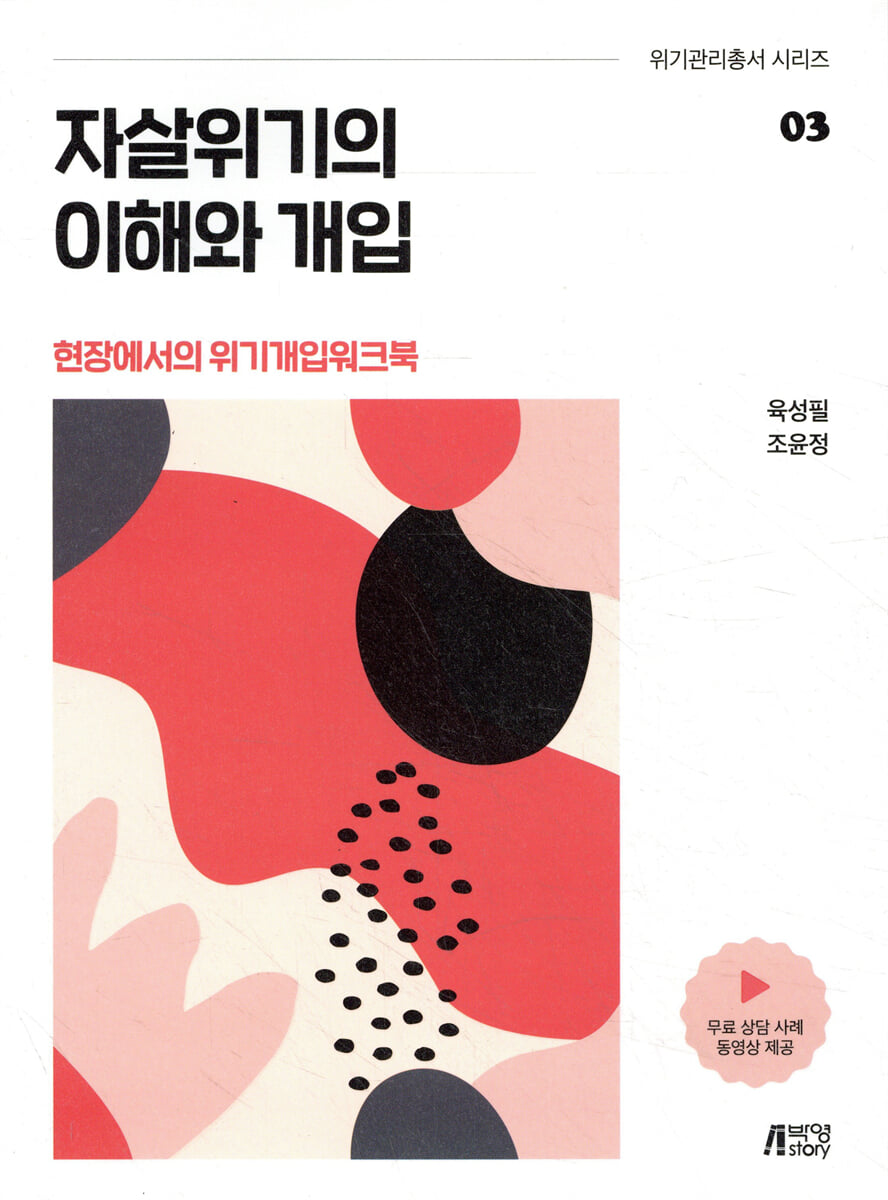
Understanding and Intervening in Suicidal Crisis - A Workbook for Crisis Intervention in the Field
 |
Description
Book Introduction
To help improve the professionalism and efficiency of crisis intervention in the field, we have planned to produce a crisis management manual, a crisis intervention workbook and manual in the field.
It is composed of content that can help field practitioners as well as experts to effectively intervene in crises.
It is based on the principle of crisis intervention that even if you experience a crisis, you do not need to think about receiving professional services, and that professional and comprehensive treatment or counseling should be based on the evaluation and initial intervention of the first intervener at the crisis site.
It is composed of content that can help field practitioners as well as experts to effectively intervene in crises.
It is based on the principle of crisis intervention that even if you experience a crisis, you do not need to think about receiving professional services, and that professional and comprehensive treatment or counseling should be based on the evaluation and initial intervention of the first intervener at the crisis site.
index
Ⅰ.
Understanding Suicidal Behavior ······························································································ 3
1.
Definition of suicide ······································································································· 4
2.
Epidemiology of Suicide ········································································································ 7
3.
Characteristics of a Suicidal Crisis ············································································································· 10
Ⅱ.
Reactions to a suicidal crisis ································································································ 23
1.
Emotional Response ··································································································· 23
2.
Cognitive response ··································································································· 30
3.
Behavioral Response ··································································································· 40
Ⅲ.
Suicide Risk Assessment and Classification ···························································································· 51
1.
Suicide Risk Assessment ································································································ 52
Ⅳ.
Suicide Crisis Intervention ···························································································· 78
1.
The Role of Suicide Crisis Interventionists ·················································································· 78
2.
Suicide Crisis Intervention Model (SAFER-R Model) ··················································· 85
3.
The Reality of Suicide Crisis Intervention ································································································ 94
Attachment ·························································································· 105
References ················································································································ 109
Index ····························································································································· 119
Appendix: Information on Related Agencies ················································································· 121
Appendix: Crisis Intervention in Practice in the Field ·························································· 162
Understanding Suicidal Behavior ······························································································ 3
1.
Definition of suicide ······································································································· 4
2.
Epidemiology of Suicide ········································································································ 7
3.
Characteristics of a Suicidal Crisis ············································································································· 10
Ⅱ.
Reactions to a suicidal crisis ································································································ 23
1.
Emotional Response ··································································································· 23
2.
Cognitive response ··································································································· 30
3.
Behavioral Response ··································································································· 40
Ⅲ.
Suicide Risk Assessment and Classification ···························································································· 51
1.
Suicide Risk Assessment ································································································ 52
Ⅳ.
Suicide Crisis Intervention ···························································································· 78
1.
The Role of Suicide Crisis Interventionists ·················································································· 78
2.
Suicide Crisis Intervention Model (SAFER-R Model) ··················································· 85
3.
The Reality of Suicide Crisis Intervention ································································································ 94
Attachment ·························································································· 105
References ················································································································ 109
Index ····························································································································· 119
Appendix: Information on Related Agencies ················································································· 121
Appendix: Crisis Intervention in Practice in the Field ·························································· 162
Publisher's Review
Korea's first crisis management workbook: Crisis Intervention Workbook and Manual
A comprehensive guide to crisis intervention for crisis workers, covering everything from the ethics of crisis intervention to specialized crisis intervention techniques for each type.
Modern life is exposed to a wide variety of crises, including economic hardship, employment problems, family conflicts, disease, domestic violence, floods, fires, collapses, death, sexual violence, and school violence, to the point where it is impossible to list them all.
When people are in real crisis, they often do not receive professional services, including formal and professional mental health professionals, from the beginning.
The first people you encounter at a crisis site are bystanders, police officers, firefighters, public health officials, and mental health officials, and you receive crisis-related services through them.
Considering these circumstances, the understanding and intervention capabilities of those involved in a crisis situation are the starting point for providing full-fledged services, enabling individuals or groups experiencing a crisis to appropriately overcome the crisis.
Although there are many efforts and increasing public and professional efforts for mental health and crisis management, the crisis intervention capabilities of early crisis interventionists in the process of providing systematic and professional assistance in the event of a crisis are still lacking in many areas.
To help improve the professionalism and efficiency of crisis intervention in the field, we have planned to produce a crisis management manual, a crisis intervention workbook and manual in the field.
It is composed of content that can help field practitioners as well as experts to effectively intervene in crises.
It is based on the principle of crisis intervention that even if you experience a crisis, you do not need to think about receiving professional services, and that professional and comprehensive treatment or counseling should be based on the evaluation and initial intervention of the first intervener at the crisis site.
The crisis intervention workbook and manual in the field are divided into eight topics: understanding and intervention in stress, understanding and intervention in crisis, understanding and intervention in suicide, understanding and intervention in disaster, understanding and intervention in disaster, understanding and intervention in domestic and sexual violence, understanding and intervention in crime victimization, understanding and intervention in grief, and understanding and intervention in burnout.
The manual covers topics such as ethics, understanding, evaluation, initial emergency response, crisis intervention, and referral to specialized agencies, and the most core and important content in the workbook is compressed to enhance usability in the field.
To enhance the effectiveness of education and training for crisis workers, a video was produced showing crisis intervention techniques used in actual initial crisis intervention sites.
Utilizing the crisis intervention workbook and manual in the field will help not only crisis intervention specialists but also crisis service providers without a crisis management background to provide effective services and help them manage their own crises.
2019.3
Crisis Intervention Workbook and Manual Authors in the Field
introduction
I began my career as a mental health service provider as a hospital-trained clinical psychologist. However, encountering various types of crises, including suicide, led me to become interested in crisis management and to engage in various training, research, program, and policy development efforts related to crisis management.
Although there have been cases of individual research on crises based on academic interest in the crisis, these have often been one-off and fragmented, based on personal interest.
This has resulted in many limitations in approaching crisis management systematically and comprehensively.
Recognizing the severity of the crisis and the need for crisis management, and to overcome these limitations, crisis management was established as a major at universities.
Our school is the first in the world to train crisis management experts.
As a professor specializing in crisis management, one of the lessons I've learned through extensive research and training is that individuals and groups face crises when they are exposed to challenges that exceed their normal capabilities or coping mechanisms.
Most people believe that there will be no crisis for them or those around them.
But the crisis is something beyond our will or choice.
As someone who majors in crisis management, every day is filled with crisis incidents.
One day, a firefighter I had never met asked me, “When a crisis situation arises, including a person attempting suicide, we respond. But one day, I started to wonder, ‘Is my role simply to respond to the scene, load the person in crisis into an ambulance, and take them to the hospital? Or is there something else I need to do at the scene of the crisis?’”
In particular, he expressed his regret that it would be very helpful if there were instructions on what to do and how to do it at the scene or during transport for those in crisis who are the first to arrive at the scene.
Hearing this was what inspired me to create the crisis management manual I am publishing this time, “Crisis Intervention Manual and Workbook in the Field.”
Previously, we simply assumed that crisis interventionists on the ground were simply doing their jobs, and we were unaware of the desire to provide better and more professional services to people in crisis.
Also, I didn't think there should be any professional support or training for them.
Crisis interventionists or mental health service providers should be the first to respond to situations where help is needed and provide appropriate services.
Crisis responders must quickly and accurately assess the needs and severity of the problems of people in crisis, and prioritize the safety and well-being of those in crisis.
When actual crisis interventionists are dispatched to a crisis site or are asked to help, they often feel confused because they cannot decide what to do or how to do it.
In addition, although they have extensive practical experience and are veterans in the field, they are able to secure control over crisis sites and carry out crisis intervention activities without much difficulty, but they also have difficulty because they are not sure whether their crisis intervention activities are proper and professional.
However, if crisis interventionists working in crisis situations lack confidence or are anxious about the services they provide, the negative impact on those in crisis can be enormous and even life-threatening.
Therefore, crisis interventionists are required to be able to quickly identify the needs of those in crisis and resolve the immediate crisis by going to the scene of a crisis.
Considering the difficult and urgent nature of crisis intervention sites, many previous studies have shown that when police officers and firefighters were educated and trained on mental health and relationship building and conversation with people seeking help, and then their work performance was evaluated, not only did the people involved in crisis intervention feel more confident and competent in performing their work, but citizens who received crisis intervention services, especially those in crisis, experienced much better recovery and stability.
Considering these realities and research findings, it is now necessary to take an interest in and assist crisis interventionists so that they can conduct crisis intervention in the field more professionally and systematically.
Efforts are needed to ensure that crisis interventionists who are currently providing crisis intervention services at crisis sites have confidence and pride in their work.
Through extensive literature research, field visits both domestically and internationally, and ongoing meetings with practitioners, the author has become convinced that if personnel dispatched to crisis sites provide appropriate services to individuals or organizations in crisis at the earliest possible stage, the crisis will not only be prevented from worsening but also resolved, and those who have experienced the crisis will be able to lead healthy, everyday lives.
Based on this conviction, we created the “Crisis Intervention Manual and Workbook” to help improve the expertise and on-site response capabilities of crisis interventionists in the field.
The author and his colleagues formed a writing committee to create a “Crisis Intervention Manual and Workbook in the Field” and began work. However, the types of crises and the fields were so diverse, and the content and types of crisis intervention services required in each situation were so numerous that even the task of setting the topic and deciding what to include was a challenge for the writing team.
Among these, defining the scope and limits of crisis management work was the most difficult task.
Mental health service providers generally consider their primary role to be providing treatment or counseling to people in crisis.
However, in actual crisis management, as the word management itself implies, the most important role is to quickly assess and confirm the risk and condition of a person in crisis and help provide the most necessary services to that person.
In other words, crisis management prioritizes ensuring the physical safety of people in crisis by first assessing the needs and risks of people or organizations in crisis during crisis intervention.
Once the crisis situation has been stabilized through this crisis management, only then, if additional and more specialized services are needed, will treatment or counseling, as we call it, be provided.
Therefore, in a crisis situation, crisis interventionists are required to play the role of psychological first aid rather than professional counselors.
Reflecting the differences between general psychological services and crisis intervention services for crisis management, the “Crisis Intervention Manual and Workbook in the Field” limits the role of the crisis interventionist to activities before full-scale services are provided by experts at the request of the crisis interventionist.
Of course, it would be ideal if the crisis interventionist could also provide professional psychological counseling or treatment.
Again, let me emphasize that in crisis intervention settings, the priority should be given to immediately and accurately assessing the current condition of the person in crisis and identifying necessary services, rather than initiating full-scale counseling or treatment.
“Crisis Intervention Manual and Workbook in the Field” is composed of contents that fully reflect the experiences and advice of participants and facilitators from three workshops, and have been revised and supplemented based on the opinions of the writing committee.
After numerous meetings and deliberations, the “Crisis Intervention Manual and Workbook in the Field” was finally divided into areas such as ethics and guidelines, stress, crisis, suicide, crime victimization, sexual and domestic violence, disaster, grief, and psychological burnout.
In the process of dividing the subject and area, domestic violence and sexual violence were also considered crimes, so initially we planned to deal with them in the criminal area. However, domestic violence and sexual violence are frequently encountered in actual clinical settings and are increasing, so they were organized independently.
“Crisis Intervention Manual and Workbook in the Field” is not a book for the general public, but is composed of contents that educate and train police officers, firefighters, and mental health workers (those who perform mental health-related work such as psychology, social welfare, nursing, medicine, law, and administration) who provide relief activities or crisis intervention services at crisis sites so that they can most efficiently carry out interviews, assessments, interventions, and referrals that are most appropriate to the content and characteristics of the crises they face in the field.
By appropriately utilizing the manuals and workbooks designed to reflect this intent and receiving education and training, we hope that crisis interventionists will be able to provide the most appropriate and effective services to those in crisis when encountering various incidents and situations.
At the same time, we hope that this will help crisis interventionists gain confidence in their expertise and abilities, and also help improve their mental health.
Additionally, all cases presented in the manual and workbook are designed for education and training purposes.
This publication of the "Crisis Intervention Manual and Workbook in the Field" was a massive undertaking, the first of its kind in Korea. Therefore, we felt a great burden and put in extra care and attention, from the data collection stage through to the proofreading and revision process.
I have tried my best to be helpful, but there may be some shortcomings and errors.
As the responsible author, I am solely responsible for this matter.
It's been over 30 years since I started working with people, and over time, there's been a huge difference between who I was as an undergraduate and who I am now.
But what is becoming increasingly stronger and clearer is that there are people who are looking in the same direction as me, and their hard work and effort together are my greatest assets and resources.
Each day adds up to make up our lives, but with the help and support of many people, we gain strength and start another day.
But we live forgetting that we and the people around us work hard and support us to get through each day.
Difficult and challenging tasks come to us unexpectedly one day.
So, for us, today's life, the life we have now, is precious.
Based on these thoughts, I would like to express my gratitude to the many people who have helped me become who I am today.
During the process of publishing “Crisis Intervention Manual and Workbook in the Field,” there were workshop participants, field practitioners, graduates, and students who shared their thoughts and discussions.
Without their dedication and sacrifice, publishing “Crisis Intervention Manual and Workbook in the Field” would not have been possible.
Despite the difficult and challenging work, I would like to express my sincere gratitude and appreciation to all those who joined us in hopes of providing even a little help to those in crisis and to those who intervene in crisis.
Although it's not yet a major in society, I'm happy to see crisis management students who are interested in crisis management and are conducting research and practicing for those in crisis. I'm grateful for the courage they give me to take on new challenges.
I also extend my gratitude to the many people who have shown interest in crisis management, and to the countless people I have met through training, education, and lectures.
We would like to express our gratitude to Jong-man Ahn, CEO of Park Young-sa, who kindly permitted and supported the publication of the 16-volume crisis intervention series, including eight crisis intervention manuals and eight workbooks.
I would like to express my deepest gratitude to Director Noh Hyeon, who coordinated the overall publication process, continuously communicated with me, and helped me to create a better book, and to Professor Kang Min-jeong, who meticulously reviewed and confirmed the manuscript despite her busy schedule, while maximizing the difficult work of the first draft, second draft, and third draft, and reflecting the demands of the demanding writing team.
Once again, I believe that with the alumni and current students who are still interested in crisis management and who are quietly researching and dedicating themselves to the field with a genuine love and faith in people, we will not be alone, and the world will be a happier place with us.
I especially want to express my love and sincere apologies and gratitude to my family, Dr. Lee Hye-seon and her two sons, who have believed in me wholeheartedly, supported me, and supported me to the best of their ability, allowing me to bravely forge a lonely and unfamiliar path that no one has ever taken before.
February 2019
Responsible author: Yuk Seong-pil
A comprehensive guide to crisis intervention for crisis workers, covering everything from the ethics of crisis intervention to specialized crisis intervention techniques for each type.
Modern life is exposed to a wide variety of crises, including economic hardship, employment problems, family conflicts, disease, domestic violence, floods, fires, collapses, death, sexual violence, and school violence, to the point where it is impossible to list them all.
When people are in real crisis, they often do not receive professional services, including formal and professional mental health professionals, from the beginning.
The first people you encounter at a crisis site are bystanders, police officers, firefighters, public health officials, and mental health officials, and you receive crisis-related services through them.
Considering these circumstances, the understanding and intervention capabilities of those involved in a crisis situation are the starting point for providing full-fledged services, enabling individuals or groups experiencing a crisis to appropriately overcome the crisis.
Although there are many efforts and increasing public and professional efforts for mental health and crisis management, the crisis intervention capabilities of early crisis interventionists in the process of providing systematic and professional assistance in the event of a crisis are still lacking in many areas.
To help improve the professionalism and efficiency of crisis intervention in the field, we have planned to produce a crisis management manual, a crisis intervention workbook and manual in the field.
It is composed of content that can help field practitioners as well as experts to effectively intervene in crises.
It is based on the principle of crisis intervention that even if you experience a crisis, you do not need to think about receiving professional services, and that professional and comprehensive treatment or counseling should be based on the evaluation and initial intervention of the first intervener at the crisis site.
The crisis intervention workbook and manual in the field are divided into eight topics: understanding and intervention in stress, understanding and intervention in crisis, understanding and intervention in suicide, understanding and intervention in disaster, understanding and intervention in disaster, understanding and intervention in domestic and sexual violence, understanding and intervention in crime victimization, understanding and intervention in grief, and understanding and intervention in burnout.
The manual covers topics such as ethics, understanding, evaluation, initial emergency response, crisis intervention, and referral to specialized agencies, and the most core and important content in the workbook is compressed to enhance usability in the field.
To enhance the effectiveness of education and training for crisis workers, a video was produced showing crisis intervention techniques used in actual initial crisis intervention sites.
Utilizing the crisis intervention workbook and manual in the field will help not only crisis intervention specialists but also crisis service providers without a crisis management background to provide effective services and help them manage their own crises.
2019.3
Crisis Intervention Workbook and Manual Authors in the Field
introduction
I began my career as a mental health service provider as a hospital-trained clinical psychologist. However, encountering various types of crises, including suicide, led me to become interested in crisis management and to engage in various training, research, program, and policy development efforts related to crisis management.
Although there have been cases of individual research on crises based on academic interest in the crisis, these have often been one-off and fragmented, based on personal interest.
This has resulted in many limitations in approaching crisis management systematically and comprehensively.
Recognizing the severity of the crisis and the need for crisis management, and to overcome these limitations, crisis management was established as a major at universities.
Our school is the first in the world to train crisis management experts.
As a professor specializing in crisis management, one of the lessons I've learned through extensive research and training is that individuals and groups face crises when they are exposed to challenges that exceed their normal capabilities or coping mechanisms.
Most people believe that there will be no crisis for them or those around them.
But the crisis is something beyond our will or choice.
As someone who majors in crisis management, every day is filled with crisis incidents.
One day, a firefighter I had never met asked me, “When a crisis situation arises, including a person attempting suicide, we respond. But one day, I started to wonder, ‘Is my role simply to respond to the scene, load the person in crisis into an ambulance, and take them to the hospital? Or is there something else I need to do at the scene of the crisis?’”
In particular, he expressed his regret that it would be very helpful if there were instructions on what to do and how to do it at the scene or during transport for those in crisis who are the first to arrive at the scene.
Hearing this was what inspired me to create the crisis management manual I am publishing this time, “Crisis Intervention Manual and Workbook in the Field.”
Previously, we simply assumed that crisis interventionists on the ground were simply doing their jobs, and we were unaware of the desire to provide better and more professional services to people in crisis.
Also, I didn't think there should be any professional support or training for them.
Crisis interventionists or mental health service providers should be the first to respond to situations where help is needed and provide appropriate services.
Crisis responders must quickly and accurately assess the needs and severity of the problems of people in crisis, and prioritize the safety and well-being of those in crisis.
When actual crisis interventionists are dispatched to a crisis site or are asked to help, they often feel confused because they cannot decide what to do or how to do it.
In addition, although they have extensive practical experience and are veterans in the field, they are able to secure control over crisis sites and carry out crisis intervention activities without much difficulty, but they also have difficulty because they are not sure whether their crisis intervention activities are proper and professional.
However, if crisis interventionists working in crisis situations lack confidence or are anxious about the services they provide, the negative impact on those in crisis can be enormous and even life-threatening.
Therefore, crisis interventionists are required to be able to quickly identify the needs of those in crisis and resolve the immediate crisis by going to the scene of a crisis.
Considering the difficult and urgent nature of crisis intervention sites, many previous studies have shown that when police officers and firefighters were educated and trained on mental health and relationship building and conversation with people seeking help, and then their work performance was evaluated, not only did the people involved in crisis intervention feel more confident and competent in performing their work, but citizens who received crisis intervention services, especially those in crisis, experienced much better recovery and stability.
Considering these realities and research findings, it is now necessary to take an interest in and assist crisis interventionists so that they can conduct crisis intervention in the field more professionally and systematically.
Efforts are needed to ensure that crisis interventionists who are currently providing crisis intervention services at crisis sites have confidence and pride in their work.
Through extensive literature research, field visits both domestically and internationally, and ongoing meetings with practitioners, the author has become convinced that if personnel dispatched to crisis sites provide appropriate services to individuals or organizations in crisis at the earliest possible stage, the crisis will not only be prevented from worsening but also resolved, and those who have experienced the crisis will be able to lead healthy, everyday lives.
Based on this conviction, we created the “Crisis Intervention Manual and Workbook” to help improve the expertise and on-site response capabilities of crisis interventionists in the field.
The author and his colleagues formed a writing committee to create a “Crisis Intervention Manual and Workbook in the Field” and began work. However, the types of crises and the fields were so diverse, and the content and types of crisis intervention services required in each situation were so numerous that even the task of setting the topic and deciding what to include was a challenge for the writing team.
Among these, defining the scope and limits of crisis management work was the most difficult task.
Mental health service providers generally consider their primary role to be providing treatment or counseling to people in crisis.
However, in actual crisis management, as the word management itself implies, the most important role is to quickly assess and confirm the risk and condition of a person in crisis and help provide the most necessary services to that person.
In other words, crisis management prioritizes ensuring the physical safety of people in crisis by first assessing the needs and risks of people or organizations in crisis during crisis intervention.
Once the crisis situation has been stabilized through this crisis management, only then, if additional and more specialized services are needed, will treatment or counseling, as we call it, be provided.
Therefore, in a crisis situation, crisis interventionists are required to play the role of psychological first aid rather than professional counselors.
Reflecting the differences between general psychological services and crisis intervention services for crisis management, the “Crisis Intervention Manual and Workbook in the Field” limits the role of the crisis interventionist to activities before full-scale services are provided by experts at the request of the crisis interventionist.
Of course, it would be ideal if the crisis interventionist could also provide professional psychological counseling or treatment.
Again, let me emphasize that in crisis intervention settings, the priority should be given to immediately and accurately assessing the current condition of the person in crisis and identifying necessary services, rather than initiating full-scale counseling or treatment.
“Crisis Intervention Manual and Workbook in the Field” is composed of contents that fully reflect the experiences and advice of participants and facilitators from three workshops, and have been revised and supplemented based on the opinions of the writing committee.
After numerous meetings and deliberations, the “Crisis Intervention Manual and Workbook in the Field” was finally divided into areas such as ethics and guidelines, stress, crisis, suicide, crime victimization, sexual and domestic violence, disaster, grief, and psychological burnout.
In the process of dividing the subject and area, domestic violence and sexual violence were also considered crimes, so initially we planned to deal with them in the criminal area. However, domestic violence and sexual violence are frequently encountered in actual clinical settings and are increasing, so they were organized independently.
“Crisis Intervention Manual and Workbook in the Field” is not a book for the general public, but is composed of contents that educate and train police officers, firefighters, and mental health workers (those who perform mental health-related work such as psychology, social welfare, nursing, medicine, law, and administration) who provide relief activities or crisis intervention services at crisis sites so that they can most efficiently carry out interviews, assessments, interventions, and referrals that are most appropriate to the content and characteristics of the crises they face in the field.
By appropriately utilizing the manuals and workbooks designed to reflect this intent and receiving education and training, we hope that crisis interventionists will be able to provide the most appropriate and effective services to those in crisis when encountering various incidents and situations.
At the same time, we hope that this will help crisis interventionists gain confidence in their expertise and abilities, and also help improve their mental health.
Additionally, all cases presented in the manual and workbook are designed for education and training purposes.
This publication of the "Crisis Intervention Manual and Workbook in the Field" was a massive undertaking, the first of its kind in Korea. Therefore, we felt a great burden and put in extra care and attention, from the data collection stage through to the proofreading and revision process.
I have tried my best to be helpful, but there may be some shortcomings and errors.
As the responsible author, I am solely responsible for this matter.
It's been over 30 years since I started working with people, and over time, there's been a huge difference between who I was as an undergraduate and who I am now.
But what is becoming increasingly stronger and clearer is that there are people who are looking in the same direction as me, and their hard work and effort together are my greatest assets and resources.
Each day adds up to make up our lives, but with the help and support of many people, we gain strength and start another day.
But we live forgetting that we and the people around us work hard and support us to get through each day.
Difficult and challenging tasks come to us unexpectedly one day.
So, for us, today's life, the life we have now, is precious.
Based on these thoughts, I would like to express my gratitude to the many people who have helped me become who I am today.
During the process of publishing “Crisis Intervention Manual and Workbook in the Field,” there were workshop participants, field practitioners, graduates, and students who shared their thoughts and discussions.
Without their dedication and sacrifice, publishing “Crisis Intervention Manual and Workbook in the Field” would not have been possible.
Despite the difficult and challenging work, I would like to express my sincere gratitude and appreciation to all those who joined us in hopes of providing even a little help to those in crisis and to those who intervene in crisis.
Although it's not yet a major in society, I'm happy to see crisis management students who are interested in crisis management and are conducting research and practicing for those in crisis. I'm grateful for the courage they give me to take on new challenges.
I also extend my gratitude to the many people who have shown interest in crisis management, and to the countless people I have met through training, education, and lectures.
We would like to express our gratitude to Jong-man Ahn, CEO of Park Young-sa, who kindly permitted and supported the publication of the 16-volume crisis intervention series, including eight crisis intervention manuals and eight workbooks.
I would like to express my deepest gratitude to Director Noh Hyeon, who coordinated the overall publication process, continuously communicated with me, and helped me to create a better book, and to Professor Kang Min-jeong, who meticulously reviewed and confirmed the manuscript despite her busy schedule, while maximizing the difficult work of the first draft, second draft, and third draft, and reflecting the demands of the demanding writing team.
Once again, I believe that with the alumni and current students who are still interested in crisis management and who are quietly researching and dedicating themselves to the field with a genuine love and faith in people, we will not be alone, and the world will be a happier place with us.
I especially want to express my love and sincere apologies and gratitude to my family, Dr. Lee Hye-seon and her two sons, who have believed in me wholeheartedly, supported me, and supported me to the best of their ability, allowing me to bravely forge a lonely and unfamiliar path that no one has ever taken before.
February 2019
Responsible author: Yuk Seong-pil
GOODS SPECIFICS
- Date of issue: February 25, 2019
- Page count, weight, size: 182 pages | 486g | 188*257*20mm
- ISBN13: 9791189643133
- ISBN10: 1189643138
You may also like
카테고리
korean


korean

![GQ KOREA Mark (Monthly): December [2025]](http://librairie.coreenne.fr/cdn/shop/files/8ef265dbbfbf186523ed75ba7319009d.jpg?v=1765340328&width=3840)


