

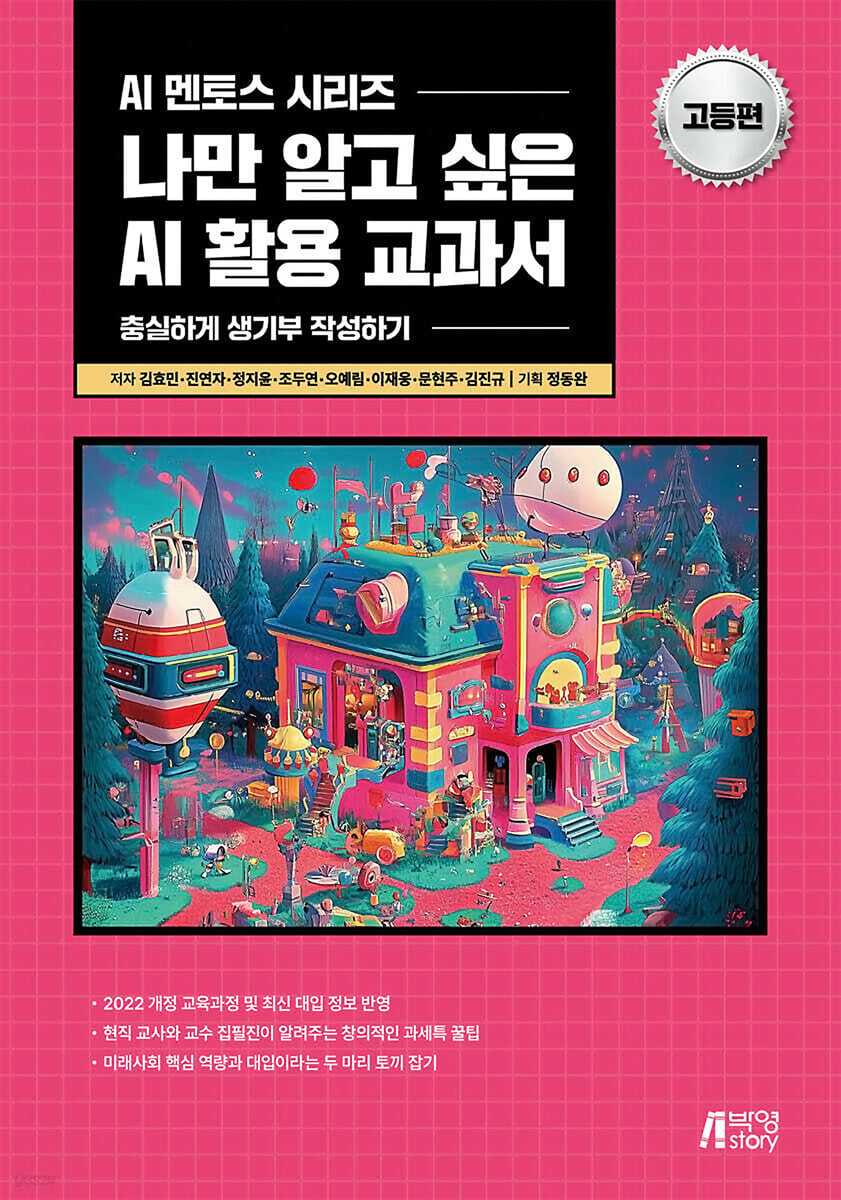
AI Utilization Textbook: High School Edition: Only I Want to Know
 |
Description
Book Introduction
This book was written by practicing educators who agree that AI education is desperately needed for young people, especially high school students, who are the core target of the new curriculum.
We have included as many illustrations as possible so that high school students or teachers can learn how to use artificial intelligence very easily and slowly, and have separated AI-utilization class cases and AI-utilization projects so that they can conveniently view only the relevant parts whenever needed.
We have included as many illustrations as possible so that high school students or teachers can learn how to use artificial intelligence very easily and slowly, and have separated AI-utilization class cases and AI-utilization projects so that they can conveniently view only the relevant parts whenever needed.
- You can preview some of the book's contents.
Preview
index
CHAPTER 01 Understanding AI 3
1. History and Development of AI 4
2 Three Main Types of AI 6
3 Everyday Use Cases of AI 7
4 Advantages and Disadvantages of AI Introduction 13
5 Things to Consider When Using AI Tools 17
6 Education and Learning in the AI Era 18
Job Outlook in the AI Era 23
CHAPTER 02 Higher Education and AI 27
1 From middle school to high school 28
2 Preparing for the High School Credit System 51
CHAPTER 03 AI Education: What Should We Teach? 69
1 The Changing Present 70
2 High School Students and AI 84
3 Developing Your Own Capabilities 89
4. AI EdTech Class for Tax Benefits 95
CHAPTER 04 Smartly Managing Curriculum Learning 139
1 Types of Courseware 141
2 Benefits and Challenges of Using Courseware 143
3 Practical Use of Courseware 144
4 Choosing the Right AI Tool for Your Purpose 169
CHAPTER 05 Generative AI and Content 211
1 Principles of Generative AI 212
2. Use of Generative AI in the Arts 213
3 Ethical Controversies Related to the Use of Generative AI 225
4 Content Creation Practice Using Generative AI 228
CHAPTER 06: Exploring AI-Based Tasks to Foster Learner Initiatives 249
1 Understanding the Assignment 250
2 Using AI to Determine Research Topics 254
3 Designing a Problem-Exploration Project Using Generative AI 270
4 AI-Powered Video and PDF Data Summary 279
5 Data Analysis and Visualization Using AI 284
6 Writing a Research Report with ChatGPT 299
CHAPTER 07 Classroom Management and Creative Experiential Activities 305
1 Class Management 306
2 Creative Experiential Activity Class 326
1. History and Development of AI 4
2 Three Main Types of AI 6
3 Everyday Use Cases of AI 7
4 Advantages and Disadvantages of AI Introduction 13
5 Things to Consider When Using AI Tools 17
6 Education and Learning in the AI Era 18
Job Outlook in the AI Era 23
CHAPTER 02 Higher Education and AI 27
1 From middle school to high school 28
2 Preparing for the High School Credit System 51
CHAPTER 03 AI Education: What Should We Teach? 69
1 The Changing Present 70
2 High School Students and AI 84
3 Developing Your Own Capabilities 89
4. AI EdTech Class for Tax Benefits 95
CHAPTER 04 Smartly Managing Curriculum Learning 139
1 Types of Courseware 141
2 Benefits and Challenges of Using Courseware 143
3 Practical Use of Courseware 144
4 Choosing the Right AI Tool for Your Purpose 169
CHAPTER 05 Generative AI and Content 211
1 Principles of Generative AI 212
2. Use of Generative AI in the Arts 213
3 Ethical Controversies Related to the Use of Generative AI 225
4 Content Creation Practice Using Generative AI 228
CHAPTER 06: Exploring AI-Based Tasks to Foster Learner Initiatives 249
1 Understanding the Assignment 250
2 Using AI to Determine Research Topics 254
3 Designing a Problem-Exploration Project Using Generative AI 270
4 AI-Powered Video and PDF Data Summary 279
5 Data Analysis and Visualization Using AI 284
6 Writing a Research Report with ChatGPT 299
CHAPTER 07 Classroom Management and Creative Experiential Activities 305
1 Class Management 306
2 Creative Experiential Activity Class 326
Publisher's Review
preface
In late 18th century England, there lived a boy named Ned Ludd who was clumsy and had a somewhat retarded intelligence.
Ned, a weaver, accidentally broke two of the factory's loom machines, and from then on, whenever the factory machinery broke down, those blamed for the breakdown would say, "Ned Ludd did it."
At that time, the gap between rich and poor in Britain was becoming noticeably worse due to the rapidly growing population, the large number of weavers who left their hometowns to work in the cities, and the factory owners who exploited them for low wages.
Then, in 1812, with the advent of the loom capable of mass weaving, weavers were suddenly forced to lose their jobs.
Desperate weavers, thinking that it would be better to get rid of the machines than lose their jobs to them, secretly formed a secret society and began to sneak out at night to destroy the machines and set the factories on fire.
When the weavers were asked, “Who is your leader?” they simply replied, “Ned Ludd, of course.” This machine-breaking activity, which continued until about 1897, later became known as the Luddite Movement, Britain’s first labor movement.
The argument that technological advancement hinders human prosperity continues to be raised even today.
Simple tasks are being replaced by robots and kiosks, and jobs once done by humans are being replaced by machines faster than ever before.
There is nothing we can do about it, as machines do not complain, rebel, or attack humans, but work steadily, without rest, and in some cases even more skillfully than humans.
Moreover, it is now artificial intelligence, not ordinary machines like weaving machines, that threatens humans.
Artificial intelligence roams the online world, spreading and brainwashing various prejudices and specific religious or political positions.
In the past, machines took away jobs held by humans, but now and in the future, machines will change human minds and society.
Unlike weak AI, which can only be applied under certain conditions, strong AI can be applied to a wide range of situations and can learn and perform tasks it has never done before, just like humans, or take over tasks. Scholars have repeatedly warned of the dangers of strong AI appearing in human society.
So what can teenagers, who haven't yet joined the established generation, do to successfully navigate this era? Vandalizing a loom under cover of darkness, claiming Ned Ludd ordered it, or dismantling the CCTV cameras that monitor unmanned stores 24/7 won't be enough to stem the tide of change.
During the First Industrial Revolution, when most people were suffering from depression, the Luddite movement received enthusiastic support from the public and intellectuals, but it could not stop the trend of 'increased productivity through machines.'
Even at this point, when the Industrial Revolution is considered to have entered its fourth phase, many people are expressing anxiety and concern about the advancements in cutting-edge technology and artificial intelligence. However, the trend of "a convenient life brought about by artificial intelligence" cannot be stopped.
Moreover, a period of rapid change in artificial intelligence has arrived, with the start of a competition among big tech companies to develop generative AI based on cloud computing starting in the second half of 2022.
This is because artificial intelligence, which had been used in a limited manner for research and corporate purposes, is now beginning to be commercialized on a mass scale.
Generative AI produces realistic results in a wide range of fields, and can complete tasks that previously took teenagers a lot of effort to complete, such as school assignments, in just seconds.
For a long time, machines have been subjected to countless criticisms from humanity, but strangely enough, the more they are criticized, the stronger and smarter they become, becoming even more gigantic.
This is why the argument that in the future we will have to choose jobs and careers that AI cannot do continues to gain traction.
It is widely expected that tasks that lack originality and activities that anyone can easily follow will be taken over by AI within a few years, and functions that can only be performed within human relationships, such as governance, ceremonies, counseling, and care, are classified as areas that are relatively difficult for AI to penetrate.
However, we, who live in a time of upheaval where we do not know when or how things will change, cannot, based solely on the current outlook, order young people to become religious people, saying things like, “You will likely not be able to keep up with AI for the time being, so you should become religious in the future.”
Looking back, technological advancement has always been faster than humanity's predictions for the future, and it is impossible to predict which direction it will take.
In other words, paradoxically, it would be wiser for us, the older generation, to teach our youth how far technology has advanced and how it can be used in a "creative" way.
If we do this, we can at least avoid repeating the kind of history where we didn't know the loom would come out, got hit in the back of the head, regretted it too late, and ended up hating the loom.
The 2022 revised curriculum, which aims to equip growing youth with "digital literacy" in addition to linguistic and mathematical skills, will be implemented starting in 2025.
In line with this, the AI Digital Textbook (AIDT) will also be introduced, and the 2028 college entrance exam reform plan, which will be applied to students who will be high school students in 2025, has also been introduced, causing the education world to be in an uproar with concern for some time.
A path that no one has ever walked before, and whose outcome cannot be guaranteed, is opening up again.
I expect there will certainly be trial and error, and there will be significant backlash and side effects.
But I can assure you that we must nonetheless educate young people and their teachers on how to work with AI, and how to use it intelligently.
No matter how much we resist this change, no matter how hard we try to ignore it, when we see how many AI users there are around the world and how many are growing, we cannot help but acknowledge that this is an unstoppable trend.
This book was written by practicing educators who agree that AI education is desperately needed for young people, especially high school students, who are the core target of the new curriculum.
We have included as many illustrations as possible so that high school students or teachers can learn how to use artificial intelligence very easily and slowly, and have separated AI-utilization class cases and AI-utilization projects so that they can conveniently view only the relevant parts whenever needed.
I often meet people around me who are still stuck in the old notions that “all you need to do well on the College Scholastic Ability Test is to get into college” and “High school classes are too much to handle even solving mock exam problems.”
We hope that through this book, teachers, parents, and even students will realize that artificial intelligence can be a significant help in high school classes, life, and college admissions.
Technology is a double-edged sword, and can be either a curse or a blessing, depending on who uses it.
I sincerely hope that readers from all walks of life will, through this book, become excellent users of artificial intelligence, harnessing its blessings.
All authors
In late 18th century England, there lived a boy named Ned Ludd who was clumsy and had a somewhat retarded intelligence.
Ned, a weaver, accidentally broke two of the factory's loom machines, and from then on, whenever the factory machinery broke down, those blamed for the breakdown would say, "Ned Ludd did it."
At that time, the gap between rich and poor in Britain was becoming noticeably worse due to the rapidly growing population, the large number of weavers who left their hometowns to work in the cities, and the factory owners who exploited them for low wages.
Then, in 1812, with the advent of the loom capable of mass weaving, weavers were suddenly forced to lose their jobs.
Desperate weavers, thinking that it would be better to get rid of the machines than lose their jobs to them, secretly formed a secret society and began to sneak out at night to destroy the machines and set the factories on fire.
When the weavers were asked, “Who is your leader?” they simply replied, “Ned Ludd, of course.” This machine-breaking activity, which continued until about 1897, later became known as the Luddite Movement, Britain’s first labor movement.
The argument that technological advancement hinders human prosperity continues to be raised even today.
Simple tasks are being replaced by robots and kiosks, and jobs once done by humans are being replaced by machines faster than ever before.
There is nothing we can do about it, as machines do not complain, rebel, or attack humans, but work steadily, without rest, and in some cases even more skillfully than humans.
Moreover, it is now artificial intelligence, not ordinary machines like weaving machines, that threatens humans.
Artificial intelligence roams the online world, spreading and brainwashing various prejudices and specific religious or political positions.
In the past, machines took away jobs held by humans, but now and in the future, machines will change human minds and society.
Unlike weak AI, which can only be applied under certain conditions, strong AI can be applied to a wide range of situations and can learn and perform tasks it has never done before, just like humans, or take over tasks. Scholars have repeatedly warned of the dangers of strong AI appearing in human society.
So what can teenagers, who haven't yet joined the established generation, do to successfully navigate this era? Vandalizing a loom under cover of darkness, claiming Ned Ludd ordered it, or dismantling the CCTV cameras that monitor unmanned stores 24/7 won't be enough to stem the tide of change.
During the First Industrial Revolution, when most people were suffering from depression, the Luddite movement received enthusiastic support from the public and intellectuals, but it could not stop the trend of 'increased productivity through machines.'
Even at this point, when the Industrial Revolution is considered to have entered its fourth phase, many people are expressing anxiety and concern about the advancements in cutting-edge technology and artificial intelligence. However, the trend of "a convenient life brought about by artificial intelligence" cannot be stopped.
Moreover, a period of rapid change in artificial intelligence has arrived, with the start of a competition among big tech companies to develop generative AI based on cloud computing starting in the second half of 2022.
This is because artificial intelligence, which had been used in a limited manner for research and corporate purposes, is now beginning to be commercialized on a mass scale.
Generative AI produces realistic results in a wide range of fields, and can complete tasks that previously took teenagers a lot of effort to complete, such as school assignments, in just seconds.
For a long time, machines have been subjected to countless criticisms from humanity, but strangely enough, the more they are criticized, the stronger and smarter they become, becoming even more gigantic.
This is why the argument that in the future we will have to choose jobs and careers that AI cannot do continues to gain traction.
It is widely expected that tasks that lack originality and activities that anyone can easily follow will be taken over by AI within a few years, and functions that can only be performed within human relationships, such as governance, ceremonies, counseling, and care, are classified as areas that are relatively difficult for AI to penetrate.
However, we, who live in a time of upheaval where we do not know when or how things will change, cannot, based solely on the current outlook, order young people to become religious people, saying things like, “You will likely not be able to keep up with AI for the time being, so you should become religious in the future.”
Looking back, technological advancement has always been faster than humanity's predictions for the future, and it is impossible to predict which direction it will take.
In other words, paradoxically, it would be wiser for us, the older generation, to teach our youth how far technology has advanced and how it can be used in a "creative" way.
If we do this, we can at least avoid repeating the kind of history where we didn't know the loom would come out, got hit in the back of the head, regretted it too late, and ended up hating the loom.
The 2022 revised curriculum, which aims to equip growing youth with "digital literacy" in addition to linguistic and mathematical skills, will be implemented starting in 2025.
In line with this, the AI Digital Textbook (AIDT) will also be introduced, and the 2028 college entrance exam reform plan, which will be applied to students who will be high school students in 2025, has also been introduced, causing the education world to be in an uproar with concern for some time.
A path that no one has ever walked before, and whose outcome cannot be guaranteed, is opening up again.
I expect there will certainly be trial and error, and there will be significant backlash and side effects.
But I can assure you that we must nonetheless educate young people and their teachers on how to work with AI, and how to use it intelligently.
No matter how much we resist this change, no matter how hard we try to ignore it, when we see how many AI users there are around the world and how many are growing, we cannot help but acknowledge that this is an unstoppable trend.
This book was written by practicing educators who agree that AI education is desperately needed for young people, especially high school students, who are the core target of the new curriculum.
We have included as many illustrations as possible so that high school students or teachers can learn how to use artificial intelligence very easily and slowly, and have separated AI-utilization class cases and AI-utilization projects so that they can conveniently view only the relevant parts whenever needed.
I often meet people around me who are still stuck in the old notions that “all you need to do well on the College Scholastic Ability Test is to get into college” and “High school classes are too much to handle even solving mock exam problems.”
We hope that through this book, teachers, parents, and even students will realize that artificial intelligence can be a significant help in high school classes, life, and college admissions.
Technology is a double-edged sword, and can be either a curse or a blessing, depending on who uses it.
I sincerely hope that readers from all walks of life will, through this book, become excellent users of artificial intelligence, harnessing its blessings.
All authors
GOODS SPECIFICS
- Date of issue: February 25, 2025
- Page count, weight, size: 382 pages | 176*248*30mm
- ISBN13: 9791172790387
- ISBN10: 1172790388
You may also like
카테고리
korean


korean

![GQ KOREA Mark (Monthly): December [2025]](http://librairie.coreenne.fr/cdn/shop/files/8ef265dbbfbf186523ed75ba7319009d.jpg?v=1765340328&width=3840)


