

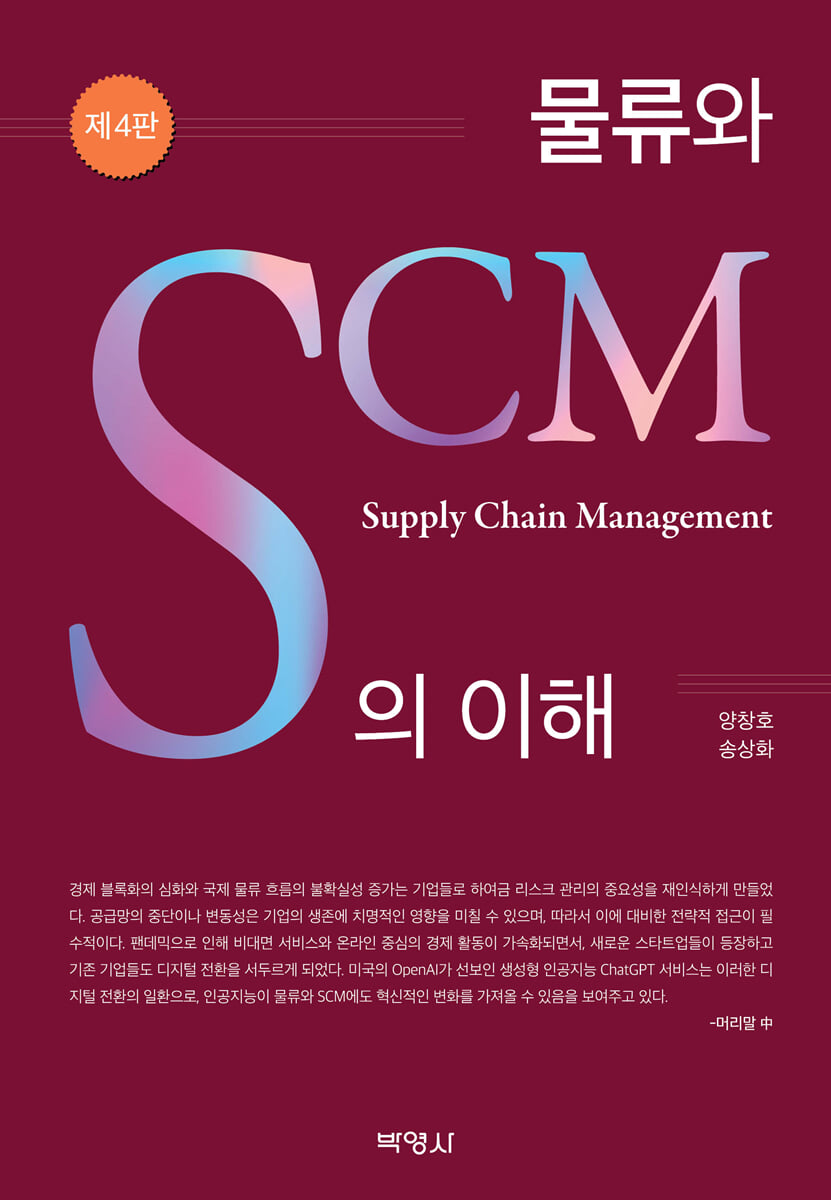
Understanding Logistics and SCM
 |
Description
Book Introduction
The widespread adoption of e-commerce is expanding into cross-border e-commerce, which is significantly changing the overall structure of logistics and supply chain management.
These changes have redefined the logistics and SCM paradigm, requiring new innovations and strategies.
New technologies and approaches, such as logistics automation, network optimization, and data-driven decision-making, are expected to drive the future of logistics and SCM.
Reflecting these contemporary demands, this fourth edition faithfully reflects recent changes in various fields, including maritime transportation, e-commerce, logistics automation, logistics network design, purchasing, and logistics information systems.
In particular, we've added ESG-related content to enhance understanding of sustainable logistics innovation, and we aim to help readers adapt to the changing environment through cutting-edge logistics and SCM cases. The book includes case studies from global companies such as UPS, Amazon, Walmart, Boeing, Dell, Nike, JD.com, and Imation, providing readers with practical insights.
These changes have redefined the logistics and SCM paradigm, requiring new innovations and strategies.
New technologies and approaches, such as logistics automation, network optimization, and data-driven decision-making, are expected to drive the future of logistics and SCM.
Reflecting these contemporary demands, this fourth edition faithfully reflects recent changes in various fields, including maritime transportation, e-commerce, logistics automation, logistics network design, purchasing, and logistics information systems.
In particular, we've added ESG-related content to enhance understanding of sustainable logistics innovation, and we aim to help readers adapt to the changing environment through cutting-edge logistics and SCM cases. The book includes case studies from global companies such as UPS, Amazon, Walmart, Boeing, Dell, Nike, JD.com, and Imation, providing readers with practical insights.
index
PART Ⅰ CONCEPTS AND STRATEGIES
Chapter 01 Concepts of Logistics and SCM
1.
Logistics and Distribution _5
2.
Development of Logistics Concepts _6
3.
The Concept of Supply Chain Management (SCM) _9
4.
Logistics Activities _14
Chapter 02 Logistics: A Source of Corporate Competitive Advantage
1.
Logistics and Competitive Advantage _23
2.
Customer-Oriented Supply Chains: A New Source of Competitive Advantage _26
3.
Reasons for the Growing Interest in Logistics in Management _29
Chapter 03 Supply Chain Management
1.
Supply Chain Management _39
2.
Supply Chain and Supply Chain Management _41
3.
Supply Chain Management and Logistics _43
4.
The Effectiveness of Supply Chain Management _46
5.
Barriers to Supply Chain Management _49
6.
Information Sharing _51
7.
Restructuring the Division of Roles in the Supply Chain _54
Chapter 04 Customer Service
1.
Customer Service in Logistics Systems _57
2.
The Meaning of Customer Service _58
3.
Characteristics of Customer Service _61
4.
Setting Customer Service Goals _64
5.
Obstacles to Improving Customer Service _67
6.
Market-Specific Customer Service Development _68
Chapter 05 Integrated Logistics
1.
Total Cost Analysis _73
2.
Integration of Logistics Activities _75
3.
Integration with Corporate Activities _86
4.
Integration within the supply chain _95
Chapter 06 Logistics and SCM Strategy
1.
Corporate Strategic Plan _99
2.
Strategic Planning Techniques _100
3.
Logistics Strategy Plan _102
4.
Supply Chain Strategy _105
5.
Future Issues Affecting Logistics _114
PART Ⅱ SUPPLY CHAIN AND LOGISTICS MANAGEMENT
Chapter 07 Components and Networks of Logistics
1.
Transportation Activities _119
2.
Archiving Activities _121
3.
Packaging Activity _123
4.
Unloading Activities _125
5.
Distribution Processing Activities _126
6.
Logistics Information Activities _129
7.
Logistics Network _130
Chapter 08 Inventory Management
1.
The Meaning of Inventory Management _135
2.
Inventory and Customer Service _137
3.
Types and Functions of Inventory _140
4.
Optimum Inventory and Inventory Costs _141
5.
Stock Model _143
6. ABC Inventory Analysis _148
7.
Inventory Management Problems _152
8.
Inventory Management Improvement Plan _154
9.
Supply Chain Inventory Management Strategy _158
Chapter 09 Transportation System
1.
Strategic Aspects of Freight Transportation _165
2.
Function of Transportation _166
3.
Transportation _169
4.
Intermodal Transport _184
5.
Deregulation and Privatization of the Transportation Industry _192
6.
The Role of Government in Transportation _199
Chapter 10 Transportation Management
1.
Current Challenges in Transportation Management _203
2.
Transportation Management System _205
3.
Selection of carrier _209
4.
Determining freight rates _210
5.
Transportation-related documents _215
Chapter 11 Maritime Logistics
1.
Maritime Transport _219
2.
Container Maritime Transport _224
3.
Maritime Logistics and Supply Chain _227
4.
Globalization and Intensifying Competition in the Shipping Industry _230
5.
The Era of Ultra-Large Container Ships _231
6.
Shipper-Oriented Shipping Policy _238
7.
The Changing Maritime Transport Industry _241
Chapter 12 International Logistics Hub
1.
International Logistics Hub Type _245
2.
Hub and Spoke System _247
3.
Logistics Node _249
4.
International Division of Labor and Ports _255
5.
Ports as Logistics Hubs _256
6.
Port Hinterland Complex _261
7.
Free Trade Zones and Port Cities _263
Chapter 13 Warehouses and Logistics Centers
1.
Warehouse facilities as logistics hubs _269
2.
Cargo Flow in Warehouse _270
3.
Logistics Innovation and Warehouses _275
4.
Logistics Center Location _279
5.
Warehouse Type _290
Chapter 14 Warehouse Management and Unloading
1.
Warehouse Design Considerations _295
2.
Warehouse Management System _297
3.
Functions of the Warehouse Control System _298
4.
Traditional unloading methods and automatic unloading systems _299
5.
Purpose and Selection of Unloading Systems _302
6.
Smart warehouse _305
Chapter 15 Inbound Logistics and Procurement
1.
The growing importance of procurement logistics _311
2.
Procurement Logistics Activities _313
3.
Minimizing Total Cost of Ownership _315
4.
Procurement Functions and Integration _317
5.
Supplier Relationships and Selection Criteria _320
6.
Purchasing and Logistics Management Strategies by Product Type _321
PART Ⅲ Logistics Management Issues
Chapter 16 Logistics Cost Analysis
1.
The Importance of Logistics Cost Analysis _327
2.
Estimating Corporate Logistics Costs _329
3.
Reducing Logistics Costs by Reviewing the Logistics System _334
4.
Activity-Based Costing _336
5.
Customer-specific logistics profitability analysis possible _339
6.
Logistics Activity Based Management (ABM) _340
Chapter 17 Logistics Standardization and Collaboration
1.
Logistics Standardization and Unit Load System _345
2.
Consistent palletization _349
3.
Pallet Pull System _351
4.
Logistics Collaboration _352
Chapter 18 Logistics Information System
1.
Information Systems _363
2.
Logistics Information _366
3.
Logistics Information System Structure _368
4.
Decision Support System _374
5.
Supply Chain Communication System _376
Chapter 19 E-commerce and Logistics
1.
The Emergence of E-Commerce Services _383
2.
E-commerce Type _385
3.
Current Status of the E-Commerce Market _387
4.
E-Commerce Logistics: Last-Mile Logistics and Fulfillment _392
5.
E-commerce Effects and Impacts _398
6.
Cross-Border E-Commerce and Logistics _404
Chapter 20 Professional Logistics Service Providers
1.
Logistics Service Provider _411
2.
Definition of Third-Party Logistics Service Provider _416
3.
Background and Characteristics of 3PL _418
4.
Logistics Support for 3PL Operators _420
5.
3PL Outsourcing Sector _422
6.
3PL Outsourcing Process _425
7.
Reasons for Delays in 3PL Implementation _426
8.
Global 3PL Logistics Company _430
9.
Current Status of Domestic Third-Party Logistics Companies _432
10.
Problems with the Domestic Third-Party Logistics Industry _433
Chapter 21 Demand Management
1.
The Importance of Demand Management in Logistics _439
2.
Demand Forecasting Methods _440
3.
Supply and Demand Synchronization _448
Chapter 22 Logistics Security
1.
Logistics Safety and Security Risks in the Supply Chain _455
2.
Logistics Security System _459
3.
Public-Private Cooperation Logistics Security _463
4.
100% dictionary search _465
PART IV Future Logistics Management Challenges
Chapter 23: Digital Supply Chains and Future Logistics
1.
Future Logistics Trends and Supply Chain Changes _473
2.
Future Logistics Industry Trends and Technological Developments _479
3.
The Impact of Future Logistics Technologies on Supply Chains _486
Chapter 24: Future Challenges for Maritime and Port Logistics
1.
Maritime Transport Industry and Supply Chain Risks _501
2.
Changes in the Shipping Environment _504
3.
Port Environmental Changes _514
Chapter 25 Supply Chain Risk Management
1.
Increased Supply Chain Risk and the Need for Management _525
2.
Types of Supply Chain Risks _530
3.
Supply Chain Risk Management Strategy _538
4.
Restructuring the Global Supply Chain _549
Chapter 26 Green Logistics and ESG
1.
Eco-friendly green logistics _557
2.
Sustainable Competitiveness of Companies _562
3.
Green Logistics Implementation _564
4.
Eco-friendly trucking measures _566
5.
Green Logistics Project in the Maritime and Port Sector _572
6.
Recycling Logistics _576
7.
Sustainable Logistics and ESG _578
Terminology _587
References _617
Search _630
Chapter 01 Concepts of Logistics and SCM
1.
Logistics and Distribution _5
2.
Development of Logistics Concepts _6
3.
The Concept of Supply Chain Management (SCM) _9
4.
Logistics Activities _14
Chapter 02 Logistics: A Source of Corporate Competitive Advantage
1.
Logistics and Competitive Advantage _23
2.
Customer-Oriented Supply Chains: A New Source of Competitive Advantage _26
3.
Reasons for the Growing Interest in Logistics in Management _29
Chapter 03 Supply Chain Management
1.
Supply Chain Management _39
2.
Supply Chain and Supply Chain Management _41
3.
Supply Chain Management and Logistics _43
4.
The Effectiveness of Supply Chain Management _46
5.
Barriers to Supply Chain Management _49
6.
Information Sharing _51
7.
Restructuring the Division of Roles in the Supply Chain _54
Chapter 04 Customer Service
1.
Customer Service in Logistics Systems _57
2.
The Meaning of Customer Service _58
3.
Characteristics of Customer Service _61
4.
Setting Customer Service Goals _64
5.
Obstacles to Improving Customer Service _67
6.
Market-Specific Customer Service Development _68
Chapter 05 Integrated Logistics
1.
Total Cost Analysis _73
2.
Integration of Logistics Activities _75
3.
Integration with Corporate Activities _86
4.
Integration within the supply chain _95
Chapter 06 Logistics and SCM Strategy
1.
Corporate Strategic Plan _99
2.
Strategic Planning Techniques _100
3.
Logistics Strategy Plan _102
4.
Supply Chain Strategy _105
5.
Future Issues Affecting Logistics _114
PART Ⅱ SUPPLY CHAIN AND LOGISTICS MANAGEMENT
Chapter 07 Components and Networks of Logistics
1.
Transportation Activities _119
2.
Archiving Activities _121
3.
Packaging Activity _123
4.
Unloading Activities _125
5.
Distribution Processing Activities _126
6.
Logistics Information Activities _129
7.
Logistics Network _130
Chapter 08 Inventory Management
1.
The Meaning of Inventory Management _135
2.
Inventory and Customer Service _137
3.
Types and Functions of Inventory _140
4.
Optimum Inventory and Inventory Costs _141
5.
Stock Model _143
6. ABC Inventory Analysis _148
7.
Inventory Management Problems _152
8.
Inventory Management Improvement Plan _154
9.
Supply Chain Inventory Management Strategy _158
Chapter 09 Transportation System
1.
Strategic Aspects of Freight Transportation _165
2.
Function of Transportation _166
3.
Transportation _169
4.
Intermodal Transport _184
5.
Deregulation and Privatization of the Transportation Industry _192
6.
The Role of Government in Transportation _199
Chapter 10 Transportation Management
1.
Current Challenges in Transportation Management _203
2.
Transportation Management System _205
3.
Selection of carrier _209
4.
Determining freight rates _210
5.
Transportation-related documents _215
Chapter 11 Maritime Logistics
1.
Maritime Transport _219
2.
Container Maritime Transport _224
3.
Maritime Logistics and Supply Chain _227
4.
Globalization and Intensifying Competition in the Shipping Industry _230
5.
The Era of Ultra-Large Container Ships _231
6.
Shipper-Oriented Shipping Policy _238
7.
The Changing Maritime Transport Industry _241
Chapter 12 International Logistics Hub
1.
International Logistics Hub Type _245
2.
Hub and Spoke System _247
3.
Logistics Node _249
4.
International Division of Labor and Ports _255
5.
Ports as Logistics Hubs _256
6.
Port Hinterland Complex _261
7.
Free Trade Zones and Port Cities _263
Chapter 13 Warehouses and Logistics Centers
1.
Warehouse facilities as logistics hubs _269
2.
Cargo Flow in Warehouse _270
3.
Logistics Innovation and Warehouses _275
4.
Logistics Center Location _279
5.
Warehouse Type _290
Chapter 14 Warehouse Management and Unloading
1.
Warehouse Design Considerations _295
2.
Warehouse Management System _297
3.
Functions of the Warehouse Control System _298
4.
Traditional unloading methods and automatic unloading systems _299
5.
Purpose and Selection of Unloading Systems _302
6.
Smart warehouse _305
Chapter 15 Inbound Logistics and Procurement
1.
The growing importance of procurement logistics _311
2.
Procurement Logistics Activities _313
3.
Minimizing Total Cost of Ownership _315
4.
Procurement Functions and Integration _317
5.
Supplier Relationships and Selection Criteria _320
6.
Purchasing and Logistics Management Strategies by Product Type _321
PART Ⅲ Logistics Management Issues
Chapter 16 Logistics Cost Analysis
1.
The Importance of Logistics Cost Analysis _327
2.
Estimating Corporate Logistics Costs _329
3.
Reducing Logistics Costs by Reviewing the Logistics System _334
4.
Activity-Based Costing _336
5.
Customer-specific logistics profitability analysis possible _339
6.
Logistics Activity Based Management (ABM) _340
Chapter 17 Logistics Standardization and Collaboration
1.
Logistics Standardization and Unit Load System _345
2.
Consistent palletization _349
3.
Pallet Pull System _351
4.
Logistics Collaboration _352
Chapter 18 Logistics Information System
1.
Information Systems _363
2.
Logistics Information _366
3.
Logistics Information System Structure _368
4.
Decision Support System _374
5.
Supply Chain Communication System _376
Chapter 19 E-commerce and Logistics
1.
The Emergence of E-Commerce Services _383
2.
E-commerce Type _385
3.
Current Status of the E-Commerce Market _387
4.
E-Commerce Logistics: Last-Mile Logistics and Fulfillment _392
5.
E-commerce Effects and Impacts _398
6.
Cross-Border E-Commerce and Logistics _404
Chapter 20 Professional Logistics Service Providers
1.
Logistics Service Provider _411
2.
Definition of Third-Party Logistics Service Provider _416
3.
Background and Characteristics of 3PL _418
4.
Logistics Support for 3PL Operators _420
5.
3PL Outsourcing Sector _422
6.
3PL Outsourcing Process _425
7.
Reasons for Delays in 3PL Implementation _426
8.
Global 3PL Logistics Company _430
9.
Current Status of Domestic Third-Party Logistics Companies _432
10.
Problems with the Domestic Third-Party Logistics Industry _433
Chapter 21 Demand Management
1.
The Importance of Demand Management in Logistics _439
2.
Demand Forecasting Methods _440
3.
Supply and Demand Synchronization _448
Chapter 22 Logistics Security
1.
Logistics Safety and Security Risks in the Supply Chain _455
2.
Logistics Security System _459
3.
Public-Private Cooperation Logistics Security _463
4.
100% dictionary search _465
PART IV Future Logistics Management Challenges
Chapter 23: Digital Supply Chains and Future Logistics
1.
Future Logistics Trends and Supply Chain Changes _473
2.
Future Logistics Industry Trends and Technological Developments _479
3.
The Impact of Future Logistics Technologies on Supply Chains _486
Chapter 24: Future Challenges for Maritime and Port Logistics
1.
Maritime Transport Industry and Supply Chain Risks _501
2.
Changes in the Shipping Environment _504
3.
Port Environmental Changes _514
Chapter 25 Supply Chain Risk Management
1.
Increased Supply Chain Risk and the Need for Management _525
2.
Types of Supply Chain Risks _530
3.
Supply Chain Risk Management Strategy _538
4.
Restructuring the Global Supply Chain _549
Chapter 26 Green Logistics and ESG
1.
Eco-friendly green logistics _557
2.
Sustainable Competitiveness of Companies _562
3.
Green Logistics Implementation _564
4.
Eco-friendly trucking measures _566
5.
Green Logistics Project in the Maritime and Port Sector _572
6.
Recycling Logistics _576
7.
Sustainable Logistics and ESG _578
Terminology _587
References _617
Search _630
Publisher's Review
Since the publication of the third edition, the global economy has undergone significant changes due to the unexpected coronavirus pandemic.
The COVID-19 pandemic has unleashed unprecedented disruption and restructuring across the global economy and social systems. The changes that have occurred over the past few years have led to such profound shifts that it is now necessary to divide economic and social systems into pre- and post-COVID periods.
In particular, the global logistics system faced a major crisis during the COVID-19 pandemic, which resulted in an opportunity to transform into a more efficient system than before.
Although completely unexpected at the start of the 2020 COVID-19 pandemic, the mismatch between container supply and demand has deepened, leading to skyrocketing container freight rates and significant difficulties for domestic manufacturers exporting their products.
A shortage of container ships has led to export delays, leaving companies scrambling to export goods ahead of schedule, creating a wider supply-demand mismatch.
The bullwhip effect, which we have always been wary of in the supply chain, has occurred, and a vicious cycle has emerged in which a shortage of supply leads to an increase in demand, which in turn worsens the shortage.
This disruption has created a profound crisis across global supply chains, highlighting the importance of logistics and supply chain management (SCM) more than ever.
As a result, the COVID-19 pandemic has become more than just a temporary disruption; it has become a catalyst for fundamental paradigm shifts in global logistics and SCM.
With offline activities halted, online purchases became more common, and investment in e-commerce and related logistics companies expanded, the industry experienced significant growth.
With the rise of e-commerce, global logistics networks have become more sophisticated and complex than ever before, transforming to deliver faster and cheaper products to consumers.
Global e-commerce platforms such as Amazon in the US, JD.com and Alibaba Group in China, and Coupang in South Korea have begun to provide customers with faster and more accurate delivery services through their efficient logistics systems. The widespread adoption of e-commerce has led to growth in transaction volume and related industries.
The success of these e-commerce platforms would not have been possible without the advancement of logistics systems, leading to a surge in demand for professionals who understand global logistics and supply chain management.
What is particularly noteworthy is that these changes have altered the traditional paradigm of logistics and supply chain management.
Before the pandemic, cost reduction was the primary goal of global supply chain operations, but now safety and sustainability are increasingly recognized as critical priorities.
In addition, ESG management, which takes into account the environment, society, and governance, has gained global attention, and companies are now focusing on achieving sustainable management beyond simply generating profits, and are showing great interest in logistics and SCM.
Intensifying competition, coupled with trade disputes and tightening regulations among major economic blocs, has also led to efforts to restructure the supply chain itself.
The deepening of economic blocs and the increasing uncertainty in international logistics flows have forced companies to re-evaluate the importance of risk management.
Supply chain disruptions or volatility can have a devastating impact on a company's survival, making a strategic approach essential.
The pandemic has accelerated the shift to non-face-to-face services and online-centric economic activity, leading to the emergence of new startups and the acceleration of digital transformation by existing companies.
OpenAI's generative AI service, ChatGPT, is part of this digital transformation, demonstrating that AI can bring about innovative changes in logistics and SCM.
The widespread adoption of e-commerce is expanding into cross-border e-commerce, significantly altering the overall structure of logistics and supply chain management.
These changes have redefined the logistics and SCM paradigm, requiring new innovations and strategies.
New technologies and approaches, such as logistics automation, network optimization, and data-driven decision-making, are expected to drive the future of logistics and SCM.
Reflecting these contemporary demands, this fourth edition faithfully reflects recent changes in various fields, including maritime transportation, e-commerce, logistics automation, logistics network design, purchasing, and logistics information systems.
In particular, we've added ESG-related content to enhance understanding of sustainable logistics innovation, and we aim to help readers adapt to the changing environment through cutting-edge logistics and SCM cases. The book includes case studies from global companies such as UPS, Amazon, Walmart, Boeing, Dell, Nike, JD.com, and Imation, providing readers with practical insights.
This revised edition maintains the original structure as much as possible, while focusing on developing readers' ability to respond to a changing global environment through the latest case studies and theoretical developments.
We hope that readers will gain a broader understanding and new perspective on logistics and SCM through this book, and that it will serve as a practical guide that will be helpful in their actual work.
August 2024
author
The COVID-19 pandemic has unleashed unprecedented disruption and restructuring across the global economy and social systems. The changes that have occurred over the past few years have led to such profound shifts that it is now necessary to divide economic and social systems into pre- and post-COVID periods.
In particular, the global logistics system faced a major crisis during the COVID-19 pandemic, which resulted in an opportunity to transform into a more efficient system than before.
Although completely unexpected at the start of the 2020 COVID-19 pandemic, the mismatch between container supply and demand has deepened, leading to skyrocketing container freight rates and significant difficulties for domestic manufacturers exporting their products.
A shortage of container ships has led to export delays, leaving companies scrambling to export goods ahead of schedule, creating a wider supply-demand mismatch.
The bullwhip effect, which we have always been wary of in the supply chain, has occurred, and a vicious cycle has emerged in which a shortage of supply leads to an increase in demand, which in turn worsens the shortage.
This disruption has created a profound crisis across global supply chains, highlighting the importance of logistics and supply chain management (SCM) more than ever.
As a result, the COVID-19 pandemic has become more than just a temporary disruption; it has become a catalyst for fundamental paradigm shifts in global logistics and SCM.
With offline activities halted, online purchases became more common, and investment in e-commerce and related logistics companies expanded, the industry experienced significant growth.
With the rise of e-commerce, global logistics networks have become more sophisticated and complex than ever before, transforming to deliver faster and cheaper products to consumers.
Global e-commerce platforms such as Amazon in the US, JD.com and Alibaba Group in China, and Coupang in South Korea have begun to provide customers with faster and more accurate delivery services through their efficient logistics systems. The widespread adoption of e-commerce has led to growth in transaction volume and related industries.
The success of these e-commerce platforms would not have been possible without the advancement of logistics systems, leading to a surge in demand for professionals who understand global logistics and supply chain management.
What is particularly noteworthy is that these changes have altered the traditional paradigm of logistics and supply chain management.
Before the pandemic, cost reduction was the primary goal of global supply chain operations, but now safety and sustainability are increasingly recognized as critical priorities.
In addition, ESG management, which takes into account the environment, society, and governance, has gained global attention, and companies are now focusing on achieving sustainable management beyond simply generating profits, and are showing great interest in logistics and SCM.
Intensifying competition, coupled with trade disputes and tightening regulations among major economic blocs, has also led to efforts to restructure the supply chain itself.
The deepening of economic blocs and the increasing uncertainty in international logistics flows have forced companies to re-evaluate the importance of risk management.
Supply chain disruptions or volatility can have a devastating impact on a company's survival, making a strategic approach essential.
The pandemic has accelerated the shift to non-face-to-face services and online-centric economic activity, leading to the emergence of new startups and the acceleration of digital transformation by existing companies.
OpenAI's generative AI service, ChatGPT, is part of this digital transformation, demonstrating that AI can bring about innovative changes in logistics and SCM.
The widespread adoption of e-commerce is expanding into cross-border e-commerce, significantly altering the overall structure of logistics and supply chain management.
These changes have redefined the logistics and SCM paradigm, requiring new innovations and strategies.
New technologies and approaches, such as logistics automation, network optimization, and data-driven decision-making, are expected to drive the future of logistics and SCM.
Reflecting these contemporary demands, this fourth edition faithfully reflects recent changes in various fields, including maritime transportation, e-commerce, logistics automation, logistics network design, purchasing, and logistics information systems.
In particular, we've added ESG-related content to enhance understanding of sustainable logistics innovation, and we aim to help readers adapt to the changing environment through cutting-edge logistics and SCM cases. The book includes case studies from global companies such as UPS, Amazon, Walmart, Boeing, Dell, Nike, JD.com, and Imation, providing readers with practical insights.
This revised edition maintains the original structure as much as possible, while focusing on developing readers' ability to respond to a changing global environment through the latest case studies and theoretical developments.
We hope that readers will gain a broader understanding and new perspective on logistics and SCM through this book, and that it will serve as a practical guide that will be helpful in their actual work.
August 2024
author
GOODS SPECIFICS
- Date of issue: September 10, 2024
- Page count, weight, size: 656 pages | 176*248*35mm
- ISBN13: 9791130321097
- ISBN10: 1130321096
You may also like
카테고리
korean


korean

![GQ KOREA Mark (Monthly): December [2025]](http://librairie.coreenne.fr/cdn/shop/files/8ef265dbbfbf186523ed75ba7319009d.jpg?v=1765340328&width=3840)


