

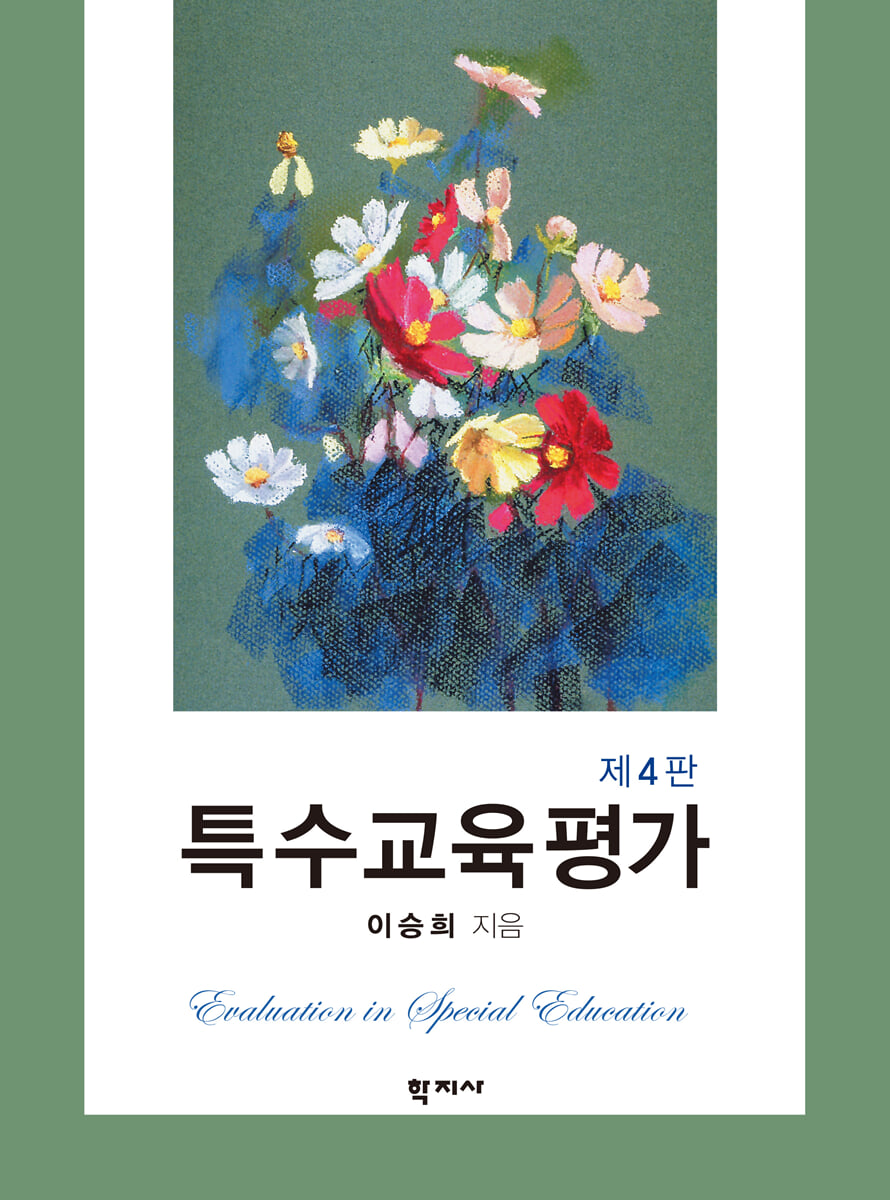
Special Education Evaluation
 |
Description
Book Introduction
The revised contents of the 4th edition are briefly introduced according to the table of contents of the book.
First, in ‘Chapter 1 Understanding Evaluation’, ‘Official Evaluation and Informal Evaluation’ was added as [Supplementary Explanation 1-2] to supplement the content on formal and informal evaluation.
Second, in 'Chapter 2 Basic Concepts of Measurement', 'Growth-referenced assessment and ability-referenced assessment' were added as [Supplementary Explanation 2-3] to supplement the contents on norm-referenced assessment and criterion-referenced assessment, and in relation to index scores, 'Example of index score calculation' was presented in [Supplementary Explanation 2-5], and 〈Figure 2-10〉 was added to help understand the relationship between validity and reliability, and 'Objectivity and Practicality' were added to the text to explain in addition to validity and reliability.
Third, in ‘Chapter 4 Observation’, the types of observation were added, the types and types of recording methods were modified, and intra-observer reliability was additionally explained in comparison with inter-observer reliability.
Fourth, in ‘Chapter 5 Interview’, the interview types have been revised and supplemented.
Fifth, in ‘Chapter 7 Performance Assessment’, ‘process-centered evaluation’ introduced in Korean schools along with the revised 2015 curriculum is briefly introduced in [Supplementary Explanation 7-2].
Sixth, in ‘Part 3 Assessment Tools’, the titles of ‘Chapter 13 Perception and Movement’ and ‘Chapter 14 Adaptive Behavior’ were revised to ‘Chapter 13 Sensory/Perception and Movement’ and ‘Chapter 14 Adaptive Behavior and Support Needs’, respectively, and assessment tools were deleted or added in all chapters (Chapters 9, 10, 11, 12, 13, 14, 15, and 17) except for ‘Chapter 16 Special Area I: Attention Deficit Hyperactivity Disorder’, resulting in a total of 78 assessment tools introduced, which is an increase of 2 from the 3rd edition.
Seventh, the glossary of terms has revised the definitions of existing terms (e.g., formal circumstances, informal circumstances, etc.) where necessary, and also provided definitions for terms added in the 4th edition (e.g., formal evaluation, informal evaluation, etc.).
Eighth, I checked the notes I had made while looking at the third edition to see if there were any areas that needed correction or supplementation, and tried to reflect them as much as possible.
First, in ‘Chapter 1 Understanding Evaluation’, ‘Official Evaluation and Informal Evaluation’ was added as [Supplementary Explanation 1-2] to supplement the content on formal and informal evaluation.
Second, in 'Chapter 2 Basic Concepts of Measurement', 'Growth-referenced assessment and ability-referenced assessment' were added as [Supplementary Explanation 2-3] to supplement the contents on norm-referenced assessment and criterion-referenced assessment, and in relation to index scores, 'Example of index score calculation' was presented in [Supplementary Explanation 2-5], and 〈Figure 2-10〉 was added to help understand the relationship between validity and reliability, and 'Objectivity and Practicality' were added to the text to explain in addition to validity and reliability.
Third, in ‘Chapter 4 Observation’, the types of observation were added, the types and types of recording methods were modified, and intra-observer reliability was additionally explained in comparison with inter-observer reliability.
Fourth, in ‘Chapter 5 Interview’, the interview types have been revised and supplemented.
Fifth, in ‘Chapter 7 Performance Assessment’, ‘process-centered evaluation’ introduced in Korean schools along with the revised 2015 curriculum is briefly introduced in [Supplementary Explanation 7-2].
Sixth, in ‘Part 3 Assessment Tools’, the titles of ‘Chapter 13 Perception and Movement’ and ‘Chapter 14 Adaptive Behavior’ were revised to ‘Chapter 13 Sensory/Perception and Movement’ and ‘Chapter 14 Adaptive Behavior and Support Needs’, respectively, and assessment tools were deleted or added in all chapters (Chapters 9, 10, 11, 12, 13, 14, 15, and 17) except for ‘Chapter 16 Special Area I: Attention Deficit Hyperactivity Disorder’, resulting in a total of 78 assessment tools introduced, which is an increase of 2 from the 3rd edition.
Seventh, the glossary of terms has revised the definitions of existing terms (e.g., formal circumstances, informal circumstances, etc.) where necessary, and also provided definitions for terms added in the 4th edition (e.g., formal evaluation, informal evaluation, etc.).
Eighth, I checked the notes I had made while looking at the third edition to see if there were any areas that needed correction or supplementation, and tried to reflect them as much as possible.
index
Preface [4th Edition]
Preface [3rd Edition]
Preface [2nd Edition]
Preface [1st Edition]
Part 1 Overview
Chapter 1: Understanding Evaluation
1.
The concept of evaluation
2.
Stages of evaluation
3.
Types of assessment methods
4.
Classification of assessment methods
Chapter 2: Basic Concepts of Measurement
1.
Descriptive statistics
2.
standardization
3.
Types of scores
4.
Validity
5.
Reliability
6.
Objectivity and practicality
Part 2: Method of assessment
Chapter 3 Inspection
1.
Norm-referenced test
2.
Criterion-referenced test
3.
Comparison of norm-referenced and criterion-referenced tests
Chapter 4 Observation
1.
Stages of observation
2.
Types of observation
3.
Method of recording observations
4.
Validity and reliability of observations
Chapter 5 Interview
1.
Interview stages
2.
Types of interviews
3.
Validity and reliability of interviews
Chapter 6 Curriculum-Centered Assessment
1.
Reference-based curriculum-centered assessment
2.
Curriculum-centered measurement
3. Comparison of CR-CBA and CBM
Chapter 7 Performance Circumstances
1.
Characteristics of performance circumstances
2.
Preparation for performance
3.
Validity and reliability of performance assessment
4.
Pros and Cons of Performance Appraisal
Chapter 8 Portfolio Assessment
1.
Characteristics of portfolio management
2.
Preparing for portfolio assessment
3.
Validity and reliability of portfolio assessment
4.
Pros and Cons of Portfolio Assessment
Part 3: Investigation Tools
Chapter 9 Intelligence
1.
Comprehensive Cognitive Function Diagnostic Test
2.
Korean Nonverbal Intelligence Test (KNIT)-2nd Edition
3.
Korean Wechsler Intelligence Scale for Children (5th edition)
4.
Korean Wechsler Intelligence Scale for Early Childhood (4th edition)
5.
Korean Version of the Lighter Nonverbal Intelligence Test (Revised)
6.
Korean version of color progressive matrix
7.
Korean version of Kaufman Brief Intelligence Test 2
8.
Korean version of KABC-II
9. KISE Korean Individual Intelligence Test
Chapter 10 Communication
1.
Phrase comprehension test
2.
Receptive and Expressive Vocabulary Test
3.
Korean version of the Boston Name Waiting Test for Children
4.
Language Problem Solving Test
5.
Infant and Toddler Language Development Test
6.
Korean Articulation and Phonology Test 2
7.
Receptive and Expressive Language Development Scales for Preschool Children
8.
Paradise Fluency Test-II
9.
Language tests for school-age children
10.
Korean Children's Stuttering Test
11.
Korean Children's Token Test-2nd Edition
12.
Korean Standard Picture Articulation and Phonological Test
13.
Korean MacArthur-Bates Communication Development Assessment
14.
Korean version of the Infant and Toddler Language and Communication Development Test
15.
Korean Standard Receptive Vocabulary Test
Chapter 11 Learning
1.
Basic Learning Function Performance Evaluation System - Mathematics Test
2.
Basic Learning Function Performance Evaluation System - Writing Test
3.
Basic Learning Skills Performance Evaluation System - Reading Test (2nd Edition)
4.
Basic Learning Skills Performance Evaluation System - Reading Comprehension
5.
Basic Learning Function Performance Evaluation System - Early Mathematics
6.
Comprehensive Basic Learning Ability Test
7.
Writing Achievement and Writing Cognitive Processing Tests
8.
Reading Achievement and Reading Cognitive Processing Tests
9.
Reading and writing tests for middle and high school students
10.
Learning Disability Screening Test
11.
Korean version of the Learning Disabilities Rating Scale
12. KISE Basic Academic Ability Test
Chapter 12 Emotions and Behavior
1.
Social Skills and Problem Behavior Test
2.
Youth Personality Assessment Questionnaire (Expanded Edition)
3.
Youth Behavior Rating Scale - Teacher Version
4.
Youth Behavior Rating Scale - Parent Version
5.
Youth Behavior Rating Scale - for Adolescents
6.
Korean Child and Adolescent Personality Assessment Scale - Teacher Evaluation
7.
Korean Child and Adolescent Personality Rating Scale - Self-Report
8.
Korean version of the Child Anxiety Scale-2nd edition
9.
Korean version of the Child Depression Scale-2nd edition
10.
Korean version of the Child and Adolescent Behavior Rating Scale
11.
Korean version of the Child Behavior Rating Scale
12.
Korean version of the Emotional and Behavioral Problems Test (2nd edition)
Chapter 13: Sensation/Perception and Movement
1.
Korean version of Sensory Profile 2
2.
Korean Visual Perception Development Test for Adolescents
3.
Korean version of the Visual Perception Test
4.
Korean Version of the Visual Perception Development Test for Children-3rd Edition
Chapter 14: Adaptive Behaviors and Support Needs
1.
Community Adaptation Test-2nd Edition
2.
Korean Vineland Adaptive Behavior Scales (2nd Edition)
3.
Korean version of the Child Support Scale
4.
Korean version of the Adaptive Behavior Test
5. KISE Adaptive Behavior Test
Chapter 15 Infant and Toddler Development
1.
Infant Development Test
2.
Assessment, Evaluation, and Program System for Infants and Toddlers
3.
Korean Infant and Toddler Development Screening Test - Revised Edition
4.
Korean Infant Development Test
5.
Korean version of Child Development Test
6.
Korean version of ASQ
7.
Korean version of DIAL-3
8.
Korean Bailey Scales of Infant and Toddler Development (3rd Edition)
9.
Korean Denver II
Chapter 16 Special Area I: Attention Deficit Hyperactivity Disorder
1.
Korean Attention Deficit Hyperactivity Disorder Diagnostic Test
2. FACT-II Personal Adaptive Attention Test
3. FAIR Attention Test
Chapter 17 Special Area II: Autism Spectrum Disorder
1.
Toddler Behavioral Development Screening Scale-Play
2.
Toddler Behavioral Development Screening Scale-Interview
3.
Denver Model Development Checklist
4.
Social Communication Questionnaire
5.
Psychoeducational Profile
6.
Autism Diagnostic Observation Schedule-2
7.
Autism Diagnostic Interview - Revised Edition
8.
Korean Autism Spectrum Disorder Diagnostic Test
9.
Korean Childhood Autism Rating Scale-2
Glossary
References
Search
Preface [3rd Edition]
Preface [2nd Edition]
Preface [1st Edition]
Part 1 Overview
Chapter 1: Understanding Evaluation
1.
The concept of evaluation
2.
Stages of evaluation
3.
Types of assessment methods
4.
Classification of assessment methods
Chapter 2: Basic Concepts of Measurement
1.
Descriptive statistics
2.
standardization
3.
Types of scores
4.
Validity
5.
Reliability
6.
Objectivity and practicality
Part 2: Method of assessment
Chapter 3 Inspection
1.
Norm-referenced test
2.
Criterion-referenced test
3.
Comparison of norm-referenced and criterion-referenced tests
Chapter 4 Observation
1.
Stages of observation
2.
Types of observation
3.
Method of recording observations
4.
Validity and reliability of observations
Chapter 5 Interview
1.
Interview stages
2.
Types of interviews
3.
Validity and reliability of interviews
Chapter 6 Curriculum-Centered Assessment
1.
Reference-based curriculum-centered assessment
2.
Curriculum-centered measurement
3. Comparison of CR-CBA and CBM
Chapter 7 Performance Circumstances
1.
Characteristics of performance circumstances
2.
Preparation for performance
3.
Validity and reliability of performance assessment
4.
Pros and Cons of Performance Appraisal
Chapter 8 Portfolio Assessment
1.
Characteristics of portfolio management
2.
Preparing for portfolio assessment
3.
Validity and reliability of portfolio assessment
4.
Pros and Cons of Portfolio Assessment
Part 3: Investigation Tools
Chapter 9 Intelligence
1.
Comprehensive Cognitive Function Diagnostic Test
2.
Korean Nonverbal Intelligence Test (KNIT)-2nd Edition
3.
Korean Wechsler Intelligence Scale for Children (5th edition)
4.
Korean Wechsler Intelligence Scale for Early Childhood (4th edition)
5.
Korean Version of the Lighter Nonverbal Intelligence Test (Revised)
6.
Korean version of color progressive matrix
7.
Korean version of Kaufman Brief Intelligence Test 2
8.
Korean version of KABC-II
9. KISE Korean Individual Intelligence Test
Chapter 10 Communication
1.
Phrase comprehension test
2.
Receptive and Expressive Vocabulary Test
3.
Korean version of the Boston Name Waiting Test for Children
4.
Language Problem Solving Test
5.
Infant and Toddler Language Development Test
6.
Korean Articulation and Phonology Test 2
7.
Receptive and Expressive Language Development Scales for Preschool Children
8.
Paradise Fluency Test-II
9.
Language tests for school-age children
10.
Korean Children's Stuttering Test
11.
Korean Children's Token Test-2nd Edition
12.
Korean Standard Picture Articulation and Phonological Test
13.
Korean MacArthur-Bates Communication Development Assessment
14.
Korean version of the Infant and Toddler Language and Communication Development Test
15.
Korean Standard Receptive Vocabulary Test
Chapter 11 Learning
1.
Basic Learning Function Performance Evaluation System - Mathematics Test
2.
Basic Learning Function Performance Evaluation System - Writing Test
3.
Basic Learning Skills Performance Evaluation System - Reading Test (2nd Edition)
4.
Basic Learning Skills Performance Evaluation System - Reading Comprehension
5.
Basic Learning Function Performance Evaluation System - Early Mathematics
6.
Comprehensive Basic Learning Ability Test
7.
Writing Achievement and Writing Cognitive Processing Tests
8.
Reading Achievement and Reading Cognitive Processing Tests
9.
Reading and writing tests for middle and high school students
10.
Learning Disability Screening Test
11.
Korean version of the Learning Disabilities Rating Scale
12. KISE Basic Academic Ability Test
Chapter 12 Emotions and Behavior
1.
Social Skills and Problem Behavior Test
2.
Youth Personality Assessment Questionnaire (Expanded Edition)
3.
Youth Behavior Rating Scale - Teacher Version
4.
Youth Behavior Rating Scale - Parent Version
5.
Youth Behavior Rating Scale - for Adolescents
6.
Korean Child and Adolescent Personality Assessment Scale - Teacher Evaluation
7.
Korean Child and Adolescent Personality Rating Scale - Self-Report
8.
Korean version of the Child Anxiety Scale-2nd edition
9.
Korean version of the Child Depression Scale-2nd edition
10.
Korean version of the Child and Adolescent Behavior Rating Scale
11.
Korean version of the Child Behavior Rating Scale
12.
Korean version of the Emotional and Behavioral Problems Test (2nd edition)
Chapter 13: Sensation/Perception and Movement
1.
Korean version of Sensory Profile 2
2.
Korean Visual Perception Development Test for Adolescents
3.
Korean version of the Visual Perception Test
4.
Korean Version of the Visual Perception Development Test for Children-3rd Edition
Chapter 14: Adaptive Behaviors and Support Needs
1.
Community Adaptation Test-2nd Edition
2.
Korean Vineland Adaptive Behavior Scales (2nd Edition)
3.
Korean version of the Child Support Scale
4.
Korean version of the Adaptive Behavior Test
5. KISE Adaptive Behavior Test
Chapter 15 Infant and Toddler Development
1.
Infant Development Test
2.
Assessment, Evaluation, and Program System for Infants and Toddlers
3.
Korean Infant and Toddler Development Screening Test - Revised Edition
4.
Korean Infant Development Test
5.
Korean version of Child Development Test
6.
Korean version of ASQ
7.
Korean version of DIAL-3
8.
Korean Bailey Scales of Infant and Toddler Development (3rd Edition)
9.
Korean Denver II
Chapter 16 Special Area I: Attention Deficit Hyperactivity Disorder
1.
Korean Attention Deficit Hyperactivity Disorder Diagnostic Test
2. FACT-II Personal Adaptive Attention Test
3. FAIR Attention Test
Chapter 17 Special Area II: Autism Spectrum Disorder
1.
Toddler Behavioral Development Screening Scale-Play
2.
Toddler Behavioral Development Screening Scale-Interview
3.
Denver Model Development Checklist
4.
Social Communication Questionnaire
5.
Psychoeducational Profile
6.
Autism Diagnostic Observation Schedule-2
7.
Autism Diagnostic Interview - Revised Edition
8.
Korean Autism Spectrum Disorder Diagnostic Test
9.
Korean Childhood Autism Rating Scale-2
Glossary
References
Search
GOODS SPECIFICS
- Date of issue: September 20, 2024
- Format: Paperback book binding method guide
- Page count, weight, size: 480 pages | 1,200g | 188*255*27mm
- ISBN13: 9788999731990
- ISBN10: 8999731995
You may also like
카테고리
korean


korean

![GQ KOREA Mark (Monthly): December [2025]](http://librairie.coreenne.fr/cdn/shop/files/8ef265dbbfbf186523ed75ba7319009d.jpg?v=1765340328&width=3840)


