

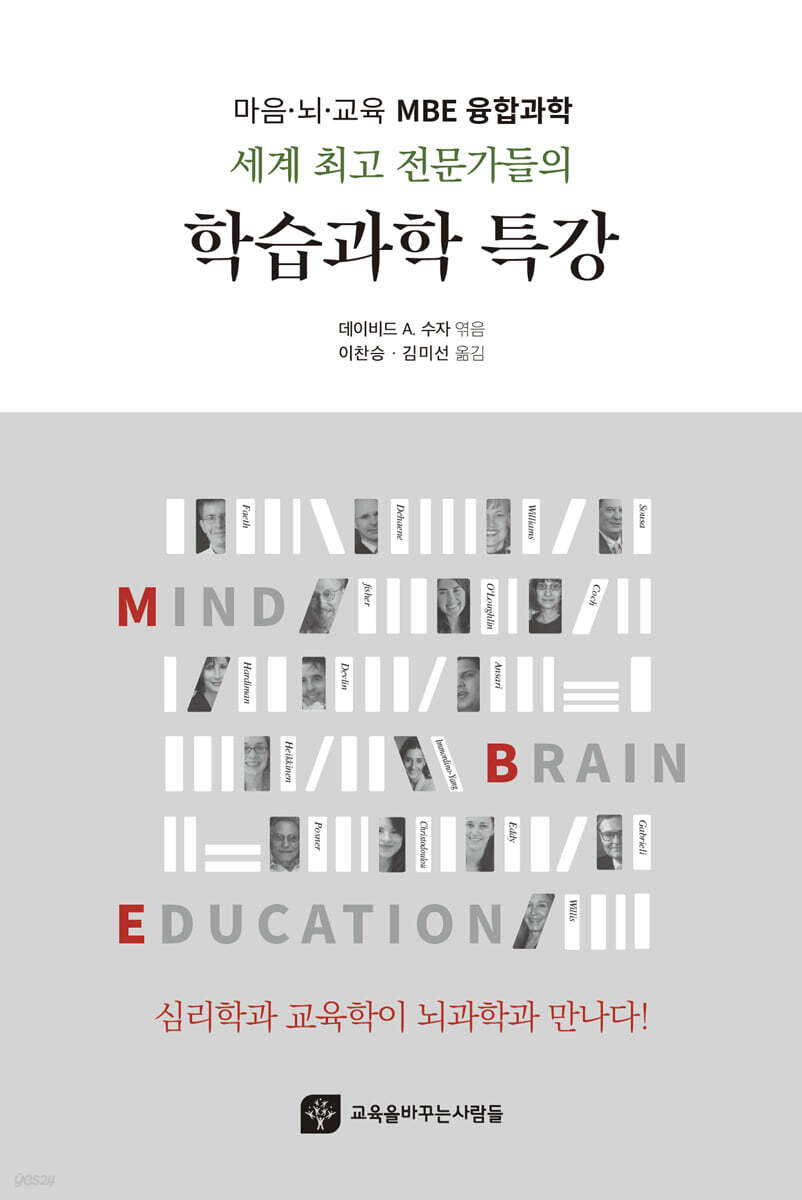
Special lectures on learning science from the world's top experts
 |
Description
Book Introduction
Presenting a New Perspective on 21st Century Education - Mind-Brain Education MBE Convergence Science
Special lectures on learning science from the world's top experts
Mind, Brain, and Education is a new convergence science born from the convergence of psychology, brain science, and education.
This book brings together leading experts in the fields of mind, brain, and education, who have led the way in the development of this field, to share their research findings and discuss their future prospects.
Learning takes place in the 'brain'.
For hundreds of years, teachers have taught students based on experience and guesswork, with little understanding of how the brain learns.
However, now, with the advancement of neuroimaging technology, it is possible to directly observe how the brain works and study the mechanisms of learning in depth.
Accordingly, psychology, brain science, and education came together to create a convergence science called 'Educational Neuroscience'.
This book is written by the main author, David A.
This book contains the research results of 17 authors who are considered the world's leading learning science experts, including Suja, Judy Willis, Daniel Ansari, and Stanislas Dehaene.
The authors present detailed research findings on how the brain learns as revealed by neuroimaging technology, the impact of emotions on learning, the learning paths and teaching strategies through which children learn language and arithmetic, teaching methods that can foster creativity, and the relationship between artistic activities and brain development. They then propose various methods that can be applied to teaching and learning.
In 21st-century education, the role of teachers will expand to 'changing the brain,' and MBE learning science will present a new future for teaching and learning.
Special lectures on learning science from the world's top experts
Mind, Brain, and Education is a new convergence science born from the convergence of psychology, brain science, and education.
This book brings together leading experts in the fields of mind, brain, and education, who have led the way in the development of this field, to share their research findings and discuss their future prospects.
Learning takes place in the 'brain'.
For hundreds of years, teachers have taught students based on experience and guesswork, with little understanding of how the brain learns.
However, now, with the advancement of neuroimaging technology, it is possible to directly observe how the brain works and study the mechanisms of learning in depth.
Accordingly, psychology, brain science, and education came together to create a convergence science called 'Educational Neuroscience'.
This book is written by the main author, David A.
This book contains the research results of 17 authors who are considered the world's leading learning science experts, including Suja, Judy Willis, Daniel Ansari, and Stanislas Dehaene.
The authors present detailed research findings on how the brain learns as revealed by neuroimaging technology, the impact of emotions on learning, the learning paths and teaching strategies through which children learn language and arithmetic, teaching methods that can foster creativity, and the relationship between artistic activities and brain development. They then propose various methods that can be applied to teaching and learning.
In 21st-century education, the role of teachers will expand to 'changing the brain,' and MBE learning science will present a new future for teaching and learning.
- You can preview some of the book's contents.
Preview
index
Foreword/ David A.
Number
Chapter 1: The Birth of Convergence Science: Mind, Brain, and Education / David A.
Number 19
How did cognitive psychology, neuroscience, and education come together?
About the Author
References
Chapter 2: Advances in Neuroimaging and Educational Neuroscience / Michael I.
Posner 47
How has neuroimaging technology evolved, and what crucial role has it played in education?
About the Author
References
Chapter 3: The Impact of Neuroscience on Teaching and Learning / Judy Willis 75
As a neurologist and teacher, why did I become an evangelist for learning science?
About the Author
References
The Role of Emotions and Intuition in Learning / Mary Helen Immordino-Yang and Matthias Paes 111
How do emotions influence learning, and what is effective social and emotional education?
About the Author
References
Lecture 5: The Talking Brain / Diane L.
Williams 135
What are some common misconceptions about language development, and how does the brain learn to speak?
About the Author
References
The Reading Brain: Lesson 6 / John Gabrielli, Joanna A.
Christodoulou, Trisha O'Lourin, and Marianna D.
Addy 169
How does the brain learn to read, and what are the causes and solutions for dyslexia?
About the Author
References
Lesson 7: Building a Reading Brain / Donna Koch 205
How does a child's brain learn to read, and what are effective strategies?
About the Author
References
The Brain That Does Math in the Quarterfinals / Keith Devlin 239
How did the brain acquire mathematical abilities?
About the Author
References
Lesson 9: The Brain Performing Simple Calculations / Stanislas D'Anne 263
How do children's number concepts develop, and what are effective ways to improve their arithmetic skills?
About the Author
References
Lecture 10: The Brain That Performs Complex Calculations / Daniel Ansari 293
How does the brain represent numbers and quantities, and what are the causes and solutions for developmental dyscalculia?
About the Author
References
Lecture 11: The Creative-Artistic Brain / Mariel M.
Hardiman 327
How does art enhance creativity, and what are brain-friendly teaching models?
About the Author
References
Lecture 12: The Future of Educational Neuroscience / Kurt W.
Fisher, Katie Heikkinen 357
What changes will educational neuroscience bring to the education sector in the future?
Glossary 390
Search 393
About the Editor 397
Number
Chapter 1: The Birth of Convergence Science: Mind, Brain, and Education / David A.
Number 19
How did cognitive psychology, neuroscience, and education come together?
About the Author
References
Chapter 2: Advances in Neuroimaging and Educational Neuroscience / Michael I.
Posner 47
How has neuroimaging technology evolved, and what crucial role has it played in education?
About the Author
References
Chapter 3: The Impact of Neuroscience on Teaching and Learning / Judy Willis 75
As a neurologist and teacher, why did I become an evangelist for learning science?
About the Author
References
The Role of Emotions and Intuition in Learning / Mary Helen Immordino-Yang and Matthias Paes 111
How do emotions influence learning, and what is effective social and emotional education?
About the Author
References
Lecture 5: The Talking Brain / Diane L.
Williams 135
What are some common misconceptions about language development, and how does the brain learn to speak?
About the Author
References
The Reading Brain: Lesson 6 / John Gabrielli, Joanna A.
Christodoulou, Trisha O'Lourin, and Marianna D.
Addy 169
How does the brain learn to read, and what are the causes and solutions for dyslexia?
About the Author
References
Lesson 7: Building a Reading Brain / Donna Koch 205
How does a child's brain learn to read, and what are effective strategies?
About the Author
References
The Brain That Does Math in the Quarterfinals / Keith Devlin 239
How did the brain acquire mathematical abilities?
About the Author
References
Lesson 9: The Brain Performing Simple Calculations / Stanislas D'Anne 263
How do children's number concepts develop, and what are effective ways to improve their arithmetic skills?
About the Author
References
Lecture 10: The Brain That Performs Complex Calculations / Daniel Ansari 293
How does the brain represent numbers and quantities, and what are the causes and solutions for developmental dyscalculia?
About the Author
References
Lecture 11: The Creative-Artistic Brain / Mariel M.
Hardiman 327
How does art enhance creativity, and what are brain-friendly teaching models?
About the Author
References
Lecture 12: The Future of Educational Neuroscience / Kurt W.
Fisher, Katie Heikkinen 357
What changes will educational neuroscience bring to the education sector in the future?
Glossary 390
Search 393
About the Editor 397
Detailed image
Into the book
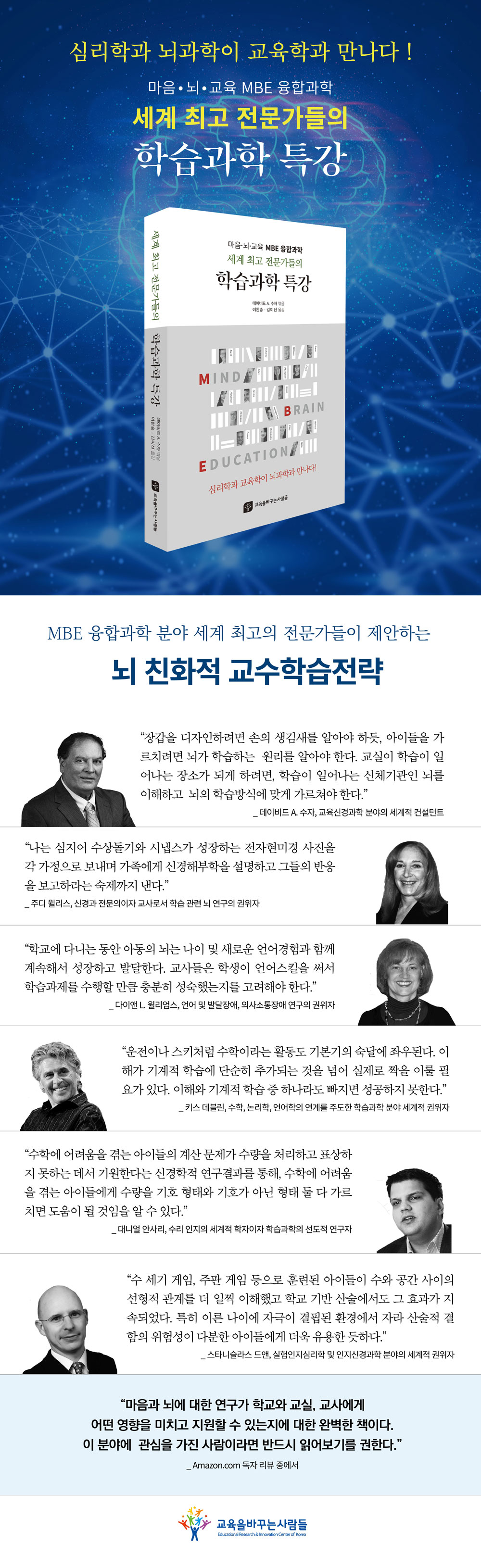
You now hold in your hands a book that will go down in history as one of the most important studies in the history of education.
This is the first book to bring together scholars who played a pivotal role in the creation of a new field of study called Educational Neuroscience.
--- p.9
Teachers are ultimately 'people who change the brain.'
They are changing their brains every day.
As long as neuroscientists continue to study what goes on inside the brain, as long as cognitive psychologists continue to try to explain learning and behavior, and as long as educators continue to apply their research findings to improve teaching methods, this emerging field will not only grow into a standalone discipline, but will also provide our children with a much more enriching educational experience.
--- p.42
When I shared this neuroplasticity information with my students through "The Brain's User Manual," they were significantly more motivated to study and review.
Neuroplasticity is the idea that, just as muscles are strengthened through repeated exercise, neural networks and memories are also strengthened through neural activation through review and practice.
When you share this knowledge with your students, they will begin to believe you when you say, "We can finish learning about least common denominators forever in this hour."
--- p.96
The highest-paying jobs of the future will likely be those that can't be done on computers.
To prepare for these opportunities, students need conceptual thinking skills to solve problems no one has yet solved.
Students who want to succeed in the future will need competencies that go far beyond the content currently assessed on standardized tests.
That means you'll need to think critically, communicate clearly, use constantly evolving technologies, be culturally savvy, adaptable, have sound judgment, be open-minded, and make complex decisions based on accurate information analysis.
The key to success lies in the collaboration between scientists and teachers.
--- p.103
For the first time, neuroscience research has shown which parts of the brain are activated when reading, how the brain supports different languages and writing systems differently, how the reading brain develops, and what the dyslexic brain looks like and how to effectively treat it.
The fundamental question is how the methods and knowledge of neuroscience can benefit teaching methods and educational policy.
While it would be beneficial to have a deeper understanding of what brain regions typically change when we read, it would be more important to understand precisely how neuroscience can be applied to education.
A primary goal might be to identify and treat dyslexia (Gabrieli, 2009).
--- p.193~194
I hope that more than anyone else, teachers and parents will read this chapter and realize that the "reading brain" is complexly structured and incredibly plastic.
To build a reading brain, several subsystems must be developed and connected.
To build a brain that can read, training and experience—that is, education—must focus on developing the reading subsystem (Berninger & Richards, 2002; Schlaggar & McCandliss, 2007).
Because the subsystems of the brain involved in reading are complexly interconnected, there are many reasons why children have difficulty reading (Spear-Swerling, 2004).
Understanding how the reading brain is structured will help us understand how the reading brain breaks down.
--- p.226
For most students, algebra is their first encounter with typical modern mathematical thinking: precise, logical, analytical thinking about purely abstract concepts.
Experienced mathematicians may feel that such thinking is 'innate', but it is the result of training and practice.
The brain never feels such thoughts naturally.
It must be learned.
The only known way to learn this is a top-down approach.
First, learn the rules, and then apply them, and you will learn and understand their meaning.
Because the human brain is wired to find meaning and understanding in everything it experiences.
--- p.256
I emphasized that children's arithmetic ability is based on a rudimentary representation of round numbers, a representation we inherited from our evolutionary past and which relies on the parietal cortex of the brain.
However, it was also emphasized that the development of arithmetic relied heavily on the ability to link these quantity representations with linguistic or Arabic numeral symbols, as well as on the reuse of nearby cortical areas involved in spatial representation.
A fundamental goal of mathematics education is to enable these representations to interact with each other fluently and automatically.
Fluency and automaticity are both essential in their own right, particularly because they refine our concepts and lead to accurate linear representations of numbers, and because they free up the prefrontal cortex's versatile working memory resources for other purposes.
--- p.288
One of the biggest challenges facing neuroscientific research on the brain's ability to perform complex computational tasks is investigating how brain activation, which underlies quantitative processing and solving during mental arithmetic tasks, changes with training and experience.
As discussed in the previous chapter, brain research related to reading has shown that well-designed intervention programs can normalize the atypical brain activation patterns of dyslexia (Eden et al., 2004; Shaywitz et al., 2004; Temple et al., 2003).
Such findings raise the question of whether programs designed to improve the computational skills of children struggling with math might also rewire neurons.
Furthermore, because several findings point to atypical activation of the parietal cortex as a hallmark of math difficulties, researchers need to investigate whether educational remediation programs can restore normal activation in the brains of math-challenged individuals and how math and arithmetic training programs alter brain activation patterns.
--- p.318
Cognitive and neuroscience research is beginning to connect the dots between how art influences non-art fields.
For example, music and dance have been shown to aid memory processing through the mediation of mirror neurons (Cross et al., 2006).
The level of mirror neuron activation appears to be similar when a subject performs a movement or observes someone else performing the same movement.
According to research published by the Dana Foundation Arts and Cognition Consortium (2008), there is a close correlation between exposure to the arts and improved cognitive and attentional abilities for learning (www.dana.org).
--- p.339
To increase student participation in class, a positive emotional climate must be created.
This way, we can encourage each person to contribute to creating class outcomes.
To do this, students' anxiety must be low and their engagement must be high.
For each class, I choose appropriate arts integration activities, such as making posters, performing, or writing letters.
When students feel supported, they feel more confident and more willing to engage in activities that require critical thinking.
When I assess student learning, I also encourage students to view those moments as opportunities to "show me what they know," and even then, the most important thing is to maintain an emotional connection with the students.
In my classroom, assessment is a celebration of learning.
The emotional atmosphere throughout the brain-friendly class is most crucial to learning success.
This is the first book to bring together scholars who played a pivotal role in the creation of a new field of study called Educational Neuroscience.
--- p.9
Teachers are ultimately 'people who change the brain.'
They are changing their brains every day.
As long as neuroscientists continue to study what goes on inside the brain, as long as cognitive psychologists continue to try to explain learning and behavior, and as long as educators continue to apply their research findings to improve teaching methods, this emerging field will not only grow into a standalone discipline, but will also provide our children with a much more enriching educational experience.
--- p.42
When I shared this neuroplasticity information with my students through "The Brain's User Manual," they were significantly more motivated to study and review.
Neuroplasticity is the idea that, just as muscles are strengthened through repeated exercise, neural networks and memories are also strengthened through neural activation through review and practice.
When you share this knowledge with your students, they will begin to believe you when you say, "We can finish learning about least common denominators forever in this hour."
--- p.96
The highest-paying jobs of the future will likely be those that can't be done on computers.
To prepare for these opportunities, students need conceptual thinking skills to solve problems no one has yet solved.
Students who want to succeed in the future will need competencies that go far beyond the content currently assessed on standardized tests.
That means you'll need to think critically, communicate clearly, use constantly evolving technologies, be culturally savvy, adaptable, have sound judgment, be open-minded, and make complex decisions based on accurate information analysis.
The key to success lies in the collaboration between scientists and teachers.
--- p.103
For the first time, neuroscience research has shown which parts of the brain are activated when reading, how the brain supports different languages and writing systems differently, how the reading brain develops, and what the dyslexic brain looks like and how to effectively treat it.
The fundamental question is how the methods and knowledge of neuroscience can benefit teaching methods and educational policy.
While it would be beneficial to have a deeper understanding of what brain regions typically change when we read, it would be more important to understand precisely how neuroscience can be applied to education.
A primary goal might be to identify and treat dyslexia (Gabrieli, 2009).
--- p.193~194
I hope that more than anyone else, teachers and parents will read this chapter and realize that the "reading brain" is complexly structured and incredibly plastic.
To build a reading brain, several subsystems must be developed and connected.
To build a brain that can read, training and experience—that is, education—must focus on developing the reading subsystem (Berninger & Richards, 2002; Schlaggar & McCandliss, 2007).
Because the subsystems of the brain involved in reading are complexly interconnected, there are many reasons why children have difficulty reading (Spear-Swerling, 2004).
Understanding how the reading brain is structured will help us understand how the reading brain breaks down.
--- p.226
For most students, algebra is their first encounter with typical modern mathematical thinking: precise, logical, analytical thinking about purely abstract concepts.
Experienced mathematicians may feel that such thinking is 'innate', but it is the result of training and practice.
The brain never feels such thoughts naturally.
It must be learned.
The only known way to learn this is a top-down approach.
First, learn the rules, and then apply them, and you will learn and understand their meaning.
Because the human brain is wired to find meaning and understanding in everything it experiences.
--- p.256
I emphasized that children's arithmetic ability is based on a rudimentary representation of round numbers, a representation we inherited from our evolutionary past and which relies on the parietal cortex of the brain.
However, it was also emphasized that the development of arithmetic relied heavily on the ability to link these quantity representations with linguistic or Arabic numeral symbols, as well as on the reuse of nearby cortical areas involved in spatial representation.
A fundamental goal of mathematics education is to enable these representations to interact with each other fluently and automatically.
Fluency and automaticity are both essential in their own right, particularly because they refine our concepts and lead to accurate linear representations of numbers, and because they free up the prefrontal cortex's versatile working memory resources for other purposes.
--- p.288
One of the biggest challenges facing neuroscientific research on the brain's ability to perform complex computational tasks is investigating how brain activation, which underlies quantitative processing and solving during mental arithmetic tasks, changes with training and experience.
As discussed in the previous chapter, brain research related to reading has shown that well-designed intervention programs can normalize the atypical brain activation patterns of dyslexia (Eden et al., 2004; Shaywitz et al., 2004; Temple et al., 2003).
Such findings raise the question of whether programs designed to improve the computational skills of children struggling with math might also rewire neurons.
Furthermore, because several findings point to atypical activation of the parietal cortex as a hallmark of math difficulties, researchers need to investigate whether educational remediation programs can restore normal activation in the brains of math-challenged individuals and how math and arithmetic training programs alter brain activation patterns.
--- p.318
Cognitive and neuroscience research is beginning to connect the dots between how art influences non-art fields.
For example, music and dance have been shown to aid memory processing through the mediation of mirror neurons (Cross et al., 2006).
The level of mirror neuron activation appears to be similar when a subject performs a movement or observes someone else performing the same movement.
According to research published by the Dana Foundation Arts and Cognition Consortium (2008), there is a close correlation between exposure to the arts and improved cognitive and attentional abilities for learning (www.dana.org).
--- p.339
To increase student participation in class, a positive emotional climate must be created.
This way, we can encourage each person to contribute to creating class outcomes.
To do this, students' anxiety must be low and their engagement must be high.
For each class, I choose appropriate arts integration activities, such as making posters, performing, or writing letters.
When students feel supported, they feel more confident and more willing to engage in activities that require critical thinking.
When I assess student learning, I also encourage students to view those moments as opportunities to "show me what they know," and even then, the most important thing is to maintain an emotional connection with the students.
In my classroom, assessment is a celebration of learning.
The emotional atmosphere throughout the brain-friendly class is most crucial to learning success.
--- p.343
Publisher's Review
MBE Convergence Science Offers a New Perspective on Education
MBE Convergence Science, or Mind, Brain, and Education, is a convergence discipline that explores a new vision for education by combining brain science, neuroscience, and education.
It is sometimes called Brain-based Education, Brain-friendly Education, or Educational Neuroscience, but all of these are fields in which neuroscientists, neuroscientists, and educators put their heads together to explore new possibilities by observing brain activity through the development of brain imaging technology and how to interpret the brain's learning mechanisms and utilize them in education.
This book examines how this field emerged, what learning principles have been revealed by brain and cognitive science, and what these research findings mean for education.
Why should educators understand mind, brain, and education?
This book will be particularly useful to teachers, parents, educators, and researchers in the field of teaching and learning.
No one would think that simply sitting down students who are distracted and have difficulty concentrating and presenting them with easily understandable content from a textbook would be enough to provide proper education.
The most important thing we have learned through the development of brain imaging technology, which has enabled us to observe brain activity, is that the brain is not a fixed entity, but is reorganized and grows through experience.
If you are an educator who reflects on what to teach, how to teach it, and more fundamentally, why to teach it, in order to provide an education that will be helpful in the world in which children will live, you need to read this book.
If a teacher's responsibility has been to impart knowledge until now, in the future it will be to change students' brains.
It is necessary to deeply understand how the brain learns and to study in depth what strategies are appropriate to teach in accordance with the brain's learning principles.
What are the benefits of knowing about mind, brain, and education?
Anyone who teaches has probably thought about this at least once.
When teaching in a similar way, why do some children follow along well and others not, why do some children get bored and others find it interesting, and why do some years feel rewarding and others just difficult?
Existing teaching strategies only claim that teaching is effective, but they do not provide evidence for this.
Mind, Brain, and Education provide the answer to that 'why.'
Learning happens in the 'brain'.
Cognitive scientists have discovered the brain's learning mechanisms based on observations using brain imaging technology of how the brain changes when learning occurs.
By deeply understanding the learning principles and new perceptions of learners that have been revealed in this way, we can secure the basis for why certain strategies are effective.
What are the virtues of this book?
This book brings together leading experts in the fields of mind, brain, and education, who have led the way in advancing the field, to present a comprehensive analysis of how the field has evolved, what its key findings have been, and how it will evolve in the future.
Our contributors are leading theorists and practitioners in their respective fields, presenting sound scientifically-based arguments.
Therefore, the information revealed in this book is highly reliable.
The cognitive process by which the brain learns to read and count is not easy for the general public to understand, but this book explains it clearly and easily enough for educators to understand.
Through special lectures on learning science presented by today's leading experts in the mind, brain, and education, you can gain valuable insights into the future direction of education and the role teachers should play.
MBE Convergence Science, or Mind, Brain, and Education, is a convergence discipline that explores a new vision for education by combining brain science, neuroscience, and education.
It is sometimes called Brain-based Education, Brain-friendly Education, or Educational Neuroscience, but all of these are fields in which neuroscientists, neuroscientists, and educators put their heads together to explore new possibilities by observing brain activity through the development of brain imaging technology and how to interpret the brain's learning mechanisms and utilize them in education.
This book examines how this field emerged, what learning principles have been revealed by brain and cognitive science, and what these research findings mean for education.
Why should educators understand mind, brain, and education?
This book will be particularly useful to teachers, parents, educators, and researchers in the field of teaching and learning.
No one would think that simply sitting down students who are distracted and have difficulty concentrating and presenting them with easily understandable content from a textbook would be enough to provide proper education.
The most important thing we have learned through the development of brain imaging technology, which has enabled us to observe brain activity, is that the brain is not a fixed entity, but is reorganized and grows through experience.
If you are an educator who reflects on what to teach, how to teach it, and more fundamentally, why to teach it, in order to provide an education that will be helpful in the world in which children will live, you need to read this book.
If a teacher's responsibility has been to impart knowledge until now, in the future it will be to change students' brains.
It is necessary to deeply understand how the brain learns and to study in depth what strategies are appropriate to teach in accordance with the brain's learning principles.
What are the benefits of knowing about mind, brain, and education?
Anyone who teaches has probably thought about this at least once.
When teaching in a similar way, why do some children follow along well and others not, why do some children get bored and others find it interesting, and why do some years feel rewarding and others just difficult?
Existing teaching strategies only claim that teaching is effective, but they do not provide evidence for this.
Mind, Brain, and Education provide the answer to that 'why.'
Learning happens in the 'brain'.
Cognitive scientists have discovered the brain's learning mechanisms based on observations using brain imaging technology of how the brain changes when learning occurs.
By deeply understanding the learning principles and new perceptions of learners that have been revealed in this way, we can secure the basis for why certain strategies are effective.
What are the virtues of this book?
This book brings together leading experts in the fields of mind, brain, and education, who have led the way in advancing the field, to present a comprehensive analysis of how the field has evolved, what its key findings have been, and how it will evolve in the future.
Our contributors are leading theorists and practitioners in their respective fields, presenting sound scientifically-based arguments.
Therefore, the information revealed in this book is highly reliable.
The cognitive process by which the brain learns to read and count is not easy for the general public to understand, but this book explains it clearly and easily enough for educators to understand.
Through special lectures on learning science presented by today's leading experts in the mind, brain, and education, you can gain valuable insights into the future direction of education and the role teachers should play.
GOODS SPECIFICS
- Publication date: December 20, 2022
- Page count, weight, size: 400 pages | 594g | 152*225*30mm
- ISBN13: 9788997724192
- ISBN10: 8997724193
You may also like
카테고리
korean


korean

![GQ KOREA Mark (Monthly): December [2025]](http://librairie.coreenne.fr/cdn/shop/files/8ef265dbbfbf186523ed75ba7319009d.jpg?v=1765340328&width=3840)


