

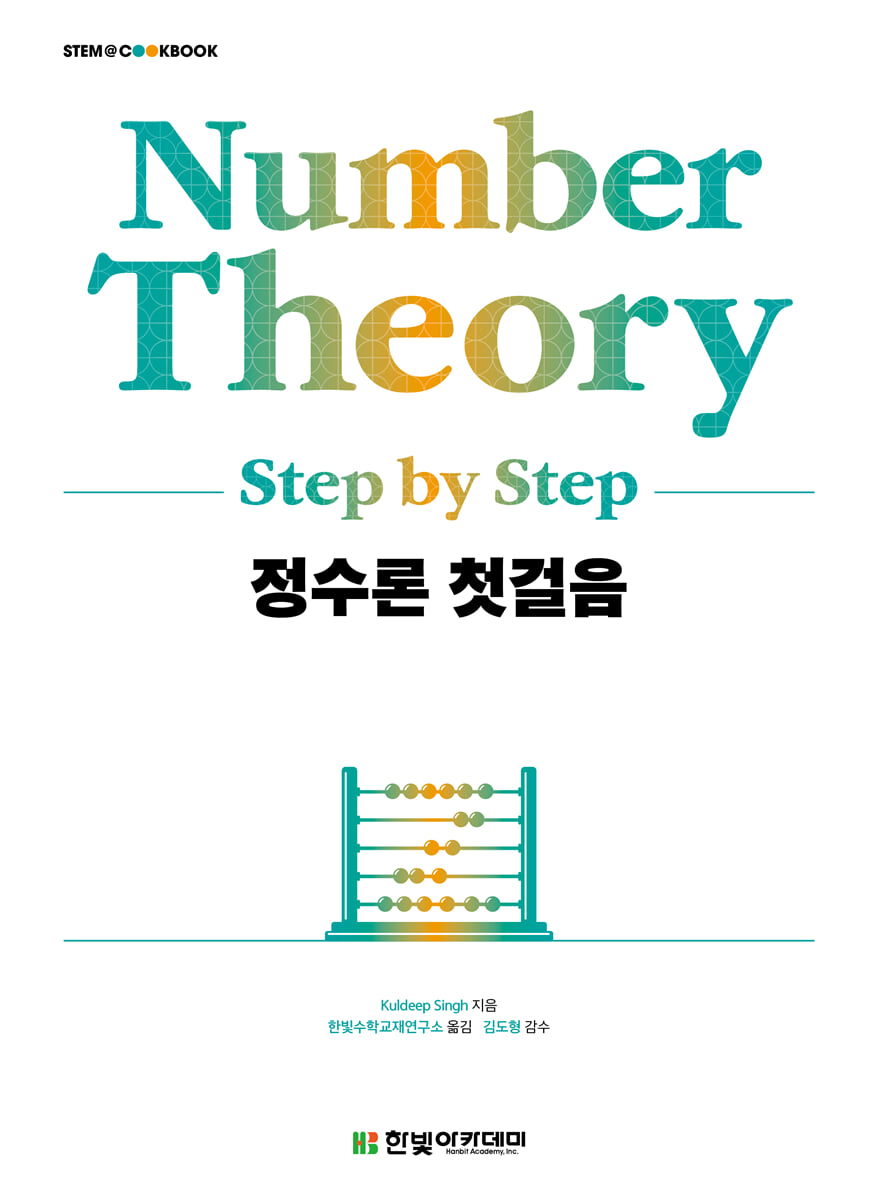
First Steps in Number Theory
 |
Description
Book Introduction
An effective way to learn number theory clearly
The most notable strengths of this book are its step-by-step explanations and rich problems.
Readers can understand and learn on their own by following explanations that gradually and clearly present everything from basic concepts of number theory to difficult application problems.
Additionally, it was structured in a way that first presents various questions that students might be curious about and clear answers to them, and then provides related explanations in an easy and detailed manner.
By reading through the lively 'question-answer' format, you can clearly grasp the core of the topic.
The most notable strengths of this book are its step-by-step explanations and rich problems.
Readers can understand and learn on their own by following explanations that gradually and clearly present everything from basic concepts of number theory to difficult application problems.
Additionally, it was structured in a way that first presents various questions that students might be curious about and clear answers to them, and then provides related explanations in an easy and detailed manner.
By reading through the lively 'question-answer' format, you can clearly grasp the core of the topic.
- You can preview some of the book's contents.
Preview
index
Chapter 1 Exploring Division
1.1 Greatest common divisor
1.2 Division Algorithm
1.3 Euclidean algorithm
1.4 Linear Diophantine equations
Chapter 1 Comprehensive Problems
Chapter 2 Prime Numbers and Factorization
2.1 Introduction to prime numbers
2.2 Prime number determination method
2.3 Properties of prime numbers
2.4 Least common multiple
Chapter 2 Comprehensive Problems
Chapter 3 Theory of Congruent Arithmetic
3.1 Joint Introduction
3.2 Congruent properties of multiplication
3.3 Solving linear congruences
3.4 The remainder of the Chinese theorem
3.5 Introduction to Factoring
Chapter 3 Comprehensive Problems
Chapter 4: Exploring Congruent Arithmetic with Law Decimals
4.1 Introduction to Fermat's Little Theorem
4.2 Wilson's Theorem
4.3 Composite numbers and pseudo-primes
4.4 Mersenne numbers
4.5 Perfect Numbers and the Sigma Function
Chapter 4 Comprehensive Problems
Chapter 5 Euler's Theorem, a Generalization of Fermat's Theorem
5.1 Euler Phi function
5.2 Euler's theorem
Chapter 5 Comprehensive Problems
Chapter 6 Primitive Roots and Indices
6.1 Order of integers for law n
6.2 index
6.3 Theory of indicators
6.4 Integers with primitive roots
Chapter 6 Comprehensive Problems
Chapter 7 Secondary Surplus
7.1 Introduction to Secondary Surplus
7.2 Legendre symbol
7.3 Secondary Mutual
7.4 Quadratic Reciprocity Law (LQR)
Chapter 7 Comprehensive Problems
Chapter 8 Nonlinear Diophantine Equations
8.1 Sum of two square numbers
8.2 Sum of four squares
8.3 Pell's equation
Chapter 8 Comprehensive Problems
1.1 Greatest common divisor
1.2 Division Algorithm
1.3 Euclidean algorithm
1.4 Linear Diophantine equations
Chapter 1 Comprehensive Problems
Chapter 2 Prime Numbers and Factorization
2.1 Introduction to prime numbers
2.2 Prime number determination method
2.3 Properties of prime numbers
2.4 Least common multiple
Chapter 2 Comprehensive Problems
Chapter 3 Theory of Congruent Arithmetic
3.1 Joint Introduction
3.2 Congruent properties of multiplication
3.3 Solving linear congruences
3.4 The remainder of the Chinese theorem
3.5 Introduction to Factoring
Chapter 3 Comprehensive Problems
Chapter 4: Exploring Congruent Arithmetic with Law Decimals
4.1 Introduction to Fermat's Little Theorem
4.2 Wilson's Theorem
4.3 Composite numbers and pseudo-primes
4.4 Mersenne numbers
4.5 Perfect Numbers and the Sigma Function
Chapter 4 Comprehensive Problems
Chapter 5 Euler's Theorem, a Generalization of Fermat's Theorem
5.1 Euler Phi function
5.2 Euler's theorem
Chapter 5 Comprehensive Problems
Chapter 6 Primitive Roots and Indices
6.1 Order of integers for law n
6.2 index
6.3 Theory of indicators
6.4 Integers with primitive roots
Chapter 6 Comprehensive Problems
Chapter 7 Secondary Surplus
7.1 Introduction to Secondary Surplus
7.2 Legendre symbol
7.3 Secondary Mutual
7.4 Quadratic Reciprocity Law (LQR)
Chapter 7 Comprehensive Problems
Chapter 8 Nonlinear Diophantine Equations
8.1 Sum of two square numbers
8.2 Sum of four squares
8.3 Pell's equation
Chapter 8 Comprehensive Problems
Detailed image

Publisher's Review
A lively progression in the form of a 'question-answer' format
A book that allows anyone to study number theory easily and clearly.
This is a good book to start learning number theory.
The author, who has extensive experience teaching number theory, collected feedback from students and organized the content to accommodate students of all skill levels.
Because it is organized in a 'question-answer' format by selecting topics that students might be curious about while studying, even those who are studying number theory for the first time can easily approach it.
Complex and difficult concepts are explained more easily and enjoyably using a variety of pictorial materials.
To pique your interest, we also present brief biographies of mathematicians involved in key theories of number theory.
We also provide a variety of problems, from basic to advanced number theory, to help you develop problem-solving skills.
Anyone can easily and clearly understand number theory because it provides friendly and detailed explanations.
A book that allows anyone to study number theory easily and clearly.
This is a good book to start learning number theory.
The author, who has extensive experience teaching number theory, collected feedback from students and organized the content to accommodate students of all skill levels.
Because it is organized in a 'question-answer' format by selecting topics that students might be curious about while studying, even those who are studying number theory for the first time can easily approach it.
Complex and difficult concepts are explained more easily and enjoyably using a variety of pictorial materials.
To pique your interest, we also present brief biographies of mathematicians involved in key theories of number theory.
We also provide a variety of problems, from basic to advanced number theory, to help you develop problem-solving skills.
Anyone can easily and clearly understand number theory because it provides friendly and detailed explanations.
GOODS SPECIFICS
- Publication date: October 17, 2022
- Page count, weight, size: 456 pages | 188*257*30mm
- ISBN13: 9791156646280
- ISBN10: 1156646286
You may also like
카테고리
korean


korean

![GQ KOREA Mark (Monthly): December [2025]](http://librairie.coreenne.fr/cdn/shop/files/8ef265dbbfbf186523ed75ba7319009d.jpg?v=1765340328&width=3840)


