

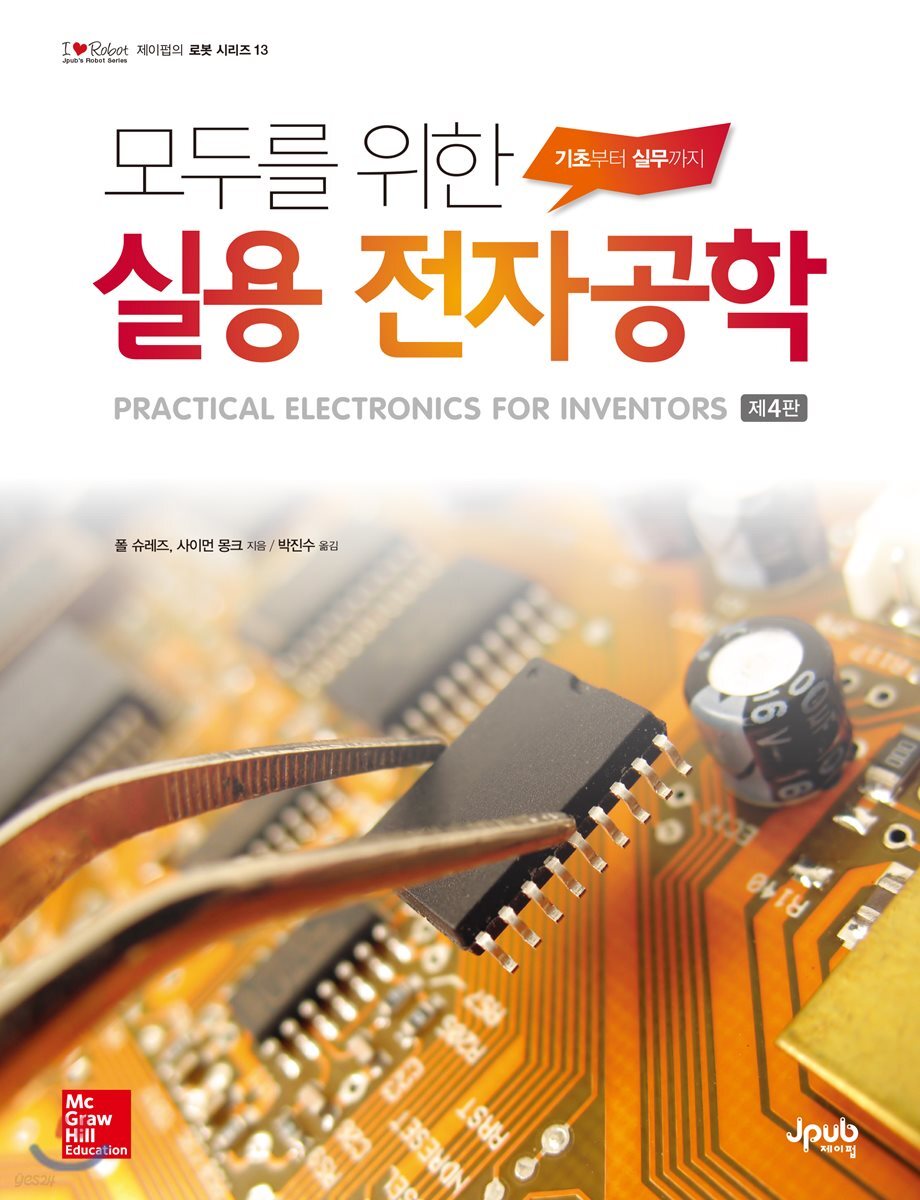
Practical Electronics for Everyone
 |
Description
Book Introduction
The electronics bible, useful for both beginner makers and professionals!
Practical Electronics for Everyone provides all the guidance, schematics, and illustrations you need to take the next step toward becoming an electronics engineer, maker, and inventor. It covers how to select the right components, design and build circuits, use microcontrollers and ICs, choose the latest software tools, and inspect and refine your finished creations.
This easy-to-follow book expands your electronics knowledge and provides new guidance on building the skills to create amazing creations.
Practical Electronics for Everyone provides all the guidance, schematics, and illustrations you need to take the next step toward becoming an electronics engineer, maker, and inventor. It covers how to select the right components, design and build circuits, use microcontrollers and ICs, choose the latest software tools, and inspect and refine your finished creations.
This easy-to-follow book expands your electronics knowledge and provides new guidance on building the skills to create amazing creations.
- You can preview some of the book's contents.
Preview
index
CHAPTER 1 Introduction to Electronics
CHAPTER 2 THEORY
2.1 Electronic Engineering Theory
2.2 Current
2.2.1 The Reality of Current
2.3 Voltage
2.3.1 Voltage Mechanism
2.3.2 Definition of voltage and general power law
2.3.3 Battery combination
2.3.4 Other voltage sources
2.3.5 Water analogy
2.4 Microscopic study of conduction phenomena
2.4.1 Voltage application
2.5 Resistance, resistivity, and conductivity
2.5.1 How the shape of a conductor affects its resistance
2.5.2 Resistivity and Conductivity
2.6 Insulators, conductors, and semiconductors
2.7 Heat and Power
2.8 Heat transfer and thermal resistance
2.8.1 Precautions when handling electric heaters
2.9 wire gauge
2.10 Grounding
2.10.1 Grounding
2.10.2 Other forms of grounding symbols
2.10.3 Grounding by loosely hanging on the ground
2.11 Electrical Circuits
2.12 Ohm's Law and Resistors
2.12.1 Power rating of resistors
2.12.2 Parallel Resistors
2.12.3 Resistors placed in series
2.12.4 Simplifying Complex Resistor Networks
2.12.5 Multi-voltage divider
2.13 Voltage and current sources
2.14 Voltage, current, and resistance measurements
2.15 Battery Connection
2.16 Open circuit and short circuit
2.17 Kirchhoff's laws
2.18 Superposition Theorem
2.19 Thévenin's theorem and Norton's theorem
2.19.1 Thévenin's theorem
2.19.2 Norton's Theorem
2.20 AC circuit
2.20.1 Creating an Exchange
2.20.2 Comparison of AC and water
2.20.3 Pulsating DC
2.20.4 Combining sine wave sources
2.20.5 AC waveform
2.20.6 AC Waveform Description
2.20.7 Frequency and short period
2.20.8 Phase
2.21 Alternating current and resistors, RMS voltage, current
2.22 Main power
2.23 capacitor
2.23.1 Determination of electrostatic capacitance
2.23.2 Commercial capacitors
2.23.3 Voltage ratings and insulation breakdown
2.23.4 Maxwell's displacement current
2.23.5 Charge-based current model through capacitors
2.23.6 Capacitors as Water
2.23.7 Energy in a capacitor
2.23.8 RC time constant
2.23.9 Drift capacitance
2.23.10 Capacitors placed in parallel
2.23.11 Capacitors placed in series
2.23.12 Alternating current in a capacitor
2.23.13 Capacitive Response Resistance
2.23.14 Capacity Divider
2.23.15 Quality Factor
2.24 Inductor
2.24.1 Electromagnetism
2.24.2 Magnetic fields and their effects
2.24.3 Self-inductance
2.24.4 Inductor
2.24.5 Inductor as a Water Analogy
2.24.6 Inductor Equation
2.24.7 Energy in an inductor
2.24.8 Inductor core
2.24.9 Understanding the Inductor Equation
2.24.10 Pressurizing the RL circuit
2.24.11 Decompression RL circuit
2.24.12 Voltage Spikes Due to Switching
2.24.13 Inductance of straight wire
2.24.14 Mutual inductance and magnetic coupling
2.24.15 Unfair combinations of spikes, lightning, and other waves
2.24.16 Inductors placed in series or parallel
2.24.17 Alternating Current and Inductors
2.24.18 Inductive reaction resistance
2.24.19 Non-ideal inductor model
2.24.20 Quality Factor
2.24.21 Inductor Applications
2.25 Complex Circuit Modeling
2.26 Complex numbers
2.27 Circuit with a sine wave source
2.27.1 Analysis of sinusoidal circuits using complex impedance
2.27.2 Sinusoidal voltage source expressed as a complex number
2.27.3 Abnormal phenomena in the reaction circuit
2.28 Power in AC circuits (apparent power, real power, reactive power)
2.28.1 Power factor
2.29 Thévenin's theorem on the form of exchange
2.30 Resonant circuit
2.30.1 Resonance in RLC circuits
2.30.2 Quality Factor Q and Bandwidth
2.30.3 Bandwidth
2.30.4 Voltage drop between components in an RLC resonant circuit
2.30.5 Capacitor Loss
2.30.6 Parallel resonant circuit
2.30.7 Q of the load circuit
2.31 decibel lecture
2.31.1 Alternative notation for decibels
2.32 Input and output impedance
2.32.1 Input Impedance
2.32.2 Output impedance
2.33 Two-port circuits and filters
2.33.1 Filter
2.33.2 Attenuator
2.34 Transient circuit
2.34.1 Series RLC circuit
2.35 Circuit with periodic non-sinusoidal sources
2.35.1 Fourier series
2.36 Aperiodic sources
2.37 Spice
2.37.1 How Spice Works
2.37.2 Limitations of Spice and Other Simulators
2.37.3 Simple Simulation Case
CHAPTER 3 BASIC ELECTRIC CIRCUIT COMPONENTS
3.1 Wires, cables, and connectors
3.1.1 Wires
3.1.2 Cable
3.1.3 Connector
3.1.4 Wiring Symbols and Connector Symbols
3.1.5 High-frequency effects in wires and cables
3.2 Battery
3.2.1 How Cells Work
3.2.2 Primary battery
3.2.3 Comparison of primary batteries
3.2.4 Secondary batteries
3.2.5 Battery capacity
3.2.6 Note on internal voltage drop within the battery
3.3 Switch
3.3.1 How the switch works
3.3.2 Description of switches
3.3.3 Switch Types
3.3.4 Simple Switch Application
3.4 Relay
3.4.1 Special relays
3.4.2 Some notes on relays
3.4.3 Some simple relay circuits
3.5 Resistor
3.5.1 Resistance and Ohm's Law
3.5.2 Resistors placed in series or parallel
3.5.3 Reading Resistor Labels
3.5.4 Actual resistor characteristics
3.5.5 Types of Resistors
3.5.6 Variable resistors (rheostats, potentiometers, trimmers)
3.5.7 Potentiometer Characteristics
3.6 Capacitor
3.6.1 Capacitance
3.6.2 Capacitors placed in parallel
3.6.3 Capacitors placed in series
3.6.4 RC time constant
3.6.5 Capacitive Response Resistance
3.6.6 Real capacitors
3.6.7 Capacitor Specifications
3.6.8 Capacitor types
3.6.9 Capacitor Applications
3.6.10 Timing and Sample Maintenance
3.6.11 RC residual filter
3.6.12 Arc Suppression
3.6.13 Supercapacitor Applications
3.6.14 Problem
3.7 Inductor
3.7.1 Inductance
3.7.2 Building the Inductor
3.7.3 Series and parallel inductors
3.7.4 RL time constant
3.7.5 Inductive Response Resistance
3.7.6 Real inductor
3.7.7 Inductor Specifications
3.7.8 Types of inductors
3.7.9 Reading Inductor Labels
3.7.10 Inductor Applications
3.7.11 EMI/EMC Design Techniques
3.8 Transformer
3.8.1 Basic Operation
3.8.2 Transformer Manufacturing
3.8.3 Single-phase transformers and variable-phase transformers
3.8.4 Circuit isolation and isolation transformer
3.8.5 Various standard and special transformers
3.8.6 Transformer Applications
3.9 Fuses and Circuit Breakers
3.9.1 Fuse and circuit breaker types
CHAPTER 4 SEMICONDUCTORS
4.1 Semiconductor Technology
4.1.1 What is a semiconductor?
4.1.2 Silicon Application Devices
4.2 Diode
4.2.1 How a PN junction diode works
4.2.2 Diode as an analogy to water
4.2.3 Rectifier/diode types
4.2.4 Practical Considerations
4.2.5 Diode/rectifier applications
4.2.6 Zener diode
4.2.7 Zener diode applications
4.2.8 Varactor diode (variable capacitance diode)
4.2.9 PIN diode
4.2.10 Microwave diodes (IMPATT, Gun, Tunnel, etc.)
4.2.11 Problem
4.3 Transistors
4.3.1 Introduction to Transistors
4.3.2 Bipolar Transistors
4.3.3 Junction field-effect transistor
4.3.4 Metal oxide semiconductor field effect transistor
4.3.5 Insulated Gate Bipolar Transistor (IGBT)
4.3.6 Unijunction transistor
4.4 Thyristor
4.4.1 Introduction
4.4.2 Silicon Controlled Rectifier
4.4.3 Silicon Control Switch
4.4.4 Triac
4.4.5 Four-layer diodes and diodes
4.5 Transient voltage suppressor
4.5.1 Lecture on Transient Phenomena
4.5.2 Devices used to suppress transient phenomena
4.6 Integrated Circuits
4.6.1 IC Package
CHAPTER 5 OPTOELECTRONICS
5.1 A Little Lecture on Photons
5.2 Lights
5.3 Light-emitting diodes
5.3.1 How LEDs Work
5.3.2 LED Types
5.3.3 Details about LEDs
5.3.4 LED Applications
5.3.5 Laser diode
5.4 Photoresistor
5.4.1 How a Photoresistor Works
5.4.2 Technical Data
5.4.3 Applications
5.5 Photodiode
5.5.1 How a Photodiode Works
5.5.2 Basic Operation
5.5.3 Types of photodiodes
5.6 Photovoltaic cells
5.6.1 Basic Operation
5.7 Phototransistor
5.7.1 How a Photodiode Works
5.7.2 Basic Configuration
5.7.3 Types of phototransistors
5.7.4 Technical Data
5.7.5 Applications
5.8 Optical Thyristor
5.8.1 How LASCR Works
5.8.2 Basic Operation
5.9 Optical isolator
5.9.1 Integrated optical isolator
5.9.2 Applications
5.10 Optical Fiber
CHAPTER 6 SENSORS
6.1 General Principles
6.1.1 Precision, accuracy, and resolution
6.1.2 Observer Effect
6.1.3 Correction
6.2 Temperature
6.2.1 Thermistor
6.2.2 Thermocouple
6.2.3 Resistance thermometer
6.2.4 Analog Output Thermometer IC
6.2.5 Digital Thermometer IC
6.2.6 Infrared thermometer/pyrometer
6.2.7 Summary
6.3 Proximity and Contact
6.3.1 Touchscreen
6.3.2 Ultrasonic distance
6.3.3 Optical distance
6.3.4 Capacitive Sensors
6.3.5 Summary
6.4 Exercise, Force, and Pressure
6.4.1 Passive infrared
6.4.2 Acceleration
6.4.3 Rotation
6.4.4 Flow rate
6.4.5 Force
6.4.6 Slope
6.4.7 Vibration and mechanical impact
6.4.8 Pressure
6.5 Chemistry
6.5.1 Smoke
6.5.2 Gas
6.5.3 Humidity
6.6 Light, Radiation, Magnetism, and Sound
6.6.1 Light
6.6.2 Ionizing radiation
6.6.3 Magnetic fields
6.6.4 Sound
6.7 GPS
CHAPTER 7: ELECTRONICS PRACTICE
7.1 Safety
7.1.1 Safety Classroom
7.1.2 Component failure due to electrostatic discharge
7.1.3 Precautions when handling parts
7.2 Circuit Construction
7.2.1 Drawing a Circuit Diagram
7.2.2 Notes on Circuit Simulator Programs
7.2.3 Building Your Own Circuit Prototype
7.2.4 Final Circuit
7.2.5 PCB Fabrication
7.2.6 Special parts of hardware used in circuit configuration
7.2.7 Soldering
7.2.8 Solder Removal
7.2.9 Circuit Packaging
7.2.10 Handy Items
7.2.11 Troubleshooting Homemade Circuits
7.3 Multimeter
7.3.1 Basic Operation
7.3.2 How Analog VOMs Work
7.3.3 How a Digital Multimeter Works
7.3.4 Notes on error measurement
7.4 Oscilloscope
7.4.1 How an Oscilloscope Works
7.4.2 Internal circuit diagram of the tester
7.4.3 Beam Aiming
7.4.4.
How to use the inspector
7.4.5 What the small knobs and switches do
7.4.6 Measurement using a tester
7.4.7 Inspector Application
7.4.8 Impedance Measurement
7.5 Electronics Laboratory
7.5.1 Workshop
7.5.2 Test Equipment
7.5.3 Multimeter
7.5.4 DC power supply
7.5.5 Oscilloscope
7.5.6 Oscilloscope probe
7.5.7 General-Purpose Function Generator
7.5.8 Frequency Counter
7.5.9 Computer
7.5.10 Other test equipment
7.5.11 Multifunction PC Meter
7.5.12 Isolation transformer
7.5.13 Variable Transformer (Variac)
7.5.14 Replacement Box
7.5.15 Test cables, connectors, and adapters
7.5.16 Soldering Equipment
7.5.17 Circular Fabrication Board
7.5.18 Tools
7.5.19 Wires, cables, hardware, and chemicals
7.5.20 Electronic Device Product Introduction Materials
7.5.21 Recommended Electronic Components
7.5.22 CAD programs for electronic engineering
7.5.23 Creating a Custom Workbench
CHAPTER 8 Operational Amplifiers
8.1 Operational Amplifier as a Water Analogy
8.2 How an Operational Amplifier Works (Explaining the 'Escape Behavior')
8.3 Theory
8.4 Negative feedback
8.5 Positive feedback
8.6 Types of real operational amplifiers
8.7 Operational Amplifier Specifications
8.8 Reinforced Operational Amplifier
8.9 Some practical notes
8.10 Voltage and current misalignment compensation
8.11 Frequency Compensation
8.12 Comparator
8.13 Comparators using hysteresis
8.13.1 Inverting comparator with hysteresis
8.13.2 Non-inverting comparator using hysteresis
8.14 Using a single-supply comparator
8.15 Windows Comparator
8.16 Voltage rating indicator
8.17 Instrumentation Amplifier
8.18 Application
CHAPTER 9 Filters
9.1 What you need to know before designing a filter
9.2 Basic Filters
9.3 Passive low-pass filter design
9.4 Notes on Filter Types
9.5 Passive high-pass filter design
9.6 Passive Bandpass Filter Design
9.7 Passive Notch Filter Design
9.8 Active Filter Design
9.8.1 Active Low-Pass Filter Example
9.8.2 Active High-Pass Filter Example
9.8.3 Active bandpass filters
9.8.4 Active Notch Filter
9.9 Integrated filter circuit
CHAPTER 10 Oscillators and Timers
10.1 RC relaxation oscillator
10.2 555 Timer IC
10.2.1 How the 555 Works (Astable Operation)
10.2.2 Basic Unstable Operations
10.2.3 How the 555 Works (Monostable Operation)
10.2.4 Basic Monostable Operations
10.2.5 Some important notes about the 555 timer
10.2.6 Simple 555 Applications
10.3 Voltage Controlled Oscillator
10.4 Binary Bridge and Twin T Oscillator
10.5 LC oscillator (sine wave oscillator)
10.6 Crystal Oscillator
10.7 Microcontroller Oscillator
CHAPTER 11 VOLTAGE REGULATORS AND POWER SUPPLY DEVICES
11.1 Voltage Regulator IC
11.1.1 Fixed Regulator IC
11.1.2 Variable Regulator IC
11.1.3 Regulator Specifications
11.2 Overview of Some Regulator Applications
11.3 Transformer
11.4 Rectifier Package
11.5 Some simple power supplies
11.6 The Core of Residue Reduction Technology
11.7 Loose ends
11.8 Switching Regulator Supply (Switcher)
11.9 Switched Mode Power Supply (SMPS)
11.10 Industrial Power Supply Package Types
11.11 Building a power supply
CHAPTER 12 DIGITAL ELECTRONICS
12.1 Fundamentals of Digital Electronics
12.1.1 Digital Logic States
12.1.2 Numeric codes used in digital electronics
12.1.3 Clock Timing and Parallel vs. Serial Transmission
12.2 Logic Gates
12.2.1 Multiple-input logic gates
12.2.2 Digital Logic Gate ICs
12.2.3 Single Logic Gate Applications
12.2.4 Combinatorial logic
12.2.5 Keeping the circuit simple (Carnot diagram)
12.3 Combination Device
12.3.1 Multiplexers (Data Selectors) and Bidirectional Switches
12.3.2 Demultiplexers (data distributors) and decoders
12.3.3 Encoders and Decoders
12.3.4 Binary Adder
12.3.5 Binary Adder/Subtractor
12.3.6 Comparator and Magnitude Comparator Integrated Circuits
12.3.7 Notes on obsolescence and the tendency to control things with microcontrollers
12.4 Logic Product Family
12.4.1 CMOS Family of ICs
12.4.2 Input/Output Voltage and Noise Margins
12.4.3 Current Ratings, Fanout, and Propagation Delay
12.5 Logic IC Enhancement and Experimentation
12.5.1 Disconnecting the power supply
12.5.2 Unused Input
12.5.3 Logic probe and logic pulse generator
12.6 Sequential logic
12.6.1 SR Flip-Flop
12.6.2 SR Flip-Flop IC
12.6.3 D-type flip-flop
12.6.4 Quadruple and Octuple D-Type Flip-Flops
12.6.5 JK Flip-Flop
12.6.6 Practical Timing Considerations Using Flip-Flops
12.6.7 Digital Clock Generators and Single Pulse Generators
12.6.8 Automatic power-up clear (reset) circuit
12.6.9 Pull-up and pull-down resistors
12.7 Counter IC
12.7.1 Asynchronous Counter (Ripple Counter) Integrated Circuit
12.7.2 Synchronous Counter IC
12.7.3 Notes on Counters Using Displays
12.8 Shift Register
12.8.1 Serial Input/Serial Output Shift Register
12.8.2 Serial-in/parallel-out shift register
12.8.3 Parallel-in/serial-out shift register
12.8.4 Ring Counter (Shift Register Sequencer)
12.8.5 Johnson shift counter
12.8.6 Shift Register IC
12.8.7 Simple Shift Register Application
12.9 Analog/Digital Interconnection
12.9.1 Evoking a Simple Logic Response from an Analog Signal
12.9.2 Using logic to drive external loads
12.9.3 Analog Switch
12.9.4 Analog Multiplexers/Demultiplexers
12.9.5 Analog-to-digital and digital-to-analog conversion
12.9.6 Analog-to-digital converter
12.10 Display
12.10.1 LED display
12.10.2 Liquid Crystal Display
12.11 Memory Device
12.11.1 Read-only memory
12.11.2 Creating a Simple ROM with a Diode
12.11.3 Memory Size and Configuration
12.11.4 Simple 'programmable ROM'
12.11.5 ROM devices
12.11.6 RAM
CHAPTER 13 MICROCONTROLLERS
13.1 Basic Microcontroller Structure
13.2 Microcontroller Example
13.2.1 ATtiny85 Microcontroller
13.2.2 PIC16Cx Microcontrollers
13.2.3 32-bit microcontroller
13.2.4 Digital Signal Processing
13.3 Board Evaluation/Development
13.4 Arduino
13.4.1 Arduino Overview
13.4.2 Arduino IDE
13.4.3 Arduino Board Model
13.4.4 Shield
13.4.5 Arduino C Library
13.4.6 Arduino Example
13.4.7 Using Arduino Offboard
13.5 Interconnection using microcontrollers
13.5.1 Switch
13.5.2 Analog Input
13.5.3 High-power digital output
13.5.4 Sound Interface
13.5.5 Serial Interface
13.5.6 Level Conversion
13.5.7 LED Display Interface
CHAPTER 14 PROGRAMMABLE LOGIC
14.1 Programmable Logic
14.2 FPGA
14.3 ISE and Elbert V2
14.3.1 Installing ISE
14.4 Elbert 2 Board
14.4.1 Installing Elbert Software
Download 14.5
14.6 Drawing Your Own FPGA Logic Design
14.6.1 Example 1: Data Selector
14.6.2 Example 2: 4-bit ripple counter
14.7 Verilog
14.7.1 Module
14.7.2 Wiring, Resistance, and Bus
14.7.3 Parallel Execution
14.7.4 Number Format
14.8 Describing Your Own FPGA in Verilog
14.8.1 Data Selectors in Verilog
14.8.2 Ripple Counter in Verilog
14.9 Modular Design
14.9.1 Counter/Decoder Example
14.9.2 Multiplexed 7-segment Counter Example
14.9.3 Modules with parameters
14.10 Simulation
14.11 VHDL
CHAPTER 15 MOTOR
15.1 DC continuous motor
15.2 DC Motor Speed Control
15.3 DC motor direction control
15.4 RC servo
15.5 Stepper Motor
15.6 Types of Stepper Motors
15.7 Stepper Motor Drive
15.8 Controlling the driver with a converter
15.9 Final remarks on stepper motor identification
CHAPTER 16 AUDIO ELECTRONICS
16.1 A small lesson on sound
16.2 mic
16.3 Microphone Specifications
16.4 Audio Amplifier
16.4.1 Inverting amplifier
16.4.2 Non-inverting amplifier
16.4.3 Digital Amplifier
16.4.4 Hum reduction within audio amplifiers
16.5 Preamplifier
16.6 Mixer circuit
16.7 Notes on Impedance Matching
16.8 speakers
16.9 Crossover Network
16.10 Simple IC for speaker driving
16.11 Audible signaling device
16.12 Other Audio Circuits
CHAPTER 17 MODULAR ELECTRONICS
17.1 We have all the integrated circuits you need.
17.2 Breakout Boards and Modules
17.2.1 Radio Frequency Module
17.2.2 Audio Module
17.3 Prototype production using plug-and-play
17.4 Open Source Hardware
APPENDIX A Power Distribution and Home Wiring
A.1 Distribution
A.2 A Closer Look at Three-Phase Electrical
A.3 Home Wiring
A.4 Electricity in each country
APPENDIX B Error Analysis
B.1 Absolute error, relative error, and percentage error
B.2 Uncertainty Estimation
APPENDIX C Useful Knowledge and Formulas
C.1 Greek letters
C.2 Prefixes for powers of 10
C.3 Linear function (y = mx + b)
C.4 Quadratic equation (y = ax2 + bx + c)
C.5 Exponents and Logarithms
C.6 Trigonometry
C.7 Complex Numbers
C.8 Differentiation
C.9 Integration
Search
CHAPTER 2 THEORY
2.1 Electronic Engineering Theory
2.2 Current
2.2.1 The Reality of Current
2.3 Voltage
2.3.1 Voltage Mechanism
2.3.2 Definition of voltage and general power law
2.3.3 Battery combination
2.3.4 Other voltage sources
2.3.5 Water analogy
2.4 Microscopic study of conduction phenomena
2.4.1 Voltage application
2.5 Resistance, resistivity, and conductivity
2.5.1 How the shape of a conductor affects its resistance
2.5.2 Resistivity and Conductivity
2.6 Insulators, conductors, and semiconductors
2.7 Heat and Power
2.8 Heat transfer and thermal resistance
2.8.1 Precautions when handling electric heaters
2.9 wire gauge
2.10 Grounding
2.10.1 Grounding
2.10.2 Other forms of grounding symbols
2.10.3 Grounding by loosely hanging on the ground
2.11 Electrical Circuits
2.12 Ohm's Law and Resistors
2.12.1 Power rating of resistors
2.12.2 Parallel Resistors
2.12.3 Resistors placed in series
2.12.4 Simplifying Complex Resistor Networks
2.12.5 Multi-voltage divider
2.13 Voltage and current sources
2.14 Voltage, current, and resistance measurements
2.15 Battery Connection
2.16 Open circuit and short circuit
2.17 Kirchhoff's laws
2.18 Superposition Theorem
2.19 Thévenin's theorem and Norton's theorem
2.19.1 Thévenin's theorem
2.19.2 Norton's Theorem
2.20 AC circuit
2.20.1 Creating an Exchange
2.20.2 Comparison of AC and water
2.20.3 Pulsating DC
2.20.4 Combining sine wave sources
2.20.5 AC waveform
2.20.6 AC Waveform Description
2.20.7 Frequency and short period
2.20.8 Phase
2.21 Alternating current and resistors, RMS voltage, current
2.22 Main power
2.23 capacitor
2.23.1 Determination of electrostatic capacitance
2.23.2 Commercial capacitors
2.23.3 Voltage ratings and insulation breakdown
2.23.4 Maxwell's displacement current
2.23.5 Charge-based current model through capacitors
2.23.6 Capacitors as Water
2.23.7 Energy in a capacitor
2.23.8 RC time constant
2.23.9 Drift capacitance
2.23.10 Capacitors placed in parallel
2.23.11 Capacitors placed in series
2.23.12 Alternating current in a capacitor
2.23.13 Capacitive Response Resistance
2.23.14 Capacity Divider
2.23.15 Quality Factor
2.24 Inductor
2.24.1 Electromagnetism
2.24.2 Magnetic fields and their effects
2.24.3 Self-inductance
2.24.4 Inductor
2.24.5 Inductor as a Water Analogy
2.24.6 Inductor Equation
2.24.7 Energy in an inductor
2.24.8 Inductor core
2.24.9 Understanding the Inductor Equation
2.24.10 Pressurizing the RL circuit
2.24.11 Decompression RL circuit
2.24.12 Voltage Spikes Due to Switching
2.24.13 Inductance of straight wire
2.24.14 Mutual inductance and magnetic coupling
2.24.15 Unfair combinations of spikes, lightning, and other waves
2.24.16 Inductors placed in series or parallel
2.24.17 Alternating Current and Inductors
2.24.18 Inductive reaction resistance
2.24.19 Non-ideal inductor model
2.24.20 Quality Factor
2.24.21 Inductor Applications
2.25 Complex Circuit Modeling
2.26 Complex numbers
2.27 Circuit with a sine wave source
2.27.1 Analysis of sinusoidal circuits using complex impedance
2.27.2 Sinusoidal voltage source expressed as a complex number
2.27.3 Abnormal phenomena in the reaction circuit
2.28 Power in AC circuits (apparent power, real power, reactive power)
2.28.1 Power factor
2.29 Thévenin's theorem on the form of exchange
2.30 Resonant circuit
2.30.1 Resonance in RLC circuits
2.30.2 Quality Factor Q and Bandwidth
2.30.3 Bandwidth
2.30.4 Voltage drop between components in an RLC resonant circuit
2.30.5 Capacitor Loss
2.30.6 Parallel resonant circuit
2.30.7 Q of the load circuit
2.31 decibel lecture
2.31.1 Alternative notation for decibels
2.32 Input and output impedance
2.32.1 Input Impedance
2.32.2 Output impedance
2.33 Two-port circuits and filters
2.33.1 Filter
2.33.2 Attenuator
2.34 Transient circuit
2.34.1 Series RLC circuit
2.35 Circuit with periodic non-sinusoidal sources
2.35.1 Fourier series
2.36 Aperiodic sources
2.37 Spice
2.37.1 How Spice Works
2.37.2 Limitations of Spice and Other Simulators
2.37.3 Simple Simulation Case
CHAPTER 3 BASIC ELECTRIC CIRCUIT COMPONENTS
3.1 Wires, cables, and connectors
3.1.1 Wires
3.1.2 Cable
3.1.3 Connector
3.1.4 Wiring Symbols and Connector Symbols
3.1.5 High-frequency effects in wires and cables
3.2 Battery
3.2.1 How Cells Work
3.2.2 Primary battery
3.2.3 Comparison of primary batteries
3.2.4 Secondary batteries
3.2.5 Battery capacity
3.2.6 Note on internal voltage drop within the battery
3.3 Switch
3.3.1 How the switch works
3.3.2 Description of switches
3.3.3 Switch Types
3.3.4 Simple Switch Application
3.4 Relay
3.4.1 Special relays
3.4.2 Some notes on relays
3.4.3 Some simple relay circuits
3.5 Resistor
3.5.1 Resistance and Ohm's Law
3.5.2 Resistors placed in series or parallel
3.5.3 Reading Resistor Labels
3.5.4 Actual resistor characteristics
3.5.5 Types of Resistors
3.5.6 Variable resistors (rheostats, potentiometers, trimmers)
3.5.7 Potentiometer Characteristics
3.6 Capacitor
3.6.1 Capacitance
3.6.2 Capacitors placed in parallel
3.6.3 Capacitors placed in series
3.6.4 RC time constant
3.6.5 Capacitive Response Resistance
3.6.6 Real capacitors
3.6.7 Capacitor Specifications
3.6.8 Capacitor types
3.6.9 Capacitor Applications
3.6.10 Timing and Sample Maintenance
3.6.11 RC residual filter
3.6.12 Arc Suppression
3.6.13 Supercapacitor Applications
3.6.14 Problem
3.7 Inductor
3.7.1 Inductance
3.7.2 Building the Inductor
3.7.3 Series and parallel inductors
3.7.4 RL time constant
3.7.5 Inductive Response Resistance
3.7.6 Real inductor
3.7.7 Inductor Specifications
3.7.8 Types of inductors
3.7.9 Reading Inductor Labels
3.7.10 Inductor Applications
3.7.11 EMI/EMC Design Techniques
3.8 Transformer
3.8.1 Basic Operation
3.8.2 Transformer Manufacturing
3.8.3 Single-phase transformers and variable-phase transformers
3.8.4 Circuit isolation and isolation transformer
3.8.5 Various standard and special transformers
3.8.6 Transformer Applications
3.9 Fuses and Circuit Breakers
3.9.1 Fuse and circuit breaker types
CHAPTER 4 SEMICONDUCTORS
4.1 Semiconductor Technology
4.1.1 What is a semiconductor?
4.1.2 Silicon Application Devices
4.2 Diode
4.2.1 How a PN junction diode works
4.2.2 Diode as an analogy to water
4.2.3 Rectifier/diode types
4.2.4 Practical Considerations
4.2.5 Diode/rectifier applications
4.2.6 Zener diode
4.2.7 Zener diode applications
4.2.8 Varactor diode (variable capacitance diode)
4.2.9 PIN diode
4.2.10 Microwave diodes (IMPATT, Gun, Tunnel, etc.)
4.2.11 Problem
4.3 Transistors
4.3.1 Introduction to Transistors
4.3.2 Bipolar Transistors
4.3.3 Junction field-effect transistor
4.3.4 Metal oxide semiconductor field effect transistor
4.3.5 Insulated Gate Bipolar Transistor (IGBT)
4.3.6 Unijunction transistor
4.4 Thyristor
4.4.1 Introduction
4.4.2 Silicon Controlled Rectifier
4.4.3 Silicon Control Switch
4.4.4 Triac
4.4.5 Four-layer diodes and diodes
4.5 Transient voltage suppressor
4.5.1 Lecture on Transient Phenomena
4.5.2 Devices used to suppress transient phenomena
4.6 Integrated Circuits
4.6.1 IC Package
CHAPTER 5 OPTOELECTRONICS
5.1 A Little Lecture on Photons
5.2 Lights
5.3 Light-emitting diodes
5.3.1 How LEDs Work
5.3.2 LED Types
5.3.3 Details about LEDs
5.3.4 LED Applications
5.3.5 Laser diode
5.4 Photoresistor
5.4.1 How a Photoresistor Works
5.4.2 Technical Data
5.4.3 Applications
5.5 Photodiode
5.5.1 How a Photodiode Works
5.5.2 Basic Operation
5.5.3 Types of photodiodes
5.6 Photovoltaic cells
5.6.1 Basic Operation
5.7 Phototransistor
5.7.1 How a Photodiode Works
5.7.2 Basic Configuration
5.7.3 Types of phototransistors
5.7.4 Technical Data
5.7.5 Applications
5.8 Optical Thyristor
5.8.1 How LASCR Works
5.8.2 Basic Operation
5.9 Optical isolator
5.9.1 Integrated optical isolator
5.9.2 Applications
5.10 Optical Fiber
CHAPTER 6 SENSORS
6.1 General Principles
6.1.1 Precision, accuracy, and resolution
6.1.2 Observer Effect
6.1.3 Correction
6.2 Temperature
6.2.1 Thermistor
6.2.2 Thermocouple
6.2.3 Resistance thermometer
6.2.4 Analog Output Thermometer IC
6.2.5 Digital Thermometer IC
6.2.6 Infrared thermometer/pyrometer
6.2.7 Summary
6.3 Proximity and Contact
6.3.1 Touchscreen
6.3.2 Ultrasonic distance
6.3.3 Optical distance
6.3.4 Capacitive Sensors
6.3.5 Summary
6.4 Exercise, Force, and Pressure
6.4.1 Passive infrared
6.4.2 Acceleration
6.4.3 Rotation
6.4.4 Flow rate
6.4.5 Force
6.4.6 Slope
6.4.7 Vibration and mechanical impact
6.4.8 Pressure
6.5 Chemistry
6.5.1 Smoke
6.5.2 Gas
6.5.3 Humidity
6.6 Light, Radiation, Magnetism, and Sound
6.6.1 Light
6.6.2 Ionizing radiation
6.6.3 Magnetic fields
6.6.4 Sound
6.7 GPS
CHAPTER 7: ELECTRONICS PRACTICE
7.1 Safety
7.1.1 Safety Classroom
7.1.2 Component failure due to electrostatic discharge
7.1.3 Precautions when handling parts
7.2 Circuit Construction
7.2.1 Drawing a Circuit Diagram
7.2.2 Notes on Circuit Simulator Programs
7.2.3 Building Your Own Circuit Prototype
7.2.4 Final Circuit
7.2.5 PCB Fabrication
7.2.6 Special parts of hardware used in circuit configuration
7.2.7 Soldering
7.2.8 Solder Removal
7.2.9 Circuit Packaging
7.2.10 Handy Items
7.2.11 Troubleshooting Homemade Circuits
7.3 Multimeter
7.3.1 Basic Operation
7.3.2 How Analog VOMs Work
7.3.3 How a Digital Multimeter Works
7.3.4 Notes on error measurement
7.4 Oscilloscope
7.4.1 How an Oscilloscope Works
7.4.2 Internal circuit diagram of the tester
7.4.3 Beam Aiming
7.4.4.
How to use the inspector
7.4.5 What the small knobs and switches do
7.4.6 Measurement using a tester
7.4.7 Inspector Application
7.4.8 Impedance Measurement
7.5 Electronics Laboratory
7.5.1 Workshop
7.5.2 Test Equipment
7.5.3 Multimeter
7.5.4 DC power supply
7.5.5 Oscilloscope
7.5.6 Oscilloscope probe
7.5.7 General-Purpose Function Generator
7.5.8 Frequency Counter
7.5.9 Computer
7.5.10 Other test equipment
7.5.11 Multifunction PC Meter
7.5.12 Isolation transformer
7.5.13 Variable Transformer (Variac)
7.5.14 Replacement Box
7.5.15 Test cables, connectors, and adapters
7.5.16 Soldering Equipment
7.5.17 Circular Fabrication Board
7.5.18 Tools
7.5.19 Wires, cables, hardware, and chemicals
7.5.20 Electronic Device Product Introduction Materials
7.5.21 Recommended Electronic Components
7.5.22 CAD programs for electronic engineering
7.5.23 Creating a Custom Workbench
CHAPTER 8 Operational Amplifiers
8.1 Operational Amplifier as a Water Analogy
8.2 How an Operational Amplifier Works (Explaining the 'Escape Behavior')
8.3 Theory
8.4 Negative feedback
8.5 Positive feedback
8.6 Types of real operational amplifiers
8.7 Operational Amplifier Specifications
8.8 Reinforced Operational Amplifier
8.9 Some practical notes
8.10 Voltage and current misalignment compensation
8.11 Frequency Compensation
8.12 Comparator
8.13 Comparators using hysteresis
8.13.1 Inverting comparator with hysteresis
8.13.2 Non-inverting comparator using hysteresis
8.14 Using a single-supply comparator
8.15 Windows Comparator
8.16 Voltage rating indicator
8.17 Instrumentation Amplifier
8.18 Application
CHAPTER 9 Filters
9.1 What you need to know before designing a filter
9.2 Basic Filters
9.3 Passive low-pass filter design
9.4 Notes on Filter Types
9.5 Passive high-pass filter design
9.6 Passive Bandpass Filter Design
9.7 Passive Notch Filter Design
9.8 Active Filter Design
9.8.1 Active Low-Pass Filter Example
9.8.2 Active High-Pass Filter Example
9.8.3 Active bandpass filters
9.8.4 Active Notch Filter
9.9 Integrated filter circuit
CHAPTER 10 Oscillators and Timers
10.1 RC relaxation oscillator
10.2 555 Timer IC
10.2.1 How the 555 Works (Astable Operation)
10.2.2 Basic Unstable Operations
10.2.3 How the 555 Works (Monostable Operation)
10.2.4 Basic Monostable Operations
10.2.5 Some important notes about the 555 timer
10.2.6 Simple 555 Applications
10.3 Voltage Controlled Oscillator
10.4 Binary Bridge and Twin T Oscillator
10.5 LC oscillator (sine wave oscillator)
10.6 Crystal Oscillator
10.7 Microcontroller Oscillator
CHAPTER 11 VOLTAGE REGULATORS AND POWER SUPPLY DEVICES
11.1 Voltage Regulator IC
11.1.1 Fixed Regulator IC
11.1.2 Variable Regulator IC
11.1.3 Regulator Specifications
11.2 Overview of Some Regulator Applications
11.3 Transformer
11.4 Rectifier Package
11.5 Some simple power supplies
11.6 The Core of Residue Reduction Technology
11.7 Loose ends
11.8 Switching Regulator Supply (Switcher)
11.9 Switched Mode Power Supply (SMPS)
11.10 Industrial Power Supply Package Types
11.11 Building a power supply
CHAPTER 12 DIGITAL ELECTRONICS
12.1 Fundamentals of Digital Electronics
12.1.1 Digital Logic States
12.1.2 Numeric codes used in digital electronics
12.1.3 Clock Timing and Parallel vs. Serial Transmission
12.2 Logic Gates
12.2.1 Multiple-input logic gates
12.2.2 Digital Logic Gate ICs
12.2.3 Single Logic Gate Applications
12.2.4 Combinatorial logic
12.2.5 Keeping the circuit simple (Carnot diagram)
12.3 Combination Device
12.3.1 Multiplexers (Data Selectors) and Bidirectional Switches
12.3.2 Demultiplexers (data distributors) and decoders
12.3.3 Encoders and Decoders
12.3.4 Binary Adder
12.3.5 Binary Adder/Subtractor
12.3.6 Comparator and Magnitude Comparator Integrated Circuits
12.3.7 Notes on obsolescence and the tendency to control things with microcontrollers
12.4 Logic Product Family
12.4.1 CMOS Family of ICs
12.4.2 Input/Output Voltage and Noise Margins
12.4.3 Current Ratings, Fanout, and Propagation Delay
12.5 Logic IC Enhancement and Experimentation
12.5.1 Disconnecting the power supply
12.5.2 Unused Input
12.5.3 Logic probe and logic pulse generator
12.6 Sequential logic
12.6.1 SR Flip-Flop
12.6.2 SR Flip-Flop IC
12.6.3 D-type flip-flop
12.6.4 Quadruple and Octuple D-Type Flip-Flops
12.6.5 JK Flip-Flop
12.6.6 Practical Timing Considerations Using Flip-Flops
12.6.7 Digital Clock Generators and Single Pulse Generators
12.6.8 Automatic power-up clear (reset) circuit
12.6.9 Pull-up and pull-down resistors
12.7 Counter IC
12.7.1 Asynchronous Counter (Ripple Counter) Integrated Circuit
12.7.2 Synchronous Counter IC
12.7.3 Notes on Counters Using Displays
12.8 Shift Register
12.8.1 Serial Input/Serial Output Shift Register
12.8.2 Serial-in/parallel-out shift register
12.8.3 Parallel-in/serial-out shift register
12.8.4 Ring Counter (Shift Register Sequencer)
12.8.5 Johnson shift counter
12.8.6 Shift Register IC
12.8.7 Simple Shift Register Application
12.9 Analog/Digital Interconnection
12.9.1 Evoking a Simple Logic Response from an Analog Signal
12.9.2 Using logic to drive external loads
12.9.3 Analog Switch
12.9.4 Analog Multiplexers/Demultiplexers
12.9.5 Analog-to-digital and digital-to-analog conversion
12.9.6 Analog-to-digital converter
12.10 Display
12.10.1 LED display
12.10.2 Liquid Crystal Display
12.11 Memory Device
12.11.1 Read-only memory
12.11.2 Creating a Simple ROM with a Diode
12.11.3 Memory Size and Configuration
12.11.4 Simple 'programmable ROM'
12.11.5 ROM devices
12.11.6 RAM
CHAPTER 13 MICROCONTROLLERS
13.1 Basic Microcontroller Structure
13.2 Microcontroller Example
13.2.1 ATtiny85 Microcontroller
13.2.2 PIC16Cx Microcontrollers
13.2.3 32-bit microcontroller
13.2.4 Digital Signal Processing
13.3 Board Evaluation/Development
13.4 Arduino
13.4.1 Arduino Overview
13.4.2 Arduino IDE
13.4.3 Arduino Board Model
13.4.4 Shield
13.4.5 Arduino C Library
13.4.6 Arduino Example
13.4.7 Using Arduino Offboard
13.5 Interconnection using microcontrollers
13.5.1 Switch
13.5.2 Analog Input
13.5.3 High-power digital output
13.5.4 Sound Interface
13.5.5 Serial Interface
13.5.6 Level Conversion
13.5.7 LED Display Interface
CHAPTER 14 PROGRAMMABLE LOGIC
14.1 Programmable Logic
14.2 FPGA
14.3 ISE and Elbert V2
14.3.1 Installing ISE
14.4 Elbert 2 Board
14.4.1 Installing Elbert Software
Download 14.5
14.6 Drawing Your Own FPGA Logic Design
14.6.1 Example 1: Data Selector
14.6.2 Example 2: 4-bit ripple counter
14.7 Verilog
14.7.1 Module
14.7.2 Wiring, Resistance, and Bus
14.7.3 Parallel Execution
14.7.4 Number Format
14.8 Describing Your Own FPGA in Verilog
14.8.1 Data Selectors in Verilog
14.8.2 Ripple Counter in Verilog
14.9 Modular Design
14.9.1 Counter/Decoder Example
14.9.2 Multiplexed 7-segment Counter Example
14.9.3 Modules with parameters
14.10 Simulation
14.11 VHDL
CHAPTER 15 MOTOR
15.1 DC continuous motor
15.2 DC Motor Speed Control
15.3 DC motor direction control
15.4 RC servo
15.5 Stepper Motor
15.6 Types of Stepper Motors
15.7 Stepper Motor Drive
15.8 Controlling the driver with a converter
15.9 Final remarks on stepper motor identification
CHAPTER 16 AUDIO ELECTRONICS
16.1 A small lesson on sound
16.2 mic
16.3 Microphone Specifications
16.4 Audio Amplifier
16.4.1 Inverting amplifier
16.4.2 Non-inverting amplifier
16.4.3 Digital Amplifier
16.4.4 Hum reduction within audio amplifiers
16.5 Preamplifier
16.6 Mixer circuit
16.7 Notes on Impedance Matching
16.8 speakers
16.9 Crossover Network
16.10 Simple IC for speaker driving
16.11 Audible signaling device
16.12 Other Audio Circuits
CHAPTER 17 MODULAR ELECTRONICS
17.1 We have all the integrated circuits you need.
17.2 Breakout Boards and Modules
17.2.1 Radio Frequency Module
17.2.2 Audio Module
17.3 Prototype production using plug-and-play
17.4 Open Source Hardware
APPENDIX A Power Distribution and Home Wiring
A.1 Distribution
A.2 A Closer Look at Three-Phase Electrical
A.3 Home Wiring
A.4 Electricity in each country
APPENDIX B Error Analysis
B.1 Absolute error, relative error, and percentage error
B.2 Uncertainty Estimation
APPENDIX C Useful Knowledge and Formulas
C.1 Greek letters
C.2 Prefixes for powers of 10
C.3 Linear function (y = mx + b)
C.4 Quadratic equation (y = ax2 + bx + c)
C.5 Exponents and Logarithms
C.6 Trigonometry
C.7 Complex Numbers
C.8 Differentiation
C.9 Integration
Search
Into the book
Understanding the principles of digital electronics will allow you to freely explore the field of microcontrollers.
A microcontroller is a device that can read values from sensors or control output devices using input/output pins, and can also be programmed, all of which can be controlled by a program on a single integrated circuit.
In practical terms, electronics uses a mix of all of these.
This aspect includes learning how to read schematics, building prototype circuits using a breadboard, examining and refining the prototype (using a multimeter, oscilloscope, and logic probe), improving the prototype (if necessary), and building the final circuit using various tools and special circuit boards.
--- p.
3
This chapter covers the fundamental concepts of electronics, such as current, voltage, resistance, power, capacitors, and induction.
After covering these concepts, this chapter will illustrate how to create mathematical models of current and voltage using basic electronic components such as resistors, capacitors, and inductors.
Additionally, it presents a method for analyzing complex circuits containing resistors, capacitors, and inductors driven by a power source using some basic laws and theorems, such as Ohm's law, Kirchhoff's laws, and Thevenin's theorem.
--- p.
5
Optoelectronics is a branch of electronics that deals with light-emitting devices and light-detecting devices.
Light-emitting devices, such as light bulbs and light-emitting diodes (LEDs), use electric current to generate electromagnetic energy that excites electrons to higher energy levels (when the electrons change energy levels, photons are emitted).
Meanwhile, photodetectors such as phototransistors and photoresistors are designed to receive incoming electromagnetic energy and convert it into current and voltage.
Typically, this happens by using photons to release electrons trapped within a semiconductor material.
Light-emitting devices are generally used for lighting or as indicator lights.
Photodetectors are primarily used in photodetectors and communication devices, such as dark-light activation switches and remote controllers.
Optoelectronic devices covered in this chapter include lights, LEDs, photoresistors, photodiodes, photocells, phototransistors, photothyristors, and optoisolators.
--- p.
487
A sensor is a device that measures physical properties such as temperature, humidity, and strain.
Since this book deals with electronics, it focuses on converting the measured information into electrical signals.
We've broadened our definition of sensors a bit to include things like the Global Positioning System (GPS), which is used to determine location in space.
Most sensors use a simple method of producing an output signal as a voltage proportional to the measured value.
Other sensors are digital devices that operate by outputting digital data corresponding to the measured value.
In both of these cases, the measurements are typically input to a microcontroller.
--- p.
519
Up until now, the field of electronics has mainly dealt with circuits that accept voltages that continuously change within a specific range and the analog field.
Such analog circuits included rectifiers, filters, amplifiers, simple RC timers, oscillators, and simple transistor switches.
Although these analog circuits each play a fundamentally important role, they are missing a crucial feature.
It lacks the information storage and processing capabilities needed to make complex logical decisions.
Incorporating logical decision-making processes into circuits requires the use of digital electronics technology.
In this chapter, we are interested in building the foundations of digital electronics.
Today's products that actually implement digital electronics are driven by microcontrollers or programmable logic devices.
A microcontroller is a device that can read values from sensors or control output devices using input/output pins, and can also be programmed, all of which can be controlled by a program on a single integrated circuit.
In practical terms, electronics uses a mix of all of these.
This aspect includes learning how to read schematics, building prototype circuits using a breadboard, examining and refining the prototype (using a multimeter, oscilloscope, and logic probe), improving the prototype (if necessary), and building the final circuit using various tools and special circuit boards.
--- p.
3
This chapter covers the fundamental concepts of electronics, such as current, voltage, resistance, power, capacitors, and induction.
After covering these concepts, this chapter will illustrate how to create mathematical models of current and voltage using basic electronic components such as resistors, capacitors, and inductors.
Additionally, it presents a method for analyzing complex circuits containing resistors, capacitors, and inductors driven by a power source using some basic laws and theorems, such as Ohm's law, Kirchhoff's laws, and Thevenin's theorem.
--- p.
5
Optoelectronics is a branch of electronics that deals with light-emitting devices and light-detecting devices.
Light-emitting devices, such as light bulbs and light-emitting diodes (LEDs), use electric current to generate electromagnetic energy that excites electrons to higher energy levels (when the electrons change energy levels, photons are emitted).
Meanwhile, photodetectors such as phototransistors and photoresistors are designed to receive incoming electromagnetic energy and convert it into current and voltage.
Typically, this happens by using photons to release electrons trapped within a semiconductor material.
Light-emitting devices are generally used for lighting or as indicator lights.
Photodetectors are primarily used in photodetectors and communication devices, such as dark-light activation switches and remote controllers.
Optoelectronic devices covered in this chapter include lights, LEDs, photoresistors, photodiodes, photocells, phototransistors, photothyristors, and optoisolators.
--- p.
487
A sensor is a device that measures physical properties such as temperature, humidity, and strain.
Since this book deals with electronics, it focuses on converting the measured information into electrical signals.
We've broadened our definition of sensors a bit to include things like the Global Positioning System (GPS), which is used to determine location in space.
Most sensors use a simple method of producing an output signal as a voltage proportional to the measured value.
Other sensors are digital devices that operate by outputting digital data corresponding to the measured value.
In both of these cases, the measurements are typically input to a microcontroller.
--- p.
519
Up until now, the field of electronics has mainly dealt with circuits that accept voltages that continuously change within a specific range and the analog field.
Such analog circuits included rectifiers, filters, amplifiers, simple RC timers, oscillators, and simple transistor switches.
Although these analog circuits each play a fundamentally important role, they are missing a crucial feature.
It lacks the information storage and processing capabilities needed to make complex logical decisions.
Incorporating logical decision-making processes into circuits requires the use of digital electronics technology.
In this chapter, we are interested in building the foundations of digital electronics.
Today's products that actually implement digital electronics are driven by microcontrollers or programmable logic devices.
--- p.
721
721
Publisher's Review
A fully-reinforced electronics bible useful for both beginner makers and professionals!
Written by a skilled engineer and a passionate inventor, this book truly showcases the true essence of electronics.
It contains all the instructions, schematics, and illustrations you need to take the next step toward becoming an electronics engineer, maker, and inventor. It shows you how to select the right components, design and build a circuit, use microcontrollers and ICs, choose the latest software tools, and inspect and refine your finished creations.
This easy-to-follow book will expand your electronics knowledge and provide new guidance on building the skills to create amazing creations.
Main contents of this book
- Resistors, capacitors, inductors, transformers
- Diodes, transistors, integrated circuits
- Optoelectronic devices, solar cells, phototransistors
- Sensors, GPS module, touchscreen
- Operational amplifiers, regulators, and power supplies
- Digital electronics, LCD displays, logic gates
- Microcontroller, prototyping platform
- Combinational and sequential programmable logic
- DC motor, RC servo, stepper motor
- Microphone, audio amplifier, speaker
- Modular electronics and prototypes
Written by a skilled engineer and a passionate inventor, this book truly showcases the true essence of electronics.
It contains all the instructions, schematics, and illustrations you need to take the next step toward becoming an electronics engineer, maker, and inventor. It shows you how to select the right components, design and build a circuit, use microcontrollers and ICs, choose the latest software tools, and inspect and refine your finished creations.
This easy-to-follow book will expand your electronics knowledge and provide new guidance on building the skills to create amazing creations.
Main contents of this book
- Resistors, capacitors, inductors, transformers
- Diodes, transistors, integrated circuits
- Optoelectronic devices, solar cells, phototransistors
- Sensors, GPS module, touchscreen
- Operational amplifiers, regulators, and power supplies
- Digital electronics, LCD displays, logic gates
- Microcontroller, prototyping platform
- Combinational and sequential programmable logic
- DC motor, RC servo, stepper motor
- Microphone, audio amplifier, speaker
- Modular electronics and prototypes
GOODS SPECIFICS
- Publication date: November 30, 2018
- Page count, weight, size: 1,076 pages | 215*280*43mm
- ISBN13: 9791188621323
- ISBN10: 1188621327
You may also like
카테고리
korean


korean

![GQ KOREA Mark (Monthly): December [2025]](http://librairie.coreenne.fr/cdn/shop/files/8ef265dbbfbf186523ed75ba7319009d.jpg?v=1765340328&width=3840)


