

This is not a pipe
 |
Description
Book Introduction
"This is not a pipe" is an unusual piece among Foucault's writings.
It is a solo work with less than 80 pages of text and is Foucault's only 'book' on painting.
This slim book, based on the 'Pipe Drawing' by René Magritte, one of the representative surrealist painters of the 20th century, is a dense work filled with layers of a philosopher's questions about the basis of painting itself.
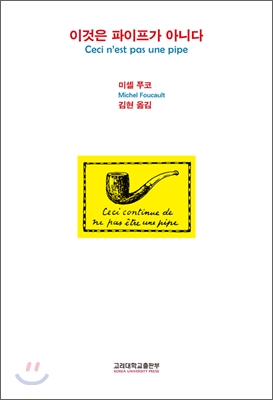
In this book, Foucault delves into the objections raised within painting itself to "the banal work, the conventional lesson" through a drawing by Magritte, consisting of a recognizable pipe and the handwritten phrase "This is not a pipe" placed beneath it.
It is a solo work with less than 80 pages of text and is Foucault's only 'book' on painting.
This slim book, based on the 'Pipe Drawing' by René Magritte, one of the representative surrealist painters of the 20th century, is a dense work filled with layers of a philosopher's questions about the basis of painting itself.
In this book, Foucault delves into the objections raised within painting itself to "the banal work, the conventional lesson" through a drawing by Magritte, consisting of a recognizable pipe and the handwritten phrase "This is not a pipe" placed beneath it.
index
I two pipes
II Disorganized Calligram
III Klee, Kandinsky, Magritte
IV The Secret Work of Words
V Seven Seals of Affirmation
VI Figure is not a confirmation
Two letters from René Magritte
circumference
Translator's note
Appendix: Foucault's Art Criticism - Kim Hyun
Preface to the revised edition _ Jeong Gwari
II Disorganized Calligram
III Klee, Kandinsky, Magritte
IV The Secret Work of Words
V Seven Seals of Affirmation
VI Figure is not a confirmation
Two letters from René Magritte
circumference
Translator's note
Appendix: Foucault's Art Criticism - Kim Hyun
Preface to the revised edition _ Jeong Gwari
Publisher's Review
Published in 1973 by the French publisher Fata Morgana, this book is not without its anomalies among Foucault's writings.
It is a solo work with less than 80 pages of text and is Foucault's only 'book' on painting (excluding this book, the only direct analysis of Foucault related to painting is on Velázquez's painting 'Las Meninas' in the first chapter of 'Languages and Things' published in 1966).
This slim book, based on the 'Pipe Drawing' by René Magritte, one of the representative surrealist painters of the 20th century, is a dense work filled with layers of a philosopher's questions about the basis of painting itself.
According to Foucault, the two principles that have dominated Western painting since the 15th century are plastic representation and analogy.
In other words, painting is the process of reproducing an object, whether real or virtual, in a formative manner using lines and colors.
It is difficult to deny that these rules, which may be considered trite and placed at the beginning of art classes, are in fact implicit principles of composition in ordinary conversation.
In this book, Foucault delves into the objections raised within painting itself to “the banal work, the conventional lesson” through a drawing by Magritte, which consists of a recognizable pipe and the handwritten phrase “This is not a pipe” placed beneath it.
Referring to Paul Klee, who broke the principle of plastic representation and instead arranged (linguistic) symbolized forms to create a new space, and Kandinsky's formless colors and lines that rejected representation based on similarity, Foucault analyzes Magritte's paintings, which, unlike them, seem to follow the traditional pictorial representational method on the surface, and shows how he secretly digs into the "old space of representation" (so Foucault tells Magritte that "the old pyramid of perspective becomes nothing more than a molehill on the verge of collapse").
Foucault's epistemological exploration, which remains vigilant against the uniformity of "affirmative discourse," finds new vitality in Magritte's pictorial space, which unfolds through the boundless play of individual formative elements, free from the "old complicity with representational assertions" and not hierarchized or fixed around a first cause—a starting point, a source, or a so-called model.
This book can be seen as a product of direct exchange between the philosopher Foucault and the painter René Magritte.
René Magritte expressed his enthusiastic response to Words and Things in a letter to his friend Marcel Lecomte, and he also wrote to Foucault directly that same year (the two continued to exchange letters).
Foucault preserved the monumental character of this book by reproducing two letters he had received from René Magritte and directly quoting portions of them in the text.
This book, which was first published in Korea in 1995 through the translation by the late Kim Hyeon, but had been in the “out-of-print labyrinth” (preface) for a long time, has now been brought to light again through an official copyright agreement with the French publisher Fata Morgana.
For this newly published 'revised edition', literary critic Professor Jeong Gwa-ri compared the existing translations with the original text one by one, corrected errors in the previous editions, and added a new preface.
From the organization of the translation manuscript to the circumstances surrounding its publication and the significance of publishing this book in Korea, where most of Foucault's other works have been translated, the author's deep longing is evident and his critical insight shines through in the preface.
Foucault's book was born from the author's will to challenge the 'ideology of representation' that constitutes the collective unconscious of modern society, and this was confirmed by the painting of the artist René Magritte, which led to the emergence of concrete thoughts and vivid sensations.
Therefore, through this book, Foucault was able to present in a very 'exemplary' way the new form of art and thought that his contemporary avant-garde artists and thinkers, including himself, dreamed of, both in theory and practice.
Next, this book had a special role to play in opening new avenues for the reception of Foucault in Korea.
Even now, the reception of Foucault in Korea at that time was almost one-sided in terms of the political aspect, that is, the aspect of the theory of power symbolized by the term 'panopticon'.
Of course, there were books published that showed other aspects, but they had difficulty gaining widespread acceptance in the Korean intellectual community.
Above all, it may be because the field of knowledge itself was ‘obsessed’ with a specific ideology of representation.
That is precisely why his theory of power was also accepted in a doubly biased way (i.e., in terms of selection and understanding).
However, before being a theorist of power, Foucault was a historian of cognition, and a philosopher in the proper sense of the word who sought to make understanding the history of cognition a constitutive factor and component of life.
His theory of power was merely one aspect of his life's work, which was the fundamental ?circlement of such perceptions.
Moreover, Foucault was also a very sensitive connoisseur, or critic, of the various occasions and realizations through which his practical knowledge actually blossomed.
Korean readers should have had the opportunity to savor his work as a philosopher and critic and the practical movement of his spirit.
This book, because of its very practical nature, had the advantage of being perfectly suited to providing such an opportunity.
It is a solo work with less than 80 pages of text and is Foucault's only 'book' on painting (excluding this book, the only direct analysis of Foucault related to painting is on Velázquez's painting 'Las Meninas' in the first chapter of 'Languages and Things' published in 1966).
This slim book, based on the 'Pipe Drawing' by René Magritte, one of the representative surrealist painters of the 20th century, is a dense work filled with layers of a philosopher's questions about the basis of painting itself.
According to Foucault, the two principles that have dominated Western painting since the 15th century are plastic representation and analogy.
In other words, painting is the process of reproducing an object, whether real or virtual, in a formative manner using lines and colors.
It is difficult to deny that these rules, which may be considered trite and placed at the beginning of art classes, are in fact implicit principles of composition in ordinary conversation.
In this book, Foucault delves into the objections raised within painting itself to “the banal work, the conventional lesson” through a drawing by Magritte, which consists of a recognizable pipe and the handwritten phrase “This is not a pipe” placed beneath it.
Referring to Paul Klee, who broke the principle of plastic representation and instead arranged (linguistic) symbolized forms to create a new space, and Kandinsky's formless colors and lines that rejected representation based on similarity, Foucault analyzes Magritte's paintings, which, unlike them, seem to follow the traditional pictorial representational method on the surface, and shows how he secretly digs into the "old space of representation" (so Foucault tells Magritte that "the old pyramid of perspective becomes nothing more than a molehill on the verge of collapse").
Foucault's epistemological exploration, which remains vigilant against the uniformity of "affirmative discourse," finds new vitality in Magritte's pictorial space, which unfolds through the boundless play of individual formative elements, free from the "old complicity with representational assertions" and not hierarchized or fixed around a first cause—a starting point, a source, or a so-called model.
This book can be seen as a product of direct exchange between the philosopher Foucault and the painter René Magritte.
René Magritte expressed his enthusiastic response to Words and Things in a letter to his friend Marcel Lecomte, and he also wrote to Foucault directly that same year (the two continued to exchange letters).
Foucault preserved the monumental character of this book by reproducing two letters he had received from René Magritte and directly quoting portions of them in the text.
This book, which was first published in Korea in 1995 through the translation by the late Kim Hyeon, but had been in the “out-of-print labyrinth” (preface) for a long time, has now been brought to light again through an official copyright agreement with the French publisher Fata Morgana.
For this newly published 'revised edition', literary critic Professor Jeong Gwa-ri compared the existing translations with the original text one by one, corrected errors in the previous editions, and added a new preface.
From the organization of the translation manuscript to the circumstances surrounding its publication and the significance of publishing this book in Korea, where most of Foucault's other works have been translated, the author's deep longing is evident and his critical insight shines through in the preface.
Foucault's book was born from the author's will to challenge the 'ideology of representation' that constitutes the collective unconscious of modern society, and this was confirmed by the painting of the artist René Magritte, which led to the emergence of concrete thoughts and vivid sensations.
Therefore, through this book, Foucault was able to present in a very 'exemplary' way the new form of art and thought that his contemporary avant-garde artists and thinkers, including himself, dreamed of, both in theory and practice.
Next, this book had a special role to play in opening new avenues for the reception of Foucault in Korea.
Even now, the reception of Foucault in Korea at that time was almost one-sided in terms of the political aspect, that is, the aspect of the theory of power symbolized by the term 'panopticon'.
Of course, there were books published that showed other aspects, but they had difficulty gaining widespread acceptance in the Korean intellectual community.
Above all, it may be because the field of knowledge itself was ‘obsessed’ with a specific ideology of representation.
That is precisely why his theory of power was also accepted in a doubly biased way (i.e., in terms of selection and understanding).
However, before being a theorist of power, Foucault was a historian of cognition, and a philosopher in the proper sense of the word who sought to make understanding the history of cognition a constitutive factor and component of life.
His theory of power was merely one aspect of his life's work, which was the fundamental ?circlement of such perceptions.
Moreover, Foucault was also a very sensitive connoisseur, or critic, of the various occasions and realizations through which his practical knowledge actually blossomed.
Korean readers should have had the opportunity to savor his work as a philosopher and critic and the practical movement of his spirit.
This book, because of its very practical nature, had the advantage of being perfectly suited to providing such an opportunity.
GOODS SPECIFICS
- Date of issue: December 30, 2010
- Page count, weight, size: 152 pages | 225g | 188*254*20mm
- ISBN13: 9788976417374
- ISBN10: 8976417372
You may also like
카테고리
korean


korean

![GQ KOREA Mark (Monthly): December [2025]](http://librairie.coreenne.fr/cdn/shop/files/8ef265dbbfbf186523ed75ba7319009d.jpg?v=1765340328&width=3840)


