

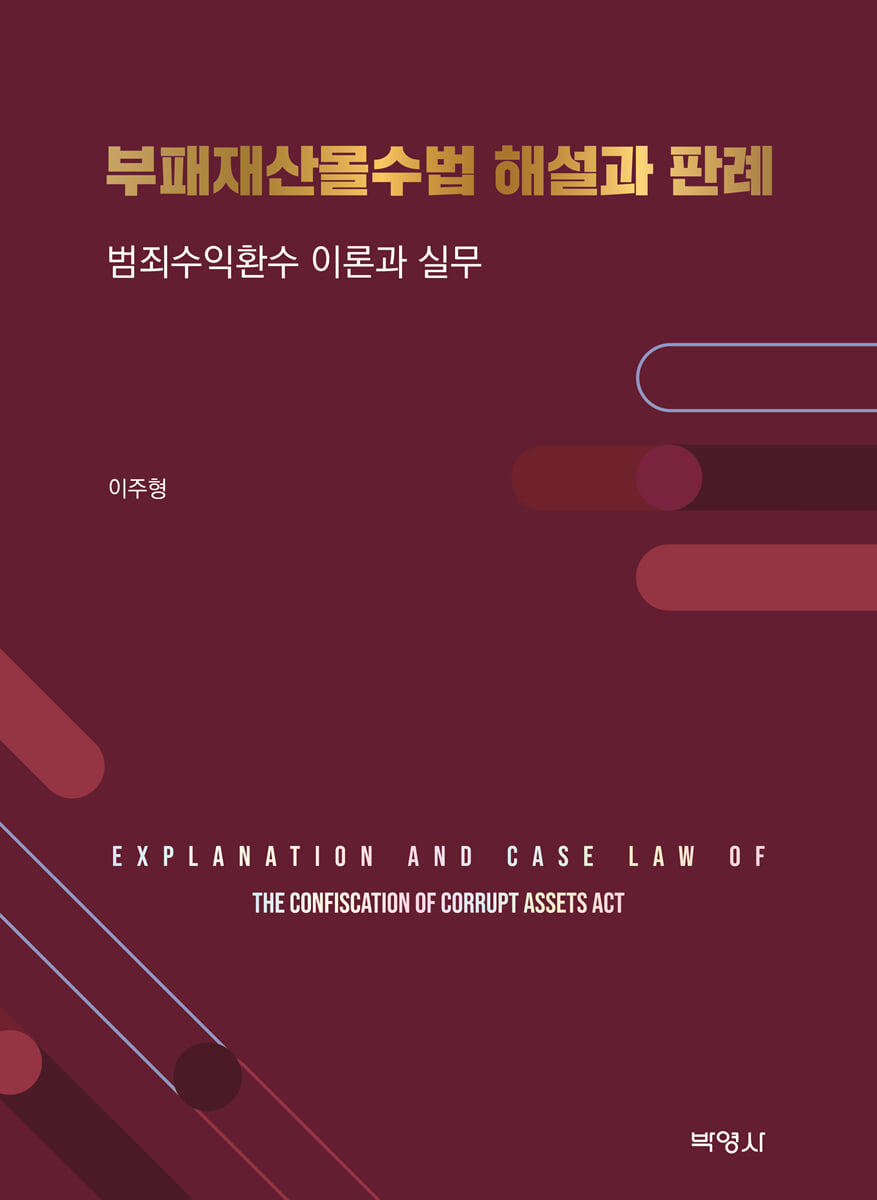
Explanation and Case Law of the Corrupt Assets Confiscation Act
 |
Description
index
Part 1
General theory on criminal proceeds and corrupt assets
Ⅰ.
Five Legal Provisions Governing the Recovery of Proceeds of Crime 3
Ⅱ.
The Need to Understand the Five Major Legal Regulations for Recovering Proceeds of Crime 4
Ⅲ.
6. Composition of crimes subject to recovery of criminal proceeds under the Act on the Control of Concealment of Criminal Proceeds
Ⅳ.
The concept of corrupt property and corruption crimes under the Corruption Assets Confiscation Act 8
V.
The Characteristics of the Corrupt Assets Confiscation Act and the Importance of Understanding It 13
Part 2
Explanation of the Corrupt Assets Confiscation Act
Chapter 1: Enactment of the Corrupt Assets Confiscation Act 19
Ⅰ.
Background of the Enactment of the Corrupt Assets Confiscation Act 19
Ⅱ.
Discussion at the time of enactment of the Corrupt Assets Confiscation Act 31
Chapter 2: The Process of Revision of the Corrupt Assets Confiscation Act 55
Ⅰ.
Overview 55
Ⅱ.
2013.
3. 23 (effective on the same day) 1st revision 56
Ⅲ.
2016.
12.
20. (Enforced on the same day) 2nd revision 56
Ⅳ.
2017.
10.
31.(2018.
11.
1. Enforcement) 3rd revision 61
V.
2019.
8. 20. (Enforced on the same day) 4th revision 62
Ⅵ.
2020.
12.
29.(2021.
12.
30.
Enforcement) 5th revision 68
Ⅶ.
2021.
12.
29.(2021.
12.
30.
Enforcement) 6th revision 69
Ⅷ.
2021.
5. 18.(2022.
5. 19.
(Enforcement) 7th revision 69
Chapter 3: Explanation of the Current Corrupt Assets Confiscation Act 70
Section 1 Overview 70
Section 2 Confiscation and Recovery of Corrupted Assets 71
Chapter 1 Overview 71
Section 2: General Theory on Confiscation and Recovery of Corrupt Assets under the Corrupt Assets Confiscation Act 73
Ⅰ.
Arbitrary Confiscation and Forfeiture Regulations under the Corruption Assets Confiscation Act, Article 73
Ⅱ.
The Legal Nature of Confiscation and Collection 74
Ⅲ.
Material? Human? Knowledge Requirements 81
Ⅳ.
Requirements for collection and criteria for calculating the amount of collection 85
V.
Legal Principles of Confiscation and Collection from Corporations and Representatives 96
Ⅵ.
Confiscation of mixed assets under the Corruption Assets Confiscation Act 99
Ⅶ.
Cryptocurrency Confiscation? The Problem of Forfeiture 107
Third-Party Confiscation and Collection under the Corruption Assets Confiscation Act, Section 3, 111
Ⅰ.
General Requirements for Confiscation - Principle 111: Prohibition of Confiscation When Corrupted Property Belongs to a Person Other Than the Offender
Ⅱ.
Third-Party Confiscation? Legal Principles of Collection 111
Ⅲ.
If a third party acquires the property of corruption after learning of the crime and becomes the subject of the crime, 112
Ⅳ.
In case of inheritance, gift, etc. to a third party without compensation, 128
V.
144 In cases where the property is transferred to a third party at a significantly lower price
Ⅵ.
Third-Party Confiscation? The Importance of Forfeiture and Legislative Theory 169
Section 3: Third-Party Confiscation of Corrupted Assets? Third-Party Participation Procedures for Recovery 171
Article 1 Regulatory System 171
Ⅰ.
Introduction 171
Ⅱ.
Specific regulations for third-party participation procedures 172
Article 2 Legal Nature of Third-Party Participation Procedures 172
Ⅰ.
Introduction 172
Ⅱ.
Comparison with Third-Party Participation under the Administrative Litigation Act 173
Ⅲ.
Comparison of Notice of Litigation and Notice of Prosecutor's Request for Participation under the Civil Procedure Act 174
Ⅳ.
Legal nature of third-party participation pursuant to the inspection's notice 176
Section 3: Specific Procedures for Third-Party Participation 181
Ⅰ.
Notice of Third-Party Participation Procedure (Public Notice)? Court Submission (Article 23 of the Narcotics Trafficking Prevention Act) 181
Ⅱ.
Specific procedures for third-party participation (Article 24, Paragraph 1 of the Anti-Drug Trafficking Act) 184
Ⅲ.
Court Actions on Third-Party Participation Applications (Article 24, Paragraphs 2 to 8 of the Narcotics Trafficking Prevention Act) 186
Article 4. Rights of Participants and Specific Trial Procedures 188
Ⅰ.
Rights of Participants, etc. (Articles 25 and 26 of the Anti-Drug Trafficking Act) 188
Ⅱ.
Application of Criminal Procedures (Articles 26 and 27 of the Anti-Drug Trafficking Act) 189
Ⅲ.
Participant's Independent Appeal and Continuation of the Forfeiture/Collection Trial (Articles 29 and 30 of the Anti-Drug Trafficking Act) 190
Ⅳ.
Application of the provisions of the Criminal Procedure Act (Article 31 of the Anti-Drug Trafficking Act) 191
Improvement of Third-Party Participation Procedures Based on the Notice of Inspection in Section 5, Article 193
Section 4: Confiscation, Collection, and Return Procedures for Crime Victims' Property 196
Article 1: The Principle of Confiscation and Recovery of Crime Victims' Property 196
Ⅰ.
?Property Crimes? 196
Ⅱ.
Serious crimes that cause property damage under the Debtor Rehabilitation Act: Fraudulent bankruptcy 198
Ⅲ.
Sintering 202
Article 203: Exceptions to the Confiscation and Recovery of Crime Victims' Property
Ⅰ.
203 Recovering property from crime victims under the Corruption Assets Confiscation Act
Ⅱ.
Interpretation (Case Law) of Cases Where Crime Victims' Recovery from Damages is Extremely Difficult 206
Ⅲ.
The Need for Revision of the Exceptions to the Return of Crime Victims' Property 219
Article 3 Procedures for Returning Crime Victim Property to Crime Victims 221
Ⅰ.
Enforcement Decree on the Delegation of Authority and Key Concepts of the Procedure for Returning Crime Victims' Property (Enforcement Decree Articles 2, 4, and 12; Enforcement Rule Article 2) 221
Ⅱ.
Initiation of the Crime Victim Property Return Procedure 223
Ⅲ.
Crime Victim Refund Claim Procedure (Enforcement Decree Article 6, Enforcement Rules Articles 4 and 5) 225
Ⅳ.
Inspection Decision on Whether to Return Property Subject to Recovery (Enforcement Decree Article 7, Enforcement Rule Article 6) 226
V.
Implementation of the Return of Property Subject to Recovery (Enforcement Decree Articles 8 and 9, Enforcement Rule Article 7) 227
Ⅵ.
Appeal Procedures, including Objection by the Claimant (Enforcement Decree Article 10) 229
Ⅶ.
Composition and Operation of the Crime Victims' Property Return Deliberation Committee (Enforcement Decree Article 11, Enforcement Rules Articles 10 to 12) 230
Section 5: Confiscation and Preservation Procedures for the Confiscation of Corrupt Assets 232
Chapter 1 Overview 232
Article 232: Post-indictment confiscation and preservation order
Ⅰ.
The Significance of the Order to Confiscate and Preserve Units 233
Ⅱ.
Requirements and Procedures for a Confiscation Preservation Order 234
Ⅲ.
Requirements for the Unit Preservation Order 237
Ⅳ.
Issuance of a court order for confiscation and preservation 238
Article 3: Pre-indictment confiscation and preservation order 238
Ⅰ.
Key Features of Pre-Indictment Confiscation Orders 238
Ⅱ.
Procedures for enforcing a pre-indictment confiscation order, etc. 240
Article 4: Confiscation? Effect of the Unit Preservation Order 241
Ⅰ.
Effect of the confiscation preservation order 242
Ⅱ.
Effect of the Unit Preservation Order 244
Ⅲ.
The Relationship Between Forfeiture Preservation Orders and Seizure 244
Article 5. Methods of Enforcement of Property-Specific Confiscation Preservation Orders 244
Ⅰ.
Method of Enforcement of a Confiscation Preservation Order 244
Ⅱ.
Confiscation and preservation of real estate, ships, etc.: Requires the prosecutor to register the confiscation and preservation of real estate. 245
Ⅲ.
Forfeiture and Preservation of Personal Property (Article 39 of the Anti-Drug Trafficking Act) 249
Ⅳ.
Forfeiture and Preservation of Bonds (Article 40 of the Anti-Drug Trafficking Act) 253
V.
Confiscation and preservation of other property (Article 41 of the Anti-Drug Trafficking Act) 261
Article 6 Cancellation and Invalidation of Confiscation Preservation Order 263
Ⅰ.
Cancellation of the confiscation preservation order (Article 42 of the Narcotics Trafficking Prevention Act) 263
Ⅱ.
Lapse of the confiscation preservation order (Article 43 of the Narcotics Trafficking Prevention Act) 267
Article 7, Section 269, Appeal against the Order of Confiscation and Preservation
Ⅰ.
Appeal against the decision of the trial court: Appeal 269
Ⅱ.
Appeal against the decision of the appellate court or high court: Immediate appeal 270
Article 8: Relationship between confiscation preservation and other enforcement procedures, etc. 271
Ⅰ.
Restrictions on the subsequent enforcement procedures for previously confiscated property (Article 45 of the Anti-Drug Trafficking Act) 271
Ⅱ.
Restrictions on confiscation trials for property subject to prior compulsory execution (Article 47 of the Anti-Drug Trafficking Act) 275
Ⅲ.
Suspension of enforcement of property subject to enforcement (Article 48 of the Anti-Drug Trafficking Act) 278
Article 9 Coordination with Auction Procedures for Forfeiture Preservation and Enforcement of Security Rights 280
Section 6 Preservation Procedures for the Recovery of Corrupted Property Value 281
Chapter 1 Overview 281
Article 282 of the Second Section: Order for Preservation of Collection of Money after Indictment
Ⅰ.
The significance of the preservation order for additional collection 282
Ⅱ.
Requirements for a Preservation Order for Recovery of Assets 283
Ⅲ.
Issuance of a court order to preserve collection 301
Ⅳ.
Issue 301 of the Payment Order in Substitution for the Preservation Order
Article 302 of the Pre-Indictment Order for Collection and Preservation of Taxes
Article 4 Procedures for Enforcement of Preservation Orders for Collection, etc. 305
Article 5. Effect of Execution of Preservation Order for Collection 306
Ⅰ.
Meaning 306
Ⅱ.
In the case of enforcement of the preservation order for additional collection, 307
Ⅲ.
Transfer of the order for preservation of additional collection to the main execution 309
Article 6 Cancellation and Validity of Preservation Orders for Collection and Payment 311
Article 7 Application of the Criminal Procedure Act to Preservation Procedures 312
Section 7. Enforcement and Appeal Procedures for Rulings on Confiscation and Recovery of Corrupted Assets 313
Section 1: Execution of Forfeiture and Recovery Judgments under the Corruption Assets Confiscation Act 313
Ⅰ.
Related Regulation 313
Ⅱ.
Prosecutor's Actions in Accordance with the Criminal Procedure Act 314
Ⅲ.
Prosecutor's Actions under the Act on the Control of Concealment of Criminal Proceeds and the Act on the Confiscation of Public Officials' Crimes 315
Ⅳ.
Special Provisions for Third-Party Enforcement of Forfeiture Judgments under the Act on the Regulation of Concealment of Criminal Proceeds and the Act on the Confiscation of Public Officials' Crimes 317
V.
Measures for Enforcing Confiscation and Forfeiture Judgments under the Corruption Assets Confiscation Act on Third-Party Property 318
Article 2, Section 1, Objection Procedure ① Third-Party Objection 318
Ⅰ.
Case Study 318
Ⅱ.
The meaning and purpose of a third-party objection 320
Ⅲ.
Scope 321
Ⅳ.
Litigation and Objections 322
V.
Litigation Procedure 332
Article 3, Section 3, Appeal Procedure ② Objection to the Execution of a Judgment 337
Ⅰ.
Significance and Purpose 337
Ⅱ.
Application Requirements 338
Ⅲ.
Application Procedure 339
Ⅳ.
Trial on Application 339
V.
In the case above, 340
Section 8: International Cooperation Procedures for the Recovery of Corrupted Assets 341
Section 1 Overview of Criminal Judicial Cooperation 341
Ⅰ.
Overview and Current Status of Criminal Judicial Cooperation 341
Ⅱ.
Purpose and Definition of Criminal Judicial Cooperation 345
Ⅲ.
Scope and Limitations of Criminal Judicial Assistance 346
Ⅳ.
Regulation 348 on the Implementation of International Cooperation under the Corruption Assets Confiscation Act
Article 351 Procedures for Cooperation at the Request of a Foreign Country
Ⅰ.
Procedure for implementing a request for cooperation 351
Ⅱ.
Procedure for Compliance with Requests for Cooperation in the Preservation of Forfeiture and Recovery 357
Ⅲ.
Request for Cooperation in the Execution of a Final Judgment for Confiscation and Recovery 360
Article 365 Procedures for Requesting Cooperation from Foreign Countries
Ⅰ.
Overview 365
Ⅱ.
Request for Cooperation Form 366
Ⅲ.
Case 368: Request for Cooperation to Recover Criminal Proceeds
Article 4. Cooperation Procedures for Recovery of Corrupted Assets 369
Ⅰ.
Procedures for the Recovery of Corrupt Assets under the United Nations Convention against Corruption 369
Ⅱ.
Special Provision 374 on Recovery of Corrupt Assets at the Request of the Requesting Party under the Corruption Assets Confiscation Act
Ⅲ.
Procedure for Requesting Recovery of Overseas Corrupt Assets under the Corruption Assets Confiscation Act 378
Part 3
Explanation of Corruption Crimes in the Appendix to the Corruption Property Confiscation Act
Chapter 1: Corruption Crimes under the Criminal Act (No. 1) 383
Section 1 General Provisions on Bribery under the Criminal Act 383
Ⅰ.
Bribery and the Recovery of Proceeds of Crime 383
Ⅱ.
Application of the "Public Officials' Crime Confiscation Act" to Recover Proceeds Acquired through Bribery 387
Section 2 Bribery under the Criminal Act (No. 1, Item A) 396
Ⅰ.
The Concept of Bribery 396
Ⅱ.
Confiscation and Collection of Money, Goods, etc. Given in Bribery Cases (Principle 400)
Ⅲ.
Bribery (Article 129, Paragraph 1 of the Criminal Act) 401
Ⅳ.
Bribery (Article 129, Paragraph 2 of the Criminal Act) 404
V.
Third-party bribery (Article 130 of the Criminal Act) 405
Ⅵ.
Corruption after Bribery (Article 131, Paragraph 1 of the Criminal Act) 407
Ⅶ.
Accepting a bribe after committing an illegal act? Third-party bribery (Article 131, Paragraph 2 of the Criminal Act) 409
Ⅷ.
Posthumous Bribery (Article 131, Paragraph 3 of the Criminal Act) 410
Ⅸ.
Brokerage Bribery (Article 132 of the Criminal Act) 411
Ⅹ.
Bribery (Article 133, Paragraph 1 of the Criminal Act) 412
?.
Bribery (Article 133, Paragraph 2 of the Criminal Act) 413
?.
Criminal Act Provisions on the Aggravated Punishment of Bribery (Article 2 of the Aggravated Punishment Act for Specific Crimes) 414
ⅩⅢ.
Case 415: Recovery of Criminal Proceeds and Punishment of Money Laundering Crimes
Section 3. Criminal Act: Obstruction of Auction and Bidding (No. 1, Item 418)
Section 4. Specific Fraud Crimes under the Criminal Act (Subparagraph 1, Item 425)
Ⅰ.
General 425
Ⅱ.
Fraud (Articles 347, 347-2, and 351 of the Criminal Act) 429
Ⅲ.
Criminal organization? Group organization? Membership? Activity crime (Article 114 of the Criminal Act) 445
Ⅳ.
Similar receipt fraud 459
V.
Multilevel Marketing Scam 467
Ⅵ.
Telecommunications and Financial Fraud 477
Section 5: Embezzlement, Breach of Trust, Acceptance of Breach of Trust, and Receiving of Breach of Trust (Article 1, Subparagraph 486)
Ⅰ.
General 486
Ⅱ.
Embezzlement and Breach of Trust (Articles 355, 356, and 359 of the Criminal Act) 488
Ⅲ.
Embezzlement? Bribery (Article 357 of the Criminal Act) 498
Chapter 2 Violation of the Act on the Aggravated Punishment, etc. of Specific Crimes (No. 3) 503
Ⅰ.
Violation of Article 3 of the Act on the Aggravated Punishment of Specific Crimes (Bridging) 504
Chapter 3 Violation of the Act on the Aggravated Punishment, etc. of Specific Economic Crimes (No. 4) 508
Ⅰ.
General 508
Ⅱ.
Violation of Article 5 of the Specific Economic Crimes Act (Fraud, etc.) 511
Ⅲ.
Article 6 of the Specific Economic Crimes Act (Crime of bribery, etc.) 520
Ⅳ.
Violation of Article 7 of the Specific Economic Crimes Act (Bridging) 524
V.
Article 8 of the Specific Economic Crimes Act (Crime of Arranging Private Financial Transactions, etc.) 528
Ⅵ.
Article 9 of the Specific Economic Crimes Act (Crime of Unfair Savings-Related Acts) 531
Chapter 4 Corruption Crimes Related to Bribery under Special Acts 538
Section 1. Bribery of Public Officials in Laws Other Than the Criminal Act (No. 2) 538
Article 2, Section 2, Prevention of Bribery of Foreign Public Officials in International Trade (No. 5) 548
Ⅰ.
Introduction 548
Ⅱ.
Component 549
Ⅲ.
Case 552: Recovery of Criminal Proceeds and Punishment of Money Laundering Crimes
Ⅳ.
Related Issues (Review of the Punishment Provisions for "Foreigners Committing Offenses Abroad" under the Act on the Control of Concealment of Criminal Proceeds) 556
Section 3 Violation of the Act on Limitation of Liability of Ship Owners, etc. (No. 11) 559
Ⅰ.
General 559
Ⅱ.
Component 563
Ⅲ.
Punishment 565
Ⅳ.
Case 565 of the Recovery of Proceeds of Crime
Section 4 Violation of the Debtor Rehabilitation and Bankruptcy Act (No. 14) 565
Ⅰ.
General 565
Ⅱ.
Rehabilitation Bribery? Bribery (Articles 645 and 646 of the Debtor Rehabilitation Act) 567
Ⅲ.
Bankruptcy Bribery? Bribery (Articles 655 and 656 of the Debtor Rehabilitation Act) 571
Section 5 Violation of the Financial Holding Companies Act (No. 23) 573
Ⅰ.
General 573
Ⅱ.
Component 574
Ⅲ.
Punishment and Recovery of Proceeds of Crime Case 577
Section 6 Violation of the Credit Union Act (No. 26) 578
Ⅰ.
General 578
Ⅱ.
Component 579
Ⅲ.
Punishment and Recovery of Criminal Proceeds Case 580
Section 7 Violation of the Oil Pollution Damage Compensation Security Act (No. 27) 581
Ⅰ.
General 581
Ⅱ.
Component 582
Ⅲ.
Punishment and Recovery of Proceeds of Crime Case 583
Chapter 5: Election and Political Funding-Related Corruption Crimes 584
Section 1 Violation of the National Referendum Act (No. 6) 584
Ⅰ.
General 584
Ⅱ.
Component 586
Ⅲ.
Case 594: Recovery of Criminal Proceeds and Punishment of Money Laundering Crimes
Section 2 Violation of the Public Official Election Act (No. 7) 595
Ⅰ.
General 595
Ⅱ.
General Purchasing and Inducing Understanding (Article 230) 596
Ⅲ.
Purchasing for the purpose of financial gain and inducing interest (Article 231) 643
Ⅳ.
Bribery and Inducement of Interest to Candidates (Article 232 of the same Act) 646
V.
Bribery and Inducement of Interest to Elected Candidates (Article 233) 651
Ⅵ.
Article 652 of the Act on the Purchase of Broadcasting, Newspapers, etc. for Illegal Use (Article 235)
Section 3 Violation of the Political Funds Act (No. 8) 663
Ⅰ.
Overview of the Concept and Target Crimes of Illegal Political Funds 665
Ⅱ.
Necessary confiscation of illegal assets? 665
Ⅲ.
Presumption of illegal assets, etc. 667
Ⅳ.
Prohibition on illegal political donations and donation receipt (Article 45, Paragraph 1) 668
V.
Violation of the Sponsorship Association Regulations (Article 45, Paragraph 2, Subparagraphs 1 to 3) 684
Ⅵ.
Violation of the Deposit and Donation Restrictions (Article 45, Paragraph 2, Subparagraphs 4 to 6) 692
Chapter 6: Corruption Crimes Related to the Use of Secret Information, etc. 715
Section 1 Violation of the Act on Prevention of Conflicts of Interest for Public Officials (No. 9) 715
Ⅰ.
General 715
Ⅱ.
Component 718
Ⅲ.
Case 727 of the Recovery of Proceeds of Crime
Chapter 7: Corruption Crimes under the Special Act on the Prohibition of Various Solicitations and Brokerage 733
Section 1 Violation of the Attorney-at-Law Act (No. 10) 733
Ⅰ.
General 733
Ⅱ.
Violation of the Prohibition on Non-Attorneys from Engaging in Legal Affairs, etc. (Article 109, Paragraph 1) 735
Ⅲ.
Violation of the Prohibition of Monopoly (Article 109, Paragraph 2, Article 33) 743
Ⅳ.
Violation of the prohibition of partnership with non-lawyers, etc. (Article 109, Paragraph 2 and Article 34 of the same Act) 744
V.
The crime of accepting bribes under the pretext of socializing with public officials such as lawyers (Article 110, each item) 761
Ⅵ.
Violation of the crime of receiving money or goods under the pretext of solicitation or brokerage (Article 111) 765
Section 2 Violation of the Commercial Act (No. 12) 773
Ⅰ.
General 773
Ⅱ.
Article 775 of the Crime of Monopoly by Promoters, Directors, and Other Executives (Article 630)
Ⅲ.
Article 778 of the Bribery Act (Article 631)
Ⅳ.
Crime of Profit-Giving, etc. in Relation to the Exercise of Shareholder Rights (Commercial Act Article 634-2) 780
Section 3 Violation of the Act on External Audit of Stock Companies, etc. (No. 13) 782
Ⅰ.
Introduction 782
Ⅱ.
Component 784
Ⅲ.
Punishment 788
Ⅳ.
Case 788 of the Recovery of Proceeds of Crime
Section 4 Violation of the Certified Public Accountants Act (No. 20) 791
Ⅰ.
General 791
Ⅱ.
The crime of accepting, demanding, or promising money or other valuables in return for an improper request (Article 53, Paragraph 1, Item 1, Article 22, Paragraph 4) 792
Ⅲ.
Crime of using damage compensation funds without approval from the Financial Services Commission (Article 53, Paragraph 1, Subparagraph 2, Article 28, Paragraph 2) 796
Ⅳ.
Prohibition on Assignment of Disputed Rights of Certified Public Accountants (Article 53, Paragraph 6, Subparagraph 3, Article 22, Paragraph 3) 798
Section 5 Violation of the Insurance Business Act (No. 24) 799
Ⅰ.
General 799
Ⅱ.
Prohibition of receiving financial benefits, etc. through improper requests related to the duties of certain public officials (Articles 201, 197, and 198) 801
Ⅲ.
The crime of prohibiting the receipt of financial benefits, etc. through improper requests regarding certain matters (Article 203) 803
Section 6 Violation of the Shipowners' Mutual Insurance Association Act (No. 25) 804
Ⅰ.
General 804
Ⅱ.
Prohibition of receiving financial benefits, etc. through improper requests related to the duties of certain public officials (Articles 59 and 56) 805
Ⅲ.
Prohibition of receiving financial benefits through improper requests related to the exercise of voting rights, etc. (Article 60) 807
Chapter 8: Corruption Crimes Related to Gambling 810
Section 1: Violation of the Racing Act (No. 15) 810
Ⅰ.
General 810
Ⅱ.
Prohibition of Accepting Unjust Solicited Property, etc. (Articles 29 and 30) 812
Ⅲ.
Prohibition of Promising and Providing Unjustly Solicited Money (Article 31 of the Racing and Racing Act) 815
Section 2 Violation of the Korea Racing Authority Act (No. 16) 817
Ⅰ.
General 817
Ⅱ.
Crime of accepting bribes, etc. in connection with an illicit request related to horse racing (Article 51, Paragraphs 1 and 2) 818
Ⅲ.
Promise, Gift, or Intention to Provide Property or Property Benefits through Unjust Solicitation (Article 51, Paragraph 3) 822
Section 3 Violation of the National Sports Promotion Act (No. 21) 823
Ⅰ.
General 823
Ⅱ.
The crime of athletes, etc., receiving, demanding, or promising property or other valuables in return for an illicit request and then committing an illicit act (Article 47, Paragraph 1, Article 14-3, Paragraph 1) 826
Ⅲ.
Crimes of Promising, Providing, or Expressing Intention to Provide Property, etc. to Athletes, etc. (Article 48, Paragraph 1, Article 14-3) 830
Ⅳ.
Crimes of accepting, demanding, or promising property after improper requests from athletes, etc. (Article 48, Paragraph 2, Article 14-3) 832
Section 4 Violation of the Traditional Bullfighting Law (No. 29) 833
Ⅰ.
General 833
Ⅱ.
Component 835
Chapter 9: Unfair Collaborative Acts, Bid Rigging, and Related Corruption Crimes 838
Section 1 Violation of the Monopoly Regulation and Fair Trade Act (No. 17) 838
Ⅰ.
General 838
Ⅱ.
Component 839
Ⅲ.
Examination of the illegality of joint acts (Regulations V above) 847
Ⅳ.
Punishment 856
V.
Case 856 of the Recovery of Proceeds of Crime
Section 2 Violation of the Construction Industry Basic Act (No. 18) 860
Ⅰ.
General 860
Ⅱ.
Construction Bid Collusion? Obstruction (Article 95) 862
Ⅲ.
Unregistered construction business operation (Article 95-2, Paragraph 1, Article 9, Paragraph 1) 869
Ⅳ.
Construction Industry Lending of Names, etc. Violation of the Prohibition on Borrowing Names (Article 95-2, Paragraph 2, Article 21, Paragraphs 1 and 2) 870
V.
Violation of the Prohibition on Brokerage of Construction Business Names, Borrowing Names, etc. (Article 95-2, Paragraph 3, Article 21, Paragraph 3) 874
Ⅵ.
Violation of the prohibition against subcontracting under the owner's name (Article 95-2, Paragraph 4, Article 21, Paragraph 4) 875
Ⅶ.
Violation of the Prohibition on Acquiring or Providing Unlawful Solicited Property (Article 95-2, Paragraph 5, Article 38-2) 876
Chapter 10 Other Corruption Crimes 882
Section 1 Violation of the Higher Education Act (No. 19) 882
Ⅰ.
General 882
Ⅱ.
Component 882
Ⅲ.
Punishment and Recovery of Proceeds of Crime Case 884
Section 2 Violation of the Labor Standards Act (No. 22) 884
Ⅰ.
General 884
Ⅱ.
Component 886
Reference 889
Case Index 892
Item Index 908
General theory on criminal proceeds and corrupt assets
Ⅰ.
Five Legal Provisions Governing the Recovery of Proceeds of Crime 3
Ⅱ.
The Need to Understand the Five Major Legal Regulations for Recovering Proceeds of Crime 4
Ⅲ.
6. Composition of crimes subject to recovery of criminal proceeds under the Act on the Control of Concealment of Criminal Proceeds
Ⅳ.
The concept of corrupt property and corruption crimes under the Corruption Assets Confiscation Act 8
V.
The Characteristics of the Corrupt Assets Confiscation Act and the Importance of Understanding It 13
Part 2
Explanation of the Corrupt Assets Confiscation Act
Chapter 1: Enactment of the Corrupt Assets Confiscation Act 19
Ⅰ.
Background of the Enactment of the Corrupt Assets Confiscation Act 19
Ⅱ.
Discussion at the time of enactment of the Corrupt Assets Confiscation Act 31
Chapter 2: The Process of Revision of the Corrupt Assets Confiscation Act 55
Ⅰ.
Overview 55
Ⅱ.
2013.
3. 23 (effective on the same day) 1st revision 56
Ⅲ.
2016.
12.
20. (Enforced on the same day) 2nd revision 56
Ⅳ.
2017.
10.
31.(2018.
11.
1. Enforcement) 3rd revision 61
V.
2019.
8. 20. (Enforced on the same day) 4th revision 62
Ⅵ.
2020.
12.
29.(2021.
12.
30.
Enforcement) 5th revision 68
Ⅶ.
2021.
12.
29.(2021.
12.
30.
Enforcement) 6th revision 69
Ⅷ.
2021.
5. 18.(2022.
5. 19.
(Enforcement) 7th revision 69
Chapter 3: Explanation of the Current Corrupt Assets Confiscation Act 70
Section 1 Overview 70
Section 2 Confiscation and Recovery of Corrupted Assets 71
Chapter 1 Overview 71
Section 2: General Theory on Confiscation and Recovery of Corrupt Assets under the Corrupt Assets Confiscation Act 73
Ⅰ.
Arbitrary Confiscation and Forfeiture Regulations under the Corruption Assets Confiscation Act, Article 73
Ⅱ.
The Legal Nature of Confiscation and Collection 74
Ⅲ.
Material? Human? Knowledge Requirements 81
Ⅳ.
Requirements for collection and criteria for calculating the amount of collection 85
V.
Legal Principles of Confiscation and Collection from Corporations and Representatives 96
Ⅵ.
Confiscation of mixed assets under the Corruption Assets Confiscation Act 99
Ⅶ.
Cryptocurrency Confiscation? The Problem of Forfeiture 107
Third-Party Confiscation and Collection under the Corruption Assets Confiscation Act, Section 3, 111
Ⅰ.
General Requirements for Confiscation - Principle 111: Prohibition of Confiscation When Corrupted Property Belongs to a Person Other Than the Offender
Ⅱ.
Third-Party Confiscation? Legal Principles of Collection 111
Ⅲ.
If a third party acquires the property of corruption after learning of the crime and becomes the subject of the crime, 112
Ⅳ.
In case of inheritance, gift, etc. to a third party without compensation, 128
V.
144 In cases where the property is transferred to a third party at a significantly lower price
Ⅵ.
Third-Party Confiscation? The Importance of Forfeiture and Legislative Theory 169
Section 3: Third-Party Confiscation of Corrupted Assets? Third-Party Participation Procedures for Recovery 171
Article 1 Regulatory System 171
Ⅰ.
Introduction 171
Ⅱ.
Specific regulations for third-party participation procedures 172
Article 2 Legal Nature of Third-Party Participation Procedures 172
Ⅰ.
Introduction 172
Ⅱ.
Comparison with Third-Party Participation under the Administrative Litigation Act 173
Ⅲ.
Comparison of Notice of Litigation and Notice of Prosecutor's Request for Participation under the Civil Procedure Act 174
Ⅳ.
Legal nature of third-party participation pursuant to the inspection's notice 176
Section 3: Specific Procedures for Third-Party Participation 181
Ⅰ.
Notice of Third-Party Participation Procedure (Public Notice)? Court Submission (Article 23 of the Narcotics Trafficking Prevention Act) 181
Ⅱ.
Specific procedures for third-party participation (Article 24, Paragraph 1 of the Anti-Drug Trafficking Act) 184
Ⅲ.
Court Actions on Third-Party Participation Applications (Article 24, Paragraphs 2 to 8 of the Narcotics Trafficking Prevention Act) 186
Article 4. Rights of Participants and Specific Trial Procedures 188
Ⅰ.
Rights of Participants, etc. (Articles 25 and 26 of the Anti-Drug Trafficking Act) 188
Ⅱ.
Application of Criminal Procedures (Articles 26 and 27 of the Anti-Drug Trafficking Act) 189
Ⅲ.
Participant's Independent Appeal and Continuation of the Forfeiture/Collection Trial (Articles 29 and 30 of the Anti-Drug Trafficking Act) 190
Ⅳ.
Application of the provisions of the Criminal Procedure Act (Article 31 of the Anti-Drug Trafficking Act) 191
Improvement of Third-Party Participation Procedures Based on the Notice of Inspection in Section 5, Article 193
Section 4: Confiscation, Collection, and Return Procedures for Crime Victims' Property 196
Article 1: The Principle of Confiscation and Recovery of Crime Victims' Property 196
Ⅰ.
?Property Crimes? 196
Ⅱ.
Serious crimes that cause property damage under the Debtor Rehabilitation Act: Fraudulent bankruptcy 198
Ⅲ.
Sintering 202
Article 203: Exceptions to the Confiscation and Recovery of Crime Victims' Property
Ⅰ.
203 Recovering property from crime victims under the Corruption Assets Confiscation Act
Ⅱ.
Interpretation (Case Law) of Cases Where Crime Victims' Recovery from Damages is Extremely Difficult 206
Ⅲ.
The Need for Revision of the Exceptions to the Return of Crime Victims' Property 219
Article 3 Procedures for Returning Crime Victim Property to Crime Victims 221
Ⅰ.
Enforcement Decree on the Delegation of Authority and Key Concepts of the Procedure for Returning Crime Victims' Property (Enforcement Decree Articles 2, 4, and 12; Enforcement Rule Article 2) 221
Ⅱ.
Initiation of the Crime Victim Property Return Procedure 223
Ⅲ.
Crime Victim Refund Claim Procedure (Enforcement Decree Article 6, Enforcement Rules Articles 4 and 5) 225
Ⅳ.
Inspection Decision on Whether to Return Property Subject to Recovery (Enforcement Decree Article 7, Enforcement Rule Article 6) 226
V.
Implementation of the Return of Property Subject to Recovery (Enforcement Decree Articles 8 and 9, Enforcement Rule Article 7) 227
Ⅵ.
Appeal Procedures, including Objection by the Claimant (Enforcement Decree Article 10) 229
Ⅶ.
Composition and Operation of the Crime Victims' Property Return Deliberation Committee (Enforcement Decree Article 11, Enforcement Rules Articles 10 to 12) 230
Section 5: Confiscation and Preservation Procedures for the Confiscation of Corrupt Assets 232
Chapter 1 Overview 232
Article 232: Post-indictment confiscation and preservation order
Ⅰ.
The Significance of the Order to Confiscate and Preserve Units 233
Ⅱ.
Requirements and Procedures for a Confiscation Preservation Order 234
Ⅲ.
Requirements for the Unit Preservation Order 237
Ⅳ.
Issuance of a court order for confiscation and preservation 238
Article 3: Pre-indictment confiscation and preservation order 238
Ⅰ.
Key Features of Pre-Indictment Confiscation Orders 238
Ⅱ.
Procedures for enforcing a pre-indictment confiscation order, etc. 240
Article 4: Confiscation? Effect of the Unit Preservation Order 241
Ⅰ.
Effect of the confiscation preservation order 242
Ⅱ.
Effect of the Unit Preservation Order 244
Ⅲ.
The Relationship Between Forfeiture Preservation Orders and Seizure 244
Article 5. Methods of Enforcement of Property-Specific Confiscation Preservation Orders 244
Ⅰ.
Method of Enforcement of a Confiscation Preservation Order 244
Ⅱ.
Confiscation and preservation of real estate, ships, etc.: Requires the prosecutor to register the confiscation and preservation of real estate. 245
Ⅲ.
Forfeiture and Preservation of Personal Property (Article 39 of the Anti-Drug Trafficking Act) 249
Ⅳ.
Forfeiture and Preservation of Bonds (Article 40 of the Anti-Drug Trafficking Act) 253
V.
Confiscation and preservation of other property (Article 41 of the Anti-Drug Trafficking Act) 261
Article 6 Cancellation and Invalidation of Confiscation Preservation Order 263
Ⅰ.
Cancellation of the confiscation preservation order (Article 42 of the Narcotics Trafficking Prevention Act) 263
Ⅱ.
Lapse of the confiscation preservation order (Article 43 of the Narcotics Trafficking Prevention Act) 267
Article 7, Section 269, Appeal against the Order of Confiscation and Preservation
Ⅰ.
Appeal against the decision of the trial court: Appeal 269
Ⅱ.
Appeal against the decision of the appellate court or high court: Immediate appeal 270
Article 8: Relationship between confiscation preservation and other enforcement procedures, etc. 271
Ⅰ.
Restrictions on the subsequent enforcement procedures for previously confiscated property (Article 45 of the Anti-Drug Trafficking Act) 271
Ⅱ.
Restrictions on confiscation trials for property subject to prior compulsory execution (Article 47 of the Anti-Drug Trafficking Act) 275
Ⅲ.
Suspension of enforcement of property subject to enforcement (Article 48 of the Anti-Drug Trafficking Act) 278
Article 9 Coordination with Auction Procedures for Forfeiture Preservation and Enforcement of Security Rights 280
Section 6 Preservation Procedures for the Recovery of Corrupted Property Value 281
Chapter 1 Overview 281
Article 282 of the Second Section: Order for Preservation of Collection of Money after Indictment
Ⅰ.
The significance of the preservation order for additional collection 282
Ⅱ.
Requirements for a Preservation Order for Recovery of Assets 283
Ⅲ.
Issuance of a court order to preserve collection 301
Ⅳ.
Issue 301 of the Payment Order in Substitution for the Preservation Order
Article 302 of the Pre-Indictment Order for Collection and Preservation of Taxes
Article 4 Procedures for Enforcement of Preservation Orders for Collection, etc. 305
Article 5. Effect of Execution of Preservation Order for Collection 306
Ⅰ.
Meaning 306
Ⅱ.
In the case of enforcement of the preservation order for additional collection, 307
Ⅲ.
Transfer of the order for preservation of additional collection to the main execution 309
Article 6 Cancellation and Validity of Preservation Orders for Collection and Payment 311
Article 7 Application of the Criminal Procedure Act to Preservation Procedures 312
Section 7. Enforcement and Appeal Procedures for Rulings on Confiscation and Recovery of Corrupted Assets 313
Section 1: Execution of Forfeiture and Recovery Judgments under the Corruption Assets Confiscation Act 313
Ⅰ.
Related Regulation 313
Ⅱ.
Prosecutor's Actions in Accordance with the Criminal Procedure Act 314
Ⅲ.
Prosecutor's Actions under the Act on the Control of Concealment of Criminal Proceeds and the Act on the Confiscation of Public Officials' Crimes 315
Ⅳ.
Special Provisions for Third-Party Enforcement of Forfeiture Judgments under the Act on the Regulation of Concealment of Criminal Proceeds and the Act on the Confiscation of Public Officials' Crimes 317
V.
Measures for Enforcing Confiscation and Forfeiture Judgments under the Corruption Assets Confiscation Act on Third-Party Property 318
Article 2, Section 1, Objection Procedure ① Third-Party Objection 318
Ⅰ.
Case Study 318
Ⅱ.
The meaning and purpose of a third-party objection 320
Ⅲ.
Scope 321
Ⅳ.
Litigation and Objections 322
V.
Litigation Procedure 332
Article 3, Section 3, Appeal Procedure ② Objection to the Execution of a Judgment 337
Ⅰ.
Significance and Purpose 337
Ⅱ.
Application Requirements 338
Ⅲ.
Application Procedure 339
Ⅳ.
Trial on Application 339
V.
In the case above, 340
Section 8: International Cooperation Procedures for the Recovery of Corrupted Assets 341
Section 1 Overview of Criminal Judicial Cooperation 341
Ⅰ.
Overview and Current Status of Criminal Judicial Cooperation 341
Ⅱ.
Purpose and Definition of Criminal Judicial Cooperation 345
Ⅲ.
Scope and Limitations of Criminal Judicial Assistance 346
Ⅳ.
Regulation 348 on the Implementation of International Cooperation under the Corruption Assets Confiscation Act
Article 351 Procedures for Cooperation at the Request of a Foreign Country
Ⅰ.
Procedure for implementing a request for cooperation 351
Ⅱ.
Procedure for Compliance with Requests for Cooperation in the Preservation of Forfeiture and Recovery 357
Ⅲ.
Request for Cooperation in the Execution of a Final Judgment for Confiscation and Recovery 360
Article 365 Procedures for Requesting Cooperation from Foreign Countries
Ⅰ.
Overview 365
Ⅱ.
Request for Cooperation Form 366
Ⅲ.
Case 368: Request for Cooperation to Recover Criminal Proceeds
Article 4. Cooperation Procedures for Recovery of Corrupted Assets 369
Ⅰ.
Procedures for the Recovery of Corrupt Assets under the United Nations Convention against Corruption 369
Ⅱ.
Special Provision 374 on Recovery of Corrupt Assets at the Request of the Requesting Party under the Corruption Assets Confiscation Act
Ⅲ.
Procedure for Requesting Recovery of Overseas Corrupt Assets under the Corruption Assets Confiscation Act 378
Part 3
Explanation of Corruption Crimes in the Appendix to the Corruption Property Confiscation Act
Chapter 1: Corruption Crimes under the Criminal Act (No. 1) 383
Section 1 General Provisions on Bribery under the Criminal Act 383
Ⅰ.
Bribery and the Recovery of Proceeds of Crime 383
Ⅱ.
Application of the "Public Officials' Crime Confiscation Act" to Recover Proceeds Acquired through Bribery 387
Section 2 Bribery under the Criminal Act (No. 1, Item A) 396
Ⅰ.
The Concept of Bribery 396
Ⅱ.
Confiscation and Collection of Money, Goods, etc. Given in Bribery Cases (Principle 400)
Ⅲ.
Bribery (Article 129, Paragraph 1 of the Criminal Act) 401
Ⅳ.
Bribery (Article 129, Paragraph 2 of the Criminal Act) 404
V.
Third-party bribery (Article 130 of the Criminal Act) 405
Ⅵ.
Corruption after Bribery (Article 131, Paragraph 1 of the Criminal Act) 407
Ⅶ.
Accepting a bribe after committing an illegal act? Third-party bribery (Article 131, Paragraph 2 of the Criminal Act) 409
Ⅷ.
Posthumous Bribery (Article 131, Paragraph 3 of the Criminal Act) 410
Ⅸ.
Brokerage Bribery (Article 132 of the Criminal Act) 411
Ⅹ.
Bribery (Article 133, Paragraph 1 of the Criminal Act) 412
?.
Bribery (Article 133, Paragraph 2 of the Criminal Act) 413
?.
Criminal Act Provisions on the Aggravated Punishment of Bribery (Article 2 of the Aggravated Punishment Act for Specific Crimes) 414
ⅩⅢ.
Case 415: Recovery of Criminal Proceeds and Punishment of Money Laundering Crimes
Section 3. Criminal Act: Obstruction of Auction and Bidding (No. 1, Item 418)
Section 4. Specific Fraud Crimes under the Criminal Act (Subparagraph 1, Item 425)
Ⅰ.
General 425
Ⅱ.
Fraud (Articles 347, 347-2, and 351 of the Criminal Act) 429
Ⅲ.
Criminal organization? Group organization? Membership? Activity crime (Article 114 of the Criminal Act) 445
Ⅳ.
Similar receipt fraud 459
V.
Multilevel Marketing Scam 467
Ⅵ.
Telecommunications and Financial Fraud 477
Section 5: Embezzlement, Breach of Trust, Acceptance of Breach of Trust, and Receiving of Breach of Trust (Article 1, Subparagraph 486)
Ⅰ.
General 486
Ⅱ.
Embezzlement and Breach of Trust (Articles 355, 356, and 359 of the Criminal Act) 488
Ⅲ.
Embezzlement? Bribery (Article 357 of the Criminal Act) 498
Chapter 2 Violation of the Act on the Aggravated Punishment, etc. of Specific Crimes (No. 3) 503
Ⅰ.
Violation of Article 3 of the Act on the Aggravated Punishment of Specific Crimes (Bridging) 504
Chapter 3 Violation of the Act on the Aggravated Punishment, etc. of Specific Economic Crimes (No. 4) 508
Ⅰ.
General 508
Ⅱ.
Violation of Article 5 of the Specific Economic Crimes Act (Fraud, etc.) 511
Ⅲ.
Article 6 of the Specific Economic Crimes Act (Crime of bribery, etc.) 520
Ⅳ.
Violation of Article 7 of the Specific Economic Crimes Act (Bridging) 524
V.
Article 8 of the Specific Economic Crimes Act (Crime of Arranging Private Financial Transactions, etc.) 528
Ⅵ.
Article 9 of the Specific Economic Crimes Act (Crime of Unfair Savings-Related Acts) 531
Chapter 4 Corruption Crimes Related to Bribery under Special Acts 538
Section 1. Bribery of Public Officials in Laws Other Than the Criminal Act (No. 2) 538
Article 2, Section 2, Prevention of Bribery of Foreign Public Officials in International Trade (No. 5) 548
Ⅰ.
Introduction 548
Ⅱ.
Component 549
Ⅲ.
Case 552: Recovery of Criminal Proceeds and Punishment of Money Laundering Crimes
Ⅳ.
Related Issues (Review of the Punishment Provisions for "Foreigners Committing Offenses Abroad" under the Act on the Control of Concealment of Criminal Proceeds) 556
Section 3 Violation of the Act on Limitation of Liability of Ship Owners, etc. (No. 11) 559
Ⅰ.
General 559
Ⅱ.
Component 563
Ⅲ.
Punishment 565
Ⅳ.
Case 565 of the Recovery of Proceeds of Crime
Section 4 Violation of the Debtor Rehabilitation and Bankruptcy Act (No. 14) 565
Ⅰ.
General 565
Ⅱ.
Rehabilitation Bribery? Bribery (Articles 645 and 646 of the Debtor Rehabilitation Act) 567
Ⅲ.
Bankruptcy Bribery? Bribery (Articles 655 and 656 of the Debtor Rehabilitation Act) 571
Section 5 Violation of the Financial Holding Companies Act (No. 23) 573
Ⅰ.
General 573
Ⅱ.
Component 574
Ⅲ.
Punishment and Recovery of Proceeds of Crime Case 577
Section 6 Violation of the Credit Union Act (No. 26) 578
Ⅰ.
General 578
Ⅱ.
Component 579
Ⅲ.
Punishment and Recovery of Criminal Proceeds Case 580
Section 7 Violation of the Oil Pollution Damage Compensation Security Act (No. 27) 581
Ⅰ.
General 581
Ⅱ.
Component 582
Ⅲ.
Punishment and Recovery of Proceeds of Crime Case 583
Chapter 5: Election and Political Funding-Related Corruption Crimes 584
Section 1 Violation of the National Referendum Act (No. 6) 584
Ⅰ.
General 584
Ⅱ.
Component 586
Ⅲ.
Case 594: Recovery of Criminal Proceeds and Punishment of Money Laundering Crimes
Section 2 Violation of the Public Official Election Act (No. 7) 595
Ⅰ.
General 595
Ⅱ.
General Purchasing and Inducing Understanding (Article 230) 596
Ⅲ.
Purchasing for the purpose of financial gain and inducing interest (Article 231) 643
Ⅳ.
Bribery and Inducement of Interest to Candidates (Article 232 of the same Act) 646
V.
Bribery and Inducement of Interest to Elected Candidates (Article 233) 651
Ⅵ.
Article 652 of the Act on the Purchase of Broadcasting, Newspapers, etc. for Illegal Use (Article 235)
Section 3 Violation of the Political Funds Act (No. 8) 663
Ⅰ.
Overview of the Concept and Target Crimes of Illegal Political Funds 665
Ⅱ.
Necessary confiscation of illegal assets? 665
Ⅲ.
Presumption of illegal assets, etc. 667
Ⅳ.
Prohibition on illegal political donations and donation receipt (Article 45, Paragraph 1) 668
V.
Violation of the Sponsorship Association Regulations (Article 45, Paragraph 2, Subparagraphs 1 to 3) 684
Ⅵ.
Violation of the Deposit and Donation Restrictions (Article 45, Paragraph 2, Subparagraphs 4 to 6) 692
Chapter 6: Corruption Crimes Related to the Use of Secret Information, etc. 715
Section 1 Violation of the Act on Prevention of Conflicts of Interest for Public Officials (No. 9) 715
Ⅰ.
General 715
Ⅱ.
Component 718
Ⅲ.
Case 727 of the Recovery of Proceeds of Crime
Chapter 7: Corruption Crimes under the Special Act on the Prohibition of Various Solicitations and Brokerage 733
Section 1 Violation of the Attorney-at-Law Act (No. 10) 733
Ⅰ.
General 733
Ⅱ.
Violation of the Prohibition on Non-Attorneys from Engaging in Legal Affairs, etc. (Article 109, Paragraph 1) 735
Ⅲ.
Violation of the Prohibition of Monopoly (Article 109, Paragraph 2, Article 33) 743
Ⅳ.
Violation of the prohibition of partnership with non-lawyers, etc. (Article 109, Paragraph 2 and Article 34 of the same Act) 744
V.
The crime of accepting bribes under the pretext of socializing with public officials such as lawyers (Article 110, each item) 761
Ⅵ.
Violation of the crime of receiving money or goods under the pretext of solicitation or brokerage (Article 111) 765
Section 2 Violation of the Commercial Act (No. 12) 773
Ⅰ.
General 773
Ⅱ.
Article 775 of the Crime of Monopoly by Promoters, Directors, and Other Executives (Article 630)
Ⅲ.
Article 778 of the Bribery Act (Article 631)
Ⅳ.
Crime of Profit-Giving, etc. in Relation to the Exercise of Shareholder Rights (Commercial Act Article 634-2) 780
Section 3 Violation of the Act on External Audit of Stock Companies, etc. (No. 13) 782
Ⅰ.
Introduction 782
Ⅱ.
Component 784
Ⅲ.
Punishment 788
Ⅳ.
Case 788 of the Recovery of Proceeds of Crime
Section 4 Violation of the Certified Public Accountants Act (No. 20) 791
Ⅰ.
General 791
Ⅱ.
The crime of accepting, demanding, or promising money or other valuables in return for an improper request (Article 53, Paragraph 1, Item 1, Article 22, Paragraph 4) 792
Ⅲ.
Crime of using damage compensation funds without approval from the Financial Services Commission (Article 53, Paragraph 1, Subparagraph 2, Article 28, Paragraph 2) 796
Ⅳ.
Prohibition on Assignment of Disputed Rights of Certified Public Accountants (Article 53, Paragraph 6, Subparagraph 3, Article 22, Paragraph 3) 798
Section 5 Violation of the Insurance Business Act (No. 24) 799
Ⅰ.
General 799
Ⅱ.
Prohibition of receiving financial benefits, etc. through improper requests related to the duties of certain public officials (Articles 201, 197, and 198) 801
Ⅲ.
The crime of prohibiting the receipt of financial benefits, etc. through improper requests regarding certain matters (Article 203) 803
Section 6 Violation of the Shipowners' Mutual Insurance Association Act (No. 25) 804
Ⅰ.
General 804
Ⅱ.
Prohibition of receiving financial benefits, etc. through improper requests related to the duties of certain public officials (Articles 59 and 56) 805
Ⅲ.
Prohibition of receiving financial benefits through improper requests related to the exercise of voting rights, etc. (Article 60) 807
Chapter 8: Corruption Crimes Related to Gambling 810
Section 1: Violation of the Racing Act (No. 15) 810
Ⅰ.
General 810
Ⅱ.
Prohibition of Accepting Unjust Solicited Property, etc. (Articles 29 and 30) 812
Ⅲ.
Prohibition of Promising and Providing Unjustly Solicited Money (Article 31 of the Racing and Racing Act) 815
Section 2 Violation of the Korea Racing Authority Act (No. 16) 817
Ⅰ.
General 817
Ⅱ.
Crime of accepting bribes, etc. in connection with an illicit request related to horse racing (Article 51, Paragraphs 1 and 2) 818
Ⅲ.
Promise, Gift, or Intention to Provide Property or Property Benefits through Unjust Solicitation (Article 51, Paragraph 3) 822
Section 3 Violation of the National Sports Promotion Act (No. 21) 823
Ⅰ.
General 823
Ⅱ.
The crime of athletes, etc., receiving, demanding, or promising property or other valuables in return for an illicit request and then committing an illicit act (Article 47, Paragraph 1, Article 14-3, Paragraph 1) 826
Ⅲ.
Crimes of Promising, Providing, or Expressing Intention to Provide Property, etc. to Athletes, etc. (Article 48, Paragraph 1, Article 14-3) 830
Ⅳ.
Crimes of accepting, demanding, or promising property after improper requests from athletes, etc. (Article 48, Paragraph 2, Article 14-3) 832
Section 4 Violation of the Traditional Bullfighting Law (No. 29) 833
Ⅰ.
General 833
Ⅱ.
Component 835
Chapter 9: Unfair Collaborative Acts, Bid Rigging, and Related Corruption Crimes 838
Section 1 Violation of the Monopoly Regulation and Fair Trade Act (No. 17) 838
Ⅰ.
General 838
Ⅱ.
Component 839
Ⅲ.
Examination of the illegality of joint acts (Regulations V above) 847
Ⅳ.
Punishment 856
V.
Case 856 of the Recovery of Proceeds of Crime
Section 2 Violation of the Construction Industry Basic Act (No. 18) 860
Ⅰ.
General 860
Ⅱ.
Construction Bid Collusion? Obstruction (Article 95) 862
Ⅲ.
Unregistered construction business operation (Article 95-2, Paragraph 1, Article 9, Paragraph 1) 869
Ⅳ.
Construction Industry Lending of Names, etc. Violation of the Prohibition on Borrowing Names (Article 95-2, Paragraph 2, Article 21, Paragraphs 1 and 2) 870
V.
Violation of the Prohibition on Brokerage of Construction Business Names, Borrowing Names, etc. (Article 95-2, Paragraph 3, Article 21, Paragraph 3) 874
Ⅵ.
Violation of the prohibition against subcontracting under the owner's name (Article 95-2, Paragraph 4, Article 21, Paragraph 4) 875
Ⅶ.
Violation of the Prohibition on Acquiring or Providing Unlawful Solicited Property (Article 95-2, Paragraph 5, Article 38-2) 876
Chapter 10 Other Corruption Crimes 882
Section 1 Violation of the Higher Education Act (No. 19) 882
Ⅰ.
General 882
Ⅱ.
Component 882
Ⅲ.
Punishment and Recovery of Proceeds of Crime Case 884
Section 2 Violation of the Labor Standards Act (No. 22) 884
Ⅰ.
General 884
Ⅱ.
Component 886
Reference 889
Case Index 892
Item Index 908
Publisher's Review
preface
188 billion won.
This is the amount of company money embezzled by a single employee in the company's financial management department.
That person used the embezzled money to invest in other companies' stocks, purchased over 800 kg of gold bars, and hid them in the homes of his father and younger brother. He also used his wife's name to purchase an officetel, and his younger brother's name to purchase a resort membership, using every method imaginable to conceal the proceeds of his crimes.
The affected company was completely unaware of the embezzlement that had been going on for nearly a year, and ended up bearing the full brunt of the damages amounting to hundreds of billions of won. Ultimately, it was so shaken that it was at risk of being delisted.
This is a clear example of how much social harm corruption causes.
Let's take another example.
The Cho Hee-pal multi-level marketing fraud case, which caused damages exceeding 3 trillion won and had tens of thousands of victims; the JU shareholder financial fraud case, which recorded damages of over 2 trillion won; and voice phishing fraud cases, in which overseas bases in China, the Philippines, and other countries call an unspecified number of domestic victims to swindle tens or hundreds of billions of won, are all creating huge social problems because their criminal methods are very sophisticated, the result is a large number of victims, and the amount of damage is enormous. However, not only are the same types of crimes being repeated and recurring endlessly, but the severity of the crimes is becoming more serious day by day.
In the past, these cases often resulted in much larger damages than other criminal cases, but the punishments given to the perpetrators were often lenient.
Furthermore, the investigative agencies, such as the prosecution and police, that handle the case are only interested in whether the crime was committed and focus their capabilities on it, and do not show much interest in the flow of money and the disposal process, which are the essence of the case.
As a result, crime victims had to recover from the damages 'on their own', but the criminal who meticulously planned and executed the crime from the beginning hid the money long before the crime was discovered, and as a result, the damages were passed on entirely to the victims.
Corruption crimes, such as bribery, embezzlement, breach of trust, and voice phishing fraud, are characterized by the fact that they are committed to make money through illicit means, and thus the crimes are thoroughly planned in advance, carried out in great secrecy, and the evidence is completely destroyed after the crime.
Recently, sophisticated concealment methods have been employed, such as using virtually untraceable cryptocurrencies to smuggle corrupt assets overseas, making it increasingly difficult for victims to recover their losses.
The Corruption Assets Confiscation Act was enacted in 2008 as an implementation legislation of the UN Convention against Corruption, which was adopted in 2003 to unite the world in eradicating corruption crimes and protecting victims of crimes in response to the nature and characteristics of such corruption crimes.
4. 26.
Enacted? Implemented.
However, the Corruption Assets Confiscation Act was enacted late as one of the five major domestic recovery-related laws (Act on the Regulation of Concealment of Criminal Proceeds, Anti-Drug Trafficking Act, Act on the Confiscation of Corruption Assets, Act on the Confiscation of Public Officials' Crimes, and Act on the Illegal Political Funds). In addition, it is a new law that has been in effect in Korea for less than 20 years, so its importance has been largely overlooked, and it is true that there have not been many cases of its application compared to corruption crimes, which have many actual application cases.
However, the existence of unique and one-of-a-kind provisions that do not exist in other laws, such as ① confiscation and recovery of criminal property through forfeiture, ② exceptional recovery of criminal proceeds obtained through specific fraudulent crimes such as organized crime, quasi-receipt, multi-level marketing, and electronic financial fraud, ③ forfeiture from third parties, and ④ forfeiture and forfeiture sentences for third parties who acquired corrupt property free of charge or at a significantly low price, allows us to understand the importance of understanding the Act on Confiscation of Corruption Property and its practical application.
The existence of this law on confiscation of corrupt assets allows the state to recover criminal proceeds resulting from various corruption crimes, such as specific fraud, embezzlement, and breach of trust, which cause damages worth trillions of won, and return them to the victims. It also allows the state to track down money that criminals have embezzled and hidden from third parties and quickly return it.
The main purpose of this book is to inform not only judges, prosecutors, lawyers, police officers, and other practitioners, but also the general public, of the details, characteristics, and past application cases of the Corruption Assets Confiscation Act, which are not yet well-known or introduced in Korea, to help them understand the Corruption Assets Confiscation Act and to expand its specific application cases.
In line with the above objectives, this book specifically introduces ① the characteristics of the UN Convention against Corruption (UNCAC), which served as the background for the creation of the Corrupt Assets Confiscation Act; ② the enactment and 7th revision process of the Corrupt Assets Confiscation Act; ③ the characteristics and cases of third-party confiscation and collection unique to the Corrupt Assets Confiscation Act; ④ the meaning and application examples of third-party participation procedures; and ⑤ the elements of various corruption crimes, precedents, and cases stipulated in a total of 29 items of the attached table of the Corrupt Assets Confiscation Act.
Furthermore, ⑥ the general provisions for the recovery of criminal proceeds and the basic legal principles of confiscation and collection, ⑦ the detailed contents of the confiscation and collection preservation procedures conducted together with criminal cases before and after indictment, ⑧ procedures such as third-party objection lawsuits and objections to execution of judgment, as well as various civil lawsuits and civil execution legal principles, were described in order to broaden the overall understanding of the recovery of criminal proceeds.
It's been about three years since the publication of "Crimes Subject to Criminal Proceeds Recovery: Explanation and Case Law" in January 2022, and I'm personally deeply honored to be publishing a booklet that delves into the details of the Corruption Assets Confiscation Act. I also extend my sincere gratitude to the staff at Park Young-sa, who provided invaluable assistance in the publication process.
I believe that if readers show their unwavering interest and criticism toward this book, which is lacking and inadequate, it will be reborn with even more advanced content in the future. I also hope that this book will contribute, even if only slightly, to the improvement and development of the Korean Corruption Assets Confiscation Act.
2025.
3.
At Stanford University
Prosecutor Lee Ju-hyung
188 billion won.
This is the amount of company money embezzled by a single employee in the company's financial management department.
That person used the embezzled money to invest in other companies' stocks, purchased over 800 kg of gold bars, and hid them in the homes of his father and younger brother. He also used his wife's name to purchase an officetel, and his younger brother's name to purchase a resort membership, using every method imaginable to conceal the proceeds of his crimes.
The affected company was completely unaware of the embezzlement that had been going on for nearly a year, and ended up bearing the full brunt of the damages amounting to hundreds of billions of won. Ultimately, it was so shaken that it was at risk of being delisted.
This is a clear example of how much social harm corruption causes.
Let's take another example.
The Cho Hee-pal multi-level marketing fraud case, which caused damages exceeding 3 trillion won and had tens of thousands of victims; the JU shareholder financial fraud case, which recorded damages of over 2 trillion won; and voice phishing fraud cases, in which overseas bases in China, the Philippines, and other countries call an unspecified number of domestic victims to swindle tens or hundreds of billions of won, are all creating huge social problems because their criminal methods are very sophisticated, the result is a large number of victims, and the amount of damage is enormous. However, not only are the same types of crimes being repeated and recurring endlessly, but the severity of the crimes is becoming more serious day by day.
In the past, these cases often resulted in much larger damages than other criminal cases, but the punishments given to the perpetrators were often lenient.
Furthermore, the investigative agencies, such as the prosecution and police, that handle the case are only interested in whether the crime was committed and focus their capabilities on it, and do not show much interest in the flow of money and the disposal process, which are the essence of the case.
As a result, crime victims had to recover from the damages 'on their own', but the criminal who meticulously planned and executed the crime from the beginning hid the money long before the crime was discovered, and as a result, the damages were passed on entirely to the victims.
Corruption crimes, such as bribery, embezzlement, breach of trust, and voice phishing fraud, are characterized by the fact that they are committed to make money through illicit means, and thus the crimes are thoroughly planned in advance, carried out in great secrecy, and the evidence is completely destroyed after the crime.
Recently, sophisticated concealment methods have been employed, such as using virtually untraceable cryptocurrencies to smuggle corrupt assets overseas, making it increasingly difficult for victims to recover their losses.
The Corruption Assets Confiscation Act was enacted in 2008 as an implementation legislation of the UN Convention against Corruption, which was adopted in 2003 to unite the world in eradicating corruption crimes and protecting victims of crimes in response to the nature and characteristics of such corruption crimes.
4. 26.
Enacted? Implemented.
However, the Corruption Assets Confiscation Act was enacted late as one of the five major domestic recovery-related laws (Act on the Regulation of Concealment of Criminal Proceeds, Anti-Drug Trafficking Act, Act on the Confiscation of Corruption Assets, Act on the Confiscation of Public Officials' Crimes, and Act on the Illegal Political Funds). In addition, it is a new law that has been in effect in Korea for less than 20 years, so its importance has been largely overlooked, and it is true that there have not been many cases of its application compared to corruption crimes, which have many actual application cases.
However, the existence of unique and one-of-a-kind provisions that do not exist in other laws, such as ① confiscation and recovery of criminal property through forfeiture, ② exceptional recovery of criminal proceeds obtained through specific fraudulent crimes such as organized crime, quasi-receipt, multi-level marketing, and electronic financial fraud, ③ forfeiture from third parties, and ④ forfeiture and forfeiture sentences for third parties who acquired corrupt property free of charge or at a significantly low price, allows us to understand the importance of understanding the Act on Confiscation of Corruption Property and its practical application.
The existence of this law on confiscation of corrupt assets allows the state to recover criminal proceeds resulting from various corruption crimes, such as specific fraud, embezzlement, and breach of trust, which cause damages worth trillions of won, and return them to the victims. It also allows the state to track down money that criminals have embezzled and hidden from third parties and quickly return it.
The main purpose of this book is to inform not only judges, prosecutors, lawyers, police officers, and other practitioners, but also the general public, of the details, characteristics, and past application cases of the Corruption Assets Confiscation Act, which are not yet well-known or introduced in Korea, to help them understand the Corruption Assets Confiscation Act and to expand its specific application cases.
In line with the above objectives, this book specifically introduces ① the characteristics of the UN Convention against Corruption (UNCAC), which served as the background for the creation of the Corrupt Assets Confiscation Act; ② the enactment and 7th revision process of the Corrupt Assets Confiscation Act; ③ the characteristics and cases of third-party confiscation and collection unique to the Corrupt Assets Confiscation Act; ④ the meaning and application examples of third-party participation procedures; and ⑤ the elements of various corruption crimes, precedents, and cases stipulated in a total of 29 items of the attached table of the Corrupt Assets Confiscation Act.
Furthermore, ⑥ the general provisions for the recovery of criminal proceeds and the basic legal principles of confiscation and collection, ⑦ the detailed contents of the confiscation and collection preservation procedures conducted together with criminal cases before and after indictment, ⑧ procedures such as third-party objection lawsuits and objections to execution of judgment, as well as various civil lawsuits and civil execution legal principles, were described in order to broaden the overall understanding of the recovery of criminal proceeds.
It's been about three years since the publication of "Crimes Subject to Criminal Proceeds Recovery: Explanation and Case Law" in January 2022, and I'm personally deeply honored to be publishing a booklet that delves into the details of the Corruption Assets Confiscation Act. I also extend my sincere gratitude to the staff at Park Young-sa, who provided invaluable assistance in the publication process.
I believe that if readers show their unwavering interest and criticism toward this book, which is lacking and inadequate, it will be reborn with even more advanced content in the future. I also hope that this book will contribute, even if only slightly, to the improvement and development of the Korean Corruption Assets Confiscation Act.
2025.
3.
At Stanford University
Prosecutor Lee Ju-hyung
GOODS SPECIFICS
- Date of issue: October 30, 2025
- Page count, weight, size: 936 pages | 182*257*40mm
- ISBN13: 9791130337982
- ISBN10: 1130337987
You may also like
카테고리
korean


korean

![GQ KOREA Mark (Monthly): December [2025]](http://librairie.coreenne.fr/cdn/shop/files/8ef265dbbfbf186523ed75ba7319009d.jpg?v=1765340328&width=3840)


