

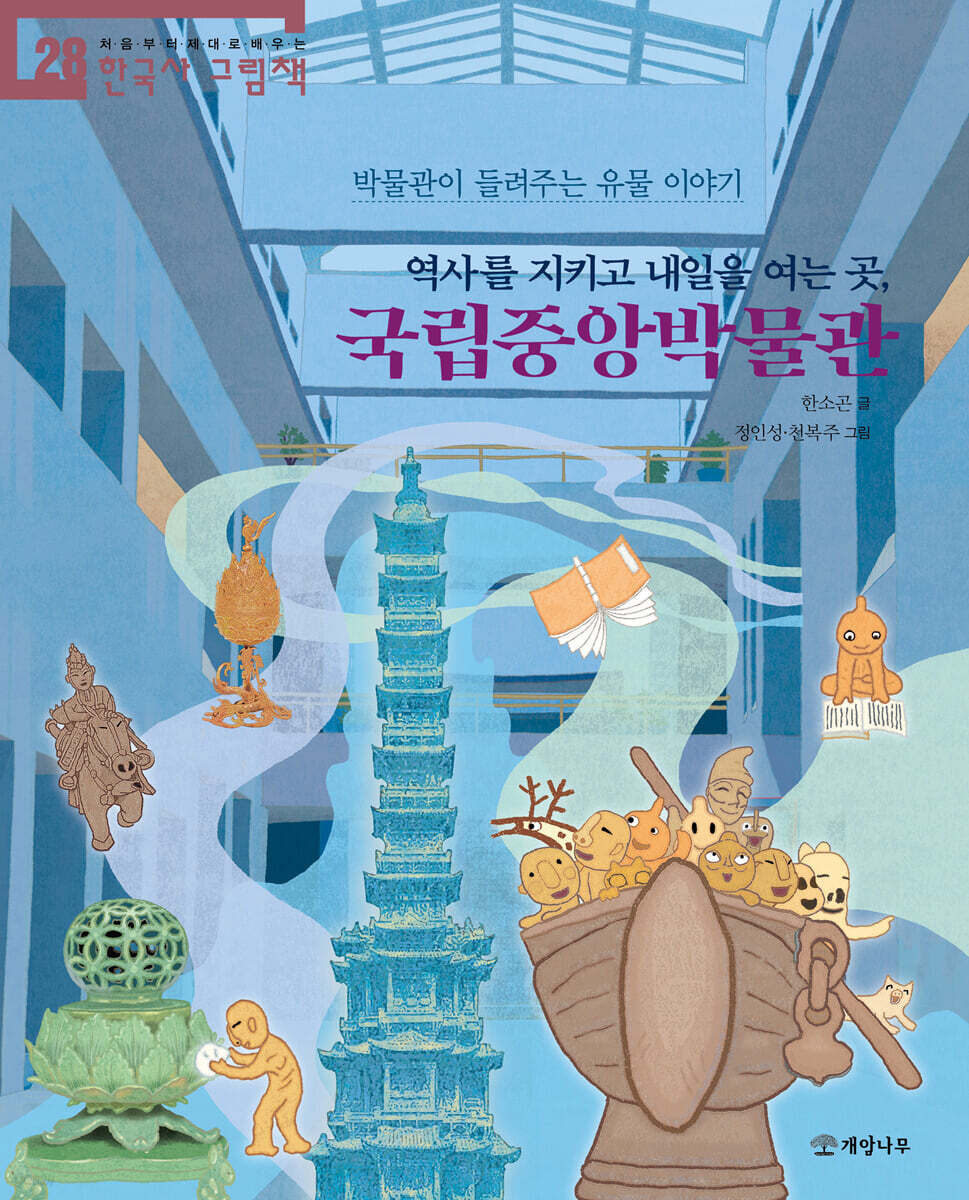
The National Museum of Korea, a place that preserves history and opens the door to tomorrow.
 |
Description
Book Introduction
A museum that preserves the past and illuminates the present,
A history classroom for all of us that empowers us to move forward into the future.
《National Museum of Korea, a Place to Preserve History and Open Tomorrow》 is a Korean history picture book that features the National Museum of Korea as its narrator and tells the story of a group of children who travel around the museum one day with the question, “Which artifact is the most important?”
As the children encounter stone pagodas, Goryeo celadon, Jikji, and underground storage relics, they realize that each relic is a precious entity that holds its own time and story.
By following the history from prehistoric times to the Korean Empire, children can naturally learn the meaning of cultural heritage and the flow of our history.
A history classroom for all of us that empowers us to move forward into the future.
《National Museum of Korea, a Place to Preserve History and Open Tomorrow》 is a Korean history picture book that features the National Museum of Korea as its narrator and tells the story of a group of children who travel around the museum one day with the question, “Which artifact is the most important?”
As the children encounter stone pagodas, Goryeo celadon, Jikji, and underground storage relics, they realize that each relic is a precious entity that holds its own time and story.
By following the history from prehistoric times to the Korean Empire, children can naturally learn the meaning of cultural heritage and the flow of our history.
- You can preview some of the book's contents.
Preview
Detailed image

Publisher's Review
Today, Korean culture is attracting attention all over the world.
As K-contents that are loved by people around the world, such as the movie “K-Pop Demon Hunters,” increase, the number of visitors visiting museums to learn about the roots of Korean culture has also increased significantly.
At its center is the National Museum of Korea.
The National Museum of Korea is Korea's largest comprehensive museum. Since its opening in 1945, it has played a vital role in preserving, researching, and promoting our cultural heritage to the world.
From Paleolithic tools to modern and contemporary materials, artifacts containing the history of the Korean Peninsula are gathered in one place, providing the deepest and broadest view of the flow and identity of Korean culture.
This is also why this book uses the 'museum' as its subject.
If a museum that has long embraced our history tells its own story, children will be able to encounter "living history," not just knowledge.
It naturally comes to mind why the artifacts are precious, what the museum does, and why we should visit this place.
The story begins in a museum after the sun has set and all the visitors have left.
The tows, seated on one side of the exhibition hall, suddenly ask, “Whose most important relic is it?”
Looking at the delicate crafts of the Baekje room, the splendid gold crown of the Silla room, and the brave plate armor of the Gaya room, I felt small and insignificant.
At that time, the equestrian figure-shaped pottery suggests that we go to see the gilt-bronze Maitreya Bodhisattva sitting in meditation, which has been in deep thought for a long time.
And so begins the adventure of the tows.
In the spacious museum they first enter, the tou may get lost, but along the way, they encounter a fist axe, the Bangudae Petroglyphs of Daegok-ri, Ulju, the ten-story stone pagoda of Gyeongcheonsa Temple, Jikji, and relics from the underground storage.
As they listen to the stories of relics of various eras, shapes, and uses, the Tows begin to think anew about the meaning of 'important relics.'
When they finally reach the room of reason, the tows change their initial question and ask the half-hearted Sayu.
“Are we all important relics?”
This book is based on the actual exhibition route of the National Museum of Korea, allowing you to grasp the major flow of Korean history at a glance.
We help children discover for themselves not only the characteristics of relics, but also how culture, technology, and lifestyle have changed in each era.
So, if you read it before visiting the museum, your visit will be more enjoyable, and if you open it after your visit, the meaning of the artifacts will be deeper, making it a fun review.
As you follow the journey of the Toads, you will naturally learn that several countries existed on the Korean Peninsula, including Gojoseon, the Three Kingdoms, Goryeo, and Joseon, and that each era developed its own unique culture.
It gradually shows that precious value is hidden not only in widely known relics but also in a small fragment or an old painting.
Cultural heritage is not simply old objects, but a living record of a nation's history and identity, conveying the message from a child's perspective.
The book ends with a rich appendix to aid children's understanding.
It explains in an easy and engaging way what cultural and national heritage are and the process through which artifacts are excavated or recovered and brought to the museum.
We will also learn why records are important through the Gilt-bronze Buddha statue of the Seventh Year of the Yeonga Dynasty, and how underground storage protects relics.
Finally, we'll introduce some must-see artifacts at the National Museum of Korea, so by the time you close the book, the museum will feel much more familiar.
"The National Museum of Korea, Preserving History and Opening the Future" is a Korean history picture book that helps children reflect on the meaning and value of our cultural heritage through the eyes of children.
By exploring the flow of history that connects eras and generations, centered around the National Museum of Korea, children will realize that cultural heritage is the wisdom that transcends the past and illuminates the future.
This book will open the doors to museums for children who may otherwise feel unfamiliar with them, and foster their interest and curiosity about our history.
As K-contents that are loved by people around the world, such as the movie “K-Pop Demon Hunters,” increase, the number of visitors visiting museums to learn about the roots of Korean culture has also increased significantly.
At its center is the National Museum of Korea.
The National Museum of Korea is Korea's largest comprehensive museum. Since its opening in 1945, it has played a vital role in preserving, researching, and promoting our cultural heritage to the world.
From Paleolithic tools to modern and contemporary materials, artifacts containing the history of the Korean Peninsula are gathered in one place, providing the deepest and broadest view of the flow and identity of Korean culture.
This is also why this book uses the 'museum' as its subject.
If a museum that has long embraced our history tells its own story, children will be able to encounter "living history," not just knowledge.
It naturally comes to mind why the artifacts are precious, what the museum does, and why we should visit this place.
The story begins in a museum after the sun has set and all the visitors have left.
The tows, seated on one side of the exhibition hall, suddenly ask, “Whose most important relic is it?”
Looking at the delicate crafts of the Baekje room, the splendid gold crown of the Silla room, and the brave plate armor of the Gaya room, I felt small and insignificant.
At that time, the equestrian figure-shaped pottery suggests that we go to see the gilt-bronze Maitreya Bodhisattva sitting in meditation, which has been in deep thought for a long time.
And so begins the adventure of the tows.
In the spacious museum they first enter, the tou may get lost, but along the way, they encounter a fist axe, the Bangudae Petroglyphs of Daegok-ri, Ulju, the ten-story stone pagoda of Gyeongcheonsa Temple, Jikji, and relics from the underground storage.
As they listen to the stories of relics of various eras, shapes, and uses, the Tows begin to think anew about the meaning of 'important relics.'
When they finally reach the room of reason, the tows change their initial question and ask the half-hearted Sayu.
“Are we all important relics?”
This book is based on the actual exhibition route of the National Museum of Korea, allowing you to grasp the major flow of Korean history at a glance.
We help children discover for themselves not only the characteristics of relics, but also how culture, technology, and lifestyle have changed in each era.
So, if you read it before visiting the museum, your visit will be more enjoyable, and if you open it after your visit, the meaning of the artifacts will be deeper, making it a fun review.
As you follow the journey of the Toads, you will naturally learn that several countries existed on the Korean Peninsula, including Gojoseon, the Three Kingdoms, Goryeo, and Joseon, and that each era developed its own unique culture.
It gradually shows that precious value is hidden not only in widely known relics but also in a small fragment or an old painting.
Cultural heritage is not simply old objects, but a living record of a nation's history and identity, conveying the message from a child's perspective.
The book ends with a rich appendix to aid children's understanding.
It explains in an easy and engaging way what cultural and national heritage are and the process through which artifacts are excavated or recovered and brought to the museum.
We will also learn why records are important through the Gilt-bronze Buddha statue of the Seventh Year of the Yeonga Dynasty, and how underground storage protects relics.
Finally, we'll introduce some must-see artifacts at the National Museum of Korea, so by the time you close the book, the museum will feel much more familiar.
"The National Museum of Korea, Preserving History and Opening the Future" is a Korean history picture book that helps children reflect on the meaning and value of our cultural heritage through the eyes of children.
By exploring the flow of history that connects eras and generations, centered around the National Museum of Korea, children will realize that cultural heritage is the wisdom that transcends the past and illuminates the future.
This book will open the doors to museums for children who may otherwise feel unfamiliar with them, and foster their interest and curiosity about our history.
GOODS SPECIFICS
- Date of issue: November 28, 2025
- Page count, weight, size: 84 pages | 342g | 210*260*6mm
- ISBN13: 9788968308963
- ISBN10: 8968308969
- KC Certification: Certification Type: Conformity Confirmation
You may also like
카테고리
korean


korean

![GQ KOREA Mark (Monthly): December [2025]](http://librairie.coreenne.fr/cdn/shop/files/8ef265dbbfbf186523ed75ba7319009d.jpg?v=1765340328&width=3840)


