

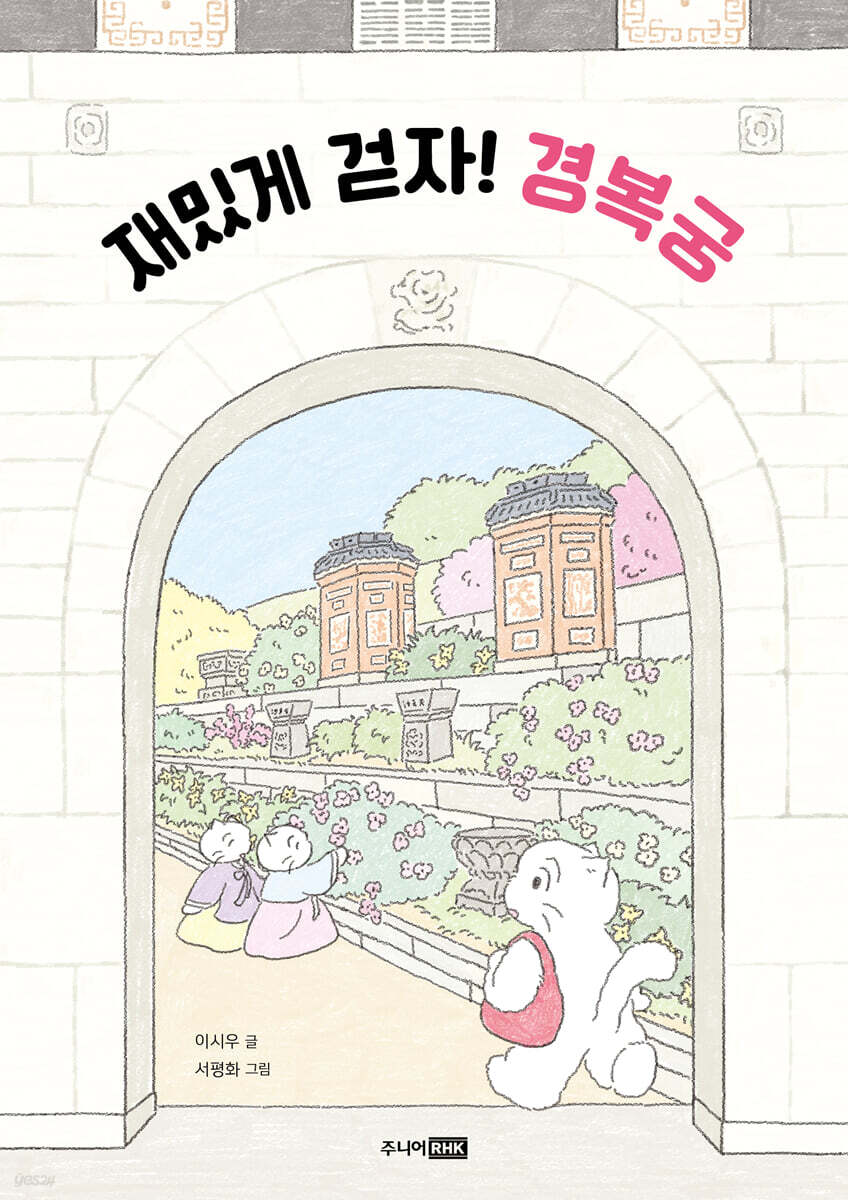
Let's have fun walking! Gyeongbokgung Palace
 |
Description
Book Introduction
“Palaces are fun!” Our palaces, a treasure trove of stories
Walk around every nook and cranny, see, feel, and discover!
A must-read before visiting the palace, and a must-have when visiting: the Gyeongbokgung Palace Exploration Guide.
Author Lee Si-woo, who is active as a cultural heritage education expert, forest interpreter, and program planner for the program "Time to Walk Through the Palace," meets readers with his first children's educational book.
The "Children's Palace Explorers" series being introduced this time is a "guidebook for exploring our palaces" that you can take with you at any time and unfold while walking around the palaces with a light breath.
Starting with Gyeongbokgung Palace, which holds over 500 years of Joseon history and is located in the heart of Seoul, we will introduce Changdeokgung Palace, Changgyeonggung Palace, Deoksugung Palace, and Gyeonghuigung Palace in that order.
The first book in the series, "Let's Walk Fun! Gyeongbokgung Palace," explores every nook and cranny of Gyeongbokgung Palace, its 17 locations.
Rather than focusing on the history and characteristics of palace architecture and the extensive knowledge centered on the Joseon royal family lineage, the focus is on telling the stories of the traces of the ancient people that remain in every corner of the palace and the stories related to them, and on making people imagine the hidden stories.
To this end, we have incorporated a variety of vivid information into the story, including exploration tips and missions that children can approach with curiosity and interest, and thematic courses.
Above all, we hope that you will be able to view the palace buildings from a different perspective and experience them firsthand, and we have filled 17 locations with this desire.
The illustrations of Seo Pyeong-hwa, who is receiving much love from various fields, make palace exploration even more interesting.
The adorable cat with fluffy white fur and a red bag sometimes acts as an explorer, sometimes as a guide, and sometimes as a character in a historical scene, stimulating children's curiosity and making them willing to participate in palace explorations.
Let's walk, see, hear, touch, and feel, guided by the expedition leader and the cat.
As you discover and imagine the stories engraved in the palace, you will discover a different side of the palace that you could not have known from reading about it, and you will have an amazing experience where your historical imagination and sensibility will sprout.
Walk around every nook and cranny, see, feel, and discover!
A must-read before visiting the palace, and a must-have when visiting: the Gyeongbokgung Palace Exploration Guide.
Author Lee Si-woo, who is active as a cultural heritage education expert, forest interpreter, and program planner for the program "Time to Walk Through the Palace," meets readers with his first children's educational book.
The "Children's Palace Explorers" series being introduced this time is a "guidebook for exploring our palaces" that you can take with you at any time and unfold while walking around the palaces with a light breath.
Starting with Gyeongbokgung Palace, which holds over 500 years of Joseon history and is located in the heart of Seoul, we will introduce Changdeokgung Palace, Changgyeonggung Palace, Deoksugung Palace, and Gyeonghuigung Palace in that order.
The first book in the series, "Let's Walk Fun! Gyeongbokgung Palace," explores every nook and cranny of Gyeongbokgung Palace, its 17 locations.
Rather than focusing on the history and characteristics of palace architecture and the extensive knowledge centered on the Joseon royal family lineage, the focus is on telling the stories of the traces of the ancient people that remain in every corner of the palace and the stories related to them, and on making people imagine the hidden stories.
To this end, we have incorporated a variety of vivid information into the story, including exploration tips and missions that children can approach with curiosity and interest, and thematic courses.
Above all, we hope that you will be able to view the palace buildings from a different perspective and experience them firsthand, and we have filled 17 locations with this desire.
The illustrations of Seo Pyeong-hwa, who is receiving much love from various fields, make palace exploration even more interesting.
The adorable cat with fluffy white fur and a red bag sometimes acts as an explorer, sometimes as a guide, and sometimes as a character in a historical scene, stimulating children's curiosity and making them willing to participate in palace explorations.
Let's walk, see, hear, touch, and feel, guided by the expedition leader and the cat.
As you discover and imagine the stories engraved in the palace, you will discover a different side of the palace that you could not have known from reading about it, and you will have an amazing experience where your historical imagination and sensibility will sprout.
- You can preview some of the book's contents.
Preview
index
-To the members of the Children's Palace Exploration Team
-Gyeongbokgung Palace Exploration Map
Gwanghwamun : The majestic main gate of Gyeongbokgung Palace
Gwanghwamun Woldae : The road unfolds again in front of Gwanghwamun
Haetae : The representative guardian of Gyeongbokgung Palace
Yeongjegyo Bridge : A bridge guarding the palace with eight guards
│Theme Exploration Course ①│Finding the four gates of the East, West, South, and North
Geunjeongjeon : The central building symbolizing the king's dignity
Sajeongjeon : The Joseon king's office
Gangnyeongjeon : A house to pray for the king's health
Gyo Tae-jeon : The Queen's Dignity Decorated in the Backyard
Gyeonghoeru : Joseon's official state banquet hall
Jasindang, Bihyeon-gak, and Gyejodang : A space where future kings were raised
│Theme Exploration Course ②│Finding symbols to prevent fire
Sojubang : The kitchen responsible for the royal family's meals
Jagyeongjeon Flower Wall : An Outdoor Art Museum at Gyeongbokgung Palace
Jagyeongjeon : A house filled with filial piety toward the highest elders of the royal family
Hyangwonjeong : The private garden of Emperor Gojong and Empress Myeongseong
Taewonjeon : Where the deceased king and queen stayed
Geoncheonggung Palace : A palace within a palace built by King Gojong
Jibokjae : Emperor Gojong's study, built in the latest fashion
│Theme Exploration Course ③│In Search of Traces of King Gojong
-Explore the History of Gyeongbokgung Palace
-References
-Gyeongbokgung Palace Exploration Map
Gwanghwamun : The majestic main gate of Gyeongbokgung Palace
Gwanghwamun Woldae : The road unfolds again in front of Gwanghwamun
Haetae : The representative guardian of Gyeongbokgung Palace
Yeongjegyo Bridge : A bridge guarding the palace with eight guards
│Theme Exploration Course ①│Finding the four gates of the East, West, South, and North
Geunjeongjeon : The central building symbolizing the king's dignity
Sajeongjeon : The Joseon king's office
Gangnyeongjeon : A house to pray for the king's health
Gyo Tae-jeon : The Queen's Dignity Decorated in the Backyard
Gyeonghoeru : Joseon's official state banquet hall
Jasindang, Bihyeon-gak, and Gyejodang : A space where future kings were raised
│Theme Exploration Course ②│Finding symbols to prevent fire
Sojubang : The kitchen responsible for the royal family's meals
Jagyeongjeon Flower Wall : An Outdoor Art Museum at Gyeongbokgung Palace
Jagyeongjeon : A house filled with filial piety toward the highest elders of the royal family
Hyangwonjeong : The private garden of Emperor Gojong and Empress Myeongseong
Taewonjeon : Where the deceased king and queen stayed
Geoncheonggung Palace : A palace within a palace built by King Gojong
Jibokjae : Emperor Gojong's study, built in the latest fashion
│Theme Exploration Course ③│In Search of Traces of King Gojong
-Explore the History of Gyeongbokgung Palace
-References
Detailed image

Publisher's Review
ㆍThe 'pleasant shock' encountered when walking, seeing, hearing, touching, feeling, and imagining
_How to Explore a 'Living' Palace for Kids!
Five 'palaces' stand in the heart of Seoul, a city bustling with tall buildings, wide, long streets, and countless cars and people.
The main characters are Gyeongbokgung Palace, Changdeokgung Palace, Changgyeonggung Palace, Deoksugung Palace, and Gyeonghuigung Palace, which were the homes of the Joseon kings and royal families for over 500 years and where national affairs were conducted.
The palace is not a place of the past that exists only in historical records or books, but a 'living' site where we can walk through and vividly experience Joseon's history.
The author says that at the first cultural heritage site tour he went on after entering university, he encountered a cold stone tower left alone in an empty lot and a castle wall that had stood unbroken for hundreds or thousands of years, and that he 'experienced' a scene from history that had been lying flat in a book come to life and unfold in three dimensions.
And to share the ‘joyful shock’ I received at that time with children, I published the ‘Children’s Palace Explorers’ series.
There was something about the cultural heritage site that could never be felt through books, something that could be gained through the senses.
I mean, walking around the field trip site and feeling the soil and stones with both hands.
I smell the weeds growing haphazardly on the temple grounds, and listen carefully to the sound of the wind.
_From the author's note
The "Children's Palace Explorers" series is the result of much thought put into how to make it easier for children to visit the palace, enjoy it, and return home, and how to make them excited to visit the palace again, rather than simply organizing a vast amount of historical knowledge, such as the palace's history, architectural features, and the genealogy of the people who passed through it.
This book is great to read while sitting still, but it really comes into its own when you take it out and walk around the palace grounds.
As you walk, see, hear, touch, and feel the stories engraved in the palace as guided by the book, you will experience the sprouting of historical imagination and sensitivity that words cannot fully capture.
In the upcoming installments of "Let's Walk Fun! Changdeokgung Palace and Changgyeonggung Palace" and "Let's Walk Fun! Deoksugung Palace and Gyeonghuigung Palace," we plan to explore four of our palaces in turn, following Gyeongbokgung Palace.
ㆍThe unique faces of Gyeongbokgung Palace, Joseon's premier palace
_A must-read guide to exploring Gyeongbokgung Palace before and after visiting the palace.
① 17 locations in Gyeongbokgung Palace with historical scenes engraved on them
Exploring Gyeongbokgung Palace begins at Gwanghwamun, the main gate.
We explore 17 locations one by one, including the space where the king and royal family looked after the people and the country, the kitchen where royal cuisine was prepared, the beautiful back garden that served as a resting place for the royal family, the banquet hall where national feasts were held, and the place where an electric generator was installed two years before Japan and China, and where the queen was murdered by a Japanese assassin.
Gyeongbokgung Palace, which spans the beginning and end of Joseon's 500-year history, lost its luster and use during wars and Japanese colonial rule, but continues to regain its former appearance, bringing us, living today, to the very heart of history.
As you follow the stories in this book and tour the 17 locations and walk along the paths, you will encounter the different faces of Gyeongbokgung Palace, layered with layers of time.
② A special guide to make exploring Gyeongbokgung Palace even more enjoyable
What is particularly noteworthy in this book is the unique and special palace exploration guide provided by the expedition leader.
For example, when you arrive at the Jageungjeon Hall, before going into the story of King Gojong and Queen Sinjeong, who are related to the building, and the historical story surrounding them, you are first introduced to the 'flower wall' that can be seen around the corner.
And I suggest that you come closer and smell the scent of the flowers carved into the flower wall to feel the season, and that you stand far away and take in the entire flower wall, which is like a painting.
While explaining the meaning of setting up eight animal guards at Yeongjegyo, he suggests looking for Cheonrok, who sticks out his tongue and says, “Merong!” He also gives a sneaky tip that the twin dragon sculptures on the ceiling of Geunjeongjeon are best seen when standing in front of the east or west gate, not the front of the building.
③ 17 exploration missions that will foster historical imagination and sensitivity.
Once you've explored each location, it's time to tackle the 'Exploration Missions' provided at the end of each chapter.
There are missions where you have to find something yourself, such as finding your zodiac animal among the twelve zodiac animal sculptures at Geunjeongjeon and counting the number of miscellaneous statues on the roof at Gyeonghoeru. There are also missions where you have to think about why the expressions of the Yeongjegyo Seosu, who were supposed to protect the palace, were made playful, and what the "precious treasure" in the name of Jibokjae is.
From missions with answers like this one to missions that require them to find, think, imagine, and feel, children can naturally develop their historical imagination and sensitivity as they solve each given exploration mission.
④ Vivid and beautiful illustrations that seem to have been moved from the actual location of Gyeongbokgung Palace
Before exploring Gyeongbokgung Palace in person, you can first encounter each location in the pictures.
In some places, the entire building and landscape are depicted in a refreshing manner, while in other places, the most beautiful parts are captured in close-up, containing meaning worth thinking about.
There is also a place where a scene from the history surrounding the building is vividly reenacted.
Author Seo Pyeong-hwa maintains the unique, fancy tone and drawing style he has consistently presented, while also fully capturing the beauty of our unique traditional architecture in this book, conveying the charm of palaces to both children and adults.
The buildings and landscapes are vividly depicted as if they were taken from actual locations, helping you get closer to each location and making exploring Gyeongbokgung Palace even more enjoyable.
ㆍCultural heritage education expert and historical content writer Lee Si-woo's 'Strong and Warm Content'
A charming palace story created by illustrator Seo Pyeong-hwa's "soft and lovable characters."
This is the first children's educational book by author Lee Si-woo, who majored in history in college and is now active as a cultural heritage education expert, forest interpreter, and planner and writer of historical content.
In this series, he leads the 'Children's Palace Exploration Team' as a strong explorer.
It is very appealing that the book contains interesting courses and methods that allow you to walk and explore the palace from a different perspective, breaking away from the typical historical experiential learning experience, and vivid information.
This is likely due to the sensibility and expertise that came from running the program, “Time to Walk the Palace,” with the goal of “looking deeply and slowly” rather than “looking a lot.”
The characters created by author Seo Pyeong-hwa, who is loved by readers from various fields, make palace exploration even more interesting.
A lovely cat with fluffy white fur and a red bag, sometimes an explorer and sometimes a guide, willingly invites children to join in on palace explorations.
Sometimes, she becomes a historical figure, such as Empress Myeongseong, sitting in Okhoru and looking out at the light of the lantern, or the King of Joseon, passing over the fish bridge on the Woldae Pavilion at Gwanghwamun, satisfying the curiosity of readers.
The story behind the creation of the white cat character, which began with a trip to the palace, has expanded into the "Children's Palace Explorers" series. Let's walk together into the charming palace story created by the two authors!
ㆍToday, go where your feet take you, tomorrow, go where your heart leads you!
Gyeongbokgung Palace Exploration Course Planned and Executed by Me
You can explore in the order suggested in the book, but you can change the order at any time according to your mood, choices, weather, or surrounding circumstances.
If you want to know where you are now and where to go next, open the Gyeongbokgung Palace exploration map at the front of the book.
If there's a place that catches your eye, I hope you'll stay for a long time and take a closer look, or take a side trip to discover your own secret place.
If you hide under the nearby eaves to avoid the scorching sunlight or the sudden drizzle, you might encounter a new, unexpected face of the palace.
There are interesting thematic courses scattered throughout the book, such as exploring the Four Great Gates outside the walls of Gyeongbokgung Palace, exploring to discover symbols that prevent fire, and exploring to follow the footsteps of Emperor Gojong. So, choose a topic that interests you and walk along that course, or even create your own Gyeongbokgung Palace course, which will be a fun experience.
_How to Explore a 'Living' Palace for Kids!
Five 'palaces' stand in the heart of Seoul, a city bustling with tall buildings, wide, long streets, and countless cars and people.
The main characters are Gyeongbokgung Palace, Changdeokgung Palace, Changgyeonggung Palace, Deoksugung Palace, and Gyeonghuigung Palace, which were the homes of the Joseon kings and royal families for over 500 years and where national affairs were conducted.
The palace is not a place of the past that exists only in historical records or books, but a 'living' site where we can walk through and vividly experience Joseon's history.
The author says that at the first cultural heritage site tour he went on after entering university, he encountered a cold stone tower left alone in an empty lot and a castle wall that had stood unbroken for hundreds or thousands of years, and that he 'experienced' a scene from history that had been lying flat in a book come to life and unfold in three dimensions.
And to share the ‘joyful shock’ I received at that time with children, I published the ‘Children’s Palace Explorers’ series.
There was something about the cultural heritage site that could never be felt through books, something that could be gained through the senses.
I mean, walking around the field trip site and feeling the soil and stones with both hands.
I smell the weeds growing haphazardly on the temple grounds, and listen carefully to the sound of the wind.
_From the author's note
The "Children's Palace Explorers" series is the result of much thought put into how to make it easier for children to visit the palace, enjoy it, and return home, and how to make them excited to visit the palace again, rather than simply organizing a vast amount of historical knowledge, such as the palace's history, architectural features, and the genealogy of the people who passed through it.
This book is great to read while sitting still, but it really comes into its own when you take it out and walk around the palace grounds.
As you walk, see, hear, touch, and feel the stories engraved in the palace as guided by the book, you will experience the sprouting of historical imagination and sensitivity that words cannot fully capture.
In the upcoming installments of "Let's Walk Fun! Changdeokgung Palace and Changgyeonggung Palace" and "Let's Walk Fun! Deoksugung Palace and Gyeonghuigung Palace," we plan to explore four of our palaces in turn, following Gyeongbokgung Palace.
ㆍThe unique faces of Gyeongbokgung Palace, Joseon's premier palace
_A must-read guide to exploring Gyeongbokgung Palace before and after visiting the palace.
① 17 locations in Gyeongbokgung Palace with historical scenes engraved on them
Exploring Gyeongbokgung Palace begins at Gwanghwamun, the main gate.
We explore 17 locations one by one, including the space where the king and royal family looked after the people and the country, the kitchen where royal cuisine was prepared, the beautiful back garden that served as a resting place for the royal family, the banquet hall where national feasts were held, and the place where an electric generator was installed two years before Japan and China, and where the queen was murdered by a Japanese assassin.
Gyeongbokgung Palace, which spans the beginning and end of Joseon's 500-year history, lost its luster and use during wars and Japanese colonial rule, but continues to regain its former appearance, bringing us, living today, to the very heart of history.
As you follow the stories in this book and tour the 17 locations and walk along the paths, you will encounter the different faces of Gyeongbokgung Palace, layered with layers of time.
② A special guide to make exploring Gyeongbokgung Palace even more enjoyable
What is particularly noteworthy in this book is the unique and special palace exploration guide provided by the expedition leader.
For example, when you arrive at the Jageungjeon Hall, before going into the story of King Gojong and Queen Sinjeong, who are related to the building, and the historical story surrounding them, you are first introduced to the 'flower wall' that can be seen around the corner.
And I suggest that you come closer and smell the scent of the flowers carved into the flower wall to feel the season, and that you stand far away and take in the entire flower wall, which is like a painting.
While explaining the meaning of setting up eight animal guards at Yeongjegyo, he suggests looking for Cheonrok, who sticks out his tongue and says, “Merong!” He also gives a sneaky tip that the twin dragon sculptures on the ceiling of Geunjeongjeon are best seen when standing in front of the east or west gate, not the front of the building.
③ 17 exploration missions that will foster historical imagination and sensitivity.
Once you've explored each location, it's time to tackle the 'Exploration Missions' provided at the end of each chapter.
There are missions where you have to find something yourself, such as finding your zodiac animal among the twelve zodiac animal sculptures at Geunjeongjeon and counting the number of miscellaneous statues on the roof at Gyeonghoeru. There are also missions where you have to think about why the expressions of the Yeongjegyo Seosu, who were supposed to protect the palace, were made playful, and what the "precious treasure" in the name of Jibokjae is.
From missions with answers like this one to missions that require them to find, think, imagine, and feel, children can naturally develop their historical imagination and sensitivity as they solve each given exploration mission.
④ Vivid and beautiful illustrations that seem to have been moved from the actual location of Gyeongbokgung Palace
Before exploring Gyeongbokgung Palace in person, you can first encounter each location in the pictures.
In some places, the entire building and landscape are depicted in a refreshing manner, while in other places, the most beautiful parts are captured in close-up, containing meaning worth thinking about.
There is also a place where a scene from the history surrounding the building is vividly reenacted.
Author Seo Pyeong-hwa maintains the unique, fancy tone and drawing style he has consistently presented, while also fully capturing the beauty of our unique traditional architecture in this book, conveying the charm of palaces to both children and adults.
The buildings and landscapes are vividly depicted as if they were taken from actual locations, helping you get closer to each location and making exploring Gyeongbokgung Palace even more enjoyable.
ㆍCultural heritage education expert and historical content writer Lee Si-woo's 'Strong and Warm Content'
A charming palace story created by illustrator Seo Pyeong-hwa's "soft and lovable characters."
This is the first children's educational book by author Lee Si-woo, who majored in history in college and is now active as a cultural heritage education expert, forest interpreter, and planner and writer of historical content.
In this series, he leads the 'Children's Palace Exploration Team' as a strong explorer.
It is very appealing that the book contains interesting courses and methods that allow you to walk and explore the palace from a different perspective, breaking away from the typical historical experiential learning experience, and vivid information.
This is likely due to the sensibility and expertise that came from running the program, “Time to Walk the Palace,” with the goal of “looking deeply and slowly” rather than “looking a lot.”
The characters created by author Seo Pyeong-hwa, who is loved by readers from various fields, make palace exploration even more interesting.
A lovely cat with fluffy white fur and a red bag, sometimes an explorer and sometimes a guide, willingly invites children to join in on palace explorations.
Sometimes, she becomes a historical figure, such as Empress Myeongseong, sitting in Okhoru and looking out at the light of the lantern, or the King of Joseon, passing over the fish bridge on the Woldae Pavilion at Gwanghwamun, satisfying the curiosity of readers.
The story behind the creation of the white cat character, which began with a trip to the palace, has expanded into the "Children's Palace Explorers" series. Let's walk together into the charming palace story created by the two authors!
ㆍToday, go where your feet take you, tomorrow, go where your heart leads you!
Gyeongbokgung Palace Exploration Course Planned and Executed by Me
You can explore in the order suggested in the book, but you can change the order at any time according to your mood, choices, weather, or surrounding circumstances.
If you want to know where you are now and where to go next, open the Gyeongbokgung Palace exploration map at the front of the book.
If there's a place that catches your eye, I hope you'll stay for a long time and take a closer look, or take a side trip to discover your own secret place.
If you hide under the nearby eaves to avoid the scorching sunlight or the sudden drizzle, you might encounter a new, unexpected face of the palace.
There are interesting thematic courses scattered throughout the book, such as exploring the Four Great Gates outside the walls of Gyeongbokgung Palace, exploring to discover symbols that prevent fire, and exploring to follow the footsteps of Emperor Gojong. So, choose a topic that interests you and walk along that course, or even create your own Gyeongbokgung Palace course, which will be a fun experience.
GOODS SPECIFICS
- Date of issue: April 25, 2024
- Page count, weight, size: 128 pages | 152*215*20mm
- ISBN13: 9788925575193
- ISBN10: 8925575191
- KC Certification: Certification Type: Conformity Confirmation
You may also like
카테고리
korean


korean

![GQ KOREA Mark (Monthly): December [2025]](http://librairie.coreenne.fr/cdn/shop/files/8ef265dbbfbf186523ed75ba7319009d.jpg?v=1765340328&width=3840)


