

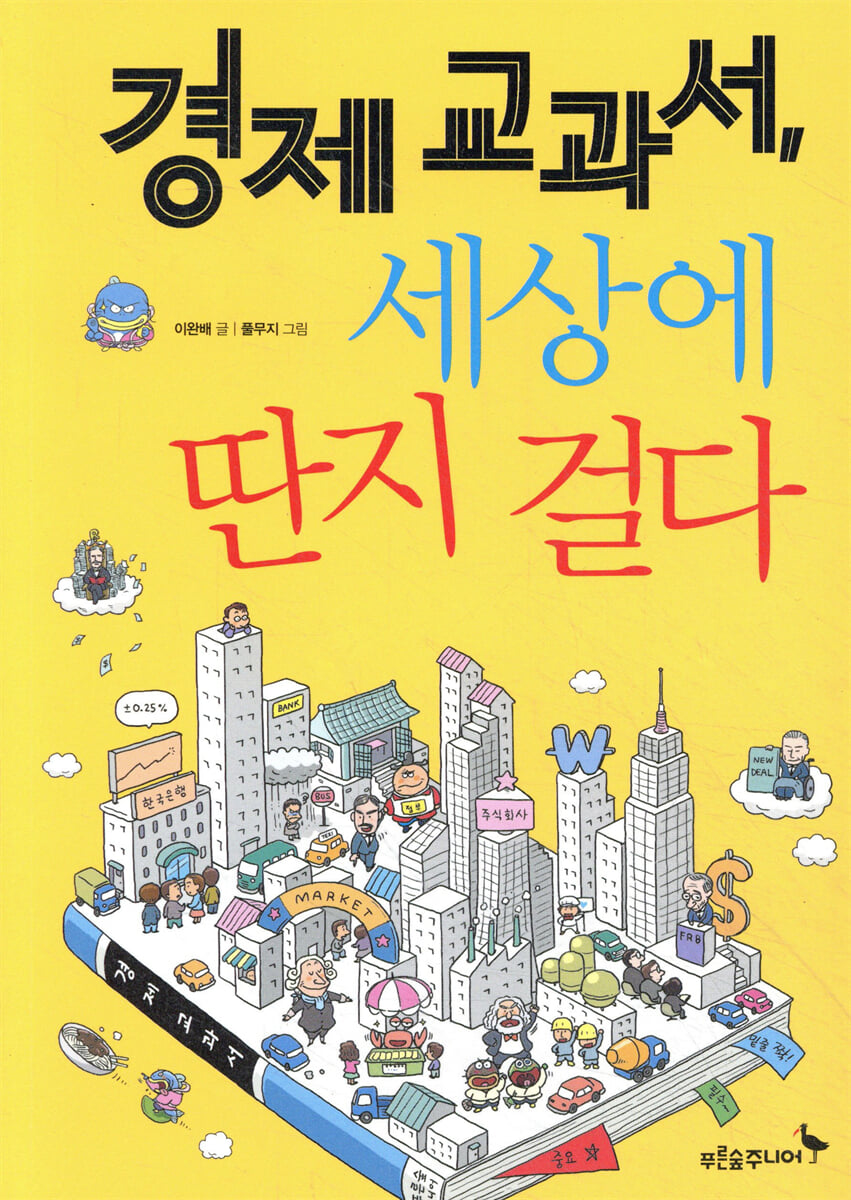
Economics textbooks challenge the world
 |
Description
Book Introduction
It starts with basic economic vocabulary that appears in middle and high school textbooks and explains them in order, and uses interesting episodes to make it easy to understand the related background knowledge. In addition, it devotes an entire chapter to the most frequently appearing mathematical part of economics, 'probability', and explains it in detail by connecting it to our real lives.
The most striking part is the examples that help understanding.
Because this book naturally explains economic concepts by incorporating diverse and rich materials that anyone can easily relate to, such as domestic dramas, movies, TV commercials, and reality shows, readers will be able to read this book comfortably as if they were reading an essay, despite its economic nature.
Also, do students have to pay taxes? Is it okay to lend money to a friend and charge interest? Are there ways for middle and high school students to earn money? Starting with these real-life economic questions that young people are curious about today, the book guides readers through a broader perspective on the world governed by economic principles.
The most striking part is the examples that help understanding.
Because this book naturally explains economic concepts by incorporating diverse and rich materials that anyone can easily relate to, such as domestic dramas, movies, TV commercials, and reality shows, readers will be able to read this book comfortably as if they were reading an essay, despite its economic nature.
Also, do students have to pay taxes? Is it okay to lend money to a friend and charge interest? Are there ways for middle and high school students to earn money? Starting with these real-life economic questions that young people are curious about today, the book guides readers through a broader perspective on the world governed by economic principles.
- You can preview some of the book's contents.
Preview
index
1. Keep a Cool Head, Keep a Warm Heart: Why Study Economics Now
I want to rent out the entire movie theater too! │Should I go to Lotte World or Everland? │Don't throw away donuts that are 24 hours old!
Aha! The Economic Backstory... Bhutan, a Poor but Happy Country
2. As I Like It vs. As You Say, That Is the Question: Planned Economy vs. Market Economy
I hate being interfered with!│You think things will run smoothly if you just leave them alone?│If you feel wronged, you should become the president too!│Oh, in our country, there is no 'visible hand'... ...│Please mix it together!
Aha! The Economic Backstory... Japan, the Undisputed Powerhouse of a Planned Economy
3 Where is the 'Invisible Hand' Hidden?: Market Economy and the Price Determination Process
No need to be thankful when eating? │ Let's not curse people who live selfishly! │ Who is controlling Okdongja? │ Invisible X-Man, who are you? │ Something is missing for everyone to be happy.
Aha! The Economics Behind the Scenes... Sharing Ice Cream Cake with a Genius Economist
4 Don't Bury Your California Oranges: A History of the Great Depression
Do you have to ask to live?│The invisible hand, have you been dozing off for a moment?│That's why the government has to do its job!
Aha! The Economics Behind the Scenes... Keynes, the Master of Reality, on His Investment Know-How
5 I Hate Taxes!: Why You Should Pay Taxes
What has the government done for me? Stop thinking that a surplus is a good thing! │Who really pays the most taxes? │Your tax bill tells you what you did during your last term.
Aha! The Economic Backstory...A Society That Recommends Everything, America
I want to rent out the entire movie theater too! │Should I go to Lotte World or Everland? │Don't throw away donuts that are 24 hours old!
Aha! The Economic Backstory... Bhutan, a Poor but Happy Country
2. As I Like It vs. As You Say, That Is the Question: Planned Economy vs. Market Economy
I hate being interfered with!│You think things will run smoothly if you just leave them alone?│If you feel wronged, you should become the president too!│Oh, in our country, there is no 'visible hand'... ...│Please mix it together!
Aha! The Economic Backstory... Japan, the Undisputed Powerhouse of a Planned Economy
3 Where is the 'Invisible Hand' Hidden?: Market Economy and the Price Determination Process
No need to be thankful when eating? │ Let's not curse people who live selfishly! │ Who is controlling Okdongja? │ Invisible X-Man, who are you? │ Something is missing for everyone to be happy.
Aha! The Economics Behind the Scenes... Sharing Ice Cream Cake with a Genius Economist
4 Don't Bury Your California Oranges: A History of the Great Depression
Do you have to ask to live?│The invisible hand, have you been dozing off for a moment?│That's why the government has to do its job!
Aha! The Economics Behind the Scenes... Keynes, the Master of Reality, on His Investment Know-How
5 I Hate Taxes!: Why You Should Pay Taxes
What has the government done for me? Stop thinking that a surplus is a good thing! │Who really pays the most taxes? │Your tax bill tells you what you did during your last term.
Aha! The Economic Backstory...A Society That Recommends Everything, America
Detailed image
Publisher's Review
You turn your head away whenever the economy is mentioned?
Economics is no longer a choice, it's survival.
A story about the economy in the world, read along with textbooks!
Our 'present' and our youth's 'future' depend on the economy!
In the United States, which experienced a financial crisis in the mid-2000s, economic education for elementary, middle, and high school students was significantly strengthened starting in 2008.
In some states, completion of an economics course is included in high school graduation requirements, and the U.S. Congress has even enacted related laws, such as the Economic Education Act.
This is because the country judged that the economy is an important factor that determines not only the future of individuals but also the 'survival' of society as a whole.
This means that behind the meshing of gears in the world, there is an economic principle hidden.
The reason for studying economics is not simply to learn economic terms, but the greatest meaning lies in broadening one's perspective on the world.
Economics is recognized as one of the most difficult subjects for young people, despite being a subject that is practically necessary for living.
Middle school social studies teachers who teach students in the field also complain that students have a hard time when they only get into the economics part.
So why is economics so difficult? For one thing, it's filled with technical terms derived from Chinese characters and loanwords, requires a thorough understanding of historical background, and is comprised of complex principles that require understanding, not memorization.
It also includes a mathematical element that most people shy away from.
The fact that the examples that should help us understand easily are foreign examples that are unfamiliar to us also contributes to the fact that the discipline of 'economics' feels difficult and distant.
Considering these points, "Economics Textbook, Challenging the World" explains the basic economic terms that appear in middle and high school textbooks in an easy-to-understand order, and uses interesting episodes to make it easy to understand the related background knowledge. In addition, an entire chapter is dedicated to the "probability" part of mathematics, which appears the most in economics, and explains it in detail by connecting it to our real lives.
The most striking part is the examples that help understanding.
Because this book naturally explains economic concepts by incorporating diverse and rich materials that anyone can easily relate to, such as domestic dramas, movies, TV commercials, and reality shows, readers will be able to read this book comfortably as if they were reading an essay, despite its economic nature.
Also, do students have to pay taxes? Is it okay to lend money to a friend and charge interest? Are there ways for middle and high school students to earn money? Starting with these real-life economic questions that young people are curious about today, the book guides readers through a broader perspective on the world governed by economic principles.
A vivid economic story explained through real-life events!
This book is an economics textbook for young people that provides information sequentially, from the basics of economics to expanded current affairs knowledge, to help them develop fundamental economic skills.
To make the unfamiliar field of 'economics' easily accessible, the concepts and principles of economics are explained step by step, following the flow of economics textbooks.
Furthermore, rather than simply marking related units as superficial links, the book was meticulously organized from the planning stage to incorporate actual textbook content, including quoting and explaining the actual content.
We select topics that middle and high school students must know - market economy, capitalism, taxes, monopolies, corporations, finance, etc. - and explain them at a level that is suitable for young people.
This book does not force you to believe that “economics is life.”
However, the economic story is told using familiar and interesting examples that anyone would have experienced at least once in real life.
Therefore, as readers read the book, they will naturally accept the formula “economy = life.”
“Hey, lend me 10,000 won.
“I’ll pay you back tomorrow.”
“Okay, but pay me back 11,000 won tomorrow, including interest.”
“Yeah, well.”
Have you ever been in a transaction like this? Were you the lender or the borrower? If you were the lender, lending 10,000 won and receiving 1,000 won in interest in one day, you'd be a true daytime robber.
You will become a legend in the world of robbery.
Let's interpret the seemingly everyday transaction above in financial terms.
Bank interest rates are usually around 4%.
If you leave it for one year, you will receive 4% interest.
The law also stipulates that the interest rate on the terrifying private loan cannot exceed 44% per annum.
If you charge interest higher than that, you will be arrested.
So, what interest rate did the master of day labor, who lent 10,000 won and received 1,000 won in interest in one day, set to secure this deal? If you confidently declared, "10%!", you need to reread the beginning of this book.
Interest rates are usually given on an annual basis.
The King of the Day Robbers received 10% per day.
If we simply convert this to annual interest rates, the interest rate is a whopping 3,650%.
Let's express the transaction we saw earlier a little differently.
“Hey, lend me 10,000 won.
“I’ll pay you back in a year.”
“Yeah, but you have to pay back 375,000 won in one year, including interest.”
Knowing this, how could you possibly propose such a deal? It's simply ridiculous.
But surprisingly, we can see quite a few of these transactions around us.
(pp.170~171)
With bursts of laughter, you will develop new perspectives on the world!
The author's humor in the story provides refreshing laughter, but the events that unfold the story itself make you agree with them, saying, "Oh, that's right! That's right!" (Sometimes, it feels like you've been hit in the back of the head!).
But it doesn't end with just laughter, all stories end with 'the eyes to see the world', a precious asset that cannot be measured in grades or money.
While the primary goal is to convey economic concepts and knowledge, the author's loving wish for young readers is to understand the principles of how the world works based on this.
Through this book, readers will learn not only the fish of economic knowledge, but also the fishing method of life wisdom.
One convenience store in the US reportedly throws away any donuts on display that are more than 24 hours old.
It's not that they're expired or inedible, but it's the company's policy to provide customers with the freshest donuts possible.
But now in Africa, countless children are starving to death because they can't get donuts that are even 24 days old, let alone 24 hours old.
Why throw away day-old donuts? Why not help starving children with them?
You can't blame the convenience store.
Because they have to make money too.
That convenience store just made a rational choice with a cool head.
(syncopation)
As you learn more about economics, you will naturally become interested in everything that happens in the world and begin to interpret the ways in which the world works through economic logic.
You can develop the ability to judge what is right and what is wrong.
It is this kind of brain training that helps us choose our dreams correctly and guides us to interpret our country and the world with sound eyes.
“Keep your head cool, your heart warm!”
Now you know why, right?
(pp.23~25)
A delightful [tip information] that conveys a wealth of knowledge.
From [Just Know This, I Can Become an Economics Doctor], which provides in-depth background information on the economy, to [Aha! Behind the Economy], which expands knowledge on various fields such as economics, history, culture, current affairs, and people, to [Glossary], a new format that conveys background knowledge rather than just obvious explanations.
The author's extensive experience and knowledge, gained through many years of working as a social affairs and economics reporter, are fully reflected in this book.
A humorous witty remark and vivid photos are included as a bonus!
These tips are designed to break the stereotype that 'economics is boring and difficult' and provide special fun.
You can find stories that are attractive just by their titles, such as 'Sharing Ice Cream Cake with a Genius Economist', which is a story about an economist who makes his sisters share a cake; 'Investment Know-How of Keynes, the Master of Reality', which covers the investment techniques of an economist who made a fortune in the stock market; and 'A Country Where Billionaires Can't Even Hand Out Business Cards', which investigates the incident of bundles of money loaded onto a cart in Zimbabwe, Africa.
Once upon a time, there lived an old man who was the best stock investor in the world.
Many people asked Grandpa.
"Grandpa, how on earth can I make money investing in stocks? Please tell me some secrets."
“Okay, I’ll tell you the secret.
“Write it down.”
“Yes, yes, I am embarrassed.”
“First of all, if you want to make money through stock investment, you just need to follow two principles.”
“Oh! What is that?”
"Rule number one! Never lose money."
“Huh? (Isn’t that so obvious?)”
"Rule number two! Always follow rule number one."
“……”
This is not a made up story.
This grandfather is not a man from 'once upon a time', he is still alive today, and these two principles that seem funny were created by this grandfather himself.
My grandfather's name is Warren Buffett.
(pp.240~241)
The Bank of Korea is a bank created by the government.
It's completely different from the banks we commonly see around us.
That's why the highest person is called the 'governor' rather than the 'bank president'.
The most important thing the Bank of Korea does is create money.
To be precise, the Korea Minting and Security Printing Corporation prints money, and the Bank of Korea decides 'how much money to create.'
(syncopation)
So, don't just search for things like, "How much interest will I get if I deposit my money in the Bank of Korea?"
It's a bank in name only, but it doesn't accept deposits.
(/ p.55)
Introduction to the text structure
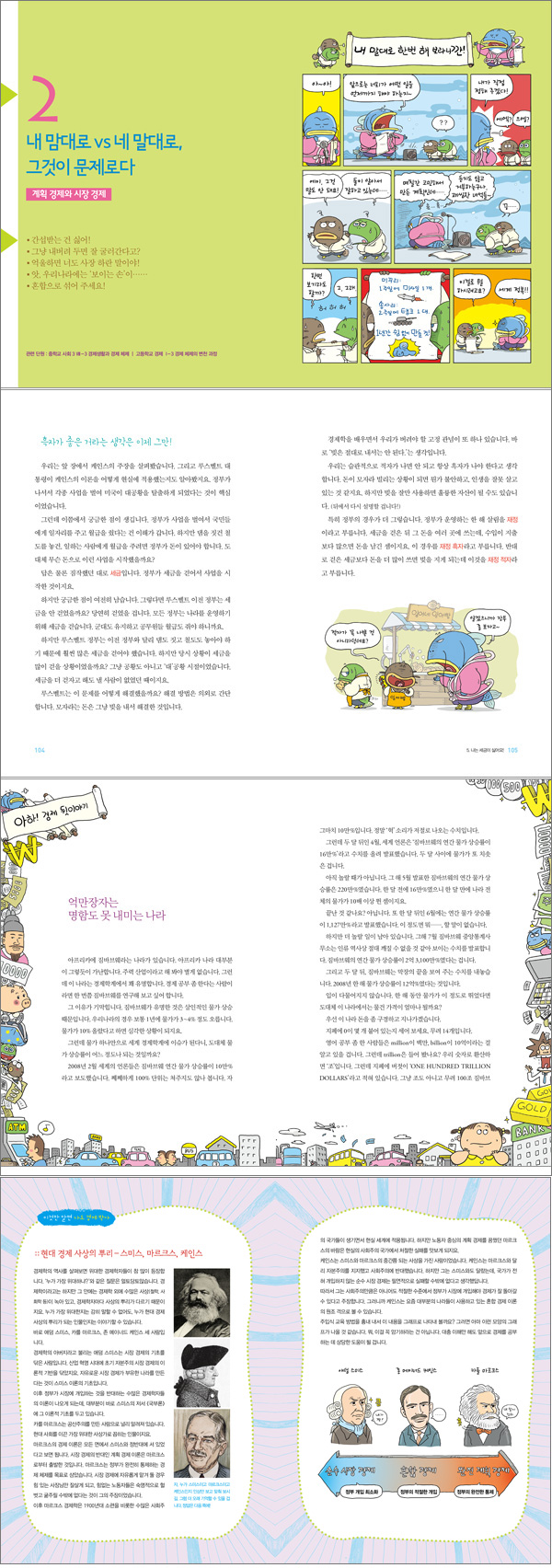
Introduction: The relevant subject is listed at the beginning of each chapter, so that you can read it together with the textbook or easily look up concepts you didn't know in the textbook.
It goes without saying that the easy and fun introduction naturally leads the textbook content into the main text!
Chapter 2.
As I please vs. As you say, that is the question.
: Planned economy and market economy
_Middle School Social Studies 3 Ⅷ-3 Economic Life and Economic System
_High School Economics I-3 The Evolution of the Economic System
We live very regularly, following pre-determined plans and times at school or work.
How wonderful would it be to live a life where you could do whatever you wanted without interference from anyone? From an economic perspective, it's possible.
In economics, it is not necessarily the case that 'doing things in a planned manner' produces better results than 'doing things freely'.
A person decides to start a business.
But one day, a person in a high position came to me and said this.
“You have to open a toothpaste factory.
Please select 30 workers, 15 men and 15 women.
The salary is 1 million won per month, and only 50,000 toothpastes can be produced per year.
(If you make more, you’ll die, so take care of it~.)”
What kind of absurd situation is this? Businesses should do what they want.
The country decided to make toothpaste and set the annual production amount.
It may seem absurd, but just 30 years ago, this was commonplace in half the world's countries.
This is precisely what I mean in the socialist countries that led the ‘planned economy’.
(pp.34~35)
Textbook Linkage: We actively utilize textbooks by citing expert texts or providing easy-to-understand explanations of economic terms that appear in textbooks.
Since it is content that has been encountered at least once through textbooks, it is easy to approach and helps you naturally learn difficult concepts that you could not understand through textbooks alone.
Chapter 6.
What if Shin Ramyun was the only ramen in this world?
: Emergence and regulation of monopolies
_High School Economics II-3: Limitations of Market Functions and Supplemental Measures
Public enterprises are clearly businesses that make things and make money.
However, the owner of this company is not a private individual, but the government.
The government invests money to create businesses.
Why would the government create businesses?
Let's look again at the textbook we looked at earlier.
Monopolistic companies restrict competition by creating various barriers to entry into the market.
These barriers to entry can arise naturally, but others are created by government legislation.
What does it mean when the government legally creates barriers to entry? It means the government completely monopolizes the market before a monopoly can emerge.
(pp.126~128)
Use of examples: When explaining important concepts, we use examples that are common among young people to make them easier to understand and remember.
Chapter 8.
If you know finance, you can get a pork cutlet even while you sleep.
: The meaning and influence of finance
_High School Economics III-1 Desirable Consumption Choices
Time is of the essence in financial transactions.
Let's say you go to a friend and say this:
(This is just a random example to help you understand, so don't do this in real life!)
“Since you want to buy a smartphone now, I will lend you the money to suppress my desire to buy it.”
“Wow, thank you! Without you, I would have gone crazy.
“You are a true friend.”
“Here’s 300,000 won.
“But I have to pay you back in 30 minutes.”
“…….”
What should I do? If I say this and it doesn't work out, then it's fortunate.
If you have a friend who's going to have 300,000 won in 30 minutes, why would you borrow money now? Right?
That friend also has to pay his respects on the next Lunar New Year's Day and save up a little bit of his allowance every month to pay it back.
Of course, it will take time to save money.
So, when lending money, you must give them some time to repay it.
(pp.164~65)
Economics is no longer a choice, it's survival.
A story about the economy in the world, read along with textbooks!
Our 'present' and our youth's 'future' depend on the economy!
In the United States, which experienced a financial crisis in the mid-2000s, economic education for elementary, middle, and high school students was significantly strengthened starting in 2008.
In some states, completion of an economics course is included in high school graduation requirements, and the U.S. Congress has even enacted related laws, such as the Economic Education Act.
This is because the country judged that the economy is an important factor that determines not only the future of individuals but also the 'survival' of society as a whole.
This means that behind the meshing of gears in the world, there is an economic principle hidden.
The reason for studying economics is not simply to learn economic terms, but the greatest meaning lies in broadening one's perspective on the world.
Economics is recognized as one of the most difficult subjects for young people, despite being a subject that is practically necessary for living.
Middle school social studies teachers who teach students in the field also complain that students have a hard time when they only get into the economics part.
So why is economics so difficult? For one thing, it's filled with technical terms derived from Chinese characters and loanwords, requires a thorough understanding of historical background, and is comprised of complex principles that require understanding, not memorization.
It also includes a mathematical element that most people shy away from.
The fact that the examples that should help us understand easily are foreign examples that are unfamiliar to us also contributes to the fact that the discipline of 'economics' feels difficult and distant.
Considering these points, "Economics Textbook, Challenging the World" explains the basic economic terms that appear in middle and high school textbooks in an easy-to-understand order, and uses interesting episodes to make it easy to understand the related background knowledge. In addition, an entire chapter is dedicated to the "probability" part of mathematics, which appears the most in economics, and explains it in detail by connecting it to our real lives.
The most striking part is the examples that help understanding.
Because this book naturally explains economic concepts by incorporating diverse and rich materials that anyone can easily relate to, such as domestic dramas, movies, TV commercials, and reality shows, readers will be able to read this book comfortably as if they were reading an essay, despite its economic nature.
Also, do students have to pay taxes? Is it okay to lend money to a friend and charge interest? Are there ways for middle and high school students to earn money? Starting with these real-life economic questions that young people are curious about today, the book guides readers through a broader perspective on the world governed by economic principles.
A vivid economic story explained through real-life events!
This book is an economics textbook for young people that provides information sequentially, from the basics of economics to expanded current affairs knowledge, to help them develop fundamental economic skills.
To make the unfamiliar field of 'economics' easily accessible, the concepts and principles of economics are explained step by step, following the flow of economics textbooks.
Furthermore, rather than simply marking related units as superficial links, the book was meticulously organized from the planning stage to incorporate actual textbook content, including quoting and explaining the actual content.
We select topics that middle and high school students must know - market economy, capitalism, taxes, monopolies, corporations, finance, etc. - and explain them at a level that is suitable for young people.
This book does not force you to believe that “economics is life.”
However, the economic story is told using familiar and interesting examples that anyone would have experienced at least once in real life.
Therefore, as readers read the book, they will naturally accept the formula “economy = life.”
“Hey, lend me 10,000 won.
“I’ll pay you back tomorrow.”
“Okay, but pay me back 11,000 won tomorrow, including interest.”
“Yeah, well.”
Have you ever been in a transaction like this? Were you the lender or the borrower? If you were the lender, lending 10,000 won and receiving 1,000 won in interest in one day, you'd be a true daytime robber.
You will become a legend in the world of robbery.
Let's interpret the seemingly everyday transaction above in financial terms.
Bank interest rates are usually around 4%.
If you leave it for one year, you will receive 4% interest.
The law also stipulates that the interest rate on the terrifying private loan cannot exceed 44% per annum.
If you charge interest higher than that, you will be arrested.
So, what interest rate did the master of day labor, who lent 10,000 won and received 1,000 won in interest in one day, set to secure this deal? If you confidently declared, "10%!", you need to reread the beginning of this book.
Interest rates are usually given on an annual basis.
The King of the Day Robbers received 10% per day.
If we simply convert this to annual interest rates, the interest rate is a whopping 3,650%.
Let's express the transaction we saw earlier a little differently.
“Hey, lend me 10,000 won.
“I’ll pay you back in a year.”
“Yeah, but you have to pay back 375,000 won in one year, including interest.”
Knowing this, how could you possibly propose such a deal? It's simply ridiculous.
But surprisingly, we can see quite a few of these transactions around us.
(pp.170~171)
With bursts of laughter, you will develop new perspectives on the world!
The author's humor in the story provides refreshing laughter, but the events that unfold the story itself make you agree with them, saying, "Oh, that's right! That's right!" (Sometimes, it feels like you've been hit in the back of the head!).
But it doesn't end with just laughter, all stories end with 'the eyes to see the world', a precious asset that cannot be measured in grades or money.
While the primary goal is to convey economic concepts and knowledge, the author's loving wish for young readers is to understand the principles of how the world works based on this.
Through this book, readers will learn not only the fish of economic knowledge, but also the fishing method of life wisdom.
One convenience store in the US reportedly throws away any donuts on display that are more than 24 hours old.
It's not that they're expired or inedible, but it's the company's policy to provide customers with the freshest donuts possible.
But now in Africa, countless children are starving to death because they can't get donuts that are even 24 days old, let alone 24 hours old.
Why throw away day-old donuts? Why not help starving children with them?
You can't blame the convenience store.
Because they have to make money too.
That convenience store just made a rational choice with a cool head.
(syncopation)
As you learn more about economics, you will naturally become interested in everything that happens in the world and begin to interpret the ways in which the world works through economic logic.
You can develop the ability to judge what is right and what is wrong.
It is this kind of brain training that helps us choose our dreams correctly and guides us to interpret our country and the world with sound eyes.
“Keep your head cool, your heart warm!”
Now you know why, right?
(pp.23~25)
A delightful [tip information] that conveys a wealth of knowledge.
From [Just Know This, I Can Become an Economics Doctor], which provides in-depth background information on the economy, to [Aha! Behind the Economy], which expands knowledge on various fields such as economics, history, culture, current affairs, and people, to [Glossary], a new format that conveys background knowledge rather than just obvious explanations.
The author's extensive experience and knowledge, gained through many years of working as a social affairs and economics reporter, are fully reflected in this book.
A humorous witty remark and vivid photos are included as a bonus!
These tips are designed to break the stereotype that 'economics is boring and difficult' and provide special fun.
You can find stories that are attractive just by their titles, such as 'Sharing Ice Cream Cake with a Genius Economist', which is a story about an economist who makes his sisters share a cake; 'Investment Know-How of Keynes, the Master of Reality', which covers the investment techniques of an economist who made a fortune in the stock market; and 'A Country Where Billionaires Can't Even Hand Out Business Cards', which investigates the incident of bundles of money loaded onto a cart in Zimbabwe, Africa.
Once upon a time, there lived an old man who was the best stock investor in the world.
Many people asked Grandpa.
"Grandpa, how on earth can I make money investing in stocks? Please tell me some secrets."
“Okay, I’ll tell you the secret.
“Write it down.”
“Yes, yes, I am embarrassed.”
“First of all, if you want to make money through stock investment, you just need to follow two principles.”
“Oh! What is that?”
"Rule number one! Never lose money."
“Huh? (Isn’t that so obvious?)”
"Rule number two! Always follow rule number one."
“……”
This is not a made up story.
This grandfather is not a man from 'once upon a time', he is still alive today, and these two principles that seem funny were created by this grandfather himself.
My grandfather's name is Warren Buffett.
(pp.240~241)
The Bank of Korea is a bank created by the government.
It's completely different from the banks we commonly see around us.
That's why the highest person is called the 'governor' rather than the 'bank president'.
The most important thing the Bank of Korea does is create money.
To be precise, the Korea Minting and Security Printing Corporation prints money, and the Bank of Korea decides 'how much money to create.'
(syncopation)
So, don't just search for things like, "How much interest will I get if I deposit my money in the Bank of Korea?"
It's a bank in name only, but it doesn't accept deposits.
(/ p.55)
Introduction to the text structure
Introduction: The relevant subject is listed at the beginning of each chapter, so that you can read it together with the textbook or easily look up concepts you didn't know in the textbook.
It goes without saying that the easy and fun introduction naturally leads the textbook content into the main text!
Chapter 2.
As I please vs. As you say, that is the question.
: Planned economy and market economy
_Middle School Social Studies 3 Ⅷ-3 Economic Life and Economic System
_High School Economics I-3 The Evolution of the Economic System
We live very regularly, following pre-determined plans and times at school or work.
How wonderful would it be to live a life where you could do whatever you wanted without interference from anyone? From an economic perspective, it's possible.
In economics, it is not necessarily the case that 'doing things in a planned manner' produces better results than 'doing things freely'.
A person decides to start a business.
But one day, a person in a high position came to me and said this.
“You have to open a toothpaste factory.
Please select 30 workers, 15 men and 15 women.
The salary is 1 million won per month, and only 50,000 toothpastes can be produced per year.
(If you make more, you’ll die, so take care of it~.)”
What kind of absurd situation is this? Businesses should do what they want.
The country decided to make toothpaste and set the annual production amount.
It may seem absurd, but just 30 years ago, this was commonplace in half the world's countries.
This is precisely what I mean in the socialist countries that led the ‘planned economy’.
(pp.34~35)
Textbook Linkage: We actively utilize textbooks by citing expert texts or providing easy-to-understand explanations of economic terms that appear in textbooks.
Since it is content that has been encountered at least once through textbooks, it is easy to approach and helps you naturally learn difficult concepts that you could not understand through textbooks alone.
Chapter 6.
What if Shin Ramyun was the only ramen in this world?
: Emergence and regulation of monopolies
_High School Economics II-3: Limitations of Market Functions and Supplemental Measures
Public enterprises are clearly businesses that make things and make money.
However, the owner of this company is not a private individual, but the government.
The government invests money to create businesses.
Why would the government create businesses?
Let's look again at the textbook we looked at earlier.
Monopolistic companies restrict competition by creating various barriers to entry into the market.
These barriers to entry can arise naturally, but others are created by government legislation.
What does it mean when the government legally creates barriers to entry? It means the government completely monopolizes the market before a monopoly can emerge.
(pp.126~128)
Use of examples: When explaining important concepts, we use examples that are common among young people to make them easier to understand and remember.
Chapter 8.
If you know finance, you can get a pork cutlet even while you sleep.
: The meaning and influence of finance
_High School Economics III-1 Desirable Consumption Choices
Time is of the essence in financial transactions.
Let's say you go to a friend and say this:
(This is just a random example to help you understand, so don't do this in real life!)
“Since you want to buy a smartphone now, I will lend you the money to suppress my desire to buy it.”
“Wow, thank you! Without you, I would have gone crazy.
“You are a true friend.”
“Here’s 300,000 won.
“But I have to pay you back in 30 minutes.”
“…….”
What should I do? If I say this and it doesn't work out, then it's fortunate.
If you have a friend who's going to have 300,000 won in 30 minutes, why would you borrow money now? Right?
That friend also has to pay his respects on the next Lunar New Year's Day and save up a little bit of his allowance every month to pay it back.
Of course, it will take time to save money.
So, when lending money, you must give them some time to repay it.
(pp.164~65)
GOODS SPECIFICS
- Date of publication: July 20, 2012
- Page count, weight, size: 244 pages | 454g | 153*224*20mm
- ISBN13: 9788971849460
- ISBN10: 8971849460
You may also like
카테고리
korean


korean

![GQ KOREA Mark (Monthly): December [2025]](http://librairie.coreenne.fr/cdn/shop/files/8ef265dbbfbf186523ed75ba7319009d.jpg?v=1765340328&width=3840)


