

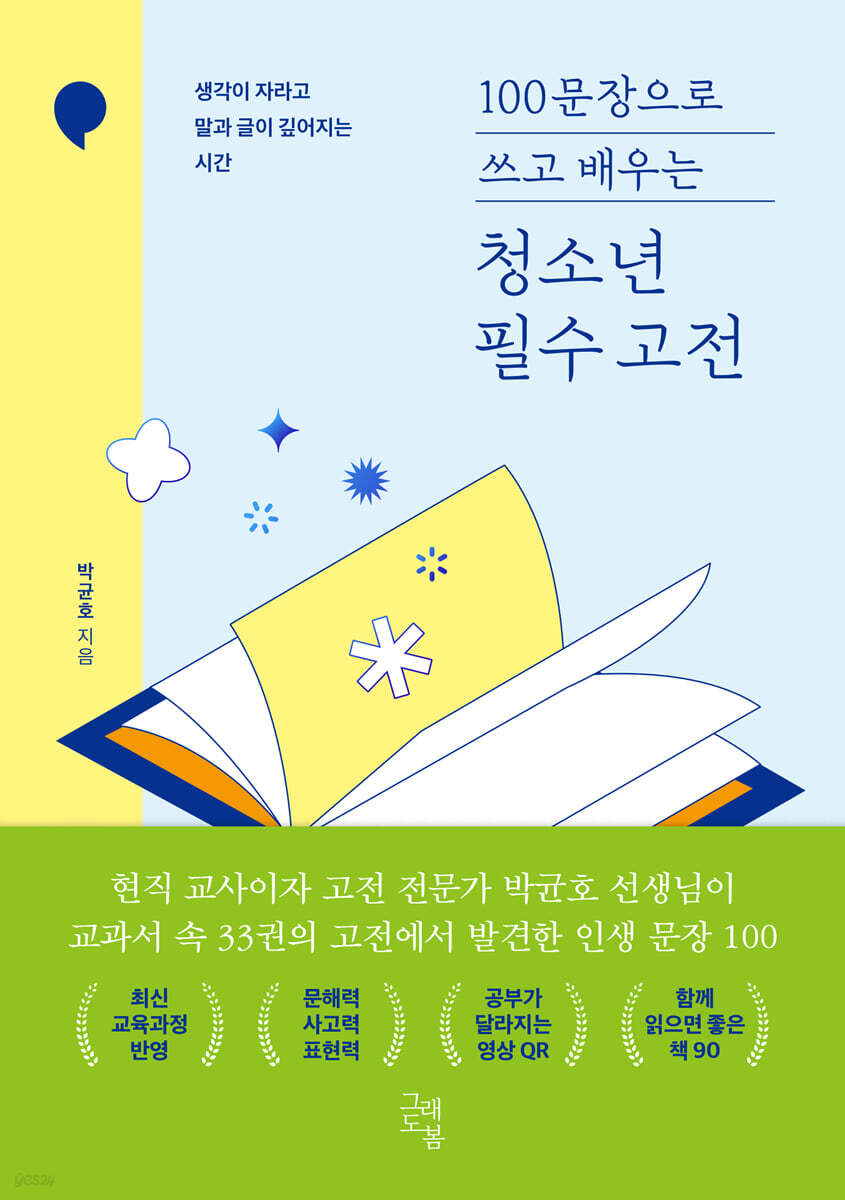
Essential Classics for Teenagers: Learn and Write in 100 Sentences
 |
Description
Book Introduction
One Sentence a Day, 100-Day Growth Notes
Mr. Park Gyun-ho, a current teacher and classics expert
100 key sentences carefully selected from 33 classic textbooks
These days, experts in the Korean education field are focusing on the value of transcription, analyzing it not as a simple copying but as a process of structuring the flow of thoughts into language.
In line with this trend, Park Gyun-ho, a current teacher and classics expert, has published a new book titled "Essential Classics for Youth: Writing and Learning in 100 Sentences," which focuses on "how to think and write" rather than "what to write."
It is a reinterpretation of the classics as a ‘class of writing and learning’ rather than simply reading them.
This book, which faithfully reflects the latest curriculum, contains 100 carefully selected famous sentences from 33 essential classic textbooks, ranging from Eastern classics such as The Analects of Confucius, The Tao Te Ching, and The Shepherd's Heart to Western humanities and literature classics such as Demian, Les Misérables, The Little Prince, and Silent Spring.
Readers will experience a new form of classical study method that naturally connects thinking and practice through reading and writing with the goal of 'completing one sentence a day for 100 days.'
Each peak is composed of a three-dimensional structure for deep thinking expansion.
It includes 'Classic One Line' that captures the essence of the work, 'Classic Wisdom' that interprets its meaning in today's language, 'Think About It' that broadens your thinking, 'Today's Mission' that puts learning into action, and a 'Reading Classics' corner that explains the background and theme of each classic, as well as 'Video QR' that links to related lectures and documentaries.
We have taken care to ensure that the classics can be understood in a three-dimensional way and can be effectively linked to school curriculum.
This book will serve as a supplementary textbook for teachers, a guide for parents to study classics with their children, and a powerful growth notebook for students that simultaneously cultivates literacy, thinking, and expressive skills.
You can experience an amazing transformation as the sentences from Eastern and Western classics pile up to strengthen your inner self and deepen your everyday speech and writing.
Mr. Park Gyun-ho, a current teacher and classics expert
100 key sentences carefully selected from 33 classic textbooks
These days, experts in the Korean education field are focusing on the value of transcription, analyzing it not as a simple copying but as a process of structuring the flow of thoughts into language.
In line with this trend, Park Gyun-ho, a current teacher and classics expert, has published a new book titled "Essential Classics for Youth: Writing and Learning in 100 Sentences," which focuses on "how to think and write" rather than "what to write."
It is a reinterpretation of the classics as a ‘class of writing and learning’ rather than simply reading them.
This book, which faithfully reflects the latest curriculum, contains 100 carefully selected famous sentences from 33 essential classic textbooks, ranging from Eastern classics such as The Analects of Confucius, The Tao Te Ching, and The Shepherd's Heart to Western humanities and literature classics such as Demian, Les Misérables, The Little Prince, and Silent Spring.
Readers will experience a new form of classical study method that naturally connects thinking and practice through reading and writing with the goal of 'completing one sentence a day for 100 days.'
Each peak is composed of a three-dimensional structure for deep thinking expansion.
It includes 'Classic One Line' that captures the essence of the work, 'Classic Wisdom' that interprets its meaning in today's language, 'Think About It' that broadens your thinking, 'Today's Mission' that puts learning into action, and a 'Reading Classics' corner that explains the background and theme of each classic, as well as 'Video QR' that links to related lectures and documentaries.
We have taken care to ensure that the classics can be understood in a three-dimensional way and can be effectively linked to school curriculum.
This book will serve as a supplementary textbook for teachers, a guide for parents to study classics with their children, and a powerful growth notebook for students that simultaneously cultivates literacy, thinking, and expressive skills.
You can experience an amazing transformation as the sentences from Eastern and Western classics pile up to strengthen your inner self and deepen your everyday speech and writing.
- You can preview some of the book's contents.
Preview
index
In publishing the book
_I understand myself and refine my life by following the classics.
How to use the book
PART 1.
The Power That Builds Me_Thoughts and Philosophy
DAY 1 Those who know how to have fun go the farthest
DAY 2 The desire to learn is more important
DAY 3: Be suspicious at least once
DAY 4: Admitting What You Don't Know Will Help You Learn More
[Reading Classics 1] The Analects, Confucius
DAY 5 If you find advice annoying, I'll stop too.
DAY 6 Don't you want to bring out a better you?
DAY 7 Do you want to be a brave and upright person?
[Reading the Classics 2] Nicomachean Ethics, Aristotle
DAY 8 What is it like to live like water?
DAY 9 Don't try to be better than others, try to beat yourself.
DAY 10 Don't be too swayed by pleasant words
[Reading Classics 3] Tao Te Ching, Lao Tzu
DAY 11 Live today as if it were your last.
DAY 12 Injustice grows bigger when we ignore it.
DAY 13 A day to reflect on myself is more precious.
[Reading Classics 4] Meditations, Marcus Aurelius
DAY 14 When you focus on just one thing, the path appears.
DAY 15 The person who laughs is the wisest person.
DAY 16 It's okay to cry.
That's for me
[Reading Classics 5] Essays, Michel de Montaigne
DAY 17 Happiness awaits at the end of a difficult road
DAY 18 Build yourself up instead of putting others down.
DAY 19 I grow by being around people with depth.
[Reading the Classics 6] The Apology of Socrates, Plato
DAY 20 A person who lives peacefully is a happy person.
DAY 21 It's okay to lose.
Because I learn more
DAY 22 The joy begins while you are learning.
[Reading the Classics 7] Epicurean Pleasures, Epicurus
DAY 23 Don't Stop Just Because There's No Way
DAY 24 You and I, we need two wings
DAY 25 Think again from the other person's perspective
[Reading Classics 8] 『Zhuangzi』, Zhuangzi
PART 2.
Courage to Face the World_Justice and Freedom
DAY 26 Learning grows when shared.
DAY 27 Actions speak louder than words
DAY 28 If you believe and act, your dreams will eventually become reality.
[Reading Classics 9] Les Misérables, Victor Hugo
DAY 29 The more greedy you become, the drier your heart becomes.
DAY 30 A person's heart is not always visible on the outside.
DAY 31 If you can't turn back, forgetting is also courage.
[Classic Reading 10] Macbeth, William Shakespeare
DAY 32 There is also courage in eating food for the first time.
DAY 33 In the end, I am the one who will shine
DAY 34 Be the first to suggest doing it together
[Reading Classics 11] The Autobiography of Benjamin Franklin, Benjamin Franklin
DAY 35: Happiness begins after hardship? Life isn't that simple.
DAY 36 Animals are neither toys nor objects.
DAY 37 Living for myself alone isn't enough
[Classic Reading 12] The Autobiography of Scott Nearing, Scott Nearing
DAY 38 The path I walk is more important than the path others walk.
DAY 39 The process of persuasion helps me grow.
DAY 40 If you think alone, you miss something.
[Classic Reading 13] On Liberty, John Stuart Mill
DAY 41 You can feel affection even when you meet someone for the first time.
DAY 42 "No big deal" ruins things
DAY 43 Can I just overlook small mistakes?
[Reading Classics 14] Crime and Punishment, Fyodor Dostoevsky
DAY 44 Humor is the courage that pushes away despair.
DAY 45 I can't change the world, but I can.
DAY 46 Success isn't something you achieve, it's something that follows.
[Classic Reading 15] Search for Meaning, Viktor Frankl
DAY 47 Preparation is better than luck, that's true skill
DAY 48 It's not 'Someone will do it', it's 'I have to do it'
DAY 49 You become truly strong when you act even when you are hurt.
[Classic Reading 16] History of the Peloponnesian War, Thucydides
PART 3.
How to Connect Hearts_Love and Friendship
DAY 50 If you pour your heart into it, the path will appear.
DAY 51 You are a special being who cannot be replaced by anything.
DAY 52 Don't just think about it, take action.
[Reading Classics 17] Demian, Hermann Hesse
DAY 53 The most important thing is always now.
DAY 54 It all starts with the desire to try.
DAY 55 Forgiveness is ultimately for me.
[Classic Reading 18] What Men Live By, Leo Tolstoy
DAY 56 If you put it off because it's annoying, it becomes more annoying.
DAY 57 There are things you miss if you just look with your eyes.
DAY 58 There's something inside me I haven't discovered yet.
[Reading Classics 19] The Little Prince, Antoine de Saint-Exupéry
DAY 59 Friendship isn't just about giving.
DAY 60 Friends are the sun that illuminates life.
DAY 61 Not everything you do for your friends is right.
[Classic Reading 20] On Friendship, Marcus Tullius Cicero
DAY 62 When you feel empty, open a book.
DAY 63 If there's something you want to do, just do it.
DAY 64 If you keep going little by little, you'll eventually get there.
[Reading Classics 21] Van Gogh, Letters from the Soul, Vincent van Gogh
DAY 65 Those who tell the truth are never alone.
DAY 66 Tears are not a sign of weakness.
DAY 67 The world is a mirror reflecting ourselves.
[Classic Reading 22] Oliver Twist, Charles Dickens
DAY 68 Love is the first to give.
DAY 69 Love is an action, not a feeling.
DAY 70 Love those close to you first
[Classic Reading 23] The Art of Loving, Erich Fromm
PART 4.
Reading the World_History and Society
DAY 71 The truth will come out even if you try to hide it.
DAY 72 The quieter the good deed, the deeper it becomes.
DAY 73 If you're too frugal, your relationship will become distant.
[Reading Classics 24] 『Mokminsimseo』, Jeong Yak-yong
DAY 74 Before you say you're happy, wait a minute
DAY 75 It's Okay to Be Loose Sometimes
DAY 76 Keep the peace, not fight
[Reading Classics 25] 『Herodotus's Histories』, Herodotus
DAY 77 When things don't work out, start by organizing your desk.
DAY 78 Anyone Can Be a Teacher
DAY 79 Direct experience is more profound than seeing and hearing.
[Reading Classics 26] 『Yeolha Diary』, Park Ji-won
DAY 80 Learning from Other People's Mistakes
DAY 81 I hope you choose the honest path, even without praise.
DAY 82 Time will tell
[Reading Classics 27] Plutarch's Lives, Plutarch
DAY 83 How do you spend your free time?
DAY 84 We must live together even if our thoughts differ.
DAY 85 Utopians didn't see gold as anything special.
[Reading Classics 28] Utopia, Thomas More
PART 5.
Discovery on the Road_Travel and Nature
DAY 86 The more you know, the sadder you become, and the more you feel sad, the more you act.
DAY 87 You can't treat nature with money alone.
DAY 88 History isn't just about people.
[Classic Reading 29] The Twelve Months of the Sand Army, Aldo Leopold
DAY 89 The world becomes more beautiful with small acts of consideration and love.
DAY 90 When hearts come together, we can bring about change.
DAY 91 It's not the appearance that counts, it's the sincerity.
[Reading Classics 30] Samguk Yusa, Ilyeon
DAY 92 There is no problem in the world that cannot be solved.
DAY 93 If you fall into guesswork, you get further from the truth.
DAY 94 Observation is the first step to thinking.
[Classic Reading 31] Sherlock Holmes, Arthur Conan Doyle
DAY 95 It's the star inside me that keeps me from getting lost.
DAY 96 Just a little further and joy will greet you.
DAY 97 It's okay, reflection is already a step
[Reading Classics 32] The Divine Comedy, Dante Alighieri
DAY 98 Nature is our neighbor
DAY 99 I'm more afraid of the danger that approaches stealthily.
DAY 100 Weeds are not useless grass.
[Classic Reading 33] Silent Spring, Rachel Carson
_I understand myself and refine my life by following the classics.
How to use the book
PART 1.
The Power That Builds Me_Thoughts and Philosophy
DAY 1 Those who know how to have fun go the farthest
DAY 2 The desire to learn is more important
DAY 3: Be suspicious at least once
DAY 4: Admitting What You Don't Know Will Help You Learn More
[Reading Classics 1] The Analects, Confucius
DAY 5 If you find advice annoying, I'll stop too.
DAY 6 Don't you want to bring out a better you?
DAY 7 Do you want to be a brave and upright person?
[Reading the Classics 2] Nicomachean Ethics, Aristotle
DAY 8 What is it like to live like water?
DAY 9 Don't try to be better than others, try to beat yourself.
DAY 10 Don't be too swayed by pleasant words
[Reading Classics 3] Tao Te Ching, Lao Tzu
DAY 11 Live today as if it were your last.
DAY 12 Injustice grows bigger when we ignore it.
DAY 13 A day to reflect on myself is more precious.
[Reading Classics 4] Meditations, Marcus Aurelius
DAY 14 When you focus on just one thing, the path appears.
DAY 15 The person who laughs is the wisest person.
DAY 16 It's okay to cry.
That's for me
[Reading Classics 5] Essays, Michel de Montaigne
DAY 17 Happiness awaits at the end of a difficult road
DAY 18 Build yourself up instead of putting others down.
DAY 19 I grow by being around people with depth.
[Reading the Classics 6] The Apology of Socrates, Plato
DAY 20 A person who lives peacefully is a happy person.
DAY 21 It's okay to lose.
Because I learn more
DAY 22 The joy begins while you are learning.
[Reading the Classics 7] Epicurean Pleasures, Epicurus
DAY 23 Don't Stop Just Because There's No Way
DAY 24 You and I, we need two wings
DAY 25 Think again from the other person's perspective
[Reading Classics 8] 『Zhuangzi』, Zhuangzi
PART 2.
Courage to Face the World_Justice and Freedom
DAY 26 Learning grows when shared.
DAY 27 Actions speak louder than words
DAY 28 If you believe and act, your dreams will eventually become reality.
[Reading Classics 9] Les Misérables, Victor Hugo
DAY 29 The more greedy you become, the drier your heart becomes.
DAY 30 A person's heart is not always visible on the outside.
DAY 31 If you can't turn back, forgetting is also courage.
[Classic Reading 10] Macbeth, William Shakespeare
DAY 32 There is also courage in eating food for the first time.
DAY 33 In the end, I am the one who will shine
DAY 34 Be the first to suggest doing it together
[Reading Classics 11] The Autobiography of Benjamin Franklin, Benjamin Franklin
DAY 35: Happiness begins after hardship? Life isn't that simple.
DAY 36 Animals are neither toys nor objects.
DAY 37 Living for myself alone isn't enough
[Classic Reading 12] The Autobiography of Scott Nearing, Scott Nearing
DAY 38 The path I walk is more important than the path others walk.
DAY 39 The process of persuasion helps me grow.
DAY 40 If you think alone, you miss something.
[Classic Reading 13] On Liberty, John Stuart Mill
DAY 41 You can feel affection even when you meet someone for the first time.
DAY 42 "No big deal" ruins things
DAY 43 Can I just overlook small mistakes?
[Reading Classics 14] Crime and Punishment, Fyodor Dostoevsky
DAY 44 Humor is the courage that pushes away despair.
DAY 45 I can't change the world, but I can.
DAY 46 Success isn't something you achieve, it's something that follows.
[Classic Reading 15] Search for Meaning, Viktor Frankl
DAY 47 Preparation is better than luck, that's true skill
DAY 48 It's not 'Someone will do it', it's 'I have to do it'
DAY 49 You become truly strong when you act even when you are hurt.
[Classic Reading 16] History of the Peloponnesian War, Thucydides
PART 3.
How to Connect Hearts_Love and Friendship
DAY 50 If you pour your heart into it, the path will appear.
DAY 51 You are a special being who cannot be replaced by anything.
DAY 52 Don't just think about it, take action.
[Reading Classics 17] Demian, Hermann Hesse
DAY 53 The most important thing is always now.
DAY 54 It all starts with the desire to try.
DAY 55 Forgiveness is ultimately for me.
[Classic Reading 18] What Men Live By, Leo Tolstoy
DAY 56 If you put it off because it's annoying, it becomes more annoying.
DAY 57 There are things you miss if you just look with your eyes.
DAY 58 There's something inside me I haven't discovered yet.
[Reading Classics 19] The Little Prince, Antoine de Saint-Exupéry
DAY 59 Friendship isn't just about giving.
DAY 60 Friends are the sun that illuminates life.
DAY 61 Not everything you do for your friends is right.
[Classic Reading 20] On Friendship, Marcus Tullius Cicero
DAY 62 When you feel empty, open a book.
DAY 63 If there's something you want to do, just do it.
DAY 64 If you keep going little by little, you'll eventually get there.
[Reading Classics 21] Van Gogh, Letters from the Soul, Vincent van Gogh
DAY 65 Those who tell the truth are never alone.
DAY 66 Tears are not a sign of weakness.
DAY 67 The world is a mirror reflecting ourselves.
[Classic Reading 22] Oliver Twist, Charles Dickens
DAY 68 Love is the first to give.
DAY 69 Love is an action, not a feeling.
DAY 70 Love those close to you first
[Classic Reading 23] The Art of Loving, Erich Fromm
PART 4.
Reading the World_History and Society
DAY 71 The truth will come out even if you try to hide it.
DAY 72 The quieter the good deed, the deeper it becomes.
DAY 73 If you're too frugal, your relationship will become distant.
[Reading Classics 24] 『Mokminsimseo』, Jeong Yak-yong
DAY 74 Before you say you're happy, wait a minute
DAY 75 It's Okay to Be Loose Sometimes
DAY 76 Keep the peace, not fight
[Reading Classics 25] 『Herodotus's Histories』, Herodotus
DAY 77 When things don't work out, start by organizing your desk.
DAY 78 Anyone Can Be a Teacher
DAY 79 Direct experience is more profound than seeing and hearing.
[Reading Classics 26] 『Yeolha Diary』, Park Ji-won
DAY 80 Learning from Other People's Mistakes
DAY 81 I hope you choose the honest path, even without praise.
DAY 82 Time will tell
[Reading Classics 27] Plutarch's Lives, Plutarch
DAY 83 How do you spend your free time?
DAY 84 We must live together even if our thoughts differ.
DAY 85 Utopians didn't see gold as anything special.
[Reading Classics 28] Utopia, Thomas More
PART 5.
Discovery on the Road_Travel and Nature
DAY 86 The more you know, the sadder you become, and the more you feel sad, the more you act.
DAY 87 You can't treat nature with money alone.
DAY 88 History isn't just about people.
[Classic Reading 29] The Twelve Months of the Sand Army, Aldo Leopold
DAY 89 The world becomes more beautiful with small acts of consideration and love.
DAY 90 When hearts come together, we can bring about change.
DAY 91 It's not the appearance that counts, it's the sincerity.
[Reading Classics 30] Samguk Yusa, Ilyeon
DAY 92 There is no problem in the world that cannot be solved.
DAY 93 If you fall into guesswork, you get further from the truth.
DAY 94 Observation is the first step to thinking.
[Classic Reading 31] Sherlock Holmes, Arthur Conan Doyle
DAY 95 It's the star inside me that keeps me from getting lost.
DAY 96 Just a little further and joy will greet you.
DAY 97 It's okay, reflection is already a step
[Reading Classics 32] The Divine Comedy, Dante Alighieri
DAY 98 Nature is our neighbor
DAY 99 I'm more afraid of the danger that approaches stealthily.
DAY 100 Weeds are not useless grass.
[Classic Reading 33] Silent Spring, Rachel Carson
Detailed image

Into the book
The best way to keep the classics close is to read the sentences and copy them by hand.
That is, it is a transcription.
In that sense, this book helps you expand what you have learned by reading and writing the classics yourself into your own thoughts and language.
It also provides practical help with specific concerns that teenagers face in their daily lives (e.g., direction of study, career choice, difficulties in relationships with friends, conflicts with family, etc.).
In the process of rereading and translating the classics, students can reflect on their own problems within the text and find their own answers.
As you chew over each sentence and write it down, you will understand the context of the work and connect the ideas of the classics to your life today.
In the process, your thinking and literacy skills will grow, and your perspective on the world will deepen.
--- p.4
I believe that praise can sometimes bring about fear.
I believe that humiliation should be accepted with the same care as my own body.
Lao Tzu, Tao Te Ching
It feels good to hear compliments, but there are times when I feel like I'm being dragged along by those words.
You become more and more cautious about disappointing others next time, and you find yourself saying or doing less and less.
Shame is the opposite.
You will experience times when you are overcome with emotions that cannot be expressed in words, and you will have to endure it alone, unable to rely on anyone.
That kind of time lasts longer than you think, and touches something deep in your heart.
But don't stay there too long.
When the time comes, it is definitely better for me to shake it off, get up, and move forward again.
--- p.44
The Tao Te Ching is a collection of short and concise writings written by Lao Tzu, a philosopher of the Spring and Autumn Period of China, around the 6th century BC.
This book, consisting of 81 chapters, covers a wide range of topics, including politics, leadership, human relationships, and attitudes toward life, but the roots of all ideas lie in the "Tao" and "naturalness."
The teaching that we can gain greater strength through emptiness and humility, without forcing ourselves, by following the flow of nature, remains valid even after thousands of years.
Moreover, the Tao Te Ching conveys the message that in a society where competition and speed are taken for granted, it is more valuable to maintain one's own path than to get ahead of others.
In particular, it emphasizes that a leader is not someone who stands in front and leads, but someone who supports from behind and walks alongside.
These teachings teach young people to value balance in relationships over achievement, cooperation over domination, and a life attitude that allows them to maintain composure even in the face of impatience.
--- p.46
Anyone who puts all their attention and all their will into a specific goal can eventually reach it.
_Hermann Hesse, Demian
Friends, hobbies, exercise, family - we often get so caught up in so many things that we lose focus on what's truly important.
When you can focus your mind completely in one direction, the path begins to open itself.
Focusing all your attention and will on a single goal is not easy, but it is incredibly powerful.
If there's something you really want to accomplish, practice clearing away distractions and focusing on that task.
The moment you put your whole heart into it, paths you didn't see before will begin to appear.
--- p.156
『Demian』 is a coming-of-age novel published in 1919 by German author Hermann Hesse.
The work deals with the mental conflicts and identity issues of young people in the social turmoil immediately following World War I.
At the time of its publication, it was published under the pseudonym 'Emil Sinclair' and was so vividly reflected in the concerns of young people of the time that it was mistaken for a new work by a young author.
『Demian』 is considered one of the representative works of early 20th-century German Expressionist literature, and is a classic that deals with the exploration of an individual's self, and is consistently read around the world.
In Korea in particular, it has established itself as one of the most widely read Western classic novels among teenagers and college students.
This work had a great influence on European intellectual circles in the early 20th century, and has since been read as a symbol of youth culture and the spirit of resistance.
In the 1960s and 1970s, it gained attention again amid the hippie generation and anti-war movement, becoming a bestseller worldwide.
It is still being translated and published consistently to this day as a ‘classic of self-discovery.’
--- p.162
Time is the wisest adviser.
_Plutarch, 『Plutarch's Lives』
Brave and honorable generals often rush into dangerous wars.
Because I want to achieve great victory and be praised as a great general.
A wise leader neither envies nor seeks to emulate these courageous people.
If you overcome your impatience and wait, you will be able to make better decisions.
We experience many moments in our daily lives when we feel like we have to make hasty decisions.
'Should I buy this?', 'Should I just say this?', 'Should I keep seeing this friend?' The best decisions are the ones that feel right over time.
Today's feelings may disappear like bubbles tomorrow.
If it's not an issue that needs to be decided right away, ask your wisest advisor, Time.
Then you can make better decisions.
--- p.242
Plutarch's Lives is a biographical work by the ancient Greek philosopher and historian Plutarch, which compares and describes the lives of approximately 50 representative figures of ancient Greece and Rome.
Rather than simply listing the accomplishments of great men, we delve deeply into their personalities and values, the crucial moments of choice, and the consequences of those actions on their communities and history.
In particular, the way it pairs and compares figures from different eras and cultures, such as Alexander the Great and Caesar, or Theseus and Romulus, allows readers to broadly reflect on human nature and the essence of leadership.
That is, it is a transcription.
In that sense, this book helps you expand what you have learned by reading and writing the classics yourself into your own thoughts and language.
It also provides practical help with specific concerns that teenagers face in their daily lives (e.g., direction of study, career choice, difficulties in relationships with friends, conflicts with family, etc.).
In the process of rereading and translating the classics, students can reflect on their own problems within the text and find their own answers.
As you chew over each sentence and write it down, you will understand the context of the work and connect the ideas of the classics to your life today.
In the process, your thinking and literacy skills will grow, and your perspective on the world will deepen.
--- p.4
I believe that praise can sometimes bring about fear.
I believe that humiliation should be accepted with the same care as my own body.
Lao Tzu, Tao Te Ching
It feels good to hear compliments, but there are times when I feel like I'm being dragged along by those words.
You become more and more cautious about disappointing others next time, and you find yourself saying or doing less and less.
Shame is the opposite.
You will experience times when you are overcome with emotions that cannot be expressed in words, and you will have to endure it alone, unable to rely on anyone.
That kind of time lasts longer than you think, and touches something deep in your heart.
But don't stay there too long.
When the time comes, it is definitely better for me to shake it off, get up, and move forward again.
--- p.44
The Tao Te Ching is a collection of short and concise writings written by Lao Tzu, a philosopher of the Spring and Autumn Period of China, around the 6th century BC.
This book, consisting of 81 chapters, covers a wide range of topics, including politics, leadership, human relationships, and attitudes toward life, but the roots of all ideas lie in the "Tao" and "naturalness."
The teaching that we can gain greater strength through emptiness and humility, without forcing ourselves, by following the flow of nature, remains valid even after thousands of years.
Moreover, the Tao Te Ching conveys the message that in a society where competition and speed are taken for granted, it is more valuable to maintain one's own path than to get ahead of others.
In particular, it emphasizes that a leader is not someone who stands in front and leads, but someone who supports from behind and walks alongside.
These teachings teach young people to value balance in relationships over achievement, cooperation over domination, and a life attitude that allows them to maintain composure even in the face of impatience.
--- p.46
Anyone who puts all their attention and all their will into a specific goal can eventually reach it.
_Hermann Hesse, Demian
Friends, hobbies, exercise, family - we often get so caught up in so many things that we lose focus on what's truly important.
When you can focus your mind completely in one direction, the path begins to open itself.
Focusing all your attention and will on a single goal is not easy, but it is incredibly powerful.
If there's something you really want to accomplish, practice clearing away distractions and focusing on that task.
The moment you put your whole heart into it, paths you didn't see before will begin to appear.
--- p.156
『Demian』 is a coming-of-age novel published in 1919 by German author Hermann Hesse.
The work deals with the mental conflicts and identity issues of young people in the social turmoil immediately following World War I.
At the time of its publication, it was published under the pseudonym 'Emil Sinclair' and was so vividly reflected in the concerns of young people of the time that it was mistaken for a new work by a young author.
『Demian』 is considered one of the representative works of early 20th-century German Expressionist literature, and is a classic that deals with the exploration of an individual's self, and is consistently read around the world.
In Korea in particular, it has established itself as one of the most widely read Western classic novels among teenagers and college students.
This work had a great influence on European intellectual circles in the early 20th century, and has since been read as a symbol of youth culture and the spirit of resistance.
In the 1960s and 1970s, it gained attention again amid the hippie generation and anti-war movement, becoming a bestseller worldwide.
It is still being translated and published consistently to this day as a ‘classic of self-discovery.’
--- p.162
Time is the wisest adviser.
_Plutarch, 『Plutarch's Lives』
Brave and honorable generals often rush into dangerous wars.
Because I want to achieve great victory and be praised as a great general.
A wise leader neither envies nor seeks to emulate these courageous people.
If you overcome your impatience and wait, you will be able to make better decisions.
We experience many moments in our daily lives when we feel like we have to make hasty decisions.
'Should I buy this?', 'Should I just say this?', 'Should I keep seeing this friend?' The best decisions are the ones that feel right over time.
Today's feelings may disappear like bubbles tomorrow.
If it's not an issue that needs to be decided right away, ask your wisest advisor, Time.
Then you can make better decisions.
--- p.242
Plutarch's Lives is a biographical work by the ancient Greek philosopher and historian Plutarch, which compares and describes the lives of approximately 50 representative figures of ancient Greece and Rome.
Rather than simply listing the accomplishments of great men, we delve deeply into their personalities and values, the crucial moments of choice, and the consequences of those actions on their communities and history.
In particular, the way it pairs and compares figures from different eras and cultures, such as Alexander the Great and Caesar, or Theseus and Romulus, allows readers to broadly reflect on human nature and the essence of leadership.
--- p.244
Publisher's Review
A classic textbook I encountered for the first time,
How to learn interestingly and develop your thinking
Into a 'writing and learning class'
100-Day Literacy & Thinking Skills
“The best way to keep the classics close is to read the sentences and copy them by hand.”
Copying famous quotes → Wisdom of the classics → Opening the mind → Reading essential classics → Media convergence learning
These days, experts in the Korean education field are focusing on the value of transcription, analyzing it not as a simple copying but as a process of structuring the flow of thoughts into language.
However, most manuscripts remain mere collections of good sentences, and have the limitation of failing to show how those sentences can be expanded through thought and learning.
The new book, “Essential Classics for Teens: Learn and Write in 100 Sentences,” stands out in that respect.
This book focuses on 'how to think and write' rather than 'what to write'.
It is a reinterpretation of the classics as a ‘class to learn through writing’ rather than a book to simply read.
This book, which reflects the latest curriculum, contains 100 carefully selected famous sentences from 33 essential classic textbooks, ranging from Eastern classics such as The Analects of Confucius, The Tao Te Ching, and The Shepherd's Heart to Western humanities and literature classics such as Demian, Les Misérables, The Little Prince, and Silent Spring.
This is a new type of growth notebook where reading and writing, thinking and expression are naturally connected within the time frame of 'Complete one sentence a day for 100 days.'
The structure, which faithfully reflects the latest curriculum, not only fosters literacy, thinking, and expressive skills emphasized in the Korean language performance assessment, but also helps young people immerse themselves in the world of classics.
The author of this book, Park Gyun-ho, is a teacher with over 30 years of experience and a classics expert who has consistently researched classics interpretation and reading methods suited to the level of young people.
Through numerous educational books, including 『Reading the Unclassical Classics』(2018), 『My First Classic Reading Class for Teenagers』(2021), and 『World Classic Travel Troupe』(2023), he has consistently delivered the message that "classics are not books of the past, but mirrors that reflect me today," by explaining classics in an easy and interesting way.
This new book, “Essential Classics for Teens: Learn and Write in 100 Sentences,” is also an extension of that.
The key to this new book is not simply reading the classics, but transcribing each sentence into your own hands and connecting it to your own life.
This is what the author calls "study that teaches me," and it is the most accurate answer that classics can provide to modern youth who lack time for deep thought and self-reflection.
“Classic sentences, even as time passes, still lead us to better choices and serve as keys that open the door to new ideas.” This book began with that belief.
One sentence a day,
A must-have classic for teenagers: "100-Day Growth Notes"
_Three-dimensional learning completed through expansion of thinking
“If you read and write one sentence at a time for 100 days, the sentence will soon become an idea.
“Thoughts lead to language, and language leads to attitude.”
"Essential Classics for Teenagers: Learn and Write in 100 Sentences" is a collection of 100 sentences from 33 essential textbook classics organized into five themes (the power to build oneself, the courage to face the world, how to connect hearts, reading the world, and discoveries on the road) tailored to the growth stages of teenagers.
It presents a concrete learning structure called "Complete One Sentence a Day for 100 Days" so that students can utilize it in both school classes and daily life, and expands their thinking through the following three-dimensional corners.
It begins with a "classic line" that captures the essence of the work, followed by "classic wisdom" that interprets the thoughts contained in the sentence in today's language, "think about it" questions that expand thoughts, and "today's mission" practical tasks that put what you've learned into action.
As you write a sentence, you will experience that it becomes your thoughts, thoughts become language, and language eventually becomes your attitude.
Additionally, the 'Reading Classics' corner, which explains the background and theme of each classic, includes 'video QR' links to documentaries, lectures, interviews, etc.
Classics, previously learned only through text, can be combined with visual materials to provide a three-dimensional understanding of the historical context and humanistic significance of the works.
This structure will not only simultaneously cultivate literacy, thinking, and expressive skills, which are emphasized in the Korean language proficiency assessment, but will also be a useful tool for students who do not know how to read classics and students who are struggling with preparing book reviews and essays.
In addition, it is highly useful for teachers as a supplementary teaching material and for parents as a medium for studying classics with their children.
Through this process of translating the language of the classics into their own language over 100 days, students will read, write, think, and create their own sentences.
After 100 days, those sentences will accumulate and become the power that fills a person's inner self. Isn't that the true meaning of studying the classics?
Six Changes You Can Achieve in 100 Days
1.
As I write, my thoughts become organized and my mind becomes calm.
2.
A language is created to express one's thoughts.
3.
As records accumulate, your own growth notebook is completed.
4.
You will put what you learn into practice in your daily life.
5.
It gives you the power to understand the class and opens your eyes to see the world.
6.
A power that lasts longer than entrance exams, deepening the ability to think and express oneself.
How to learn interestingly and develop your thinking
Into a 'writing and learning class'
100-Day Literacy & Thinking Skills
“The best way to keep the classics close is to read the sentences and copy them by hand.”
Copying famous quotes → Wisdom of the classics → Opening the mind → Reading essential classics → Media convergence learning
These days, experts in the Korean education field are focusing on the value of transcription, analyzing it not as a simple copying but as a process of structuring the flow of thoughts into language.
However, most manuscripts remain mere collections of good sentences, and have the limitation of failing to show how those sentences can be expanded through thought and learning.
The new book, “Essential Classics for Teens: Learn and Write in 100 Sentences,” stands out in that respect.
This book focuses on 'how to think and write' rather than 'what to write'.
It is a reinterpretation of the classics as a ‘class to learn through writing’ rather than a book to simply read.
This book, which reflects the latest curriculum, contains 100 carefully selected famous sentences from 33 essential classic textbooks, ranging from Eastern classics such as The Analects of Confucius, The Tao Te Ching, and The Shepherd's Heart to Western humanities and literature classics such as Demian, Les Misérables, The Little Prince, and Silent Spring.
This is a new type of growth notebook where reading and writing, thinking and expression are naturally connected within the time frame of 'Complete one sentence a day for 100 days.'
The structure, which faithfully reflects the latest curriculum, not only fosters literacy, thinking, and expressive skills emphasized in the Korean language performance assessment, but also helps young people immerse themselves in the world of classics.
The author of this book, Park Gyun-ho, is a teacher with over 30 years of experience and a classics expert who has consistently researched classics interpretation and reading methods suited to the level of young people.
Through numerous educational books, including 『Reading the Unclassical Classics』(2018), 『My First Classic Reading Class for Teenagers』(2021), and 『World Classic Travel Troupe』(2023), he has consistently delivered the message that "classics are not books of the past, but mirrors that reflect me today," by explaining classics in an easy and interesting way.
This new book, “Essential Classics for Teens: Learn and Write in 100 Sentences,” is also an extension of that.
The key to this new book is not simply reading the classics, but transcribing each sentence into your own hands and connecting it to your own life.
This is what the author calls "study that teaches me," and it is the most accurate answer that classics can provide to modern youth who lack time for deep thought and self-reflection.
“Classic sentences, even as time passes, still lead us to better choices and serve as keys that open the door to new ideas.” This book began with that belief.
One sentence a day,
A must-have classic for teenagers: "100-Day Growth Notes"
_Three-dimensional learning completed through expansion of thinking
“If you read and write one sentence at a time for 100 days, the sentence will soon become an idea.
“Thoughts lead to language, and language leads to attitude.”
"Essential Classics for Teenagers: Learn and Write in 100 Sentences" is a collection of 100 sentences from 33 essential textbook classics organized into five themes (the power to build oneself, the courage to face the world, how to connect hearts, reading the world, and discoveries on the road) tailored to the growth stages of teenagers.
It presents a concrete learning structure called "Complete One Sentence a Day for 100 Days" so that students can utilize it in both school classes and daily life, and expands their thinking through the following three-dimensional corners.
It begins with a "classic line" that captures the essence of the work, followed by "classic wisdom" that interprets the thoughts contained in the sentence in today's language, "think about it" questions that expand thoughts, and "today's mission" practical tasks that put what you've learned into action.
As you write a sentence, you will experience that it becomes your thoughts, thoughts become language, and language eventually becomes your attitude.
Additionally, the 'Reading Classics' corner, which explains the background and theme of each classic, includes 'video QR' links to documentaries, lectures, interviews, etc.
Classics, previously learned only through text, can be combined with visual materials to provide a three-dimensional understanding of the historical context and humanistic significance of the works.
This structure will not only simultaneously cultivate literacy, thinking, and expressive skills, which are emphasized in the Korean language proficiency assessment, but will also be a useful tool for students who do not know how to read classics and students who are struggling with preparing book reviews and essays.
In addition, it is highly useful for teachers as a supplementary teaching material and for parents as a medium for studying classics with their children.
Through this process of translating the language of the classics into their own language over 100 days, students will read, write, think, and create their own sentences.
After 100 days, those sentences will accumulate and become the power that fills a person's inner self. Isn't that the true meaning of studying the classics?
Six Changes You Can Achieve in 100 Days
1.
As I write, my thoughts become organized and my mind becomes calm.
2.
A language is created to express one's thoughts.
3.
As records accumulate, your own growth notebook is completed.
4.
You will put what you learn into practice in your daily life.
5.
It gives you the power to understand the class and opens your eyes to see the world.
6.
A power that lasts longer than entrance exams, deepening the ability to think and express oneself.
GOODS SPECIFICS
- Date of issue: November 30, 2025
- Page count, weight, size: 296 pages | 148*210*20mm
- ISBN13: 9791192410616
- ISBN10: 1192410610
You may also like
카테고리
korean


korean

![GQ KOREA Mark (Monthly): December [2025]](http://librairie.coreenne.fr/cdn/shop/files/8ef265dbbfbf186523ed75ba7319009d.jpg?v=1765340328&width=3840)


