

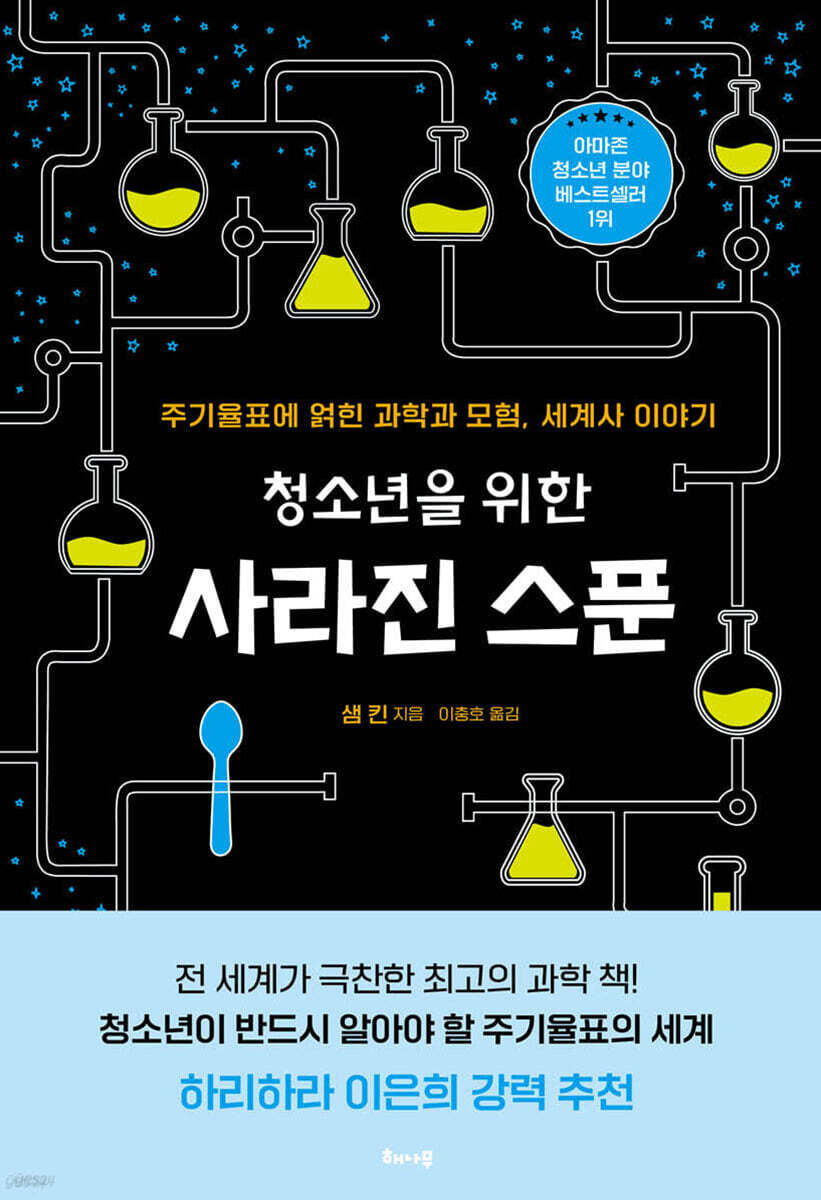
The Lost Spoon for Youth
 |
Description
Book Introduction
A youth edition of the best-selling book, The Lost Spoon, acclaimed by readers around the world.
"The Lost Spoon," which successfully transformed difficult scientific facts into vivid stories, has been refined to make it easier for young readers, with only the core content carefully selected.
This book explores the discovery and uses of every element in the periodic table, and provides a fascinating account of how these elements have influenced human history, mythology, conflict, war, art, and crime.
It is also a useful reference book that explains the basic concepts of chemistry, which are often learned in boring textbooks, in an easy-to-understand way through storytelling.
As you follow the author's brilliant writing style and explore the periodic table, you will be able to break free from the prejudice that chemistry is difficult and rigid, and discover just how fascinating the world of the periodic table can be.
"The Lost Spoon," which successfully transformed difficult scientific facts into vivid stories, has been refined to make it easier for young readers, with only the core content carefully selected.
This book explores the discovery and uses of every element in the periodic table, and provides a fascinating account of how these elements have influenced human history, mythology, conflict, war, art, and crime.
It is also a useful reference book that explains the basic concepts of chemistry, which are often learned in boring textbooks, in an easy-to-understand way through storytelling.
As you follow the author's brilliant writing style and explore the periodic table, you will be able to break free from the prejudice that chemistry is difficult and rigid, and discover just how fascinating the world of the periodic table can be.
- You can preview some of the book's contents.
Preview
index
preface
Part 1 - The Birth of the Periodic Table
Chapter 1: Geography of the Elements
Chapter 2: The Fathers of the Periodic Table
Chapter 3: Genealogy of the Elements
Part 2 - The Creation and Decomposition of Atoms
Chapter 4: How did atoms come into being?: "We are made of star matter."
Chapter 5 Elements Used in War
Chapter 6: The Periodic Table Completed by Explosion
Chapter 7: The Competition of the Elements: The Expansion of the Periodic Table and the Spread of the Cold War
Part 3 - Mistakes and Competition
Chapter 8 Bad Chemistry
Chapter 9: The Poisoners' Corridor: "Ouch, Ouch!"
Chapter 10: The Elements That Created Miracle Medicines
Chapter 11: The Tricks of the Elements
Part 4 - Elements of Human Character
Chapter 12 Political Elements
Chapter 13 Elements Used as Money
Chapter 14 Artistic Elements
Chapter 15: The Elements of Madness
Part 5 - Elemental Science Present and Future
Chapter 16 Cryogenic Chemistry
Chapter 17: The Science of Bubbles
Chapter 18: Ridiculously Precise Tools
Chapter 19 Beyond the Periodic Table
Acknowledgements
Glossary of Terms
Periodic Table of Elements
References
Search
Part 1 - The Birth of the Periodic Table
Chapter 1: Geography of the Elements
Chapter 2: The Fathers of the Periodic Table
Chapter 3: Genealogy of the Elements
Part 2 - The Creation and Decomposition of Atoms
Chapter 4: How did atoms come into being?: "We are made of star matter."
Chapter 5 Elements Used in War
Chapter 6: The Periodic Table Completed by Explosion
Chapter 7: The Competition of the Elements: The Expansion of the Periodic Table and the Spread of the Cold War
Part 3 - Mistakes and Competition
Chapter 8 Bad Chemistry
Chapter 9: The Poisoners' Corridor: "Ouch, Ouch!"
Chapter 10: The Elements That Created Miracle Medicines
Chapter 11: The Tricks of the Elements
Part 4 - Elements of Human Character
Chapter 12 Political Elements
Chapter 13 Elements Used as Money
Chapter 14 Artistic Elements
Chapter 15: The Elements of Madness
Part 5 - Elemental Science Present and Future
Chapter 16 Cryogenic Chemistry
Chapter 17: The Science of Bubbles
Chapter 18: Ridiculously Precise Tools
Chapter 19 Beyond the Periodic Table
Acknowledgements
Glossary of Terms
Periodic Table of Elements
References
Search
Detailed image
.jpg)
Into the book
“I was eating breakfast recently and thinking about old mercury stories, and it occurred to me that every element on the periodic table has its own fascinating, strange, and eerie story.
At the same time, the periodic table is one of humanity's greatest intellectual achievements.
The periodic table is both a scientific achievement and a fascinating storybook.
So I wrote this book to show you, layer by layer, all the layers of the periodic table, just as the transparencies in an anatomy book tell the same story from different depths.”
--- p.11 From the “Preface”
“The Periodic Table Story is not just a fun story, it helps you understand the periodic table in a way you will never find in a textbook or lab guide.
We eat and breathe the elements of the periodic table.
People bet and lose huge amounts of money on the elements in the periodic table.
Philosophers use the periodic table to find meaning in science.
The periodic table poisons people and breeds war.
Between hydrogen at the top left and the artificial elements at the bottom, you will encounter bubbles, bombs, money, alchemy, politics, history, poison, crime, and love.
“You can even get a little bit of science involved.”
--- p.12 From the “Preface”
“Mendeleev was writing a textbook and, pressed for time, he hurriedly created his first periodic table.
He completed the manuscript for the first volume of that textbook, but by then it had only covered eight elements.
Now, in Volume 2, all the remaining elements had to be covered.
After procrastinating for six weeks without meeting the deadline, a good idea suddenly occurred to me: to simply display the information about the elements in a table.
In this periodic table, Mendeleev not only predicted that elements would be discovered in the future to fill the blank spaces below elements such as silicon (number 14) and boron (number 5), but he also gave them temporary names.”
--- p.38 From Chapter 2
“Le Coq de Boisbaudran immediately realized that he had discovered a new element.
He named the element gallium (number 31), after Gaul, the Latin name for the ancient region of France.
…It took several years to purify the sample, but in 1878 Lecoq de Boisbaudran finally succeeded in obtaining pure gallium.
Gallium is a solid at room temperature, but it melts at 29.8°C, so if you place it on your palm, it will melt and turn into a liquid (since body temperature is about 36.7°C).
Gallium is one of the few metals that does not burn when touched in its liquid state.
So gallium is often used as a tool to demonstrate magic.
Because gallium can be easily shaped into any desired shape and looks like aluminum, one popular trick is to make spoons out of gallium.
Then, a gallium spoon is served to the guest along with hot tea.
Then, after a while, the guest is startled to see the spoon in the teacup disappear.”
--- p.40 From Chapter 2
“Our solar system was also born from a supernova explosion.
About 4.6 billion years ago, a shock wave from a supernova passed through a flat cloud of cosmic dust about 24 billion kilometers in diameter—the remnants of at least two previous stars.
The dust particles mixed with the supernova debris to form a huge cloud.
The dense cloud center burned to form the sun, and the matter orbiting it clumped together to form planets.
It's not just planets that are created here.
Everything around us, including books, walls, tables, and food, is made from these materials.
Even our bodies were once made from matter that was inside stars.
That's why astrophysicist Carl Sagan said, "We are made of star stuff."
--- p.63 From Chapter 4
“Patterson’s experiments analyzing lead revealed another important fact.
It has been discovered that lead concentrations in the air continue to increase because people use a lot of lead-containing materials (pipes, paints, gasoline, etc.), and this has very bad consequences for our health and the environment.
So Patterson became an environmental activist, and… thanks to Patterson’s efforts, lead paint was banned and cars no longer emit lead fumes.”
--- p.66~67 from “Chapter 4”
“In 1972, the Japanese government's health committee concluded that cadmium (No. 48) was the cause of Itai-itai disease, based on the overwhelming evidence presented by Hagino.
Thirteen years later, in the Godzilla film series, The Return of Godzilla, the Japanese military prepares a cadmium warhead missile to kill Godzilla, showing how deeply the fear of element 48 was ingrained in the Japanese people's minds.
It was the hydrogen bomb that gave birth to Godzilla.
So the story of cadmium defeating the monster created by nuclear weapons shows just how horrific the image of this element is.”
--- p.126 From Chapter 9
“Even after hundreds of years since chemistry began in earnest, elements continue to amaze us.
It is true that chemists have learned much about the properties of elements, including their melting points and the quantities found in the Earth's crust.
Moreover, elements behave quite predictably at the atomic level.
But when combined with their confusing biology, the elements exhibit bizarre behavior.
Even ordinary elements we encounter on a daily basis sometimes exhibit surprising behavior when encountered in unnatural places.
When elements are in the wrong place in our bodies, they can confuse our minds and senses, or disrupt vital functions like automatic breathing.”
--- p.145 From Chapter 11
“Goethe was not the only great writer who influenced the periodic table.
Another person is the great American writer Mark Twain.
Like Goethe, Twain was deeply fascinated by scientific discovery.
Twain wrote short stories about inventions and technology, dystopias, space travel and time travel, and even the dangers of the periodic table in a fascinating short story titled "Sold to Satan."
This novel, about 2,000 words long, is set in the period immediately following the economic crisis around 1904.
The protagonist, exhausted from his poverty, decides to sell his soul to the devil.
"What does this story have to do with the periodic table? In this novel, the demon's body is made entirely of radium!"
--- p.188 From Chapter 14
“The most well-known fundamental constant is the fine-structure constant (alpha), which is related to electrons.
…the alpha value measured today is approximately 1 in 137.0359.
This value is why the periodic table exists.
Alpha allows atoms of all elements to exist and react with each other to form compounds because it keeps electrons from straying too far from the nucleus, while also preventing them from getting too close to it.
Because of this exquisite balance, many scientists believe that the fine-structure constant value did not appear in the universe by chance.
Those who believe more in theology than science claim that Alpha is evidence that a creator "programmed" the universe to produce molecules and life.
So in 1976, when Soviet (now American) scientist Alexander Shlyakhter visited a strange place called Oklo in Gabon, Africa, and announced that Alpha was growing, the world was turned upside down.”
--- From p.229~230, Chapter 18
“The pillars of the periodic table have been the norm since Mendeleev’s time, but Mendeleev himself created over 30 different versions of the periodic table, and by the 1970s, scientists had created over 700 different versions of the table.
Some chemists separated hydrogen and helium and made them into separate columns.
A modern periodic table has a honeycomb-like shape, with hydrogen at the center and hexagonal cells extending outward in increasingly larger spiral arms.
…it is a bit disappointing that chemistry textbook makers don't try to balance the existing periodic table by introducing some oddly shaped ones.
For example, a pop-up periodic table could pop out of the page and curve around to bring elements that are far apart closer together.
Then, looking at the elements lined up side by side, you may get new inspiration about the relationships between the elements.
…the current periodic table has served its purpose well, but it is important for all of us to imagine and recreate a new periodic table.”
--- p.245~246 From Chapter 19
“If aliens come to Earth, there is no guarantee that we will be able to communicate with them smoothly or explain our main concerns.
Could they understand concepts like love, religion, respect, family, or peace? Perhaps the only things they can grasp are numbers like π… and the properties of the periodic table.
I want them to admire the ingenuity with which we have organized that character.
And I hope that among the various periodic tables we have created, there are some that they recognize.”
--- p.246~247 from “Chapter 19”
“Our wonderful and neat periodic table, with its columns and columns and towers, has served its purpose quite admirably so far.
The periodic table has helped us understand the science of everything from stars to great white shark teeth, from medicine to natural nuclear reactors.
And new discoveries continue to occur in both the human and scientific realms.
The periodic table forms the basis for many discoveries in chemistry, physics, and biology.
And there are only a few things that are universally understood (i.e., something that even aliens could fully understand), and the periodic table is one of them.
The periodic table is also deeply human, in that it is a treasure trove of all our passions and obsessions.
“I’m always amazed at how much we were able to cram into it.”
At the same time, the periodic table is one of humanity's greatest intellectual achievements.
The periodic table is both a scientific achievement and a fascinating storybook.
So I wrote this book to show you, layer by layer, all the layers of the periodic table, just as the transparencies in an anatomy book tell the same story from different depths.”
--- p.11 From the “Preface”
“The Periodic Table Story is not just a fun story, it helps you understand the periodic table in a way you will never find in a textbook or lab guide.
We eat and breathe the elements of the periodic table.
People bet and lose huge amounts of money on the elements in the periodic table.
Philosophers use the periodic table to find meaning in science.
The periodic table poisons people and breeds war.
Between hydrogen at the top left and the artificial elements at the bottom, you will encounter bubbles, bombs, money, alchemy, politics, history, poison, crime, and love.
“You can even get a little bit of science involved.”
--- p.12 From the “Preface”
“Mendeleev was writing a textbook and, pressed for time, he hurriedly created his first periodic table.
He completed the manuscript for the first volume of that textbook, but by then it had only covered eight elements.
Now, in Volume 2, all the remaining elements had to be covered.
After procrastinating for six weeks without meeting the deadline, a good idea suddenly occurred to me: to simply display the information about the elements in a table.
In this periodic table, Mendeleev not only predicted that elements would be discovered in the future to fill the blank spaces below elements such as silicon (number 14) and boron (number 5), but he also gave them temporary names.”
--- p.38 From Chapter 2
“Le Coq de Boisbaudran immediately realized that he had discovered a new element.
He named the element gallium (number 31), after Gaul, the Latin name for the ancient region of France.
…It took several years to purify the sample, but in 1878 Lecoq de Boisbaudran finally succeeded in obtaining pure gallium.
Gallium is a solid at room temperature, but it melts at 29.8°C, so if you place it on your palm, it will melt and turn into a liquid (since body temperature is about 36.7°C).
Gallium is one of the few metals that does not burn when touched in its liquid state.
So gallium is often used as a tool to demonstrate magic.
Because gallium can be easily shaped into any desired shape and looks like aluminum, one popular trick is to make spoons out of gallium.
Then, a gallium spoon is served to the guest along with hot tea.
Then, after a while, the guest is startled to see the spoon in the teacup disappear.”
--- p.40 From Chapter 2
“Our solar system was also born from a supernova explosion.
About 4.6 billion years ago, a shock wave from a supernova passed through a flat cloud of cosmic dust about 24 billion kilometers in diameter—the remnants of at least two previous stars.
The dust particles mixed with the supernova debris to form a huge cloud.
The dense cloud center burned to form the sun, and the matter orbiting it clumped together to form planets.
It's not just planets that are created here.
Everything around us, including books, walls, tables, and food, is made from these materials.
Even our bodies were once made from matter that was inside stars.
That's why astrophysicist Carl Sagan said, "We are made of star stuff."
--- p.63 From Chapter 4
“Patterson’s experiments analyzing lead revealed another important fact.
It has been discovered that lead concentrations in the air continue to increase because people use a lot of lead-containing materials (pipes, paints, gasoline, etc.), and this has very bad consequences for our health and the environment.
So Patterson became an environmental activist, and… thanks to Patterson’s efforts, lead paint was banned and cars no longer emit lead fumes.”
--- p.66~67 from “Chapter 4”
“In 1972, the Japanese government's health committee concluded that cadmium (No. 48) was the cause of Itai-itai disease, based on the overwhelming evidence presented by Hagino.
Thirteen years later, in the Godzilla film series, The Return of Godzilla, the Japanese military prepares a cadmium warhead missile to kill Godzilla, showing how deeply the fear of element 48 was ingrained in the Japanese people's minds.
It was the hydrogen bomb that gave birth to Godzilla.
So the story of cadmium defeating the monster created by nuclear weapons shows just how horrific the image of this element is.”
--- p.126 From Chapter 9
“Even after hundreds of years since chemistry began in earnest, elements continue to amaze us.
It is true that chemists have learned much about the properties of elements, including their melting points and the quantities found in the Earth's crust.
Moreover, elements behave quite predictably at the atomic level.
But when combined with their confusing biology, the elements exhibit bizarre behavior.
Even ordinary elements we encounter on a daily basis sometimes exhibit surprising behavior when encountered in unnatural places.
When elements are in the wrong place in our bodies, they can confuse our minds and senses, or disrupt vital functions like automatic breathing.”
--- p.145 From Chapter 11
“Goethe was not the only great writer who influenced the periodic table.
Another person is the great American writer Mark Twain.
Like Goethe, Twain was deeply fascinated by scientific discovery.
Twain wrote short stories about inventions and technology, dystopias, space travel and time travel, and even the dangers of the periodic table in a fascinating short story titled "Sold to Satan."
This novel, about 2,000 words long, is set in the period immediately following the economic crisis around 1904.
The protagonist, exhausted from his poverty, decides to sell his soul to the devil.
"What does this story have to do with the periodic table? In this novel, the demon's body is made entirely of radium!"
--- p.188 From Chapter 14
“The most well-known fundamental constant is the fine-structure constant (alpha), which is related to electrons.
…the alpha value measured today is approximately 1 in 137.0359.
This value is why the periodic table exists.
Alpha allows atoms of all elements to exist and react with each other to form compounds because it keeps electrons from straying too far from the nucleus, while also preventing them from getting too close to it.
Because of this exquisite balance, many scientists believe that the fine-structure constant value did not appear in the universe by chance.
Those who believe more in theology than science claim that Alpha is evidence that a creator "programmed" the universe to produce molecules and life.
So in 1976, when Soviet (now American) scientist Alexander Shlyakhter visited a strange place called Oklo in Gabon, Africa, and announced that Alpha was growing, the world was turned upside down.”
--- From p.229~230, Chapter 18
“The pillars of the periodic table have been the norm since Mendeleev’s time, but Mendeleev himself created over 30 different versions of the periodic table, and by the 1970s, scientists had created over 700 different versions of the table.
Some chemists separated hydrogen and helium and made them into separate columns.
A modern periodic table has a honeycomb-like shape, with hydrogen at the center and hexagonal cells extending outward in increasingly larger spiral arms.
…it is a bit disappointing that chemistry textbook makers don't try to balance the existing periodic table by introducing some oddly shaped ones.
For example, a pop-up periodic table could pop out of the page and curve around to bring elements that are far apart closer together.
Then, looking at the elements lined up side by side, you may get new inspiration about the relationships between the elements.
…the current periodic table has served its purpose well, but it is important for all of us to imagine and recreate a new periodic table.”
--- p.245~246 From Chapter 19
“If aliens come to Earth, there is no guarantee that we will be able to communicate with them smoothly or explain our main concerns.
Could they understand concepts like love, religion, respect, family, or peace? Perhaps the only things they can grasp are numbers like π… and the properties of the periodic table.
I want them to admire the ingenuity with which we have organized that character.
And I hope that among the various periodic tables we have created, there are some that they recognize.”
--- p.246~247 from “Chapter 19”
“Our wonderful and neat periodic table, with its columns and columns and towers, has served its purpose quite admirably so far.
The periodic table has helped us understand the science of everything from stars to great white shark teeth, from medicine to natural nuclear reactors.
And new discoveries continue to occur in both the human and scientific realms.
The periodic table forms the basis for many discoveries in chemistry, physics, and biology.
And there are only a few things that are universally understood (i.e., something that even aliens could fully understand), and the periodic table is one of them.
The periodic table is also deeply human, in that it is a treasure trove of all our passions and obsessions.
“I’m always amazed at how much we were able to cram into it.”
--- p.247 From Chapter 19
Publisher's Review
★★★★★ #1 Amazon Youth Bestseller
★★★★★ Highly recommended by American chemistry teachers and librarians!
★★★★★ Harihara Lee Eun-hee highly recommended!
Amazon's Best Science Book, New York Times Bestseller
The Lost Spoon, which has been praised all over the world
A youth edition with only the essential content selected!
“The periodic table that creates all the complex things in the world,
“Let’s share the joy of discovering its charm!”
_Harihara Lee Eun-hee
A youth edition of the bestseller The Lost Spoon, acclaimed by readers around the world.
"The Lost Spoon," which successfully transformed difficult scientific facts into vivid stories, has been refined to make it easier for young readers, with only the core content carefully selected.
The periodic table is a kingdom of elements that holds all the secrets of the world.
From hydrogen, the most abundant element in the universe, to carbon, the element of life, to uranium, whose incredible destructive power has driven humanity to despair, the periodic table is filled with elements, each with their own unique personality and colorful story.
At first glance, the periodic table appears to be a boring table of columns with letters and numbers lined up in a dry manner.
But according to the book's author, Sam Keen, the periodic table is like a "fun storybook."
This means that the periodic table contains all of humanity's passion and moments of exploration, from the history of element discovery to the mistakes and competitions of scientists.
“Fun scientific facts and
“It’s full of thought-provoking stories.”
Hewlett Woodmere Public Library, USA
This book explores the discovery and uses of every element in the periodic table, and provides a fascinating account of how these elements have influenced human history, mythology, conflict, war, art, and crime.
It tells the tragic story of how human greed for tantalum and niobium led to the annihilation of the Congolese gorillas, but it also features bizarre and humorous anecdotes, such as a U.S. Senate candidate whose skin turned a shocking blue after drinking silver-laced water, and a chemist who used radioactive lead tracking technology to catch a business owner who reused food.
As you follow the author's brilliant writing style and explore the periodic table, you will be able to break free from the prejudice that chemistry is difficult and rigid and discover just how fascinating the world of the periodic table can be.
From the birth of the periodic table, a great scientific achievement of mankind
Even the basic concepts of chemistry are explained easily through storytelling.
The World of the Periodic Table: Must-Know for Teens
Another great strength of this book is that it uses storytelling to explain the basic concepts of chemistry, which we only learned stiffly in textbooks.
The book explains the most important concepts in chemistry, such as what an element is, how its position on the periodic table determines its properties, what acids and bases are and how they differ from each other, in an engaging and clear way, using original analogies and anecdotes from scientists.
For example, the vertical rows in the periodic table are called 'groups', and the scientific fact that elements in the same group have very similar properties is vividly explained through a story about a heated debate among engineers about semiconductors.
The main raw material for modern semiconductors is silicon, but if you follow the interesting anecdote that germanium, which belongs to the same group as silicon, was once considered a suitable raw material for semiconductors, you can naturally acquire the concept of 'group'.
“There are many books that cover the elements in the periodic table.
There is a terminator here too, and that is The Lost Spoon.”
Lee Jeong-mo (Director of the National Science Museum in Gwacheon)
“The story that makes up everything in the world”
Kim Sang-wook (Professor of Physics, Kyung Hee University)
“Chemistry begins and ends with the periodic table.” “A chemist’s periodic table is like a geographer’s world map.” These are the words of Lee Jeong-mo, director of the National Science Museum in Gwacheon, and Kim Sang-wook, professor of physics at Kyung Hee University, who strongly recommended “The Lost Spoon” and emphasized the importance of the periodic table.
By carefully selecting only the essential elements and lowering the barrier to entry, this book makes it easier to enjoy the periodic table, which is so important.
As you navigate between hydrogen at the top left and the man-made elements below, you'll discover the amazing properties and fascinating world history of the 118 elements, and you'll find yourself immersed in one of humanity's greatest achievements: the periodic table.
★★★★★ Highly recommended by American chemistry teachers and librarians!
★★★★★ Harihara Lee Eun-hee highly recommended!
Amazon's Best Science Book, New York Times Bestseller
The Lost Spoon, which has been praised all over the world
A youth edition with only the essential content selected!
“The periodic table that creates all the complex things in the world,
“Let’s share the joy of discovering its charm!”
_Harihara Lee Eun-hee
A youth edition of the bestseller The Lost Spoon, acclaimed by readers around the world.
"The Lost Spoon," which successfully transformed difficult scientific facts into vivid stories, has been refined to make it easier for young readers, with only the core content carefully selected.
The periodic table is a kingdom of elements that holds all the secrets of the world.
From hydrogen, the most abundant element in the universe, to carbon, the element of life, to uranium, whose incredible destructive power has driven humanity to despair, the periodic table is filled with elements, each with their own unique personality and colorful story.
At first glance, the periodic table appears to be a boring table of columns with letters and numbers lined up in a dry manner.
But according to the book's author, Sam Keen, the periodic table is like a "fun storybook."
This means that the periodic table contains all of humanity's passion and moments of exploration, from the history of element discovery to the mistakes and competitions of scientists.
“Fun scientific facts and
“It’s full of thought-provoking stories.”
Hewlett Woodmere Public Library, USA
This book explores the discovery and uses of every element in the periodic table, and provides a fascinating account of how these elements have influenced human history, mythology, conflict, war, art, and crime.
It tells the tragic story of how human greed for tantalum and niobium led to the annihilation of the Congolese gorillas, but it also features bizarre and humorous anecdotes, such as a U.S. Senate candidate whose skin turned a shocking blue after drinking silver-laced water, and a chemist who used radioactive lead tracking technology to catch a business owner who reused food.
As you follow the author's brilliant writing style and explore the periodic table, you will be able to break free from the prejudice that chemistry is difficult and rigid and discover just how fascinating the world of the periodic table can be.
From the birth of the periodic table, a great scientific achievement of mankind
Even the basic concepts of chemistry are explained easily through storytelling.
The World of the Periodic Table: Must-Know for Teens
Another great strength of this book is that it uses storytelling to explain the basic concepts of chemistry, which we only learned stiffly in textbooks.
The book explains the most important concepts in chemistry, such as what an element is, how its position on the periodic table determines its properties, what acids and bases are and how they differ from each other, in an engaging and clear way, using original analogies and anecdotes from scientists.
For example, the vertical rows in the periodic table are called 'groups', and the scientific fact that elements in the same group have very similar properties is vividly explained through a story about a heated debate among engineers about semiconductors.
The main raw material for modern semiconductors is silicon, but if you follow the interesting anecdote that germanium, which belongs to the same group as silicon, was once considered a suitable raw material for semiconductors, you can naturally acquire the concept of 'group'.
“There are many books that cover the elements in the periodic table.
There is a terminator here too, and that is The Lost Spoon.”
Lee Jeong-mo (Director of the National Science Museum in Gwacheon)
“The story that makes up everything in the world”
Kim Sang-wook (Professor of Physics, Kyung Hee University)
“Chemistry begins and ends with the periodic table.” “A chemist’s periodic table is like a geographer’s world map.” These are the words of Lee Jeong-mo, director of the National Science Museum in Gwacheon, and Kim Sang-wook, professor of physics at Kyung Hee University, who strongly recommended “The Lost Spoon” and emphasized the importance of the periodic table.
By carefully selecting only the essential elements and lowering the barrier to entry, this book makes it easier to enjoy the periodic table, which is so important.
As you navigate between hydrogen at the top left and the man-made elements below, you'll discover the amazing properties and fascinating world history of the 118 elements, and you'll find yourself immersed in one of humanity's greatest achievements: the periodic table.
GOODS SPECIFICS
- Date of issue: May 25, 2022
- Page count, weight, size: 264 pages | 420g | 145*210*16mm
- ISBN13: 9791164051601
- ISBN10: 1164051601
You may also like
카테고리
korean


korean

![GQ KOREA Mark (Monthly): December [2025]](http://librairie.coreenne.fr/cdn/shop/files/8ef265dbbfbf186523ed75ba7319009d.jpg?v=1765340328&width=3840)


