

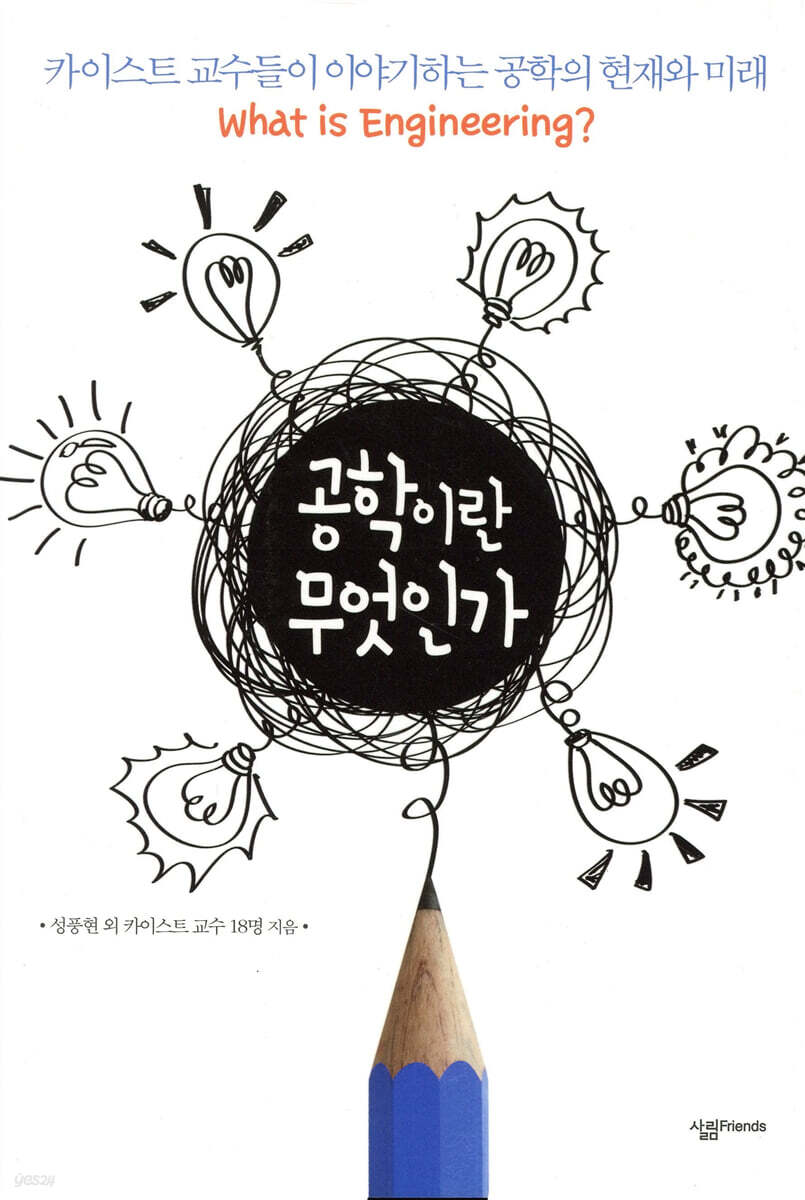
What is Engineering
 |
Description
Book Introduction
Engineering, the representative discipline of convergence, everything about engineering that changes the world and creates the future!
KAIST professors have joined forces to spark interest in engineering and change prejudice against engineers!
Are engineering and science different disciplines?
The question most frequently asked by engineering professors is, "Are engineering and science different?"
Most people think that engineering is a discipline that is part of science.
I don't know the criteria for distinguishing between engineering and science, it's just a slight difference in words.
Even students who go on to engineering schools say they don't go there with a clear understanding of the differences between engineering and science.
KAIST professors, who research and teach cutting-edge engineering in Korea, say they have always felt sorry about this.
Engineering is a discipline that allows people all over the world to enjoy cutting-edge technology and brings about overall changes in human life. However, the problem is that not only is everyone so ignorant about this discipline, but even aspiring students do not understand its significance.
Therefore, I wrote this book to explain to the youth who will take responsibility for the future, and to the general public, the history of engineering as a discipline, its role, and its vision for the future.
KAIST professors have joined forces to spark interest in engineering and change prejudice against engineers!
Are engineering and science different disciplines?
The question most frequently asked by engineering professors is, "Are engineering and science different?"
Most people think that engineering is a discipline that is part of science.
I don't know the criteria for distinguishing between engineering and science, it's just a slight difference in words.
Even students who go on to engineering schools say they don't go there with a clear understanding of the differences between engineering and science.
KAIST professors, who research and teach cutting-edge engineering in Korea, say they have always felt sorry about this.
Engineering is a discipline that allows people all over the world to enjoy cutting-edge technology and brings about overall changes in human life. However, the problem is that not only is everyone so ignorant about this discipline, but even aspiring students do not understand its significance.
Therefore, I wrote this book to explain to the youth who will take responsibility for the future, and to the general public, the history of engineering as a discipline, its role, and its vision for the future.
- You can preview some of the book's contents.
Preview
index
Introduction What is Engineering?
Chapter 1: Creating Reality from Myth: Nuclear Engineering: The Crystallization of Imagination - Jang Soon-hong, Lee Jeong-ik
Chapter 2: Earth's Largest Network Engineering: Marine Systems Engineering - Han Sun-hong
Chapter 3: A Century of Passion for the Sky and Space: Aerospace Engineering - Shim Hyeon-cheol
Chapter 4 Welcome to Mechanic World,
Mechanical Engineering - Bae Jung-myeon
Chapter 5 'This is not design',
Industrial Design - Lee Geon-pyo
Chapter 6: A Preview of the World of Knowledge: Knowledge Service Engineering, from Cognitive Science to Big Data - Wan-cheol Yoon
Review all 7 chapters and decide on the best option.
Industrial and Systems Engineering - Tae-Eok Lee
Chapter 8: Exploring the Universe of Thought
Bio and Brain Engineering - Kwang-hyung Lee
Chapter 9: The World of Modern Wizards
Computer Engineering - Bae Doo-hwan
Chapter 10: The most powerful force that changes daily life
Electronic Engineering - Jo Dong-ho
Chapter 11: Dreaming of a Future City Like in Science Fiction? Green Transportation Engineering - Seo In-su
Chapter 12: The Pride of 'Engineering Aid'
Civil and Environmental Engineering - Jin-Geun Kim, Hee-Kyung Park, Ji-Yeon Han
Chapter 13: From Adam and Eve's Leaves to Carbon Nanotubes: New Materials Engineering - Kim Do-kyung
Chapter 14: Until Everyone Holds Spider-Man's Web, Biochemical Engineering - Lee Sang-yeop
Conclusion For students who want to become engineers
Chapter 1: Creating Reality from Myth: Nuclear Engineering: The Crystallization of Imagination - Jang Soon-hong, Lee Jeong-ik
Chapter 2: Earth's Largest Network Engineering: Marine Systems Engineering - Han Sun-hong
Chapter 3: A Century of Passion for the Sky and Space: Aerospace Engineering - Shim Hyeon-cheol
Chapter 4 Welcome to Mechanic World,
Mechanical Engineering - Bae Jung-myeon
Chapter 5 'This is not design',
Industrial Design - Lee Geon-pyo
Chapter 6: A Preview of the World of Knowledge: Knowledge Service Engineering, from Cognitive Science to Big Data - Wan-cheol Yoon
Review all 7 chapters and decide on the best option.
Industrial and Systems Engineering - Tae-Eok Lee
Chapter 8: Exploring the Universe of Thought
Bio and Brain Engineering - Kwang-hyung Lee
Chapter 9: The World of Modern Wizards
Computer Engineering - Bae Doo-hwan
Chapter 10: The most powerful force that changes daily life
Electronic Engineering - Jo Dong-ho
Chapter 11: Dreaming of a Future City Like in Science Fiction? Green Transportation Engineering - Seo In-su
Chapter 12: The Pride of 'Engineering Aid'
Civil and Environmental Engineering - Jin-Geun Kim, Hee-Kyung Park, Ji-Yeon Han
Chapter 13: From Adam and Eve's Leaves to Carbon Nanotubes: New Materials Engineering - Kim Do-kyung
Chapter 14: Until Everyone Holds Spider-Man's Web, Biochemical Engineering - Lee Sang-yeop
Conclusion For students who want to become engineers
Into the book
Design is a scientific and engineering prescription for solving the unreasonable and inconvenient problems encountered in everyday life.
There is an artistic side to it, and there is also a human-centered approach that is geared towards people.
The incorrect chair button introduced earlier is an example where this concept is not sufficiently reflected.
It's hard to say that it's a proper design.
René MagritteR.
I'm tempted to parody the title of Magritte's painting and call it "This is not design."
So what is real design?
Let's consider some common misconceptions about design.
To know 'what design is', you must first know 'what cannot be called design'.
Prejudice 1.
“As expected from an artist, he is different!”, Prejudice 2.
“You do design, so you must be good at drawing!”, Prejudice 3.
“The design department is part of the art college, right?”
-p.97 (Chapter 5, 'This is not design', Industrial Design)
What I should do vs.
What colleagues should do
Let's say you decide to work on an assignment with your classmates.
How can we share this work fairly?
If some people do a lot and others do a little, there will be dissatisfaction.
Also, how should I manage my schedule?
When should I start and when should I finish to be efficient?
This problem is also a research topic in industrial and systems engineering.
And actually, research has been done.
It is a project management PM.
-p.157 (Review the entire Chapter 7 and decide optimally.
Industrial and Systems Engineering)
1.
Could a brain sensor chip that soothes the mind be born?
The brain is silent.
When you open up the heart for surgery, you can see what's wrong with it, but that's not the case with the brain.
How can we understand what's happening in the brain? The field that studies this is neuroengineering.
Wait a minute here.
Many people have heard of 'brain science', but the term 'brain engineering' may be unfamiliar.
Brain engineering is a field that provides methods for exploring the principles of the brain and nervous system, or for diagnosing and treating diseases of the brain and nervous system.
We also research technologies that restore or enhance brain function.
How exactly does this work? The brain doesn't speak, but instead sends out other signals.
Brain engineering is about making these brain signals or brain images more vivid and using these signals to uncover the secret processes occurring in the brain.
-p.175 (Chapter 8: Exploring the Universe of Thought, Bio and Brain Engineering)
People who see long lines of cars lining the streets of downtown often wonder:
'Why can't we solve the parking problem?' The reason why city streets turn into long parking lots is fundamentally because there is a lack of parking spaces.
So, this can be solved by either securing more space or reducing the number of cars.
If even this doesn't work, reducing the size of the car could help solve the problem.
Because the parking problem is a function of space, number of cars, and size.
It is the most fundamental solution, but the problem is that it is not easy to apply.
We can't create infinite space, and we can't just blindly restrict car use.
However, no other solution comes to mind.
But what if we change our perspective? Anyone who's ever been to a large supermarket knows the "transformation" of shopping carts.
A large cart, loaded with items, folds up neatly and tucks away between other carts when not in use.
Not only does it not take up space, it is also easy to move.
Sometimes it's a wonder to see dozens of carts folded and stacked on top of each other, moving in a long train-like formation.
The reason shopping carts don't cause 'parking' problems in narrow supermarkets is thanks to a simple idea: one side of the cart folds down.
Couldn't this idea be applied to cars? When not in use, the car could be folded up and stacked with other vehicles, then returned to its original form when in use.
You might think this is a joke, but this is actually research being done at KAIST.
Make the vehicle smaller to reduce the space it takes up, and make the body out of strong but lightweight materials.
If you design it so that it can be folded and stored, you can create a car that transforms into something small.
There is an artistic side to it, and there is also a human-centered approach that is geared towards people.
The incorrect chair button introduced earlier is an example where this concept is not sufficiently reflected.
It's hard to say that it's a proper design.
René MagritteR.
I'm tempted to parody the title of Magritte's painting and call it "This is not design."
So what is real design?
Let's consider some common misconceptions about design.
To know 'what design is', you must first know 'what cannot be called design'.
Prejudice 1.
“As expected from an artist, he is different!”, Prejudice 2.
“You do design, so you must be good at drawing!”, Prejudice 3.
“The design department is part of the art college, right?”
-p.97 (Chapter 5, 'This is not design', Industrial Design)
What I should do vs.
What colleagues should do
Let's say you decide to work on an assignment with your classmates.
How can we share this work fairly?
If some people do a lot and others do a little, there will be dissatisfaction.
Also, how should I manage my schedule?
When should I start and when should I finish to be efficient?
This problem is also a research topic in industrial and systems engineering.
And actually, research has been done.
It is a project management PM.
-p.157 (Review the entire Chapter 7 and decide optimally.
Industrial and Systems Engineering)
1.
Could a brain sensor chip that soothes the mind be born?
The brain is silent.
When you open up the heart for surgery, you can see what's wrong with it, but that's not the case with the brain.
How can we understand what's happening in the brain? The field that studies this is neuroengineering.
Wait a minute here.
Many people have heard of 'brain science', but the term 'brain engineering' may be unfamiliar.
Brain engineering is a field that provides methods for exploring the principles of the brain and nervous system, or for diagnosing and treating diseases of the brain and nervous system.
We also research technologies that restore or enhance brain function.
How exactly does this work? The brain doesn't speak, but instead sends out other signals.
Brain engineering is about making these brain signals or brain images more vivid and using these signals to uncover the secret processes occurring in the brain.
-p.175 (Chapter 8: Exploring the Universe of Thought, Bio and Brain Engineering)
People who see long lines of cars lining the streets of downtown often wonder:
'Why can't we solve the parking problem?' The reason why city streets turn into long parking lots is fundamentally because there is a lack of parking spaces.
So, this can be solved by either securing more space or reducing the number of cars.
If even this doesn't work, reducing the size of the car could help solve the problem.
Because the parking problem is a function of space, number of cars, and size.
It is the most fundamental solution, but the problem is that it is not easy to apply.
We can't create infinite space, and we can't just blindly restrict car use.
However, no other solution comes to mind.
But what if we change our perspective? Anyone who's ever been to a large supermarket knows the "transformation" of shopping carts.
A large cart, loaded with items, folds up neatly and tucks away between other carts when not in use.
Not only does it not take up space, it is also easy to move.
Sometimes it's a wonder to see dozens of carts folded and stacked on top of each other, moving in a long train-like formation.
The reason shopping carts don't cause 'parking' problems in narrow supermarkets is thanks to a simple idea: one side of the cart folds down.
Couldn't this idea be applied to cars? When not in use, the car could be folded up and stacked with other vehicles, then returned to its original form when in use.
You might think this is a joke, but this is actually research being done at KAIST.
Make the vehicle smaller to reduce the space it takes up, and make the body out of strong but lightweight materials.
If you design it so that it can be folded and stored, you can create a car that transforms into something small.
---From the text
Publisher's Review
The core spirit needed in this era, ‘fusion’
The representative academic discipline, 'engineering'
Engineering is a discipline that deals with 'technical problems' and can be defined as 'a discipline that discovers problems and presents technical solutions to them.'
Here, technical problems include not only malfunctions or errors, but also ‘inconveniences’ in daily life.
It refers to a very wide range of problems, from small issues like car parts to large issues like traffic congestion and global warming.
Most of these diverse problems cannot be solved by a single discipline.
Convergence means that two or more different academic disciplines are treated as a single discipline.
However, in reality, convergence studies are born to solve problems, not independently.
Understanding the complex phenomena occurring in the brain requires the ability to use sophisticated electronic measurement equipment.
Just as the Department of Brain Engineering was born as a convergence department that cultivates talents with a good understanding of existing medical science, electronic engineering, and computer engineering,
Engineering is a discipline that was born from the foundation of problem solving, so the discipline itself already has a convergence nature.
However, disciplines that have been taught for a long time, such as civil engineering or mechanical engineering, have come to be associated with simplified job fields, such as civil engineers being people who do civil engineering work or mechanical engineers being technicians who handle machines.
However, engineers ultimately work to ensure that humanity enjoys technologically 'optimized convenience'.
A discipline that changes the real lives of mankind
This book introduces 14 different engineering fields, including relatively old academic fields such as mechanical engineering, civil engineering, electrical and electronic engineering, chemical engineering, and new materials engineering, as well as new engineering fields that have recently been in the spotlight such as nuclear engineering, marine systems engineering, aerospace engineering, industrial design, knowledge service engineering, industrial and systems engineering, bio and brain engineering, computer engineering, green transportation engineering, environmental engineering, and biochemical engineering.
If you read this book and learn that everything from the buildings, bridges, and towers we live on, to machines like cars, airplanes, and computers, to cutting-edge products like cell phones, prosthetic limbs, and navigation systems, is the result of engineering, you will see the world we live in in a new light.
The representative academic discipline, 'engineering'
Engineering is a discipline that deals with 'technical problems' and can be defined as 'a discipline that discovers problems and presents technical solutions to them.'
Here, technical problems include not only malfunctions or errors, but also ‘inconveniences’ in daily life.
It refers to a very wide range of problems, from small issues like car parts to large issues like traffic congestion and global warming.
Most of these diverse problems cannot be solved by a single discipline.
Convergence means that two or more different academic disciplines are treated as a single discipline.
However, in reality, convergence studies are born to solve problems, not independently.
Understanding the complex phenomena occurring in the brain requires the ability to use sophisticated electronic measurement equipment.
Just as the Department of Brain Engineering was born as a convergence department that cultivates talents with a good understanding of existing medical science, electronic engineering, and computer engineering,
Engineering is a discipline that was born from the foundation of problem solving, so the discipline itself already has a convergence nature.
However, disciplines that have been taught for a long time, such as civil engineering or mechanical engineering, have come to be associated with simplified job fields, such as civil engineers being people who do civil engineering work or mechanical engineers being technicians who handle machines.
However, engineers ultimately work to ensure that humanity enjoys technologically 'optimized convenience'.
A discipline that changes the real lives of mankind
This book introduces 14 different engineering fields, including relatively old academic fields such as mechanical engineering, civil engineering, electrical and electronic engineering, chemical engineering, and new materials engineering, as well as new engineering fields that have recently been in the spotlight such as nuclear engineering, marine systems engineering, aerospace engineering, industrial design, knowledge service engineering, industrial and systems engineering, bio and brain engineering, computer engineering, green transportation engineering, environmental engineering, and biochemical engineering.
If you read this book and learn that everything from the buildings, bridges, and towers we live on, to machines like cars, airplanes, and computers, to cutting-edge products like cell phones, prosthetic limbs, and navigation systems, is the result of engineering, you will see the world we live in in a new light.
GOODS SPECIFICS
- Date of issue: September 10, 2013
- Page count, weight, size: 340 pages | 575g | 152*225*30mm
- ISBN13: 9788952227294
- ISBN10: 8952227298
You may also like
카테고리
korean


korean

![GQ KOREA Mark (Monthly): December [2025]](http://librairie.coreenne.fr/cdn/shop/files/8ef265dbbfbf186523ed75ba7319009d.jpg?v=1765340328&width=3840)


