

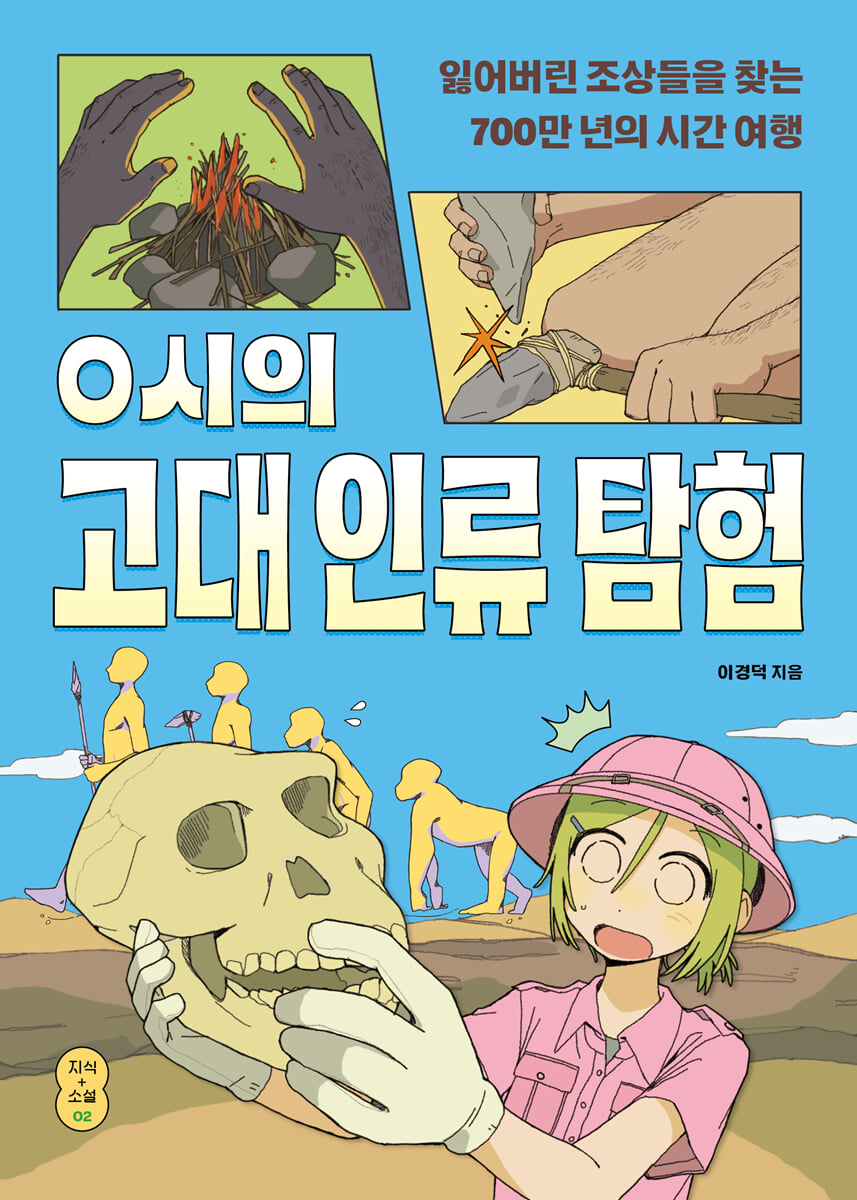
Exploring Ancient Humanity at 0:00
 |
Description
Book Introduction
“Where do we come from and where do we go?”
A 7-Million-Year Time Journey with a Ghostly Paleoanthropologist
The second volume of the "Knowledge Plus Novel" series, "Ancient Human Exploration at Midnight," has been published.
We often say, 'Be human.'
Those words contain the unique human mind and actions, and this book is a story about finding the history of that 'humanity.'
About 7 million years ago, with the appearance of Sahelanthropus tchadensis, humans began to diverge from their common ancestor, the chimpanzee.
After that, Australopithecus began to walk on two feet, Homo habilis made and used tools, and Homo erectus completely changed their way of life by mastering fire.
Also, as the whites of the eyes widened, we could read each other's gaze, and as the hyoid bone developed, we could share our emotions through speech.
In this way, humanity grew into beings who cared for the wounded, raised children together, and honored the dead.
All these changes were the beginning of humanity.
After closing the book, the reader will ask himself these questions:
“What kind of person am I living as?”
A 7-Million-Year Time Journey with a Ghostly Paleoanthropologist
The second volume of the "Knowledge Plus Novel" series, "Ancient Human Exploration at Midnight," has been published.
We often say, 'Be human.'
Those words contain the unique human mind and actions, and this book is a story about finding the history of that 'humanity.'
About 7 million years ago, with the appearance of Sahelanthropus tchadensis, humans began to diverge from their common ancestor, the chimpanzee.
After that, Australopithecus began to walk on two feet, Homo habilis made and used tools, and Homo erectus completely changed their way of life by mastering fire.
Also, as the whites of the eyes widened, we could read each other's gaze, and as the hyoid bone developed, we could share our emotions through speech.
In this way, humanity grew into beings who cared for the wounded, raised children together, and honored the dead.
All these changes were the beginning of humanity.
After closing the book, the reader will ask himself these questions:
“What kind of person am I living as?”
- You can preview some of the book's contents.
Preview
index
Before embarking on a human exploration
Introducing the Human Exploration Team
Prologue_In Search of My First Grandmother
1 The Birth of a Lucky Mother_Mitochondrial Eve
Meeting the Anthropologists | We All Have the Same Mother? | If There Was Eve, There Was Adam | The Ancestors of 'Current' Humans, Not the First
2 The Crossroads of Chimpanzees and Humans_Sahelanthropus tchadensis
The First Day of Human Exploration | 7 Million Years Ago in Search of the First Humans | Evidence of Upright Walking Is Here | How the Jungle Became a Desert
3. Beginning to walk on two feet_Australopithecus
How many bones does one person have? | The moment the name 'Lucy' was born | The little canine that brought peace
The Rise of the Tool Genius_Homo habilis
Humans originated in Africa | First human discovered? | 'That guy's' name is Zinjanthropus | Rudolph? Homo rudolfensis!
5 Travelers Who Left with Fire_Homo Erectus
The changes brought about by the white of the eye | The first to leave Africa | Oldowan and Acheulean stone tools | How fire changed everything
6. Getting Smarter_Homo soloensis
Meet the descendants of Java's origins | What's so great about a bigger brain? | A bigger brain isn't always better.
7 Hidden Links of Humanity_Homo heidelbergensis
Why are ancient human names in Latin? | The Secret of Heidelberg | Grandmothers Saved Humanity | Similarities to Homo sapiens
8 Giant Brains, Amazing Survival Skills_Neanderthals
The Secret of the Name 'Neanderthal' | Humans Lived in Extended Families | I Thought It Was a Bear Skull | How Did Humans Stay Extinct? | Neanderthal Traces Left Behind Us
9. The identity of the human race that roamed Asia_Denisovans
Three Humans Meet in a Cave | The Mystery of Finger Bones | How Did They Get to the South Pacific?
10 Little Humans Who Survived on the Island_Homo floresiensis
Same Ancestors, Different Looks | When Did We Get Smarter Than Dolphins? | Changes for Island Survival
11 Becoming the only human on Earth_Homo sapiens
The End of 7 Million Years, the Beginning of "Me" | The Rise of the Wise | Beyond the Past, Towards the Future
Nanseo's Presentation_The Story of Ancient Korean Humans
Author's Note: We are creating the future of humanity.
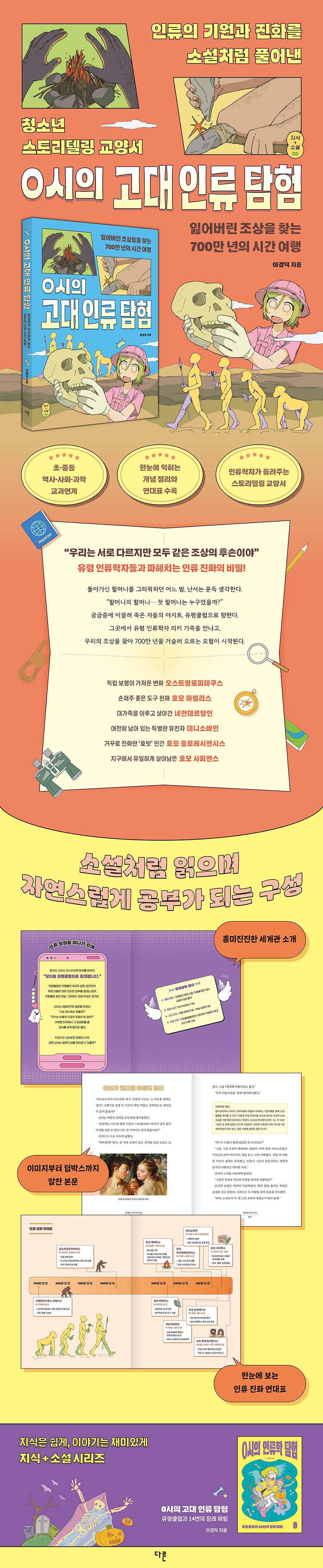
Human Evolution Timeline
Dictionary of Human Evolution Terms
Photo source
Introducing the Human Exploration Team
Prologue_In Search of My First Grandmother
1 The Birth of a Lucky Mother_Mitochondrial Eve
Meeting the Anthropologists | We All Have the Same Mother? | If There Was Eve, There Was Adam | The Ancestors of 'Current' Humans, Not the First
2 The Crossroads of Chimpanzees and Humans_Sahelanthropus tchadensis
The First Day of Human Exploration | 7 Million Years Ago in Search of the First Humans | Evidence of Upright Walking Is Here | How the Jungle Became a Desert
3. Beginning to walk on two feet_Australopithecus
How many bones does one person have? | The moment the name 'Lucy' was born | The little canine that brought peace
The Rise of the Tool Genius_Homo habilis
Humans originated in Africa | First human discovered? | 'That guy's' name is Zinjanthropus | Rudolph? Homo rudolfensis!
5 Travelers Who Left with Fire_Homo Erectus
The changes brought about by the white of the eye | The first to leave Africa | Oldowan and Acheulean stone tools | How fire changed everything
6. Getting Smarter_Homo soloensis
Meet the descendants of Java's origins | What's so great about a bigger brain? | A bigger brain isn't always better.
7 Hidden Links of Humanity_Homo heidelbergensis
Why are ancient human names in Latin? | The Secret of Heidelberg | Grandmothers Saved Humanity | Similarities to Homo sapiens
8 Giant Brains, Amazing Survival Skills_Neanderthals
The Secret of the Name 'Neanderthal' | Humans Lived in Extended Families | I Thought It Was a Bear Skull | How Did Humans Stay Extinct? | Neanderthal Traces Left Behind Us
9. The identity of the human race that roamed Asia_Denisovans
Three Humans Meet in a Cave | The Mystery of Finger Bones | How Did They Get to the South Pacific?
10 Little Humans Who Survived on the Island_Homo floresiensis
Same Ancestors, Different Looks | When Did We Get Smarter Than Dolphins? | Changes for Island Survival
11 Becoming the only human on Earth_Homo sapiens
The End of 7 Million Years, the Beginning of "Me" | The Rise of the Wise | Beyond the Past, Towards the Future
Nanseo's Presentation_The Story of Ancient Korean Humans
Author's Note: We are creating the future of humanity.
Human Evolution Timeline
Dictionary of Human Evolution Terms
Photo source
Detailed image
Into the book
“We may have different skin colors and appearances, but we are all descendants of the same ancestors.
All of the 8 billion people living on Earth can be considered relatives.
From an anthropological perspective, you and I are distant relatives.”
--- p.23
“Mitochondrial Eve was not the first woman of humanity.
She too had a mother, and above that, there were ancestors.
It just means that the closest common ancestor of all living humans is that person.”
--- p.28
Nanseo walked around Lake Turkana for a while, carefully examining the land.
I was wondering if there might be any fossils.
Mary, seeing that, approached Nanseo and spoke in a soft voice.
“The world must sometimes be viewed close up, and sometimes from afar.
“It’s like looking at fossils under your feet and seeing a very distant past through those fossils.”
--- p.80
“You say your body changed when you used fire?”
"huh.
Cooking food makes it easier to digest, so we started eating more meat.
As a result, the digestive organ, the intestines, became shorter, and the body became longer and more elongated, becoming closer to the body shape of modern humans.”
--- p.96
“Is brain capacity that important?”
Nanseo asked with a puzzled look.
“It’s very important.
Remember how we said that early archaic humans were characterized by upright walking and small canines? Another important characteristic was their brain capacity.
“It is thanks to brain capacity, or the power that comes from the head, that we can now see chimpanzees and other beasts that were much stronger than ancient humans 7 million years ago in zoos, and even send probes into space.”
--- p.105~106
“But what country are all the ancient human names from?”
“Latin.
“It’s the language used by the ancient Romans.”
Nanseo asked back with a surprised face.
“Why are you naming it after the Romans? Rome has already fallen.”
“That’s the important point.
The reason we use Latin for the scientific names of plants, animals, and ancient humans is because, as you said, Rome fell and Latin became a dead language that is no longer used.
You could call it a ‘ghost language’.”
--- p.119~120
“Homo heidelbergensis had a brain capacity of about 1,100 to 1,400 cc, which is almost the same as ours.
Even his appearance wasn't much different from that of a person today.
The average male would have been about 180cm tall and had a muscular, solid build.
If you trim your hair and beard neatly and wear a suit, you might not be able to tell them apart from today's humans on the street.”
--- p.130
"that's right.
Traces of a broken leg being treated have been found in a Neanderthal fossil.
When someone in the group was injured, they cared for and treated that person with consideration and affection, even though they might have starved to death without food.”
--- p.143~144
“When the Ice Age came, mammoths adapted to the cold with thick fur and layers of fat.
But people made clothes and wore them.
When the Ice Age ended and the weather got warmer, woolly mammoths couldn't adapt and eventually went extinct, but humans just had to take off their clothes.
This is precisely what ‘wisdom’ and ‘smartness’ are.”
All of the 8 billion people living on Earth can be considered relatives.
From an anthropological perspective, you and I are distant relatives.”
--- p.23
“Mitochondrial Eve was not the first woman of humanity.
She too had a mother, and above that, there were ancestors.
It just means that the closest common ancestor of all living humans is that person.”
--- p.28
Nanseo walked around Lake Turkana for a while, carefully examining the land.
I was wondering if there might be any fossils.
Mary, seeing that, approached Nanseo and spoke in a soft voice.
“The world must sometimes be viewed close up, and sometimes from afar.
“It’s like looking at fossils under your feet and seeing a very distant past through those fossils.”
--- p.80
“You say your body changed when you used fire?”
"huh.
Cooking food makes it easier to digest, so we started eating more meat.
As a result, the digestive organ, the intestines, became shorter, and the body became longer and more elongated, becoming closer to the body shape of modern humans.”
--- p.96
“Is brain capacity that important?”
Nanseo asked with a puzzled look.
“It’s very important.
Remember how we said that early archaic humans were characterized by upright walking and small canines? Another important characteristic was their brain capacity.
“It is thanks to brain capacity, or the power that comes from the head, that we can now see chimpanzees and other beasts that were much stronger than ancient humans 7 million years ago in zoos, and even send probes into space.”
--- p.105~106
“But what country are all the ancient human names from?”
“Latin.
“It’s the language used by the ancient Romans.”
Nanseo asked back with a surprised face.
“Why are you naming it after the Romans? Rome has already fallen.”
“That’s the important point.
The reason we use Latin for the scientific names of plants, animals, and ancient humans is because, as you said, Rome fell and Latin became a dead language that is no longer used.
You could call it a ‘ghost language’.”
--- p.119~120
“Homo heidelbergensis had a brain capacity of about 1,100 to 1,400 cc, which is almost the same as ours.
Even his appearance wasn't much different from that of a person today.
The average male would have been about 180cm tall and had a muscular, solid build.
If you trim your hair and beard neatly and wear a suit, you might not be able to tell them apart from today's humans on the street.”
--- p.130
"that's right.
Traces of a broken leg being treated have been found in a Neanderthal fossil.
When someone in the group was injured, they cared for and treated that person with consideration and affection, even though they might have starved to death without food.”
--- p.143~144
“When the Ice Age came, mammoths adapted to the cold with thick fur and layers of fat.
But people made clothes and wore them.
When the Ice Age ended and the weather got warmer, woolly mammoths couldn't adapt and eventually went extinct, but humans just had to take off their clothes.
This is precisely what ‘wisdom’ and ‘smartness’ are.”
--- p.189
Publisher's Review
“Where do we come from and where do we go?”
A 7-Million-Year Time Journey with a Ghostly Paleoanthropologist
The second volume of the "Knowledge Plus Novel" series, "Ancient Human Exploration at Midnight," has been published.
In an era where artificial intelligence is replacing human work, we suddenly find ourselves wondering.
“So what makes humans different?” The discipline that started from this question is paleoanthropology.
Paleoanthropology explores how humans evolved into our present form by following the traces left by our ancestors millions of years ago.
The second volume of the 'Knowledge Plus Novel' series, 'Ancient Human Exploration at 0:00', is a storytelling textbook that unfolds the long history of mankind like a novel.
If Volume 1, "Anthropological Exploration at 0 O'Clock," dealt with the "end of life," death, and funeral culture, Volume 2 contains a journey toward the "beginning of life," the origins of humans.
The story's protagonist, Nansuh, embarks on an expedition across time and space with the ghostly paleoanthropologists Leakey family (Louis Leakey, Mary Leakey, and Richard Leakey).
Every night at midnight, they teleport to the site of an ancient human fossil excavation.
From Mitochondrial Eve, known as the "first mother," to Homo sapiens, the only remaining human species, we follow the path of evolution over millions of years and trace the footsteps of humanity.
The book includes a chronology and glossary as appendices, making it ideal for use in conjunction with curriculum learning for students from upper elementary to middle school.
This book does not simply look back on the past.
It asks fundamental questions such as “Who am I?” and “Where do we come from and where are we going?” and allows us to take a fresh look at our “present selves” within the grand flow of human evolution.
“What kind of person am I living as?”
The history of 'humanity' that made us who we are today
We often say, 'Be human.'
Those words contain the unique human mind and actions.
This book is a story about finding the history of 'humanity'.
About 7 million years ago, with the appearance of Sahelanthropus tchadensis, humans began to diverge from their common ancestor, the chimpanzee.
After that, Australopithecus began walking on two feet, Homo habilis made and used tools, and Homo erectus completely changed their way of life by mastering fire.
Also, as the whites of the eyes widened, we could read each other's gaze, and as the hyoid bone developed, we could share our emotions through speech.
In this way, humanity grew into beings who cared for the wounded, raised children together, and honored the dead.
All these changes were the beginning of humanity.
After closing the book, readers will ask themselves these questions:
“What kind of person am I living as?”
The textbook doesn't cover everything
Hidden Stories of Human Evolution
When you open a history textbook, the first topic that appears is the emergence and evolution of mankind.
However, it is difficult to imagine how they lived because the explanations in textbooks only briefly list names and characteristics.
This book fills that void and brings ancient human life back to life.
For example, Australopithecus had smaller canines than chimpanzees or orangutans.
This is an evolution that symbolizes peace, meaning that we no longer have to threaten each other.
Homo floresiens, also known as 'hobbit humans', evolved backwards while living in isolation on an island for a long time.
Although food was scarce, they adapted to an environment with few natural enemies, and their body size and brain size actually decreased.
In the book, the main character Nanseo asks these questions.
Why did humans originate in Africa? Why did we leave the jungle and venture into the dangerous grasslands? What are the benefits of a larger brain? What does menopause in women mean for human survival? The Leakey family, ghost paleoanthropologists, offer answers that blend science and imagination.
As you follow their conversations, sometimes cheerful and sometimes serious, you will vividly unfold before your eyes the secrets of human evolution that textbooks cannot fully capture.
A 7-Million-Year Time Journey with a Ghostly Paleoanthropologist
The second volume of the "Knowledge Plus Novel" series, "Ancient Human Exploration at Midnight," has been published.
In an era where artificial intelligence is replacing human work, we suddenly find ourselves wondering.
“So what makes humans different?” The discipline that started from this question is paleoanthropology.
Paleoanthropology explores how humans evolved into our present form by following the traces left by our ancestors millions of years ago.
The second volume of the 'Knowledge Plus Novel' series, 'Ancient Human Exploration at 0:00', is a storytelling textbook that unfolds the long history of mankind like a novel.
If Volume 1, "Anthropological Exploration at 0 O'Clock," dealt with the "end of life," death, and funeral culture, Volume 2 contains a journey toward the "beginning of life," the origins of humans.
The story's protagonist, Nansuh, embarks on an expedition across time and space with the ghostly paleoanthropologists Leakey family (Louis Leakey, Mary Leakey, and Richard Leakey).
Every night at midnight, they teleport to the site of an ancient human fossil excavation.
From Mitochondrial Eve, known as the "first mother," to Homo sapiens, the only remaining human species, we follow the path of evolution over millions of years and trace the footsteps of humanity.
The book includes a chronology and glossary as appendices, making it ideal for use in conjunction with curriculum learning for students from upper elementary to middle school.
This book does not simply look back on the past.
It asks fundamental questions such as “Who am I?” and “Where do we come from and where are we going?” and allows us to take a fresh look at our “present selves” within the grand flow of human evolution.
“What kind of person am I living as?”
The history of 'humanity' that made us who we are today
We often say, 'Be human.'
Those words contain the unique human mind and actions.
This book is a story about finding the history of 'humanity'.
About 7 million years ago, with the appearance of Sahelanthropus tchadensis, humans began to diverge from their common ancestor, the chimpanzee.
After that, Australopithecus began walking on two feet, Homo habilis made and used tools, and Homo erectus completely changed their way of life by mastering fire.
Also, as the whites of the eyes widened, we could read each other's gaze, and as the hyoid bone developed, we could share our emotions through speech.
In this way, humanity grew into beings who cared for the wounded, raised children together, and honored the dead.
All these changes were the beginning of humanity.
After closing the book, readers will ask themselves these questions:
“What kind of person am I living as?”
The textbook doesn't cover everything
Hidden Stories of Human Evolution
When you open a history textbook, the first topic that appears is the emergence and evolution of mankind.
However, it is difficult to imagine how they lived because the explanations in textbooks only briefly list names and characteristics.
This book fills that void and brings ancient human life back to life.
For example, Australopithecus had smaller canines than chimpanzees or orangutans.
This is an evolution that symbolizes peace, meaning that we no longer have to threaten each other.
Homo floresiens, also known as 'hobbit humans', evolved backwards while living in isolation on an island for a long time.
Although food was scarce, they adapted to an environment with few natural enemies, and their body size and brain size actually decreased.
In the book, the main character Nanseo asks these questions.
Why did humans originate in Africa? Why did we leave the jungle and venture into the dangerous grasslands? What are the benefits of a larger brain? What does menopause in women mean for human survival? The Leakey family, ghost paleoanthropologists, offer answers that blend science and imagination.
As you follow their conversations, sometimes cheerful and sometimes serious, you will vividly unfold before your eyes the secrets of human evolution that textbooks cannot fully capture.
GOODS SPECIFICS
- Date of issue: October 27, 2025
- Page count, weight, size: 220 pages | 364g | 150*210*14mm
- ISBN13: 9791156337263
- ISBN10: 1156337267
You may also like
카테고리
korean


korean

![GQ KOREA Mark (Monthly): December [2025]](http://librairie.coreenne.fr/cdn/shop/files/8ef265dbbfbf186523ed75ba7319009d.jpg?v=1765340328&width=3840)


