

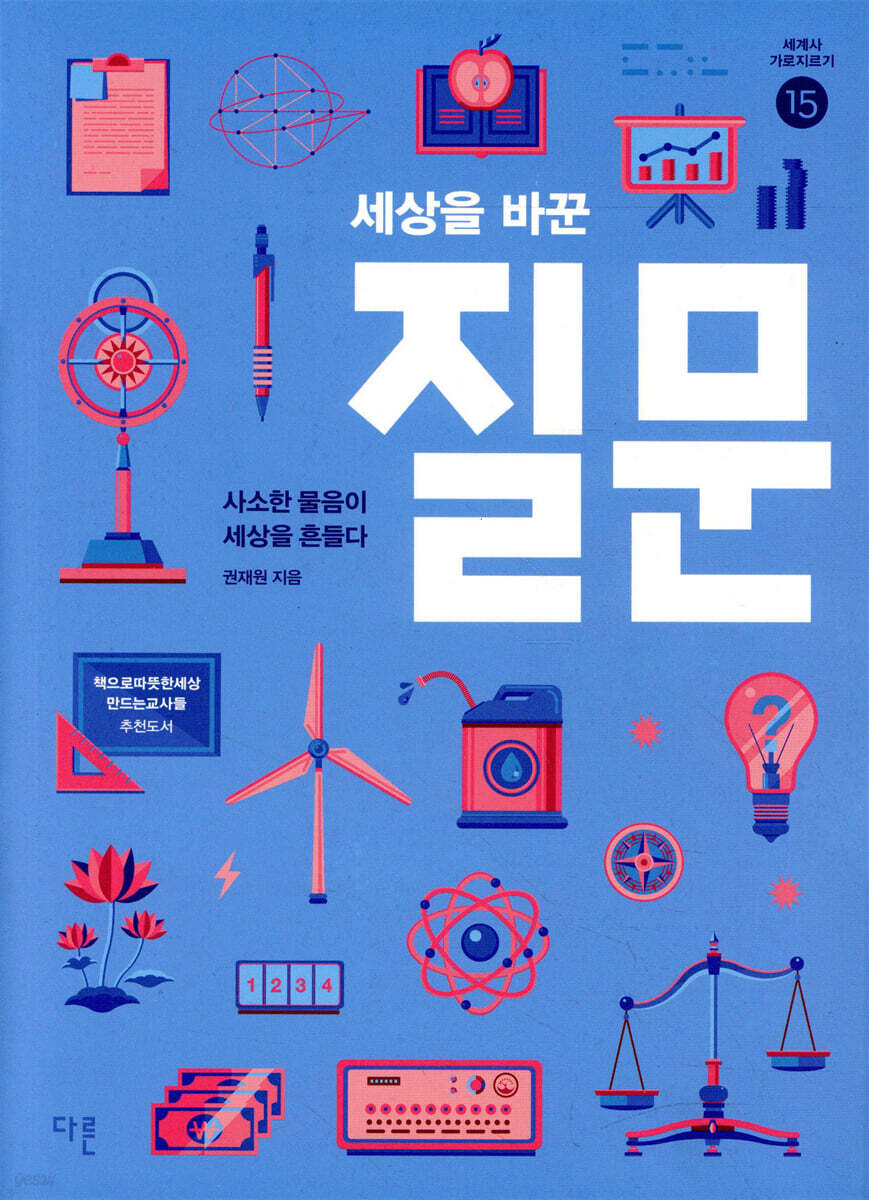
The question that changed the world
 |
Description
Book Introduction
Questions are the beginning of inquiry.
Curiosity leads to questions, and once a question arises, it becomes the beginning of a concern.
Questions are also evidence of communication.
Because a question is only complete when there is someone who asks it and someone who answers it.
And the question is another future.
Because when existing things cannot solve the current problem, humans ask questions.
Therefore, a society without questions has no future.
Such important 'questions' exert their power not only in personal history but also in the history of human civilization.
The history of human civilization is a history of questions.
There are countless examples of how a simple question, completely unaware of the person who asked it, completely changed the course of history.
Big questions serve as major turning points in human civilization.
The 15th theme of the 'Across World History' series, which aims to foster curiosity about history in young people and awaken their humanistic brains, is 'Question.'
"Questions That Changed the World" is a book written by Kwon Jae-won, an active middle school social studies teacher, who has quietly turned the world upside down by selecting seven questions in the history of human civilization, and contains information about what those questions were and how the world changed after each question was asked.
The author tells the story of the questions that served as major turning points in the era, along with the background from which they arose.
And to answer the question, we follow the historical footsteps of what humanity, especially intellectuals, did and what they answered.
Curiosity leads to questions, and once a question arises, it becomes the beginning of a concern.
Questions are also evidence of communication.
Because a question is only complete when there is someone who asks it and someone who answers it.
And the question is another future.
Because when existing things cannot solve the current problem, humans ask questions.
Therefore, a society without questions has no future.
Such important 'questions' exert their power not only in personal history but also in the history of human civilization.
The history of human civilization is a history of questions.
There are countless examples of how a simple question, completely unaware of the person who asked it, completely changed the course of history.
Big questions serve as major turning points in human civilization.
The 15th theme of the 'Across World History' series, which aims to foster curiosity about history in young people and awaken their humanistic brains, is 'Question.'
"Questions That Changed the World" is a book written by Kwon Jae-won, an active middle school social studies teacher, who has quietly turned the world upside down by selecting seven questions in the history of human civilization, and contains information about what those questions were and how the world changed after each question was asked.
The author tells the story of the questions that served as major turning points in the era, along with the background from which they arose.
And to answer the question, we follow the historical footsteps of what humanity, especially intellectuals, did and what they answered.
- You can preview some of the book's contents.
Preview
index
Preface: Why Do Humans Ask Questions? 08
1. First question: What is the origin of all things?
The Ancient Greeks Asked About the Origin of All Things 14
Story Talk: Thales 20 Falling into a Puddle
Realistic China, Metaphysical Greece 22
China for technology, Greece for science 27
When Science Meets Technology 29
The Opium Wars: Science and Technology Overtake Technology 31
2 Second question: Why do you speak of profit, my king?
Mencius Opens the Great Gate of Royal Politics, Part 40
Story Talk: Song Dynasty Yanggong's Seal 45
The will of the people is the will of heaven 46
Western and Eastern monarchies are different 51
The Question That Ruled Two Thousand Years and Its Shadow 57
60 Questions of Mencius That Still Relevant After Jeong Do-jeon
3. Third Question: How can I be sure that what I know is true?
Modern Europeans Question the Certainty of Knowledge 64
Humanity, Questioning the First Principle 66
Descartes's Crackling Doubt 70
Mechanism and the Mathematical World 75
Story Talk: Lazy Genius Descartes 83
4. Fourth Question: As civilization advances, do humans become more excellent?
Rousseau 86, a fastball during the Age of Enlightenment
Return to Nature 94
Clash! Rousseau vs. Voltaire 98
Rousseau's Great Legacy 102
Story Talk: Kant, Who Forgot Time 109
Question 5: Why does poverty worsen even as society progresses?
Is a poor British worker better than an African king? 112
The first answer: Poverty is due to population growth. 116
Second answer: Poverty is due to exploitation by landlords. 119
Third answer: Let's tax all unearned income. 122
The Most Powerful Answer: Let's Change the Society That Reproduces Poverty 126
Poverty Can Be Cured by the Lord 135
Story Talk: Marx 138
Question 6: How easily can a human become a demon?
Auschwitz, the worst tragedy of human civilization 142
Mass murder 147, so rational and scientific
Why the most rational civilization became the most barbaric 154
Capitalism May Be a Giant Auschwitz 157
The Way Not to Become a Devil Lies in Art 162
Arendt and Adorno, After 164
Question 7: Is sustainable development possible?
Is sustainable development possible? 170
Dangers Threatening Human Civilization 172
Reaction to the Club of Rome 175
Has humanity truly overcome the limits of growth? 178
Another problem hindering growth: imbalance 181
Focus on Sustainability 183
Books to Read 191/Image Source 193/Curriculum Linkage 196
1. First question: What is the origin of all things?
The Ancient Greeks Asked About the Origin of All Things 14
Story Talk: Thales 20 Falling into a Puddle
Realistic China, Metaphysical Greece 22
China for technology, Greece for science 27
When Science Meets Technology 29
The Opium Wars: Science and Technology Overtake Technology 31
2 Second question: Why do you speak of profit, my king?
Mencius Opens the Great Gate of Royal Politics, Part 40
Story Talk: Song Dynasty Yanggong's Seal 45
The will of the people is the will of heaven 46
Western and Eastern monarchies are different 51
The Question That Ruled Two Thousand Years and Its Shadow 57
60 Questions of Mencius That Still Relevant After Jeong Do-jeon
3. Third Question: How can I be sure that what I know is true?
Modern Europeans Question the Certainty of Knowledge 64
Humanity, Questioning the First Principle 66
Descartes's Crackling Doubt 70
Mechanism and the Mathematical World 75
Story Talk: Lazy Genius Descartes 83
4. Fourth Question: As civilization advances, do humans become more excellent?
Rousseau 86, a fastball during the Age of Enlightenment
Return to Nature 94
Clash! Rousseau vs. Voltaire 98
Rousseau's Great Legacy 102
Story Talk: Kant, Who Forgot Time 109
Question 5: Why does poverty worsen even as society progresses?
Is a poor British worker better than an African king? 112
The first answer: Poverty is due to population growth. 116
Second answer: Poverty is due to exploitation by landlords. 119
Third answer: Let's tax all unearned income. 122
The Most Powerful Answer: Let's Change the Society That Reproduces Poverty 126
Poverty Can Be Cured by the Lord 135
Story Talk: Marx 138
Question 6: How easily can a human become a demon?
Auschwitz, the worst tragedy of human civilization 142
Mass murder 147, so rational and scientific
Why the most rational civilization became the most barbaric 154
Capitalism May Be a Giant Auschwitz 157
The Way Not to Become a Devil Lies in Art 162
Arendt and Adorno, After 164
Question 7: Is sustainable development possible?
Is sustainable development possible? 170
Dangers Threatening Human Civilization 172
Reaction to the Club of Rome 175
Has humanity truly overcome the limits of growth? 178
Another problem hindering growth: imbalance 181
Focus on Sustainability 183
Books to Read 191/Image Source 193/Curriculum Linkage 196
Publisher's Review
The history before and after the question is different.
The more questions people ask, the more they think, and the more they think, the more they come up with new ideas.
History, it is questions and answers.
A quiet Republic of Korea where questions disappear
“The professor begins to write quietly on the blackboard.
Any questions? Of course not.
All students have to do is copy down what is written on the board and listen to the professor's explanations throughout class.”
In 2011, a certain newspaper published a feature article titled “A Classroom Where Questions Have Disappeared.”
The article's point is that questions have disappeared from classrooms in our country, from elementary school to university.
It is quite different from English-speaking children who “have a class like a conversation between about twenty children” and “ask questions without hesitation even with their mouths full of cola and hamburgers.”
This was Korean society in 2011.
But what about us in 2015? Korean society seems to have barely changed.
Rather, not only students in the classroom, but also adults in our society do not ask questions about politics, economics, society, and culture.
The incidents that make headlines every day are unprecedentedly serious and major accidents, yet the public remains unquestioning.
Since no questions are raised, naturally no questions are asked, and so it disappears from the people's minds like flowing water.
No one asks “Why?” or “How?”
Questions are the beginning of inquiry.
Curiosity leads to questions, and once a question arises, it becomes the beginning of a concern.
Questions are also evidence of communication.
Because a question is only complete when there is someone who asks it and someone who answers it.
And the question is another future.
Because when existing things cannot solve the current problem, humans ask questions.
Therefore, a society without questions has no future.
Such important 'questions' exert their power not only in personal history but also in the history of human civilization.
The history of human civilization is a history of questions.
There are countless examples of how a simple question, completely unaware of the person who asked it, completely changed the course of history.
Big questions serve as major turning points in human civilization.
The 15th theme of the 'Across World History' series, which aims to foster curiosity about history in young people and awaken their humanistic brains, is 'Question.'
Author Kwon Jae-won, who is actively engaged in educational activities as a middle school social studies teacher, has selected seven questions that have quietly turned the world upside down in the history of human civilization.
The book "Questions That Changed the World" contains information about what those questions were and how the world changed after each question was asked.
In "Questions That Changed the World," we explore the questions that played a major role in the turning points of our time, along with the backgrounds that led to their emergence.
And to answer the question, we follow the historical footsteps of what humanity, especially intellectuals, did and what they answered.
What's interesting here is that the questions presented in "Questions That Changed the World" are still relevant today.
Many philosophers, thinkers, and scientists are still searching for an answer to this question.
Of course, this means that readers of this book also have the opportunity to answer.
In that sense, the author does not provide an answer to the question.
Answers to the questions presented here have been intentionally omitted.
Because it becomes a meaningful question only when we find the answer ourselves in the process of living.
_ From the preface
What on earth has humanity been wondering about? When I think about it, it's truly fascinating.
From this question, “The Question That Changed the World” began.
The ancient Greek question: "What is the origin of all things?"
The first people to ask this question were the Greeks thousands of years ago.
No one in any part of the world has ever asked such a question.
Everyone was following the creation myth, so they had no interest in what God used to create the world.
As a result, natural philosophy became popular in Greece, and natural philosophers laid the foundations of science in Western civilization.
The foundations of mathematics, chemistry, and physics were laid by Thales, Pythagoras, Empedocles, and Democritus.
Later, Western civilization overtook Chinese civilization, which developed technology based on materialism.
The questions of the ancient Greeks, who sought the essence beyond reality rather than reality, became a tremendous reality thousands of years later through technology.
The ancient Chinese question: "Why does Your Majesty speak of profit?"
2,500 years ago, China was in the Warring States Period.
Mencius, who was wandering around looking for a king who would promote him, met King Hui of Wei.
King Hye asks.
“A teacher known for his wisdom has come a long way to visit me. Is there any way he can benefit my country?” he asks.
Instead of answering this, Mencius responds with a question.
This is the question above.
From this, the Eastern idea of royal politics was born, which states that “the will of the people is the will of heaven” and that the king must be benevolent and righteous.
Why does this question have so much power?
Because it is a warning to the king to look after the interests of the people, not his own.
The 'benevolence' that Mencius spoke of means caring for the people, taking into account their lives, and governing fairly in all matters.
Mencius' question is still valid for politicians in our country today.
The question of modern Europe: "How can I be sure that what I know is true?"
About 400 years ago, Europe experienced a great change called the Renaissance.
During this period, as navigation and printing technology developed, people learned many new things.
As a result, questions also increased.
As we learn more, it becomes more difficult to discern what is true knowledge.
French philosopher and mathematician René Descartes succeeded in laying a solid foundation for the modern view of knowledge by providing the clearest answer to this question.
Descartes, who answered the above question with “I doubt, therefore I must be certain that I exist,” can be called the father of modernity.
The Enlightenment Question: "As civilization advances, do humans become more excellent?"
During the Enlightenment, a magazine called the French Mercury issued a contest for essays addressing the above question.
When Rousseau learned of this contest, he said, “No.
The answer is, “In the state of nature, humans had virtue, but as so-called civilization developed, they became more and more corrupt.”
Rousseau's ideas, which began in this way, became the foundation for the French Revolution and the source of the democratic republic.
His ideas became the source of progressive educational theory and the starting point of Romantic art.
And above all, it liberated human emotions and instincts that had been suppressed in the midst of nobility.
The question of the poor and working class: "Why does poverty worsen even as society progresses?"
Britain, where the Industrial Revolution was most advanced in the world.
But British workers were living miserable lives.
Britain became the richest country in the world during the 18th and 19th centuries, with its production increasing dozens of times, but its farmers lost their land and became homeless or working in coal mines.
Workers had to live in harsh conditions, working 12 hours a day and with an average life expectancy in the early 20s.
At this time, the above question was raised everywhere.
Thomas Malthus, David Ricardo, Henry George, and Karl Marx have representatively answered this question.
The answers given at that time were later put into practice in countries around the world.
And that is how the world we know today was born.
The Auschwitz Question: "How Easily Can a Man Become a Demon?"
When the Nazi war crimes trials in Germany began, humanity was shocked by the fact that the people tried were so ordinary.
It was a moment when I saw with my own eyes that the most heinous crime and massacre in human history was not committed by evil murderers, but by the hands of very ordinary people.
This brought about far greater fear than the fact that the massacre was carried out by Nazi murderers.
Even an ordinary, normal person can easily become a devil under certain conditions.
At this time, philosopher Hannah Arendt asked the above question.
And she asserted, “If we do not have the ability to reflect and imagine at every moment, we are all potential Nazis.”
Afterwards, psychologists such as Milgram and Zimbardo conducted research on humans, and Max Horkheimer and Theodor Adorno delved into this issue.
And it presented a surprising and shocking view that “the Auschwitz massacre was not a barbaric event that went beyond civilization, but rather the result of Western modern civilization based on reason and science.”
The Question of Human Civilization: "Is Sustainable Development Possible?"
In 1972, the Club of Rome, an organization formed by former heads of state from around the world, published a book titled “The Limits to Growth.”
The content of this book is that humanity cannot grow infinitely and that it will eventually reach a limit to its growth.
The problem, however, is that the limit is imminent.
The above question was raised with the warning that human civilization or the Earth is in danger of population explosion, environmental pollution, resource depletion, and food shortage.
Of course, the answer to that is “no.”
Meanwhile, around the same time, German economist Ernst Schumacher published a book titled Small is Beautiful, in which he established the concept of "sustainable growth" and criticized human civilization for being based on the false belief that "bigger is better."
Schumacher proposes a village economy and a reasonable level of technology.
Meanwhile, Jeremy Rifkin calls it the Third Industrial Revolution, emphasizing sustainable growth and mid-sized technologies and economies.
The Third Industrial Revolution signifies a shift from an industrial society focused solely on quantitative expansion to a new economic paradigm centered on resource conservation and reduction of side effects, i.e., sustainability.
Few people in positions of authority and responsibility today advocate reckless growth.
If it weren't for the questions and answers of the Club of Rome, Schumacher, and Rifkin, we might be living on a planet littered with garbage and depleted of resources.
▣ A New Perspective on Humanity and Civilization: The "Across World History" Series
This series was designed to show, through accessible narratives from experts in each field, that the objects and ideas we commonly encounter around us are actually important elements that make up human civilization.
We hope that readers will gain a new perspective on the world through the Crossing series, which focuses on 'what, how, and why' rather than the traditional world history learning method of memorizing the names of trees while telling readers to look at the forest.
Following "Questions That Changed the World," the story unfolds about how chemistry, architecture, art, cities, and seeds changed the world.
The more questions people ask, the more they think, and the more they think, the more they come up with new ideas.
History, it is questions and answers.
A quiet Republic of Korea where questions disappear
“The professor begins to write quietly on the blackboard.
Any questions? Of course not.
All students have to do is copy down what is written on the board and listen to the professor's explanations throughout class.”
In 2011, a certain newspaper published a feature article titled “A Classroom Where Questions Have Disappeared.”
The article's point is that questions have disappeared from classrooms in our country, from elementary school to university.
It is quite different from English-speaking children who “have a class like a conversation between about twenty children” and “ask questions without hesitation even with their mouths full of cola and hamburgers.”
This was Korean society in 2011.
But what about us in 2015? Korean society seems to have barely changed.
Rather, not only students in the classroom, but also adults in our society do not ask questions about politics, economics, society, and culture.
The incidents that make headlines every day are unprecedentedly serious and major accidents, yet the public remains unquestioning.
Since no questions are raised, naturally no questions are asked, and so it disappears from the people's minds like flowing water.
No one asks “Why?” or “How?”
Questions are the beginning of inquiry.
Curiosity leads to questions, and once a question arises, it becomes the beginning of a concern.
Questions are also evidence of communication.
Because a question is only complete when there is someone who asks it and someone who answers it.
And the question is another future.
Because when existing things cannot solve the current problem, humans ask questions.
Therefore, a society without questions has no future.
Such important 'questions' exert their power not only in personal history but also in the history of human civilization.
The history of human civilization is a history of questions.
There are countless examples of how a simple question, completely unaware of the person who asked it, completely changed the course of history.
Big questions serve as major turning points in human civilization.
The 15th theme of the 'Across World History' series, which aims to foster curiosity about history in young people and awaken their humanistic brains, is 'Question.'
Author Kwon Jae-won, who is actively engaged in educational activities as a middle school social studies teacher, has selected seven questions that have quietly turned the world upside down in the history of human civilization.
The book "Questions That Changed the World" contains information about what those questions were and how the world changed after each question was asked.
In "Questions That Changed the World," we explore the questions that played a major role in the turning points of our time, along with the backgrounds that led to their emergence.
And to answer the question, we follow the historical footsteps of what humanity, especially intellectuals, did and what they answered.
What's interesting here is that the questions presented in "Questions That Changed the World" are still relevant today.
Many philosophers, thinkers, and scientists are still searching for an answer to this question.
Of course, this means that readers of this book also have the opportunity to answer.
In that sense, the author does not provide an answer to the question.
Answers to the questions presented here have been intentionally omitted.
Because it becomes a meaningful question only when we find the answer ourselves in the process of living.
_ From the preface
What on earth has humanity been wondering about? When I think about it, it's truly fascinating.
From this question, “The Question That Changed the World” began.
The ancient Greek question: "What is the origin of all things?"
The first people to ask this question were the Greeks thousands of years ago.
No one in any part of the world has ever asked such a question.
Everyone was following the creation myth, so they had no interest in what God used to create the world.
As a result, natural philosophy became popular in Greece, and natural philosophers laid the foundations of science in Western civilization.
The foundations of mathematics, chemistry, and physics were laid by Thales, Pythagoras, Empedocles, and Democritus.
Later, Western civilization overtook Chinese civilization, which developed technology based on materialism.
The questions of the ancient Greeks, who sought the essence beyond reality rather than reality, became a tremendous reality thousands of years later through technology.
The ancient Chinese question: "Why does Your Majesty speak of profit?"
2,500 years ago, China was in the Warring States Period.
Mencius, who was wandering around looking for a king who would promote him, met King Hui of Wei.
King Hye asks.
“A teacher known for his wisdom has come a long way to visit me. Is there any way he can benefit my country?” he asks.
Instead of answering this, Mencius responds with a question.
This is the question above.
From this, the Eastern idea of royal politics was born, which states that “the will of the people is the will of heaven” and that the king must be benevolent and righteous.
Why does this question have so much power?
Because it is a warning to the king to look after the interests of the people, not his own.
The 'benevolence' that Mencius spoke of means caring for the people, taking into account their lives, and governing fairly in all matters.
Mencius' question is still valid for politicians in our country today.
The question of modern Europe: "How can I be sure that what I know is true?"
About 400 years ago, Europe experienced a great change called the Renaissance.
During this period, as navigation and printing technology developed, people learned many new things.
As a result, questions also increased.
As we learn more, it becomes more difficult to discern what is true knowledge.
French philosopher and mathematician René Descartes succeeded in laying a solid foundation for the modern view of knowledge by providing the clearest answer to this question.
Descartes, who answered the above question with “I doubt, therefore I must be certain that I exist,” can be called the father of modernity.
The Enlightenment Question: "As civilization advances, do humans become more excellent?"
During the Enlightenment, a magazine called the French Mercury issued a contest for essays addressing the above question.
When Rousseau learned of this contest, he said, “No.
The answer is, “In the state of nature, humans had virtue, but as so-called civilization developed, they became more and more corrupt.”
Rousseau's ideas, which began in this way, became the foundation for the French Revolution and the source of the democratic republic.
His ideas became the source of progressive educational theory and the starting point of Romantic art.
And above all, it liberated human emotions and instincts that had been suppressed in the midst of nobility.
The question of the poor and working class: "Why does poverty worsen even as society progresses?"
Britain, where the Industrial Revolution was most advanced in the world.
But British workers were living miserable lives.
Britain became the richest country in the world during the 18th and 19th centuries, with its production increasing dozens of times, but its farmers lost their land and became homeless or working in coal mines.
Workers had to live in harsh conditions, working 12 hours a day and with an average life expectancy in the early 20s.
At this time, the above question was raised everywhere.
Thomas Malthus, David Ricardo, Henry George, and Karl Marx have representatively answered this question.
The answers given at that time were later put into practice in countries around the world.
And that is how the world we know today was born.
The Auschwitz Question: "How Easily Can a Man Become a Demon?"
When the Nazi war crimes trials in Germany began, humanity was shocked by the fact that the people tried were so ordinary.
It was a moment when I saw with my own eyes that the most heinous crime and massacre in human history was not committed by evil murderers, but by the hands of very ordinary people.
This brought about far greater fear than the fact that the massacre was carried out by Nazi murderers.
Even an ordinary, normal person can easily become a devil under certain conditions.
At this time, philosopher Hannah Arendt asked the above question.
And she asserted, “If we do not have the ability to reflect and imagine at every moment, we are all potential Nazis.”
Afterwards, psychologists such as Milgram and Zimbardo conducted research on humans, and Max Horkheimer and Theodor Adorno delved into this issue.
And it presented a surprising and shocking view that “the Auschwitz massacre was not a barbaric event that went beyond civilization, but rather the result of Western modern civilization based on reason and science.”
The Question of Human Civilization: "Is Sustainable Development Possible?"
In 1972, the Club of Rome, an organization formed by former heads of state from around the world, published a book titled “The Limits to Growth.”
The content of this book is that humanity cannot grow infinitely and that it will eventually reach a limit to its growth.
The problem, however, is that the limit is imminent.
The above question was raised with the warning that human civilization or the Earth is in danger of population explosion, environmental pollution, resource depletion, and food shortage.
Of course, the answer to that is “no.”
Meanwhile, around the same time, German economist Ernst Schumacher published a book titled Small is Beautiful, in which he established the concept of "sustainable growth" and criticized human civilization for being based on the false belief that "bigger is better."
Schumacher proposes a village economy and a reasonable level of technology.
Meanwhile, Jeremy Rifkin calls it the Third Industrial Revolution, emphasizing sustainable growth and mid-sized technologies and economies.
The Third Industrial Revolution signifies a shift from an industrial society focused solely on quantitative expansion to a new economic paradigm centered on resource conservation and reduction of side effects, i.e., sustainability.
Few people in positions of authority and responsibility today advocate reckless growth.
If it weren't for the questions and answers of the Club of Rome, Schumacher, and Rifkin, we might be living on a planet littered with garbage and depleted of resources.
▣ A New Perspective on Humanity and Civilization: The "Across World History" Series
This series was designed to show, through accessible narratives from experts in each field, that the objects and ideas we commonly encounter around us are actually important elements that make up human civilization.
We hope that readers will gain a new perspective on the world through the Crossing series, which focuses on 'what, how, and why' rather than the traditional world history learning method of memorizing the names of trees while telling readers to look at the forest.
Following "Questions That Changed the World," the story unfolds about how chemistry, architecture, art, cities, and seeds changed the world.
GOODS SPECIFICS
- Date of issue: September 14, 2015
- Page count, weight, size: 200 pages | 290g | 152*210*14mm
- ISBN13: 9791156330509
- ISBN10: 1156330505
You may also like
카테고리
korean


korean

![GQ KOREA Mark (Monthly): December [2025]](http://librairie.coreenne.fr/cdn/shop/files/8ef265dbbfbf186523ed75ba7319009d.jpg?v=1765340328&width=3840)


