

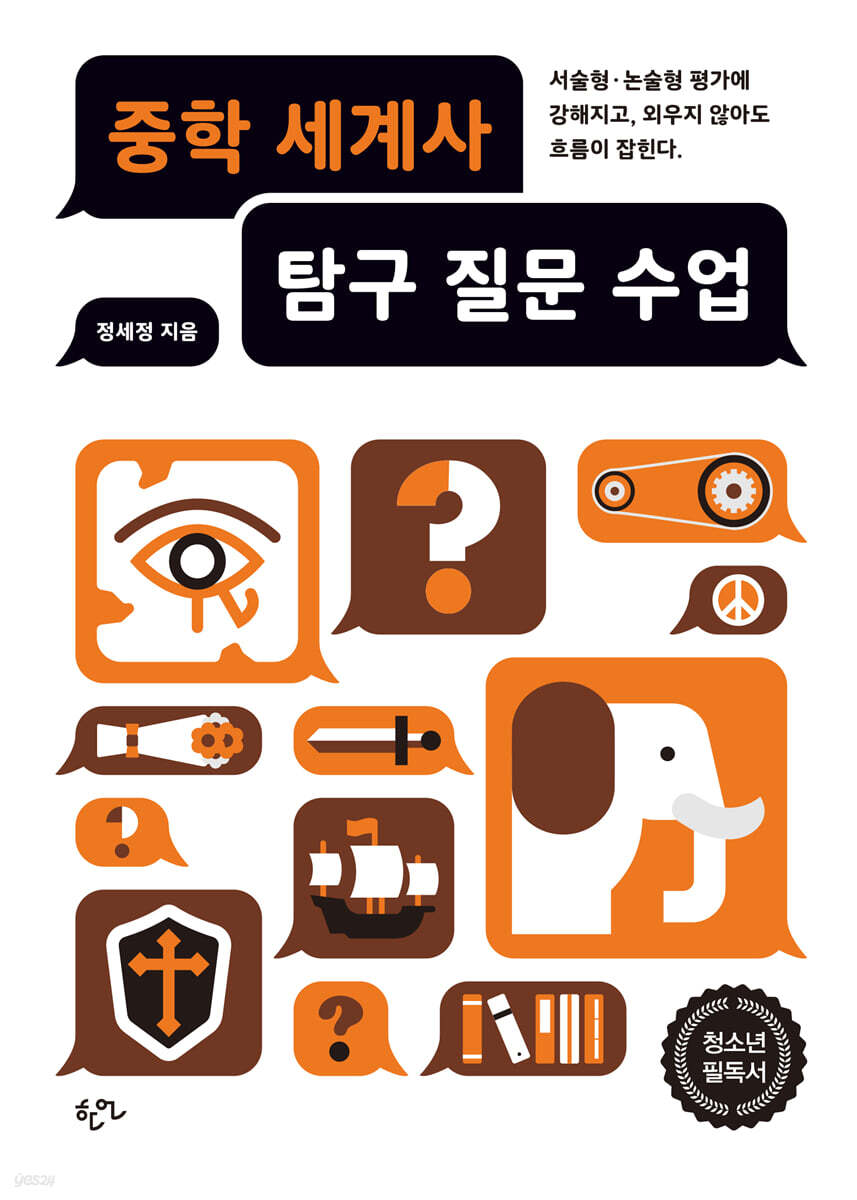
Middle School World History Inquiry Questions Class
 |
Description
Book Introduction
World history—why is it so difficult? There's so much to memorize, but the flow is unclear, and events seem disconnected.
The 2022 revised curriculum emphasizes "questioning, exploring, and reflective classes" to address this issue.
The idea is to change world history from a 'subject to be memorized' to a 'subject to be understood through questions.'
"Middle School World History Inquiry Class" is the book that marks the starting point of that change.
The moment we ask questions like, “Why did they make that choice?” or “What would have happened if they had chosen a different path?” world history instantly becomes a living story.
Students naturally develop historical literacy, critical thinking, and data interpretation skills through the process of asking questions, reading, comparing, and interpreting data like historians.
Even complex events can be understood by connecting them with the question "why," and descriptive and argumentative assessments become much easier to approach.
This book contains a framework of inquiry questions that can be used immediately in the classroom, a lesson structure that organizes each unit around questions, and the author's practical experience in running numerous reading-discussion-based and inquiry-based classes.
World history is not a list of the past, but a window that allows us to understand today and imagine tomorrow.
This book will be the key to opening that window.
The 2022 revised curriculum emphasizes "questioning, exploring, and reflective classes" to address this issue.
The idea is to change world history from a 'subject to be memorized' to a 'subject to be understood through questions.'
"Middle School World History Inquiry Class" is the book that marks the starting point of that change.
The moment we ask questions like, “Why did they make that choice?” or “What would have happened if they had chosen a different path?” world history instantly becomes a living story.
Students naturally develop historical literacy, critical thinking, and data interpretation skills through the process of asking questions, reading, comparing, and interpreting data like historians.
Even complex events can be understood by connecting them with the question "why," and descriptive and argumentative assessments become much easier to approach.
This book contains a framework of inquiry questions that can be used immediately in the classroom, a lesson structure that organizes each unit around questions, and the author's practical experience in running numerous reading-discussion-based and inquiry-based classes.
World history is not a list of the past, but a window that allows us to understand today and imagine tomorrow.
This book will be the key to opening that window.
- You can preview some of the book's contents.
Preview
index
Entering
Part 1.
Why Did I Make That Choice? - Moments of Choice That Changed My Fate
Chapter 1.
Why did Hannibal lead elephants across the Alps?
Chapter 2.
Why did Luther challenge the Pope?
Chapter 3.
Why did the Ming Dynasty's Zheng He stop sailing?
Chapter 4.
Why did the Crusaders try to reclaim the Holy Land?
Part 2.
Was History Really Like That? - Questions That Challenge Conventional Beliefs
Chapter 5.
Was Rome really a 'symbol of civilization'?
Chapter 6.
Was medieval Europe really a dark age?
Chapter 7.
Are the Mongols invaders or connectors?
Chapter 8.
Was the Industrial Revolution 'progressive' for everyone?
Chapter 9.
Was the Age of Exploration the discovery of a new world or the beginning of plunder?
Chapter 10.
Did imperialism give 'modernization' to its colonies?
Part 3.
Whose Memory? - Exhibitions, Museums, and Historical Interpretation
Chapter 11.
How is the Holocaust displayed and remembered?
Chapter 12.
Why didn't France talk about the Algerian War for so long?
Chapter 13.
How does Japan deal with historical issues?
Chapter 14.
Whose Egyptian artifacts do the British Museum have?
Part 4.
How to Reconcile: A New Horizon for History
Chapter 15.
Why did the UN send peacekeepers to countries where war had ended?
Chapter 16.
Why did South Africa establish a Truth and Reconciliation Commission?
Chapter 17.
How did Germany and France come to create a joint history textbook?
Chapter 18.
Why did artist Banksy leave a message of peace on a war zone?
In conclusion
Part 1.
Why Did I Make That Choice? - Moments of Choice That Changed My Fate
Chapter 1.
Why did Hannibal lead elephants across the Alps?
Chapter 2.
Why did Luther challenge the Pope?
Chapter 3.
Why did the Ming Dynasty's Zheng He stop sailing?
Chapter 4.
Why did the Crusaders try to reclaim the Holy Land?
Part 2.
Was History Really Like That? - Questions That Challenge Conventional Beliefs
Chapter 5.
Was Rome really a 'symbol of civilization'?
Chapter 6.
Was medieval Europe really a dark age?
Chapter 7.
Are the Mongols invaders or connectors?
Chapter 8.
Was the Industrial Revolution 'progressive' for everyone?
Chapter 9.
Was the Age of Exploration the discovery of a new world or the beginning of plunder?
Chapter 10.
Did imperialism give 'modernization' to its colonies?
Part 3.
Whose Memory? - Exhibitions, Museums, and Historical Interpretation
Chapter 11.
How is the Holocaust displayed and remembered?
Chapter 12.
Why didn't France talk about the Algerian War for so long?
Chapter 13.
How does Japan deal with historical issues?
Chapter 14.
Whose Egyptian artifacts do the British Museum have?
Part 4.
How to Reconcile: A New Horizon for History
Chapter 15.
Why did the UN send peacekeepers to countries where war had ended?
Chapter 16.
Why did South Africa establish a Truth and Reconciliation Commission?
Chapter 17.
How did Germany and France come to create a joint history textbook?
Chapter 18.
Why did artist Banksy leave a message of peace on a war zone?
In conclusion
Into the book
History is made up of countless stories.
But at the center of those stories is always ‘decision.’
Some started wars, some went out to the great seas, and still others fought against the great powers that surrounded them.
But why did they make such a choice? Was it mere coincidence? Why did Hannibal lead a massive elephant across the Alps? Why did Zheng He stop his endless voyage? Why did Luther issue a challenge to the Pope?
--- From the text "Part 1"
The Pope's cry was not a mere slogan.
It was a declaration that 'it is God's will to reclaim Jerusalem.'
Medieval Europeans firmly believed that God's will must be followed unconditionally.
So farmers, artisans, knights, nobles, and even children all came together under the name of the Crusades.
But was this war truly "God's will"? Or was there another reason behind it?
--- From Chapter 4 of the main text
"All roads lead to Rome." You've probably heard that saying before, right? The magnificent Colosseum, the well-maintained roads and sewerage system, and even the Latin language and legal system.
The Roman Empire is often called the 'symbol of civilization'.
In Western history books, it is often emphasized as the 'root of Western civilization.'
But is this all there is? Behind this splendid civilization, hidden war and conquest, slavery and discrimination, and brutal power struggles.
Knowing this fact might change the way you look at Rome.
--- From Chapter 5 of the main text
People often say, “The Industrial Revolution developed the world” and “It opened the door to modern society.”
But was that really the case? Was the Industrial Revolution truly "progress" for everyone? Did factories truly make people happier? Today, we'll explore the dark shadows hidden behind the dazzling light of the Industrial Revolution.
Let's consider together how that change was a new opportunity for some, but a deep pain for others.
--- From Chapter 8 of the main text
Have you ever heard of the word "Holocaust"? It refers to the systematic murder of countless people by Nazi Germany during World War II, including Jews, Gypsies, people with disabilities, and political opponents.
It is known that over 6 million Jews lost their lives.
The atrocities committed in the concentration camps and gas chambers remain among the most tragic crimes in human history.
So how is this tragic past displayed and remembered today? This event isn't simply contained in history books; it lives on in museums and memorials around the world, as well as in films and educational programs.
But at the center of those stories is always ‘decision.’
Some started wars, some went out to the great seas, and still others fought against the great powers that surrounded them.
But why did they make such a choice? Was it mere coincidence? Why did Hannibal lead a massive elephant across the Alps? Why did Zheng He stop his endless voyage? Why did Luther issue a challenge to the Pope?
--- From the text "Part 1"
The Pope's cry was not a mere slogan.
It was a declaration that 'it is God's will to reclaim Jerusalem.'
Medieval Europeans firmly believed that God's will must be followed unconditionally.
So farmers, artisans, knights, nobles, and even children all came together under the name of the Crusades.
But was this war truly "God's will"? Or was there another reason behind it?
--- From Chapter 4 of the main text
"All roads lead to Rome." You've probably heard that saying before, right? The magnificent Colosseum, the well-maintained roads and sewerage system, and even the Latin language and legal system.
The Roman Empire is often called the 'symbol of civilization'.
In Western history books, it is often emphasized as the 'root of Western civilization.'
But is this all there is? Behind this splendid civilization, hidden war and conquest, slavery and discrimination, and brutal power struggles.
Knowing this fact might change the way you look at Rome.
--- From Chapter 5 of the main text
People often say, “The Industrial Revolution developed the world” and “It opened the door to modern society.”
But was that really the case? Was the Industrial Revolution truly "progress" for everyone? Did factories truly make people happier? Today, we'll explore the dark shadows hidden behind the dazzling light of the Industrial Revolution.
Let's consider together how that change was a new opportunity for some, but a deep pain for others.
--- From Chapter 8 of the main text
Have you ever heard of the word "Holocaust"? It refers to the systematic murder of countless people by Nazi Germany during World War II, including Jews, Gypsies, people with disabilities, and political opponents.
It is known that over 6 million Jews lost their lives.
The atrocities committed in the concentration camps and gas chambers remain among the most tragic crimes in human history.
So how is this tragic past displayed and remembered today? This event isn't simply contained in history books; it lives on in museums and memorials around the world, as well as in films and educational programs.
--- From Chapter 11 of the main text
Publisher's Review
In the new era of education, how can we cultivate "questioning students"?
As the 2022 revised curriculum is fully implemented, the central topic in the educational field is 'curriculum literacy.'
The new curriculum is not simply a change in content; it presents a new way of learning, one that is necessary in an era of increasing uncertainty and complexity.
Amidst unpredictable changes such as global pandemics, the rapid growth of artificial intelligence, and the climate crisis, the power of students to question, explore, and reflect on their own has become more important than ever.
The direction of 'questioning, exploration, and reflection' emphasized in this revision is ultimately to help students grow into learners who can expand their own thinking and solve problems.
Unraveling the core competencies of the new curriculum through "inquiry questions."
“Questions determine the direction of inquiry”—the power of asking, reading, and interpreting like a historian.
"Middle School World History Inquiry Class" demonstrates specifically how the spirit of this curriculum can be put into practice in world history classes.
The reason why world history feels difficult is not simply because there is so much to learn, but because students are unable to structure the 'reasons', 'context', and 'flow' of events on their own.
This book helps to naturally resolve these difficulties by reconstructing world history as a question-centered, inquiry-based class.
"Why did they make those choices?" "How would the world be different if they had made different choices?" Lessons centered around these questions help students grow beyond mere recipients of knowledge into mini-historians who analyze sources, compare evidence, and interpret context.
Checking sources, comparing perspectives, and understanding context naturally lead beyond history classes to the digital literacy and critical thinking skills essential today.
View world history as a 'field of selection and interpretation'!
This book views world history not as a list of past events, but as a series of choices and interpretations, and as a field of inquiry that connects memory and the future.
◆Part 1.
Context - History's decisions are made for a reason!
It emphasizes that historical choices are made within the context of historical conditions and social background, and helps students understand why things happened that way.
◆ Part 2.
Interpretation - One History, Many Truths
It shows that the same event can be interpreted very differently depending on the evidence and perspective.
Understanding the diversity of interpretations is central to historical literacy.
◆ Part 3.
Memory - For whom is history remembered, and how?
It allows us to reflect on the meaning of how historical events are remembered and commemorated in today's society, and to think about how to connect the past and present.
◆ Part 4.
The Future - Can We Move Toward Reconciliation and Coexistence?
In a world history of war and conflict, we explore the values that today's students must consider: the meaning of reconciliation, coexistence, and peace.
“History is not a window into the past, but a window into the future.”
The world history this book guides is not a simple memorization, but a world history that questions and interprets.
Reading and interpreting like a historian is not about accepting the past as is, but rather about looking back at the past with present questions and imagining future possibilities within it.
"Middle School World History Inquiry Questions" is a practical guide that helps teachers design lessons centered on inquiry questions, and presents a learning model that encourages students to think, interpret, and grow independently.
The experience of exploring the issues of conflict and coexistence in history naturally leads to the civic competencies demanded by future society: critical thinking, empathy, a sensitivity to coexistence, and the ability to judge information.
This book will serve as a guide for middle school students learning world history for the first time, as well as for teachers contemplating classroom innovation and parents seeking to understand the direction of education in the new era, asking the fundamental question, "What should learning for the future be?"
As the 2022 revised curriculum is fully implemented, the central topic in the educational field is 'curriculum literacy.'
The new curriculum is not simply a change in content; it presents a new way of learning, one that is necessary in an era of increasing uncertainty and complexity.
Amidst unpredictable changes such as global pandemics, the rapid growth of artificial intelligence, and the climate crisis, the power of students to question, explore, and reflect on their own has become more important than ever.
The direction of 'questioning, exploration, and reflection' emphasized in this revision is ultimately to help students grow into learners who can expand their own thinking and solve problems.
Unraveling the core competencies of the new curriculum through "inquiry questions."
“Questions determine the direction of inquiry”—the power of asking, reading, and interpreting like a historian.
"Middle School World History Inquiry Class" demonstrates specifically how the spirit of this curriculum can be put into practice in world history classes.
The reason why world history feels difficult is not simply because there is so much to learn, but because students are unable to structure the 'reasons', 'context', and 'flow' of events on their own.
This book helps to naturally resolve these difficulties by reconstructing world history as a question-centered, inquiry-based class.
"Why did they make those choices?" "How would the world be different if they had made different choices?" Lessons centered around these questions help students grow beyond mere recipients of knowledge into mini-historians who analyze sources, compare evidence, and interpret context.
Checking sources, comparing perspectives, and understanding context naturally lead beyond history classes to the digital literacy and critical thinking skills essential today.
View world history as a 'field of selection and interpretation'!
This book views world history not as a list of past events, but as a series of choices and interpretations, and as a field of inquiry that connects memory and the future.
◆Part 1.
Context - History's decisions are made for a reason!
It emphasizes that historical choices are made within the context of historical conditions and social background, and helps students understand why things happened that way.
◆ Part 2.
Interpretation - One History, Many Truths
It shows that the same event can be interpreted very differently depending on the evidence and perspective.
Understanding the diversity of interpretations is central to historical literacy.
◆ Part 3.
Memory - For whom is history remembered, and how?
It allows us to reflect on the meaning of how historical events are remembered and commemorated in today's society, and to think about how to connect the past and present.
◆ Part 4.
The Future - Can We Move Toward Reconciliation and Coexistence?
In a world history of war and conflict, we explore the values that today's students must consider: the meaning of reconciliation, coexistence, and peace.
“History is not a window into the past, but a window into the future.”
The world history this book guides is not a simple memorization, but a world history that questions and interprets.
Reading and interpreting like a historian is not about accepting the past as is, but rather about looking back at the past with present questions and imagining future possibilities within it.
"Middle School World History Inquiry Questions" is a practical guide that helps teachers design lessons centered on inquiry questions, and presents a learning model that encourages students to think, interpret, and grow independently.
The experience of exploring the issues of conflict and coexistence in history naturally leads to the civic competencies demanded by future society: critical thinking, empathy, a sensitivity to coexistence, and the ability to judge information.
This book will serve as a guide for middle school students learning world history for the first time, as well as for teachers contemplating classroom innovation and parents seeking to understand the direction of education in the new era, asking the fundamental question, "What should learning for the future be?"
〔Curriculum Linkage〕
[Social Studies] Unit 4, 1st Semester, 1st Grade, Middle School: Diverse Worlds, Diverse Cultures
Unit 6, International Society and International Politics, 2nd Semester, 1st Grade, Middle School
[History ①] Unit 1, 1st semester, 2nd year of middle school: The emergence of civilization and the formation of the ancient world
Unit 3, 1st semester, 2nd grade, middle school: Exchange and change in the local world
Unit 4, Second Semester, Second Grade, Middle School: Imperialist Invasion and the Movement to Build a Nation
Unit 5, Second Semester, Second Grade, Middle School: World War I and Social Change
[History ②] Unit 3, 1st Semester, 3rd Grade, Middle School: The Establishment and Transformation of Goryeo (Curriculum Linked)
[Social Studies] Unit 4, 1st Semester, 1st Grade, Middle School: Diverse Worlds, Diverse Cultures
Unit 6, International Society and International Politics, 2nd Semester, 1st Grade, Middle School
[History ①] Unit 1, 1st semester, 2nd year of middle school: The emergence of civilization and the formation of the ancient world
Unit 3, 1st semester, 2nd grade, middle school: Exchange and change in the local world
Unit 4, Second Semester, Second Grade, Middle School: Imperialist Invasion and the Movement to Build a Nation
Unit 5, Second Semester, Second Grade, Middle School: World War I and Social Change
[History ②] Unit 3, 1st semester, 3rd year of middle school: The Establishment and Transformation of Goryeo
[Social Studies] Unit 4, 1st Semester, 1st Grade, Middle School: Diverse Worlds, Diverse Cultures
Unit 6, International Society and International Politics, 2nd Semester, 1st Grade, Middle School
[History ①] Unit 1, 1st semester, 2nd year of middle school: The emergence of civilization and the formation of the ancient world
Unit 3, 1st semester, 2nd grade, middle school: Exchange and change in the local world
Unit 4, Second Semester, Second Grade, Middle School: Imperialist Invasion and the Movement to Build a Nation
Unit 5, Second Semester, Second Grade, Middle School: World War I and Social Change
[History ②] Unit 3, 1st Semester, 3rd Grade, Middle School: The Establishment and Transformation of Goryeo (Curriculum Linked)
[Social Studies] Unit 4, 1st Semester, 1st Grade, Middle School: Diverse Worlds, Diverse Cultures
Unit 6, International Society and International Politics, 2nd Semester, 1st Grade, Middle School
[History ①] Unit 1, 1st semester, 2nd year of middle school: The emergence of civilization and the formation of the ancient world
Unit 3, 1st semester, 2nd grade, middle school: Exchange and change in the local world
Unit 4, Second Semester, Second Grade, Middle School: Imperialist Invasion and the Movement to Build a Nation
Unit 5, Second Semester, Second Grade, Middle School: World War I and Social Change
[History ②] Unit 3, 1st semester, 3rd year of middle school: The Establishment and Transformation of Goryeo
GOODS SPECIFICS
- Date of issue: November 20, 2025
- Page count, weight, size: 264 pages | 150*210*20mm
- ISBN13: 9788955968736
- ISBN10: 8955968736
You may also like
카테고리
korean


korean

![GQ KOREA Mark (Monthly): December [2025]](http://librairie.coreenne.fr/cdn/shop/files/8ef265dbbfbf186523ed75ba7319009d.jpg?v=1765340328&width=3840)


