

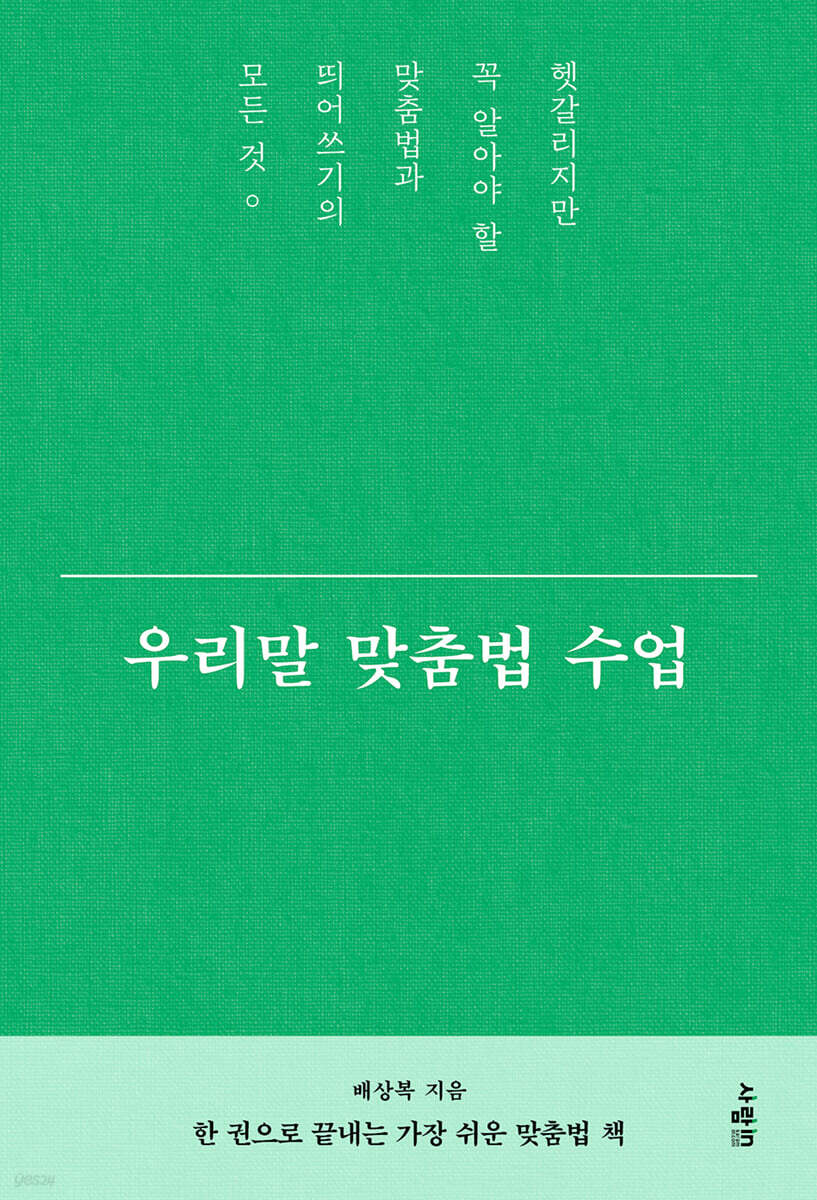
Korean spelling class
 |
Description
Book Introduction
Reporter Bae Sang-bok, a Korean language expert, reports
The easiest spelling book to finish in one volume
Hangul is easy, but our language is truly difficult.
Because spelling and spacing are secretly tricky and confusing.
Couldn't spelling, the foundation of writing, be easily covered in one book? To address this, Bae Sang-bok, a Korean language expert who has been writing the column "Correcting Our Language" for the JoongAng Ilbo for over 20 years, has written a spelling guide anyone can easily understand.
It contains everything from the basic principles of spelling to correcting common mistakes and solutions to review problems, all in one book.
If you read it once and then solve the review problems, you will gain confidence in spelling.
Furthermore, you can receive better evaluations than others in self-introductions, reports, and report writing.
The easiest spelling book to finish in one volume
Hangul is easy, but our language is truly difficult.
Because spelling and spacing are secretly tricky and confusing.
Couldn't spelling, the foundation of writing, be easily covered in one book? To address this, Bae Sang-bok, a Korean language expert who has been writing the column "Correcting Our Language" for the JoongAng Ilbo for over 20 years, has written a spelling guide anyone can easily understand.
It contains everything from the basic principles of spelling to correcting common mistakes and solutions to review problems, all in one book.
If you read it once and then solve the review problems, you will gain confidence in spelling.
Furthermore, you can receive better evaluations than others in self-introductions, reports, and report writing.
- You can preview some of the book's contents.
Preview
index
Chapter 1: Basic Principles of Spelling
'Namnyeo' and 'Yeonnam' - that's the problem | Initial consonant law
'Year' and 'Year' vary each time|Exceptions to the initial consonant rule
Should I say 'greetings' or 'greetings'?|Saisiot
Which one is it? 'Io' or 'Iyo'?|~Io/~Iyo
Even if I try hard, it's hard to distinguish between '~i' and '~hi'|Adverbials ~i/~hi
Palatalization: Guji and Haedoji, Evolving into Written Language|Palatalization
You won't be disappointed if you know '~ji' and '~chi'.|Notation when 'ha' is reduced
'Seonbyeol' has a really weird face shape!|Shorthand notation
Is it 'Ajirangi' or 'Ajirangi'? I'm not sure|'|' Vowel retrograde
Should I get 'permission' or 'acceptance'?|The original sound and the false sound
Chapter 2: Distinguishing Similar Words
- Words used with different meanings
You must know this: 'Do' 'Do'|Do/Do
Why did you bring me this rice cake?|Why/Why
You can't do it whether it's wrong or not|~deundeun/~deundeunji
You must not be able to distinguish between '안' and '안'|안/안
As of today, with this, I end you|as ~/as ~
Which should be increased: the 'birth rate' or the 'birth rate'?|~rate/~rate
Do you water 'the flowers' or do you water 'the flowers'?|~에/~에게
'Teach' 'Indicate' I'll teach you properly|Teach/Indicate
Why are there so many overdue payments?|Payment/Payment
'Section' 'Part' is a really difficult part|Section/Part
'~de' and '~dae' are really difficult|~de/~dae
I'll go and see how much 'Geumsae' is 'Geumsae'|Geumsae/Geumsae
Which is softer, the 'peel' or the 'shell'? | Peel/Shell
Hurry up and give birth! What?|Get better/give birth
Beyond the mountain, there is a village beyond the pass|Beyond/Over
Should I lengthen the hem of my pants or not? | Lengthen/Extend
'Different' does not mean wrong|Different/Wrong
Are you hungry? Are you craving something?|Tug/Craving
Don't blame others, it's all thanks to me|Fault/Thanks/Because
Should I smile or not?|Smile/Smile
Will I win the lottery or not?|Guess/Guess
I put a stamp on the letter to send it|send/post it
The 'prime' time has passed 'a long time'|prime/prime
Don't steer the ship, steer it.|Rowing/Steering
I would like to take this opportunity to thank you for borrowing it last time.
Let's not end up in a situation of chasing and being chased|Chasing/Chasing
Should I wear a 'top' or a 'top'?|Top/Top
Cutting your nails with nail clippers | Nail clippers/Nail clippers
Chapter 3: Correcting Commonly Mistakes
- One of them is wrong
I'll tell you about 'I'm going to go'|I'll go/I'll go
Is the neck 'long' or 'long'?|Long/Long
It's not 'geoyeyo'|geoyeyo/geoyeyo
A 'childish' face needs plastic surgery to become a 'young' face|Adolescent/young
'I' like the 'flying' past better than the past?|Flying/I
Does kimchi taste good if you make it? Does it taste good if you make it?|Made/Made
Even after several days have passed, I still don't know how many days it is.|How many days/How many days
Is 'Bonttaya' coming out properly? Is 'Bonttaya' coming out properly? | Bonttada/Bonttada
If you dated your girlfriend for two years, you were scammed.
Please refrain from using 'samgahada'|Samgahada/Samgahada
Is it the excitement of first snow, or is it just excitement?|Thrilling/Thrilling
I know 'How am I', but what should I do?|How/What should I do?
'As you know' is not 'as you know'|As you know/as you know
I always know that it's not 'usual'|usual/usual
Should we hold an election? Should we hold an election? | Held/Hold
It's not 'No'|No/No
You don't need to make up for the lack of sleep. It's not enough.
I'm not sure if I'm 'sleepy' or 'sleepy' | I'm sleepy/sleepy
Should I Eat 'Oisobaegi' or 'Oisobagi'?|Oisobaegi/Oisobagi
Chapter 4: Expressions to Avoid Where Possible
The nickname of the insecure Manager Kim is 'Same' | '~same' is a soulless expression
Don't just say 'do', just say 'do'|Let's shorten 'do'
"50,000 won, please": Money is more important than the customer | Hospitality comment: "50,000 won, please"
Why are you straining my neck?|"I'll strain your neck."
If there are many '들', '들들들' will roll around.|Let's abbreviate '~들'.
'~의' creates deformed words|Let's abbreviate '~의'
The phrase '~jungida' that is ingrained in your mouth while learning English|Let's abbreviate '~jungida'
'~에 있다' is not necessary | Overuse of '~에 있다'
'Feeling' is just a feeling|Let's abbreviate '~적'
Excessive 'have' due to over-greed|Overuse of 'have ~'
'~by' is mostly unnecessary | Overuse of '~by'
'From ~' must have an ending point | Overuse of 'From ~'
Chapter 5: Mastering Spacing in One Shot
1.
Basic principles of spacing
2.
Spacing of titles and proper nouns
3.
Things that have different spacing depending on their usage
4.
Other confusing spacing
Chapter 6: Foreign Word Spelling
Chapter 7 Review Problem Solutions and Answers (100 Questions)
Appendix Punctuation
'Namnyeo' and 'Yeonnam' - that's the problem | Initial consonant law
'Year' and 'Year' vary each time|Exceptions to the initial consonant rule
Should I say 'greetings' or 'greetings'?|Saisiot
Which one is it? 'Io' or 'Iyo'?|~Io/~Iyo
Even if I try hard, it's hard to distinguish between '~i' and '~hi'|Adverbials ~i/~hi
Palatalization: Guji and Haedoji, Evolving into Written Language|Palatalization
You won't be disappointed if you know '~ji' and '~chi'.|Notation when 'ha' is reduced
'Seonbyeol' has a really weird face shape!|Shorthand notation
Is it 'Ajirangi' or 'Ajirangi'? I'm not sure|'|' Vowel retrograde
Should I get 'permission' or 'acceptance'?|The original sound and the false sound
Chapter 2: Distinguishing Similar Words
- Words used with different meanings
You must know this: 'Do' 'Do'|Do/Do
Why did you bring me this rice cake?|Why/Why
You can't do it whether it's wrong or not|~deundeun/~deundeunji
You must not be able to distinguish between '안' and '안'|안/안
As of today, with this, I end you|as ~/as ~
Which should be increased: the 'birth rate' or the 'birth rate'?|~rate/~rate
Do you water 'the flowers' or do you water 'the flowers'?|~에/~에게
'Teach' 'Indicate' I'll teach you properly|Teach/Indicate
Why are there so many overdue payments?|Payment/Payment
'Section' 'Part' is a really difficult part|Section/Part
'~de' and '~dae' are really difficult|~de/~dae
I'll go and see how much 'Geumsae' is 'Geumsae'|Geumsae/Geumsae
Which is softer, the 'peel' or the 'shell'? | Peel/Shell
Hurry up and give birth! What?|Get better/give birth
Beyond the mountain, there is a village beyond the pass|Beyond/Over
Should I lengthen the hem of my pants or not? | Lengthen/Extend
'Different' does not mean wrong|Different/Wrong
Are you hungry? Are you craving something?|Tug/Craving
Don't blame others, it's all thanks to me|Fault/Thanks/Because
Should I smile or not?|Smile/Smile
Will I win the lottery or not?|Guess/Guess
I put a stamp on the letter to send it|send/post it
The 'prime' time has passed 'a long time'|prime/prime
Don't steer the ship, steer it.|Rowing/Steering
I would like to take this opportunity to thank you for borrowing it last time.
Let's not end up in a situation of chasing and being chased|Chasing/Chasing
Should I wear a 'top' or a 'top'?|Top/Top
Cutting your nails with nail clippers | Nail clippers/Nail clippers
Chapter 3: Correcting Commonly Mistakes
- One of them is wrong
I'll tell you about 'I'm going to go'|I'll go/I'll go
Is the neck 'long' or 'long'?|Long/Long
It's not 'geoyeyo'|geoyeyo/geoyeyo
A 'childish' face needs plastic surgery to become a 'young' face|Adolescent/young
'I' like the 'flying' past better than the past?|Flying/I
Does kimchi taste good if you make it? Does it taste good if you make it?|Made/Made
Even after several days have passed, I still don't know how many days it is.|How many days/How many days
Is 'Bonttaya' coming out properly? Is 'Bonttaya' coming out properly? | Bonttada/Bonttada
If you dated your girlfriend for two years, you were scammed.
Please refrain from using 'samgahada'|Samgahada/Samgahada
Is it the excitement of first snow, or is it just excitement?|Thrilling/Thrilling
I know 'How am I', but what should I do?|How/What should I do?
'As you know' is not 'as you know'|As you know/as you know
I always know that it's not 'usual'|usual/usual
Should we hold an election? Should we hold an election? | Held/Hold
It's not 'No'|No/No
You don't need to make up for the lack of sleep. It's not enough.
I'm not sure if I'm 'sleepy' or 'sleepy' | I'm sleepy/sleepy
Should I Eat 'Oisobaegi' or 'Oisobagi'?|Oisobaegi/Oisobagi
Chapter 4: Expressions to Avoid Where Possible
The nickname of the insecure Manager Kim is 'Same' | '~same' is a soulless expression
Don't just say 'do', just say 'do'|Let's shorten 'do'
"50,000 won, please": Money is more important than the customer | Hospitality comment: "50,000 won, please"
Why are you straining my neck?|"I'll strain your neck."
If there are many '들', '들들들' will roll around.|Let's abbreviate '~들'.
'~의' creates deformed words|Let's abbreviate '~의'
The phrase '~jungida' that is ingrained in your mouth while learning English|Let's abbreviate '~jungida'
'~에 있다' is not necessary | Overuse of '~에 있다'
'Feeling' is just a feeling|Let's abbreviate '~적'
Excessive 'have' due to over-greed|Overuse of 'have ~'
'~by' is mostly unnecessary | Overuse of '~by'
'From ~' must have an ending point | Overuse of 'From ~'
Chapter 5: Mastering Spacing in One Shot
1.
Basic principles of spacing
2.
Spacing of titles and proper nouns
3.
Things that have different spacing depending on their usage
4.
Other confusing spacing
Chapter 6: Foreign Word Spelling
Chapter 7 Review Problem Solutions and Answers (100 Questions)
Appendix Punctuation
Detailed image

Into the book
'Part' means a small range that makes up a whole or one of several parts that make up a whole.
If you cut an apple into three pieces, each of the three pieces becomes a part.
If there is a rotten area on the apple, it is a rotten part.
It is used in phrases such as “cut out and shave off the rotten parts” and “take some responsibility”.
There are few people who do not know the meaning or usage of 'part'.
The problem is 'sector'.
'Department' refers to a branch divided according to certain criteria.
It is something that humans have classified according to established standards, such as social sciences and natural sciences.
In culture, art, and academia, the divisions of fields should be called 'sectors'.
--- p.60~61, from “Section/Part”
One of the most frequently asked questions about the Korean language is the difference between '~de' and 'dae'.
For example, when you say “That person is getting married/is getting married,” it is confusing which is correct.
The distinction is simple.
You can judge it by whether you heard it directly or from someone else.
'~de' is to convey to others what you have seen or heard yourself.
When you say “~got married,” you are conveying the fact after seeing or hearing it directly.
'~dae' is used when indirectly conveying what someone else said.
In other words, if you say “I heard ~ got married,” you are relaying something you heard from someone else.
--- p.62~63, from “~de/~dae”
One of the words that we use frequently in our daily lives but often get wrong is 'eure'.
'Eure' means 'of course, without a doubt'.
It is used in phrases like “He always blames others” or “The people who should have been there were nowhere to be seen.”
The similarly shaped words 'eurye' and 'uirye' are incorrect and should be corrected to 'eure'.
There are also cases where it is expressed as 'uire' or 'eurekkkeut', but these are also non-existent words.
--- p.131, from “Ureum/Ureum”
There is a tendency to overuse the suffix '~들', which is used to make things plural.
In Korean, when the plural can be inferred from the flow of the story or when the plural can be known from other words in the sentence, '들' is not added.
The English expression of always adding '들' to plural is a form of expression.
For example, in “There are restaurants lined up in the food alley,” you can see that the predicate “lined up” is plural, so there is no need to add “들” to “식점.”
The expression “Restaurants line the food alley” is sufficient.
If you cut an apple into three pieces, each of the three pieces becomes a part.
If there is a rotten area on the apple, it is a rotten part.
It is used in phrases such as “cut out and shave off the rotten parts” and “take some responsibility”.
There are few people who do not know the meaning or usage of 'part'.
The problem is 'sector'.
'Department' refers to a branch divided according to certain criteria.
It is something that humans have classified according to established standards, such as social sciences and natural sciences.
In culture, art, and academia, the divisions of fields should be called 'sectors'.
--- p.60~61, from “Section/Part”
One of the most frequently asked questions about the Korean language is the difference between '~de' and 'dae'.
For example, when you say “That person is getting married/is getting married,” it is confusing which is correct.
The distinction is simple.
You can judge it by whether you heard it directly or from someone else.
'~de' is to convey to others what you have seen or heard yourself.
When you say “~got married,” you are conveying the fact after seeing or hearing it directly.
'~dae' is used when indirectly conveying what someone else said.
In other words, if you say “I heard ~ got married,” you are relaying something you heard from someone else.
--- p.62~63, from “~de/~dae”
One of the words that we use frequently in our daily lives but often get wrong is 'eure'.
'Eure' means 'of course, without a doubt'.
It is used in phrases like “He always blames others” or “The people who should have been there were nowhere to be seen.”
The similarly shaped words 'eurye' and 'uirye' are incorrect and should be corrected to 'eure'.
There are also cases where it is expressed as 'uire' or 'eurekkkeut', but these are also non-existent words.
--- p.131, from “Ureum/Ureum”
There is a tendency to overuse the suffix '~들', which is used to make things plural.
In Korean, when the plural can be inferred from the flow of the story or when the plural can be known from other words in the sentence, '들' is not added.
The English expression of always adding '들' to plural is a form of expression.
For example, in “There are restaurants lined up in the food alley,” you can see that the predicate “lined up” is plural, so there is no need to add “들” to “식점.”
The expression “Restaurants line the food alley” is sufficient.
--- p.155, from “Let’s abbreviate ‘~deul’”
Publisher's Review
Confusing but must know
All About Spelling and Spacing
Guji (it's a shame), Munan (it's okay), Eoieopda (it's ridiculous), Myeonguihoeson (defamation), Walking a dog you don't know (it's better not to know), Work, Do this, Do that, Trust me, Golita-bun (it's a shame)... These are examples from a surprising collection of spellings that has recently become a hot topic on the Internet.
It's shocking and absurd to see such a notation, but it makes me realize the importance of spelling when I hear that so many people actually know and use it that way.
In fact, it is likely that you think you know Korean well, but when it comes to actually writing, there are many things that are confusing.
In particular, as we become more accustomed to abbreviated text messages and internet terms, the number of people who have difficulty with spelling and spacing has increased.
Feeling sorry for this reality, Korean language expert Bae Sang-bok of JoongAng Ilbo published a book titled “Korean Spelling Class,” which is an easy-to-read spelling book.
This book explains the basic principles of spelling and spacing that you must know in an easy and fun way through everyday examples and examples, rather than difficult and complicated theories.
In particular, 100 review problems are included so you can check your skills by solving them yourself.
In an era where spelling is considered a form of culture, let's elevate the quality of our writing and speech with "Korean Spelling Class."
“Have a baby soon.”
When texting a sick person, you should say, “Get well soon,” but surprisingly often people mistakenly write, “Get well soon.”
If you say 'Have a baby', it means to have a baby.
Telling a sick person to give birth quickly is bound to be absurd from the other person's perspective.
'Nataseyo' is a form in which 'nat', the stem of 'natda', is added to '~seoseyo', which indicates a polite request.
When a disease or injury is restored to its original state, it is not 'given birth' but 'cured'.
“We dated for two years.”
When looking at text messages or social media posts, you often see expressions like “I dated my girlfriend for two years,” “If there was a man like this, I would date him too,” and “I’ve been dating him since last year.”
If you break down '사겨타', it is a shortened form of '사기때', which is a combination of '사기다' and '때', which indicates the past.
So what does 'fraud' mean?
It is a form of ‘sagi (詐欺)’, which means to deceive others with bad tricks, with the descriptive ending ‘da’ attached.
Therefore, saying “I dated my girlfriend for two years” is similar to saying that the two years I spent with my girlfriend were a fraud.
“It’s fifty thousand won.”
The phrases we hear most often from cashiers at department stores and discount stores are expressions that use the word '~seyo', such as "50,000 won" or "100,000 won."
In the past, we rarely heard this kind of thing, but it has been increasing in number recently.
It seems that these words are used with the intention of expressing more politely than saying “It’s 50,000 won” or “It’s 100,000 won.”
Is this really an expression that shows more respect to the guest?
It is correct to use the word '~seyo' itself as a word that shows respect.
It is used in phrases such as “This is my mother” or “This is my teacher.”
However, as you can see from the example, the object of respect must be a person.
Objects cannot be objects of respect.
How funny would it be if someone said, “This is my laptop.”
All About Spelling and Spacing
Guji (it's a shame), Munan (it's okay), Eoieopda (it's ridiculous), Myeonguihoeson (defamation), Walking a dog you don't know (it's better not to know), Work, Do this, Do that, Trust me, Golita-bun (it's a shame)... These are examples from a surprising collection of spellings that has recently become a hot topic on the Internet.
It's shocking and absurd to see such a notation, but it makes me realize the importance of spelling when I hear that so many people actually know and use it that way.
In fact, it is likely that you think you know Korean well, but when it comes to actually writing, there are many things that are confusing.
In particular, as we become more accustomed to abbreviated text messages and internet terms, the number of people who have difficulty with spelling and spacing has increased.
Feeling sorry for this reality, Korean language expert Bae Sang-bok of JoongAng Ilbo published a book titled “Korean Spelling Class,” which is an easy-to-read spelling book.
This book explains the basic principles of spelling and spacing that you must know in an easy and fun way through everyday examples and examples, rather than difficult and complicated theories.
In particular, 100 review problems are included so you can check your skills by solving them yourself.
In an era where spelling is considered a form of culture, let's elevate the quality of our writing and speech with "Korean Spelling Class."
“Have a baby soon.”
When texting a sick person, you should say, “Get well soon,” but surprisingly often people mistakenly write, “Get well soon.”
If you say 'Have a baby', it means to have a baby.
Telling a sick person to give birth quickly is bound to be absurd from the other person's perspective.
'Nataseyo' is a form in which 'nat', the stem of 'natda', is added to '~seoseyo', which indicates a polite request.
When a disease or injury is restored to its original state, it is not 'given birth' but 'cured'.
“We dated for two years.”
When looking at text messages or social media posts, you often see expressions like “I dated my girlfriend for two years,” “If there was a man like this, I would date him too,” and “I’ve been dating him since last year.”
If you break down '사겨타', it is a shortened form of '사기때', which is a combination of '사기다' and '때', which indicates the past.
So what does 'fraud' mean?
It is a form of ‘sagi (詐欺)’, which means to deceive others with bad tricks, with the descriptive ending ‘da’ attached.
Therefore, saying “I dated my girlfriend for two years” is similar to saying that the two years I spent with my girlfriend were a fraud.
“It’s fifty thousand won.”
The phrases we hear most often from cashiers at department stores and discount stores are expressions that use the word '~seyo', such as "50,000 won" or "100,000 won."
In the past, we rarely heard this kind of thing, but it has been increasing in number recently.
It seems that these words are used with the intention of expressing more politely than saying “It’s 50,000 won” or “It’s 100,000 won.”
Is this really an expression that shows more respect to the guest?
It is correct to use the word '~seyo' itself as a word that shows respect.
It is used in phrases such as “This is my mother” or “This is my teacher.”
However, as you can see from the example, the object of respect must be a person.
Objects cannot be objects of respect.
How funny would it be if someone said, “This is my laptop.”
GOODS SPECIFICS
- Date of issue: September 11, 2023
- Page count, weight, size: 256 pages | 322g | 128*188*15mm
- ISBN13: 9791171010257
- ISBN10: 1171010257
You may also like
카테고리
korean


korean

![GQ KOREA Mark (Monthly): December [2025]](http://librairie.coreenne.fr/cdn/shop/files/8ef265dbbfbf186523ed75ba7319009d.jpg?v=1765340328&width=3840)


