

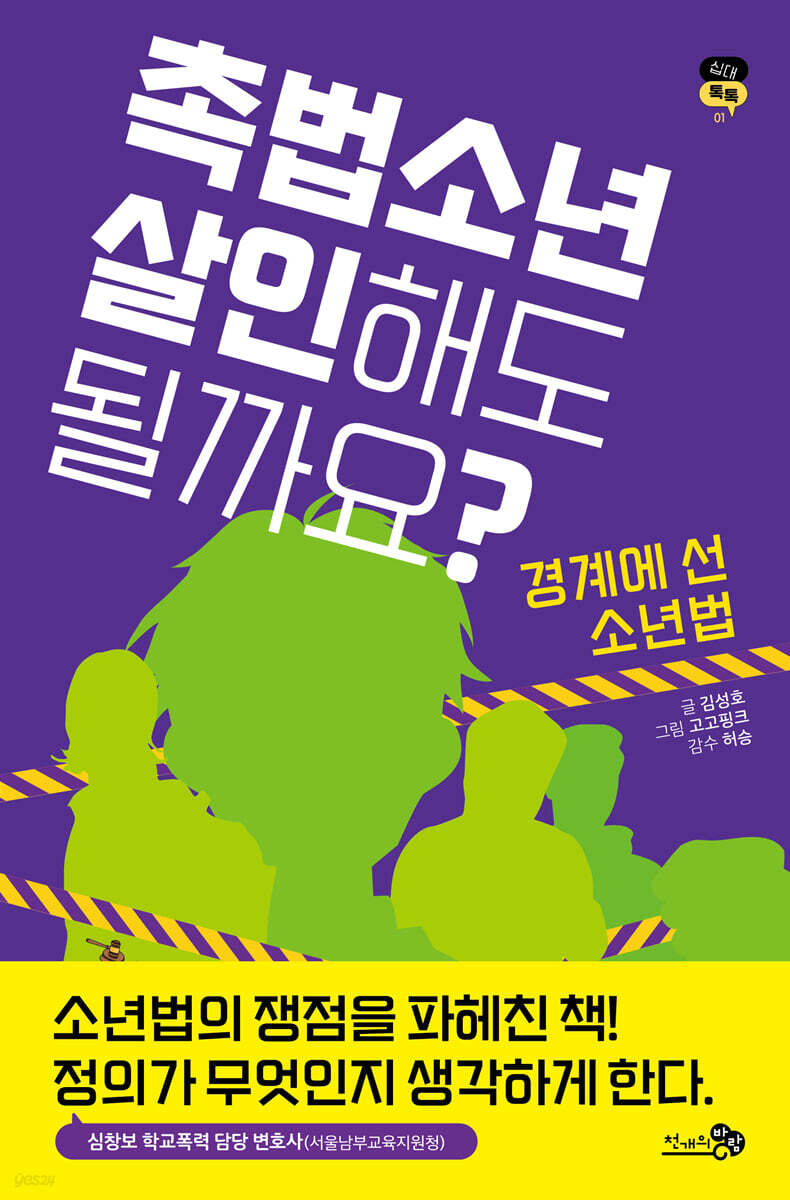
Juvenile offender, can I kill?
 |
Description
Book Introduction
In 2022, the South Korean Ministry of Justice drew its sword in the face of increasingly brutal and daring juvenile crimes.
The bill to amend the law to lower the age of juvenile delinquents by one year from the current age of 14 to 13 was announced.
As soon as the news was reported, social media and internet communities heated up.
Overall public opinion was positive.
Rather, there were strong voices that argued that lowering the age by one year was not enough and that the juvenile delinquency system should be abolished altogether.
It was a reaction that gave us an idea of how stressed the public was about the bold and even vicious juvenile crime.
However, many human rights groups have joined forces to oppose the Ministry of Justice's proposed amendment to the law.
The argument was that lowering the age of juvenile delinquency would not prevent juvenile crimes.
Rather, they opposed it, saying that it would only produce more juvenile criminals.
Can South Korea prevent juvenile delinquency, a growing social problem, by lowering the age of delinquency by one year? The Ministry of Justice's proposed revision to the Juvenile Delinquency Act has rekindled one of humanity's most enduring debates.
It was a debate about whether strong punishment could prevent crime.
This book informs young people of the purpose and intent of juvenile delinquency.
Furthermore, by looking back at the system and history of the Juvenile Act, and the role and function of the law, it allows youth to think about what justice is for themselves.
By delving into the functions and properties of punishment, you can develop your own perspective on the issues surrounding the revision of the Juvenile Offenders Act.
The bill to amend the law to lower the age of juvenile delinquents by one year from the current age of 14 to 13 was announced.
As soon as the news was reported, social media and internet communities heated up.
Overall public opinion was positive.
Rather, there were strong voices that argued that lowering the age by one year was not enough and that the juvenile delinquency system should be abolished altogether.
It was a reaction that gave us an idea of how stressed the public was about the bold and even vicious juvenile crime.
However, many human rights groups have joined forces to oppose the Ministry of Justice's proposed amendment to the law.
The argument was that lowering the age of juvenile delinquency would not prevent juvenile crimes.
Rather, they opposed it, saying that it would only produce more juvenile criminals.
Can South Korea prevent juvenile delinquency, a growing social problem, by lowering the age of delinquency by one year? The Ministry of Justice's proposed revision to the Juvenile Delinquency Act has rekindled one of humanity's most enduring debates.
It was a debate about whether strong punishment could prevent crime.
This book informs young people of the purpose and intent of juvenile delinquency.
Furthermore, by looking back at the system and history of the Juvenile Act, and the role and function of the law, it allows youth to think about what justice is for themselves.
By delving into the functions and properties of punishment, you can develop your own perspective on the issues surrounding the revision of the Juvenile Offenders Act.
- You can preview some of the book's contents.
Preview
index
Chapter 1: I am a juvenile delinquent
There is no such thing as a "juvenile delinquent" in the Juvenile Act...
011 / The fact that juvenile offenders are not subject to criminal punishment has nothing to do with the Juvenile Act...
014 / Are juvenile offenders really given special treatment?
017 / Why 14 of all people? ...
022 / The History of Toktok Law: If you hide here, you won't be caught...
026 / The Fearless Boys of Joseon...
028 / What's the difference between civil and criminal trials?
034 / TalkTalk Plus Why the United States Doesn't Join the UN Convention on the Rights of the Child...
038
Chapter 2 Juvenile Protection Trial
To meet the inspector or not to meet...
043 / Notification system for juvenile delinquents...
047 / History of the Law: Prisoners Running on a Treadmill...
050 / Purpose of Juvenile Protection Trials...
052 / Shock and Awe: The Boy Classification Examiner...
055 / Full set of protective measures...
059 / Juvenile Prison ...
065 / Toktok Plus 2 Years of Juvenile Detention...
068
-Chapter 3 History of Juvenile Law
Punishing a boy without mercy...
075 / Common Law vs. Equity ...
079 / The History of Toktok Law: Cannibalism and Legal Judgments...
083 / The state is the child's biological parent...
085 / The First Juvenile Court is Born...
088 / War on Juvenile Crime...
090 / Shocking Juvenile Crime...
093 / There is no law of love anymore...
098 / Parents, take responsibility from now on! ...
100 / Toktok Plus Philippe Aries's "The Birth of a Child" ...
104
Chapter 4: The Severe Punishment Debate
Controversy over unconstitutionality...
109 / Debate on lowering the age of juvenile delinquency...
111 / Why is punishment justified? ...
115 / Toktok Law's History of Public Executions...
118 / Allow revenge, retributivism...
120 / Speeding is too expensive...
123 / Why are the US sentences so harsh? ...
124 / Strict punishment costs a lot of money...
126 / Can strict punishment prevent crime? ...
129 / Is the revision of the age of criminal responsibility law a harsh punishment?
132 / Toktok Plus Cesare Beccaria, the Father of Modern Criminal Law...
135
Chapter 5 Restorative Justice
Daegu middle school student suicide case...
139 / The Unheard Victim's Voice...
141 / Marginalized Victims...
144 / The Elmira Incident...
146 / Restorative Justice in New Zealand and South Africa...
150 / Reprimands and warm looks...
154 / Toktok Plus Higashino Keigo's "Letter" ...
159
There is no such thing as a "juvenile delinquent" in the Juvenile Act...
011 / The fact that juvenile offenders are not subject to criminal punishment has nothing to do with the Juvenile Act...
014 / Are juvenile offenders really given special treatment?
017 / Why 14 of all people? ...
022 / The History of Toktok Law: If you hide here, you won't be caught...
026 / The Fearless Boys of Joseon...
028 / What's the difference between civil and criminal trials?
034 / TalkTalk Plus Why the United States Doesn't Join the UN Convention on the Rights of the Child...
038
Chapter 2 Juvenile Protection Trial
To meet the inspector or not to meet...
043 / Notification system for juvenile delinquents...
047 / History of the Law: Prisoners Running on a Treadmill...
050 / Purpose of Juvenile Protection Trials...
052 / Shock and Awe: The Boy Classification Examiner...
055 / Full set of protective measures...
059 / Juvenile Prison ...
065 / Toktok Plus 2 Years of Juvenile Detention...
068
-Chapter 3 History of Juvenile Law
Punishing a boy without mercy...
075 / Common Law vs. Equity ...
079 / The History of Toktok Law: Cannibalism and Legal Judgments...
083 / The state is the child's biological parent...
085 / The First Juvenile Court is Born...
088 / War on Juvenile Crime...
090 / Shocking Juvenile Crime...
093 / There is no law of love anymore...
098 / Parents, take responsibility from now on! ...
100 / Toktok Plus Philippe Aries's "The Birth of a Child" ...
104
Chapter 4: The Severe Punishment Debate
Controversy over unconstitutionality...
109 / Debate on lowering the age of juvenile delinquency...
111 / Why is punishment justified? ...
115 / Toktok Law's History of Public Executions...
118 / Allow revenge, retributivism...
120 / Speeding is too expensive...
123 / Why are the US sentences so harsh? ...
124 / Strict punishment costs a lot of money...
126 / Can strict punishment prevent crime? ...
129 / Is the revision of the age of criminal responsibility law a harsh punishment?
132 / Toktok Plus Cesare Beccaria, the Father of Modern Criminal Law...
135
Chapter 5 Restorative Justice
Daegu middle school student suicide case...
139 / The Unheard Victim's Voice...
141 / Marginalized Victims...
144 / The Elmira Incident...
146 / Restorative Justice in New Zealand and South Africa...
150 / Reprimands and warm looks...
154 / Toktok Plus Higashino Keigo's "Letter" ...
159
Detailed image

Publisher's Review
A book that delves into the core of the controversy surrounding the revision of the Juvenile Act.
The purpose of our country's Juvenile Act is to help juveniles grow up in a healthy way.
So the boy who committed the crime is not called the perpetrator, but rather the 'boy in need of protection'.
The trial that the juvenile offender receives is a 'juvenile protection trial'.
The trial will be held in secret to thoroughly protect the identity of the juvenile offender.
The punishment that the juvenile offender receives is not a punishment but a 'protective measure' given for educational purposes.
Even if a juvenile offender is punished for his or her crime, the sentence is lighter than that of an adult offender.
Not only is it difficult for the victim to participate in the trial, but he or she also has no way of knowing what kind of punishment the juvenile offender received.
Despite the fact that most victims of juvenile crime are youth from their peer group, the Juvenile Act has long failed to take victims into consideration.
It's the absurdity that everyone rushes to the child who hit them and asks, "Are you okay? Does your fist hurt?" and shows concern, but no one reaches out to the child who got hit and fell.
Our country's juvenile law has favored the perpetrator for a long time, to the point where you wonder if this is even possible.
The victim boy was that marginalized.
_From “Juvenile Offender, Can I Kill?”
Today, juvenile crime has become more brutal and bold.
Incidents that make you shiver with fear, such as the kidnapping and murder of an elementary school student in Incheon in 2017, the gang assault of a middle school girl in Busan, the gang rape of a middle school girl in Incheon in 2019, and the juvenile delinquent who caused a ruckus at a convenience store in Wonju in 2022, are occurring one after another and are emerging as social problems.
Even considering the changing patterns of juvenile crime and the public's emotional feelings toward juvenile offenders, lowering the age of delinquency seems inevitable.
How can we resolve the social problems caused by juvenile delinquency and the injustice suffered by victims?
This book provides an in-depth analysis of the issues we must consider today regarding the revision of the Juvenile Act: imposing punishment appropriate to the gravity of the crime, and finding the appropriate balance and coordinates between crime and punishment.
People whose families were torn apart by juvenile delinquents, children who jumped from buildings because they could no longer endure the bullying and violence of their peers, and people who are still taking psychiatric medication and cannot shake off the trauma of that day—punishment can be considered the only means and treatment that can soothe the pain and wounds of these victims.
_From “Juvenile Offender, Can I Kill?”
A book that closely analyzes the effectiveness of the Juvenile Act through abundant examples and real-life incidents.
This book provides a detailed explanation of 'protective measures,' which can be considered the core of the Juvenile Act.
Through real-life examples of juvenile detention centers, which are often called the ultimate in protective dispositions, the contents of protective dispositions from No. 1 to No. 10 and the expected effects of protective dispositions are introduced in detail.
Only when the door closed behind us and the wall surrounding us like a castle came into view did I finally realize what kind of place I was in.
The first day, I was immediately discouraged when I saw the children with blue bruises on their faces.
Typically, 13 to 15 people lived in a room, and like in the military, the children were assigned ranks, there was absurd discipline, and violence that was both covert and overt existed.
_From “Juvenile Offender, Can I Kill?”
Juvenile detention centers are strictly educational facilities, and they issue diplomas and leave no criminal record.
However, juvenile detention centers are often compared to prisons, with their confinement facilities that are no different from prisons, their vicious inmates, and their strict discipline that doesn't allow lights to be turned off even at night.
The punishment given to juvenile offenders does not end here.
Victims of juvenile crime may file a civil suit against the juvenile's guardian.
Although the boy committed the crime, the court is seeking a large sum of compensation from the boy's parents instead of the boy who has no financial means.
This does not mean that juvenile offenders, such as juvenile offenders, are exempt from criminal punishment, but rather that they are exempt from civil liability for damages.
Anyone who has suffered physical, economic, or mental damage due to a crime committed by a juvenile offender can file a civil suit against the juvenile's guardian (parent) to claim compensation for damages.
Since most juvenile offenders do not have financial means, they are charged to their parents who are responsible for their supervision.
_From “Juvenile Offender, Can I Kill?”
This book details the punishment of juvenile offenders, which young people have not been fully aware of, to raise awareness of juvenile crime and serve as an opportunity for young people to be more vigilant.
A must-read book on juvenile law highly recommended to youth by a sitting judge and a lawyer specializing in school violence.
Judge Heo Seung, who works as a research judge at the Supreme Court, reviewed this book and meticulously checked whether the legal interpretation and explanation were appropriate.
We sought legal knowledge and advice for systematic explanations and logical theories to help young people who are new to the Juvenile Act understand it correctly.
In addition, I received a recommendation for this book from attorney Sim Chang-bo, who is in charge of defending school violence cases at the Seoul Southern Office of Education.
Recommended by a lawyer who has personally witnessed school violence and juvenile crime in the field, we are confident that this book is a good tool for fostering the ability of young people to think and make decisions on their own.
The first volume of the "Teen Talk Talk" series of youth education books, "Cheongae Wind," aims to establish a proper legal consciousness.
The 'Teen Talk Talk Series' is a youth education series created by Thousand Winds in the hopes that teenagers and the world can communicate.
It contains stories about teenagers that teenagers are curious about.
We hope that by reading the Teen Talk series, which selects topics that teenagers need to know today and approaches them from various perspectives, you will be able to develop a perspective on society.
"Juvenile Offender, Can I Kill?" is the first volume in the Teen Talk series, and contains stories about teenagers, crime, law, and justice.
Adolescence is a transitional period between childhood and adulthood, and values and concepts are established.
It is an important time to receive various education to have the right thoughts and learn how to face society and the world.
Crime and punishment are fundamental institutions that maintain society, like morality, customs, and religion.
It is important to establish a correct understanding of the law during adolescence and lay the foundation for growth into a sound adult.
I hope that through this book, young people will grow into democratic citizens with a proper legal consciousness.
The purpose of our country's Juvenile Act is to help juveniles grow up in a healthy way.
So the boy who committed the crime is not called the perpetrator, but rather the 'boy in need of protection'.
The trial that the juvenile offender receives is a 'juvenile protection trial'.
The trial will be held in secret to thoroughly protect the identity of the juvenile offender.
The punishment that the juvenile offender receives is not a punishment but a 'protective measure' given for educational purposes.
Even if a juvenile offender is punished for his or her crime, the sentence is lighter than that of an adult offender.
Not only is it difficult for the victim to participate in the trial, but he or she also has no way of knowing what kind of punishment the juvenile offender received.
Despite the fact that most victims of juvenile crime are youth from their peer group, the Juvenile Act has long failed to take victims into consideration.
It's the absurdity that everyone rushes to the child who hit them and asks, "Are you okay? Does your fist hurt?" and shows concern, but no one reaches out to the child who got hit and fell.
Our country's juvenile law has favored the perpetrator for a long time, to the point where you wonder if this is even possible.
The victim boy was that marginalized.
_From “Juvenile Offender, Can I Kill?”
Today, juvenile crime has become more brutal and bold.
Incidents that make you shiver with fear, such as the kidnapping and murder of an elementary school student in Incheon in 2017, the gang assault of a middle school girl in Busan, the gang rape of a middle school girl in Incheon in 2019, and the juvenile delinquent who caused a ruckus at a convenience store in Wonju in 2022, are occurring one after another and are emerging as social problems.
Even considering the changing patterns of juvenile crime and the public's emotional feelings toward juvenile offenders, lowering the age of delinquency seems inevitable.
How can we resolve the social problems caused by juvenile delinquency and the injustice suffered by victims?
This book provides an in-depth analysis of the issues we must consider today regarding the revision of the Juvenile Act: imposing punishment appropriate to the gravity of the crime, and finding the appropriate balance and coordinates between crime and punishment.
People whose families were torn apart by juvenile delinquents, children who jumped from buildings because they could no longer endure the bullying and violence of their peers, and people who are still taking psychiatric medication and cannot shake off the trauma of that day—punishment can be considered the only means and treatment that can soothe the pain and wounds of these victims.
_From “Juvenile Offender, Can I Kill?”
A book that closely analyzes the effectiveness of the Juvenile Act through abundant examples and real-life incidents.
This book provides a detailed explanation of 'protective measures,' which can be considered the core of the Juvenile Act.
Through real-life examples of juvenile detention centers, which are often called the ultimate in protective dispositions, the contents of protective dispositions from No. 1 to No. 10 and the expected effects of protective dispositions are introduced in detail.
Only when the door closed behind us and the wall surrounding us like a castle came into view did I finally realize what kind of place I was in.
The first day, I was immediately discouraged when I saw the children with blue bruises on their faces.
Typically, 13 to 15 people lived in a room, and like in the military, the children were assigned ranks, there was absurd discipline, and violence that was both covert and overt existed.
_From “Juvenile Offender, Can I Kill?”
Juvenile detention centers are strictly educational facilities, and they issue diplomas and leave no criminal record.
However, juvenile detention centers are often compared to prisons, with their confinement facilities that are no different from prisons, their vicious inmates, and their strict discipline that doesn't allow lights to be turned off even at night.
The punishment given to juvenile offenders does not end here.
Victims of juvenile crime may file a civil suit against the juvenile's guardian.
Although the boy committed the crime, the court is seeking a large sum of compensation from the boy's parents instead of the boy who has no financial means.
This does not mean that juvenile offenders, such as juvenile offenders, are exempt from criminal punishment, but rather that they are exempt from civil liability for damages.
Anyone who has suffered physical, economic, or mental damage due to a crime committed by a juvenile offender can file a civil suit against the juvenile's guardian (parent) to claim compensation for damages.
Since most juvenile offenders do not have financial means, they are charged to their parents who are responsible for their supervision.
_From “Juvenile Offender, Can I Kill?”
This book details the punishment of juvenile offenders, which young people have not been fully aware of, to raise awareness of juvenile crime and serve as an opportunity for young people to be more vigilant.
A must-read book on juvenile law highly recommended to youth by a sitting judge and a lawyer specializing in school violence.
Judge Heo Seung, who works as a research judge at the Supreme Court, reviewed this book and meticulously checked whether the legal interpretation and explanation were appropriate.
We sought legal knowledge and advice for systematic explanations and logical theories to help young people who are new to the Juvenile Act understand it correctly.
In addition, I received a recommendation for this book from attorney Sim Chang-bo, who is in charge of defending school violence cases at the Seoul Southern Office of Education.
Recommended by a lawyer who has personally witnessed school violence and juvenile crime in the field, we are confident that this book is a good tool for fostering the ability of young people to think and make decisions on their own.
The first volume of the "Teen Talk Talk" series of youth education books, "Cheongae Wind," aims to establish a proper legal consciousness.
The 'Teen Talk Talk Series' is a youth education series created by Thousand Winds in the hopes that teenagers and the world can communicate.
It contains stories about teenagers that teenagers are curious about.
We hope that by reading the Teen Talk series, which selects topics that teenagers need to know today and approaches them from various perspectives, you will be able to develop a perspective on society.
"Juvenile Offender, Can I Kill?" is the first volume in the Teen Talk series, and contains stories about teenagers, crime, law, and justice.
Adolescence is a transitional period between childhood and adulthood, and values and concepts are established.
It is an important time to receive various education to have the right thoughts and learn how to face society and the world.
Crime and punishment are fundamental institutions that maintain society, like morality, customs, and religion.
It is important to establish a correct understanding of the law during adolescence and lay the foundation for growth into a sound adult.
I hope that through this book, young people will grow into democratic citizens with a proper legal consciousness.
GOODS SPECIFICS
- Date of issue: May 25, 2023
- Page count, weight, size: 168 pages | 256g | 135*203*10mm
- ISBN13: 9791165734145
- ISBN10: 1165734141
You may also like
카테고리
korean


korean

![GQ KOREA Mark (Monthly): December [2025]](http://librairie.coreenne.fr/cdn/shop/files/8ef265dbbfbf186523ed75ba7319009d.jpg?v=1765340328&width=3840)


