

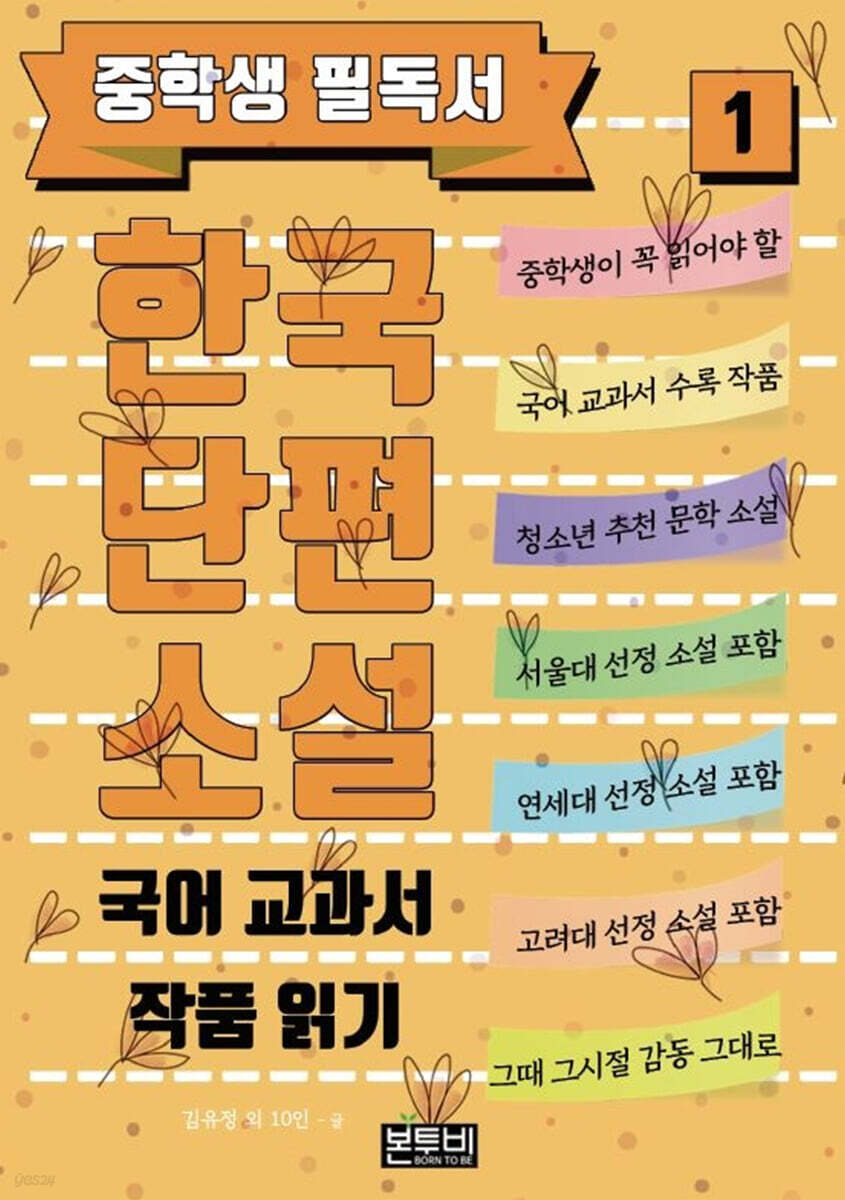
Required Reading for Middle School Students: Korean Short Stories 1: Reading Korean Language Textbook Works
 |
Description
Book Introduction
* Reading works included in middle and high school Korean language textbooks
* Includes many must-read books selected by Seoul National University, Yonsei University, and Korea University.
* Reading the emotions of the time just as they were in those days for the middle-aged
It is an agglutinative language used by Koreans, and it is generally considered to belong to the Altaic language family.
It is used throughout the Korean peninsula.
Word order is subject, object (or complement), and predicate, and has the characteristic of the word modifying being placed before the word being modified.
This book, compiled to be used as the main teaching material according to the curriculum in Korean language education schools, includes Korea's most popular short stories.
We recommend Korean short stories that teenagers must read, and encourage young adults and boys, as well as middle school and high school students under the age of 19, to read works included in Korean language textbooks that they should read at least once.
The history of Korean literature (or Korean literature history) covers the history of changes and development of our literature from ancient times to the present, and the academic studies on it, including many must-read books selected by Seoul National University, Yonsei University, and Korea University.
Korean modern and contemporary short stories are short novels written in short pieces.
Usually, it is about 70 pages of 200-character manuscript paper, and it is possible to sharply grasp a cross-section of life from an independent perspective, express it concisely, and achieve a single effect with a single topic.
A novel is a literary form in prose that fictionally tells a story based on facts or the author's imagination.
It reveals the human condition or social aspects through the background and the actions, thoughts, and psychology of the characters within a certain structure.
Depending on the length, it can be divided into long, medium, and short stories, and depending on the content, it can be divided into science fiction, historical novels, and mystery novels. It has developed into a literary style that has developed in modern times by inheriting the traditions of ancient tales and epics.
* Includes many must-read books selected by Seoul National University, Yonsei University, and Korea University.
* Reading the emotions of the time just as they were in those days for the middle-aged
It is an agglutinative language used by Koreans, and it is generally considered to belong to the Altaic language family.
It is used throughout the Korean peninsula.
Word order is subject, object (or complement), and predicate, and has the characteristic of the word modifying being placed before the word being modified.
This book, compiled to be used as the main teaching material according to the curriculum in Korean language education schools, includes Korea's most popular short stories.
We recommend Korean short stories that teenagers must read, and encourage young adults and boys, as well as middle school and high school students under the age of 19, to read works included in Korean language textbooks that they should read at least once.
The history of Korean literature (or Korean literature history) covers the history of changes and development of our literature from ancient times to the present, and the academic studies on it, including many must-read books selected by Seoul National University, Yonsei University, and Korea University.
Korean modern and contemporary short stories are short novels written in short pieces.
Usually, it is about 70 pages of 200-character manuscript paper, and it is possible to sharply grasp a cross-section of life from an independent perspective, express it concisely, and achieve a single effect with a single topic.
A novel is a literary form in prose that fictionally tells a story based on facts or the author's imagination.
It reveals the human condition or social aspects through the background and the actions, thoughts, and psychology of the characters within a certain structure.
Depending on the length, it can be divided into long, medium, and short stories, and depending on the content, it can be divided into science fiction, historical novels, and mystery novels. It has developed into a literary style that has developed in modern times by inheriting the traditions of ancient tales and epics.
index
01.
Kim Yu-jeong, "Author's Work"
- Camellia
- Manmubang
02.
Na Do-hyang (Author's Work)
- Mute Samryong
03.
Hyun Jin-geon, "Author's Work"
- Love letter from Director B
- hometown
04.
Lee Tae-jun, "Author's Works"
- Bokdeokbang
- Moonlit night
05.
Gye Yong-muk (Author's Works)
- Idiot Adada
06.
Chae Man-sik, "Author's Works"
- Tooth decay
07.
Choi Seo-hae, "Author's Works"
- Escape
08.
Kim Dong-in, "Author's Works"
- Red Mountain
09.
Above 〈Author's Works〉
- Wings
10.
Lee Hyo-seok, "Author's Works"
- When buckwheat flowers bloom
11.
An Guk-seon, "Author's Works"
- Minutes of the Goldfish Meeting
Kim Yu-jeong, "Author's Work"
- Camellia
- Manmubang
02.
Na Do-hyang (Author's Work)
- Mute Samryong
03.
Hyun Jin-geon, "Author's Work"
- Love letter from Director B
- hometown
04.
Lee Tae-jun, "Author's Works"
- Bokdeokbang
- Moonlit night
05.
Gye Yong-muk (Author's Works)
- Idiot Adada
06.
Chae Man-sik, "Author's Works"
- Tooth decay
07.
Choi Seo-hae, "Author's Works"
- Escape
08.
Kim Dong-in, "Author's Works"
- Red Mountain
09.
Above 〈Author's Works〉
- Wings
10.
Lee Hyo-seok, "Author's Works"
- When buckwheat flowers bloom
11.
An Guk-seon, "Author's Works"
- Minutes of the Goldfish Meeting
GOODS SPECIFICS
- Date of issue: April 18, 2023
- Page count, weight, size: 245 pages | 148*210*20mm
- ISBN13: 9791169173988
- ISBN10: 1169173985
You may also like
카테고리
korean


korean

![GQ KOREA Mark (Monthly): December [2025]](http://librairie.coreenne.fr/cdn/shop/files/8ef265dbbfbf186523ed75ba7319009d.jpg?v=1765340328&width=3840)


