

Bulbul horn
 |
Description
Book Introduction
“I can’t do it because I’m being told I can’t do it
“Rush like a raging bull with horns”
Bulbul Horn, an invincible spell that summons hope
Poet Lee Jang-geun's youth poetry collection, "Bulbul Horn," has been published.
Poet Lee Jang-geun compared the ever-changing appearance of youth to animals in 50 poems.
The idea of comparing each character in the poem to an animal is novel and innovative.
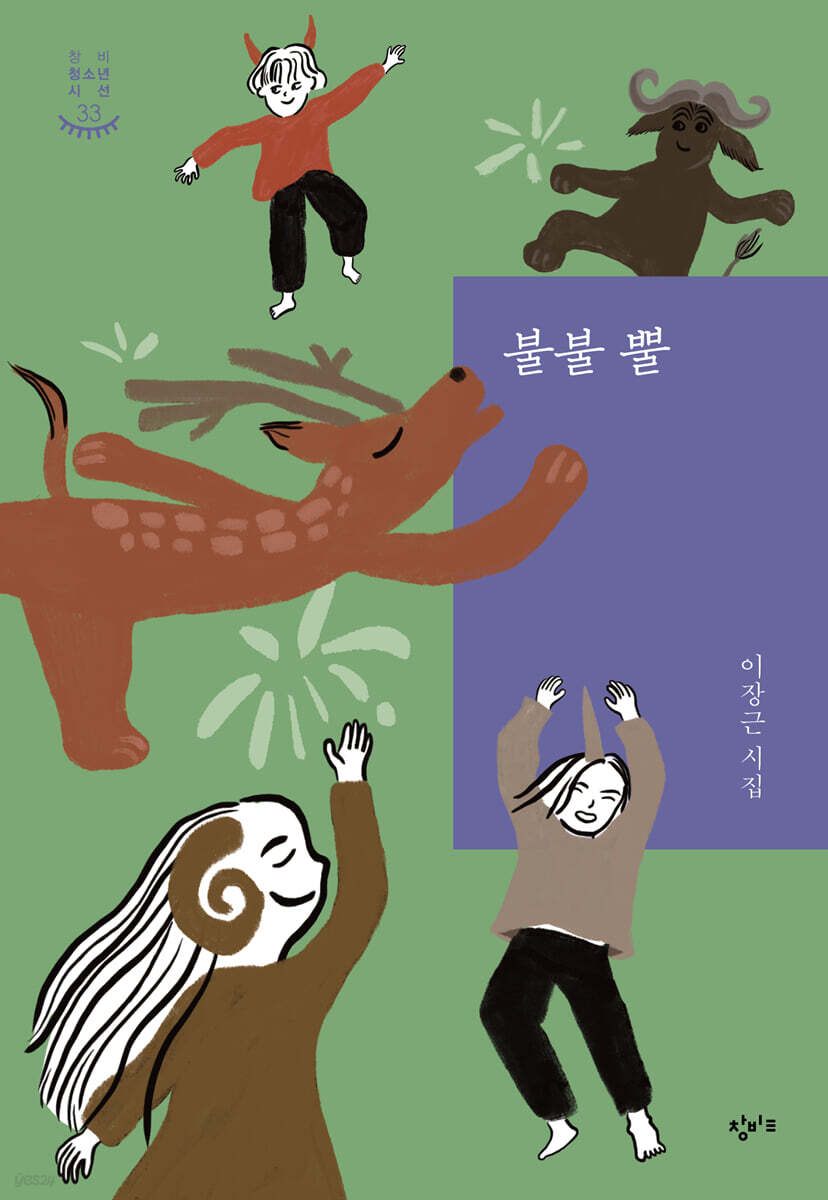
Additionally, the poet's hand-drawn illustrations added to the special quality of the poetry collection.
Poetry and painting become a perfect pair, creating an exquisite harmony.
In addition to the pleasure of reading poetry, you can also enjoy the pleasure of appreciating the poet's extraordinary artistic skills.
Poet Lee Jang-geun is also a teacher who has been working in middle school for a long time.
As such, this collection of poems was written to perfectly suit the level of curious and energetic middle school students.
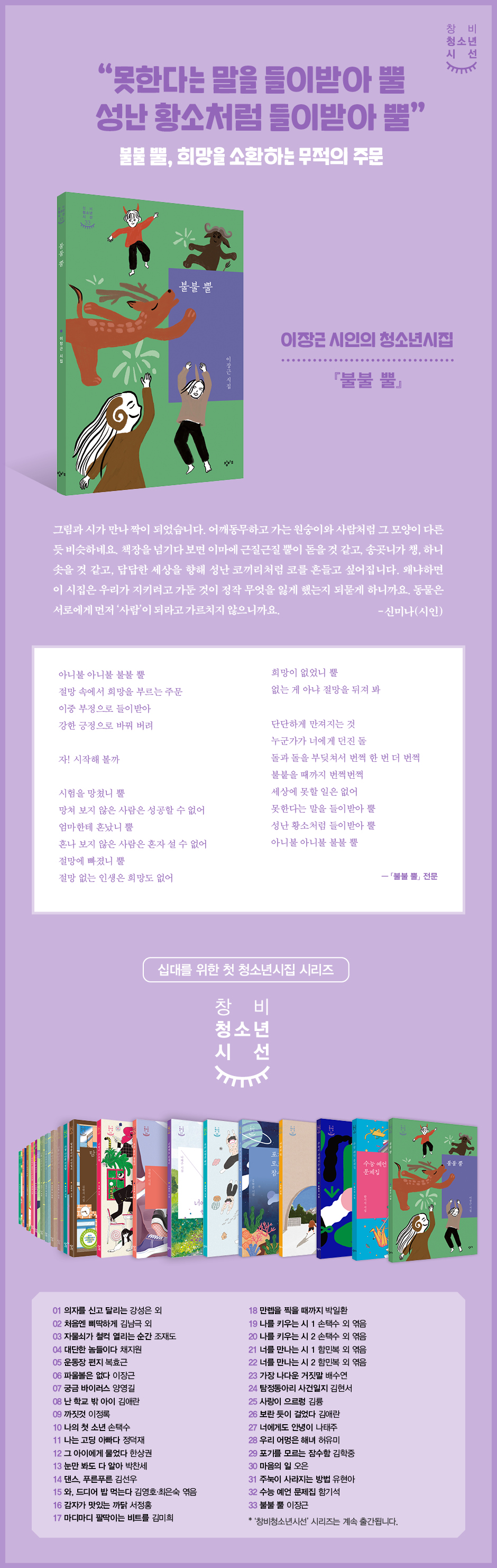
The title of the poetry collection, 'Bulbul Horn', is a spell of hope that turns a desperate situation into a strong positive by taking the double negative of 'No, no' and turning it into a strong positive.
It is not a spell to attack anyone, but rather a positive spell to give us the courage to break down the negativity that holds us back.
As its title suggests, "Bulbul Horn" will provide warm encouragement to young people in need of comfort and courage.
“Rush like a raging bull with horns”
Bulbul Horn, an invincible spell that summons hope
Poet Lee Jang-geun's youth poetry collection, "Bulbul Horn," has been published.
Poet Lee Jang-geun compared the ever-changing appearance of youth to animals in 50 poems.
The idea of comparing each character in the poem to an animal is novel and innovative.
Additionally, the poet's hand-drawn illustrations added to the special quality of the poetry collection.
Poetry and painting become a perfect pair, creating an exquisite harmony.
In addition to the pleasure of reading poetry, you can also enjoy the pleasure of appreciating the poet's extraordinary artistic skills.
Poet Lee Jang-geun is also a teacher who has been working in middle school for a long time.
As such, this collection of poems was written to perfectly suit the level of curious and energetic middle school students.
The title of the poetry collection, 'Bulbul Horn', is a spell of hope that turns a desperate situation into a strong positive by taking the double negative of 'No, no' and turning it into a strong positive.
It is not a spell to attack anyone, but rather a positive spell to give us the courage to break down the negativity that holds us back.
As its title suggests, "Bulbul Horn" will provide warm encouragement to young people in need of comfort and courage.
- You can preview some of the book's contents.
Preview
index
I Met a Person in the Dictionary / Fifteen Tadpoles / A Flock of Crows Go Go / Hedgehog / Rhinoceros's Snort / A Young Cat and Dog / Bulbul Horn / There's No "Straight" in the Bat Dictionary / Interview with King Kong / Chameleon / Feeling Like a Pigeon / The Cat's Perfect Move / The Goldfish's Magic Show / Crow / Snail / Flying Monkey / Acorns and Jellyfish / Hare / Play with Saurus / Confess, Giraffe / Beautiful Hamster Wheel / Whale and the Sea / Little Fish / Rabbit in the Hat / Tunnel Snake / Dancing Snail / Eagle Mark / The Shrimp That Gave Birth to a Whale / A Flock of Spiders / Camel / Tree and Sloth / There's a Coin in the Kangaroo's Pouch / Crane Dance / Why Cheetahs Run 1 / Tigers Be Tigers / Ants' Answer / Horses Living in the Tidal Flats / The Owl's Night is Bright / Circus / The Stolen Nest / Earthworm Love Song / The Beaver Family / Why Cheetahs Run 2 / Elephant Jump / Festival / Cheese Hyena / Sora-ge / Butterfly Season / Zebra / I Met a Person at the Zoo
Detailed image
Into the book
I'm thinking about it
They say they use language
They say they make and use tools
We live in a society
It's an animal
---From "Meeting a Person in the Dictionary"
The front legs are short
The hind legs are long
Like a rabbit optimized for climbing
Hopping towards the top
place
nine
roo
roo
roo
When going down
My feet are useless
On the way home with my report card
---From "The Mountain Rabbit"
Outside the bars
Watching animals in cages
There are animals
Some animals
Live in captivity with animals
They say they use language
They say they make and use tools
We live in a society
It's an animal
---From "Meeting a Person in the Dictionary"
The front legs are short
The hind legs are long
Like a rabbit optimized for climbing
Hopping towards the top
place
nine
roo
roo
roo
When going down
My feet are useless
On the way home with my report card
---From "The Mountain Rabbit"
Outside the bars
Watching animals in cages
There are animals
Some animals
Live in captivity with animals
---From "I Met a Person at the Zoo"
Publisher's Review
I am a happy pattern running through the meadow called life
This book colorfully expresses the poet's unique ideas through words and pictures.
The poet's drawings, which appear to be drawn without much thought and at first glance resemble doodles, are not flashy, which makes them shine even more.
Poetry and paintings complement each other's shortcomings and maintain a balance without leaning too much to one side, adding to the enjoyment of reading poetry.
Besides the inclusion of hand-drawn illustrations by the poet, there is another unique aspect to this poetry collection.
Animals appear in every poem in the collection.
At first glance, it appears to be a collection of animal poems.
However, the protagonist of the poem is clearly a teenager.
These “Fifteen Tadpoles” (“Fifteen Tadpoles”), who are already shaking their tails to tear them off, wanting to become frogs, continue to struggle today as well.
“In the hand that gently strokes it/it becomes hair//and in the hand that tries to grab it/it becomes thorns” (“Hedgehog”), he transforms into a chameleon that “empathizes with everyone” (“Chameleon”) by “becoming green when it meets green//and becoming red when it meets red,” and he also becomes a squirrel that “runs around with thoughts like acorns in its mouth” (“Acorns and Ink”), “rolling its tail into a question mark/and peeling off the shell of thoughts” (“Acorns and Ink”).
The poet accurately captures the characteristics of animals and vividly depicts the ever-changing appearance of young people, meticulously reading their free-spirited minds.
Is white the background?
Is the background black?
That doesn't matter
A pattern of white and black
It's my presence
Aptitude? Talent?
What does that matter?
I'm going to do what I like
I don't want to be the best
I am running through the meadow called life
Happy pattern
―Specializing in "Zebra"
Fear of becoming a mutant
For teenagers in their most sensitive period, there is a fresh heart that searches for “spring in winter” (“Season of the Butterfly”), with worries that cannot be expressed, and “when a secret is revealed/the neck becomes long” and “the neck falls off/and the promise of tomorrow” (“Confess, Giraffe”).
They also have warm hearts that support each other, saying, “Not hiding/but being by our side” (“Chameleon”).
But sometimes, I feel lonely in a family that “lives in the same house” but each lives by their own “stubbornness” (“The Beaver Family”), and on days when my parents fight, I feel sad as I “lie down with the blanket rolled up like a cochlea” and look at the “eardrum-like door” (“The Dancing Snail”) that seems ready to burst.
Even during vacation, if you go to a 'speed' academy to go to 'Sky University', you will feel anxious because you might end up becoming a "mutant born of speed" ("Tunnel Snake").
When his parents nagged him, “What are you going to be when you grow up?” he rebelled by saying, “I’m old enough to be big,” but he also took a step back and reflected on himself, saying, “The more I think about it, I think I need to grow up a little more” (“The Cat and the Dog in Youth”).
My family
I like building houses
We live in the same house
Each of us lives in our own house
Dad is at dad's house
Mom is at mom's house
I am at my house
In stubbornness
In a remote house, near yet far
We are each lonely
―Beaver Family Special
Why does the shadow only follow me?
Why do trees take off their clothes in winter?
Why do cicadas only know how to buzz?
Why don't cats make friends with mice?
Running around with thoughts like acorns in their mouths
Where did the squirrel go?
Roll the tail into a question mark shape
There is no squirrel that peels the shell of thought.
(syncopation)
Why don't we ask about happiness?
Why should we be content with not being unhappy?
I can't say anything today either
Just swallow it all
―Full text of "Acorns and Ink"
We have one vote too
Now, he shrugs his shoulders and says, “I’m a proper middle school student,” but the “fifteen tadpoles” are scolded, saying, “I still have a long way to go before I can become a frog” (“Fifteen Tadpoles”).
But they are not always so reckless.
There are times when the eyes that look at the twisted world and the absurd contradictions of a society that “does not care about the means and methods to achieve its goals” (“A Tiger Becomes a Tiger”) are sharp.
Watching a bird's nest being cut down with a chainsaw inside an apartment complex, one comes to think, "People are so selfish" ("The Stolen Nest"), and one also shows a mature side by criticizing the hypocrisy of adult politicians who, like hyenas searching for food, wander around here and there "looking for a vote" and "serving only with their lips" ("Cheese Hyena").
So, we cannot simply dismiss or belittle the thoughts and opinions of young people by saying, “They still have a long way to go before they become frogs.”
We must not overlook the fact that they too have their own perspectives on the world and possess judgment and critical awareness no less than that of adults.
Young people grow up like that, “running and running to become a beautiful me” (“The Reason Cheetahs Run 2”).
Every house in the world is a prison
You have to follow the rules made by the landlord.
There I am not myself
Because it's not a rule I made.
I'm just a being that follows someone's rules
Throw away the word "good"
That means giving up freedom
Are you running away from home?
No! I'm going to my house.
―The "Cat's Perfect Move" section
The Horn of Fire, an invincible spell that shakes the inside and outside!
Even so, teenagers are still imperfect beings.
Being imperfect means that there is infinite potential hidden within.
Therefore, if there is a “spell that calls for hope in despair,” then “there is nothing in the world that cannot be done” (“Bulbul Horn”).
It rises to the sky and falls to the ground.
To adults, they may seem like a “rabble” who live without thinking, but the poet understands the hearts of the youth better than anyone else, protesting that “even a blind dance is a dance” and that “disorder isn’t always a bad thing” (“A Flock of Crows, Go Go”).
The poet hopes that the youth who live as “beings who simply follow someone’s rules” (“The Cat’s Perfect Move”) will jump over the thorny fence of school and run freely in the “meadow of life” (“Zebra”).
I hope to break free from the uniformity and set framework of life, “go go, shake it up as you want” (“A Flock of Crows, Go Go”), and love my life and enjoy the world to the fullest with a mind of “double negative” or “strong positive” while speaking my own cheerful and cheerful voice.
No, no, no, no, no, no, horn
A spell to call hope in despair
Hit with a double negative
Change it into a strong positive
Okay! Let's get started.
Did you fail the test?
Those who have never failed cannot succeed.
Did you get scolded by your mom?
A person who has never been scolded cannot stand alone.
Are you in despair?
A life without despair has no hope.
Was there no hope?
It's not that there isn't anything, look into despair
―The "Bulbul Horn" section
Dreams aren't given, they're found.
Poet Shin Mi-na says in her recommendation, “As I turn the pages, I feel like horns will grow on my forehead, fangs will pop out, and I want to shake my trunk like an angry elephant at the stifling world.”
For young people who live for tomorrow rather than today, “Dreams are not given/but something you find” (“Beautiful Hamster Wheel”).
Aptitude and talent are only the standards of adults, and the background color is not important.
When we confidently say, “I’m going to do what I love” (“Zebra”), rather than blindly trying to be the “best” without caring about background colors, we will finally be able to listen to the “whisper of the wind” and find our true selves, “who feel so distant” (“Tree and Sloth”).
I believe that this poetry collection, which offers warm comfort to young people, will become a true textbook for cultivating a clear and blue world better than the one we have now, and will become a hope that allows us to become “camels carrying dreams” and “sleep freely in the sky in our own way” (“Elephant Jump”).
Even when a camel goes alone
I'm not going alone
Maybe one, maybe two
Carrying a lump on your back
Neither heat, nor cold, nor thirst
I can bear it even though I have a lump
I'm going alone too
I'm not going alone
One dream
Dream Two
Still a long way to go
Still going
―Camel specialist
Poet's words
I don't think kids know what great artists they are.
The nature of art is curiosity.
We are constantly interested in different things and are reborn anew by combining with other things.
Poetry is also an art, so it cannot exist alone.
Combine with painting, combine with music, combine with theater, combine with photography, combine with video.
Kids do it instinctively.
When art meets artist, it's a wonderful combination.
The energy for poetry is something I gave to my children, but the energy for combining it with other media is something I received from them.
We go together like this, giving and receiving.
While reading the notebooks written by children, I decided to publish a poetry collection combining poetry and drawings.
I made promises in front of the children several times, afraid that it would end up as a decision I made alone.
However, there were many days when I gave up after just a few days of starting.
It wasn't simply a matter of drawing a picture next to a poem.
A union is when two different things become one, so they fill in each other's shortcomings, but there also has to be a void in each side so that one side does not lean.
As if the bond between me and my children should be like that too.
This poetry collection was completed thanks to the energy that the children and I shared.
This book colorfully expresses the poet's unique ideas through words and pictures.
The poet's drawings, which appear to be drawn without much thought and at first glance resemble doodles, are not flashy, which makes them shine even more.
Poetry and paintings complement each other's shortcomings and maintain a balance without leaning too much to one side, adding to the enjoyment of reading poetry.
Besides the inclusion of hand-drawn illustrations by the poet, there is another unique aspect to this poetry collection.
Animals appear in every poem in the collection.
At first glance, it appears to be a collection of animal poems.
However, the protagonist of the poem is clearly a teenager.
These “Fifteen Tadpoles” (“Fifteen Tadpoles”), who are already shaking their tails to tear them off, wanting to become frogs, continue to struggle today as well.
“In the hand that gently strokes it/it becomes hair//and in the hand that tries to grab it/it becomes thorns” (“Hedgehog”), he transforms into a chameleon that “empathizes with everyone” (“Chameleon”) by “becoming green when it meets green//and becoming red when it meets red,” and he also becomes a squirrel that “runs around with thoughts like acorns in its mouth” (“Acorns and Ink”), “rolling its tail into a question mark/and peeling off the shell of thoughts” (“Acorns and Ink”).
The poet accurately captures the characteristics of animals and vividly depicts the ever-changing appearance of young people, meticulously reading their free-spirited minds.
Is white the background?
Is the background black?
That doesn't matter
A pattern of white and black
It's my presence
Aptitude? Talent?
What does that matter?
I'm going to do what I like
I don't want to be the best
I am running through the meadow called life
Happy pattern
―Specializing in "Zebra"
Fear of becoming a mutant
For teenagers in their most sensitive period, there is a fresh heart that searches for “spring in winter” (“Season of the Butterfly”), with worries that cannot be expressed, and “when a secret is revealed/the neck becomes long” and “the neck falls off/and the promise of tomorrow” (“Confess, Giraffe”).
They also have warm hearts that support each other, saying, “Not hiding/but being by our side” (“Chameleon”).
But sometimes, I feel lonely in a family that “lives in the same house” but each lives by their own “stubbornness” (“The Beaver Family”), and on days when my parents fight, I feel sad as I “lie down with the blanket rolled up like a cochlea” and look at the “eardrum-like door” (“The Dancing Snail”) that seems ready to burst.
Even during vacation, if you go to a 'speed' academy to go to 'Sky University', you will feel anxious because you might end up becoming a "mutant born of speed" ("Tunnel Snake").
When his parents nagged him, “What are you going to be when you grow up?” he rebelled by saying, “I’m old enough to be big,” but he also took a step back and reflected on himself, saying, “The more I think about it, I think I need to grow up a little more” (“The Cat and the Dog in Youth”).
My family
I like building houses
We live in the same house
Each of us lives in our own house
Dad is at dad's house
Mom is at mom's house
I am at my house
In stubbornness
In a remote house, near yet far
We are each lonely
―Beaver Family Special
Why does the shadow only follow me?
Why do trees take off their clothes in winter?
Why do cicadas only know how to buzz?
Why don't cats make friends with mice?
Running around with thoughts like acorns in their mouths
Where did the squirrel go?
Roll the tail into a question mark shape
There is no squirrel that peels the shell of thought.
(syncopation)
Why don't we ask about happiness?
Why should we be content with not being unhappy?
I can't say anything today either
Just swallow it all
―Full text of "Acorns and Ink"
We have one vote too
Now, he shrugs his shoulders and says, “I’m a proper middle school student,” but the “fifteen tadpoles” are scolded, saying, “I still have a long way to go before I can become a frog” (“Fifteen Tadpoles”).
But they are not always so reckless.
There are times when the eyes that look at the twisted world and the absurd contradictions of a society that “does not care about the means and methods to achieve its goals” (“A Tiger Becomes a Tiger”) are sharp.
Watching a bird's nest being cut down with a chainsaw inside an apartment complex, one comes to think, "People are so selfish" ("The Stolen Nest"), and one also shows a mature side by criticizing the hypocrisy of adult politicians who, like hyenas searching for food, wander around here and there "looking for a vote" and "serving only with their lips" ("Cheese Hyena").
So, we cannot simply dismiss or belittle the thoughts and opinions of young people by saying, “They still have a long way to go before they become frogs.”
We must not overlook the fact that they too have their own perspectives on the world and possess judgment and critical awareness no less than that of adults.
Young people grow up like that, “running and running to become a beautiful me” (“The Reason Cheetahs Run 2”).
Every house in the world is a prison
You have to follow the rules made by the landlord.
There I am not myself
Because it's not a rule I made.
I'm just a being that follows someone's rules
Throw away the word "good"
That means giving up freedom
Are you running away from home?
No! I'm going to my house.
―The "Cat's Perfect Move" section
The Horn of Fire, an invincible spell that shakes the inside and outside!
Even so, teenagers are still imperfect beings.
Being imperfect means that there is infinite potential hidden within.
Therefore, if there is a “spell that calls for hope in despair,” then “there is nothing in the world that cannot be done” (“Bulbul Horn”).
It rises to the sky and falls to the ground.
To adults, they may seem like a “rabble” who live without thinking, but the poet understands the hearts of the youth better than anyone else, protesting that “even a blind dance is a dance” and that “disorder isn’t always a bad thing” (“A Flock of Crows, Go Go”).
The poet hopes that the youth who live as “beings who simply follow someone’s rules” (“The Cat’s Perfect Move”) will jump over the thorny fence of school and run freely in the “meadow of life” (“Zebra”).
I hope to break free from the uniformity and set framework of life, “go go, shake it up as you want” (“A Flock of Crows, Go Go”), and love my life and enjoy the world to the fullest with a mind of “double negative” or “strong positive” while speaking my own cheerful and cheerful voice.
No, no, no, no, no, no, horn
A spell to call hope in despair
Hit with a double negative
Change it into a strong positive
Okay! Let's get started.
Did you fail the test?
Those who have never failed cannot succeed.
Did you get scolded by your mom?
A person who has never been scolded cannot stand alone.
Are you in despair?
A life without despair has no hope.
Was there no hope?
It's not that there isn't anything, look into despair
―The "Bulbul Horn" section
Dreams aren't given, they're found.
Poet Shin Mi-na says in her recommendation, “As I turn the pages, I feel like horns will grow on my forehead, fangs will pop out, and I want to shake my trunk like an angry elephant at the stifling world.”
For young people who live for tomorrow rather than today, “Dreams are not given/but something you find” (“Beautiful Hamster Wheel”).
Aptitude and talent are only the standards of adults, and the background color is not important.
When we confidently say, “I’m going to do what I love” (“Zebra”), rather than blindly trying to be the “best” without caring about background colors, we will finally be able to listen to the “whisper of the wind” and find our true selves, “who feel so distant” (“Tree and Sloth”).
I believe that this poetry collection, which offers warm comfort to young people, will become a true textbook for cultivating a clear and blue world better than the one we have now, and will become a hope that allows us to become “camels carrying dreams” and “sleep freely in the sky in our own way” (“Elephant Jump”).
Even when a camel goes alone
I'm not going alone
Maybe one, maybe two
Carrying a lump on your back
Neither heat, nor cold, nor thirst
I can bear it even though I have a lump
I'm going alone too
I'm not going alone
One dream
Dream Two
Still a long way to go
Still going
―Camel specialist
Poet's words
I don't think kids know what great artists they are.
The nature of art is curiosity.
We are constantly interested in different things and are reborn anew by combining with other things.
Poetry is also an art, so it cannot exist alone.
Combine with painting, combine with music, combine with theater, combine with photography, combine with video.
Kids do it instinctively.
When art meets artist, it's a wonderful combination.
The energy for poetry is something I gave to my children, but the energy for combining it with other media is something I received from them.
We go together like this, giving and receiving.
While reading the notebooks written by children, I decided to publish a poetry collection combining poetry and drawings.
I made promises in front of the children several times, afraid that it would end up as a decision I made alone.
However, there were many days when I gave up after just a few days of starting.
It wasn't simply a matter of drawing a picture next to a poem.
A union is when two different things become one, so they fill in each other's shortcomings, but there also has to be a void in each side so that one side does not lean.
As if the bond between me and my children should be like that too.
This poetry collection was completed thanks to the energy that the children and I shared.
GOODS SPECIFICS
- Date of issue: March 3, 2021
- Page count, weight, size: 112 pages | 170g | 145*210*7mm
- ISBN13: 9791165700508
- ISBN10: 1165700506
You may also like
카테고리
korean


korean

![GQ KOREA Mark (Monthly): December [2025]](http://librairie.coreenne.fr/cdn/shop/files/8ef265dbbfbf186523ed75ba7319009d.jpg?v=1765340328&width=3840)


