

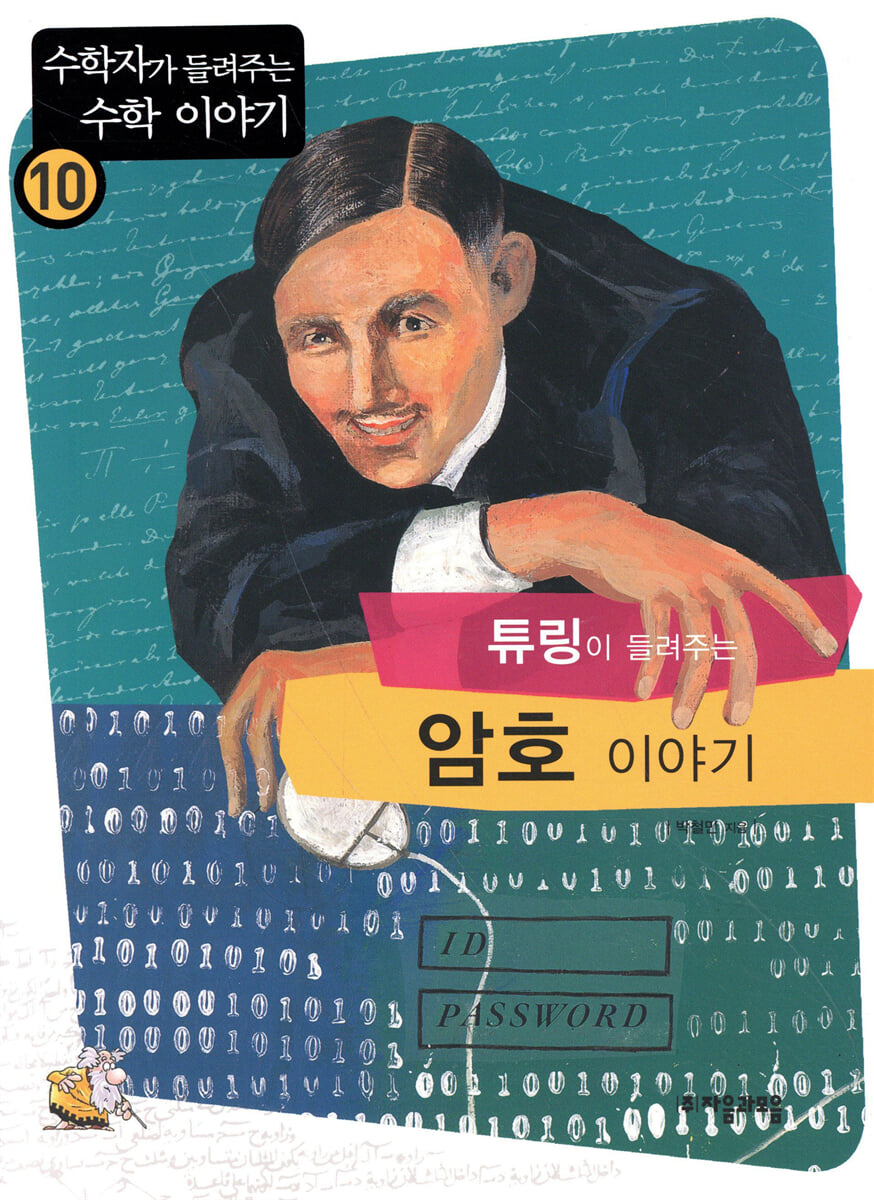
Turing's story about cryptography
 |
Description
Book Introduction
"Turing's Cryptography Story" tells the story of cryptography through the lens of Alan Turing, the world's first hacker and the father of computers.
A cipher is said to be a function with special properties in mathematics, and the relationship between cipher and mathematics is explained.
We will examine various ciphers, from classical ciphers that use relatively simple mathematics to modern ciphers that require advanced mathematics, and examine the mathematics used in those ciphers.
Makes cryptographic mathematics more accessible by making people feel the need for various cryptography and the mathematics that goes with it.
A cipher is said to be a function with special properties in mathematics, and the relationship between cipher and mathematics is explained.
We will examine various ciphers, from classical ciphers that use relatively simple mathematics to modern ciphers that require advanced mathematics, and examine the mathematics used in those ciphers.
Makes cryptographic mathematics more accessible by making people feel the need for various cryptography and the mathematics that goes with it.
index
Recommendation
At the beginning of the book
Guide
Introducing Turing.
Lesson 1 - What is a password?
Second Lesson _ Let's learn about simple remainder operations.
Lesson 3 - Let's find the weaknesses of the Caesar cipher.
Lesson 4 - Let's learn about a variant of the Caesar cipher.
Lesson 5 - Let's learn about public key cryptography.
Lesson 6 - Let's learn about discrete logarithm problems based on public key cryptography.
Lesson 7 - Let's learn about the factorization problem that public key cryptography is based on.
Lesson 8 - Let's learn about zero knowledge.
At the beginning of the book
Guide
Introducing Turing.
Lesson 1 - What is a password?
Second Lesson _ Let's learn about simple remainder operations.
Lesson 3 - Let's find the weaknesses of the Caesar cipher.
Lesson 4 - Let's learn about a variant of the Caesar cipher.
Lesson 5 - Let's learn about public key cryptography.
Lesson 6 - Let's learn about discrete logarithm problems based on public key cryptography.
Lesson 7 - Let's learn about the factorization problem that public key cryptography is based on.
Lesson 8 - Let's learn about zero knowledge.
Publisher's Review
The story of cryptography told by Turing, the genius hacker who proposed the mathematical model of modern computers!
'What kind of passwords do we use?'
You can find various cryptographic methods used in fields such as electronic commerce and financial transactions, such as electronic signatures and electronic currency.
■■■ The taste of seeing the truth of the world through mathematics! The story of "Turing's Code" will give you that taste!
A decisive reason for Germany's defeat by the Allies in World War II was Alan Turing, the world's first hacker and father of the computer.
In 1943, Turing created the world's first computing computer, Colossus, which was 3 meters tall.
This computer punches about 5,000 characters per second, and compares the ciphertext as it passes through a paper tape until it matches the Enigma code.
The Colossus was used to crack Germany's famously impenetrable Enigma code, which would have been impossible to crack by human hands.
Modern people use passwords several times a day.
When you open your email, you enter your ID and password, which are your own passwords, or when you use a badge to enter a building, you also use a password.
Encrypted records can be decrypted to reveal the original content by the person who was assigned to receive the content or the person who performed the encryption.
Of course, only those with decryption authority know and can decrypt the data.
Now, technologies are being developed to decrypt encrypted data without the authority to decrypt it, and these encryption and decryption technologies influence each other and advance cryptography.
In this way, "Turing's Cryptography Story" cannot easily explain all the mathematics involved in cryptography, but it is organized as simply as possible, from classical cryptography using basic mathematics to modern public key cryptography using relatively modern mathematics.
■■■ From the birth of encryption to the protection of personal information and intellectual property rights, and the efforts of cryptographic geniuses to ensure the reliability and stability of electronic transactions, this is revealed!
《Turing's Story of Cryptography》 begins by explaining the relationship between cryptography and mathematics by explaining that cryptography is a function with special properties in mathematics.
We will look at various ciphers, from classical ciphers that use relatively simple mathematics to modern ciphers that require advanced mathematics, and we will also look at the mathematics used in those ciphers.
From middle and high school students currently learning mathematics to the general public interested in cryptography, cryptography and the mathematics used in cryptography will be easily accessible.
Furthermore, by explaining the basic methods of deciphering codes, we will be able to see that solving mathematical problems is not always achieved through a logically perfect procedure like deciphering codes, but is sometimes achieved through multiple trials and errors based on simple assumptions and estimates.
■ Structure and Advantages of This Book
- By looking at the mathematics used in cryptography, it gives you an opportunity to see how mathematics is used and applied in the real world.
- It eliminates the prejudice that mathematical problem-solving methods are logically perfect through basic decryption methods.
- By making students feel the need for various types of passwords and the corresponding mathematics through problem situations, we make cryptographic mathematics more accessible.
- Class organization: By organizing important math terms separately for each class, students can clearly organize concepts on their own.
'What kind of passwords do we use?'
You can find various cryptographic methods used in fields such as electronic commerce and financial transactions, such as electronic signatures and electronic currency.
■■■ The taste of seeing the truth of the world through mathematics! The story of "Turing's Code" will give you that taste!
A decisive reason for Germany's defeat by the Allies in World War II was Alan Turing, the world's first hacker and father of the computer.
In 1943, Turing created the world's first computing computer, Colossus, which was 3 meters tall.
This computer punches about 5,000 characters per second, and compares the ciphertext as it passes through a paper tape until it matches the Enigma code.
The Colossus was used to crack Germany's famously impenetrable Enigma code, which would have been impossible to crack by human hands.
Modern people use passwords several times a day.
When you open your email, you enter your ID and password, which are your own passwords, or when you use a badge to enter a building, you also use a password.
Encrypted records can be decrypted to reveal the original content by the person who was assigned to receive the content or the person who performed the encryption.
Of course, only those with decryption authority know and can decrypt the data.
Now, technologies are being developed to decrypt encrypted data without the authority to decrypt it, and these encryption and decryption technologies influence each other and advance cryptography.
In this way, "Turing's Cryptography Story" cannot easily explain all the mathematics involved in cryptography, but it is organized as simply as possible, from classical cryptography using basic mathematics to modern public key cryptography using relatively modern mathematics.
■■■ From the birth of encryption to the protection of personal information and intellectual property rights, and the efforts of cryptographic geniuses to ensure the reliability and stability of electronic transactions, this is revealed!
《Turing's Story of Cryptography》 begins by explaining the relationship between cryptography and mathematics by explaining that cryptography is a function with special properties in mathematics.
We will look at various ciphers, from classical ciphers that use relatively simple mathematics to modern ciphers that require advanced mathematics, and we will also look at the mathematics used in those ciphers.
From middle and high school students currently learning mathematics to the general public interested in cryptography, cryptography and the mathematics used in cryptography will be easily accessible.
Furthermore, by explaining the basic methods of deciphering codes, we will be able to see that solving mathematical problems is not always achieved through a logically perfect procedure like deciphering codes, but is sometimes achieved through multiple trials and errors based on simple assumptions and estimates.
■ Structure and Advantages of This Book
- By looking at the mathematics used in cryptography, it gives you an opportunity to see how mathematics is used and applied in the real world.
- It eliminates the prejudice that mathematical problem-solving methods are logically perfect through basic decryption methods.
- By making students feel the need for various types of passwords and the corresponding mathematics through problem situations, we make cryptographic mathematics more accessible.
- Class organization: By organizing important math terms separately for each class, students can clearly organize concepts on their own.
GOODS SPECIFICS
- Date of issue: February 25, 2008
- Page count, weight, size: 174 pages | 384g | 164*225*20mm
- ISBN13: 9788954415514
- ISBN10: 8954415512
You may also like
카테고리
korean


korean

![GQ KOREA Mark (Monthly): December [2025]](http://librairie.coreenne.fr/cdn/shop/files/8ef265dbbfbf186523ed75ba7319009d.jpg?v=1765340328&width=3840)


